




















![How to FUNK Like A PRO [FREE PDF] | "Superstition" by Stevie Wonder](https://i.ytimg.com/vi_webp/Bv7sqAXYReE/maxresdefault.webp)







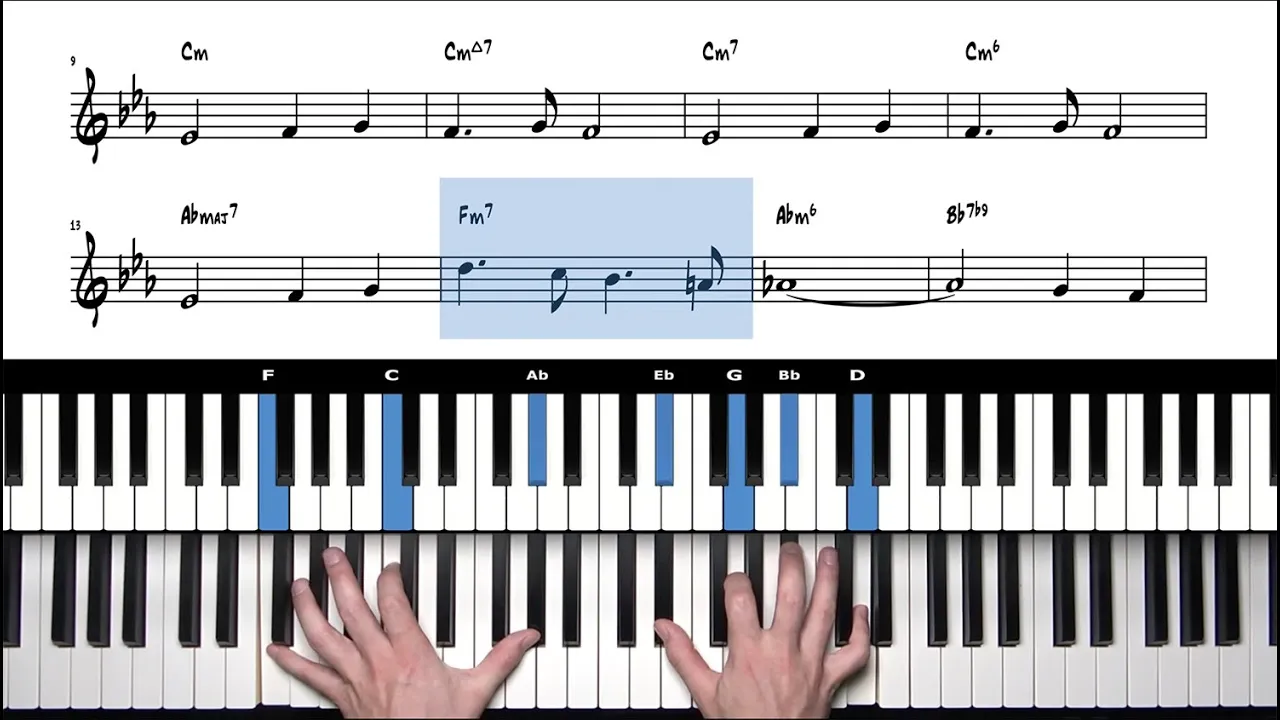
To create a funky piano sound, harmonize each note of the C minor blues scale (C, Eb, F, G, Bb) with perfect fourth intervals (C-G, Eb-Bb, F-Bb, Gb-C), using finger combinations of 1-3 and 2-4; for intermediate players, stack additional fourths below to create quartal voicings (C-G-D, Eb-Bb-F, F-Bb-Eb, Gb-C-G, Bb-C-G), which can then be improvised over the 12-bar funk blues progression (C for 4 bars, F for 2 bars, C for 2 bars, G7 for 1 bar, F for 1 bar, G7 for 1 bar).
How to Play Funk Piano Solos: Funky 4ths Tutorial
Added:Understanding basic musical intervals, specifically perfect fourths, and how to visualize them on the keyboard.
Familiarity with the construction and fingering of the minor pentatonic and blues scales.
Basic knowledge of the 12-bar blues chord progression structure and dominant 7th chords.
A foundational grasp of funk rhythm, syncopation, and sixteenth-note subdivisions.
Exploring quartal harmony and modern modal jazz voicing techniques inspired by Herbie Hancock.
Developing two-handed independence for clavinet-style comping and bass line coordination (Stevie Wonder style).
Integrating advanced improvisational concepts, such as chromatic passing tones and upper-structure triads over funk grooves.
Studying keyboard sound design and expression techniques on vintage instruments like the Fender Rhodes and Hohner Clavinet.
117.4K views4Klikes12:12Original Release: 2020-10-02
[Music] hey there johnny may here and welcome to this week's quick tip where i'm going to teach you how to play funk piano now if you want to sound like stevie wonder herbie hancock or richard t at the piano then you absolutely need to know how to play funky fourths and in today's lesson i'm going to teach you exactly how to do that so let's go ahead and dive in all right the first step to improvising in the funky blues style is to make sure you know your c minor blues scale if you already know this you can skip ahead but let's do a quick review on the scale the scale here is c e flat f i'm gonna use my thumb here on the f f sharp that's my third finger thumb on g and then third finger on b flat okay c blues or c minor blues scale it's the scale that you know most professional pianists will use if they're playing any type of funky blues or just a standard blues tune you make you got to make sure you know the scale before you move on okay once you know the c blues scale then here is the trick to really getting that cool funky sound and that is what i call funky fourths okay funky force what what's what are funky fourths well you can take every note of your c blues scale or c minor blues scale and you can harmonize it in fourth intervals okay so check this out we're going to take that first note of the c scale and we're going to go down a fourth interval to g okay very very simple next on the e flat we're going to use the b flat and the e flat underneath that e flat so we're harmonizing the e flat with a perfect fourth then i'm going to go one and three fingers here c and f so i'm harmonizing the f with the fourth interval down g flat we're going to play like this okay be also mindful of your fingering i like to switch between one and three and then two and four you do not want to use the same fingers like this okay so 1 and 3 2 and 4 1 3 2 and 4 there's my b flat and then we're back up to c and g on the bottom okay does this make sense so if you're a little bit more on the beginner's side let's say you're a little bit newer to funk improv and you kind of want to master this funk sound is work on these fourth intervals up and down the piano and you can go up several octaves make sense and then you can come down [Music] all right just make sure as you're playing this scale up and down that you're using these two sets of fingers now before i teach you the intermediate approach if you're enjoying this lesson please give it a thumbs up and if you're new to the channel hit that subscribe button for more videos just like this okay that's going to be the more beginner approach let's say you have some experience playing the piano and you want more of that sound which is a very cool more of a modern sound i would say you can do two sets of fourth intervals or what i call stacked fourths and basically we can add another fourth interval below the g down to this d so we have two sets of fourth intervals and we get this very cool fourth sound or what we call the quartal sound in jazz music it was made famous by a jazz pianist named mccoy tyner but it's used in a lot of funk music so what we're going to do is we're going to go back up this scale and now we're going to use perfect fourth intervals to harmonize each of the notes of the c blues scale okay so check this out let's start on the first one i like to use fingers five two one then we're gonna come up here to e flat four two one okay on the f five two one we've got the g there on the bottom again all fourth intervals now this is the really cool one has kind of a crunchy sound against that c on the bottom but it's gonna sound really nice in your solo okay so here's your three notes there on the the f sharp or the g flat here's your g make sure you can play that comfortably there's your b flat we got you got the c on the bottom there and then finally on the c on top we're going to use d g and c okay now again as you're practicing this make sure you're using different sets of fingers so on the first one put the five on the top and maybe the four on the top for this one and then switch to the five on top you can also switch middle fingers like two to three that's really helpful helpful for a lot of students two in the middle you see that to three okay so you might want to try that as well but the point is you want to kind of spread the workload between your fingers so that the same fingers are not doing all the work okay so you learned your funky force if you're on a little bit on the beginner's side we played them pretty simply like this if you're more on the intermediate or advanced side we talked about doing these stacked fourths so how do we actually use this to create lines well what i first recommend doing is to just play these chords over a simple c minor in fact in my left hand i just kind of want to hit some bass notes like this okay and then in my right hand i'm going to start inventing some lines using these ideas so i'm going to start with the beginner fourths and let's see what we can come up with okay that's a line here's another line isn't that cool and basically i'm just doing a little pedal point down here at the bottom and i'm playing some lines over this okay now if you're a little bit more in the intermediate advanced side and you want to do these quartal voicings or these stacked fourths you can try this as well okay so we're going to keep that left hand base going and this time let's play some lines using the stacked force okay here's here are some examples notice that i'm sliding sometimes the middle notes like i'll slide that g in the right hand come way up high on the piano okay see all the really cool ideas that you can create just using the notes from your c minor blues scale doesn't that sound amazing all right the next step is to improvise using funky fourths over the full 12 bar funk blues chord progression but before we do this if you guys are enjoying this lesson i want to recommend a really good course for funky blues soloing it's called funky blue soloing and i'll put a link to that below in the description all right so let's jump to the final step here and by the way this is a little example solo here that you can learn in the right hand uh by the way this lesson sheet music is downloadable and printable over at pianowithjohnny.com as well as the lesson sheet music you can change the key with the click of one button and practice this in any key alright so the final step here is you want to play this over several chords when you're playing funky blues like this you're not just playing on one chord like a c you're oftentimes going to chords like an f chord or you might be on a g chord okay so what you want to do is you actually want to play this over these three chords and i call this the funk blues progression or the funk blues form and so let's do a quick review on this and then we'll invent some lines on this so we're gonna play a c for four bars you know one two three four two two three three two three four and four okay then you go to an f for a couple bars back to c all right now you could play chords in the left hand if you wanted i like to use these simple bass notes here one at five chord to g f and back to c okay and then i like to throw a quick g in at the very end to get us back to the c chord all right so we want to create some lines over this progression and so basically you can pick whichever idea you want you can use the simple force you can use the stacked fourths okay but you want to be able to play these over some different chords okay so we're going to go kind of slowly here i'm going to show you how you might make up some lines and then we're going to play this with the included backing tracks by the way this lesson comes with three backing tracks which you can download at pianowithjohnny.com so i'll put a link to those below okay here we go let's create some lines we're going to sit on our c you can go ahead and play with me and i'm going to play some examples here i'm going to use the stacked fourth okay here it is slowly okay that's four bars of c now we need to go to our f chord so we're gonna hop up here you could also come down low if you wanted and let's play some more lines and then back to c okay here's our g7 chord we can hop down to that g and again if you're a little bit more on the beginner side you can just use the simple fourth intervals to create your lines same thing we're going to go to our f chord [Music] that makes sense the final step here is to play with the included backing track this comes with three backing tracks at three different tempos we're going to do the medium tempo at 80 bpm and the key is to be creative you want to have a lot of variety okay here it is at 80 bpm go ahead and play along with me here we go [Music] c two more bars [Music] f [Music] back to c [Music] g [Music] f [Applause] [Music] g [Music] all right this concludes this week's quick tip and if you enjoyed this lesson be sure to check out piano pianowithjohnny.com we have over 900 step-by-step lessons in jazz blues funk theory technique improvisation it's the full learning platform for all playing levels also be sure to check out the piano with johnny membership this gives you unlimited access to all of our courses plus you get to be part of our live monthly events including our live q as our live workshop lessons we do student assessments where you can send me a video and i'll give you personalized feedback we do weekly challenges for our students student collaborations and we have a ton of fun so go check out piano with johnny and i'll see you in the next one [Music] you
Up Next

8:37
How to Play Chromatic Passing Chords for Gospel, Jazz & Neo Soul
@prettysimplemusic
100K views•2023-05-08

12:54
Triumph of Orthodoxy Icon: Byzantine Art & History Explained
@BenCallan
2.1K views•2024-08-06

12:39
4 Whole Tone Scale Tricks for Piano Improvisation
@PianoWithJonny
36.1K views•2022-07-22

1:42
Game of Thrones Opening Credits: A Cinematic Analysis
@gameofthrones
46.3M views•2011-04-18
Related Study Plans & Knowledge Roadmaps
Structured learning paths in General & Interdisciplinary Studies
general-studies
Elevator Engineering: History, Physics & Cities
01From Hoists to Safety Brakes: The Dawn of Vertical Lift
02Hydraulic vs. Traction: The Engineering Physics of Elevators
03Modern Speed, Safety, and Algorithms
+ 2 more learning modules
12h5 modules
Explore Roadmap
general-studies
Rubber: Material Science, History & Geopolitics
01Origins of Natural Rubber & Mesoamerican History
02The Chemistry of Natural Rubber & Vulcanization
03The Geopolitics of the Rubber Boom & Colonization
+ 2 more learning modules
12h5 modules
Explore Roadmap
general-studies
Containerization: Evolution, Logistics & Trade
01Ancient Trade & Bulk Cargo: Amphorae to Barrels
02The Industrial Revolution & Cardboard Packaging
03The Containerization Revolution: Malcom McLean
+ 2 more learning modules
12h5 modules
Explore Roadmap
general-studies
Textile Tech: Evolution, Labor & Global Impact
01Pre-Industrial Textiles: Handloom & Cottage Industry
02Mechanization: The Spinning Jenny to the Power Loom
03The Factory System & Global Labor Transformation
+ 2 more learning modules
10h5 modules
Explore Roadmap