



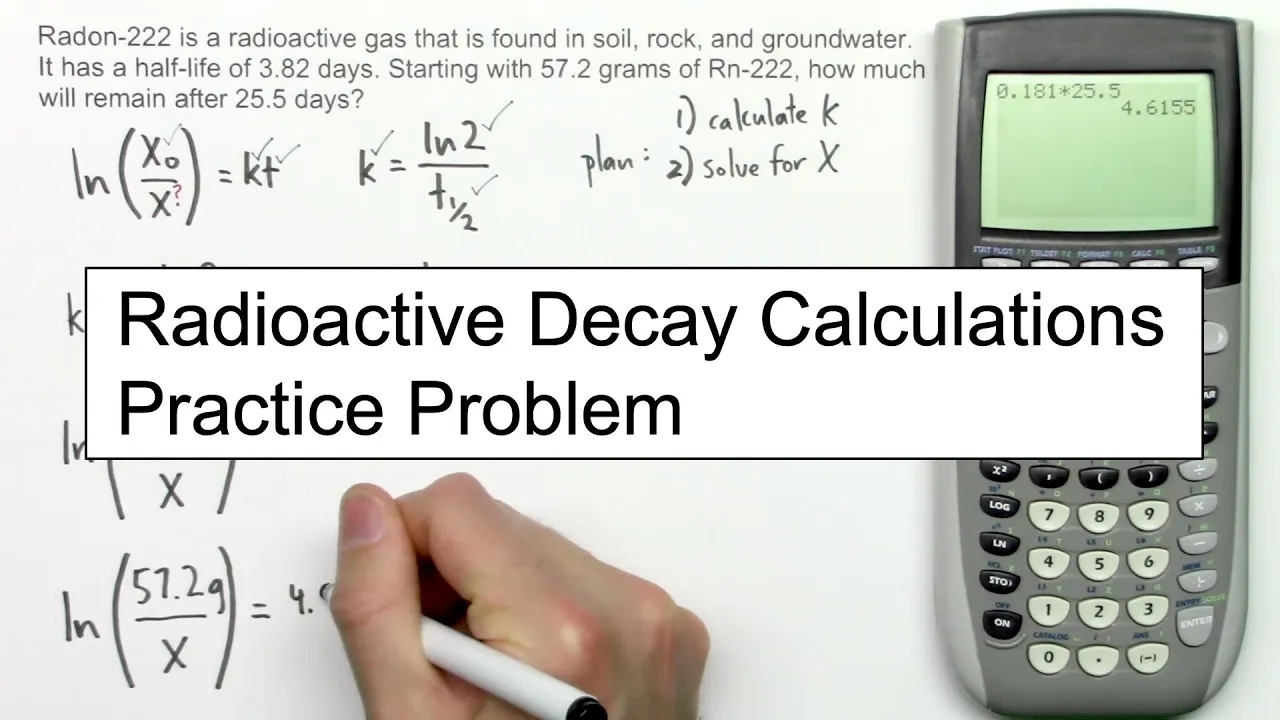

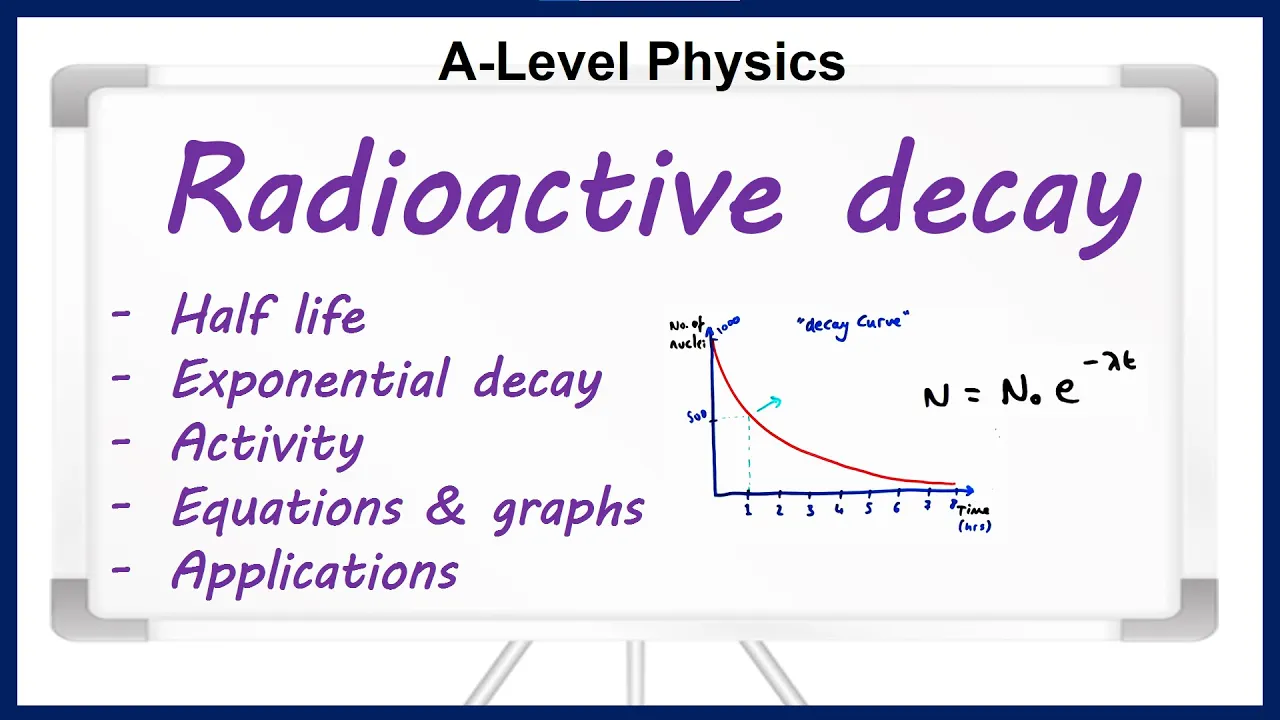


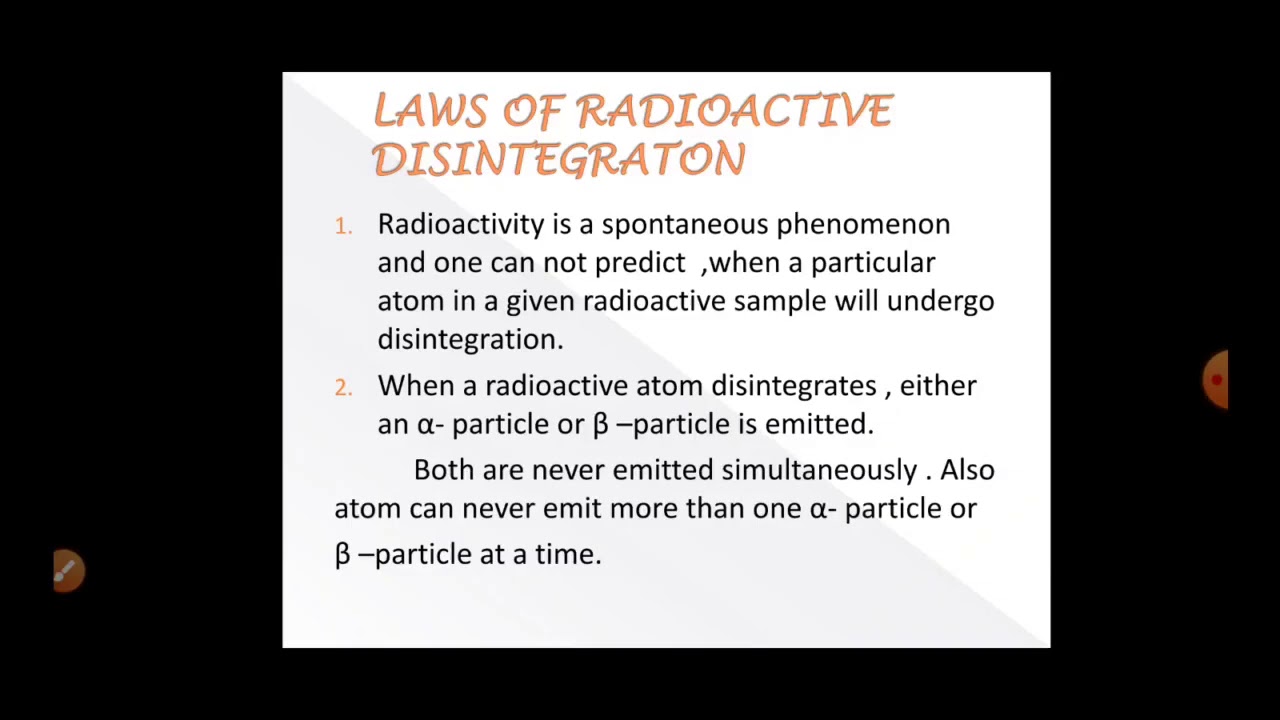



















The decay constant λ is calculated using λ = ln(2)/t₁/₂, and the fraction of radioactive nuclei remaining after time t is given by N(t)/N₀ = e^(-λt); for cobalt-60 with a half-life of 5.27 years, the decay constant is 0.132 yr⁻¹, and after 15.0 years (approximately 2.85 half-lives), approximately 13.8% of the original nuclei remain.
Radioactive Half-Life Practice Problem: Decay Constant & Fraction Remaining
Added:Basic understanding of isotopes, unstable atomic nuclei, and the conceptual definition of radioactive decay.
Familiarity with exponential mathematical functions and natural logarithms (ln), as they are central to decay equations.
A foundational grasp of what a 'half-life' represents qualitatively (the time it takes for 50% of a sample to decay).
Basic algebraic skills for rearranging equations to solve for unknown variables like time, decay constant, or initial quantity.
Practical applications of radioactive decay, such as Carbon-14 dating for archaeology and Uranium-Lead dating for geology.
Calculating the activity of a radioactive sample (measured in Becquerels or Curies) using the decay constant and the number of nuclei.
Connecting radioactive decay to first-order chemical reaction kinetics, including differential and integrated rate laws.
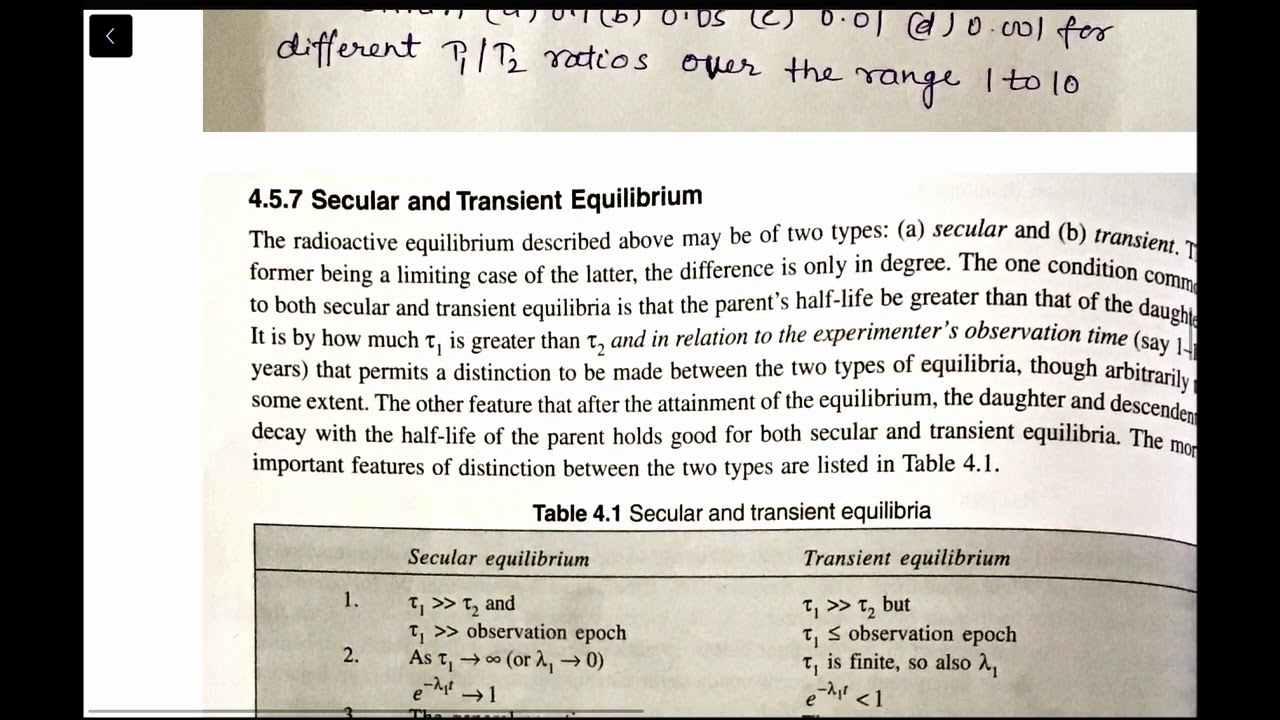
Exploring multi-step decay series and nuclear equilibrium, where parent isotopes decay into unstable daughter isotopes before reaching stability.
70.5K views868likes4:00Original Release: 2019-10-29
okay let's check out a problem regarding radioactive half-life cobalt-60 decays with a half-life of 5.2 7 years to produce nickel 60 so the first question is what is the decay constant for this disintegration and in order to answer that we will need this expression and the second question is what fraction of a sample of cobalt 60 nuclei will remain after 15.0 years and to answer that we will need this expression so that's all the information we need go ahead and give this a try.
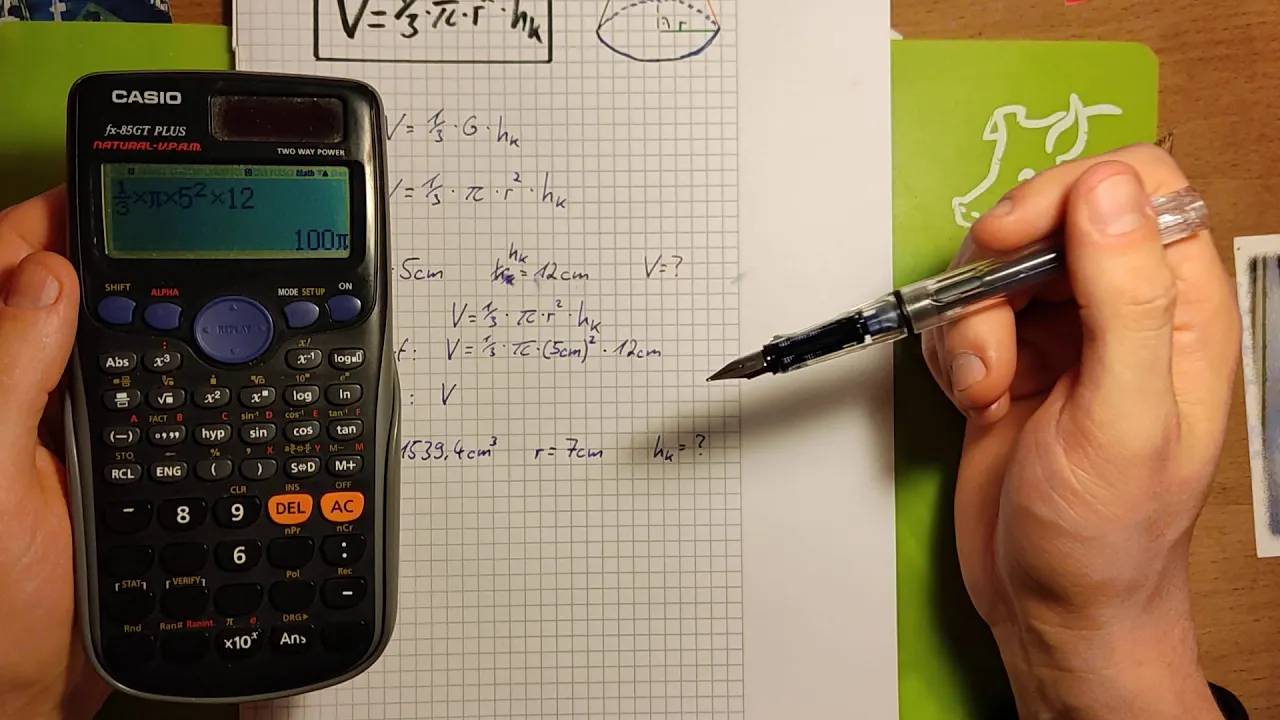
so let's put our value for half-life up at the top that is 5.2 seven years and we have this expression where the half-life is equal to natural log of 2 over the decay constant so if we want to get that decay constant let's solve for it by bringing the decay constant up to the left side and then bringing the half-life down to the denominator of the right side and then we can plug in what we know so the natural log of 2 is 0.693 and the half-life is 5.2 seven years and that will give us a decay constant of 0.1 3 2 years to the minus 1 now we want to find out some information about how many nuclei will remain after a certain period of time and for that we will need this expression so what are we going to do with this expression we have NT equals N0 e to the negative lambda T and so we have the number of nuclei that remain at some time T equally the number of nuclei that were initially there right and N naught or N0 implies some initial condition and then we have e raised to the negative decay constant times time so what we can do is we can divide both sides by n zero and we'll get NT over n0 on the left and that is important because that represents the fraction left after time T right we're not asked for a specific number or a specific amount we're asked for a relative amount we just want to know a fraction or a ratio and so Nt over N0 is the amount that is left after time T divided by the initial amount and that will be the fraction left after time T so let's just plug in what we know we can plug in our decay constant and then for T let's plug in 15.0 years because that's what the question asked we wanted to know the fraction left after 15 years had elapsed so we just do the arithmetic that is going to be equal to e to the negative one point nine eight and that will be equal to 0.138 which expressed as a percentage will be thirteen point eight percent so after fifteen years which is just a little bit under three half-lives we will have thirteen point eight percent of the radioactive nuclei remaining.
Up Next
4:38
Radiation Detection: Gas Amplification and Ionization Chambers
@nuclearsecuritynsspi
12.5K views•2017-09-27

12:53
21cm Hyperfine Transition in Neutral Hydrogen: Radio Astronomy Basics
@AaronRobertParsons
12.4K views•2011-10-13
6:20
General Relativity Explained: Curvature of Spacetime & Gravity
@ProfessorDaveExplains
629.6K views•2017-05-25

27:14
Entropy and the Second Law of Thermodynamics Explained
@veritasium
27.5M views•2023-07-01
Related Study Plans & Knowledge Roadmaps
Structured learning paths in Physics
physics
Nuclear Physics (Decay, Fission & Reactors)
01Atomic Structure and the Binding Force
02Radioactive Decay and Half-Life
03Nuclear Fission Mechanics and Chain Reactions
+ 2 more learning modules
12h5 modules
Explore Roadmap
physics
Soft Matter (Polymers, Colloids & Rheology)
01Foundations of Soft Matter & Thermal Forces
02Polymer Physics and Macromolecules
03Colloids, Surfactants, and Self-Assembly
+ 2 more learning modules
38h5 modules
Explore Roadmap
physics
Analytical Mechanics: Lagrangian & Hamiltonian
01Mathematical Foundations: Calculus of Variations
02From Newtonian Mechanics to Constraint Dynamics
03The Principle of Least Action & Lagrangian Mechanics
+ 3 more learning modules
28h6 modules
Explore Roadmap
physics
General Relativity (Spacetime & Cosmology)
01Foundations of Relativity: Special Relativity
02The Geometry of Spacetime: Equivalence Principle & Curvature
03Einstein's Field Equations: The Mathematics of Gravity
+ 2 more learning modules
55h5 modules
Explore Roadmap