










![[Conférence] P. SANSONETTI - L'infection est un "ménage à trois": pathogène, microbiote et hôte](https://i.ytimg.com/vi_webp/eRHOHSmKMDw/maxresdefault.webp)

![❌REACCIONES Adversas a ALIMENTOS y su relación con la MICROBIOTA [Alergias / Intolerancias]](https://i.ytimg.com/vi_webp/Uoublsy0oPA/maxresdefault.webp)


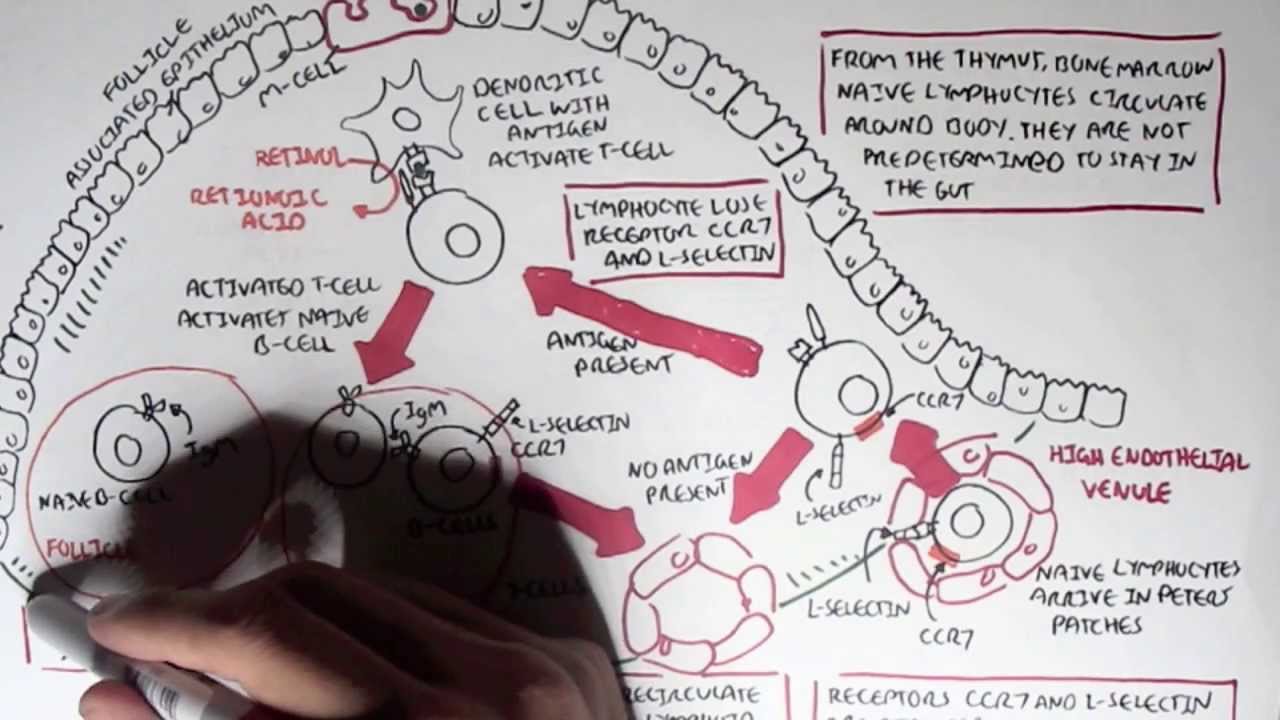
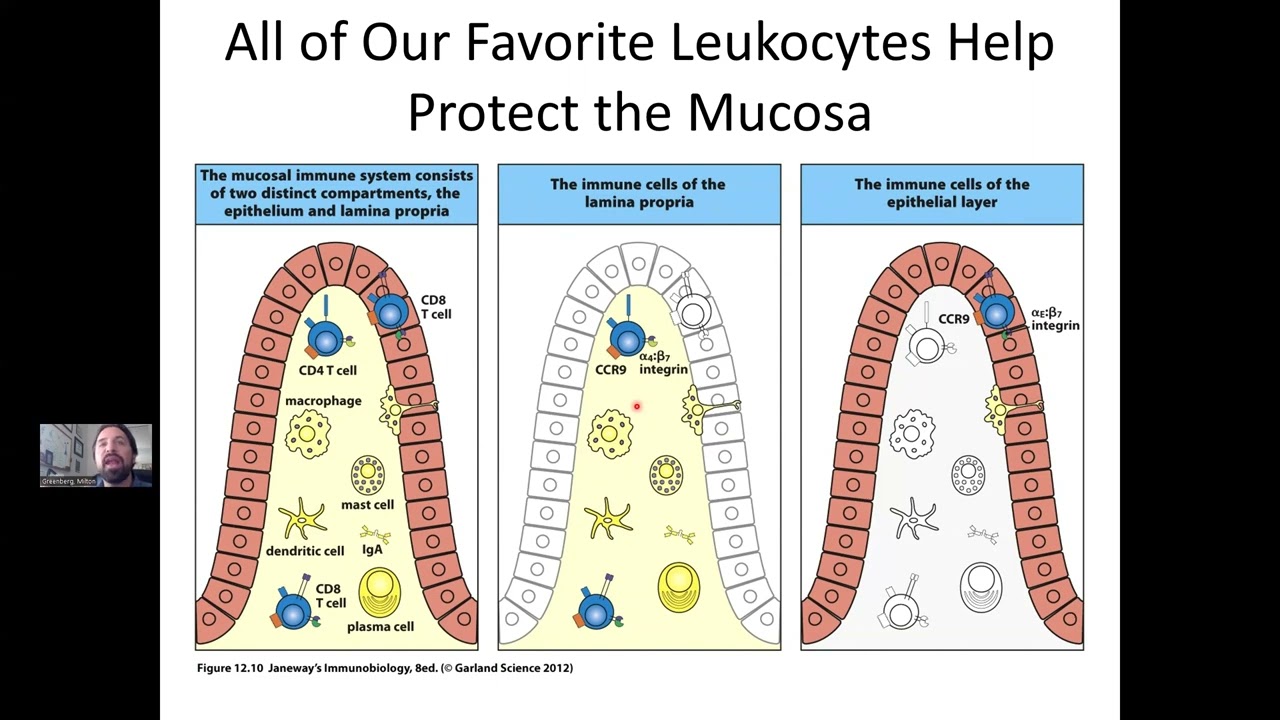




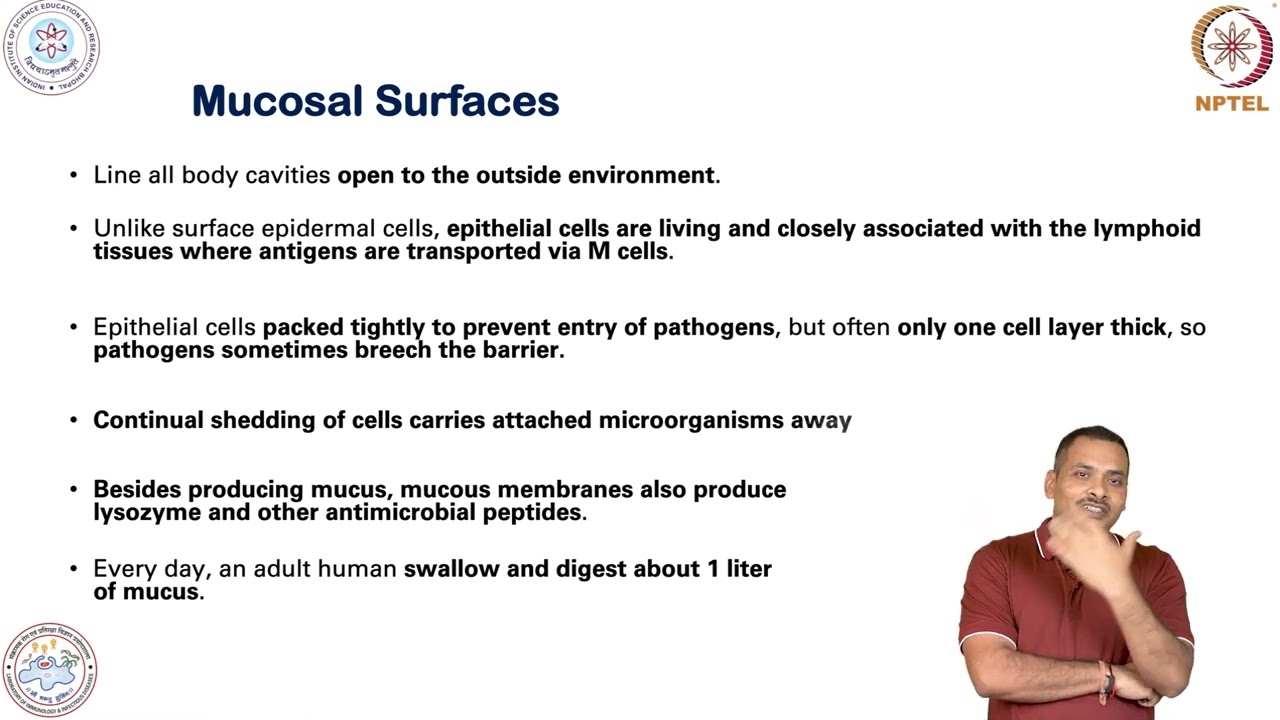
The lungs have a critical function in gas exchange and cannot maintain their own immune factories. Instead, they borrow immunity from off-site factories through a clever mechanism: lung secretions containing antigens are swallowed into the gut, where they reach Peyer's patches and stimulate immune responses. TH17 cells, a subcategory of CD4 helper T cells, migrate from Peyer's patches to the bronchus. These cells are sensitized to specific antigens and then migrate to lung lymphoid tissue. They stimulate B cells to produce IgA antibodies and recruit neutrophils, creating a powerful protective system. This represents a form of 'learned innate immunity' where the innate system becomes more proactive after initial T cell stimulation.
Mucosal Immunology: The Body's First Line of Defense
Added:Basic components of the immune system, specifically the distinction between innate and adaptive immunity.
The structure and function of antibodies (immunoglobulins), particularly Immunoglobulin A (IgA) and Immunoglobulin G (IgG).
Anatomy of the body's primary barrier surfaces, such as the respiratory, gastrointestinal, and urogenital tracts.
General mechanisms of vaccination, including how antigens trigger immune memory and antibody production.
Design and delivery challenges of mucosal vaccines (e.g., intranasal or oral vaccines) compared to traditional intramuscular injections.
The role of the mucosal microbiome in training the immune system and maintaining epithelial barrier integrity.
Cellular homing mechanisms, including how mucosal lymphocytes traffic to specific mucosal tissues via integrins and chemokines.
Pathogenesis of mucosal-targeting pathogens (like SARS-CoV-2, influenza, or cholera) and how they evade first-line immune defenses.
138.7K views5.2Klikes4:06Original Release: 2023-04-05
well welcome to this video and uh delighted to welcome back Professor Robert Clancy who needs no introduction now on this channel at all Robert thank you for for coming back pleasure now we've looked at the this is our sort of potted history of the the development of immunology and how to understand it this layered approach we looked at the specific era where there was antigens and forming particular stimulating the production of particular antibodies then the cellular era then the molecular era and now we're into a modern era and I believe we're going to use some interesting examples where would you like to start Robin what what we've done so far we've talked about traditional Immunology the type of Immunology that's taught in every medical school every nursing school and probably every science course and that is the Immunology of systemic immunity and there's a lot of reasons for this it's very easy to study it's got very clear-cut messages and those of you who have been following this series will remember that we talked about IGM and IGG antibodies and we talked about those as occurring within the bloodstream circulating in the body and stimulated by an injected antigen or an antigen that gets into the bloodstream for example a measles vaccine or a measles virus infecting somebody quickly gets into the bloodstream before it gets to the skin and the various Target organs and so this is a very efficient system the whole aim is to make sure that the inter internal part of the body is free of infection free of foreign antigens and so it has a a way of exploding and killing whatever comes in very quickly and that you uses an innate system based on either phagocytic cells which will eat the the bacteria or virus or cascading systems that explode with effector mechanisms that will kill the bacteria and the most important and the best known one of those is the complement system now way back in around about World War one it was recognized that there may be a different way of handling various infections that don't actually get into the body but operate on the surfaces of the body particularly the mucosal surface that is the surface the wet surfaces that line the lung or the gut or the eye the nose uh the vagina uh so uh the the various the bladder the various uh systems that are exposed to the outside world uh and have to deal with all the bacteria and all the different antigens that come their way and a man called Bez wrecker who was from Czechoslovakia who worked in the pastor Institute started killing cilitaria that caused shigella dysentery this was a terrible problem where more people died in some of the theaters of war from shigella dysentery than they actually did from being killed on the battlefield and he was able to show that by actually feeding these killed bacteria he can actually induce a level of immunity but no one quite understood it you know how could you do this when all the work that had been done in the pastor Institute and the Institute in Berlin all the the great mucosa the Immunology centers that it appeared over the last 30 or 40 years were working on this systemic immune response well not much really happened other than other studies like this until in the mid-1960s a man called Tom tomasi working in Buffalo New York Tom found that a newly identified immunoglobulin and remember that the IGG antibody was an immunoglobulin that's the type of protein it was a newly defined one which was called IGA was actually that that anti the antibodies in the secretions of the body were mainly IGA antibodies so we're at IGG they were IGA and that created a completely new area of Discovery and work and a completely new area of Immunology which we now call mucosal Immunology because this was the Immunology of the surfaces not the systemic inside parts of the body and it all began with identifying IGA as the marker of this system because most of the antibodies and remember that there are more antibodies actually in secretions than there are actually in blood there's huge amounts there's handfuls of IgA antibody and the remarkable thing was that this IGA antibody wasn't like IGG it didn't activate the complement system to go through enzymic steps to explosively kill bacteria it did have an effect on bacteria that would Clump them together so that the macrophages and the phagocytic cells could take those cells up and Destroy them it prevented virus getting through into cells so it had an effect on by itself but not with the various innate immune system mechanisms that we have come to understand with respect to IGG antibody in the blood system lymphocytes living in the mucosal areas to produce these antibodies yeah absolutely and in fact the next stage uh as always John you're one step one step ahead of progress here um the the factory for the B lymphocytes because it's always been lymphocytes that make antibody yeah was not in the spleen and the lymph nodes which is the factories for systemic immunity but little tiny knobs of lymphoid tissue in the wall of the small bowel which anyone here who is even somewhere similar to my age would remember doing anatomy and seeing these little lumps and they were called past patches and we didn't have a clue we had no idea what they did and it was a bit of a nuisance that we had to remember them because they seem pretty useless well now uh in 1971 John sieber another a very important American immunologist John and his PhD students found that the payers patches contain find the factory for the IGA molecules the B lymphocytes that if you took the B lymphocytes from payus patches uh in a rabbit and injected them into a rabbit they turned up in the gut making IGA antibody and so this was the second big step but there needed to be a third step and the third step came the following year 1972 1973 I was fortunate enough to be working in the group led by professor John beanenstock at McMaster University in Canada my role was to kill the rabbits I had a pretty small role in all of this I was a very junior junior person but John came up with the idea that this system that zebra had described of aggregated if you like lymphoid tissue in the mucosal surface of the gut maybe it also occurred in the lung and so he came up with the idea if we take the lymphocytes that we could take from the lining of the lung and injected them back into a radiated rabbits then we uh we could see what happened and what actually happened was both in the lung and in the gut little um B lymphocytes making IGA antibody were found and so he said ah there's a system that there must be a communication system between all the different mucosal surfaces of the body and he came up with the term the common mucosal system and so this basically completed the Triad of observations that put together this mucosal immune system so in principle you had an IGA a unique new molecule appearing in secretions called the IGA antibody the factory for them were the little lymphoid tissue which was in the wall of the small bowel called past patches and there were similar little lymphoid tissues not so dominant in the wall of the bronchus the the various tubes that go to the the lung and which John benefic called the bronchus associated lymphoid tissue or booked and So within a couple of years we then had a system we didn't quite know if it did much but we knew it existed but that really established the the ground rules for mucosal Immunology so to put it simply there's pairs patches in the bronchi as well yes but they they were they were actually morphologically and functionally the same there's not many Inhumans um in the rabbit that there is quite a few and every animal system has some but in humans you normally only see it when there's a infection and there's a reason to have a process for and for processing antigens in the bronchus Lumen so that it's mainly and and will come to this that the the dominant flow of the B lymphocytes and then we showed later that it was also involving T lymphocytes these cells flowed from the post patch to the lung rather than the lung creating its own um its own protection nearly all of it comes from the players patch and what um what my group went on and showed was that the secretions of the lung pour into the gut as we sit here perfectly healthy people we swallow a cup full of Creations from the uh from the lung every day without knowing it it's only when you get to a couple of cup fulls of secretions that you start coughing and coughing that up at what we call sputum or phlegm um and that's the excess amount so we're presenting into the gut the antigens that might be in the bronchus if bacteria virus if you've got the covert virus it gets aspirated up into the gut and it goes to the post patches and so what developed John was this idea that there was an off-site development of immunity for the lung and the lung was recognized as having one big function and that is gas exchange critical function oxygen in carbon dioxide out and it would borrow from off-site whatever immunity it needed it would tell the off-site factories by actually by them swallowing whatever was in the lung and going down to these past patches and you can see as that diagram up the yes yes in the diagram you can see it's a fairly schematic diagram but you can see a blue line which is number one yeah and that represents the normal aspiration of secretions into the gut uh you can see the stomach and then after the stomach there are these little patches the blue patches and they're the past patches now the interesting thing you'll see that what is demonstrated here is a T Cell not a B cell that's going to the bronchus yes and that that didn't make sense it certainly didn't make sense to us because we did these studies in rats and we were able to cannulate the thoracic duct which is where all the lymphocytes from the gut they go into the thoracic duct which then goes into the blood stream and we just assume these would be B lymphocytes making antibody but in fact it turned out that the most protective cells for infection with a teen lymphocytes now this was quite unprecedented it didn't make sense and it was only 15 20 years later that people discovered a new type of T Cell called the th17 cell which was we've talked about T4 cells and th cells in the systemic immune response uh the T4 cell being the helper CD4 T Cell being the helper cell the cd8 T Cell being the killer cells here we have a CD4 cell which is actually they're actually CD4 cells I should I should have made that clear but the th17 because of the particular role and function that they have uh and uh when we heard about this being discovered we went back and looked and found that exactly they were exactly the cells that we'd found back in the mid uh 1990s that was transferring the immunity uh from the gut to the lung so we we then had a system that created immunity off-site presenting it as it was needed to the Airways to protect it against infection so these th17 cells are it's a subcategory of the CD4 the the the the helper lymphocytes they go they go from the pet pairs so they're sensitized to the specific antigen in the gut because we've swallowed it from the lung yes yes these cells then migrate into the lymphoid Associated tissue of the lung into this the lining mucosa of the lung right right right and then the these helper cells must stimulate uh B cells that are already there presumably to produce it's interesting what we found was that the the dominant protection mechanism uh sure there's also B cells making a little bit IGA antibody and various other things but the dominant protective mechanism was recruiting and activating neutrophils now I think you once called neutrophils microphages or yeah microphage as opposed to yeah it's a good term the the little gobbler opposite they're they're the the garbage disposal cells but what was happening and this this was again we didn't appreciate the significance of this when we first observed it was that these th17 cells bring in from the bloodstream uh an innate system which is dominated by AI cells which are called they're part of the white cells of the blood they're the the poly you can see there's some there listed number five you can see and you can see the little dots of the nucleus um they can also be the dots of gobbling up bacteria I suppose but the the nucleus of the neutrophil uh is segmented so you have uh it's like a little roll of sausages and it's quite easy it's found in every pathology laboratory when you have a blood count they count the number of neutrophils that you have the number of lymph the different types of white cells yeah but the interesting thing here was and again we didn't we we noted it but we didn't realize how significant it would be was that these neutrophils became highly activated and long living and they created if you like um a game of their own within the within the actual bronchus Lumen within the inside part of the tube that goes down to the the gas exchange part of the lung and they would actually clear the bacteria that were there and very powerful very powerful system I'm unclear about what there's there's lots of immunoglobulin taipees in the respiratory mucus I'm still a bit unsure where that's actually being these immunoglobins are being produced the igas and the respiratory mucus right that's a good question um IGA is coming from the past patches too it's just that it's not as powerful a system as the T cells the IGA B lymphocytes also migrate from the past patch and they have special receptors on their surface just as the th17 cells basically saying look I'm a postage stamp take me to the bronchus mucosa and there they appear and then they make the IGA antibody which contributes to protection and it will block virus being taken up into cells uh it will aggregate the bacteria to make them more palatable for the the phagocyte but what they will not do is activate the various cascading systems that will provide the hand grenade that we talked about in systemic immunology and so that became in essence the the core part of mucosal Immunology but you might notice there's another slide here which told us that there was something else extremely powerful extremely important and has probably been the elephant in the room when we come to the covert story because it was never ever promptly factored into the equation yeah just before we go on to that I think I think I've got this so it's it the it's the that there are B cells that are sensitized to a particular antigen in the past patch they do migrate to the lymphoid Associated tissue in the bronchus and they do produce immunoglobulin type A's it's just that we get more immunity stimulated by the th17 CD force that then stimulate the neutrophil system yes or for example if you put a bacteria that's going to kill well and this was done in rats you put a bacteria like a what pseudomona saraginosa which is the major bacteria that's very powerful in children with cystic fibrosis if you put that in a wrap um my colleagues who were helping me with these studies would take the rats home to do 12-hour studies because all the rats would be dead by the time they came back to work the next morning was very powerful bacteria however if you fed them a lot of killed pseudomonas so they would go to the past or we actually cheated sometimes and injected it directly into the post patch but if you pass these to the Past patch the immunity was so strong that the rats were sitting up there asking for their breakfast the next morning they didn't turn a hair it was unbelievably powerful now the the interesting thing is that if we then looked at what cells from the payus patch was creating this high level of protection we assumed it was going to be IGA antibody but the B cells did a little bit but not much and we could show the antibodies that were appearing and but not much but if we put the T cells in then it completely prevented death in these uh these animals it was approachable point of view Robert um how how much stronger an immune response is it to direct the pseudomonas attenuated dead antigen directly into the pairs patches as opposed to Simply swallowing it because I I would find it much easier just to swallow something and have it have it injected into my pairs patches as a patient my colleagues with serious PhD scientists and they wanted to know exactly how much antigen went into a player's patch what we did we did both and we showed that both were equally effective um I'm really sure yes I was yes certainly we weren't cheating we were just uh um making uh minimizing the variables I mean I mean the the this this first world war doctor just basically getting shigella presumably just killing it in some way yep and then giving giving the guys it to drink I mean it's just wonderfully simple and it worked and it worked yeah and and so you must have saved thousands of lives from shagalosis which is horrible I'm sure that's true um all of this is documented um it's interesting I actually have a copy of his his monograph uh the problem is it's in French and I'm not a particularly good reader or French when I come across London I mean it's interesting isn't it that that someone as important as berserica I I doubt is known to any of the modern day immunologists uh and yet he made these observations and he actually showed that there were a glutenants antibodies that would Clump the shigella together but he didn't of course know it was an IGA or an IGG all of that came 20 30 years later yeah I used to teach the students that the the antibodies prepare the food for the phagocytes table and and that's it you taught them well yeah they Clump it all in one nice bit that's right instead of having your Smarties all around the room yeah you have the more than one tube ready to pick them up that's exactly right exactly right yeah I mean it just seems the world is missing one heck of a trick I've never had any oral vaccines apart from polio well no no there's there's the cholera vaccine if you go no I've never had that but right yeah yeah there's a standard color of accident very effective very effective yeah yeah um we may get on to you know the options of this is completely new area of options and potential for for changing the way a mucosal surface reacts you know to a coronavirus to a covert virus to a flu uh by optimizing this process but it's also been sitting on the shelf since the first world war so it seems like a bit of a I don't know there's a lot of shells it's just that they're they're they've got locks on them we quickly have to move on to the the elephant in the room yes uh I I was lucky enough I I after I finished my PhD I I went to work with John benefic in in Canada which is how obviously I got involved in mucosal immunology and I've always been into two things which were a bit different to John um and that was I was interested in humans and I was interested in T cells uh because my PhD had been in T cells and Auto in autoimmune disease and so um I started extracting um T cells from these mucosal surfaces in the gut human gut and working also in in the rabbit now I put up the a slide from one of our very early Publications too long ago for me to even remember let alone tell you but it makes a very important point these were rabbits that have been injected either into the lung into the Takia the airway going into the lung or into the skin um and uh he you what you're looking at is the uh the uh T Cell response T cells taken from either the Washings inside the Bronco so these are the T cells actually outside of the body if you like in the secretions working away all the T cells that were found in the lining of the mucosa which we call bronchus Associated lymphoid tissue balt or T cells that we got from the spleen so here uh there this is only small part of a larger experiment the point I want to make is that if you look at the teaser on the vertical axis this is the response when you're trying to stimulate the T cells the T cells are responding to either make their cytokines or divide so it doesn't really matter what index so on the vertical index we're looking at response and on the horizontal index we're looking at time and they one two and three are weeks so with zero time the antigen which was one we made a unique antigen the rabbit had never seen called dnph doesn't really matter what it is and you can see looking at the T cell responsiveness at one week obviously at zero time there was none at all should have been connected but one week you can see that already you're getting response of T cells in the bronchus lining in the mucosa uh no response yet in the cells in the bronchial Washings by two weeks the spleen cells still hadn't really got their act together remember the antigen not been injected into the body that had just been put down into the chakia the breathing tube going into the lungs by two weeks we've got a really good uh proliferative response the cells are dividing quickly when they're stimulated in a test tube after they've been taken out of the Washings and you've still got a fair amount of stimulation in the bronchus lymphoid tissue taken from the mucosa but the important point is at three weeks there is no response at all now this is crazy because if I put up which we did the study of the systemic immune response by three weeks there'd be a huge response of T cells whereas in the mucosa it's not responding at all but you can see the antigen from the bronch us has leaked into the body and that spleen cells are now are starting to take off and if we extended the study out the spleen cells would actually continue to respond but my point here is some either the cells had become non-responsive all by themselves or something was turning them off so this is the elephant in the room of mucosal immunology and when I've talked to you in the past about down regulation or tolerance this is what I'm talking about it occurs in the gut it occurs in the lung and I I wanted to put this up not because I'm proud of what I did many many years ago because it's a it's a pretty piece of science Robert it is a nice piece of science well it it at the time it was people couldn't understand we couldn't understand it but I then went back to work at Prince Alfred Hospital the greatest Hospital in in Australia wonderful hospital I set up the clinically Immunology unit there and um with I had some remarkable PhD students and what we did is we said well look are these non-reacting cells is there something wrong with them or is there something turning them off and we then did a very simple experiment where we took patients who were having lungs resected for tuberculosis and uh we took lymphocytes from their ball from their bronchus and we mixed it with their blood lymphocytes and the blood lymphocytes if we stimulated them with PPD which is the antigen from tuberculosis it was really very high but if we mixed small numbers of cells from the lining of the book of the bronchus it completely turned them off so this was really the first demonstration of suppressor cells outside of the bloodstream that this was these were tissue suppressor cells and this is Tony fauci and I this is our Tony fauci and I became friends a long long time ago because we were both doing similar sorts of things um a long time ago um and um so so I I might try to promote very old science I'm simply trying to say that that this is real real life science where you've got a suppression and other people like Pat Halt and others around the world really took this suppressor cell thing to the next level and found that the lungs actually had a carpet of remember we talked about dendritic or antigen presenting cells and these cells capture all the antigens coming in and as well as the the antigen going down to the Past patch it activates these antigen presenting cells which go to the local lymph nodes and create what we call not two suppressor cells these days but t-reg cells which do the same thing so what we're looking at here not knowing what they were at the time is T reg or t regulation cells very powerful cells generated from within the lung environment and the bronchial lymph nodes the lymph nodes which of the lymphoid tissue immediately close to the the bronchus and the lung and presumably the function of these regulatory cells is to prevent inflammation in the Airways is it Robin exactly exactly because look at what's happened systemically systemically you want a completely sterile bloodstream internal environment and you're prepared to have a big inflammatory response to get that because free-floating bacterium virus inside you is potentially a big danger and death whereas if you look at the lining cells of the lung and the gut they're loaded with bacteria we we talk about the microbiota in the gut we say there are so there are more cells in the microbiota of the gut this is bacterial cells then there is in the rest of the body we talk about it as the the new organ system because it talks to the brain and talks to the rest of the body uh just talking to a colleague today and he was talking about how maybe this bacterial population creates or gets rid of fat within the livers I mean all sorts of things now are being talked about in diabetes and fat Metabolism from these bacteria but of course you've got to control them if they get out of hand you're going to have infection and destruction of the gut and the lung and of course Invasion of the Body and so you have this very very clever mucosal immune system which is not sterilizing not sterilizing but controlling keeps the microbiome down to acceptable levels microbiologically then there's a complete difference so you've got this massive eco-bacterial ecosystem in the gut but the mucus lining the Airways is pretty pretty clean isn't it no well it's not it's got bacteria in it this is that's where the microbiome is right so we do have a protected microbiometer surfaces even the eye will have a microbiome a particular collection of bacteria right so so if you do a culture insensitivity on the sputum test if you're looking for the right bacteria it will always be positive you'll find back to always find bacteria yes but very often it's contaminant from the microbiome of the upper Airways because the sputum's got to come up from the lung go through the pharynx and then be swallowed so it'll it'll catch um the the same the back a different set of bacteria which which aligning the pharynx um and the tonsils and the tonsils work in a similar fashion to pose patches they're doing for the upper Airways what the past patches are doing for the lower Airways yeah this but the belt the the bronchial Associated lymphatic right and I think that what we what we must take from this is that when you get the mucosal immune system activated by bacteria or virus it will stimulate through the past patch not just a mucosal immune response and at the same time you've got the down regulating so we're already talking about a balance but it distributes it makes some IGG cells which will go to the lymph node and the spleen and so you you get systemic and this is why you get antibodies when you get a say coronavir a covert virus which never gets into your lung you still get circulating antibodies and that's how you say oh you've had covert but it was very mild well it hasn't been because the covert has got into the systemic immune system it hasn't it's been aspirated down into the past patch and the past patch delivers some IGG producing B lymphocytes which home go by homing to the lymph nodes to the spleen but also you've got these suppressor cells going to the same sites and so while the IGG antibody responds to an injected vaccine for say measles gives you antibodies years later and higher levels of antibody uh you don't get that when you get the IGG being distributed from mucosal aggregated lymphoid tissues like the past patch and the tonsils and the pharyngeal lymphoid tissue you don't because you have then you get a balance which brings into play the elephant in the room the suppressor cells that we've been talking about and that's why people run into problems with multiple vaccination uh in in covert so I I kind of assumed that the systemic antibody response was caused by a level of bacterial Escape no that's not necessarily the case I mean sure uh in a person with bad covert that gets breathless we know the bacteria's got into the gas exchange Opera yes of course a lot of that will be systemic stimulation but at the same time it's already activated IGT systems by earlier being in it within the the bronchus mucosa and going through the that Loop that we we can see you can see the loop um uh in that diagram that we we had up but this is an incredibly important idea because it means as soon as you get an infection into the upper respiratory tract before most times it will go away but the odd one that does become systemic because it gets down to the alveoli by the time the bacteria or virus hit the bloodstream then there's already going to be antibodies there ready to combat it specific antibodies for that particular antigen that's brilliant that that's that's correct and of course uh nothing's new um most of us have been getting similar types of virus infections all through our life coronaviruses flu viruses and so there's a high level of priming um uh but but of course that priming also primes the down regulator and the up regulator and we we have to understand that this is all about uh a balance yeah one thing I I didn't go into which I think is important if you buy the fact that the activation of if you like the specific or the Adaptive immune system that we've been talking about coming from the post patches how do you get ongoing protection when you get such a short pulse of activity and the answer is that the specific T cells that are going to the lining of the lung that you can see migrating there they don't only just re they activate the the neutrophils that are brought in to gobble up the um gobble up the bacteria but they also change them that means it's called a phenotypic change or a change in its nature they become long-lived and they become very active at taking up and killing bacteria and this phenotypic change is caused by cytokines produced from the T cells and the epithelial cells that the T cells act on to create a loop involving what's known as interleukon one which is one of the early discovered cytokines in the whole T Cell system and this is called an autocrine Loop now you might remember that in an earlier session we were you gave a very good analogy of endocrine where and we took the thyroid where the thyroid stimulating hormone from the pituitary gland comes all the way through the body to go to the thyroid gland and we call that an endocrine system but we talk somewhere along the line of a paracrine system where a cell sitting next to another cell and I think we did this in relation to Addington presenting cells yeah and dendritic cells it can make a cytokine or a hormone and act on the cell beside it which might be a T cell uh and that very close proximity is called um uh so we had the order crime uh and which is called a paracrine yeah because it's very fun yeah here we've got an autocrine system where the cells making its own stimulus very clever and we were able to show that in people who have got chronic bronchitis or coughing up um yellow sputum um and yellow sputum just means there's a lot of activated neutrophils it's the neutrophils that make it look yellow right um we took those neutrophils and found that if we exposed them to a monocle an antibody against interleukon one it stopped that it stopped that autocrine Loop and the neutrophils went back to being just like a blood lymphocyte blood neutrophil and didn't last very long and wasn't particularly active and so this is very clever system and this this is just an example of how now the innate immune system remember the neutrophil is part of the innate immune system how it continues the protective mechanism after a pulse of T lymphocytes come from the past patches they're turned off but they leave the ongoing innate system and many years later people picked up this idea in different systems and called it learned innate immunity the innate immunity has learned to become much more proactive neutrophils the sensitized neutrophils do we know if they're long-lived or do these neutrophils divide and produce daughter cells that also have the same immunological memory they they probably act very much like what happens with lymphocytes in systemic immunity some become memory T cells but what happens they become residing within the lung and recently there's been a lot of interest in pulling out um B lymphocytes and T cells from the lung and say oh here we are we've got resident T cells resonant B cells now these cells almost certainly have come from the past patches they've done their job they've they've kicked the innate system into action they sit there in the lung a lot of this is still very much being sorted out and the actual role of the T and the B lymphocyte once they've done their initial kicking along uh it is still to me at least a little unclear it's very easy in an experimental system to pull some out and say oh look it does this and this but in the biological system where you've got interactive up and down regulating cells uh it's a very different different picture so I think people will be interested Robert how this applies to the current uh covid vaccine um I think what we have to call it an international debate now really that's going on about this yeah um the the limits or or the problems with it I mean can we address the ige issue first the immunoglobulin type e issue with covid vaccine yes well um if we just before we did that if we if we just take covert and see what happens when a covert virus if we put all this together in a real life covert situation um is that okay John yeah please yeah very quickly um that the covert virus comes into the Airways and is taken up by the lymphoid tissue in the upper Airways and some get swallowed down to the post patch and so you get billion T cells responding but most importantly remember the antigen presenting cells that dendritic cell could create interferon and various other very antiviral molecules very quickly so so that that very quick response from those cells involving those receptor systems that we we talked about um that exist on the surface of the dendritic cell and inside the dendritic cell um they will translate they they get red into the DNA nucleus that makes a DNA of the nucleus that makes these and this is all innate immunity and the excitement of course is that innate immunity now is moving from one side of the T cell to another and we we talked about that but they also stimulate an IGA immune response which which has been measured and also T cells which have been measured just as we've been discussing the way they should and and in most people that will contain the virus to within the bronchus it doesn't get any further however if and it's what makes the coronavirus Corona 19 the virus of Corona uh virus 19 makes it a nasty virus is that it escapes whereas the old coronaviruses really have ever escaped from the bronchus and gets into the gas exchange apparatus where it then starts interacting with the uh systemic immune response and depending on the how much antibody and how much antigen the virus being the antigen the relationship between the two is whether you get immunity and no breathlessness or viral pneumonia or overactive cytokine storm that all depends on the the expansive activation of the complement system the activation of various other enzymic systems that give this explosive hand grenade effect plus the toxicity of the spike protein which is the important protein on the surface of the the virus that will bind to the cells to let the virus get in it's the main way in which the virus gets into the cell to replicate and so um that's the difference between covid-19 and its precursor coronaviruses that have been around for probably thousands of years so the main difference is that the SARS coronavirus 2 has got this ability to get down to the alveoli yes it can escape out of the bronchus yeah yeah it gets down it gets right down there into the alveol line right down there once it's in the alveoli they're only such a thin membrane it's essentially in the systemic circulation and the protection mechanism is no longer the IGA the mucosal system it's the systemic immune system say because the the lung says with the gas exchange No Holds Barred we've got to really do everything we can to keep that going if you don't get oxygen going in carbon dioxide going out you don't live very long got it so the alveoli are part of the systemic immune immune system yeah the other very interesting thing just before we move off this is that the spike protein will actually bind to Red cells as well as uh getting the virus into the the epithelial cells that will allow it to replicate and when it binds to the red cells they agglutinate they come together and this was a relatively unique feature of covert uh particularly in the early days when we had a very invasive virus and what was happening is that within a day or two the oxygen tension was dropping even before there was a lot of radiological change of pneumonia and it's now been shown by a group in France with some help from some very clever Americans that um uh the the the actual virus can agglutinate the red cells and I probably shouldn't say it but the one thing that prevents that agglutination is Ivermectin but that's a different story that's that's a scientific observation I'm talking about oh yeah we're allowed to we're allowed to talk about purely academic scientific this has been published in peer-reviewed quality journals but it's very interesting so that's what happens so what happens when you vaccinate someone uh well first of all before I do that I'll just make two more points yeah um that when you the virus is coming into the the bronchus and the pharynx and the nasal cavities it's also stimulating suppressor cells which are going to go out to the periphery as well as act on the mucosa and the other important thing is it's only the local immune response that's going to prevent spread of the virus to the person in the family or the person next door because IGG antibody for all intents and purposes does not get into the bronchus secretions and this was something that should have been understood but never was and it took them a long while to realize that by vaccinating someone with which is going to stimulate IGG antibody but essentially no or very little or useless IGA antibody in the secretions then the IGG antibody won't get into the secretions to prevent the virus multiplying and being distributed to infect other people a very very important point that I think underpinned a lot of the public health issues it is and it's also a very very annoying it's a very annoying Point as well because we had senior medical officers uh standing up and telling us that telling children for example to become vaccinated to prevent their grandmothers getting infected and yet let me ask you this question Robert how long have you known about this physiology that you've just described um or basically since around about 19 early 1970s I mean this is not rocket science this stuff has been known it was all in the literature um but I think In fairness I think the people who are making decisions did not understand the biology of covert infection they did not understand mucosal immunology and they certainly didn't understand the the importance of balance between up and down regulation that occurs uh it's now obvious that you know it's become quite obvious I I wrote an article I know in in January of 21 21 yeah it was January or February 21 yeah and I said look you know this doesn't make sense to me you know you this is going to be like a flu vaccine uh you're going to get a small transient response it'll probably be good for serious disease it will stop IGG antibody will ameliorate the serious viral pneumonia that can occur which which I think it did in those early days um but you know it's not going to affect what goes on in the bronchus uh this is a local immune determined event so um I'm sure other people were saying the same thing yeah but it's still I still find it bemusing that senior doctors didn't know this I mean they've all got mates who are respiratory Physicians and immunologists haven't they you know that yeah well yeah I think yeah I won't say anything yeah they could have picked up the phone and talked to you know it was quite interesting when you look at the people who are on the decision-making committees uh and I talked to some of my um there's some very very good clinically menologists in Australia and I I talked to a few of them at the time and saying look I asked them I said you know are you on a Target you know the committee no no we don't know anyone on otagi um and uh it was um it was bizarre they were infectious disease Physicians Public Health Physicians but In fairness you know um I'm not a virologist I I'm not going to talk about the intricities of viral replication I know a little bit about it but not the not all the detail but just as the virologists really don't understand well apparently not understand much of mucosal Immunology it would appear so so I think that does take us on to the vaccine limitations now Rob yeah starting off with the ige yeah sorry I you did you did ask about um no no that that was absolutely uh part of the linear process you're quite correct okay uh ige is one of the immunoglobulins that occurs um when against particular patterns of antigens a particular um everyone who uh is listening to this will know someone with hay fever or asthma or eczema and about 20 25 of people in the population make have a propensity to make ige against uh antigens which are generally presented to a surface either the skin or the mucosal surfaces and that's why allergies uh lung allergies or gut allergies or skin allergies this is a ATP Robert isn't it people a topi is the term used it's got a long history in terms of what it means but today it means a tendency to make ige anybody it's a genetic tendency you know if you have mothers and fathers that got asthma the chance of their children uh having asthma and hay fever is much much much much higher so you have a strong genetic Factor now the ige is a very interesting antibody it was only really discovered by a Japanese husband and wife team again in the 60s uh late 60s and uh issues and what they found was that the old skins that they knew that there was a funny antibody that would bind to mast cells in the skin which was called Skin sensitizing antibody but they didn't know what it was and then an ige myeloma a myeloma is a tumor of of B cells and occasionally they make ige and then you can get handfuls of this IGG ige antibody which normally is very low amount in in the blood and this was found to be the so-called skin sensitizing antibody which meant that it bound to cells called mast cells m-a-s-t mast cells which reside particularly in mucosal surfaces the lung and the gut and also the skin and if you then have an antigen say you've got an ige antibody against a covert um uh antigen that you're going to inject in a vaccine then or you have a messenger RNA making that antigen then if you've got the ige antibody then the antigen will bind to that and the Mast Cell will release all its contents uh mainly things like histamine and various leukotrienes there's a whole range of these mediators that will act on blood vessels to dilate them and to make mucous secretion and if it occurs in the skin you get a red itchy lump which is called urticaria in the nulls you'll get swelling and get hay fever in the lung you get asthma in the guts you can get food intolerance various food allergies you get a diarrhea may be abdominal pain so you get these sets of symptoms if it occurs if the ige antibody he's floating around in the blood and you inject the antigen as you do with a vaccine and it will buy and that antigen will bind to that ige you get massive release of these cytokines throughout the body not a localized effect in the skin the lung or the gut but a massive systemic release that's known as anaphylaxis and that is life-threatening you have to treat that with injected adrenaline straight away which is why the doctor will say to you or the pharmacist I want you to sit here for 15 minutes before you leave when I give you the injection because one in ten thousand people not very common but pretty important for that one person one in ten thousand people injected with a covered vaccine will have ige antibody in their blood and they will get anaphylaxis which if you treat it straight away with adrenaline and that's why the doctor has you sitting there for 15 minutes because he's got adrenaline sitting in a syringe just in case you're the one in ten thousand so this is pretty uncommon but very important to know about yep and um the next point there is is auto antigen what what's the thinking with vaccination and potential Auto and auto antigen stimulation well this is what is unique this has not been seen before with any form of vaccine this is only occurring in the context of uh messenger RNA vaccines now what we know about messenger RNA vaccines is they go to many cells in the body they don't just go to the regional lymph node where antibody is made but they spread and they make an um I mean a completely unquantifiable amount of antigen if you inject a very small amount of flu vaccine as we have at the moment our flu season is coming and we're all getting our flu vaccines you get a very small amount of measured microgram amounts of antigen however when you inject uh basically a piece of genetic material that goes into cells and takes over the factories for protein in the cell and and and takes priority within those factories it will make an unlimited amount no one knows how much antigen is made on the surface of the cell or secreted into the bloodstream we do know you can pick the antigen which we know is the spike protein because the spike protein is the uh protect the antigen to which you're making an immune response to prevent the virus getting into the cell to infect you uh we we we don't know how much antibody is being made and as we've discussed before the amount of immune response is dependent on how much antigen too little or too much antigen has a negative effect and so if you have a completely unregulated amount of antigen production it's going to make you more likely to have a negative or tolerant effect to repeated vaccines and again that's exactly what we find that on one hand you've got the turning off of the immune response you want and on the other hand you've got turning on autoimmune response against that Spike protein sitting on the surface of the cell that's taken up the messenger RNA so it's sitting there as a Target now this has been demonstrated in postmortems the Germans have led the way in doing this there's been some very good small studies done certainly in America showing that the spike protein can actually be shown to be produced in the tissues of people dying following vaccination and you can see the T cells clusting around just as you would see in an autoimmune disease this is only autoimmune and it's not autoimmune in one sense because it's the foreign antigen but it's being seen in the same way and acted upon in the same way as you would see in an autoimmune disease and this to the best of my knowledge is unique in vaccinology and it's something similar with the adenovirus factor vaccines but yes yeah that can do it too but probably less so in the sense that you're um the adenovirus your antigen or the the DNA that's going to code for it is part of the the the actual attenuated virus that's going to be stopped yeah it's not going to go on and on and on in the same way that it you know you can get Messenger distributed everywhere I mean there's no doubt that potentially you can and and probably you do to some extent but um if you look at all the people who are getting myocarditis and young people getting heart disease and uh all the consequences of that which we're only just starting to see the tip of the iceberg of uh in terms of numbers and and outcomes uh sudden deaths on sport fields people dying from um heart problems or brain problems in the first couple of days or first week after a vaccine oh this is not occurring in in Lots but it's occurring in some people and uh yeah when you put it in those terms I just find this somewhat horrendous you know if you've got a pain Robert you can take 15 milligrams of codeine or you can take 150 milligrams of codeine or you can take 1 500 milligrams of codeine as if you know but by the way you can't please don't do that no but but you know we're not controlling the doses you wouldn't be liable to getting diarrhea under those things no no only take drugs that your own doctor prescribes of course we use this purely as an example but you know you know or or if I gave you some morphine I you know I'd be terrified to give you more than five milligrams unless it was very very slowly and that's right but yeah you know don't worry about it take 50 take 500 you know the dose doesn't matter it's just but that's what's happening with these vaccines we're not getting a controlled dose advantages it's a very good example of how we have built Medical Practice uh we've built Medical Practice on careful observation careful quantitation of uh what goes in and what comes out and um I think that while it's very sexy to think about genetic vaccines like messenger RNA um it's uh no one no one has ever shown they're better or cheaper or or quicker to develop than the good old-fashioned vaccines that we've had for a hundred years that we know work we know how they work we know the level of them working and we know their safety issues so why at Earth create something we know nothing about and give it to what is it something like 85 percent of the world's population unless you live in China where they use the side effects yes yes and put it in those terms it's just completely very smart yeah it's just yeah yeah my words have gone it's just when you see the objectivity of it it's just um it makes no scientific sense no and we've talked about this before but I think it's worth repeating John that to see billions of dollars billions of dollars being put into factories uh off here you we were talking about making TB vaccines using messenger RNA I mean for goodness sake sort out the positives and negatives now while we can get all the pre-clinical data get all the clinical data sort out the distribution how much antigens being produced can we do it better um yes we can we must be able to uh well I I wouldn't I would have thought it's a good idea to do that work before we build the factory in Melbourne to produce 100 million doses a year before we build the factory in Oxford to produce 250 million doses a year before we build the factory in Canada before we enlarge the factors in the United States you're sounding awfully logical and awfully scientific yeah we all know these are all cynical but it's not cynical they wouldn't I mean the science makes sense yeah I've got my grandchildren are going to be injected with messenger RNA around the corner for diphtheria uh pertussis uh flu uh rbn I'm going to be asked to have a flu vaccine in a year or so very soon uh which is made with from messenger RNA and and everything that's gone wrong with the covert one will go wrong with every other one because they're going to use exactly the same Delivery Systems yep I think we should finally met Robert um mention genetic the potential for genetic incorporation with mRNA vaccines we're not allowed to say there's genetic incorporation with the uh the current covert vaccine so if we just talk about the theoretical possibility first transcriptase genetic incorporation with mRNA vaccines yeah correct me if I'm wrong but uh when a couple of weeks ago we were talking about the the pre-clinical um the there was a comment on the pre-clinical data that was submitted by Pfizer saying we don't have to do genetic studies because this is a vaccine study was it something along those lines uh that's the way I understand it this was the lead report from from the uh the TGA in Australia wasn't it yeah it was the information that went to every regulatory uh body in the world which was only released as a result of Freedom of Information requests uh the uh the thing about our messenger RNA is that the the body does have an enzyme called reverse transcriptase now the reverse transcriptase I can remember back in the 80s and 90s when uh HIV was dominant and um the reverse transcriptase became a big thing and I actually got the feeling back then that the body didn't have any reverse transcriptase because uh you might remember they were making antivirals which were very effective and really changed the outcome of HIV it's been terrific um very different to what we we see in in covert um but although it was really great breakthrough you know Nobel prizes were given um the but what what what has become clear is that the human cells do have some reverse transcriptase and I'm certainly aware of three papers uh that have described the reversal of genetic information and again uh when I was a student it was DNA to RNA to protein well now we've got a situation where you can actually go from the RNA back to the DNA by using an enzyme that changes the single base difference between RNA and DNA the uracil gets replaced out and don't forget um with the uracil in the um in the vaccine the messenger RNA vaccine it's actually a suit they've got a pseudo-uracy so you've got an abnormal an abnormal amino acid and what I don't know sorry yeah abnormal puree pyrimidine sorry I said so so the euro is still in the vaccine is different to the eurocell in our physiology I I'm I am not certain whether they're all the uracils in the vaccine have been replaced with pseudo-uracy which is a methylated uracil uh and again I I should know this but I I now you ask me I'm not certain I do but there may be a mixture but we certainly know pseudo-eurysil is there now if you're getting reversal of the messenger RNA into DNA so you've now got DNA coding for Spike protein in the cell um I you've got this potential added problem and there may well be experts who know a lot more about this than I do who say no no for some reason the pseudo uridine doesn't get translated but my guess is it would be but certainly there are at least three studies showing you do get this reversal of genetic information now what does that do to the cell does that sell more likely to become a cancer cell if it's a germline cell in the ovary or the testers are those cells more likely to pass on to the next generation abnormal information encoded a spike protein is going to be produced in a progeny uh in a you know your grandson your great grandson we don't know these things I don't know the answer and I haven't don't think anyone else I know no one else knows the answers these to me John are the questions that have to be asked and answered before we start giving this to 80 percent of the world's population I think he's the same as yours Robert but when the HIV thing first kicked off in the early 80s I assumed that um the reverse transcriptase was delivered purely by the virus itself yeah um but I'm unclear where where the virus comes from it in most of the reverse transcriptase in HIV but as you correctly say from the virus yes yes yeah I don't know if it comes from both or or what but but there's certainly reverse transcriptase in human cells I mean this is now yeah yeah well I think that's true uh and um there have been um as I said a couple of studies I've seen where they've actually shown how the the DNA has been changed to incorporate this new message producing uh um Spike protein producing information well you know how many cells this has happened to does it increase with time do you get self-replication do you get this in the epigenetic in the mitochondrial DNA I don't know um and um so these questions should be asked before anything is anything further is done I mean I I I tend to suspect that the risk of reverse transcription of of spike in somatic cells is probably relatively low because we must be getting reverse transcription of viral infections all the time and I agree I agree with that I agree with that so presumably in Old DNA like ours if you look at our somatic cell DNA that that will bear the traces of uh virus viral infections that we've had throughout our lifetimes it does indeed I think it's uh the the only right I I think that's that's right and I I would I should have said that but I think the only writer is that we're incorporating uh a a different messenger RNA it's being translated I'm not sure how the pseudo uradine for example the methylated uh uracil whether that gets translated I mean thymidine from memory's got a methyl group anyway um correctly if I'm wrong I can't remember going back a bit um but uh you know it it may be that uh you don't get that transferred back these are just questions that people like us should be told answers to yeah I I I'm not I mean the the question should be answered before we go on but uh it's it's a risk which probably is there hopefully won't be there or a big problem but it certainly should be answered but the the one about the autoimmune stimulation and the uncontrolled antigen is the science there is they're big issues they're issues that occur and they really need to be sorted out I I agree with you um and when I've talked about this uh I I don't say too much about the reversal in the DNA because I like you I believe that every virus around is going to have a little bit of a pop back into you know we've got a very complex nucleic acid structure in the nucleus haven't we fascinating yeah uh I always feel pleasantly tired after these talks it's a it's it's not it's a nice feeling when I'm left with lots more questions but I think we'll leave that one there today I would just say to people do check on the whole series I'll put the links for the whole series of of these videos the specific area of the cellular era the molecular era and now this Cutting Edge really horrible vaccines the certainly now coming to light even after uh research going back to the first world war fascinating stuff well I think what John maybe we can just conclude by saying that uh in a sense you and I decided we'd put on this series of four um showing that the immuno the immune system can be understood if you untangle untangle the complexities and the mouse genetics and all of that sort of thing and we've actually gone through some fairly sophisticated ideas in Immunology hopefully in a way that people can understand and we've packaged this I mean it came out of the covert story and we were talking about so many things that people said well we think it's interesting but we don't understand it so we said well let's let's put together a short series of very simple understanding and we decided to do it in an evolutionary sense how it came over time so that we we didn't confuse uh the simple things with genetics that occurred later and we went through the antibody era the cellular era the molecular area and today we finished with saying wait a second not everything is inside the body um there's and particularly we could finish with some comments on Covert because it's so relevant to the mucosal immune response which has been so neglected uh in this whole Saga well I'll just say one thing that I'm hoping that people pick this up and can you I I'd be delighted to uh I'm trying this out with some uh medical students and doctors that uh I deal with and saying look have a look at the these these talks and then let's have a question and answer session for say an hour by Zoom or whatever and I'm certainly very happy to uh to do that with people as or groups of people uh if they're really interested that's great Robert thank you and we're also going to work out a way with my techie to make these files uh downloadable or separate downloadable files so uh they can be viewed offline you can put them on your phone if you ever desire to do so and and many will excellent Professor Clancy as always been a pleasure and fascinating thank you very much been a great pleasure I've enjoyed it
Up Next

4:30
Fecal Microbiota Transplantation: Procedure and Recovery (Mayo Clinic)
@MayoClinic
131.3K views•2014-03-04

48:47
Graphic Medicine: Comics for Collaborative Healthcare Communication
@nationalpatientadvocate
189 views•2023-12-04

10:28
Neuroanatomy: Central and Peripheral Nervous System Divisions Explained
@AKLECTURES
136.2K views•2014-09-20
3:05
Stages of Labor and Vaginal Birth | Childbirth Animation
@nucleusmedicalmedia
52.1M views•2017-08-18
Related Study Plans & Knowledge Roadmaps
Structured learning paths in Medicine
medicine
Abnormal LFTs: Diagnostic Workup & Pathology
01Liver Anatomy and Basic Physiology
02Introduction to Liver Function Tests (LFTs)
03Hepatocellular vs. Cholestatic Patterns
+ 3 more learning modules
12h6 modules
Explore Roadmap
medicine
Analyzing Blood Smears: RBC, WBC & Platelets
01Introduction to Blood Components & Smear Preparation
02Normal Morphology of Blood Cells
03Erythrocyte Pathologies & Morphological Variants
+ 2 more learning modules
12h5 modules
Explore Roadmap
medicine
Mechanical Ventilation: Waveforms & Alarms
01Anatomy and Physiology of Breathing
02Introduction to Mechanical Ventilation & Core Modes
03Ventilator Settings and Waveform Interpretation
+ 2 more learning modules
12h5 modules
Explore Roadmap
medicine
Neuro Exam: Localization & Stroke Syndromes
01Foundations of Neuroanatomy and Vascular Supply
02The Neurological Examination: Step-by-Step
03Principles of Neurological Localization
+ 3 more learning modules
18h6 modules
Explore Roadmap