





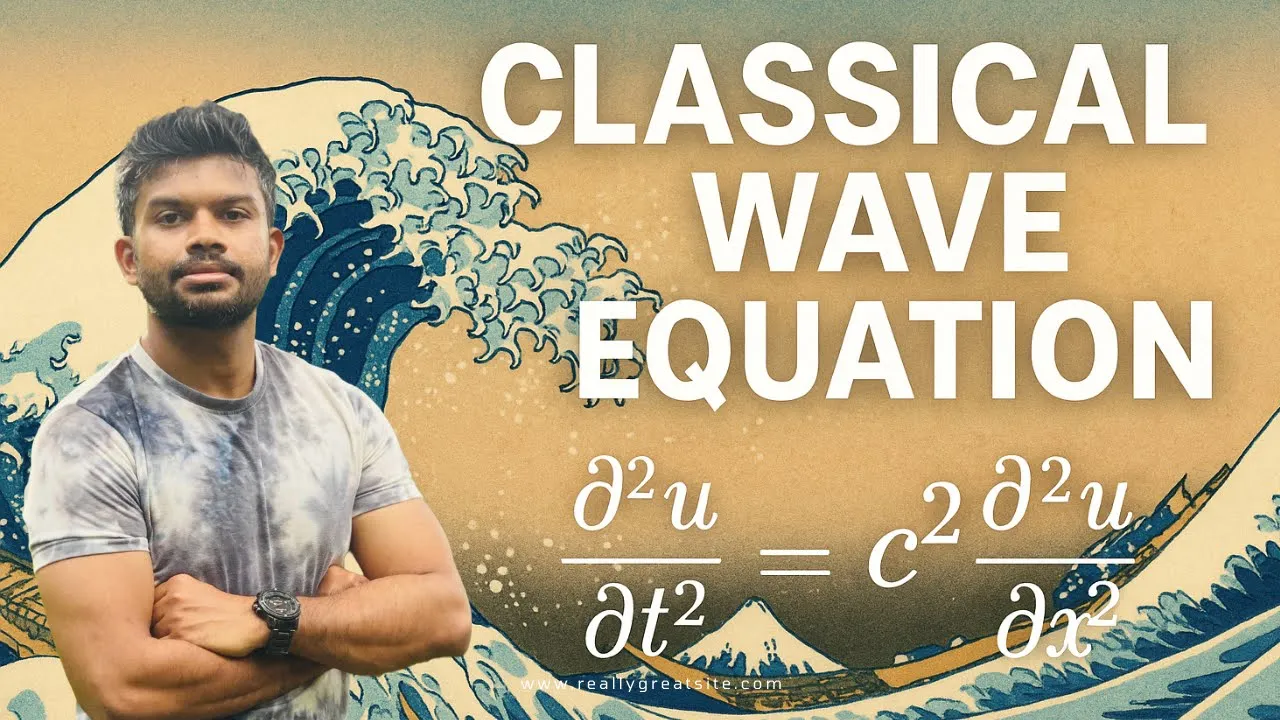
![[Quantum Chemistry] Ch2. The Classical Wave Equation (1)](https://i.ytimg.com/vi/oewTxFyYFAk/hqdefault.jpg)


















![[Nanophotonics] 2. Electromagnetic waves - part 2](https://i.ytimg.com/vi_webp/6YK8PozhaKo/maxresdefault.webp)




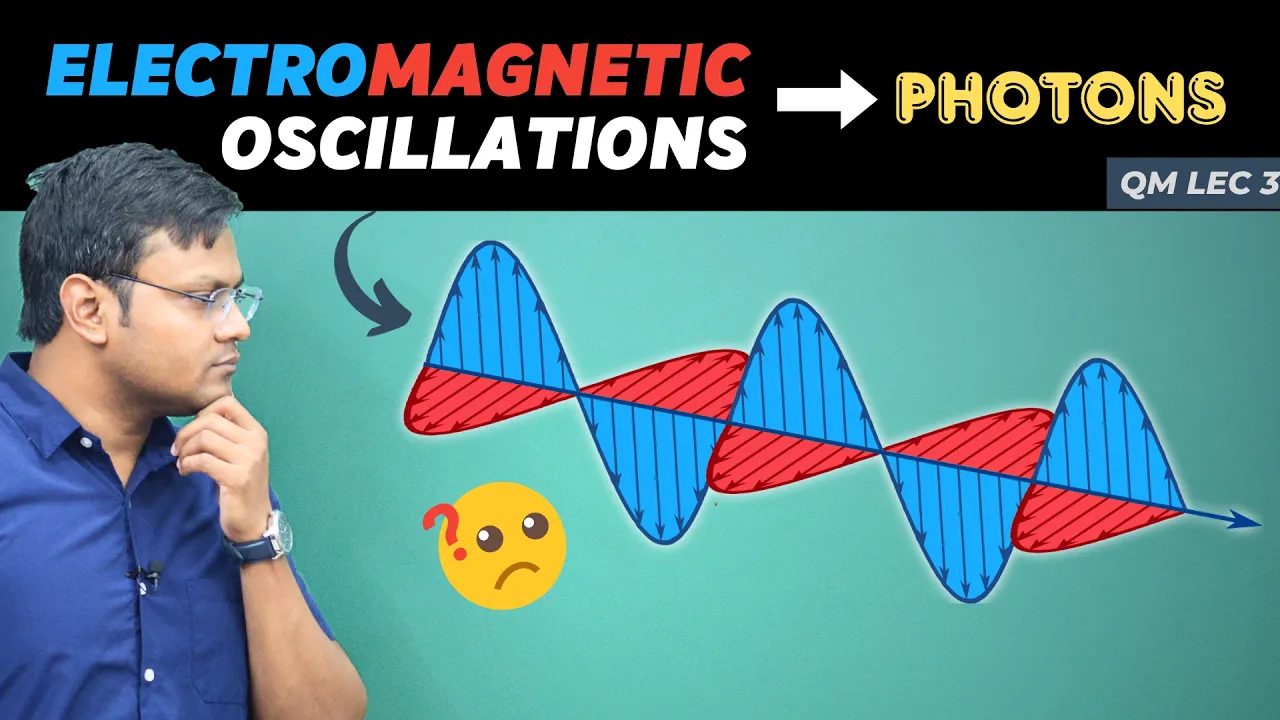
Electromagnetic waves in free space satisfy the wave equation ∇²E = (1/c²)(∂²E/∂t²) and ∇²B = (1/c²)(∂²B/∂t²), where c = 1/√(μ₀ε₀) is the speed of light; additionally, the electric field (E) and magnetic field (B) are always perpendicular to each other and to the direction of wave propagation (k-vector).
Deriving the Electromagnetic Wave Equation in Vacuum
Added:Maxwell's Equations in Differential Form: Familiarity with the four fundamental equations of electromagnetism, particularly their simplified forms in a vacuum where charge density and current density are zero.
Vector Calculus and Field Operators: Understanding curl, divergence, gradient, and key vector identities, especially the 'curl of a curl' identity.
Classical Wave Mechanics: Basic knowledge of the classical, mathematical wave equation and how to identify wave velocity from its coefficients.
Physical Constants of Free Space: Conceptual understanding of the vacuum permittivity (epsilon-0) and vacuum permeability (mu-0).
Energy and Momentum of EM Waves: Deriving and applying the Poynting vector, electromagnetic energy density, and radiation pressure.
Electromagnetic Waves in Matter: Studying wave propagation in linear, isotropic dielectrics and conducting media, introducing absorption, dispersion, and skin depth.
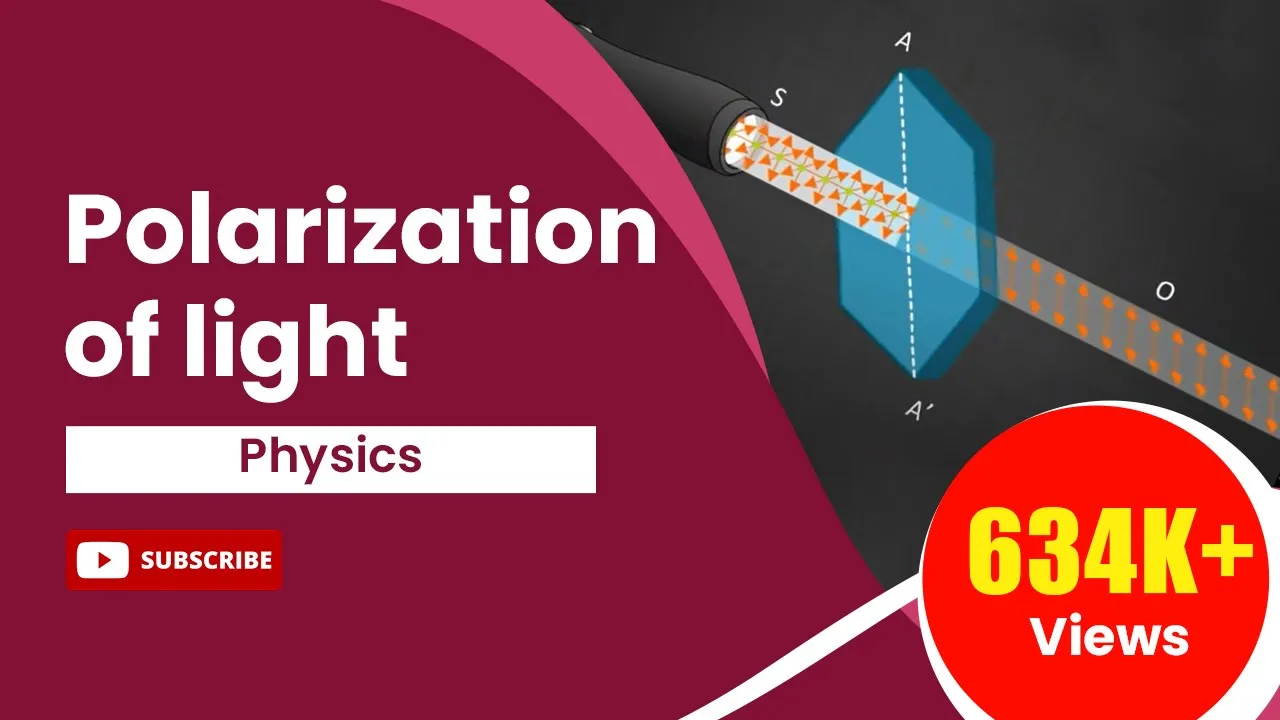
Polarization of Light: Investigating the transverse nature of EM waves to understand linear, circular, and elliptical polarization.
Boundary Conditions and Fresnel Equations: Analyzing what happens to electromagnetic waves at the interface between two different media.
Relativistic Electrodynamics: Exploring how the invariance of the speed of light in vacuum underpins Einstein's Special Theory of Relativity.
128.4K views4.1Klikes8:34Original Release: 2022-02-05
This is a simulation of a two-dimensional electromagnetic wave.
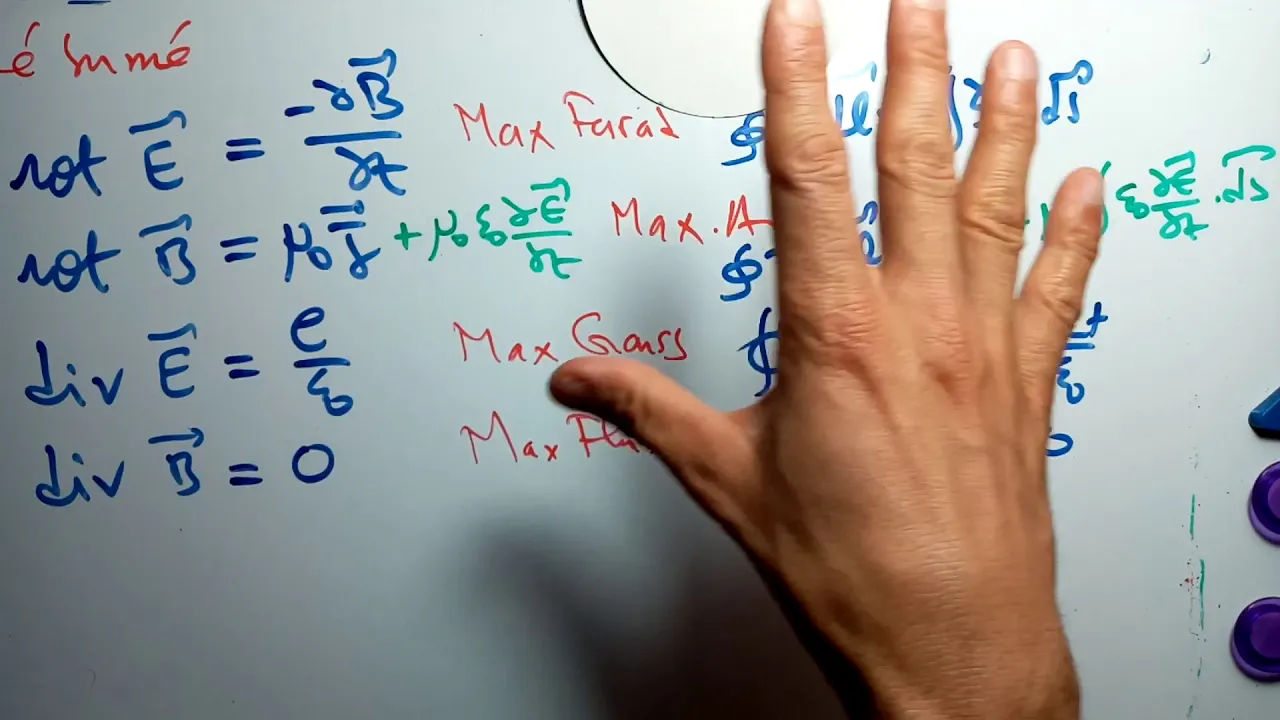
Such waves are predicted by Maxwell's four equations, which we learned in the video about Maxwell's equations.
If we set charge density and the current density equal to zero, we get Maxwell equations whose solutions are valid only if there are no charges and currents in space.
We get Maxwell equations in vacuum.
These tell us the existence of electromagnetic waves in vacuum.
How do we get the wave equations for the E- and B-field?
The Maxwell equations are coupled differential equations, that means: The unknowns "E" and "B" are together in one equation, namely in the third and fourth Maxwell equation.
Let us take Maxwell's equation for the curl of the E-field and decouple it.
To do this, we apply the cross product with the Nabla operator on both sides of the equation.
The time derivative together with the minus sign may be placed in front of the Nabla operator, because the Nabla operator does not depend on time.
Now you can insert the fourth Maxwell equation, the curl of the B-field.
You may place the time derivative in front of the two constants and combine it with the other time derivative to the second derivative.
We are finished with one side of the equation.
For the other side, we use an equation from mathematics that equates curl of the curl of a vector field F with the gradient of the divergence of F MINUS the divergence of the gradient of F.
This is just a relationship that can be derived.
In our case, F is the electric field E. So let's substitute the double cross product with this relation.
The first Maxwell equation tells us what the divergence of the electric field is - it is zero.
So we can omit this term.
If we remove the minus sign on both sides, we get the wave equation for the electric field E in vacuum.
The derivation of the wave equation for the B-field is analogous.
You get exactly the same wave equation, only that instead of the letter E, you get the letter B in the wave equation.
How do we know that we now have a wave equation?
Well, by comparing our result with the general form of a wave equation.
Here, "v_p" is the phase velocity of the wave.
It indicates how fast a wave crest of the wave propagates from A to B.
If you compare the two wave equations, you see that "Mu_0 times Epsilon_0" must be equal to "1 divided by v_p squared".
Rearrange for the phase velocity.
Both "Mu_0" and "Epsilon_0" are physical constants whose values we know.
If you insert values for the physical constants, then you get a certain value for the phase velocity of the electric wave E.
This value should be familiar to you.
As you can see, the solution of the wave equations for E-field and B-field, propagate with the speed of light "c".
We can express our derived wave equation with the speed of light "c".
Let's briefly look at the structure of the wave equation.
On the left side of the wave equation is the spatial change of the wave and on the right side is the temporal change.
This wave equation is a vector field equation for the E-field and represents a very compact notation for three scalar wave equations.
"Nabla^2 E" is in the three-dimensional case a vector with three components.
If you write out this vector, you get for the first component: the sum of the second derivatives of "E_x" with respect to x, y and z.
For the second component you get the sum of the second derivatives of "E_y" and for the third component the sum of the second derivatives of "E_z".
The right hand side is a vector containing the time derivatives of the E-field components.
These are three non-coupled partial differential equations of second order.
Their solution gives the E-field of the wave at any time and at any location.
If you solve the first differential equation, then you find out how the first E-field component changes in time and space.
With all three components of the E-field and the three components of the B-field, you know the entire temporal and spatial behavior of the wave.
Solution of the wave equation is a wave, but not necessarily an electromagnetic wave!
The solution of the wave equation must also fulfill all Maxwell’s equations in vacuum.
To see what condition is required by the first Maxwell equation, let us consider as an example a specific solution of the wave equation, namely a three-dimensional plane wave described by this sine function.
"E_0" is a vector pointing in the direction of "E" and has three amplitudes in x-, y- and z-direction as components.
"k" is the wave vector and defines the direction of propagation of the wave.
"Omega" is the angular frequency.
You can also write out the scalar product of k with the position vector "r" like this.
The divergence of the E-field is the sum of the derivatives of the individual field components with respect to x, y and z.
And this sum is supposed to be zero according to Maxwell's equation.
Let's calculate the derivatives.
The derivative of sine with respect to "x" is cosine and the wave number "k_x" is added as a factor in front of it.
Then we differentiate the sine with respect to "y".
And then with respect to "z".
We can factor out the cosine.
The sum in the parenthesis corresponds exactly to the scalar product between the wave vector “k” and the E-field vector with the amplitudes.
For the first Maxwell equation to be zero for all times "t" and locations x, y, z, the scalar product must be zero because cosine function is not always zero, of course.
For the scalar product to be zero, the wave vector and the E-field vector must be orthogonal to each other at all times and locations.
Thus, Maxwell's first equation in vacuum requires that the E-field oscillates only perpendicular to the direction of propagation.
If you take a plane wave for the B-field and proceed analogously with the second Maxwell equation, divergence of B is equal to zero, then you will find out that also the B-field is always orthogonal to the direction of propagation.
Let's see what other conditions the solution of the wave equation for B and E field must satisfy to be an electromagnetic wave.
Let us take the fourth Maxwell equation for the curl of the B-field.
We know from mathematics that the resulting vector of the cross product is always orthogonal to the vectors between which the cross product is formed.
So, in this case, the B-field vector is orthogonal to the vector that is the derivative of the E-field.
In the case of a plane wave, the E-field vector and its time derivative point in the same direction.
Thus, the B-field is not only orthogonal to the derivative of the E-field, but also to the E-field vector itself.
The same condition is also required by the third Maxwell equation.
Thus, the E-field of an electromagnetic wave in vacuum must always be orthogonal to its B-field.
So we can summarize: An electromagnetic wave propagating in vacuum with speed of light has a B-field and E-field.
The two field vectors are always orthogonal to each other AND to the direction of propagation of the wave.
Up Next
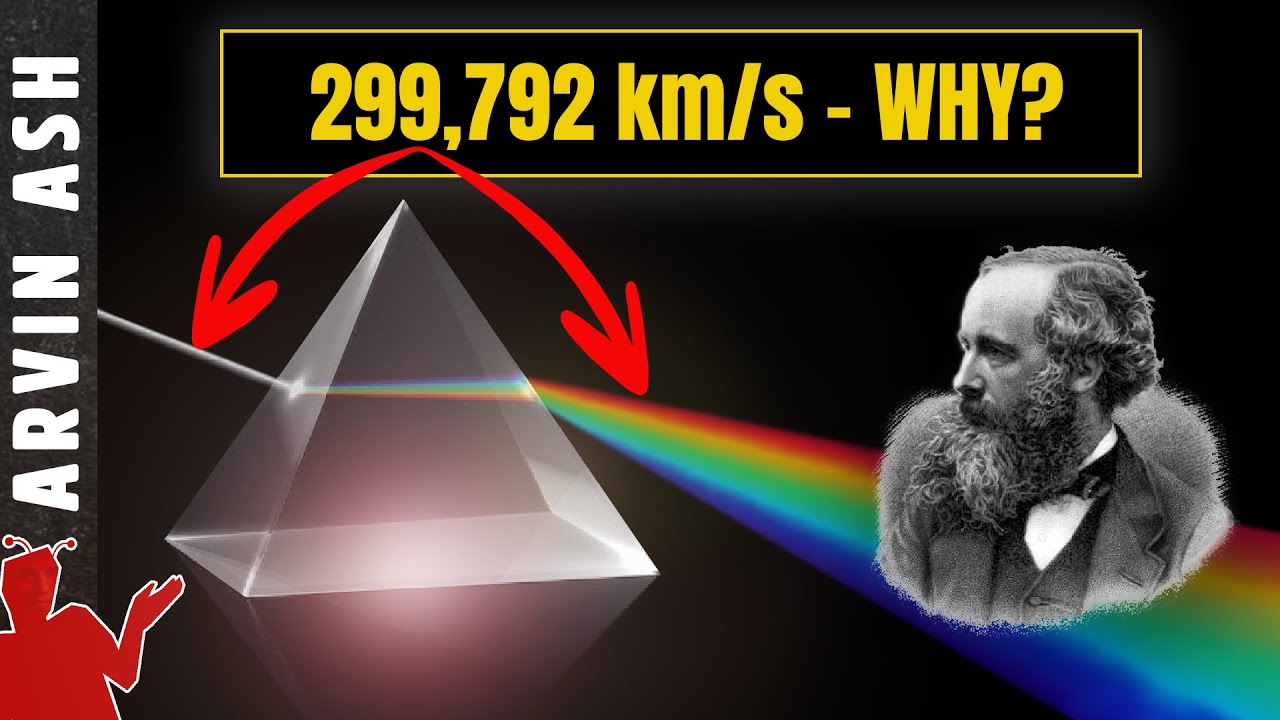
13:19
Why Is the Speed of Light Constant? Maxwell's Equations Explained
@ArvinAsh
2M views•2020-03-25

12:53
21cm Hyperfine Transition in Neutral Hydrogen: Radio Astronomy Basics
@AaronRobertParsons
12.4K views•2011-10-13

32:32
NMR Spin Physics I: Zeeman Effect, Resonance Condition & Larmor Frequency
@nptel-indianinstituteofsci8064
2.3K views•2024-01-17

27:14
Entropy and the Second Law of Thermodynamics Explained
@veritasium
27.5M views•2023-07-01
Related Study Plans & Knowledge Roadmaps
Structured learning paths in Physics
physics
Nuclear Physics (Decay, Fission & Reactors)
01Atomic Structure and the Binding Force
02Radioactive Decay and Half-Life
03Nuclear Fission Mechanics and Chain Reactions
+ 2 more learning modules
12h5 modules
Explore Roadmap
physics
Soft Matter (Polymers, Colloids & Rheology)
01Foundations of Soft Matter & Thermal Forces
02Polymer Physics and Macromolecules
03Colloids, Surfactants, and Self-Assembly
+ 2 more learning modules
38h5 modules
Explore Roadmap
physics
Analytical Mechanics: Lagrangian & Hamiltonian
01Mathematical Foundations: Calculus of Variations
02From Newtonian Mechanics to Constraint Dynamics
03The Principle of Least Action & Lagrangian Mechanics
+ 3 more learning modules
28h6 modules
Explore Roadmap
physics
General Relativity (Spacetime & Cosmology)
01Foundations of Relativity: Special Relativity
02The Geometry of Spacetime: Equivalence Principle & Curvature
03Einstein's Field Equations: The Mathematics of Gravity
+ 2 more learning modules
55h5 modules
Explore Roadmap