

























This lecture covers fundamental thermodynamic concepts including internal energy (U), enthalpy (H = U + PV), and heat capacity (C). Internal energy is an extensive state function representing molecular motions and intermolecular interactions, with its absolute value unmeasurable but changes determinable. For ideal gases, internal energy depends only on temperature. Enthalpy change equals heat at constant pressure (ΔH = Q_p), while internal energy change equals heat at constant volume (ΔU = Q_v). Heat capacity relates heat exchange to temperature change (Q = CΔT), with C_p > C_v for gases due to expansion work, but C_p ≈ C_v for solids and liquids. The first law of thermodynamics states ΔU = Q + W, where Q and W are positive when energy enters the system.
Thermodynamics of Enthalpy, Heat Capacity & Ideal Gases
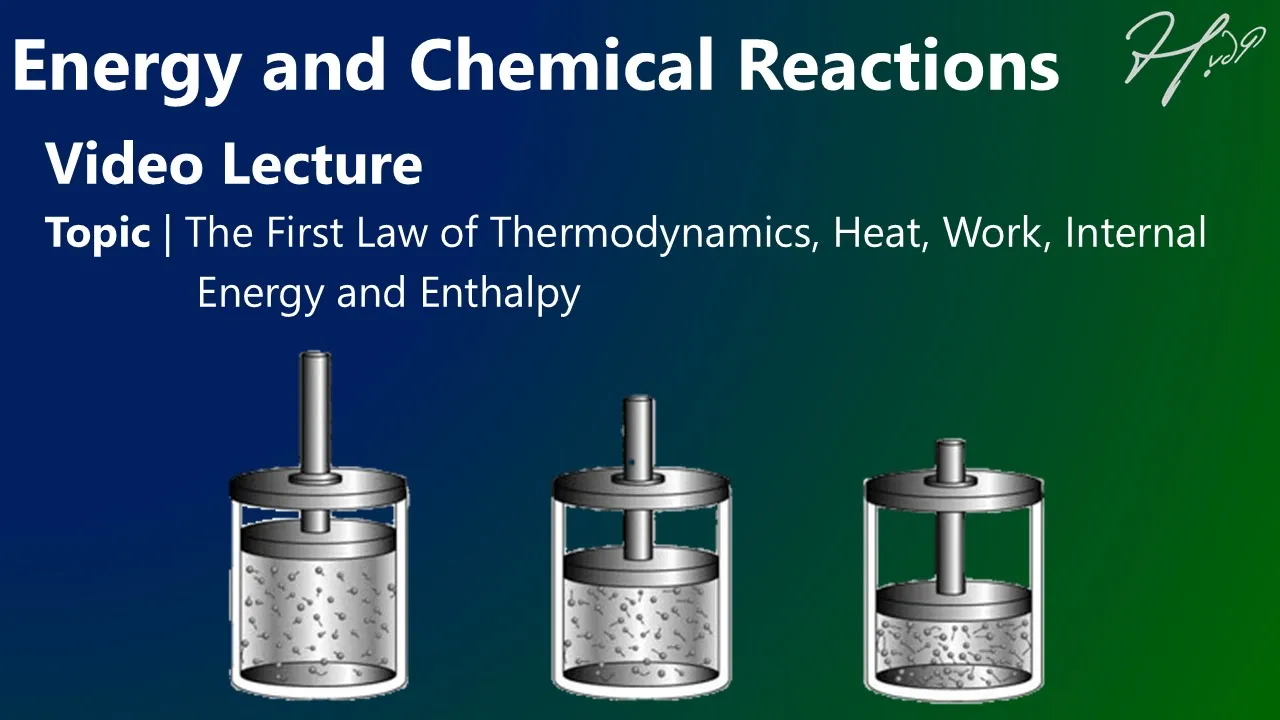
Added:[Music] [Music] [Music] welcome back to our discussion on this unit on thermodynamics and uh in this uh today's lecture third lecture which is in this unit we will uh talk about enthalpy and heat capacity and then determination of internal in internal energy change and enthalpy change for different processes but before that I just wanted to revise some part which I covered in second lecture which are shown here in blue color we know the total energy of a body e can be represented as k + v+ U where K is the macroscopic kinetic energy and V is the macroscopic potential energies of the body K happens due to the motion of body through space and V potential energy because of presence of field that acts on the body and U is we discussed in last class that U is the internal energy of the body due to mole motions and intermolecular interactions so change in total energy could be represented as change of each of these energies and if we talk about uh absence of any varying external field acting on system which means Delta V is zero and system is at rest Delta k z which is the case we talk about in chemistry chemical reactions and different chemical processes this is the scenario then total energy change would be represented at by change in internal energy and if the system does not interact with surroundings at all there's no exchange of energy between system and surroundings then which is the case for an isolated system then the first law says which is basically the conservation of energy which says that energy cannot be created or energy cannot be destroyed so Delta e is constant so for isolated system when the system does not interact with surroundings or does not exchange any energy between system and surroundings Delta e the internal energy should be constant so Delta U should be is zero okay so this is the mathematical description of first law of thermodynamics that for an isolated system change in internal energy is zero now what is internal energy we discussed in last lecture as well internal energy is the energy of within the body which is due to the molecular motions and intermolecular reactions interm moleculars interactions between the molecules present in a system so and also you know that internal energy we described in last class it's a extensive quantity so if you increase the more amount of if you add more amount of substance in a system obviously internal energy will increase so for a closed system where we talking about there's no change in amount or no change in composition in the system intern energy can be given by the following term this translational motion of the molecules energy due to translational motion of the molecules rotational energy vibrational energy electronic energy and intermolecular the energy due to intermolecular interactions between molecules and Ur rest we described this is the rest M energy of the electrons and nuclei which given by m rest c² C is the velocity of right which is a constant term and as we cannot get this experimentally measured so this absolute as we discussed in the last lecture as well the absolute value of U cannot be measured we can only measure the change in internal energy experimentally these terms are either some of these terms could be constant for some cases but most cases either they are and most cases they are function of temperature these terms depend on temperature only and the second term intermolecular the the energy due to intermolecular interactions will depend on the distance between the molecules which will depends upon temperature and volume or you can say temperature and pressure as well so the first term is dependent these first four terms dependent on temperature second terms dependent on temperature and pressure or temperature volume and this is a constant term so we can write for a close system entropy can sorry internal energy can be represented as a function of volume or temperature or function of pressure and temperature now if we consider ideal gas or a perfect gas then you know that there is no intermolecular interactions between mole ules in case of an ideal gas of a or a perfect gas then this term will not be it will be zero so the internal energy of an ideal gas would be only dependent on temperature for a closed system of course so for an ideal gas closed system internal energy will depend only on temperature so if we fix temperature and we change the volume or we change the pressure the internal energy of the ideal gas will will not change please uh keep it this in his mind that internal energy of an ideal gas in a closed system only depend on temperature so U is a external extensive quantity extensive property and obviously because it's a state function if you come back to the original state then change will be zero so the cyclic for a cyclic process change in internal energy is zero and change in internal energy between two states initial State and fin final state is not dependent on path is basically dependent only on the theramic state of the initial State and the final state so how can you change the value of internal energy of a closed system obviously by exchanging energy with surroundings now what are the different ways we can exchange energy with surroundings we talked about there are basically two ways one by work exchange or by heat exchange now work could be of different types but in our uh or this unit will be restricting ourself only to the pressure volume work or which also called expansion work or mechanical work so basically we now know that intern energy can be altered in a closed system intern energy con can be altered by work or by heat exchange between system and surroundings so if you in a closed system if you want to write the first law of thermodynamics in a general form then we'll write the change in internal energy in a close system is given by Q Plus W where what is q q is the increase in the energy of the system remember we're talking about increase in the energy of the system due to Thermal exchange through dimal wall and W is the increase in the energy of the system due to Mechanical exchange or expansion work through non- rigid wall obviously if rigid wall there will be no movement of the walls no volume change and then W would be zero so in both case Q and W we are talking about increase in energy okay so the S and W and Q are positive if system gains some energy or the increase there's a increase in energy of the system and they are negative if system loses some energy or there is a decrease in energy of the system please remember that W and Q are positive if the system gains some energy and negative if they loses some energy so in the surrounding does some work in the system which happens in compression case it is W is greater than zero because system gains some energy and if system does some work on surroundings then it's which happens in case of expansion then system loses some energy W should be negative similarly when a system receiv receives some energy from heat from as a heat from surroundings then Q is positive and system loses some energy to the surroundings then Q is zero Q is greater than less than zero is negative so we look for the some questions which are there in your uh textbook Express Express the change in internal energy of the system when no heat is absorbed by the system from surroundings but work W is done on the system and what type of wall does the system have now in this case no heat heat is absorbed so Q is zero W is this is the magnitude W is the magnitude of work is done on the system that means system gains this W amount of energy so then Dela u in this case would be Q + W from first law and in this case W is positive because work is done on the system and what type of s wall this is this is a no heat is absorbed so it's a adiabetic wall and because there's a work done so it will be a non rigid all so I'm assuming that this a closed system there is it's also uh a nonp permeable not permeable wall the second question no work is done on the system so obviously W is zero but Q is the amount of his taken out note this term taken out from the system and given to the surroundings so in this case system is losing some energy and magnitude is Q here so from first law in first law in the main equation we had Q was increase so in this case because it is decreasing we will write w minus Q which is minus Q in this case no work is done on the system so in this case Q is Q is the magnitude and because heat is taken out of system system will lose some energy so instead of increase it will decrease so it will be a minus Q value and the type of wall would be obviously non adiabetic because heat is getting exchanged or dimal and it's a rigid wall because no AR is done in the third question W is the amount of work done by by the system work done by the system which means system is losing some energy so it will be minus W and Q is the amount of heat supplied to the system that means system is gaining energy so in this case W would be Q minus W where W is the amount of work done by the system when system is doing the work that means he losing some energy and Q is the amount of heat supplied to the system so it will be a positive number and obviously this is a close system because work is getting done and volume is getting changed so generally we talk about volume in case of Clos system especially in the gasier system we move to the second question you just see for each process state whether q w and D is positive Z or negative so this process is given you have to tell whether what is the sign of qw and W so that will clarify this one more time so combustion in a sealed container with a rigid and adiabetic wall now when talking about rigid wall that means w is zero adiabetic wall Q is zero obviously du is zero in this case combustion of benzene in a sealed container that is immersed in a water bath at 25° Cen has a rigid thermally conducting wall it say it has a thermally conducting wall so which allows energy exchange as a heat and because combustion of Ben is a exothermic reaction heat gets generates which goes out of the system to the surroundings which is the water bath so in this case system is losing some energy as a heat so Q would be negative rigid so w would be zero so daily would be Q + W so would be negative as well C adiabetic expansion of a non ideal gas into vacuum adiabetic Q is zero it's expansion into vacuum expansion into vacuum we know W is zero and D is zero so if I had expansion of the nonideal gas other than vacuum some against some constant external pressure then because of expansion W would have been negative and Del would have been negative so I hope by this time you you very clear about the sign of w q and du in any processes so next we'll move to work and in last and and as I said the beginning of this lecture that work could be of uh two types one is basically the work commonly what we are describing the expansion work the mechanical work or the PV work and any other work like electrical work or magnetic work we call together as a non-expansion or additional work but in this unit we'll be only talking about PV work and mechanic or or mechanical work or work of expansion so if nothing is mentioned about the work you have to assume that it's a PB work it's a PB work on uh or we can just if no nothing is me as I said nothing is mentioned you would think that is a PB work and we talked about the how to calculate those in in last lecture that for a reversible process it's given by this expression and because P external is infinite estimately close to uh the pressure of the system and for irreversible process we write uh we have we have the expression where W is the P external sorry p is PX is the external pressure final volume initial volume that we discussed in last lecture expansion against constant pressure you can so it's minus P Delta V V2 minus V1 or V final minus V initial free expansion expansion against constant opposing pressure is p external is zero so w is zero and for reversible isothermal process for ideal gas we have seen that uh this is the expression for work now I quickly ask a question and uh let's see whether you can uh solve this so that will my question three in this uh lecture so I'll take ideal gas and close system and we consider a reversible process so what you have to do you have to calculate uh the change in or calculate the work involved in this process and you have to schematically draw uh the area which will corresponds to the work so this is the initial State some temperature T it's a isothermal condition to 1 Pascal 10 m CU is the volume and that temperature T so in this case that's my first part so if I want to get W you know ideal gas reversible process isothermal condition so I can write in our T Ln V final which is 10 m Cub by 1 M cub and which will nrt is equivalent to PV for ideal gas so 10 which will give us minus 10 into 1 I just write 10 here M Cub into 2.303 or - 23303 jewles and if I want to draw schematically in this uh graph if this x-axis is volume and y- AIS is pressure then if this is your 10 Pascal and this is say One Pascal and this is your 1 M Cube and this is your 10 m Cube then you have this area corresponds to your work now in the second part of the this this question we'll write we'll do the same thing instead of a reverse isothermal way we'll do it in two parts like I'll take 10 Pascal 1 M Cub T and then first do a isocoric constant volume process take it to some other temp temperature and then do a isobaric constant pressure process and take to get the F this this initial State and final state is same as in the last example here this initial state is and final state is same in this case but in earlier I dided a reversible isothermal way in this case we are doing in two step isocoric and isobaric then what will be the work done in this case total work would be the work done in these two step and first step is a constant volume process so it will be zero and in second case it will be minus P V2 minus V1 which is zero minus I can remove 0 1 Pascal 10 - 1 M Cub gives 9 Z you can see this is a expansion process volume is going from one to 10 m cubes and because expansion process system is losing some energy so in all the cases you are getting a negative value for your work now if I draw this in in p v scale so this is your higher pressure to same volume isocoric condition you're getting to lower pressure and then you are increasing to the volume so this area would be your work so in third case I can do the other way around 10 PA 1 M Cube now I do the I just reverse the step earlier in in last example I did it isocoric isobaric now in this case I'm doing isobaric and is so followed by isocoric so in this case again W would be W1 + W2 and this case Min - 10 PA 10 - 1 M Cub plus this is isocoric process so that would be zero which gives 90 jeel and if I want to draw this pressure volume curve so you start from here isobaric process so do is go to a intermediate State and then bring the pressure down so the this is your first process second process this is one two so this would be your this area would be your work done in this case so basically if you compare the three the three ones we just discussed so basically you are doing uh we're doing the same change from initial State one to state two but we are getting different value of work done which shows that work done between two states is a path function it does not only depend on the two states but it depends how you are carrying out the changes just for your uh as a home part of homework you can do this solve this problem where you do the same change irreversible way in one step and then two step and then in infinite number step which is basically a reversible process and you also calculate the work done in forward Direction and work done in backward Direction and you'll see that again the the value of work will be different as you change the process so that you can do uh in your uh yourself at home so next we'll talk about enthalpy and we started talking about enthalpy in uh last class we defined uh mathematically inp as u+ PV these are all a state variable U PV so H is also a state variable or state function or State Property whatever you call U is extensive quantity it depends on the size of the system or mass of the system so a h would be also extensive quantity and again as the value of U cannot be DET absolute value of U cannot be experimentally determined so absolute value of H also absolute value of H also cannot be cannot be determined experimentally and again because it's a state variable so Delta H the value of delta H between State one and state two or initial state to final state will only depend on the value of delta H will only depends on the initial and final States now we know that uh from first law we uh from first law of thermodynamics we know first law that du is given by Q + W for close system of course we now if you talk a process which is at a process uh which is happening at constant volume so just like P1 T1 V to say P2 T2 and V so we doing a change at constant volume and if as you're doing it constant volume obviously W would be zero then du would be the change which is happening at constant the heat change which is happening at constant volume now if the process is for a process at constant pressure we can write generally like T1 V1 P2 T2 V2 and P in this case we have seen in last class that QP the CH heat exchange can be written as QP is equal to DH so QV is the process is as constant volume then Q is equals to Du and if the process is constant pressure then it is the Q is equals to the Del H enthalpy change now if we consider a constant pressure process again and then DH we know from definition d u plus constant pressure so we can write P DV and for we know that for liquid uh for liquid or say solid now this change in volume is uh negligibly small or very small delv is very small for a process so in this case we can consider that delv is uh negligibly small so we can consider DV is Zer so DH is equals to D for solid and liquid okay these are very close not exactly same but because the volume is uh very small so this we can consider these are almost close to this but for gas for gases the the reactions or the process involved gases so the reactions or processes which involve processes involving gaseous substances or gases we had uh shown that uh in last lecture the DU is DN G RT now we in that deriving this we considered that the gases are ideal okay this we had uh considered so we'll just move to next problem and then just we'll uh to will be question five so we consider a process a process where we talking about okay this problem is uh given here so the molar enthalpy change of theorization of water at 1 bar and 100° Cen is 41 KJ per mole calculate the internal energy when uh this two one and two and assume the water vapor is a perfect gas this is from your textbook so if you note down so this is basically a vaporization process and one mole of it is given one mole of water is vaporized at one bar at 100° Cen so H2 liquid to H2O gas at 1 bar 100° CRA and we talking one mole here one mole and in this case it is given DH for this vaporization process we can write Del vaporization H is 41 KJ per mole now again this is a positive number because for vaporization we have to add some or Supply some heat to the system so the system actually gains some energy that's the reason it is a positive number so we can get the other value d uh from the expression we learned just now plus d n g RT or d u is DH minus d n g RT we're talking about one mole of substance one mole of water so this value 41 KJ per mole that is molar into 1 mole of substance minus again 1 mole Delta n g is change of 1 mole ignoring the volume of liquid so basically one mole of gas is produced into r value is 8.31 4 JW per mole per Kelvin into 373 100° Cen we considering 373 K in in solving uh physical chemistry problem you must be very careful about uh the units and if you put units appropriately you will get your final answer exactly the way you want because it's a Dau which basically you are talking about energy change so it should give you energy number so in this case it is giving you a energy so for and because you are doing it for one mole you can write it that Delta U for vaporization is 37.9 K per mole but this is your answer 37.9 K is the change in uh uh value of change in internal energy for vaporizing one mole of liquid to one mole of gas so in the second problem uh you have one mole of water is converted to ice so we can write uh in so that's uh second one so H2O solid again this is one mole this is one mole and generally it is done at uh generally this uh we're considering this Con this is done this transition is done at constant pressure so constant pressure condition is what we assuming so DH can be considered as D+ P DV and as we consider as we talked earlier that because of solid and liquid the volume change is we are considering is negligibly small so in this case we'll have du is close to Du which is 41 KJ for one mole of gas so you can write Del is equal to 41 K per mole as well but your answer is 41 K so we talked about enthalpy we talked about work we talked about internal energy and we now we'll talk about how to calculate the heat part the Q in your first law now heat uh exchange happen exchange of heat energy happens because of or heat exchange happens between system and surroundings because of temperature difference between system and surroundings because of temperature difference that we all know we understand that if there is a temperature difference between system and surroundings if they brought in contact through a non adiabetic wall heat exchange will happen and heat will move from higher temperature to lower temp temperature and we all we know that this heat is proportional to the temperature difference of system and surroundings and if we consider small change then we can write DQ which is the small value and which is uh we can write small this is DQ is for small value of Q and DT is the small value of very small value of temperature difference so for so what is the proportionality constant we have this proportionality constant as C Capital C so for the entire process we can get Q summation of integration of T1 T2 DT if C is constant if C is constant in temperature range between T1 and T2 then we can take this out of integral then it will be C delt which is giving giving us the same value C delt okay so that is only you can write in case C is not dependent on the temperature which will for in this unit or in your case we'll consider this C is independent of the temperature range we are talking about so we now know that Q is C Del T this C is called heat capacity of the substance we are talking about this is remember this is where this is capital letter or upper case whatever you call that is for the entire substance obviously if you have more substance this value will go up so this is a extensive quantity now we can also write Q as if we divide by number of moles and write C is n CM where cm is C byn molar heat capacity then n is the number of moles then in this case molar heat capacity would be a intensive quantity we can also Express in terms of mass and small C where C is capital c/ by M and M is mass and this case C is remember we are talking about C is small letter or lower case and we are calling this as specific heat capacity now what is how you can what is the difference now the heat exchange can happen uh can happen uh or can be carried out in two ways one at constant pressure other could be constant volume now if as we said have you seen earlier if the process is if a process is uh at constant V like the example we had earlier P1 T1 V2 P2 T2 V then we know du is QV as W is zero so du would be given by CV delt similarly if the process is process of our interest is at constant pressure as you have seen earlier then DH is QP so DH would be given by CP DT but if you have a general case we have say a process we have a general process all three are changing say I have P1 V1 T1 to P2 V2 T2 then how do you get uh this DH and du now because DH and du both are are State variable they don't depend on the path so we can break down the process in two step for example if I want to get du I'll let me break this to this process into two step T1 to V1 T2 and some other temperature P3 and then so this is at constant V and we do it next is constant T T2 V2 and P2 so we are reaching from State one if the the call State one to state two we are going State one to state two but in two steps now so what will be du then du would be du in the first step plus d in the second step now if you consider a simple case of an ideal gas now what do we know the ideal gas U is only function of temperature so if temperature is fixed then Del would be zero which means for the Second Step where temperature is constant Del would be zero so Del second process would be zero as temperature is fixed remember we talking about I gas please don't generalize this this is only applicable for ideal gas and daily one is a constant volume process as we discussed earlier it will be given by CV DT so Del will be given by Del one first process and second process so CV delt plus 0 CV DT so we can write D is CV DT that is only for ideal gases ideal gas do not this expression is only valid for ideal gas please do not confuse this a general expression and CV is we're talking about heat capacity at constant volume okay similarly we can think of General process and we can break down to a constant pressure and constant temperature process and we can get again DH is CP DT for ideal gas if we can write one more time Delta U is CV delt these are for ideal gas this is not for General example okay generally is applicable now how CP and CV are related how they are related means which is what is the relationship between them if we consider two process uh say we take a cylinder and and first we consider this is a piston first we consider that this is a fixed so the volume does not changes and we have Supply some heat which will because we supplying some heat it will increase the energy and temperature will go up so here whatever heat is supplied here this will increase the internal energy which will increase the temperature of this of of the system but if we do the process at constant pressure we write the same thing but in this case this is not fixed this is movable okay so this is movable or non rigid then if you have Supply heat volume will expand the gas the volume of the gas will expand and in result there will be volume expansion and if volume expansion happens you know that system is losing some energy or it is doing some work on the surroundings and so it is losing some energy by doing work so this is a constant pressure process this is a constant pressure we have applied and this is a constant volume process so now you can compare that in this case constant pressure process whatever energy you have supplied as a heat it is it is increasing it is used to utilized to increase the internal energy or temperature of the system plus some of which are getting lost as doing work on the surroundings but here whatever you are adding as a heat they're all U getting utilized to increase the temperature so you can now compare that because in this case if you want to increase same temperature delt in both cases you have to supply more heat here so Q has to be more in this case compared to constant volume case because part of the Q which is getting in is getting lost as the system is doing some expansion work on the surroundings so CP is greater than CV and this is true mainly for gaseous substances gases because in case of gas the volume change is significant and as we have talked earlier also that for solids and liquids for solids and liquid generally uh the volume change delv is negligibly small so CP is nearly same as CV so this is the case for solid and liquid but and but but if you true sense in true sense if you don't like neglect the small volume change then CP would be greater than CV with exception where with exception where volume reduces or decreases on heating if there are cases like water between 0° Cen to 4 4° Centigrade on increasing or on heating the volume decreases then you can get CV less than CP but most and almost every cases CP is greater than CV there cases also exception CV is equals to CV like the the when the volume goes through minimum so that's 4° Cen water at one atmospheric pressure so these are exception where where CP is equals to CV most cases or every cases uh with just few exception where CP is greater than uh CV but in practically for solids and liquid CP is almost close to uh CB but for gases for gaseous substances we always have CP greater than CV now for ideal gas we'll talk about ideal gas that's the simplest case we are always talking uh we can get DH is equal to D plus d PV D plus d n t now for ideal case we know DH is CP DT D is CV DT and in this case NR delt so we can write from this CP minus CV is NR for ideal case or CPM we talk about M heat capacity CVM would be given as R so these are expressions for your um I ideal ideal gas now what we'll do we'll go back and look at few questions to uh uh clarify uh uh just to see clear your ideas and uh we'll write uh say for each of the following processes the I'll just write a following process and you have to get me the s of q w uh D and DH so I'll write the process and you have to tell me uh the sign so one first would be reversible melting of benzene at one atmospheric pressure and normal melting point so you tell me what is the value of q w d and DH Now Melting process requires heat in the system so Q must be greater than zero this is a constant pressure process at one atmospheric pressure so Q is QP which is equals to DH so DH equals to Zer now in this case on melting volume increases so DV is positive even though it is uh very small but it increases expand so w would be minus P DV DV is positive so w would be negative in this case and du is Q + W now as I said this is a solid so w is negligibly small compared to Q so you can ignore Q in this case so at Q is positive du should be positive so that's the first uh question uh uh example in the second example we'll do the same thing but for ice reversible melting of ice at one atmosic pressure 0° Cen again you have to find sign of Q again for melting you have to supply heat so Q is greater than zero and is a constant pressure process so QP is Del H greater than zero now in this case on melting at 0° C What atmosphere actually volume drops so in this case W is minus P DV so w should be a positive number because the volume comes down volume decreases so du is a positive W is a positive quantity but very small as we talked about solid and liquid so because it's very small so we can consider D is equal to Q + W and this is small so the sign of w should be du should be same as Q so D should be greater than zero we'll talk about the third example reversible isothermal expansion of an ideal gas now isothermal reversible expansion when we talk about expansion DV is greater than zero so w is less than zero ideal gas isothermal so delt is zero and when delt is zero we know for ideal gas Del DH is 0 D is z du is 0 which is Q + W and W is less than Z so Q must have to be greater than zero so what we'll do we'll uh stop in this class uh now uh we'll I'll give you few more uh this type of problem in the next class and next class we'll talk about how to determine the uh values of DH and du experimentally and then we'll talk about uh uh DH for different processes for
Up Next
Second Law of Thermodynamics | MIT 5.60 Thermodynamics & Kinetics
@mitocw
113K views•2008-12-12

Biocatalysis and Catalysis in Islatravir Synthesis | Merck Webinar
@SCIwheresciencemeetsbusiness
675 views•2020-10-08
1H NMR: Determining Number of Peaks from Structure
@MSJChem
59.2K views•2017-04-06

Edible Water Bottles: A DIY Guide to Sodium Alginate Spherification
@ryan
10.5M views•2019-06-21
Related Study Plans & Knowledge Roadmaps
Structured learning paths in Chemistry