























Riparian buffers—vegetated areas surrounding rivers—play a crucial role in restoring degraded river ecosystems by providing shade to regulate water temperature, filtering pollutants and nutrients (removing up to 85% of nitrogen with wider buffers), creating wildlife habitats, and improving overall water quality; however, their effectiveness depends on factors like width, length, and plant species, and they cannot solve all pollution problems, requiring balanced approaches that consider human needs alongside ecological restoration.
How Riparian Buffer Plants Restore River Ecosystems
Added:Basic understanding of watershed dynamics and how surface runoff transports nutrients, sediment, and pollutants from land into freshwater systems.
The definition of a 'riparian zone' as the critical transitional interface between terrestrial land and a river or stream.
Fundamental plant biology concepts, specifically how root systems physically stabilize soil and absorb dissolved nutrients like nitrogen and phosphorus.
The concept of ecological food webs, particularly how terrestrial plant matter (like leaves and falling insects) supports aquatic trophic levels.
Advanced principles of phytoremediation, focusing on how specific plant species biologically degrade, extract, or immobilize complex chemical pollutants.
Multi-zone riparian buffer design, studying how to plan and plant distinct zones (grasses, shrubs, and deep-rooted trees) for maximum agricultural runoff mitigation.
Stream health bioassessment techniques, such as surveying benthic macroinvertebrate populations to evaluate the success of a riparian restoration project.
Environmental policy and land-use management strategies, including government incentive programs that encourage landowners to implement conservation buffers.
214.5K views11.9Klikes5:48Original Release: 2022-09-25
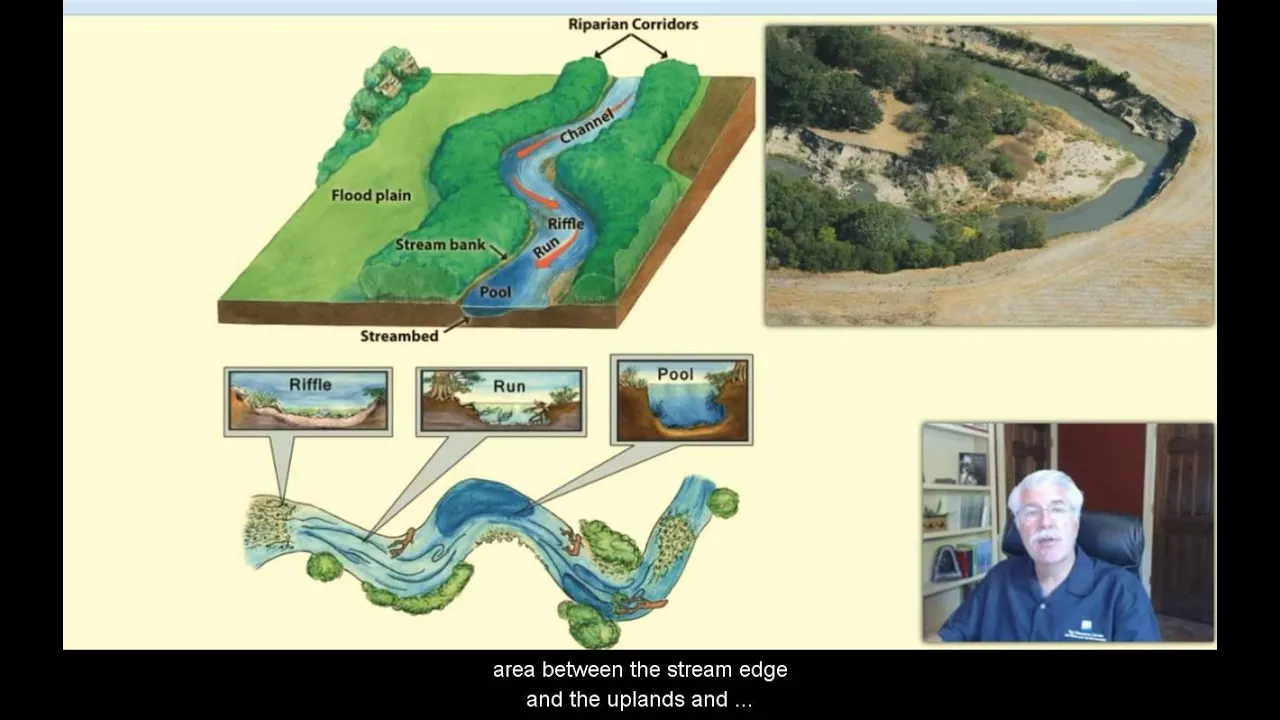
foreign if you are familiar with the Los Angeles River you might be surprised that it is a natural River at all because today it looks a lot more like a massive concrete ditch in the 1930s the LA River was almost completely encased in concrete to prevent frequent damaging floods that flood control worked but it also devastated the river's natural ecosystem an estimated 90 to 95 percent of the river habitat has been lost now this is an extreme example but Rivers worldwide have been heavily modified to suit human needs like bringing water to agriculture or controlling floods these modifications have huge impacts on ecosystems destroying habitats and polluting waterways so we just as a species want to restore River ecosystems but there's no like undo button for the changes we've made and we have to balance critical human needs like growing food and not being flooded one powerful tool to help River restoration comes in the form of plants restoring native plants around the river helps the entire ecosystem regain its hold and depending on exactly how we do it these plants can also help the restored ecosystem continue to do what we humans need so let's take a look at how to strike that balance the technical term for an area of vegetation surrounding a river is a riparian buffer most of these are fairly small less than 20 meters on each side of a river and less than 10 kilometers along its length but as we will discuss bigger buffers do tend to have more benefits these plants are crucial to providing habitat for animals who live in and around the river first of all they provide shade which cools and moderates the temperature of the entire ecosystem big swings in temperature can decrease biodiversity and a warmer River holds less dissolved oxygen in its water just 30 meters of plants on each side of a river can keep the water temperature the same as if the river flowed through a massive forest in terms of habitat they can provide nesting sites for birds and act as Wildlife corridors for animals to safely travel through areas of human development larger pieces of wood that fall into the river provide habitats for fish and invertebrates and having a buffer also means cleaner water riparian buffers can essentially filter out pollution nutrients and sediments in particular this matters when your river flows through farmland or other places where a lot of fertilizer is used fertilizer runoff can cause eutrophication where the extra nutrients cause excess algae to grow this can deplete the oxygen in the water with consequences that Ripple through the entire ecosystem but having a buffer around the river means that plants and microbes can use up the excess nutrients before they reach the water the Improvement in water quality is pretty dramatic one analysis of multiple studies published in 2007 found that buffers in general remove 67 percent of nitrogen and wider buffers of at least 50 meters can remove 85 percent protecting rivers from too many nutrients helps keep this pollution out of lakes wetlands and the oceans they flow into but riparian buffers are complex systems and accounting for all the ins and outs is tricky even though they're great at absorbing nitrogen runoff from fertilizer and the process they also can emit nitrous oxide which is a greenhouse gas and they don't work for every type of pollution one study found that buffer is made from a particular Willow shrub didn't do much to block runoff of glyphosate that's a widely used herbicide solder to the name Roundup it's a good reminder that plants are not some magical solution that can stop anything we throw at a river we need to minimize pollution in the first place and we need to understand how restoring buffers will achieve our desired goals and of course not all buffers are the same factors like how long and wide they are how far Upstream they're located and what plants they include all change their effectiveness but if you make a bigger buffer you could take land away from other uses like farming so how do we balance human needs with the ecosystems we aim to restore sometimes it can be as simple as which plants we choose some profitable crops like the American hazelnut can be planted as part of a buffer this means they allow the land to be used for human purposes while improving the river's habitat the nitrous oxide problem indicates that we need more research on how buffers Emit and absorb greenhouse gases but according to a 2010 study buffers still take more carbon out of the atmosphere than they give off so restoring buffers helps us help the climate as well what is clear is that the benefits of riparian buffers outweigh the downsides restoring River ecosystems isn't easy but rebuilding the plants surrounding waterways is a great first step if done right it can lead to a huge number of changes that percolate through to many other aspects of the ecosystem the LA River still has a long way to go but a 2016 feasibility study proposed restoring the area around an 11 Mile section the goal is to complete the majority of the work by 2028. other restored rivers are already doing better like the Green River in the Puget Sound region of Washington state where the removal of a levy has helped restore the forested floodplain and provide habitat for wild salmon we've made mistakes in trying to force rivers to serve humans at the expense of our environment but adding plants back to River ecosystems can help us start to correct these mistakes while still meeting our own needs this video was made in collaboration with BBC Earth their initiative our green planet has three main goals to raise awareness of how awesome our planet's green ecosystems are to connect people with a plant's critical role in biodiversity and to spread these stories of positive change makers around the world thanks again to BBC Earth for collaborating with us on this video head over to bbcearth.com our Green Planet to find out more and thanks for watching [Music] foreign [Music]
Up Next
26:11
Constructed Wetland Design: Types, Function, and Treatment Processes
@stephanielansing5768
18.2K views•2021-02-20

15:54
Life in Biosphere 2: Sustainable Ecosystems & Human Survival
@TED
334.9K views•2009-06-16

10:04
How Light Pollution Disrupts Ecosystems and Human Health
@SciShow
1M views•2014-05-22
10:28
Ice Stupa Artificial Glaciers: Solving Ladakh's Water Crisis
@SonamWangchuk66
3.2M views•2015-05-03
Related Study Plans & Knowledge Roadmaps
Structured learning paths in Environmental Science
environmental-science
Ocean Noise: Cetacean Impacts & Mitigation
01Fundamentals of Underwater Acoustics
02Marine Mammal Bioacoustics
03Anthropogenic Noise: Shipping & Seismic Surveying
+ 2 more learning modules
16h5 modules
Explore Roadmap
environmental-science
Road Ecology: Corridors, Overpasses & Fencing
01Foundations of Habitat Fragmentation and Carnivore Ecology
02The Road Barrier: Ecological Impacts of Transport Infrastructure
03Principles of Ecological Corridors and Connectivity Mapping
+ 3 more learning modules
14h6 modules
Explore Roadmap
environmental-science
Ocean Acidification: Kelp Buffering & Shellfish
01Fundamentals of Ocean Chemistry & pH
02Chemical Pathways of Coastal Acidification
03Bivalve Physiology & Calcification Under Stress
+ 2 more learning modules
18h5 modules
Explore Roadmap
environmental-science
Ice Stupas: Glacial Retreat & Water Security
01Foundations of Glaciology & Mountain Hydrology
02Climate Change and Glacial Retreat Dynamics
03The Science of Ice Stupas & Artificial Glaciers
+ 2 more learning modules
14h5 modules
Explore Roadmap