Ocean Acidification: Kelp Buffering & Shellfish
Learning Goal: Analyze the chemical pathways of coastal ocean acidification, evaluate its physiological effects on calcification in bivalves, and design an integrated multi-trophic aquaculture system utilizing kelp to locally buffer pH levels and protect shellfish hatcheries.
- Prerequisites: Basic high-school chemistry (chemical equilibria, Le Chatelier's principle, acid-base concepts) and basic marine ecology.
- Estimated Total Study Time: 18 Hours
Module 1: Fundamentals of Ocean Chemistry & pH
This module covers the foundational chemistry of the marine carbonate system. You will explore how carbon dioxide () dissolves in seawater, the steps of carbonic acid dissociation, and the fundamental chemical reactions that govern the pH of the global ocean.
Recommended Videos
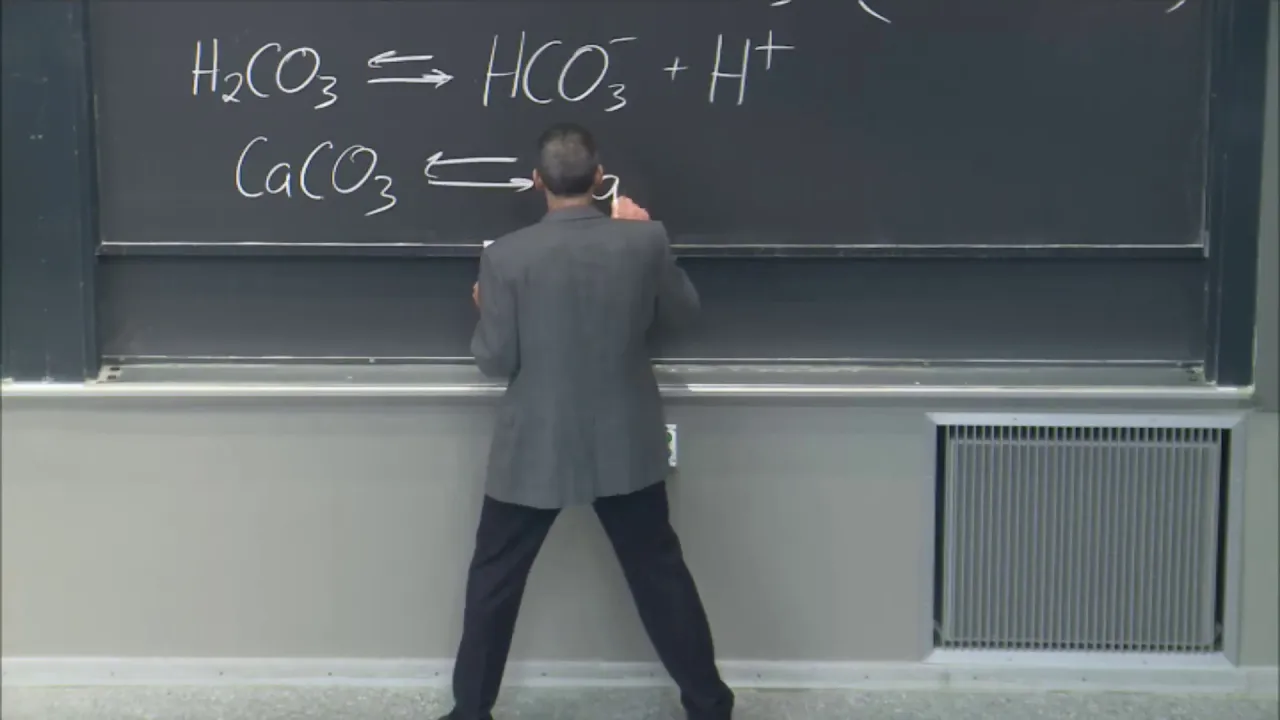
- Why this video is valuable: This MIT OpenCourseWare lecture provides a rigorous step-by-step breakdown of the chemical equilibrium of carbon dioxide dissolving in seawater. It models the progression from gaseous to carbonic acid (), and its subsequent dissociation into bicarbonate () and hydrogen () ions. It is an ideal chemical foundation.

- Why this video is valuable: This landmark NRDC documentary translates molecular chemistry into global ecological context. It shows how the rapid post-industrial rise in atmospheric directly correlates with the lowering of global ocean pH, providing real-world environmental stakes to the chemical formulas.

- Why this video is valuable: This segment provides a clear, high-yield structural summary of the ocean acidification chemical pathway. It explicitly highlights how excess hydrogen () ions generated by carbonic acid dissociation deplete free carbonate ions () by binding with them to form more bicarbonate ().
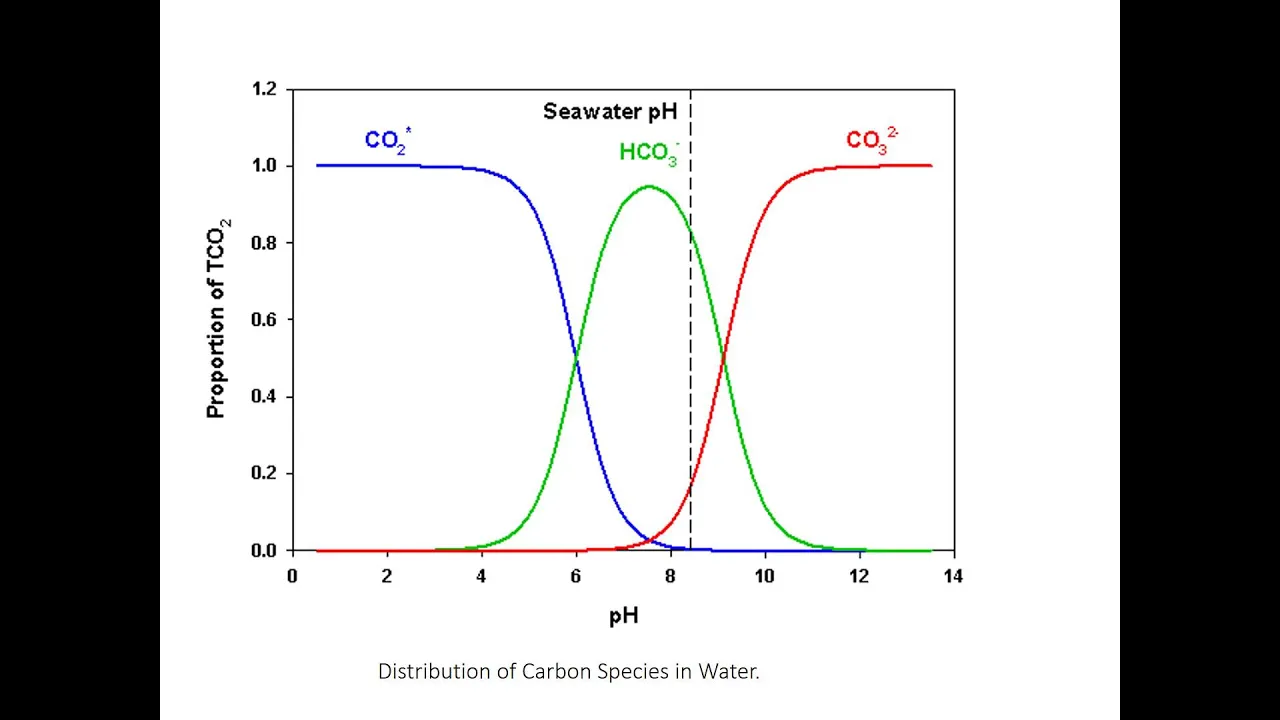
- Why this video is valuable: A concise overview of Dissolved Inorganic Carbon (DIC). It defines the components of the ocean's carbonate buffering system, visualizing how carbon fluctuates between three main oceanic states: dissolved , bicarbonate, and carbonate.
Knowledge Checkpoint
- Write the step-by-step equilibrium chemical equations for carbon dioxide dissolving in water and forming carbonic acid, bicarbonate, and hydrogen ions.
- Explain how a decrease in seawater pH shifts the equilibrium ratio of bicarbonate to carbonate ions.
- Define the ocean's natural carbonate buffering system and explain how it historically stabilized marine pH.
Module 2: Chemical Pathways of Coastal Acidification
This module transitions from open-ocean chemistry to localized coastal environments. You will study how coastal upwelling and agricultural runoff interact with anthropogenic carbon dioxide to create localized pH drops, and define the thermodynamics of calcite and aragonite saturation states ().
Recommended Videos

- Why this video is valuable: This university-level lecture provides a mathematical and thermodynamic analysis of seawater carbonate chemistry. It covers chemical equilibria, gas exchange, and defines the crucial components of ocean alkalinity and dissolved inorganic carbon under pressure and variable temperatures.

- Why this video is valuable: This video focuses on the aragonite saturation state (), explaining the mathematical ratio between dissolved calcium and carbonate ions relative to the solubility product (). It explains why represents supersaturated waters (stable shell building) and leads to active dissolution.

- Why this video is valuable: This segment explains the physical oceanography of upwelling. It shows how offshore winds displace surface waters, forcing deep, cold, nutrient-dense, and highly acidic waters to rise to coastal shelves, compounding localized acidification challenges.
- Why this video is valuable: An illustrative case study showing wind-driven seasonal upwelling along the Pacific Northwest coast. It visually models how Earth's rotation (Coriolis effect) drives the transport of surface water offshore, allowing highly corrosive, deep ocean currents to invade commercial shellfish environments.
Knowledge Checkpoint
- Define aragonite saturation state () mathematically and explain what a value of indicates.
- Explain why deep upwelled waters naturally possess lower pH and higher levels than surface waters.
- Describe how agricultural runoff introduces excess nutrients (nitrogen/phosphorus) to cause coastal eutrophication and a subsequent drop in localized water column pH.
- Compare the structural stability and solubility of aragonite versus calcite in acidic marine waters.
Module 3: Bivalve Physiology & Calcification Under Stress
This module focuses on the biological and bioenergetic impacts of acidification on calcifying bivalves. You will evaluate how hydrogen ions compete for cellular transporters, explore the metabolic costs of maintaining pH at the site of calcification, and analyze larval vulnerability during their first 48 hours.
Recommended Videos
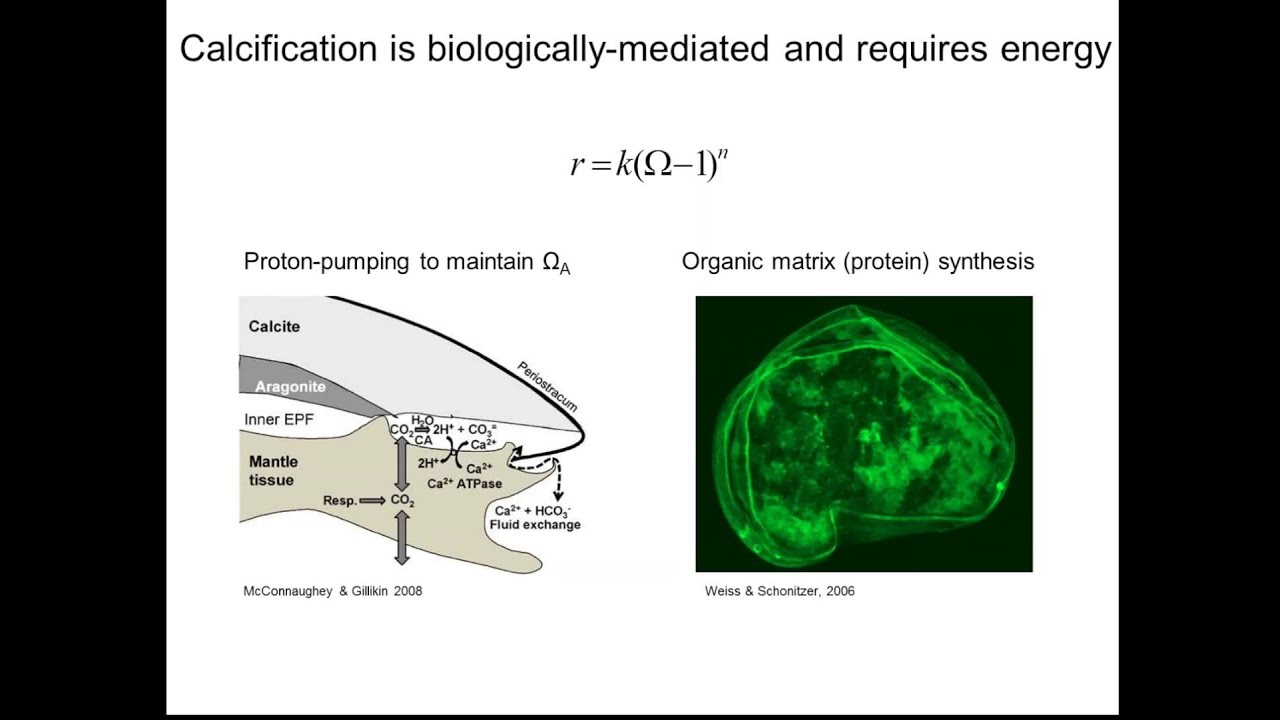
- Why this video is valuable: An advanced academic presentation by leading OSU researcher Dr. George Waldbusser. This seminar provides the definitive physiological explanation of why bivalve larvae are highly vulnerable to aragonite saturation states. It explores the kinetics of early-stage shell formation, the energetic barriers of calcification, and why pH itself is often less critical than carbonate ion availability during rapid development.
- Why this video is valuable: This video highlights the critical developmental window of oyster larvae. It shows that the initial 48 hours of life require rapid, high-energy shell precipitation from surrounding seawater. If carbonate ion concentration is low, larvae suffer severe developmental defects or complete failure.

- Why this video is valuable: Demonstrates the bioenergetic tradeoffs bivalves face under acidification. Rather than shells dissolving instantly, the video explains that organisms must reallocate energy from growth, immune defense, and reproduction to fuel proton pumps and actively transport calcium and carbonate ions.
- Why this video is valuable: This case study examines the mid-2000s commercial shellfish hatchery collapse in Washington State. It illustrates the real-world connection between larval mortalities and low-pH upwelling events that bypassed hatchery filtration systems.
Knowledge Checkpoint
- Explain why the first 48 hours of larval development represent a highly vulnerable period for shell calcification.
- Describe the cellular mechanisms bivalve larvae use to pump protons () out of the subcalcifying space to precipitate calcium carbonate ().
- Explain how ocean acidification creates bioenergetic trade-offs in adult oysters, particularly regarding somatic growth and immune resilience.
Module 4: Kelp Physiology & Carbon Drawdown: Localized pH Buffering
This module investigates the biological mechanisms of macroalgal carbon drawdown. You will evaluate how fast-growing brown kelp varieties use light and dissolved inorganic carbon to drive localized photosynthetically induced pH shifts, creating protective zones for calcifiers.
Recommended Videos

- Why this video is valuable: Dr. Brooke Weigel presents kelp physiology, showing how kelp absorbs dissolved organic and inorganic carbon. It illustrates how kelp forests actively alter coastal carbon cycles through fast daily growth rates, altering localized seawater carbonate equilibria.
- Why this video is valuable: Explains how fleshy seaweeds with high photosynthetic rates counteract ocean acidification on a localized scale. It explores how macroalgae draw down dissolved during daylight hours, elevating both localized pH and aragonite saturation states.

- Why this video is valuable: Shows the physiology of kelp macroanatomy, noting that every surface of a kelp blade is photosynthetic. This high-capacity carbon-uptake system allows kelp to rapidly absorb nitrogen, phosphorus, and dissolved carbon directly from the water column.
- Why this video is valuable: This lecture outlines the cellular mechanisms of macroalgal photosynthesis. It explains the enzymatic reduction of inorganic carbon and water into glucose, highlighting the biological pathway that drives localized dissolved oxygen production and carbon extraction.
Knowledge Checkpoint
- Detail the chemical mechanism by which macroalgal photosynthesis shifts dissolved inorganic carbon (DIC) species to elevate localized seawater pH.
- Contrast how kelp forests affect seawater chemistry during daylight photoperiods versus nocturnal respiration.
- Explain the physiological difference between kelp's uptake of particulate organic carbon (POC) and dissolved organic carbon (DOC).
Module 5: Designing Integrated Multi-Trophic Aquaculture (IMTA)
In this engineering-focused module, you will design a co-culture system pairing sugar kelp with shellfish hatcheries. You will analyze spatial layouts, hydrodynamic flows, and seasonal timing to establish a "halo effect" that buffers incoming water and shields fragile bivalve seed.
Recommended Videos

- Why this video is valuable: This masterclass from the US Aquaculture Society provides the design blueprints, spatial mapping, and multi-trophic calculations needed to build functional IMTA systems. It covers the spatial and nutrient balance between fed species (finfish), organic extractors (shellfish), and inorganic extractors (kelp), showing how to engineer layout configurations for optimal biogeochemical performance.

- Why this video is valuable: This video highlights a physical field study where mussels were transplanted inside and near kelp farms in the Gulf of Maine. It presents real structural data showing that bivalves grown in close proximity to buffering kelp farms developed thicker, denser shells with higher crack resistance.
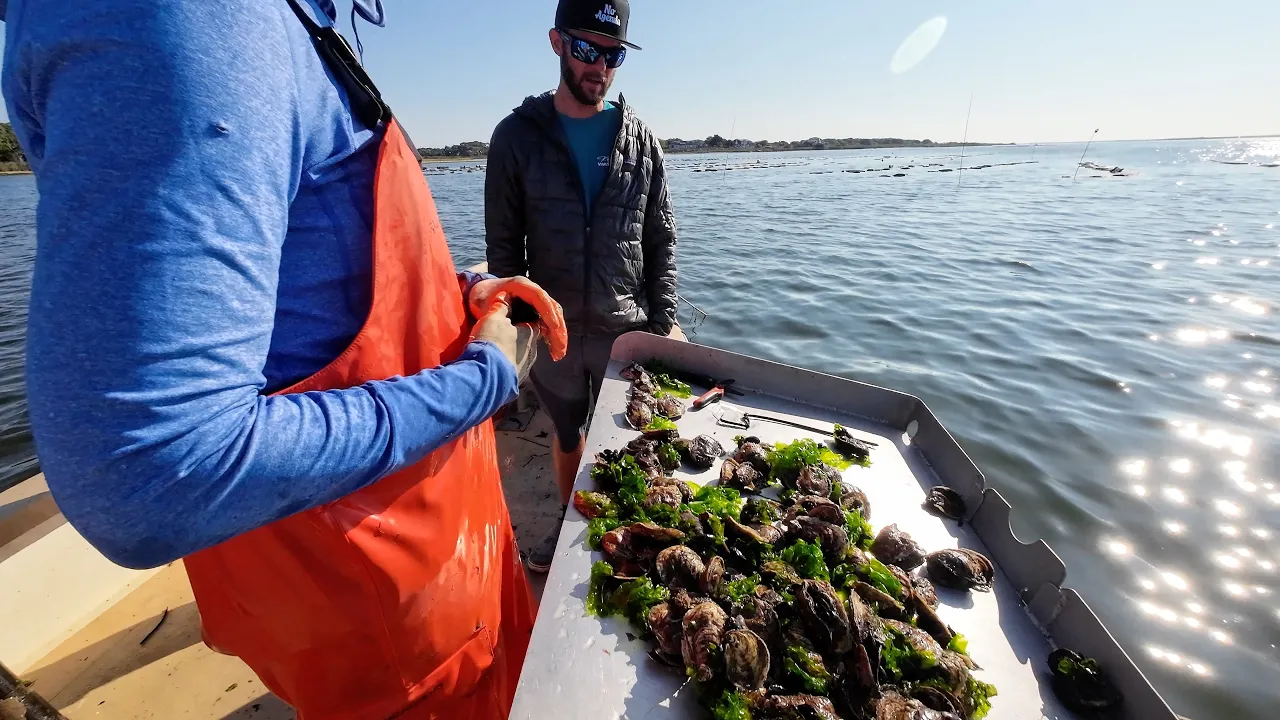
- Why this video is valuable: This video tours an active kelp-oyster co-culture system on Long Island. It explores physical layouts, showing how to hang kelp lines above or adjacent to floating oyster gear to exploit localized geochemical shifts.

- Why this video is valuable: This conceptual video breaks down the multi-trophic circular economy of IMTA. It models the transfer of nitrogen, phosphorus, and organic waste, illustrating how kelp acts as an inorganic filter that converts shellfish metabolites into biomass while stabilizing regional chemistry.
Knowledge Checkpoint
- Sketch an IMTA layout that positions kelp arrays relative to tidal flow to optimize chemical buffering for a downstream bivalve nursery.
- Explain how boundary layer hydrodynamics inside kelp canopies alter local water velocity and residence time, and how this influences pH buffering efficiency.
- Describe the nitrogen-carbon balance in a co-culture system, explaining how bivalve respiration () and excretion () feed into kelp assimilation pathways.
Course Map
Below is the recommended learning progression. You must master the foundational chemical pathways in Modules 1 and 2 before applying these principles to biological calcification (Module 3) and kelp physiology (Module 4). This builds to Module 5, where you will integrate these concepts into a co-culture design.
Key People Index
- Dr. George Waldbusser (Oregon State University): Led research linking larval bivalve development directly to aragonite saturation states. His work showed that larvae struggle with the calcification rate within their first 48 hours, highlighting saturation state rather than raw pH as the main developmental bottleneck.
- Dr. Brooke Weigel (Moss Landing Marine Laboratories): Marine ecologist focused on the physiology, microbiome, and carbon cycling pathways of kelp forests. Her work maps macroalgal dissolved organic carbon (DOC) pathways and localized chemical buffering.
- Dr. Richard Feely (NOAA PMEL): Senior researcher and chemical oceanographer. He was among the first to trace global ocean acidification profiles and identify corrosive, upwelled water along North America's Pacific coastline.
Final Self-Assessment
Review this list after completing the curriculum. If you can confidently check every box, you have mastered the learning objectives.
- I can write and balance the complete chemical equilibrium equations for the marine carbonate system, from gas dissolution to carbonate ion formation.
- I can explain the mathematical derivation of the aragonite saturation state () and determine if a body of water is corrosive to shells based on this value.
- I can identify how coastal upwelling and agricultural runoff interact to depress localized pH levels below typical open-ocean averages.
- I can explain why larval oysters are vulnerable during their first 48 hours, referencing the energetic cost of rapid calcification.
- I can explain how hydrogen ions () compete with calcium ions () at the calcifying interface of marine bivalves under low-pH conditions.
- I can trace the biochemical pathway of carbon drawdown in brown kelp, explaining how it alters localized bicarbonate concentrations.
- I can explain how water residence time and flow velocities inside kelp canopies influence local pH buffering capacity.
- I can design a detailed multi-trophic aquaculture layout that positions kelp arrays upstream of shellfish lines to maximize pH buffering and secure nitrogen assimilation.