



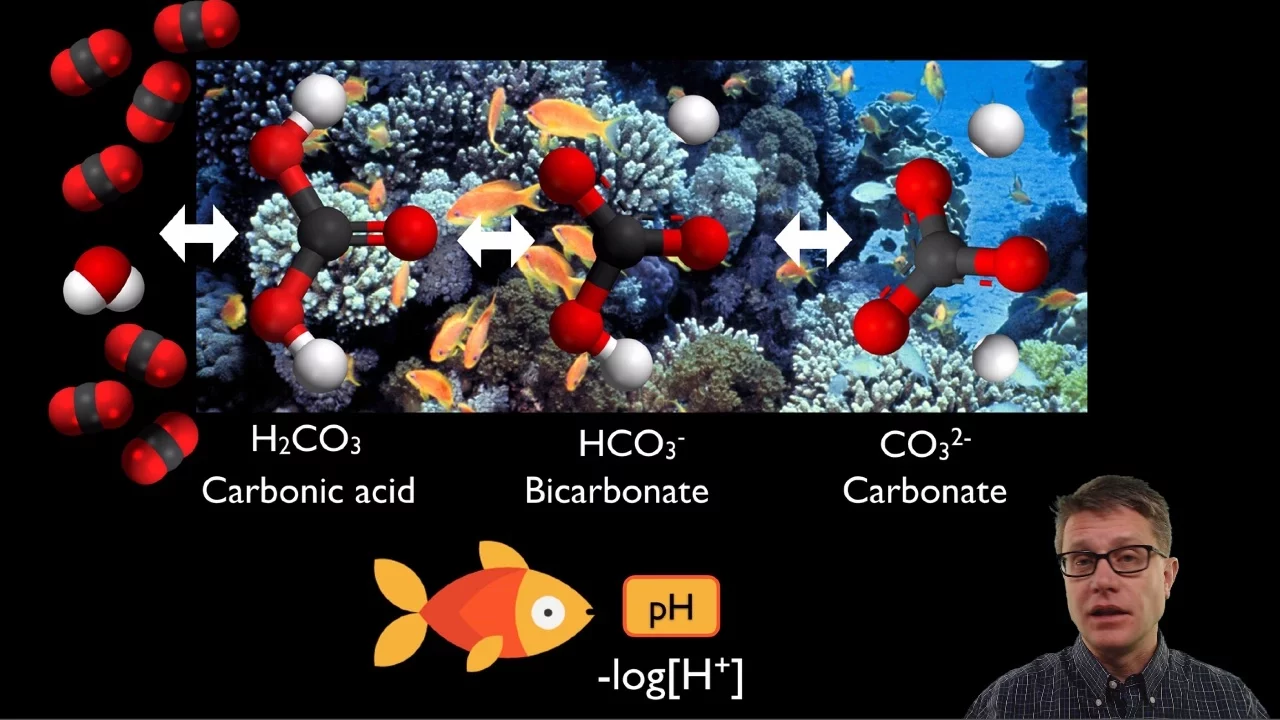





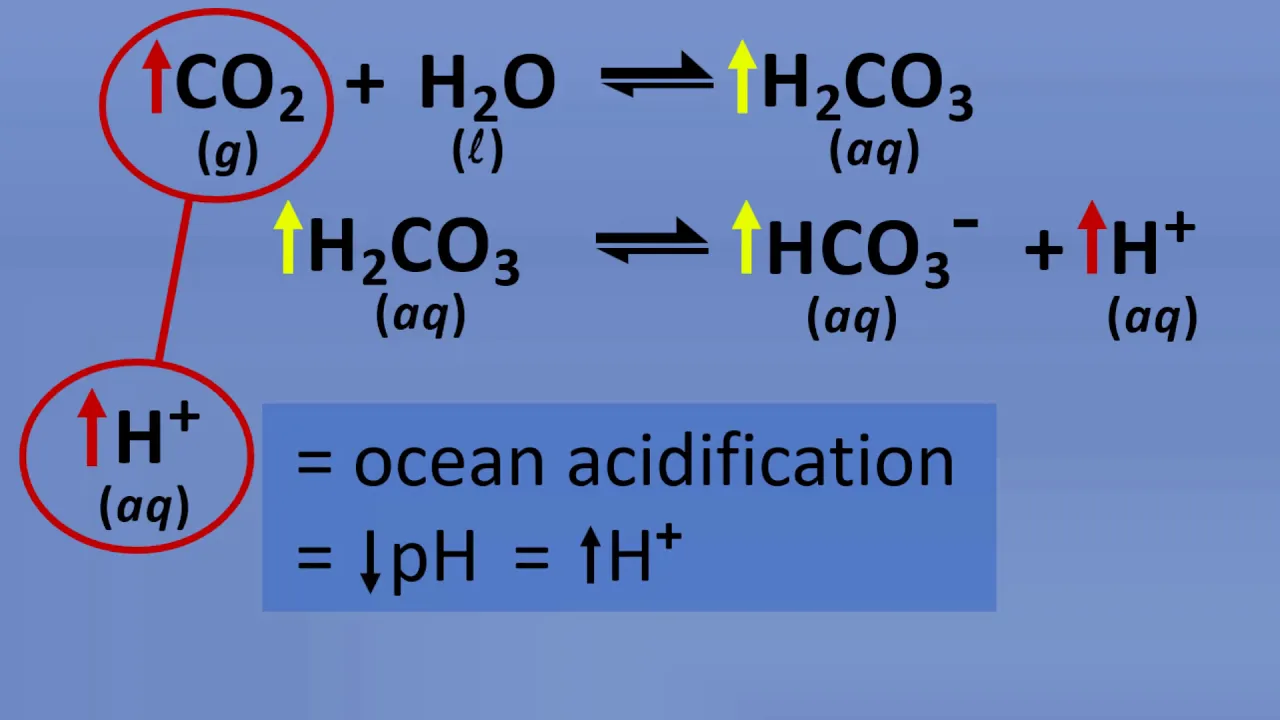








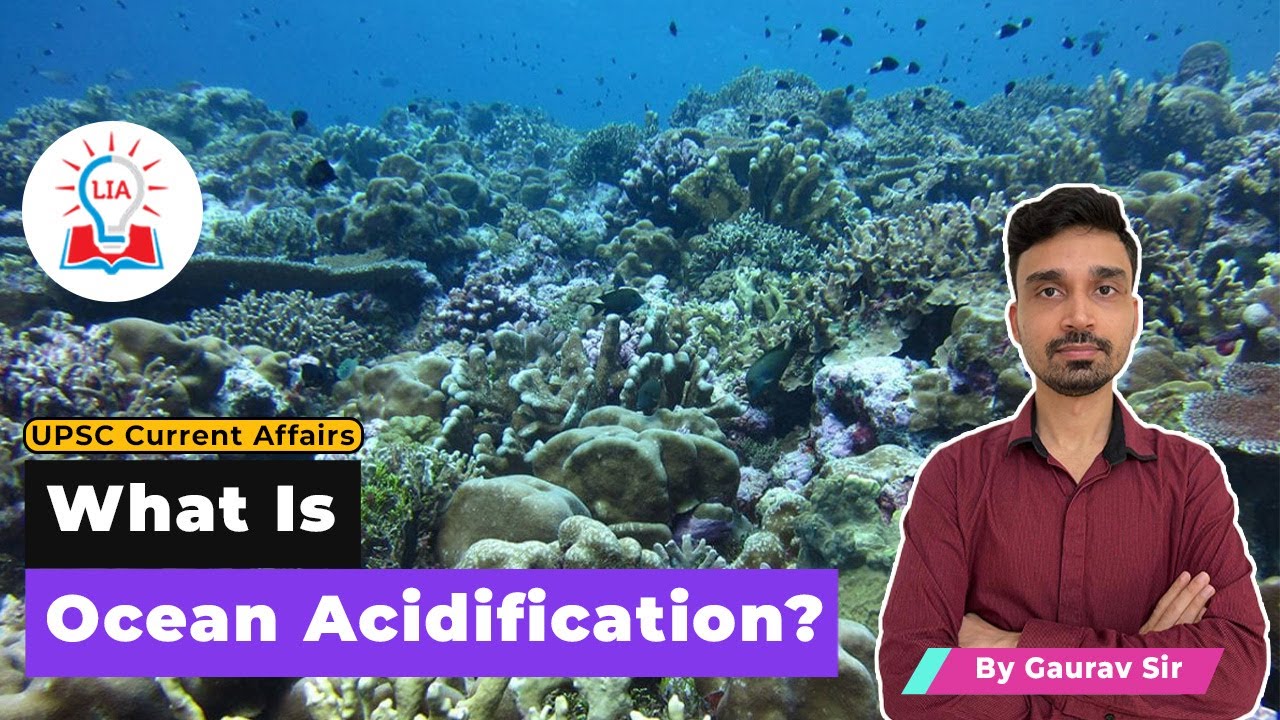





Ocean acidification occurs when atmospheric CO2 dissolves in seawater, forming carbonic acid and lowering pH; this increased acidity makes seawater corrosive to calcium carbonate structures, forcing calcifying organisms (like oysters, clams, and snails) to expend more energy extracting carbonate ions from water, leaving less energy for essential life processes such as growth, reproduction, and feeding.
Ocean Acidification: Shells on Acid Demonstration
Added:The pH scale and the basic chemical differences between acids, bases, and neutral substances.
The chemical composition of marine shells, specifically focusing on calcium carbonate (CaCO3).
How carbon dioxide (CO2) from the atmosphere dissolves in seawater to form carbonic acid, leading to ocean acidification.
The general concept of a chemical reaction, specifically how acids react with carbonates to produce carbon dioxide gas and dissolve solids.
The detailed chemical equilibrium of the marine carbonate system, including bicarbonate and carbonate ion saturation states.
The broader ecological impacts of ocean acidification on marine food webs, coral reef ecosystems, and sensory systems of marine organisms.
Socio-economic consequences of declining shellfish populations on global fisheries, aquaculture, and coastal economies.
Local and global mitigation strategies, such as seaweed cultivation to buffer pH, selective breeding of acid-tolerant shellfish, and international carbon reduction policies.
23K views95likes12:10Original Release: 2016-04-06
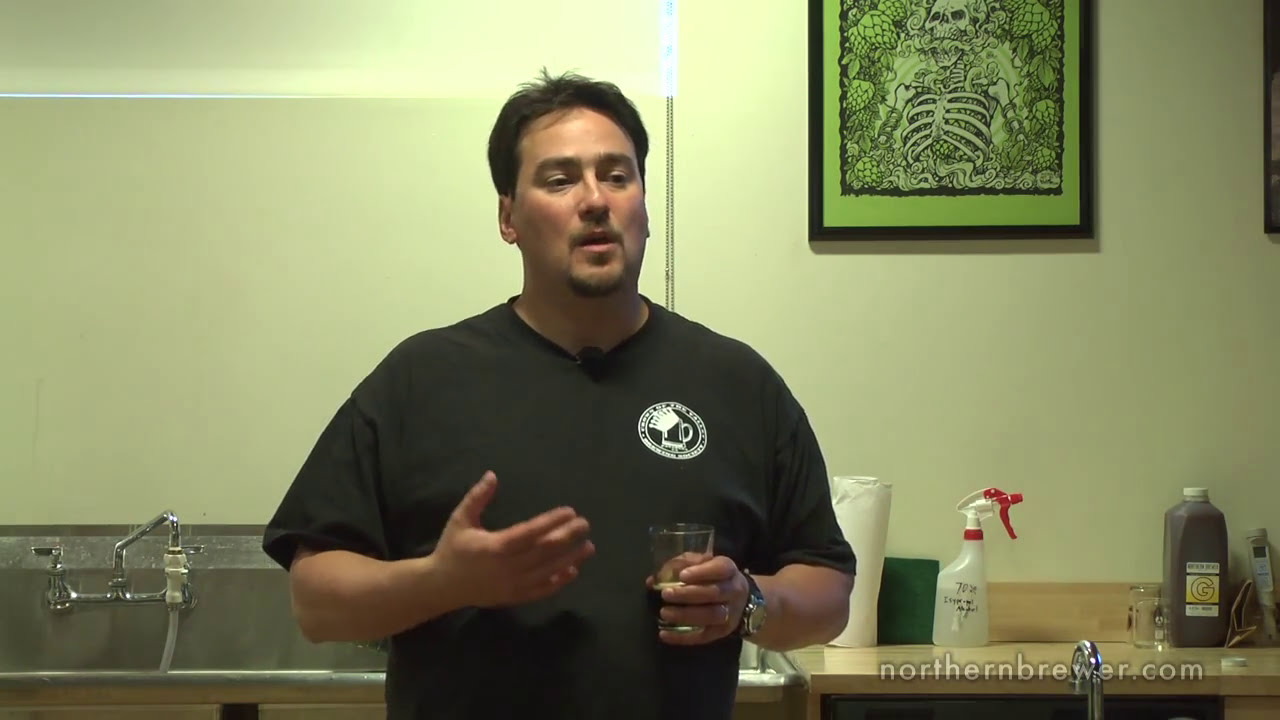
all right this is a demonstration that I call shells on acid and I find it's particularly useful for helping people understand why calcifiers organisms like those shown on the slide that build their skeletons and hard parts from calcium carbonate are particularly vulnerable to ocean acidification now for this demo you only need white vinegar and uh shell made of calcium carbonate if you uh live near a beach like I do here in seatt you can go down to the beach and collect a clam or an oyster or a snail shell all of those will work really well if you don't have access to a marine environment you can try using a land snail shell I've never done it so test it first but I think it should work or you can go out and purchase dustless chalk dustless chalk is still made from calcium carbonate modern chalk I don't know what they're using now but uh you can't count on it being cel carbonate unless you see that it says dustless on the label on the website where you found this video you'll also find a PowerPoint presentation that I often show before I uh perform this demonstration and I encourage you to watch the recorded presentation and also download my slides to use with your own audiences in particular this slide of the pH scale I'm going to move this screen I'm not sure if you can see this split screen but I can so I'm going to move it there um and in my presentation I spend quite a bit of time introducing the concept of pH and this pH scale so I'm not going to reiterate any of that here other than what's relevant to the shells on acid demonstration first uh you should notice that vinegar um which we're going to use in this demonstration is pH 3.0 five units uh five pH pH units lower than the pH of sea waterer now if you watched my presentation already you'll know that this means that the concentration of hydrogen ions in vinegar is five orders of magnitude higher than the concentration of hydrogen ions in seawat every solution listed on this scale has some amount of hydrogen ions even those in the basic half of the scale but the concentration of hydrogen ions increases exponen ually As you move from the high pH end or basic end towards the low PH or acidic end of the scale hydrogen ions are what give acid its kick and they can react with calcium carbonate and break it down the reaction between hydrogen ions and calcium carbonate occurs much much faster in vinegar than it does in seawater because there are 100,000 times as many hydrogen ions in vinegar as there are in seawater and that's why we're using vinegar in this demonstration today because we haven't got all day to watch shells dissolve you'll also notice that seawater is slightly basic it's here at pH 8.1 this is the current average pH of the ocean surface as we continue to burn fossil fuels and release carbon dioxide into the atmosphere in the oceans that carbon dioxide is going to continue to react with seawater to form carbonic acid which is what's Shifting the pH of seawater towards the acidic end of the scale and this is why even though the pH of seawater is still basic it is correct to say that it is acidifying in other words becoming more acidic than it currently is before the Industrial Revolution the pH of sea water was actually 8.2 humans use of fossil fuels has already lowered the pH of the whole world's ocean by 0.1 pH units and it will continue to acidify the seawater at an increasing rate until we stop releasing carbon dioxide which is the waste product of fossil fuel combustion as the pH of seawater declines it's going to become more and more corrosive to calcium carbonate not to the extent that we're going to see in this demonstration but certainly enough to cause serious problems for calcifying organisms like the ones you saw in the first Slide the last thing I want to say before we move on to the demonstration is about that term that I just used corrosive in the context of ocean acidification it is correct to say that acidification is causing seawater to become corrosive to calcium carbonate even though you certainly wouldn't call seawater corrosive if you put your hand into it Solutions need to be much more acidic to feel corrosive to us even vinegar doesn't burn our skin but you would notice if you were a baby oyster trying to build your first fragile shell in today's marine environment okay let's get started with the demonstration stop sharing there it is now here's my oyster shell and going to put it in the solution and turn the glass so hopefully you can see what's happening all right when I immerse this oyster shell vinegar the hydrogen ions immediately begin to ATT attack the calcium carbonate shell and break it down into its soluble components calcium and carbonate ions in other words the hydrogen ions are causing the shell to dissolve now the bubbles that started forming as soon as I dropped the shell in vinegar which is acidic because it contains acetic acid are a product of this dissolution reaction they're actually carbon dioxide which is formed when the newly released reled carbonate ions continue react further with additional hydrogen ions in the vinegar I'm going to pull this up close so you can see what's going on oh it's beautiful reaction it's bubbling just like champagne and you should pass the cup around to the members of your audience so they can see what's going on and as you do that um re remember to point out that what they see happening in the glass is not not an accurate representation of what's happening in the marine environment now we'll never see an oyster bed bubbling away like the shell in this demonstration because we're using vinegar the dissolution reaction in this demonstration is occurring at a dramatically faster rate than it would in seawater even seawater with the extremely low pH levels that scientists have observed in Puget Sound where the impacts of acidification have been particularly severe pH uh levels as low as 7.4 7.5 have been recorded recently in Hood Canal and Puget Sound but in today's oceans the problems faced by calcifiers like oysters urchins and terap pods is really one of bioenergetics simply put as seawater pH declines calcifiers are having to work harder and harder to obtain dissolve carbonate ions from seawater for their shells and hard Parts The increased idity really makes those carbonate ions want to stay in solution uh excuse my anthropomorphizing but the more energy calcifiers have to spend to maintain and build their shells the less energy they have for other essential life functions like growth reproduction fighting off disease feeding and Locomotion and this is why acidification is so tough on them juvenile Cal spiers seem to be especially vulnerable to corrosive seawater and it's often at the Juvenile stage where the impacts of ocean acidification are most apparent oyster hatcheries along the west coast of the United States saw this about 10 years ago first started seeing this about 10 years ago when their oyster larvae began dying on the second day of development the second day is the stage at which the larvae which up until that point looked nothing like adult oysters they're based basically little swimming Blobs of goo with a yolk sack um but on day two they have to undergo this major metamorphosis converting almost 80% of their body weight into shell material and they have to do this because until they can build this first shell they're unable to feed themselves they they need to have something to hang their mouth parts from and until until they can feed themselves they're subsisting on the Yol that was provided to them by their mothers as part of the egg now on the second day their gas tanks are getting kind of low they're almost out of Yol and if they can't complete this metamorphosis they're going to die of starvation so knowing what you know now you can imagine how corrosive seawater was affecting the shellfish larvae the oyster larvae in the hatcheries just needing to work that much harder to form their calcium carbonate shells in lower pH sea water that was being drawn into the hatcheries required more energy from the baby oysters than they had and they were D they died before they could feed themselves now since that time which will go down in history in Washington state as the great oyster crisis uh scientists have helped Hatchery managers figure out how to monitor the seawater that there is being drawn into the Hatchery tanks and correct the pH of that sea water when necessary but this is only a temporary solution and as the oceans as seawater becomes corrosive de calcifiers more frequently for longer periods of time it's not going to be a viable solution but even more importantly correcting the pH artificially is not even an option for the vast majority of marine calcifiers that are not born in hatcheries all those wild species that are living and uh trying to reproduce in today's increasingly corrosive marine environment all right that's a lot of talking for such a simple demonstration but I wanted to make sure you had the background that you'd need to explain this well I'm going to go back to one final slide uh here we go click click through all right and move move this down so you can see it uh on this final slide is the website of Washington SE grants ocean acidification web page you should be able to find this video uh recorded presentations PowerPoint slides uh protocol WR written up Protocols of this demonstration and others um if you uh you can also go to Noah's Source webinar page which is where I did viewed these videos and um obtained them through that program to find the source webinar page just Google Noah o AA and Source spelled wrong s o a r CE OA for ocean acidification and you should get to that web page which has a lot of really great archived webinars all about uh ways to communicate and educate around the issue of ocean acidification but one final plug Washington C Grant because I work for them uh there's a whole lot of great stuff on our ocean acidification web page and I encourage you to go there thanks very very much for tuning in
Up Next
10:11
Liquid Properties: Viscosity, Surface Tension & Capillary Action
@ProfessorDaveExplains
678.2K views•2019-05-10
83:56
Biocatalysis and Catalysis in Islatravir Synthesis | Merck Webinar
@SCIwheresciencemeetsbusiness
675 views•2020-10-08
10:06
1H NMR: Determining Number of Peaks from Structure
@MSJChem
59.2K views•2017-04-06
17:31
Edible Water Bottles: A DIY Guide to Sodium Alginate Spherification
@ryan
10.5M views•2019-06-21
Related Study Plans & Knowledge Roadmaps
Structured learning paths in Chemistry
chemistry
Nuclear Chemistry: Decay, Meds & Fuel Cycle
01Introduction to Nuclear Structure and Radioactivity
02Decay Dynamics and Kinetics
03Radiation Interaction and Detection
+ 2 more learning modules
24h5 modules
Explore Roadmap
chemistry
Supramolecular Chemistry: Forces & Machines
01Foundations of Chemical Bonding and Intermolecular Forces
02Introduction to Host-Guest Chemistry
03Thermodynamics and Dynamics of Self-Assembly
+ 2 more learning modules
16h5 modules
Explore Roadmap
chemistry
Photochemistry: Excited States & Reactions
01Foundations of Light-Matter Interactions
02Molecular Orbitals and Electronic States
03Photophysical Processes and Jablonski Diagrams
+ 2 more learning modules
18h5 modules
Explore Roadmap
chemistry
Coordination Chemistry: Bonding & Properties
01Introduction to Transition Metals and Ligands
02Crystal Field Theory (CFT) and Geometry
03Magnetic Behavior and Spin States
+ 2 more learning modules
14h5 modules
Explore Roadmap