





























Liquids exhibit several interconnected properties governed by intermolecular forces: viscosity (resistance to flow) depends on molecular size, shape, and intermolecular attraction strength, with temperature reducing viscosity; cohesive forces are attractions between liquid molecules that cause surface tension, making liquids contract into shapes minimizing surface area; adhesive forces describe attractions between liquid molecules and solid surfaces, determining whether liquids spread out (adhesive > cohesive) or bead up (cohesive > adhesive); these forces together explain capillary action, where liquids rise through narrow tubes or porous materials against gravity, with the height depending on surface tension, contact angle, tube radius, liquid density, and gravitational acceleration.
Liquid Properties: Viscosity, Surface Tension & Capillary Action
Added:It’s Professor Dave, let’s discuss the properties of liquids.
Now that we understand the phases of matter, as well as the different types of intermolecular forces, we are ready to learn about some very interesting properties of liquids, so let’s learn about these now.
First, think about a few different kinds of liquids, and what happens as they move.
Think about pouring a glass of water.
Now think about pouring maple syrup.
There is a distinct difference in the ability of these liquids to flow.
The ability of a liquid to resist flow is called viscosity.
Water has a low viscosity, because it flows freely, while substances like syrup and honey have a high viscosity, because they flow very slowly.
We can measure viscosity quantitatively by measuring the rate at which a metal ball falls through a substance.
The slower it falls, the more viscous the liquid.
There are a number of factors that dictate the viscosity of a liquid.
First, we must look at the intermolecular forces occurring between the molecules.
The greater the attraction between the molecules, the stickier and more viscous the liquid will be.
The size and shape of the molecules also play a part.
A liquid with very tiny molecules will be less viscous because of enhanced mobility.
Very large molecules will have a more difficult time moving past one another, which will restrict flow and result in a greater viscosity.
Lastly there is temperature.
Higher temperatures mean more kinetic energy, which causes the intermolecular forces to dissipate and will result in a reduced viscosity.
So a substance like water has a very low viscosity despite the strong hydrogen bonding, because water molecules are so small.
More complicated substances like honey will have much larger viscosities.
Intermolecular forces also determine things called cohesive forces and adhesive forces.
Intermolecular forces, whether dispersion or dipole-dipole, that are occurring between the molecules of a liquid, are called cohesive forces.
These are attractions that molecules can exhibit between one another that cause cohesion in a substance, which can be quite significant for a very viscous substance.
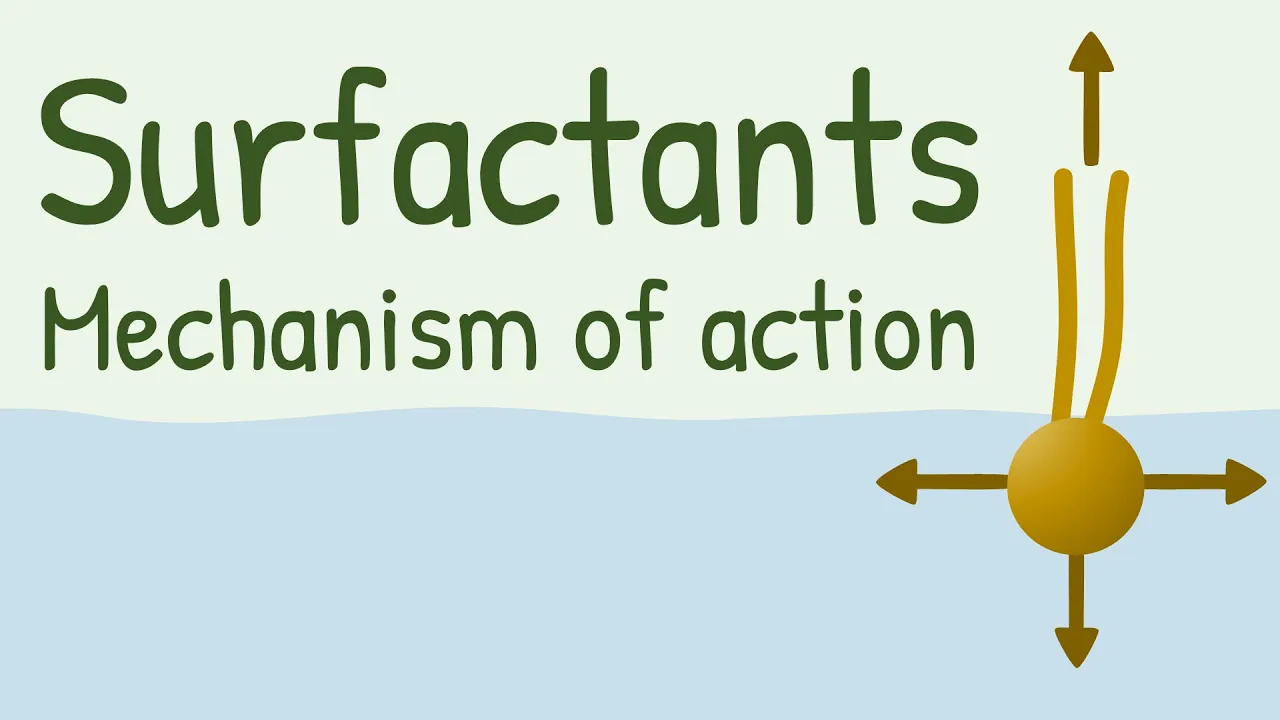
In a liquid, these cohesive forces are felt equally in all directions by most of the molecules, but not for molecules that are at the surface of the liquid.
These molecules only interact with half as many molecules as the others, because they are at the edge of the substance, with no more molecules to one side.
This is why liquids tend to contract to form shapes that minimize their surface area.
We can see this in a drop of water, which will be roughly spherical.
The sphere is the shape that minimizes surface area, so a water droplet will adopt this shape to maximize the hydrogen bonding that is occurring in the droplet, allowing the system to sit at the lowest energy possible.
Of course if this droplet becomes larger, other effects like gravity and air resistance come into play, and it will not remain spherical for long, but in a tiny droplet we can see this effect quite pronounced.
The interactions between the molecules of a liquid and some solid surface are called adhesive forces.
These describe the ability of a liquid to adhere to that surface.
Take water for example.
If we place a drop of water on a piece of plastic, or some other nonpolar surface that won’t interact with water, the water will not wet the surface, and it will retain a spherical shape.
This is because the cohesive forces, the hydrogen bonds occurring between the polar molecules inside the droplet, are stronger than the adhesive forces between the water and the nonpolar surface.
But if we place a droplet on glass or another polar surface that will interact with water, it will spread out and maximize interactions with that surface, because in such a case, the adhesive forces are stronger.
We can see this happening when we place liquids in a glass tube, like a graduated cylinder.
Because water is attracted to the glass, it will form a concave meniscus, meaning that the surface will curve downwards.
That is because this configuration will allow water to maximize its interactions with the sides of the glass tube.
If we try this again with mercury, it will look totally different.
In mercury, the cohesive forces between the mercury atoms are stronger than the adhesive forces between the mercury and the glass.
So mercury will form a convex meniscus, which is when the surface curves up like this.
It will do this so as to minimize interactions with the glass, which in turn maximizes the interactions between the mercury atoms.
This is why the mercury in a thermometer is curved in this manner.
Another phenomenon that is related to cohesive forces is called surface tension.
Surface tension is defined as the energy required to increase the surface area of a liquid.
This will depend on the strength of the cohesive forces in the liquid.
The stronger the cohesive forces, the stronger the surface tension, as any increase in surface area will necessarily disrupt some of these interactions.
Different liquids have different surface tensions, and water has an irregularly high surface tension, considering the small size of the molecule.
This is because of the strong hydrogen bonding occurring.
Water does not want to reduce the amount of hydrogen bonding occurring by increasing the surface area, and this phenomenon is the reason that a paperclip, if carefully placed on top of water, will float.
The paperclip is more dense than water, so it should sink, but the surface tension keeps it afloat, based on the strength of all the hydrogen bonds.
Many bugs take advantage of surface tension in order to walk across water, even though they too are more dense than water.
It is the strength of the cohesive forces between the water molecules that supports them.
If an object like a bug were to pierce the surface of the water, some of the hydrogen bonds would have to be disrupted, as some of the volume would then be occupied by something other than water molecules.
That is why the surface of any body of water can act almost like a stretched rubber membrane, if the object interacting with the surface is sufficiently light.
Of course if a human tries to walk on water, their mass is such that gravity will win over the cohesive forces, so don’t try this at home.
Let’s learn about one more phenomenon.
If you dip a paper towel into water, the water will climb up the paper towel, against gravity.
This is an example of something called capillary action, which is when a liquid flows through a material because of attractions between the liquid molecules and the surface of the material.
These adhesive forces, combined with the cohesive forces in the liquid, may be enough to move the liquid upwards against gravity.
Paper towels are made of materials that are attracted to water molecules, namely cellulose, which has lots of hydroxyl groups, so when a paper towel is dipped in water, the molecules will move upwards into the material to maximize the hydrogen bonding that is occurring.
We can also see capillary action occurring when we dip a narrow glass tube into water.
Because the water molecules are attracted to the glass, the water will naturally rise up through the tube, without any force being applied.
Once again, the strength of the adhesive forces between the water and the glass is strong enough to outweigh the force of gravity, and the more narrow the tube, the higher the water will climb.
Even nature uses capillary action, as some plant cells are able to bring water and nutrients up from the soil and into the roots of the plant, partly by capillary action.
We can quantify capillary action in a specific manner, by seeing the height that the liquid will rise up to in a glass capillary tube, and this height will depend on the surface tension, the contact angle between the liquid and the tube, as well as the radius of the tube, the density of the liquid, and the acceleration due to gravity.
So by applying the concept of intermolecular forces to liquids, and their interface with a solid surface, we are able to elucidate the concepts of viscosity, cohesive and adhesive forces, surface tension, and capillary action.
Up Next

Contact Angle: Wettability, Hysteresis & Measurement Methods
@audiopedia5493
3.8K views•2014-10-11

Biocatalysis and Catalysis in Islatravir Synthesis | Merck Webinar
@SCIwheresciencemeetsbusiness
675 views•2020-10-08
Intermolecular Forces and Boiling Points Explained | Chemistry
@ProfessorDaveExplains
2.7M views•2015-11-05
Edible Water Bottles: A DIY Guide to Sodium Alginate Spherification
@ryan
10.5M views•2019-06-21
Related Study Plans & Knowledge Roadmaps
Structured learning paths in Chemistry