



















Kelp forests face declining health worldwide due to climate change stressors, with research revealing critical temperature thresholds that constrain kelp survival and reproduction across their entire life cycle—from microscopic gametophytes to adult sporophytes—while also demonstrating that kelp host diverse microbial communities that may influence their ecological resilience and carbon cycling capabilities in coastal ecosystems.
Kelp Forest Ecology in a Changing Ocean | MLML Seminar
Added:Basic kelp anatomy and physiology, including the structural differences between macroalgae and terrestrial plants.
The ecological concept of foundation species and trophic cascades within temperate marine ecosystems.
Fundamentals of the marine carbon cycle, particularly photosynthesis, respiration, and the pathway of organic carbon flow.
An understanding of global ocean change stressors, specifically rising sea surface temperatures, marine heatwaves, and ocean acidification.
The basics of host-microbe interactions and the symbiotic roles that microbiomes play in organismal health.
Practical applications in marine conservation, such as kelp forest restoration techniques, marine protected area (MPA) design, and combating urchin barrens.
The marine 'holobiont' framework, exploring how host-microbiome co-evolution helps marine organisms adapt to rapid environmental shifts.
Blue carbon policy and carbon accounting, specifically analyzing the viability of macroalgae for carbon sequestration and offset credits.
Assisted evolution and selective breeding of kelp strains to identify genotypes resilient to warming ocean conditions.
Biogeochemical modeling to quantify the global contributions of macroalgal forests to coastal nutrient cycling and marine food webs.
195 views3likes1:00:35Original Release: 2025-05-15
I just tested our seminar speaker with that bell.
I know that's kind of the moss landing.
Welcome to seminars. I am really thrilled today to introduce Brooke Wel and she's here. I'm gonna give you the name of her talk, the ecology of kelp forest in a changing ocean physiology, microbiomes and carbon cycling. And as as I looked on Google Scholar at the copious number of really interesting kelp related mostly kelp related papers, I realized that she can probably and I spoke to her at lunch that she's going to do a great review of her world related to kelp, both where she's been and where she's going. And um Brooke came here from Hopkins where she just started in January as an assistant professor at Stanford University at Hopkins Marine Station and that's really exciting. Their program has really grow is really growing with a lot of new researchers and this is a great opportunity for her to find out what people are doing around Monterey Bay and you know looking for collaborative projects. She has three student PhD students starting in the spring or the fall and so she'll be you know having more students that are going to interact but many of you are working on related things and certainly what Hopkins has been one of the great collaborative um locations for us both to use their kelp forest in the front yard but also with uh researchers. So it's exciting there's a another kelp forest researcher there.
She did her undergraduate or her master's degree at UNCC right on on sponges and then the University of Chicago and working on kelp though at Tatoo Island in Washington and then has been a post-doal fellow at University of Washington. So, uh, I'm going to let you introduce yourself, but again, uh, introduce some of you, a lot of the beer pigs, the benthic ecology and experimental research, psychology in general, beer pigs. Um, they met with her, but she's also around and just down the street. So, we look forward to welcoming you back.
Yeah. Thank you so much. Um, it's really great to be here. I'm super excited to be at Moss Landing. I've heard about this place for a really long time. I feel like I applied to internships back in the day when I was a young and never ended up coming here. So, I'm really stoked to be here and to be only 20 minutes down the road um at Hopkins. So, I'm a brand new assistant professor in the oceans department um which is in the Stanford Door School of Sust sustainability. Um but my research lab and my office are based at Hopkins. Um, so this is the view that many of you have seen out from the kelp forest. Um, and yeah, if you're interested in kelp, and many of you are, you're always welcome to come down and have a chat or or email me. Um, so I'm just going to sort of tell you a bit about who I am as a researcher and the three main areas of research that I've been working in in kelp forests and sort of the directions that I'm excited about going in my future research lab. Um, so I am interested in um the physiology of kelp and how they respond to global climate change stressors. Um because we all know that there's been a lot of kelp forest declines in response to climate change and we're really trying to understand how they interact with their environment and how genetics and physiology interact um to affect their response to ocean warming and other stressors. Um I also like to study the hidden things that aren't so obvious in kelp forests. So much of my PhD work was on the kelp microbiome. So, I'll tell you a little bit about the microbiomes that live on the blade surfaces of kelp and what kind of functions they might have and what ecological roles they might play in the kelp forest. Um, and then finally, I'm really interested in carbon cycling in kelp forests. Um, mostly because I have always been interested in nutrient cycling. My very first research was all in freshwater streams and I studied biogeochemistry and nutrient cycling.
And I really like thinking about the way that nutrients flow through ecosystems.
Um, right now it's really important because there's a lot of people very interested in using kelp as a tool to sequester carbon. Um, I'm a little skeptical about some of the claims about what we can or can't do with kelp, but I think there's a lot of really important knowledge gaps to fill. So, I'll talk about some of those knowledge gaps and the way that my work is attempting to fill those.
Um I'll start by just acknowledging a lot of this work was done um during my PhD at Chicago with Kathy Fister. Um a lot of my posttock work on kelp was done at uh W Friday Harbor Labs with Megan Dier and um here's some of my funding sources and particularly the posttock work was done with a team of PhD students, research technicians and undergrads um who all contributed to this work.
Um most of my dissertation research was um done on Tatouch Island which is off the outer coast of the Olympic Peninsula of Washington. And my adviser Kathy Fister had been working there since her PhD um back in the 90s and um has continued to work there with permission of the tribe and collaborating with tribal biologists. So I feel very grateful to have been able to work on their land in such a beautiful place.
Um so just a brief outline first we're going to dive into the physiological responses of kelp to ocean warming and then we'll zoom in either even further and talk about the diversity and functional role of microbial communities on kelp and finally zoom back out a little and think about carbon cycling in these coastal ecosystems.
So many of you um are fycologists, but for those of you who aren't, um kelp are brown algae in the order laminary alles.
Um this is a fogyny just showing that they're quite uh different than red and green algae and land plants. And here we have a beautiful poster by Andrea Dingledine of the kelp of Monterey Bay.
So there's many different species of kelp. We have the two uh giant species of kelp, macrocystus, the giant kelp, and nuriocystus, the bull kelp. But there's a number of other um inner title and subtitle smaller species of kelp. Kelp um cover about a little more than 25% of global coastlines in temperate and arctic ecosystems. So they're not just found on the west coast, they're found around the world um in many different cold water locations.
Um, and kelp are incredibly important.
Uh, you all know this, but they support um a really diverse community of benthic invertebrates and fish. They're providing habitat structure and also food. Um, and they're providing a lot of ecosystem services as well to humans.
Um, I'm part of a global working group that's assessing the ecosystem value of kelp forests and um, all the things that they contribute to fisheries like salmon and rockfish and the way that they take up nutrients um, and provide recreational opportunities, their global values currently estimated at a little more than 300 billion um, per year. So, they're really important. Um, but we've been losing kelp forests in many locations worldwide. So these are just some of the news stories. Um you've uh I'll talk specifically about California, but this is also happening in Australia, New Zealand, um Tasmania, Washington, other places around the world, um even in Europe. Um so what factors contribute to the loss of kelp forest ecosystems?
Um, it's important to note that there's regional differences in stressors and in the predators in the ecosystem. Um, you probably raise your hand if you're familiar with the blob. Yeah, raise your hand if you were here for the blob.
Yeah, some of us. Okay, so the blob was this temperature anomaly where we had really warm water off the west coast from about 2015 20 2014 2015 until 2016 and that led to a widespread uh and coincided with a virus that impacted sea stars and led to a lot of declines in sea stars. Um, but in other places in the world, there's other important predators of sea urchins that eat kelp.
There's sheep's head, there's sea otterters. Up in um Washington, we have a lot of kelp crabs that eat the kelp directly. Um, so uh there's a lot of different stressors in different systems. Here in California, following that blob marine heat wave, there was a 95% loss of bull kelp in Northern California and patchy and variable losses of kelp in Southern California.
Um and again this is coming um a lot of places from the loss of these important picnapodia sea star predators which then um allowed the population of sea urchins to increase and consume all the kelp and turn them into urchin barons. Um and the frequency and intensity of marine heat waves will continue to increase. So it's important to understand how this combination of stressors is impacting kelp forests. Um, now we're going to move north and think about the Salish Sea, which is the inland uh waters of Puet Sound on the south and the straight of Georgia in the north going into Canada. So, this is the study system where I worked for um my PhD and posttock work. And um it's really interesting and different in a number of ways. One thing that's interesting is that giant kelp is restricted to the outer coast and it doesn't go into Puget Sound. So, um the primary canopy forming kelp in Puget Sound is all bullpistus Lucayana. Um and so we were interested in understanding more about the declines in bull kelp in Puget Sound. Um, I was also part of a working group that worked across the border because the kelp grow from Canada down into the US and they don't care about the border. So, we looked at the population genetics of bull kelp and giant kelp from British Columbia down into Washington. And we sequenced the whole genomes of more than 400 bull kelp and more than 200 giant kelp from Washington and British Columbia to look at the um genetic structure of these populations. And um one thing I just want to mention from this paper that's relevant to the physiological work I'll talk about is that um we saw really big differences in genetic diversity um from the outer coast of Washington going into Puet Sound. So the lowest diversity population was at the bottom of Puet Sound called Squaxen Island, Washington.
And I use this population in a lot of my follow-up experiments, but it had about 40 times lower genetic diversity than those populations on the outer coast.
So, we do see a lot of genetic differentiation between some of these populations. And in particular, these southern populations are of great concern because they have been been declining rapidly. This is a map um that shows the status of bull kelp in um different parts of Puet Sound from the outer coast. And you can see the populations are healthy and stable on the outer coast and the outer parts of the straight of Wand Fuca. But going into Puget Sound, we've had 60 to 80% loss of all bulkp in southern Puget Sound. Um and uh this is a in the middle is a map showing um the historical distribution of bulkelp beds in southern Puet Sound. So all the blue is coastline where we used to have bull kelp and the pink areas are the only places where bulkp remain in South Puget Sound. So there's only two populations left um in South Puget Sound. Um, and they're declining really quickly, the populations that are left. And the the places where we're losing kelp the fastest in Washington are warm and nutrient poor regions. So in the summertime, this is much different than the open ocean here because the water has to go all the way in the straight of Wanda Fuca and down into Puet Sound. And um, these sites are really shallow. Some of them are only like five, four or five meters deep. And um the surface water tends to get really warm and stratified and then depleted in nutrients presumably because phytolanton take up nutrients from the surface waters. So um we were left wondering why exactly are bullp declining because um there's this combination of high temperatures and low nitrogen concentrations which are both stressful for primary producers. And it's really hard to tease these apart in the field because these stressors are always co-occurring. And here in our upwelling system, you know, when there's upwelling, it's cold and nutrient-rich.
And when there's not upwelling, it gets warmer and nutrient poor. So in order to tease apart those stressors, you have to do experiments in the lab. So during my posttock research, I wanted to know how these two um stressors, high temperatures and low nitrogen concentrations, interacted to impact kelp.
And there's a hypothesis from a study that looked at um I believe juvenile sporaites of giant kelp in South America. Um and they found evidence that increasing nitrogen can buffer the effect of high temperatures. So they they thought that um additional nitrogen might increase the thermal tolerance of macrocystus. Um so I wanted to test this hypothesis in bulk neuriocystus. Um but uh as some of you know there's a really interesting and complicated life cycle.
Um so I wanted to look at the interactive effects of these two stressors across the life cycle of bulkp from those microscopic gitapytes all the way up to the sporophyte. Um so let's just review the life cycle. Um it's very similar to that of giant kelp. So if you're familiar with giant kelp it's pretty similar but we have the adult kelp sporopy that you see and bull kelp is annual. So once a year in the summer um spring to summer it forms these reproductive sorory patches and these soriy release microscopic zospores that have fleella and they settle to the bottom of the ocean and germinate into microscopic male and female gitapytes.
The male gitaphy releases sperm that fertilizes an egg on the female which grows into a little juvenile sporophyte and completes the life cycle. Um but for bulk kelp uh particularly we know very little about the impacts of temperature stress on these microscopic phases. Um so we wanted to ask how temperature and nutrients impact bulkp across these different populations because I showed you that there's differences in genetic diversity. There's really differences in the environment. Um the sites in the south are a lot warmer than the sites in the north which are in the San Juan Islands that have really high current and flow and very cold water. Um the water temperatures in the San Juans are like eight Celsius and um yeah and it gets a lot warmer in South Puget Sound.
So I grew bulk kelp from these seven different populations across seven different temperatures from 10 to 22 degrees C. And then at each temperature I grew them at two different nitrogen levels trying to mimic like high upwelling nitrogen and uh depleted nitrogen. So I'll show you a series of graphs as the results. Um this graph shows gitaphyte densities on the y- ais.
The x axis is temperature in degrees Celsius from 10 to 22. And each graph is a different um one of those populations.
And then um the points are colored by nutrient levels. So blue is high nitrogen and pink is low nitrogen. And um we found that the density of gitapytes peaked at these colder temperatures from 10 to 16 degrees and really dropped off at 18 degrees and in all treatments across all populations they were dead at 20 and 22 degrees. And so um there seemed to be a pretty stark temperature threshold and surprisingly it didn't really differ that much across all these different populations even though they have really different genetic structure and really different environmental exposure to temperature.
Um across the board the gitapyes died above 18 degrees C. Um but their growth rates, so this is the growth rate of gitapytes measured by taking weekly microscop microscope photos and measuring growth. Um growth rates peaked at a slightly warmer temperature right before they crashed, but I suspect that's because the density was lower at that um warmer temperature, but regardless um they were died above this critical threshold and I did not find that adding more nitrogen rescued them.
So nitrogen did not buffer the effect of elevated temperatures. Um and then we looked at the production of juvenile sporopyes in these experiments and you can see just visually there was a really clear temperature threshold. So the um juvenile sporaites of bull kelp they were not really produced above 16 degrees C. There's a single sporophyte at 18° but by and large um their limit was around 16° C and that's you can see that in graph form. So here's graphs again now showing the density of those um sporayes in each treatment and um they really peaked at cold temperatures of 10 to 14 degrees and um did not do well above 16 degrees. So I found slightly different thermal performance curves um for gamitapyes which had a slightly higher optimum temperature compared to the um juvenile sporaites. Um but how warm is it actually getting out in the ocean at the bottom of these kelp forests? So we went out and put temperature sensors at all of these sites and measured temperatures on the bottom of the ocean. Um, these sensors are still out there and now they've been taken over by Reef Check, which is really great because, um, when I started my posttock, we didn't have any long-term temperature data from within kelp forests in Washington. All the temperature data was from these mid channel buoys that, um, were getting much colder temperatures. So, uh, we went out and went scuba diving and put out all these sensors. And um this is a graph of daily mean bottom temperatures in these kelp forests. And um you can see that the daily mean is staying pretty cold. Blue means it's um below 16 degrees C, but you can see that one site, Cherry Point, up in the north was exceeding 16 degrees C on um six different days. Um, but when you look at the daily maximum temperature, these sites were hitting 16 and 18 degrees Celsius. And again, I want to emphasize that this is on the bottom of the kelp forest. So that site in the south of Puget Sound, Squaxen Island, was hitting um 16 degrees C on 54 different days, so like most of the summer. Um, and then it was exceeding 18 degrees on two different days. And that site in the north um also was hitting 16 and 18 Celsius. The site in the north is right below the outflow of the Frasier River in Canada. So it was getting these pulses of um warmer water from the river outflow. So um long story short, we found pretty severe temperature impacts on the microscopic gitapy and sporaites and these temperatures are being reached on the bottom um in these kelp forests, although not for the prolonged duration that I was testing them in in these experiments. Um, next we wanted to look at um the adult kelp sporophyte and how temperature and nitrogen impacted their physiology. So um I did a collaborative experiment with a PhD student Robin Fails who's now an assistant professor down in Orange County and we looked at the interactive effects of temperature and nitrogen on the physiology of nuriois bull kelp and saccharina sugar kelp. And um the reason we did this is because in some of those South Puget Sound sites where we're losing bull kelp, the sugar kelp sacarina still persists. So we hypothesized that it had a higher tolerance to warm temperatures or low nutrient levels. Um so we did this two species experiment and then we also compared two different populations.
So, we compared that really warm cherry point population that is reaching 16 degrees Celsius quite often um to this cold water population um from Turn Rock which is right outside of Pride Harbor Labs and it stays um below 12 degrees most of the year. Um so we brought um just going to skip this. So, we brought blades of both species into the lab and we manipulated temperature and nutrients in these temperature controlled tanks.
Um, we had three different temperature treatments. 13 degrees, which is the cold treatment, 16 degrees, and 21 degrees was the warm treatment. And then we had a low nitrogen treatment of less than three microars of nitrate to represent that warm stratified surface water and a high nitrogen treatment of about 30 micro moles of nitrate. And we slowly increased the temperature over multiple days and then we held them at these treatments for about eight days.
Um after which we measured a whole suite of physiological response variables. Um you can look at the paper if you're interested, but I'm just going to tell you about growth and then about how their microbial communities um changed in response to temperature and nutrients. Um so um this is a graph showing the percent change in wet weight or biomass.
So the zero line means there was no change, no growth. And you can see that at the two cold temperatures um there was positive growth. So these things grew like 10 cm in the course of our experiment and you could see the blades elongating and we didn't see a lot of differences between the warm and the cold population. Um and but at 21 degrees they had zero growth essentially. And then when we repeated the experiment with bull kelp nearus and sugar kelp saccharina um in the 21 degree treatment they had really negative growth rates. um they did not grow at all and they lost biomass and again we surprisingly didn't see a we saw some interesting nutrient interactions which I don't have time to get into but um long story short 21 degrees was bad for the sporopy blades of both species and you can see this visually um in our experiments the blades at 21 degrees started to physically dissolve you can see they got holes in them and they got patchy And this is something that folks have observed in the field in Puet Sound and up in Canada. They've seen bulkout blades physically degrading in these warm sites. And um this happened regardless of nitrogen levels. So I think this is evidence that it's these warm temperatures of 21 degrees that are causing this physiological breakdown. We also found really high respiration rates. They were respiring more than they were photosynthesizing. So they were really stressed out at these high temperatures. Um we also looked at um how microbial communities changed in these treatments. And I had a a student who did his um undergraduate honors thesis looking at the microbiome of these kelp under different temperatures.
And long story short, the high temperature uh led to the greatest shifts in microbial communities. But what was really interesting was the microbiome got more diverse at high temperatures. And we found that the like microbes that are usually really abundant on the kelp declined and other microbes invaded the community and the community reshuffled and got more diverse. So that was an interesting finding and I'll tell you a lot more about the microbiome in a minute. Um but to conclude this section, we found critical upper temperature limits for survival and reproduction of bull kelp in the sish sea. Um the juvenile sporaites did not grow well above 16 degrees. The gitapyes didn't grow well above 18 degrees and the adult sporaites did not perform well at 21 degrees. Um so in my future research lab, I'm really interested in continuing this work on how um thermal tolerance and acclamation capacity differ across giant kelp populations in California. I'm really interested in furthering um this research on how the duration and timing of marine heat waves will impact kelp forest restoration success because uh we found that growing them prolonged for multiple weeks at these high temperatures killed them. But we don't know like exactly how long of a heat wave can they survive? Can they survive a fiveday heat wave, a 10day heat wave?
Will they recover? you know, so these are the sort of things we need to know in order to predict how future marine heat waves will impact kelp forests. Um, and then I'm also really interested in thinking about the gumapy seedbank out there in nature and what limits kelp recruitment on some of these urchin barons that have been deforested. Um, I also will be getting into the um subcellular level of the gitapytes. This is another brand new faculty at Hopkins. um Vanessa Baron, she's in the biology department at Stanford, but she uses conffocal microscopy to study um subcellular development in uh sea stars and sea urchins. But we used it those are kelp gamapytes. That's a female at the top and a male at the bottom. And those are the glowing chloroplasts. So you can see inside the cells and see the chloroplast and look at how those are impacted by temperature. So with that, we're going to zoom in even further and look at the diversity and functional role of microbes. So um we know that the associations between microbes and ukarotes are ubiquitous in nature. Um there's really cool examples of symbioses like these bioluminescent microbes in the bobtail squid. I studied um the sponge microbiome from my masters and they have all sorts of interesting nitrogen cycling functions. Um, and we know that the microbes in our gut are super important for our overall health.
So, um, what do microbes associated with algae do? Um, there's been some research that has shown they can have pretty big impacts. There was a study that grew all without their microbiome in an aenic culture and they didn't develop normally. They got all stringy and weird. Um, and there's been a lot of studies that have looked at the role of microbes living on plankton and datoms in particular. And I like this one quote. They called the phytolankton service the aquatic equivalent of the ryosphere because they found that the datoms were exuding carbon for the microbes and then the microbes were feeding the datoms with nitrogen. So, a lot of these similar interactions happening on plant roots might be happening on um marine algae.
So um we wanted to look at the diversity and functional role of the kelp microbiome. And when I started my PhD, there was a single paper that had ever sequenced the microbiome of bull kelp.
Um and like a bunch of other kelp in Canada, but we know basically nothing about what functional role they have.
So, first I just went out and sampled a bunch of different kelp forests in Washington and sampled bull kelp and giant kelp and the seawater that they were living in and found that bull kelp and giant kelp have really distinct microbiomes and the microbiomes are very different from the surrounding seawater.
So, this is a um non-metric multi-dimensional scaling plot where each point represents one microbial community and points closer together have more similar microbial communities.
So you can see that they cluster according to the species that the microbes are found on. Um so then I wanted to ask how does the microbiome vary within one species bulkelp across a geographic gradient? Does bulkelp have the same microbiome in southern Puget Sound where it's declining and like the healthy big bulkelp forests on the outer coast? So we went around and sampled bulk tissues from all these places. Um and we found that the bulk microbiome displayed significant geographic variation um with some uh bacterial taxa that were common to all sites. So we call this the core microbiome. Um but this is a taxonomic bar chart and all these colors are showing the relative abundance of different bacterial families and each bar is one sample and then um you can see this is uh grouped by site from the outer coast into southern Puget Sound. So this like rainbow of colors shows a lot of diversity of microbes, but you can see that the outer coast sites had more of these yellow sapospyier and southern Puget Sound had more of these hyamona and the communities did shift um with geographic location. Um but I wanted to know more about how the microbiome assembles on bull kelp like what what is going on?
How do the microbes get there? And the cool thing about kelp is they grow super fast. So they're growing multiple centimeters a day and they grow outwards like a conveyor belt. Um so we wanted to ask how that newer tissue at the base of the bulk blade is um how their microbiome looks compared to that older tissue at the tip of the blade that's like weeks to months old. Um and to do this I collaborated with um experts in a novel imaging technique. Um this is Tabeta Ramirez Pueba and Jessica Mark Welsh and they're at the MBL in Woods Hole. And um they had this awesome technique to apply fish microscopy to the microbiome and you can label all of the different species simultaneously with different colored fluorescent probes. So we were able to take my DNA sequences and design fluorescent probes to match the dominant taxa of bacteria and then look at them in real samples using conffocal microscopy. Um so we found some really cool things. So this is a cross-section of a kelp blade with the microbiome visualized using this technique. And we found that bulk kelp host a dense and spatially structured microbial bofilm. So all these microbes are covering the surface of bulkp and um it yeah it was just so cool to see because I had done all this work with DNA sequences and you never know like what you're getting if it's actually real. You just have to go on faith that those sequences are actually like what is real. And then actually being able to see the microbes and see the sequences matching to them was super cool and gave me a lot more confidence in the 16s um work. And then another crazy thing we found was that there were some bacterial cells inside of the kelp cells. So these yellow um this is a cross-section of the kelp blade with the microbiome on the surface and then that's a kelp cell that's kind of purple colored. That's chlorophyll autofllororesence. And we found these yellow bacteriti cells inside of the kelp tissues. Um, and we still don't know exactly what those bacterites are doing, but we know that some um, microbes live inside of the kelp and some live on the surface. And then when we looked at those samples from the base of the kelp, which is the brand new tissue, and compared it to the tip of the kelp, you can see that the base of the blade has a really sparse microbiome. there was almost no microbes suggesting that that brand new tissue is clean when it's first produced and then microbes are settling onto the kelp from the seawater and by the time the tissue is old the tip of the kelp blade is covered in this really dense microbiome.
So I'm really interested in how these communities of microbes are assembling on the kelp surface in the seawater. Um so cool, we know that the kelp have this diverse microbiome, but what the heck do these microbes do? What are they? What is What are they doing out there? Um, they're also super abundant. We found that there's more than 25 million bacterial cells per centime squared of kelp tissue. And if you think about how many centimeters squared of kelp tissue there are in a giant kelp forest, that is like I don't know many trillions of microbial cells. So there's a lot of them and we should know what they're doing.
Um so uh we used metagenomic sequencing to it's basically a technique where you extract the DNA from a sample and then rather than amplifying a single gene you sequence everything. So you sequence every fragment of DNA and then you use uh computational methods to try to assemble the bacterial genomes from all that DNA. So it's like the worst puzzle ever. picture like someone mixing 10 or like a hundred different puzzles together into a big pile and like mixing them all up and then you have to build all of those hundred puzzles again. So that's what I did on the computer and I was able to assemble 79 of the bacterial genomes that live on um bull kelp and I was able to get some of the common ones and there was a lot of fun weird little stories of things I found inside of the bacterial genomes but I'll just tell you about my favorite microbe which is the most abundant one on bulke kelp. It's this round magenta cell called granulosicus and it um in all of our samples it was always the most abundant microbe on bulke kelp blades and I found a lot of genes in its genome for um assimilating or taking up dissolved carbon. So I think that it's eating the carbon that the kelp is releasing. And then I also found a full pathway of genes for synthesizing vitamin B12. And it was it had like 12 different genes.
So it's like a complex pathway and they were able to synthesize vitamin B12 which the kelp might need. And then they also had genes to reduce nitrate to ammonium. And um kelp are really fast growing and they require a lot of nitrogen and they tend to prefer ammonium because they can take it up right away and synthesize it into amino acids and if they take up nitrate they have to reduce it to ammonium themselves. So potentially these microbes are eating carbon and like producing nitrogen but none of that is proven. I just know that they have the genes in their genome to do that. Um, so future directions in my new lab, I'm really excited about continuing this work on the functional roles of the microbiome. Right now, we just got back our first metagenomes from giant kelp.
So, we're going to be assembling the bacterial genomes on giant kelp and figuring out the functions of those bacteria. Um, I'm really interested in thinking about how climate change is impacting the functional outcome of these host micro interactions. And then I really want to look at the microbiome of the kelp gitapytes. We know almost nothing about the gitapytes and how do they acquire their microbiome? If if you're growing them in the lab and then you outplant them into the aquaculture facility or into the ocean, how are they acquiring their microbes? And does the aquaculture seawater environment impact the microbiome and what does that mean for the development of the kelp? Um, there was one study recently that suggested that the microbiome can influence the productivity of kelp on kelp farms. So, there's a lot of like kind of unknown connections to explore. Um, and then super briefly, I'll just talk a little about um my interest in carbon cycling, which is connected to that idea of the kelp releasing carbon.
Um so um the last IPCC report made it clear that to limit warming to 1.5 degrees by the year 2100 we have to reduce CO2 emissions and remove CO2 from the atmosphere.
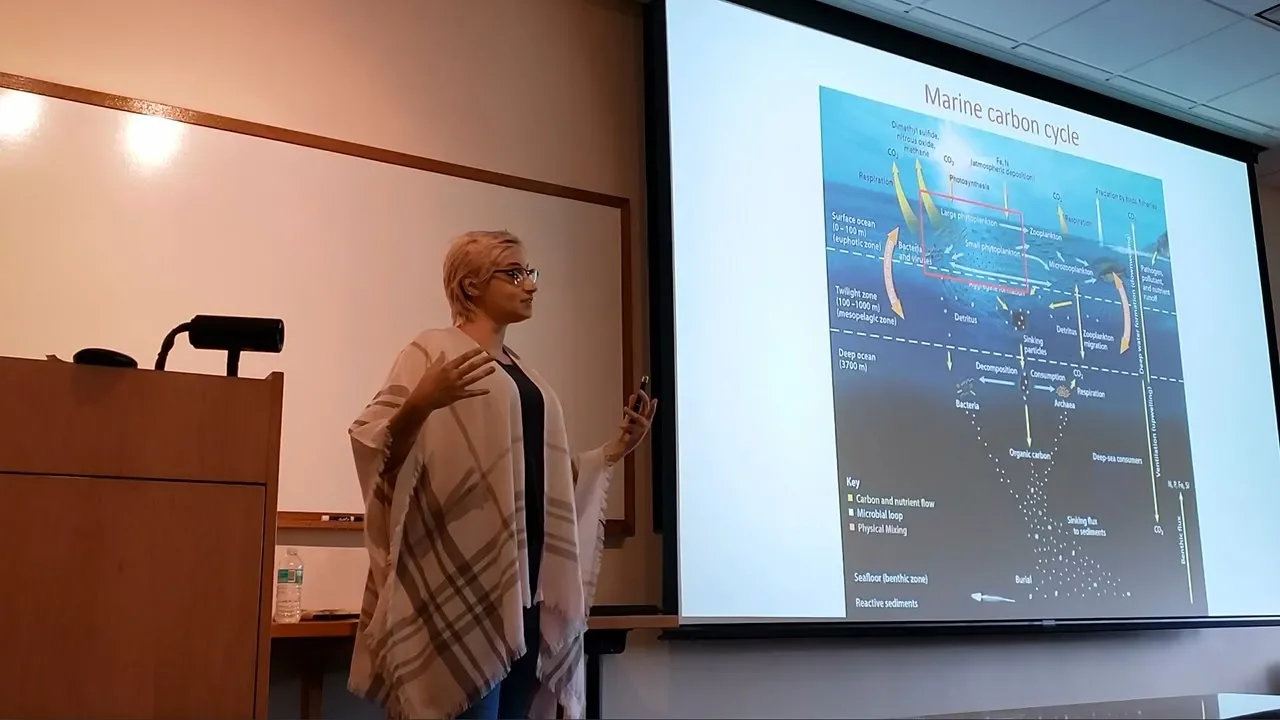
Um and macroalg forests and seaweed are super productive um per unit area per meter squared. Um, in some parts of the world they're more productive than terrestrial forests and people are really interested in harnessing this productivity to sequester carbon. So, they're super productive, but we currently there's a lot of knowledge gaps in our understanding of where all this fixed carbon goes, which prevents their inclusion in blue carbon policy frameworks. Um, so let's dig into the carbon cycle a little bit. Um, so blue carbon is just carbon that's stored in the ocean by marine primary producers. And so if we look at a giant kelp forest, um, kelp take up carbon dioxide from the seawater that gets sucked into the seawater from the atmosphere and then they, you know, grow super fast. And there's two ways that the kelp can get sequestered into the deep sea. Either the physical plant, uh, can float out to sea. And we know that bull kelp and giant kelp have floats. So they can float out and then sink to the deep sea and be sequestered in sediments. There's evidence from Edna that there's kelp carbon in the deep sea. So we know like pieces of tissue make it all the way into the bottom of the ocean that way. But then another important pathway for carbon sequestration is this dissolved carbon pathway. Um so what is that? Um so dissolved organic carbon or DOC for short is released by all um primary producers in the ocean and in freshwater. Basically algae are leaky and they leak a lot of carbon into the seawater and it's a question still whether they're they actively exude it but they also passively leak it. Um but it's important because um DOC is the largest pool of organic carbon in the ocean. There's more carbon in DOC than there is in all of the fish and living biomass. Um, and the pool of marine DOC is almost as big as the total atmospheric carbon pool. And it's mostly in like the pelagic, you know, all of the ocean. So there's a lot of DOC in the ocean. And um it's estimated that about half of all macrooal carbon is sequestered in this DOC form. Um, so this uh study estimated that about half of it makes it to the deep sea through DOC, but it was like very handwavy and based on only a few empirical measurements. Um, so I'm really interested in this pool of carbon, why kelp release it, and like where it goes.
Um, and one study that we did during uh, grad school is we just sampled seawater chemistry inside of kelp forests and we would motor outside of the kelp forest and take samples. And we did paired sampling on 27 days at three different locations and measured all different aspects of seawater chemistry, nutrients, and pH. And we found that the DOC concentrations were 50% higher inside of kelp forest than outside. So, I like to think of this like bubble of DOC existing around kelp forests, but how much doc is actually released by um bull kelp? So, I used um a stable isotope tracer method where I added 13C labeled bicarbonate um to these chambers and I put bulk blades in these chambers and floated them on a little raft in the ocean to keep them cold and mixing with the waves. Um, and I did these incubations um, um, with more than 50 different replicate blades during the day and at night and in different conditions. And I was really just trying to understand how much doc is being released. Um, and a cool thing about using the isotope tracer approach was that I was able to see that carbon go from the seawater into the solid kelp tissue and then it was released back into the seawater as 13C labeled DOC. So I could trace it through the kelp and and back out. Um and um I found that during the day, bull kelp released an average of about 16% of their fixed carbon as doc. So that's kind of a lot of carbon that they're just leaking into the seawater. And studies um in Southern California on giant kelp have shown a very similar percentage. It's about 15 or so percent.
Um, so they're leaking a lot of carbon and using the 13C tracer approach was cool because I was able to see that in these three to eight hour experiments, they released this carbon right away. So they took it up, fixed it with photosynthesis, and then dumped it. So for some reason, they're like dumping a lot of carbon um kind of rapidly.
So, um, we scaled up our measurements of carbon fixation and found that the productivity, annual productivity of bull kelp forests in Washington, where they're really dense, is as high as 2.35 kilograms of carbon per meter squared of kelp forest per year. But about 16% of that carbon is released as this dissolved carbon. And I'm really interested in studying the fate of all that carbon. It's some of its simple sugars like literally glucose and fucose and other sugars are released. Some of it's more complex like sulfated polysaccharides and those are the things that will stick along stick around longer in the ocean and contribute to carbon sequestration. So depending on like the type of molecules they're releasing it impacts where it goes and and like where it ends up if it goes in the food web or just gets respired by microbes.
Um, so in my new lab, I'm really excited to continue looking at the fate of this macroalgal dissolved carbon and particulate carbon in the nearshore ocean. And um, I'm interested in looking at how seawater microbes influence the metabolism of this carbon at different depths. Like I'm really excited to try to use the Monterey Canyon and collaborate with Embari and do some deep sea carbon cycling stuff. um because we don't know much about what happens to it in the deep sea. And there are numerous companies that have already started on the premise that they're going to grow kelp and sink it to the deep ocean. And um and we don't know what happens to it.
There's like almost no research on what actually happens to it when it gets to the deep sea and how does it get processed on the way down and how long will it even uh stay there. So I'm just interested in filling some of those knowledge gaps. Um yeah. So with that um my lab is interested in the feedbacks between climate change, primary producers, microbes and carbon cycling in the ocean and I will take any questions [Applause] here. That was a great talk. Um, I just had a methods question for you. in the first section when you're talking about nitrogen and temperature and kind of looking at decoupling and seeing how they influence um nurio and sugar kelp.
I was wondering um and you might have mentioned this, did you use in your lab experiments for nitrogen? Did you use a combination of ammonium and nitrate? Did you just stick with nitrate or did you do separate experiments to see how without the plants having to change nitrate into ammonium to use how that might affect what you saw? Yeah, that's a great question. I didn't have time to dig into the details, but we manipulated um seawater nutrients. We added um ammonium, nitrate and phosphate. And we tried to keep the nitrogen to fossius ratio like 16 to one like it's um to keep the ratio. But we added we tried to aim for like 30 micro moles of nitrogen in the high nitrogen treatment and like less than 3 to five in the low nitrogen treatment. Um it worked. It was hard because we were just calculating like based on the volume of seawater, this is how much to add. But we also didn't know what the starting value was because it was coming from the natural seawater.
And so um some of our treatments had higher nitrogen than we had intended.
And in the future, um, I'm going, well, so we started the experiments with the blades in the tanks and we let them draw down the nitrogen. And so in one day, they would suck out all of the nitrogen in these recirculating tanks. And then we would pipet it in every day and we would add more to the high nitrogen tanks than to the low nitrogen tanks.
Um, but I think in the future I would use different kelp, put them in the water, let them suck out like all of the nutrients and then start adding. Yeah, thank you.
Hi. Um, awesome talk and that was fascinating for me because I don't study this stuff at all.
Um but um my question is do you think the microbiome on the surface of the blades might impart any sort of benefit like the different microbiome might influence the heat tolerance for example of the kelp itself?
Yeah, that's a really great question. Um I don't think we're at that point yet of knowing how the microbiome influences their thermal tolerance. Um there was a recent study that came out where they tried to wipe out the microbiome on gitapytes and they found that the gitapytes had lower growth rates and like did poorly when they wiped out the microbiome. Um so I do think it's important but it's also so hard to manipulate the microbiome without also potentially having negative impacts on the kelp. So I haven't really done it in my studies. Um, people use like antibiotics or they use iodine, but like iodine isn't really great for the kelp either. So, it's super hard to manipulate and given that there's bacteria inside the kelp also like it's almost impossible to remove the microbiome entirely, but you can try to reduce it and then like do comparative studies. But yeah, that's a great question. I mean, potentially yes, but it's so hard to test that hypothesis.
Thank you. Um, awesome. Really cool results. I had a question about your first section when you were talking about the genomic or the genetic diversity of the different populations.
Did you identify any like genotypes for like thermal tolerance? And if so, like do you think it would be beneficial to like artificially select for those in those southern sites to kind of like build up that thermal tolerance because they have such low genetic diversity.
Yeah. So we we didn't do an analysis of temperature because we didn't have good temperature data from all the sites and we were kind of just doing a classic population genetics study of like what is the diversity and genetic structure.
But there's been some really cool work in Australia where they've related the genetics to the temperature at each site and found some potential links. Um, we did find that the like warmest sites just had really low genetic diversity and it was clear that those populations, first of all, I know from firsthand going out there and measuring them, the populations are shrinking over time. So, they're getting really small. The last time I went out to that Squaxon Island population, there were like 24 kelp left. So they I wouldn't use those populations um for restoration because we know the genetic diversity is really low. So like maybe they have some but when I grew the gapes across temperatures I did not find that the warmer sites had a greater resilience.
We were hoping to find that but we found that like pretty much across the board they responded similarly. So, I would pick a population that just has more genetic diversity.
Thank you. Yeah.
Um, I had another microbe question also.
This was really awesome and very thorough work. So, cool stuff. Um, microbe question. So, you said you saw bacteria inside the cells. I was curious if like you saw any of this associated with wounds at all or like tears in the kelp or if you noticed like any differences between like fresh blade versus cut blade in the microbes. So that's a good question. Um I the blades we used were like really good condition and annual bull kelp. So they're pretty clean of epipites and they're not very degraded. And I think that there weren't any tears in the blade until we made that cross-section and then you could see the microbes in it. Yeah. I also just saw another paper recently that did find bacteria inside from a different kelp species. So I do think it's a thing. Cool. Thank you. Yeah.
I have a question about the microbiomes of the kelp. I was curious. Did you see any like pathogenic microbes and things to be concerned about? I'm thinking about like our bull kelp restoration.
There's always concerns. We're growing kelp on land or at a farm, we're going to move it and out plan it. There's concerns that maybe there could be something bad that would come along with it. Yeah, totally. So, I did not find any like pathogens. It's so hard to know with microbes what is actually pathogenic because there's so much diversity. There's like hundreds to thousands of species on every kelp sample. And um and yeah, we didn't find anything that we thought was particularly pathogenic. And even those south puet sound sites that are really unhealthy. They had these hypermonia diera bacteria, but I like googled them and looked into it and it doesn't seem like they're pathogenic. They just are different. In fact, I think those bacteria like grow on little stocks into the water column so they can better access nutrients. So it might which might just be in it like reflecting the low nutrient environment in South Puget Sound. But I didn't see any pathogens really. Yeah, that's exactly what I want to hear. Uh but this is the caveat. We just don't know that much. We don't know like Yeah, I don't think we know that much about which um microbes are even pathogenic.
Yeah.
Yeah. Thank you. Um, that was all really fascinating. Um, and I I don't know, this may not be a question, but more an observation and maybe a a thought of whether you think this might apply to the kelp um, kelp microbe interaction system. Um, Christian Wild and Laura Ricks talk about coral mucus as being an important substrate for microbial communities on the surface of corals that then mediate that like the microbes are consuming dissolved organic material that is getting trapped in that coral and then that is feeding the sponge loop and other things in the coral reef ecosystem. And so thinking about you know your ideas about coral cycling and about you know the microbial communities on the surfaces do you think that that's a possible mechanism to explore in kelp forests? Yeah, I mean I think like we so when we did the imaging and the cross-sectioning like it's clear that the microbes are embedded in sort of the mucous layer and we did some staining for the mucus and I think it's in the imaging paper and so I think they are similar to corals in that the microbes are living in this mucousy layer. And something I didn't talk about was that um we imaged the microbiome of those South Puget Sound kelp from Squaxen Island and they had almost no microbes on them. They looked like the base of the kelp tissue and they were like super clean and we hypothesized that those kelp were really stressed and they're like sloing off their mucus and like shedding their microbiome. So we thought that the unhealthy kelp might have more bacteria, but they actually had less. So interesting. Yeah. Yeah, thank you.
Sounds like your kelp farming might be uh okay with microbes.
Yeah, awesome research. I'm gonna go back to the Squawken Island and you had those peaks in temperature above 16 during the summer. Yeah. And there's this observed population decrease. Do you think that thermal increase is affecting the fate of the zospores that are being released or do you think it's physiologically stressing the individual so it's not or not releasing as many zos spores as it normally would. Yeah, that's a really good question that um we're not sure. I did have a REU student at Friday Harbor that did an experiment where she put bulkelp sory in those warming tanks and we warmed the sory up to 20 degrees and then grew gitapytes from them and the gitapyes were still able to grow just fine from sory that had been warmed to 20. So, it didn't seem to have any negative impacts on the ability of the gitapytes to grow, which was actually really good news, but I didn't like look at spore release in the field or anything like that. Um, there was a student who did some of that work at Simon Frasier University in Canada and they looked at like spore release in the field and found it's just so variable.
Like every piece of sorus you take has pretty different spore counts. So, they found a lot of variability in their study. Yeah.
Um, so, uh, you pointed to an interaction effect when you looked at the Sacarina and, uh, kelp, uh, two species temperature by nitrogen experiment. Yeah. And you alluded to an interesting interaction effect there. I think at a glance I recall that like it was counterintuitive that like the enriched did poorer than the non-enriched. Is that right? Yeah, there was a there was one where the low nitrogen I think in the second experiment uh what is the Yeah, the low nitrogen kelp grew more they did better than the high nitrogen kelp. And um what's up with that?
We honestly did not have a great explanation for it. I think um I think so our low nitrogen well in these experiments the low nitrogen was pretty low. I think it was less than five micro moles but the high nitrogen we overshot and we were aiming for 30 but it ended up hitting like 80 micro moles. So, it's possible that the really high nitrate concentrations were somehow bad, but like that doesn't really make sense with other nutrient uptake studies. So, we were perplexed.
Too much of a good thing is too much. It happened in both experiments. Um, we had a Yeah, we had slightly higher growth in like the near turn rock low nitrogen compared to the high nitrogen. So, a little weird. Requires some follow-up experiments. I think I would do this again and try to have a hit the high nitrogen closer to 30 micro moles and then maybe deplete the low nitrogen even lower. I just think that the low nitrogen kelp still had enough nitrogen.
And with giant kelp, it's been shown they can grow on as little as one micro moles and we had like three to five. So, I think the low nitrogen kelp probably just still had enough nitrogen. So, yeah, but it's it's a little tricky to manipulate nitrogen levels um in seawater. We were starting with natural sea water and not instant ocean. So, it already has nutrients and you try your best to draw them down and then add it back. But yeah, but it was it was weird.
Um, yeah.
Storage. Yeah. Yeah. So, I do suspect how well does bull kelp store or for how long does it store nitrogen compared to giant kelp? Yeah, that's a good question. I mean, it's an annual, so weeks to months. But, um, yeah, we I I don't know that much about the storage particularly, but that's important for this Yeah, I think that they had internal stores and yeah, so if I were to do this experiment again, I would push the low nitrogen lower and um not go as high with the the high nitrogen. But there was a really clear effect of temperature though, which was pretty consistent and like interesting that even with high nitrogen, the blades still degraded at at high temperatures. So yeah. All right. Well, before we say thank you formally, I think um this is are there online questions? Okay. Um there is a great opportunity here for all of us in that Brooke is right down the street. She's been here since January and a lot of these people are going out in the field this summer as have you. And so invite her along or she also has reciprocally reciprocally no she has given all of you an invitation to come dive at Hopkins which some of you already are but I really uh suggest you take advantage of that opportunity of interacting with her and meeting her students. And on that note we want to say thank you. Thank you so much. All right.
I got
Up Next
21:22
Algae: An Introduction to Classification and Characteristics
@ProfGillesBolduc
36.4K views•2015-01-09
50:12
Bacterial Communication: Quorum Sensing and Biofilm Formation Explained
@JHUAAP
12.6K views•2011-06-28

5:35
Enteric Nervous System Explained: The Gut's Brain | Neurobiology Lecture
@alumniu6029
438 views•2018-09-12
7:08
Bacteriophages: Earth's Deadliest Killers and Future Antibiotics
@kurzgesagt
34.6M views•2018-05-13
Related Study Plans & Knowledge Roadmaps
Structured learning paths in Biology
biology
RNAi: Biogenesis, RISC & Gene Silencing
01Molecular Biology Foundations: DNA to Protein
02Introduction to RNA Interference (RNAi)
03Molecular Biogenesis of miRNA and siRNA
+ 2 more learning modules
10h5 modules
Explore Roadmap
biology
Mycorrhizae: Signaling, Biophysics & Ecology
01Foundations of Mycorrhizal Symbiosis
02Molecular Signaling and Root Colonization
03Biophysics and Bioenergetics of Nutrient Exchange
+ 1 more learning modules
11h4 modules
Explore Roadmap
biology
Circadian Clocks: TTFL, SCN & Periphery
01Foundations of Molecular Biology & Gene Expression
02Introduction to Chronobiology and Actograms
03The Core TTFL: Molecular Architecture of the Clock
+ 3 more learning modules
14h6 modules
Explore Roadmap
biology
Population Genetics: Math, Drift & Selection
01Genetic & Probability Foundations
02The Hardy-Weinberg Principle and Baseline Models
03Mathematical Modeling of Natural Selection
+ 3 more learning modules
18h6 modules
Explore Roadmap