















Dungeness crab is Oregon's most valuable single-species fishery, generating over $90 million annually and supporting coastal communities through a complex ecosystem dependent on wind-driven upwelling that brings nutrients to the surface, creating conditions for phytoplankton blooms that sustain the entire marine food web; however, climate change threatens this delicate balance by altering upwelling patterns and increasing harmful algal blooms that produce domoic acid, making crabs unsafe for human consumption.
Dungeness Crab Economics: Oregon Fishery and Climate Change
Added:Basic principles of supply and demand, particularly how fluctuations in harvest volume (e.g., record catches) affect market pricing.
Fundamental concepts of marine biology and ecology, including the life cycle of crustaceans and their dependence on specific ocean temperatures.
An introductory understanding of climate change indicators, specifically ocean warming, acidification, and their general effects on marine habitats.
The basics of fishery management, including concepts of sustainable yield, seasonal regulations, and the role of state and federal wildlife agencies.
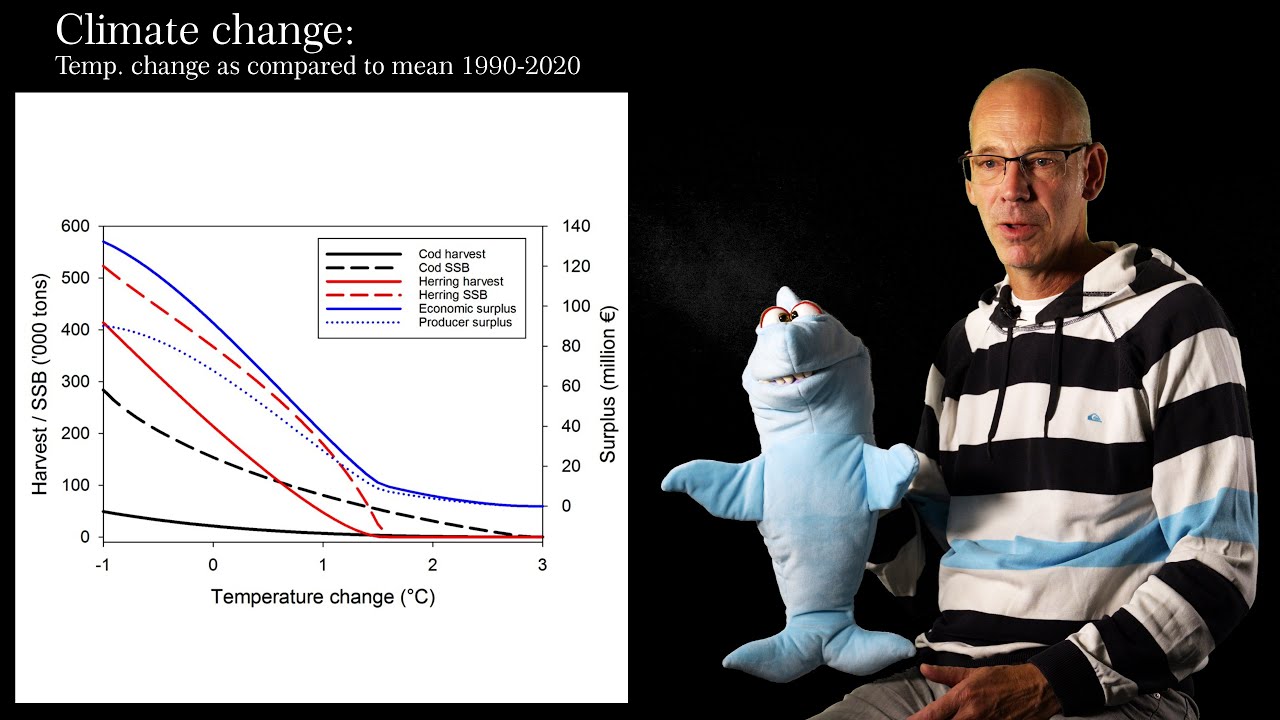
Advanced bioeconomic modeling used to predict fishery yields under various climate change and ocean acidification scenarios.
The analysis of seafood supply chain logistics and global market dynamics, exploring how local catches transition from 'sea to table' globally.
Economic diversification and adaptation strategies for coastal communities vulnerable to climate-induced disruptions in traditional fisheries.
The study of marine biotoxins (such as domoic acid) and the public health protocols required to monitor seafood safety amid rising ocean temperatures.
357.8K views3.5Klikes12:55Original Release: 2023-01-20
(playful music) (waves crashing) - It's intense.
(line whirring) The starting gun goes off and the boats go out no matter what's happening with the weather, and they catch the most crab they're gonna catch in the whole season in the first two weeks.
(playful music) - Last year was my worst crab season ever.
This year, my best crab season.
I guess it's kind of like gambling.
(playful music) (voices talking indistinctly) (gun firing) - It's luck of the draw 'cause you don't pick the crab so it can go either way.
But today's losers, tomorrow's lunch.
(playful music) (gun firing) (crab splashing into water) (water bubbling) (boat engine rumbling) - Dungeness crab is so important for Oregon coastal communities, and it's the most valuable single species fishery on the Oregon Coast.
Really on the West Coast in general.
(pensive music) No fishing family does just one fishery but almost all of them have some component of their fishing business that is connected with Dungeness crab.
- [Narrator] In the 2022 season, Oregon's fisherfolk brought in over 17 million pounds of Dungeness crab.
(forklift rumbling) That's over $90 million dollars paid at the docks.
(water dripping) (voices indistinctly talking) It's an astounding amount of crab caught, and every pound is hard won.
- The Dungeness crab fishery is a fairly dangerous fishery to be in.
That aspect of it does create a real sense of toughness, a sense of resilience, and part of who we are.
(suspenseful music) (waves crashing) - The reason I came out here was my oldest brother, his boat went down in Gold Beach, and so when he passed, you know, I came out for the service and you know, that was like when I reconnected with everyone here.
(line whirring) The ocean is chaos.
It's super dynamic.
Some years, there's a lot of crab.
Some years there's not very many crab or maybe the crab are just not there, not where you're at.
It's like chess out there, you know?
You're moving your pieces around, and if you don't have your finger on the pulse of what's going on in the ocean, you know, you can make the wrong move.
(lively music) - [Narrator] The game of crab is complex.
The board is huge and nothing is certain.
(lively music) Dungeness crabs can be found from the Aleutian Islands in Alaska all the way to Magdalena Bay in Mexico.
Its name comes from Dungeness Bay in Washington where the first commercial crab fishery opened in 1848.
The Northwest's shallow bays let in a lot of sunlight, perfect for aquatic plants like eelgrass.
These underwater meadows provide crabs with shelter from predators, allowing them to feast on shrimp, clams and whatever else they find on the sea floor.
(fisher speaking indistinctly) - [Fisherman] Yeah.
- [Narrator] But where do all those crabs come from?
Oddly enough, the wind. (playful music) - So much of our ecosystem on the Oregon coast really depends on what's called wind-driven upwelling, which is exactly what it sounds like.
You know, the wind seasonally blows from the north towards the south, and because the Earth is spinning, that means that the water closest to shore that's pushed by that wind ends up actually going offshore, and that pulls up water from the deeper depths that has more nutrients in it, and that fuels a bloom of phytoplankton, microscopic plants, that really forms the base of our entire marine food web.
- [Narrator] Upwelling is what makes the Pacific Coast one of the world's most productive ecosystems.
Those upwelled nutrients feed the algae that then feed fish, anemones and, of course, baby crabs.
(tranquil music) Before they become bottom dwellers, Dungeness crabs spend a few months offshore as floating larvae, eating algae, and other tiny things in the water.
But this all-you-can-eat buffet is sensitive to change.
(pensive music) Warming surface waters, like in El Niño events can result in weaker winds and less of an upwelling feast.
- It's all about the timing.
If they don't have food during that critical life stage, they just won't make it and they won't grow up into the crab that we then get to eat.
- Or the crabs survive into adulthood but won't be packing enough meat.
Another phenomenon that's thrown a wrench into crabbing seasons: domoic acid, a biotoxin produced by marine algae that blooms in warmer waters.
This toxin builds up in the ocean food web, and in Dungeness crab bodies, making them inedible to humans.
And warming water events like these are predicted to occur more frequently with climate change, wreaking havoc with Oregon's crabbing seasons, often delaying them for weeks.
(line whirring) (boat engine rumbling) But there are good years.
2021 to '22 was one for the record books.
Crabbing season started right on December 1st, the traditional opening day.
- This is by far the most valuable year that Dungeness crab has had in the history of the fishery.
I was actually just talking to a fisherman this morning.
They caught twice as much as they normally do, and they were getting twice the price that they normally do.
(lively music) (car driving past) And then we had all of the restaurants opening back up after lockdowns, and after all of the market disruptions.
There's really pent-up demand for being able to have, you know, a fancy crab dinner out at a restaurant.
You know, we all wanna go back out.
(lively music) - [Narrator] For many coastal Oregon towns, when everything aligns, and the ocean provides, the good times get cracking.
(upbeat music) (people cheering) (gun firing) (participants cheering) Welcome to the 35th Annual Garibaldi Crab Races.
- The crabbers were sitting around in the pub house, and they were bored, and wanted something to do.
So we've been doing it at the Old Mill ever since I've been involved since probably 2005, 2006.
(lively music) - [Narrator] Part fundraising event for the town, part enthusiastic love letter to the Dungeness crab.
(participants cheering) Very enthusiastic.
- If you touch the crab, you're eliminated.
(hands pounding) You pound on the track to get them to move.
First of all, you hope that your crab is in the sideways position because they walk sideways.
So you want them in that position, and then you can just smack your hand on the track and on the edge.
(lively music) We had one guy that had raced so many times that he broke his wrist.
(tranquil music) - [Narrator] About 900 people came to the event, and raised over $21,000 for the community.
The races are also a barometer for how well the Dungeness crab season is going.
Not counting the pandemic shutdown, there were a few canceled years caused by poor crab harvests.
- I can't remember when the last time was that they were able to have a crabbing season that would benefit them during the holidays.
I know when the word came down that they were going to be able to go out early, people were like, "Yeah.
They were all excited.
- [Narrator] And visitors came for the races but stayed for the crab dinner, served traditional with butter or as a crab melt.
- I love Dungeness crab.
It's been a staple in our family.
Maybe it's because it tastes like home.
(pensive music) - [Narrator] And the taste of home can mean a lot of things.
(water running) (people speaking in Mandarin) For the folks at Sibeiho, a supperclub in downtown Portland, Dungeness crab is the inspiration for recreating an iconic Singaporean dish.
- Oregon's bounty is amazing.
(crab breaking) Pat took me down to the coast, and then we just saw crabs, and originally, we were just eating as the Americans who eat them, like with butter and stuff.
And we're like, let's just make chili crabs.
(crab cracking) (pensive music) We wondered if anybody will pay us to to cook crabs.
That's how we started our supperclubs.
- Sibeiho means damn fucking good, you know?
And this is a swear word, you know, that we use a lot in Singapore but if anything is good, we say that is Sibeiho.
- In general, if you can make good pasta sauce, you can make good chili crab.
(oil frying) Usually we use ginger to flavor the oil first, and then you put sambal inside.
- [Narrator] Sambal being Southeast Asian chili paste.
- And once the sambal starts caramelizing, then we put in the tomato sauce.
When you make pasta sauce, it's bubbling up, that's when you know it's kind of ready to pour over your pasta, right?
So at that point in time is when you put in the crabs, and then wait for a while while the crab continues to cook, and kind of releases its juice into the sauce.
- [Narrator] And an egg on top.
(egg cracking) - You're getting like ribbons of egg inside your pasta sauce.
And once you get that, then you're pretty much very ready to serve.
(upbeat music) (tranquil music) (diners chatting indistinctly) I think when we were growing up, with chili crab, it's always, we associate it as when visitors come to visit us.
That's when we get to eat it as a special occasion meal.
It's a messy meal, it's not a meal that you'll go on a date, and be fine dining with.
(Holly chuckling) One of the supperclubs that we did, we thought we had cleaned up the apartment but we were finding crab shells about two weeks after the whole dinner was done.
(pensive music) (waves crashing) - A year like this in the Dungeness crab fishery can make a really big difference through the whole community.
I mean, it's people being able to donate at the, you know, PTA fundraiser, and sponsoring the Little League teams, and things like that that you don't think of as connected to fishing.
- [Narrator] It takes a lot of work, and luck to bring these crustaceans from the sea floor to your dinner plate.
And year after year, through the ups and downs, Oregon's coastal communities keep the faith.
- Isn't it the saying is that the tide is out and the table is set, right?
So you have this stability of that food resource along the coastline, kind of wherever you go.
And crabs are just a little deeper than that, (Amanda chuckling) but available, you know, superabundant.
(tranquil music) - [Arya] I'm series producer Arya Surowidjojo, and we had a blast bringing you these stories about Dungeness crab.
Our voyage from sea to kitchen is only possible because of OPB'S members.
Thank you.
Dig deeper into Pacific Northwest foods, and get the best of the region's bounty delivered straight to your inbox with our weekly Superabundant newsletter.
Sign up now at opb.org/superabundant.
(tranquil music)
Up Next
56:36
Coral Reef Ecosystems: Human Impact and Conservation
@uctv
17K views•2015-01-06

12:54
Triumph of Orthodoxy Icon: Byzantine Art & History Explained
@BenCallan
2.1K views•2024-08-06

9:49
FastAPI vs Flask vs Django: Choosing the Right Python Web Framework
@TechWithTim
302.5K views•2024-05-26

1:42
Game of Thrones Opening Credits: A Cinematic Analysis
@gameofthrones
46.3M views•2011-04-18
Related Study Plans & Knowledge Roadmaps
Structured learning paths in General & Interdisciplinary Studies
general-studies
Elevator Engineering: History, Physics & Cities
01From Hoists to Safety Brakes: The Dawn of Vertical Lift
02Hydraulic vs. Traction: The Engineering Physics of Elevators
03Modern Speed, Safety, and Algorithms
+ 2 more learning modules
12h5 modules
Explore Roadmap
general-studies
Rubber: Material Science, History & Geopolitics
01Origins of Natural Rubber & Mesoamerican History
02The Chemistry of Natural Rubber & Vulcanization
03The Geopolitics of the Rubber Boom & Colonization
+ 2 more learning modules
12h5 modules
Explore Roadmap
general-studies
Containerization: Evolution, Logistics & Trade
01Ancient Trade & Bulk Cargo: Amphorae to Barrels
02The Industrial Revolution & Cardboard Packaging
03The Containerization Revolution: Malcom McLean
+ 2 more learning modules
12h5 modules
Explore Roadmap
general-studies
Textile Tech: Evolution, Labor & Global Impact
01Pre-Industrial Textiles: Handloom & Cottage Industry
02Mechanization: The Spinning Jenny to the Power Loom
03The Factory System & Global Labor Transformation
+ 2 more learning modules
10h5 modules
Explore Roadmap