













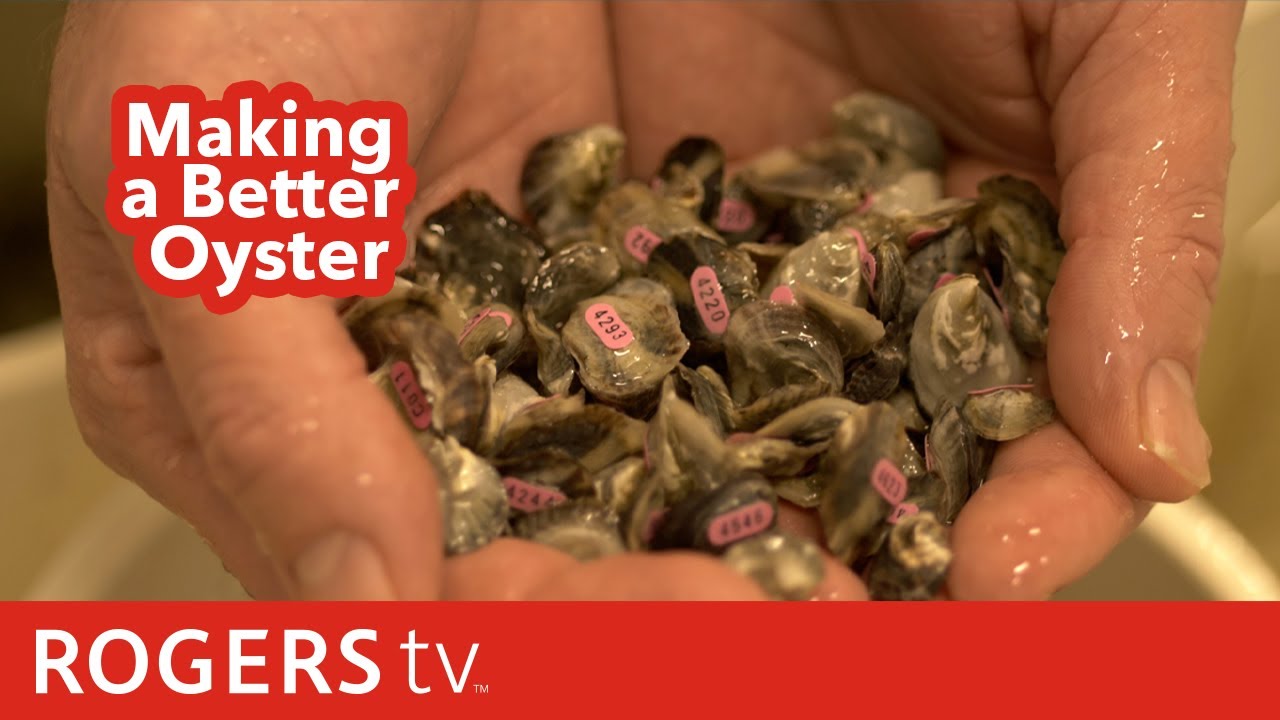

![What does a shellfish and oyster expert research? [Bite Scized Conversations with Dr. Tim Green]](https://i.ytimg.com/vi_webp/gTuTQHn_E3Q/maxresdefault.webp)
Ocean acidification, caused by increased atmospheric CO2 dissolving in seawater and lowering pH, threatens marine organisms that build shells (such as oysters, clams, and corals) by reducing carbonate ion availability needed for shell formation; this phenomenon is particularly severe along the Oregon coast due to upwelling systems bringing naturally acidic deep water to the surface, causing significant economic losses to the $110 million Pacific Northwest oyster industry and potentially disrupting entire marine food webs.
Ocean Acidification on the Oregon Coast: Impacts and Science
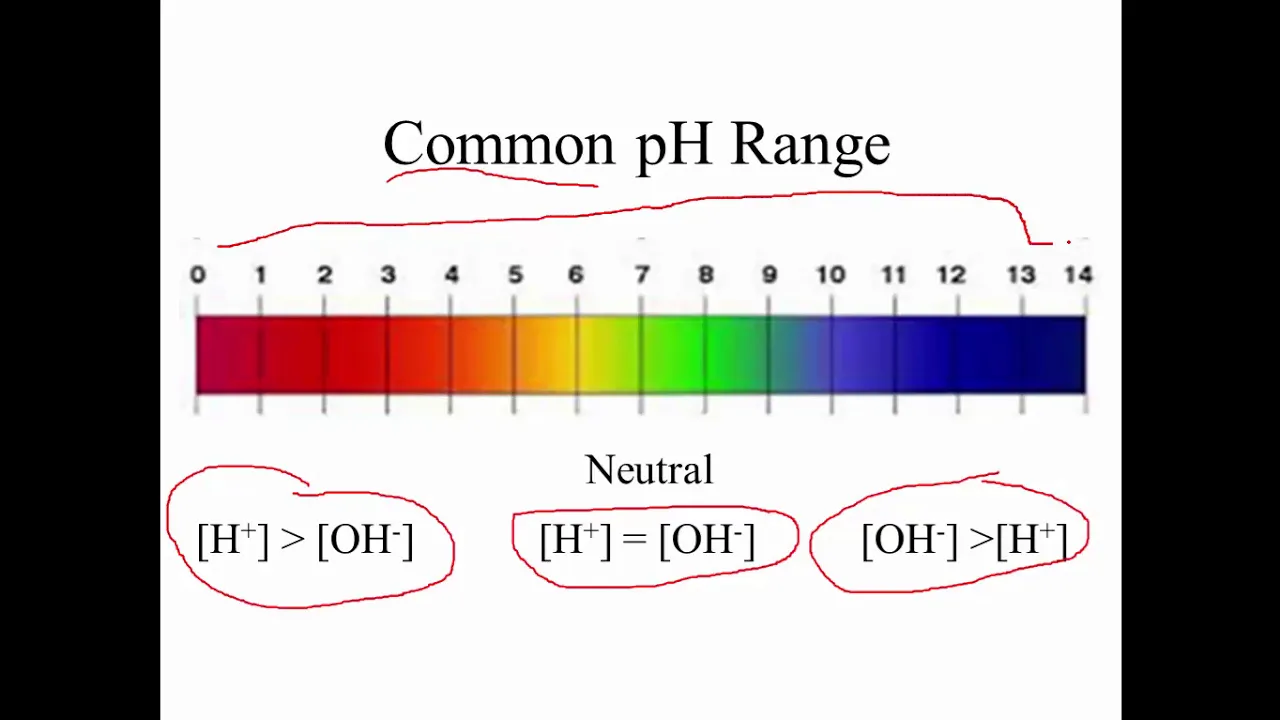
Added:The chemical definition of pH, acidity, and the logarithmic scale of acid-base chemistry.
The global carbon cycle, specifically the mechanism of how atmospheric carbon dioxide (CO2) is absorbed by and dissolves into seawater.
The biological process of calcification, explaining how marine organisms like oysters and mussels use calcium carbonate to build their shells.
The basics of coastal upwelling systems, which naturally bring deep, nutrient-rich, and CO2-dense water to the Oregon coastline.
Local adaptation and mitigation strategies in aquaculture, such as chemical monitoring and buffering in shellfish hatcheries.
The socio-economic consequences of declining fisheries on coastal communities, indigenous cultures, and local economies.
The concept of 'Blue Carbon' and the role of marine vegetation, like seagrasses and kelp forests, in local ocean acidification mitigation.
Genetic and evolutionary biology studies focusing on breeding ocean acidification-resilient strains of commercial shellfish.
82.2K views398likes12:12Original Release: 2016-01-21
We have an incredibly productive ocean. When we go out there and do our research, when I'm waiting for an instrument to come up, I can see salmon jumping. Which is, that's amazing. This issue of ocean acidification, it threatens that ability to rely commercially on these resources, and also to reply on them recreationally and socially and culturally.. About 25-30 percent of the CO2 that's released from fossil fuel combustion ends up in the ocean. That lowers pH and it also changes something we call saturation state which is the corrosivity of that water.. Based on the chemistry of the water and how marine life responds to chemistry the kinds of organisms that we think are most vulnerable are the ones that build a shell, so oyster shell, clam shells and corals. I think the things that are most important for the public to understand is that what this issue is threatening is some of our food supply. There are people's livelihoods and generations of watermen who rely on producing oysters and other shellfish. So, we talk about ocean acidification, what we're talking about is the change in carbonated chemistry of the ocean due to the increase in atmospheric CO2 from fossil fuel combustion as well as other local processes that change that chemistry, so the issue comes in is that we're changing that chemistry faster than we have in the last million years of earth's history and that's having predictable consequences on the chemistry as well as consequences on the organisms we're just starting to understand now. So we've identified the Oregon coast as one of those early impact systems, so how chemistry is already changing, and it's changed dramatically. The waters that reached Oregon's coast. If you stand on the coast and look out and see the great blue expanse, you think oh that's just one big bathtub of water. You\'92re not quite sure what\'92s there or where it's coming from, but over the years we understand very well how that water gets there, and that water reaches Oregon's shore from far across the north Pacific off from the northeast of Japan, actually. When it's at the atmosphere, ti gets the oxygen and the CO2 from the atmosphere mixed into it. It's cold enough there that the water gets dense or heavy and it sinks down to beneath the waves to about a couple hundred meters and starts this long journey across the north Pacific, and there are actually two branches.
One of them comes across the northern gulf of Alaska. Another one takes this amazingly convoluted route. Along that path, the oxygen gets lower, the CO2 goes up, the pH goes down.
It gets more acidic before it reaches Oregon's shores. If you think about the rising CO2 levels in the atmosphere, the water we're seeing at depth off Oregon has the signature of many decades ago. Even if we absolutely stop at CO2 emissions today and cap the atmospheric levels, there's still a 30-50 year increase we're going to see before that carbon at least along our coast works its way out. The effects that we're seeing, the changes that we're seeing in the chemistry of the ocean, that affects everything there: all living things and nonliving things also are changing it in ways that are going to adversely affect the things people care about because it's affecting the creatures that live there and their habitat. (Wind blowing, laughing). The oyster industry in the Pacific Northwest has already seen significant losses in production at oyster hatcheries, and so what it's meant to the oyster industry is an approximate 110 million in production losses. OSU is really sort of been a leader on this topic, and it's a bit out of necessity, and so the Oyster industry really contacted Brooke Hales and myself to understand what was happening in these oyster hatcheries and try to explore what's driving these problems and so, because this upwelling system starts with CO2 levels that are higher to begin with and puts us closer to these thresholds to the organisms, they've had to deal with these problems kind of right off the bat, and so we've had this really productive industry-academic partnership that has allowed us both to provide information and applied research to let the industry increase production and deal with some of those losses in different mitigation-adaptation strategies, but also do some really good fundamental research on understanding those responses.
At whisky creek in about 2007, suddenly the hatcheries where they produce the tiny larval oyster that are sold to the growers that actually produce the commercial product the hatchery was unable to produce those. They could not meet their demand and effectively they were producing no commercially viable larvae. When we first saw this problem, of course we never seen anything like this there before where you lose all the larvae in the hatchery on a given day, we saw some die-offs that we'd never seen before, and it really scared us.
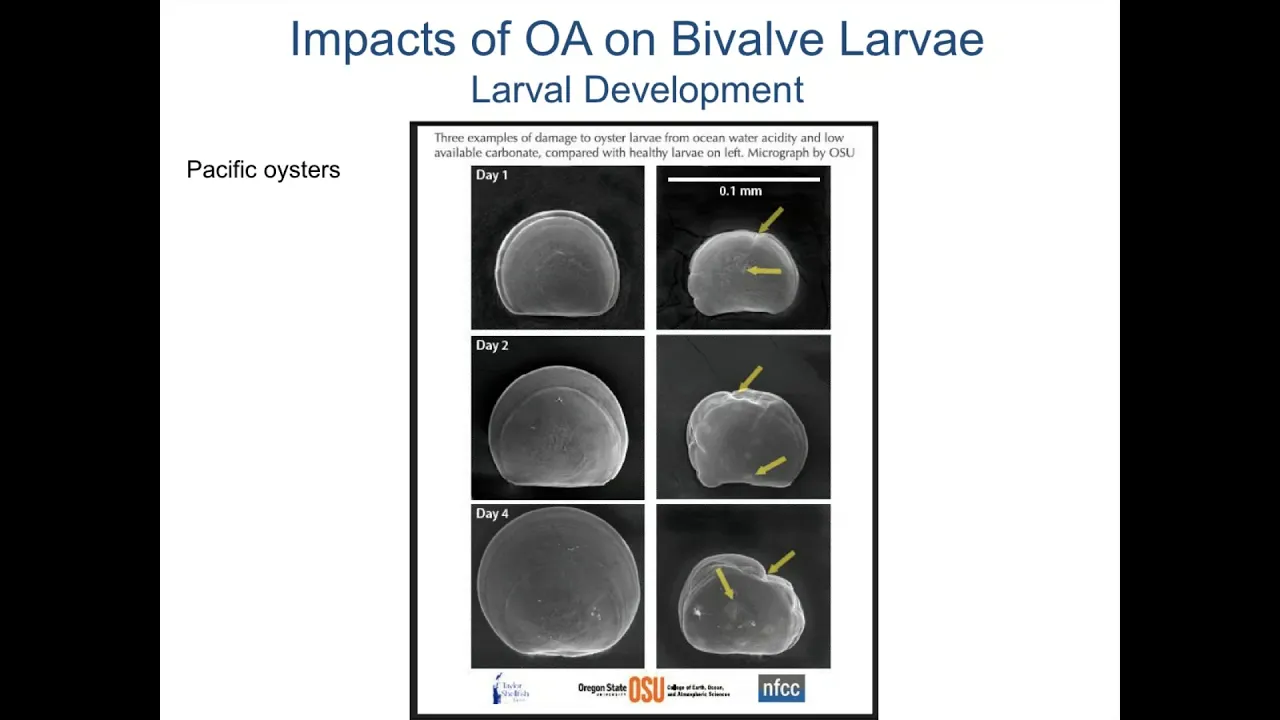
What we found was that what almost entirely determined the success of a hatch of the spawn was the carbonite ion or the shell mineral stability in the water in which they were spawned, and so it was a very narrow window of time, the first 48 hours of life of these organisms seemed to entirely predict how they would do two weeks later. What's happened here is basically we have to deal with ocean acidification, and simply, and it's not to say that all the water we pump in is bad, it's just that when conditions are right you get upwelling and whatnot then you bring up this low pH water, and you're bringing up water that basically larvae don't like and it\'92s very difficult if not impossible to grow in that type of water without somehow altering the water as it gets into the tanks.
Just because we've done a few of these things, by no means, I mean I I think we're just scratching on the surface of this problem, and I think at least in my lifetime that we'll still be trying to figure it out and probably long after I'm dead. I think it's gonna be something that people are going to struggle with and try to make better. One other canary in the cole mine is a pteropod. These are very delicate, beautiful, elaborate, swimming snails. They are important in their own rite as members of zooplankton communities, but they are also a very highly prized food for salmon. There's some really good work going on now that shows pteropod effects in the environments now without experimental manipulate, and we're seeing the shells of the pteropod partially dissolved. Ocean acidification may actually disrupt the ability of some of these microorganisms to assimilate nutrients. We're beginning to pick up some of those more subtle impacts, and it's scary. The impacts of having these kinds of changes happen on such a large scale and in the event that they became catastrophic are really more than just economic. Clearly it affects my ability to do business here, to sell local fish if the supply is diminished or threatened in that way, and of course everybody else who is involved in that: the entire fleet that goes and catches the support services here, the supply stores, the ice purveyors, the transportation providers, but it really impacts you on another level because for somebody like myself who who considers themselves a third-generation commercial fisher, even though I don't go out and ply the waters every day anymore, it's really your kind of your legacy and culture. There's a whole identity here for us on the coast that are in this industry that we have a lot of pride in, and it's something that would be impossible to replace. We haven't seen thinner shells in crabs yet, but I believe that we better watch for it. If nine out of ten scientists of pretty good reputation are all telling us the same thing, why is so hard not to believe them or give it a shot. What if we're wrong and we don't react appropriately?
Things are going to change. Big time. We have an obligation, I think to do what we can do to understand and mitigate damages and correct trends that are negative, you know, our existence might rely on this. We don't know. We know that these impacts are happening. What we don't know and what we need to know is what's happening to the ecosystem at large.
We anticipate and are concerned about impacts to fish. We're concerned about impacts to crustaceans like crab and shrimp, but we need more research. And what we know now is that some of the species that are low on the food chain are being impacted. And that implies that there are ecosystem-wide, food-web-wide impacts that we're going to start to see.
We're going to see changes in chemistry that the rest of the ocean won't see for decades and decades. On the one hand we're going to be the hardest and first hit, but on the other hand, I think it's important what we learn today in Oregon's coastal waters, that is invaluable. There's really no substitute for the kinds of information that we're going to gain by understanding our ocean. There's no substitute for that.
Up Next
21:35
Ocean Acidification in Washington: Dr. Shallin Busch
@TEDx
25.7K views•2013-05-02

15:54
Life in Biosphere 2: Sustainable Ecosystems & Human Survival
@TED
334.9K views•2009-06-16
14:30
Microplastics Everywhere: How Plastic Impacts Our Lives
@TEDx
100.9K views•2018-05-08
10:28
Ice Stupa Artificial Glaciers: Solving Ladakh's Water Crisis
@SonamWangchuk66
3.2M views•2015-05-03
Related Study Plans & Knowledge Roadmaps
Structured learning paths in Environmental Science
environmental-science
Ocean Noise: Cetacean Impacts & Mitigation
01Fundamentals of Underwater Acoustics
02Marine Mammal Bioacoustics
03Anthropogenic Noise: Shipping & Seismic Surveying
+ 2 more learning modules
16h5 modules
Explore Roadmap
environmental-science
Road Ecology: Corridors, Overpasses & Fencing
01Foundations of Habitat Fragmentation and Carnivore Ecology
02The Road Barrier: Ecological Impacts of Transport Infrastructure
03Principles of Ecological Corridors and Connectivity Mapping
+ 3 more learning modules
14h6 modules
Explore Roadmap
environmental-science
Ocean Acidification: Kelp Buffering & Shellfish
01Fundamentals of Ocean Chemistry & pH
02Chemical Pathways of Coastal Acidification
03Bivalve Physiology & Calcification Under Stress
+ 2 more learning modules
18h5 modules
Explore Roadmap
environmental-science
Ice Stupas: Glacial Retreat & Water Security
01Foundations of Glaciology & Mountain Hydrology
02Climate Change and Glacial Retreat Dynamics
03The Science of Ice Stupas & Artificial Glaciers
+ 2 more learning modules
14h5 modules
Explore Roadmap