The NIST Atomic Spectral Database provides access to atomic energy levels by searching for elements using their chemical symbol and ionization state (e.g., Na for neutral sodium, NaII for singly ionized sodium), displaying energy levels in electron volts with the lowest energy assigned a value of zero; for example, sodium's ground state is 3S₁/₂ with energy levels including 2P₁/₂ at 2.102 eV and 2P₃/₂ at 2.104 eV, followed by excited states such as 4S₁/₂ at 3191.3529 eV.
Using NIST Atomic Spectra Database for Energy Levels
Added:Deep Dive
Basic atomic structure and electron configurations, particularly for alkali metals like sodium.

Exam 1 Review Session
118
Neutral atoms have equal protons and electrons for charge balance. Alkali metals are in Group 1A. Electron configuration shows electron distribution: 1s² 2s² 2p⁶ 3s¹ for sodium (11 electrons). Electrons fill orbitals in energy order: 1s, 2s, 2p, 3s. Valence electrons equal group number for main group elements. The octet rule states atoms typically want 8 valence electrons, except hydrogen and helium which are stable with 2.
Click to watch →

كيمياء الصف الأول الثانوي الفني الترم الثاني ٢٠٢٦|عناصر المجموعة الأولى الصوديوم وطريقة دونز
411
Sodium (atomic number 11) has configuration 1s² 2s² 2p⁶ 3s¹, with 2 electrons in first level, 8 in second, and 1 in third. Potassium (atomic number 19) has 1s² 2s² 2p⁶ 3s² 3p⁶ 4s¹, with 2, 8, 8, and 1 electrons respectively. All alkali metals have exactly one electron in their outermost shell, making them monovalent. This single valence electron is easily lost during chemical reactions, explaining their high reactivity.
Click to watch →

CLASS -9| SCIENCE| UNIT-11| ATOMIC STRUCTURE| ANSWER VERY BRIEFLY| Answers
4K
The electronic configuration of alkali metals (Lithium, Sodium, Potassium) follows the pattern of having one valence electron in their outermost shell, which makes them highly reactive; Lithium has configuration 2,1; Sodium has 2,8,1; and Potassium has 2,8,8,1, where the numbers represent electrons in each energy shell.
Click to watch →

GRADE-11 | CHEMISTRY | UNIT-5 | ALKALI METALS | 17-10-2020 | 2.00 P.M
114
Alkali metals have a characteristic electronic configuration with a single valence electron in their outermost shell, represented as ns¹. This configuration makes them highly reactive as they readily lose this electron to achieve a stable noble gas configuration. Lithium (atomic number 3) has configuration 1s² 2s¹, sodium (11) has 1s² 2s² 2p⁶ 3s¹, potassium (19) has 1s² 2s² 2p⁶ 3s² 3p⁶ 4s¹, rubidium (37) has 1s² 2s² 2p⁶ 3s² 3p⁶ 4s² 3d¹⁰ 4p⁶ 5s¹, and cesium (55) has 1s² 2s² 2p⁶ 3s² 3p⁶ 4s² 3d¹⁰ 4p⁶ 5s² 4d¹⁰ 5p⁶ 6s¹.
Click to watch →

Easy Kill Inorganic Questions | Must Watch Before JEE April Attempt | Nabamita Ma'am
28.7K
Alkali metals have electronic configuration of (n-1)s² (n-1)p⁶ ns¹. For example, sodium (Na, atomic number 11): 1s² 2s² 2p⁶ 3s¹. This pattern shows one electron in the outermost s-orbital with completely filled inner shells.
Click to watch →
Deep Dive
The concept of quantized energy levels in atoms, including ground states and excited states.

نموذج بور للذرة - تكمية الطاقة - الفيزياء 3 (3-3) - المرحلة الثانوية
173
Energy levels in atoms are quantized, meaning they can only take integer values (n = 1, 2, 3, 4...) and cannot take fractional values. The nucleus sits at the center with discrete energy levels surrounding it. The ground state is the minimum energy state with electrons closest to the nucleus. An excited state occurs when electrons move to higher energy levels farther from the nucleus. As electrons move to higher levels, the atom becomes excited and its energy increases. The energy levels can be compared to a ladder where each step represents a quantized energy state.
Click to watch →
Excitation and Ionization Potential, Physics Lecture | Sabaq.pk
16.2K
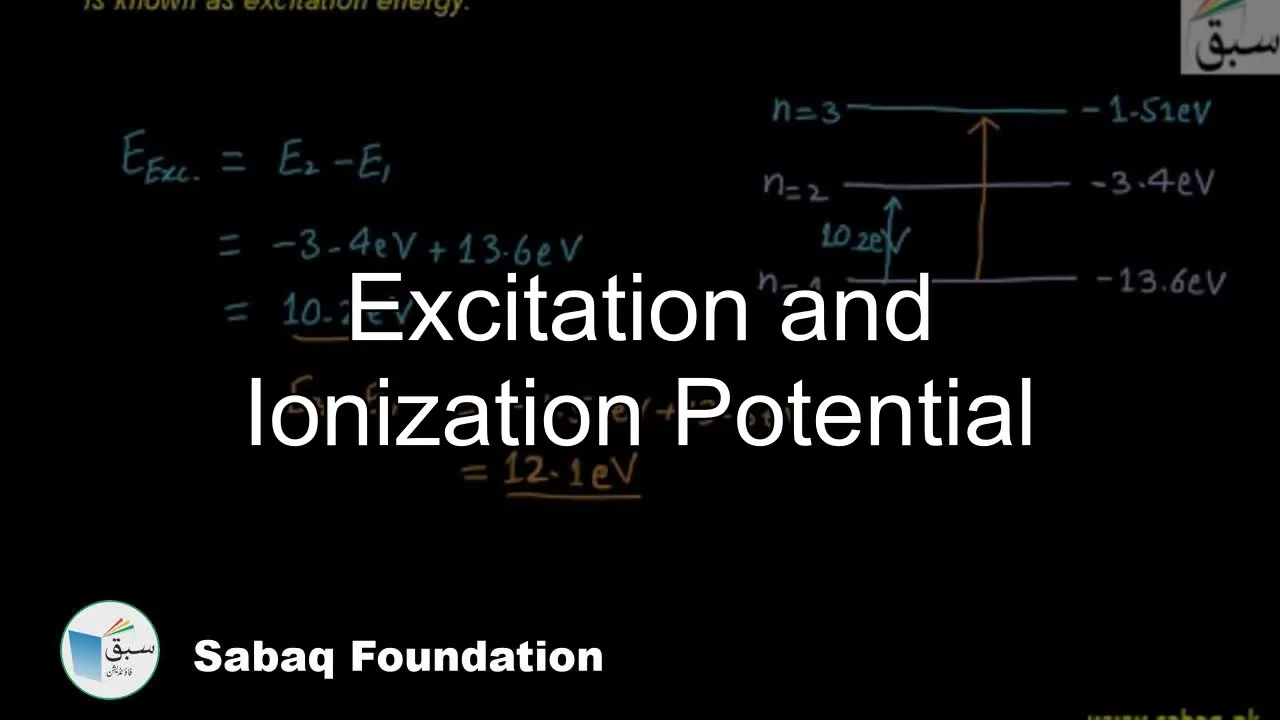
According to Bohr and quantum mechanical models, electron energy in atoms is quantized, meaning electrons occupy only specific discrete energy levels. The energy equation E = -13.6/n² eV for hydrogen shows energy depends on the principal quantum number n. The ground state (n=1) is the lowest energy configuration, while excited states (n=2,3,4...) have higher energies. The energy difference between states determines the excitation energy required for electron transitions.
Click to watch →

lumière onde particule
1.4K
Atoms exist only at specific, discrete energy levels rather than having continuous energy values. For hydrogen-like atoms, these quantized energy levels are approximately -13.6 eV, -3.4 eV, -1.51 eV, and -0.85 eV. The lowest energy state is called the ground state, while any higher state is an excited state. Atoms in excited states are unstable and tend to return to lower energy states. This quantization of atomic energy levels is fundamental to understanding how atoms interact with electromagnetic radiation and forms the basis for spectroscopic analysis.
Click to watch →

1ère Spé. La lumière : onde et particule (le cours)
6.1K
According to quantum mechanics, atoms have discrete, quantized energy levels rather than continuous energy states. An atom can only exist at specific energy values, with other values being forbidden. The lowest energy state is called the ground state (most stable), while higher energy states are called excited states. By convention, the energy of the highest excited state is set to zero, meaning all lower energy levels have negative values indicating they are more stable than the highest excited state.
Click to watch →

11 Chap 2: Atomic Structure 05 | Bohr's Theory - 2 | Total Energy of Revolving Electron - JEE/NEET
331
The ground state occurs when the electron is in the lowest energy orbit (n=1), which is the most stable configuration. An excited state occurs when an electron absorbs energy and jumps to a higher orbit (n > 1). The first excited state corresponds to n=2, the second excited state to n=3, and so on. For hydrogen, ground state energy is -13.6 eV, first excited state is -3.4 eV, and second excited state is -1.51 eV. Electrons can only occupy specific discrete energy levels (n=1, 2, 3, etc.) and cannot exist at energies between these levels. This quantization is a fundamental property of atomic systems. For excited states, the principal quantum number n equals the excitation number plus 1.
Click to watch →
Deep Dive
Familiarity with the electron volt (eV) as a standard unit of energy in atomic physics.

COURS UE1 TERMINALE 01.11.2021 ATOMISTIQUE BY BENJAMIN KUROWER
406
The electronvolt (eV) is the standard energy unit in atomic and nuclear physics. 1 eV is the energy gained by an electron accelerating through 1 volt of potential difference. 1 eV = 1.609 × 10^-19 joules. This unit is convenient because atomic energy scales are much smaller than typical joule values.
Click to watch →
Atom-1
127
The electron volt (eV) is a convenient unit of energy used in atomic physics, defined as the energy gained by an electron when accelerated through a potential difference of one volt. 1 eV = 1.602 × 10^-19 joules. This unit is particularly useful because atomic energy levels are typically on the order of electron volts, making calculations more manageable than using joules.
Click to watch →

New Experimental Light Research shows the Standard Model is Seen to be Correct....Mostly
2K
The electron volt (eV) is the standard unit of energy in atomic and nuclear physics. It equals the energy gained by an electron when it moves through an electric potential difference of one volt. As charged particles travel faster through different media or collide with harder surfaces, they gain more energy. The electron volt measures this energy gain.
Click to watch →

Le spectre atomique ( partie 5)
5.2K
The electron volt (eV) is a convenient unit of energy used in atomic physics. One electron volt equals 1.6 × 10⁻¹⁹ joules. This unit is particularly useful because atomic energy levels are typically on the order of electron volts rather than joules.
Click to watch →
Physik B2 210415 neu
471
The electronvolt (eV) is a convenient unit of energy in atomic and nuclear physics. One electronvolt is the energy gained by an electron when accelerated through a potential difference of one volt: 1 eV = 1.6 × 10⁻¹⁹ J. This unit is useful because atomic energy levels are typically in the range of a few eV, making calculations more convenient than using joules.
Click to watch →
Deep Dive
The fundamental relationship between atomic transitions and the emission or absorption of electromagnetic radiation (E = hν).

Characterization of Electromagnetic Radiation -Part1(June 2016)
1K
Electromagnetic radiation originates from atomic transitions between energy states. When an atom absorbs a photon with energy Hν, it transitions from ground state e1 to excited state e2, following e2 - e1 = Hν. The frequency is ν = (e2 - e1)/H, where H = 6.64 × 10^-34 J·s. Excited states persist briefly (≈10^-8 s for simple atoms) before emitting photons back to ground states. This absorption-emission cycle defines electromagnetic radiation as the form of energy transfer, with frequency determined by energy differences divided by Planck's constant.
Click to watch →

Bohr atomic model | Atomic structure | IIT JEE & NEET | Vineet Khatri Sir | ATP STAR Kota
104.3K
When an electron moves from a higher energy level to a lower one, it emits energy as electromagnetic radiation. The energy difference (ΔE) between levels equals the photon energy (ΔE = hν). Conversely, when an electron moves from lower to higher energy level, it absorbs energy equal to the difference. The wavelength of emitted/absorbed radiation can be calculated using ΔE = hc/λ, where h is Planck's constant and c is the speed of light.
Click to watch →
Lecture 1- Bohr Atomic Spectra of Hydrogen atom and its Postulates. Absorption and Emission Spectra
131
The energy of electromagnetic radiation emitted or absorbed during electron transitions in atoms is directly related to the frequency of the radiation. This relationship is described by the equation E = hν, where E is the energy difference between the two states, h is Planck's constant, and ν is the frequency of the radiation. When an electron jumps from a higher energy state to a lower energy state, it emits radiation with a frequency determined by the energy difference between those states. Conversely, when an electron absorbs radiation, it jumps from a lower to a higher energy state, with the absorbed radiation's frequency corresponding to the energy difference. This relationship explains why different elements produce different spectral lines: each element has a unique set of energy levels, and the transitions between these levels produce radiation with specific frequencies that are characteristic of that element. The frequency of the emitted or absorbed radiation is thus a direct measure of the energy difference between the atomic states involved in the transition.
Click to watch →

Absorption and emission | Electronic structure of atoms | Chemistry | Khan Academy
245.7K
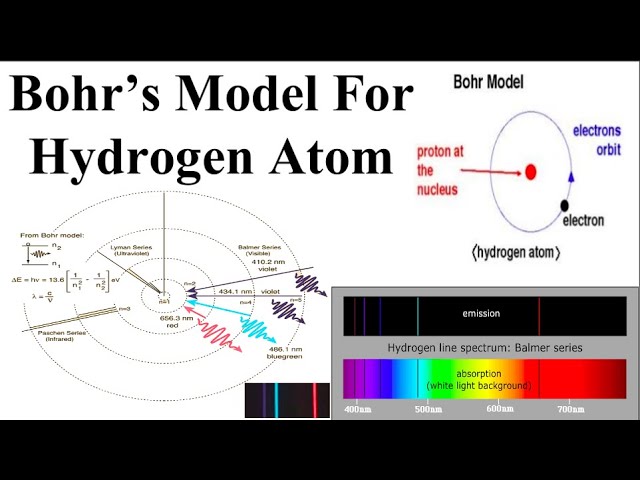
In the Bohr model, hydrogen electrons occupy discrete energy levels. Absorption occurs when electrons absorb energy and jump to higher levels (excited states). Emission happens when electrons fall back to lower levels, releasing photons. The photon energy equals the energy difference between levels. Using E = hν and c = λν, we derive E = hc/λ, showing photon energy is inversely proportional to wavelength. This fundamental relationship connects atomic structure to observable light properties.
Click to watch →
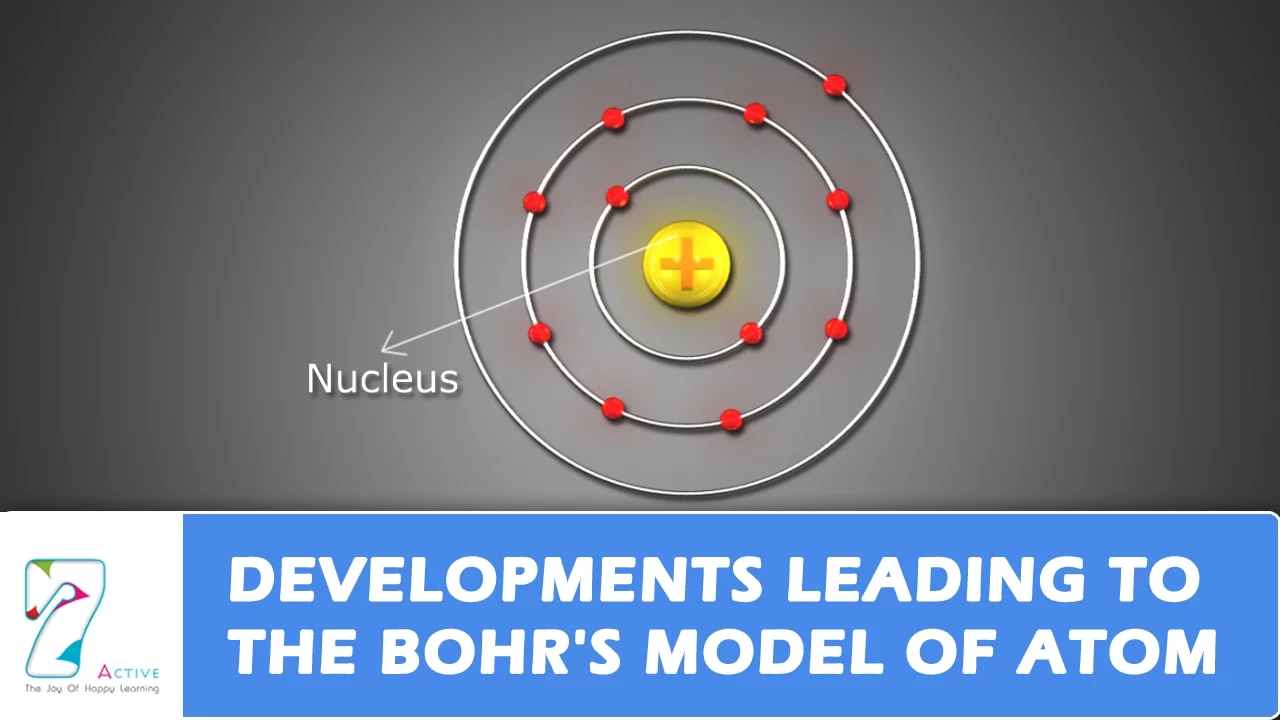
DEVELOPMENTS LEADING TO THE BOHR'S MODEL OF ATOM
72.5K
Energy is emitted when an electron jumps from an outer orbit to an inner orbit, and energy is absorbed when an electron jumps from an inner orbit to an outer orbit. The emission or absorption takes place in discrete quanta. The energy change is given by ΔE = hν (equation 1), where h is Planck's constant and ν is the frequency of radiation. Additionally, the energy of radiation emitted or absorbed equals the difference in energies of the two orbits: ΔE = E₂ - E₁ (equation 2). Combining these gives ΔE = E₂ - E₁ = hν.
Click to watch →
Prerequisite Knowledge
- Concept 01Basic atomic structure and electron configurations, particularly for alkali metals like sodium.
- Concept 02The concept of quantized energy levels in atoms, including ground states and excited states.
- Concept 03Familiarity with the electron volt (eV) as a standard unit of energy in atomic physics.
- Concept 04The fundamental relationship between atomic transitions and the emission or absorption of electromagnetic radiation (E = hν).
Subsequent Learning
- Step 01Deciphering spectroscopic term symbols (e.g., 2S_1/2, 2P_3/2) to identify specific quantum states within the NIST database.
- Step 02Applying quantum mechanical selection rules (e.g., Δl = ±1) to determine which transitions between energy levels are allowed or forbidden.
- Step 03Analyzing spin-orbit coupling and fine structure splitting, such as the famous sodium D-line doublet.
- Step 04Calculating the exact wavelengths of spectral lines from retrieved energy levels using the Planck-Einstein relation.
- Step 05Applying NIST atomic data to practical fields like astronomical spectroscopy, laser physics, and plasma diagnostics.
Locating Levels
Level Analysis
Locating Levels
0:00Playing Section
- 1
Use NIST atomic spectral database to find energy levels.
- 2
Select element and ionization state, e.g., Na for sodium.
- 3
Specify units like electron volts and retrieve data.
Ab Initio Quantum Mechanical Calculations
While the NIST Atomic Spectra Database is an invaluable resource for experimentally verified, high-precision atomic energy levels, relying solely on empirical databases has limitations. NIST data represents static, isolated atoms under ideal conditions, and often contains gaps for highly excited states, complex ions, or rare isotopes. In contrast, computational atomic physics using ab initio methods (such as Hartree-Fock, Configuration Interaction, or Density Functional Theory) allows researchers to calculate energy levels from first principles. This theoretical approach is essential for predicting energy levels in extreme environments—such as high-pressure plasmas, strong magnetic fields, or astrophysical conditions—where experimental database values are unavailable or inapplicable due to environmental perturbations like Stark and Zeeman shifts.
Deep Dive
Deciphering spectroscopic term symbols (e.g., 2S_1/2, 2P_3/2) to identify specific quantum states within the NIST database.

CSIR NET Chemical Science | PYQs Practice ചെയ്തു തുടങ്ങാം! #csirnetpreparation
163
Spectroscopic term symbols (²S+1L_J) represent the quantum states of multi-electron atoms, where L is the total orbital angular momentum quantum number (S=0, P=1, D=2, F=3, G=4), S is the total spin quantum number, and J is the total angular momentum quantum number; the lowest energy state corresponds to the highest spin multiplicity (2S+1), and term symbols are determined by considering all possible combinations of L and S values for the given electronic configuration, with the Pauli exclusion principle requiring that no two electrons have identical quantum numbers.
Click to watch →

Co-ordination Chemistry |Orgel diagram| Term Symbol| part-4 | CSIR-NET |GATE |IIT-JAM
15.3K
Term symbol (spectroscopic term symbol) is calculated using 2S + 1, where S is total spin. Spin multiplicity equals 2S + 1: 0 unpaired electrons gives multiplicity 1, 1 unpaired electron gives 2, 2 unpaired electrons give 3, and so on. A quick trick: count unpaired electrons and add 1 to get multiplicity. Orbital angular momentum quantum number (L) is calculated by summing individual l values of all electrons. The total angular momentum quantum number (J) is calculated using J = |L - S|, |L - S| + 1, ..., L + S. The ground state corresponds to the lowest J value. Microstates are different arrangements of electrons with the same energy. Number of microstates = (2L + 1) × (2S + 1). The ground state term symbol is selected by choosing the term with highest multiplicity. If multiple terms share the highest multiplicity, the one with lowest L value is chosen. For chromium (3d⁵ 4s¹), unpaired electrons = 6, multiplicity = 7, L = 10, so ground state is ⁷S₃.
Click to watch →

Spectrocopic Terms and their Notation|Spectroscopy|Unit 1|Lec 12|BSc|Physics|5 Sem|All Universities
5.1K
Spectroscopic terms describe atomic energy states using quantum numbers: the principal quantum number (n) determines the energy level, the azimuthal quantum number (l) determines the orbital type (s for l=0, p for l=1, d for l=2, f for l=3), the total spin quantum number (S) determines multiplicity (2S+1), and the total angular momentum quantum number (J) ranges from |L-S| to L+S in integer steps. The term symbol notation follows the format ^(Multiplicity)^(2S+1)J, where the superscript on the left indicates multiplicity and the superscript on the right indicates the total angular momentum quantum number. For example, a state with l=1 and s=1/2 has multiplicity 2 and J values of 1/2 and 3/2, giving term symbols ^2P_1/2 and ^2P_3/2.
Click to watch →

L S Coupling || Russell-Saunders coupling | spin spin interaction | orbit orbit interaction | #IMP
178.3K
The total angular momentum quantum number J is obtained by combining the resultant orbital angular momentum L and resultant spin angular momentum S. The possible values of J range from |L - S| to L + S in integer steps. The magnitude of total angular momentum is √[J(J+1)]ħ. Spectroscopic terms are notation used to describe atomic energy states, defined by the total orbital angular momentum quantum number L (represented by letters S, P, D, F, etc.) and the total angular momentum quantum number J. The term symbol has the form ^{2S+1}L_J, where 2S+1 is the multiplicity, L is the orbital angular momentum letter, and J is the total angular momentum quantum number. These terms are essential for understanding and predicting atomic spectra and energy level structures.
Click to watch →

Lande g factor | Multiplicity | Spectroscopic Notations | Atomic and Molecular Physics | Raj Physics
964
Spectroscopic term symbols follow the notation $^{2S+1}L_J$, where $L$ (s, p, d, f...) represents orbital angular momentum quantum number (l=0,1,2,3...), $S$ is total spin quantum number, and $J$ is total angular momentum. The multiplicity $2S+1$ indicates the number of spin orientations. For example, $^2S_{1/2}$ denotes an S-state with doublet multiplicity and J=1/2. This systematic notation allows identification of electronic configurations and prediction of energy level behavior in magnetic fields.
Click to watch →
Deep Dive
Applying quantum mechanical selection rules (e.g., Δl = ±1) to determine which transitions between energy levels are allowed or forbidden.

Aula 19 (01/03/21) - Momento magnético orbital
322
Selection rules determine which electronic transitions between atomic energy levels are allowed or forbidden. For electric dipole transitions, the selection rules are Δl = ±1 (the orbital angular momentum quantum number must change by exactly one unit) and Δm_l = 0, ±1 (the magnetic quantum number can change by zero or one unit). These rules arise from conservation laws requiring that the photon carries away angular momentum equal to ħ. Transitions violating these rules are forbidden and do not occur under normal circumstances, even though the initial and final states may have similar energies.
Click to watch →

Clase N° 13 - 93.61 - 2025 - El átomo de hidrógeno El efecto Zeeman
119
Not all transitions between energy levels are allowed. The selection rules for electric dipole transitions are: ΔL = ±1 and ΔM_L = 0, ±1. These rules arise from the conservation of angular momentum during photon emission/absorption. Transitions that do not satisfy these rules are called 'forbidden' and have very low probability. The selection rules are a key difference between the Schrödinger model and the Bohr model, which did not account for angular momentum conservation in transitions.
Click to watch →

#SelectionRule Selection Rule for Hydrogen atom spectra
949
For a transition between two energy states in hydrogen to be allowed, three selection rules must be satisfied: (1) Δs = 0 (no change in spin quantum number, always satisfied for hydrogen since s = 1/2), (2) Δl = ±1 (change in orbital angular momentum quantum number must be ±1), and (3) Δj = 0, ±1 (change in total angular momentum quantum number must be 0 or ±1). Examples: 2P₁/₂ to 2S₁/₂ (Δl = -1, Δj = 0) is allowed; 3D₃/₂ to 2S₁/₂ (Δl = -2) is forbidden.
Click to watch →
![[Quantum Chemistry] Ch7. The Hydrogen Atom (3)](https://i.ytimg.com/vi_webp/3sA3xUACDi4/maxresdefault.webp)
[Quantum Chemistry] Ch7. The Hydrogen Atom (3)
131
Electric dipole transitions follow three selection rules: Δl = ±1 (orbital angular momentum changes by one unit, because photons carry spin 1), Δs = 0 (spin state unchanged), and Δj = 0, ±1 (except j=0→j=0 forbidden). These arise from angular momentum conservation and photon spin properties. For example, 2S→1S transition is forbidden (Δl=0), but 2P→1S is allowed. These rules determine which spectral lines are observed and explain why many transitions are not seen in experiments.
Click to watch →

Лекция 15 Атом Бора
373
Selection rules are restrictions on which electron transitions between energy levels are allowed or forbidden. The most important selection rule for electric dipole transitions states that the orbital angular momentum quantum number l must change by exactly ±1 during a transition (Δl = ±1). Transitions where Δl = 0 (same l value) are forbidden and cannot occur through normal electromagnetic interactions. For example, a transition from 2s to 1s is forbidden because both are s-orbitals (l=0), while a transition from 4f to 2p is allowed because Δl = -2 (which violates the rule and is actually forbidden). These rules arise from conservation laws in quantum mechanics.
Click to watch →
Deep Dive
Analyzing spin-orbit coupling and fine structure splitting, such as the famous sodium D-line doublet.
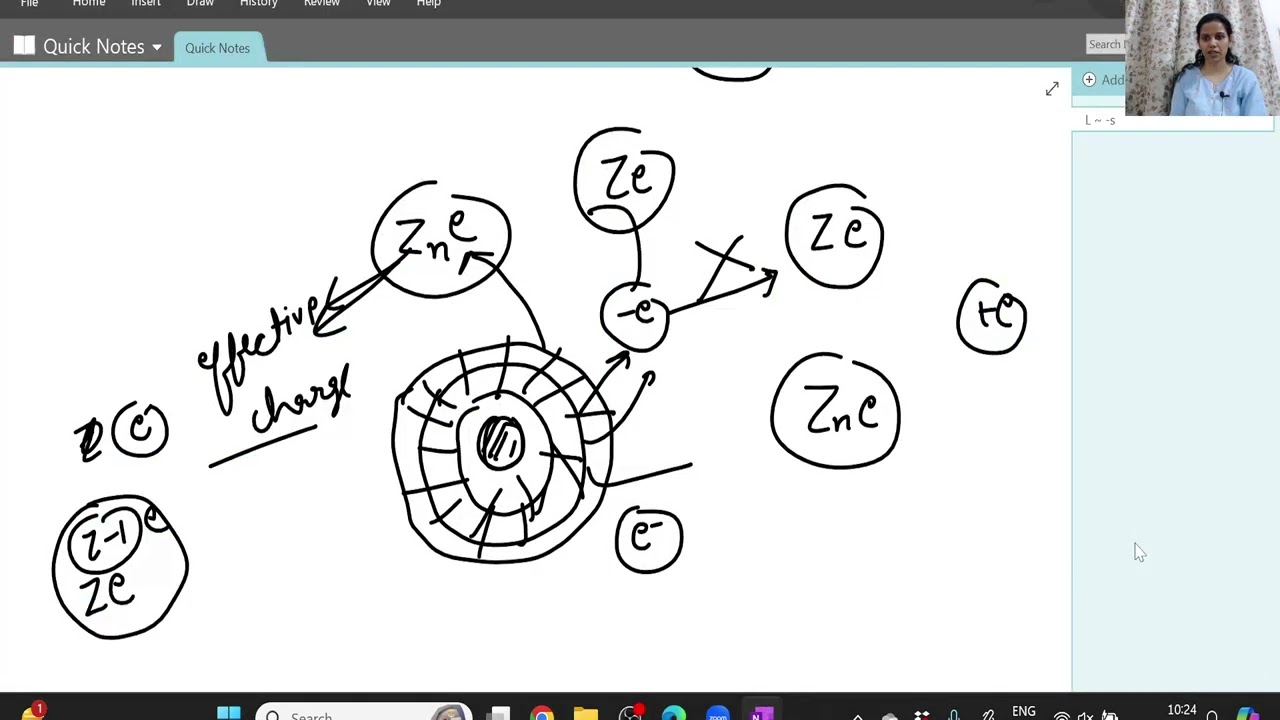
L-32 (Calculation of Level Splitting due to Spin Orbit Interaction)
292
The sodium D-line doublet (D1 and D2) arises from transitions between split 3p levels and unsplit 3s level. The 3s state has only j = 1/2 (l=0), while 3p splits into j = 1/2 and j = 3/2. Selection rules require Δl = ±1 and Δj = 0, ±1. D1 corresponds to 3p₁/₂ → 3s₁/₂, D2 to 3p₃/₂ → 3s₁/₂. D1 has lower intensity than D2. Forbidden transitions like 2D₅/₂ → 2P₁/₂ (Δj = 2) are not observed.
Click to watch →

Консультация к письменному Гос. экзамену по общей физике, оптика и квантовая физика, 14.01.24
5.5K
The sodium D-line doublet (5890 Å and 5896 Å) arises from spin-orbit splitting of the 3P energy level. The 3P level splits into two sublevels: 3P₁/₂ and 3P₃/₂, due to the coupling between the electron's spin and orbital angular momentum. The energy difference between these sublevels corresponds to the wavelength difference between the two D-lines. The splitting is caused by the interaction between the electron's spin magnetic moment and the effective magnetic field produced by the electron's orbital motion.
Click to watch →

Fine Structure of Na D lines
3K
The sodium D lines (5890 Å and 5896 Å) are actually two closely spaced spectral lines resulting from spin-orbit interaction, which splits the 3p excited state into two levels (p₁/₂ and p₃/₂) while keeping the 3s ground state as a singlet; this splitting occurs because electrons possess both spin and orbital angular momentum that interact, causing all orbitals except s to split into doublets according to the term symbol notation (2S+1L_J).
Click to watch →
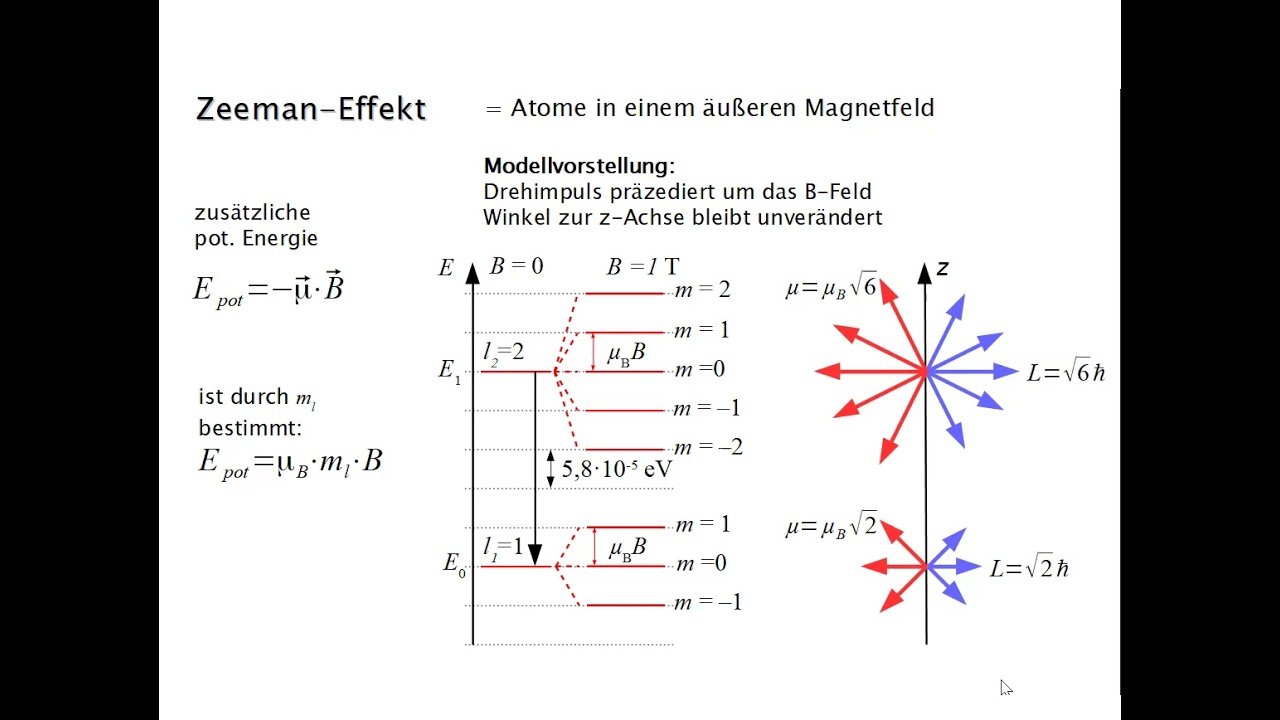
ESM2 11b Spin-Bahn-Wechselwirkung und Feinstruktur
4K
The spin-orbit interaction is a magnetic interaction between an electron's orbital angular momentum and its spin, arising because both create magnetic moments that interact with each other. This interaction causes additional energy shifts in atomic energy levels beyond those predicted by the basic Schrödinger equation, resulting in fine structure splitting of spectral lines. In LS coupling (normal for lighter atoms), all orbital angular momenta couple first to form total L, and all spins couple to form total S, which then combine to total J. In JJ coupling (occurring in heavy atoms), each electron's spin couples directly with its own orbital angular momentum to form individual j values. The sodium D-line demonstrates this fine structure as a doublet, showing how the spin-orbit interaction splits what would otherwise be a single spectral line into two closely spaced lines.
Click to watch →

Part - 05 || Solved Pyq june 2024 || CSIR UGC NET || CHEMICAL SCIENCE #PyQseries
158
The sodium D-lines arise due to spin-orbit coupling between the orbital angular momentum (L) and spin angular momentum (S) of the electron. For sodium (L=1, S=1/2), the coupling produces two states: J = L + S = 3/2 and J = L - S = 1/2. The energy splitting results in the characteristic doublet observed in the sodium spectrum. This demonstrates how spin-orbit coupling splits atomic energy levels, creating the fine structure observed in alkali metal spectra.
Click to watch →
Deep Dive
Calculating the exact wavelengths of spectral lines from retrieved energy levels using the Planck-Einstein relation.

8.4d Calculating the wavelength of a spectral line from an energy diagram
43K
When an electron transitions from a higher energy level to a lower one, it emits a photon whose wavelength can be calculated using the equation λ = hc/E, where h is Planck's constant (6.626 × 10⁻³⁴ J·s), c is the speed of light (3 × 10⁸ m/s), and E is the energy difference between the levels in joules; for example, transitioning from 1000 zeptojoules to 600 zeptojoules (400 zeptojoules = 4.00 × 10⁻¹⁹ J) yields a wavelength of approximately 497 nanometers, corresponding to green visible light.
Click to watch →

MODERN PHYSICS CLASS 12 || ATOMIC STRUCTURE CLASS 12 PHYSICS || BIHAR BOARD CLASS 12 2026
6.4K
Energy and wavelength have an inverse relationship: E = hc/λ, so higher energy means shorter wavelength. For any spectral series, the minimum wavelength (maximum energy) occurs when electrons transition from infinity to the lower orbit. For Lyman series (n=1), λ_min = 1/R. The maximum wavelength (minimum energy) occurs when electrons transition from the next higher orbit to the lower orbit. For Lyman series, λ_max = 4/(3R). The general formula is 1/λ = R(1/n₁² - 1/n₂²), where n₁ is the lower orbit and n₂ is the higher orbit. This allows calculation of any spectral line wavelength.
Click to watch →

Calculer la longueur onde avec l’énergie d’un photon
31.9K
The wavelength of a photon emitted or absorbed during an electron transition can be calculated using the formula λ = hc/ΔE, where h is Planck's constant (6.63 × 10⁻³⁴ J·s), c is the speed of light (3 × 10⁸ m/s), and ΔE is the absolute value of the energy difference between the initial and final energy levels (ΔE = |Ef - Ei|). For example, when an electron transitions from n=3 to n=2 in a hydrogen atom, the energy difference is |(-1.51 eV) - (-3.4 eV)| = 1.89 eV, which converts to 3.02 × 10⁻¹⁹ J using 1 eV = 1.6 × 10⁻¹⁹ J, resulting in a wavelength of approximately 658 nm.
Click to watch →
![[NEW] GRADE 10 SCIENCE | Quarter 2 Module 2 - EM WAVE CALCULATIONS](https://i.ytimg.com/vi/w3tnNqPaBY4/maxresdefault.jpg)
[NEW] GRADE 10 SCIENCE | Quarter 2 Module 2 - EM WAVE CALCULATIONS
18.8K
To find wavelength from energy, rearrange the combined equation to λ = hc/E. For example, with E = 5.8 × 10^-19 J, h = 6.63 × 10^-34 J·s, and c = 3 × 10^8 m/s, first calculate the numerator: 6.63 × 10^-34 × 3 × 10^8 = 1.989 × 10^-25. Then divide by energy: 1.989 × 10^-25 / 5.8 × 10^-19 = 3.43 × 10^-7 meters. Always carry intermediate values fully before rounding to maintain accuracy.
Click to watch →
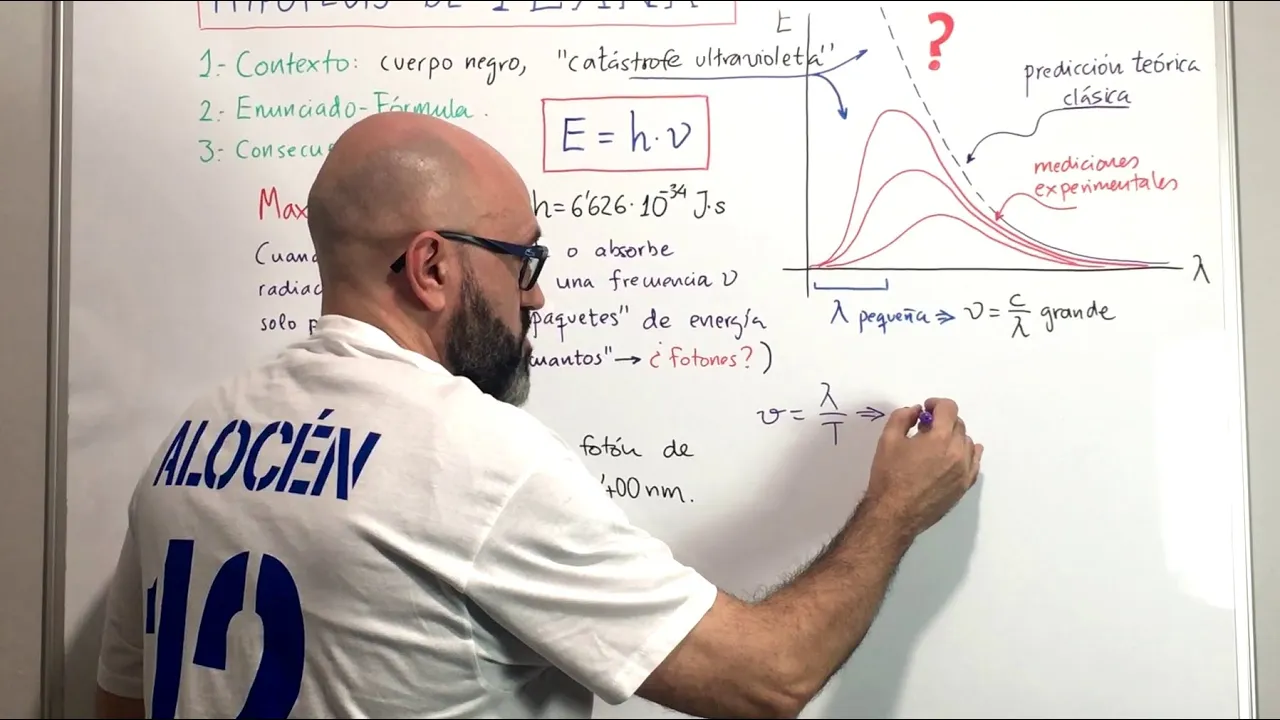
Física 7.01 Hipótesis de Planck muy fácil. Catástrofe ultravioleta, cuerpo negro, consecuencias.
93.7K
To calculate photon energy, use E = h×f with h = 6.626 × 10^-34 J·s. First convert wavelength to frequency using c = λ×f, so f = c/λ. For violet light at 400 nm: f = (3×10^8 m/s)/(400×10^-9 m) = 7.5×10^14 Hz. Then E = (6.626×10^-34 J·s) × (7.5×10^14 Hz) ≈ 5×10^-19 J. This demonstrates how Planck's formula enables practical calculations of photon energy from wavelength measurements.
Click to watch →
Deep Dive
Applying NIST atomic data to practical fields like astronomical spectroscopy, laser physics, and plasma diagnostics.

4448 22 L21 Grotrian Diagrams and the NIST Atomic Spectral Database
777
The NIST Atomic Spectral Database catalogs spectral data for identifying unknown elements in astronomical observations. Sodium vapor lamps produce characteristic yellow light from the 3s→3p transition, demonstrating practical applications of atomic spectroscopy. Electronic temperature (related to free electron energy) differs from thermal temperature (related to molecular motion)—mercury lamps operate at ~20,000-30,000 K electronically while remaining cool to the touch. These concepts enable accurate modeling of emission spectra using Saha-LTE calculations for various light sources.
Click to watch →

Stokes Inversion based on Response Functions (SIR) - Day 2: Synthesis using 1D atmospheres
276
Accurate spectral synthesis requires correct atomic parameters obtained from authoritative databases. The NIST Atomic Spectra Database (http://physics.nist.gov/PhysRefData/ASD/) provides excitation potentials (in eV or cm⁻¹), log(gf) oscillator strengths, and spectroscopic notation. Convert excitation potentials from eV to cm⁻¹ using 1 eV = 8065.5 cm⁻¹. Search by wavelength range (e.g., 6301.4-631.6 Å for iron lines) and retrieve data. Excitation potential describes the energy of the lower level, log(gf) determines line strength, and spectroscopic notation defines the transition for polarized light calculations. These parameters must be consistent across all lines in your synthesis.
Click to watch →

Sci & Tech for Society - Pedro Amaro
151
Atomic physics provides essential parameters for interpreting astronomical spectra, where characteristic emission lines serve as fingerprints to identify elements and diagnose plasma conditions such as temperature and density; accurate atomic data is critical for correct astrophysical conclusions, as demonstrated by discrepancies in XMM-Newton observations where different plasma codes showed 15% variation due to atomic data quality differences.
Click to watch →

Resources in plasma spectroscopy
271
This comprehensive section covers the global infrastructure supporting atomic and molecular data for plasma physics research. The IAEA Atomic Data Unit, established in 1976, maintains the ALADDIN database with ~20,000 evaluated entries and GENIE search engine connecting nine international databases. The CHIANTI database, developed over 20 years by a collaborative group, specializes in astrophysical plasma spectroscopy for optically thin plasmas in solar coronae, nebulae, and supernova remnants. The VAMDC network coordinates approximately thirty databases worldwide through European funding. The UK Atomic Physics Network contributes to fusion data through ADA and other databases. Together, these resources provide atomic energies, transition data, collision strengths, and charge state distribution rates, enabling spectral line analysis, plasma diagnostics, and validation of custom collisional-radiative models through systematic database comparisons.
Click to watch →

Atomic Structure 07 || Hydrogen Spectrum || Class 11/NEET || RAFTAAR
67.9K
Atomic spectroscopy has numerous practical applications: (1) Astronomical analysis: Identifying chemical compositions of stars and galaxies by analyzing their spectral signatures; (2) Forensic science: Detecting trace elements in materials through emission or absorption spectroscopy; (3) Environmental monitoring: Measuring pollutants in air and water using atomic absorption techniques; (4) Industrial quality control: Verifying material purity and composition; (5) Medical diagnostics: Analyzing biological samples for element concentrations. The ability to uniquely identify elements by their spectral fingerprints makes spectroscopy an indispensable analytical tool across many scientific disciplines.
Click to watch →
Locating Levels
Level Analysis
Locating Levels
0:00- 1
Use NIST atomic spectral database to find energy levels.
- 2
Select element and ionization state, e.g., Na for sodium.
- 3
Specify units like electron volts and retrieve data.
Ab Initio Quantum Mechanical Calculations
While the NIST Atomic Spectra Database is an invaluable resource for experimentally verified, high-precision atomic energy levels, relying solely on empirical databases has limitations. NIST data represents static, isolated atoms under ideal conditions, and often contains gaps for highly excited states, complex ions, or rare isotopes. In contrast, computational atomic physics using ab initio methods (such as Hartree-Fock, Configuration Interaction, or Density Functional Theory) allows researchers to calculate energy levels from first principles. This theoretical approach is essential for predicting energy levels in extreme environments—such as high-pressure plasmas, strong magnetic fields, or astrophysical conditions—where experimental database values are unavailable or inapplicable due to environmental perturbations like Stark and Zeeman shifts.
Basic atomic structure and electron configurations, particularly for alkali metals like sodium.
The concept of quantized energy levels in atoms, including ground states and excited states.
Familiarity with the electron volt (eV) as a standard unit of energy in atomic physics.
The fundamental relationship between atomic transitions and the emission or absorption of electromagnetic radiation (E = hν).
Deciphering spectroscopic term symbols (e.g., 2S_1/2, 2P_3/2) to identify specific quantum states within the NIST database.
Applying quantum mechanical selection rules (e.g., Δl = ±1) to determine which transitions between energy levels are allowed or forbidden.
Analyzing spin-orbit coupling and fine structure splitting, such as the famous sodium D-line doublet.
Calculating the exact wavelengths of spectral lines from retrieved energy levels using the Planck-Einstein relation.
Applying NIST atomic data to practical fields like astronomical spectroscopy, laser physics, and plasma diagnostics.
505 views1likes3:10@pchem5782Original Release: 2015-08-24
so where do we look at these uh atomic energy levels you can look it up from uh Atomic spectral database from the nist this website right here okay and so let's take a look at that uh Web book web.
n.gov what was it you just do a search for Atomic just Google uh Atomic spectral database nist and you'll find it there and once you get to that website you can just select levels here if you want to see what the allowed energy levels are we did this in the lab already when we did the atomic spectr lab U but that one we were searching for lines if you know the lines and if you have the experimental lines you can search for the atomic energy levels responsible for right so let's just look at the atomic levels uh if you're interested for example in the atomic levels for sodium you just type Na and then the Roman numeral one for the atom Roman numeral two for the singly ionized like na plus you put Roman numeral to na2 so we're we're going to put na for sodium Roman numeral one and you can specify whether you want your units in reciprocal centimeters or electron volts let's say I wanted in electron volts and then you can retrieve your data here click on this button and the these are your these are your uh energy levels for your sodium so the ground state of sodium electron configuration is one s22 s22 P6 just gives you the last part of it and then three S1 you'll notice it's a doublet s okay and all possible J values for doublet s would be J12 and that's the ground state so by convention on the on this website the lowest energy is always assigned a zero okay and you have doublet p one2 and doublet P3 halves that's 2.1 electron volts 2102 electron volts for the dou p12 and the energ of the doublet P3 Hales is 2104 electron Vols okay and then if you have a 2 P6 4s1 configuration again you have another doublet s and that's your first ex okay so this is your second third excited state your first excited state is dou p one2 the next one is dou P3 halfes okay and your third excited state would be with the electron in the 4S orbital so doublet S2 and it's 3191 3529 electron volts so that's what you need to do to look up uh energy level
Up Next
3:51
Building a DIY Emission Spectrometer with PVC Pipes
@Neptunium
2.3K views•2018-10-21

12:53
21cm Hyperfine Transition in Neutral Hydrogen: Radio Astronomy Basics
@AaronRobertParsons
12.4K views•2011-10-13

32:32
NMR Spin Physics I: Zeeman Effect, Resonance Condition & Larmor Frequency
@nptel-indianinstituteofsci8064
2.3K views•2024-01-17

27:14
Entropy and the Second Law of Thermodynamics Explained
@veritasium
27.5M views•2023-07-01
Related Study Plans & Knowledge Roadmaps
Structured learning paths in Physics
physics
Nuclear Physics (Decay, Fission & Reactors)
01Atomic Structure and the Binding Force
02Radioactive Decay and Half-Life
03Nuclear Fission Mechanics and Chain Reactions
+ 2 more learning modules
12h5 modules
Explore Roadmap
physics
Soft Matter (Polymers, Colloids & Rheology)
01Foundations of Soft Matter & Thermal Forces
02Polymer Physics and Macromolecules
03Colloids, Surfactants, and Self-Assembly
+ 2 more learning modules
38h5 modules
Explore Roadmap
physics
Analytical Mechanics: Lagrangian & Hamiltonian
01Mathematical Foundations: Calculus of Variations
02From Newtonian Mechanics to Constraint Dynamics
03The Principle of Least Action & Lagrangian Mechanics
+ 3 more learning modules
28h6 modules
Explore Roadmap
physics
General Relativity (Spacetime & Cosmology)
01Foundations of Relativity: Special Relativity
02The Geometry of Spacetime: Equivalence Principle & Curvature
03Einstein's Field Equations: The Mathematics of Gravity
+ 2 more learning modules
55h5 modules
Explore Roadmap