














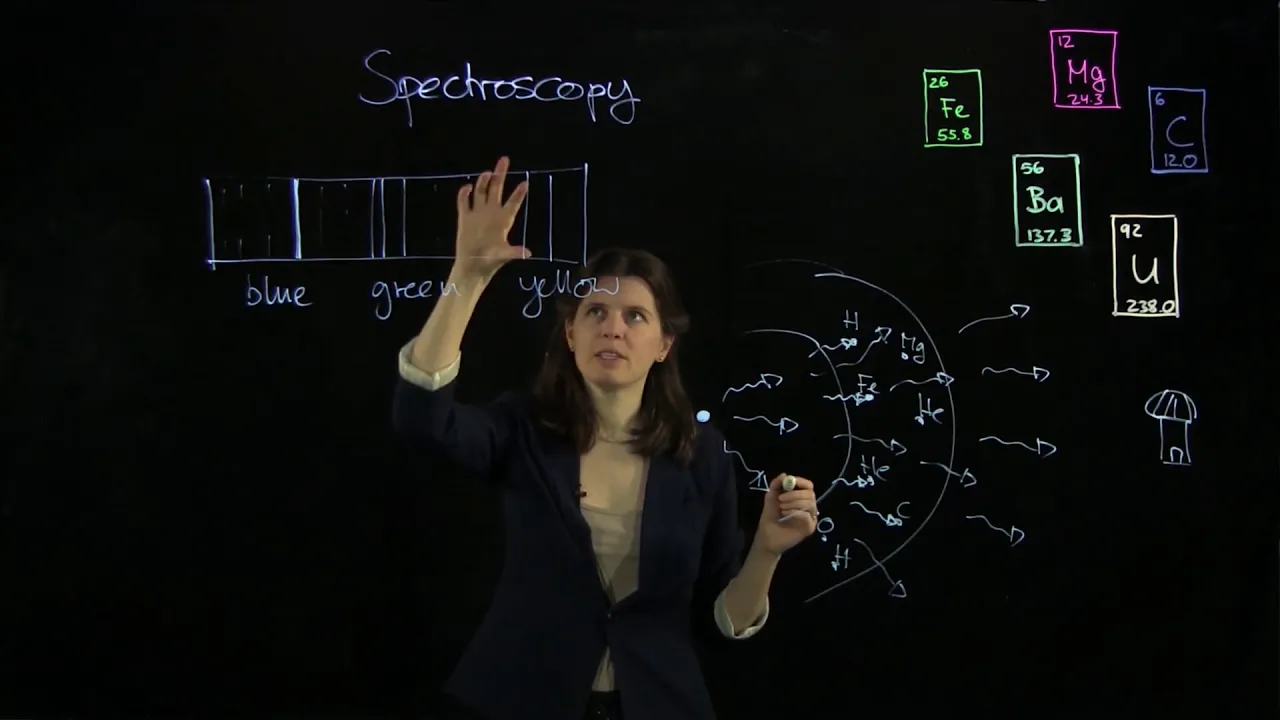




Emission spectroscopy identifies elements by analyzing the unique wavelengths of light emitted when atoms in a plasma are excited and return to lower energy states; each element produces a characteristic spectral signature that can be detected using a simple homemade spectrometer with a vacuum chamber, electrodes, and diffraction grating.
Building a DIY Emission Spectrometer with PVC Pipes
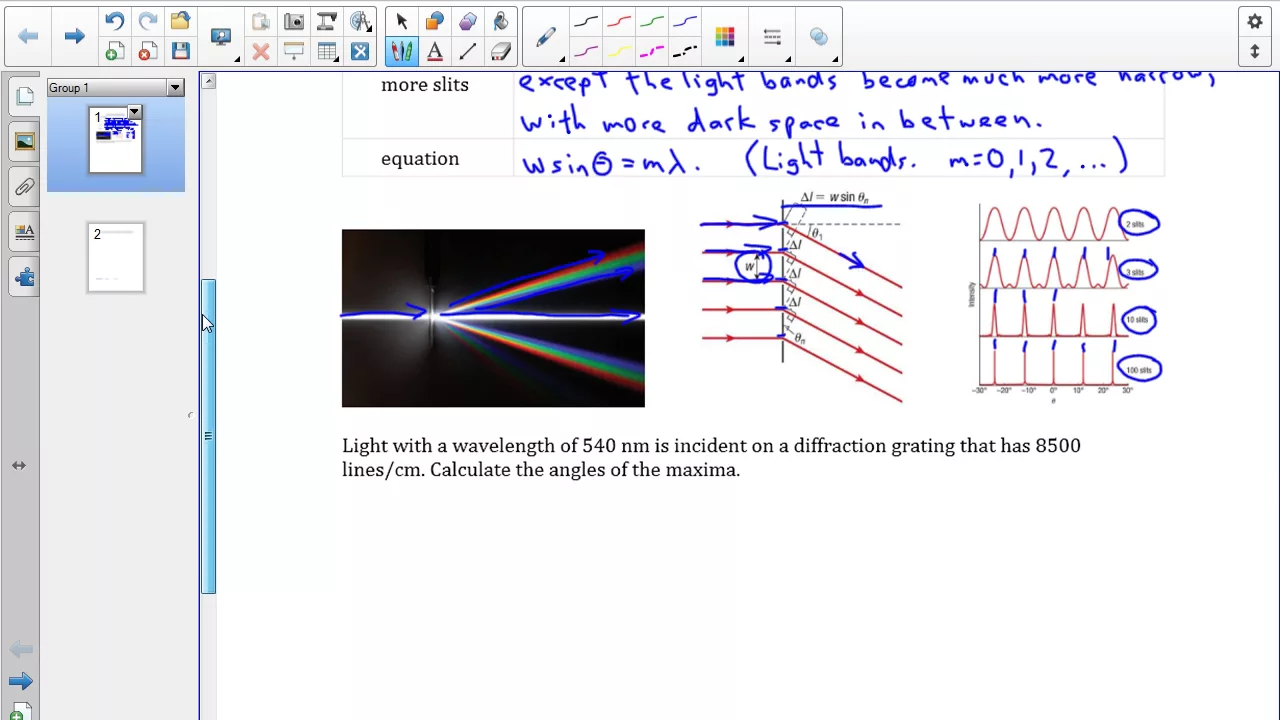
Added:Basic principles of wave optics, specifically how diffraction gratings disperse light into its constituent wavelengths.
The Bohr model of the atom and the concept of electron excitation, relaxation, and photon emission.
Understanding the electromagnetic spectrum, particularly the wavelengths and properties of visible light.
Basic chemical safety and properties of alkali and alkaline earth metals (like lithium and barium) commonly used in flame tests.
Calibration techniques for DIY spectrometers using known spectral lines (such as fluorescent light mercury lines) to measure precise wavelengths.
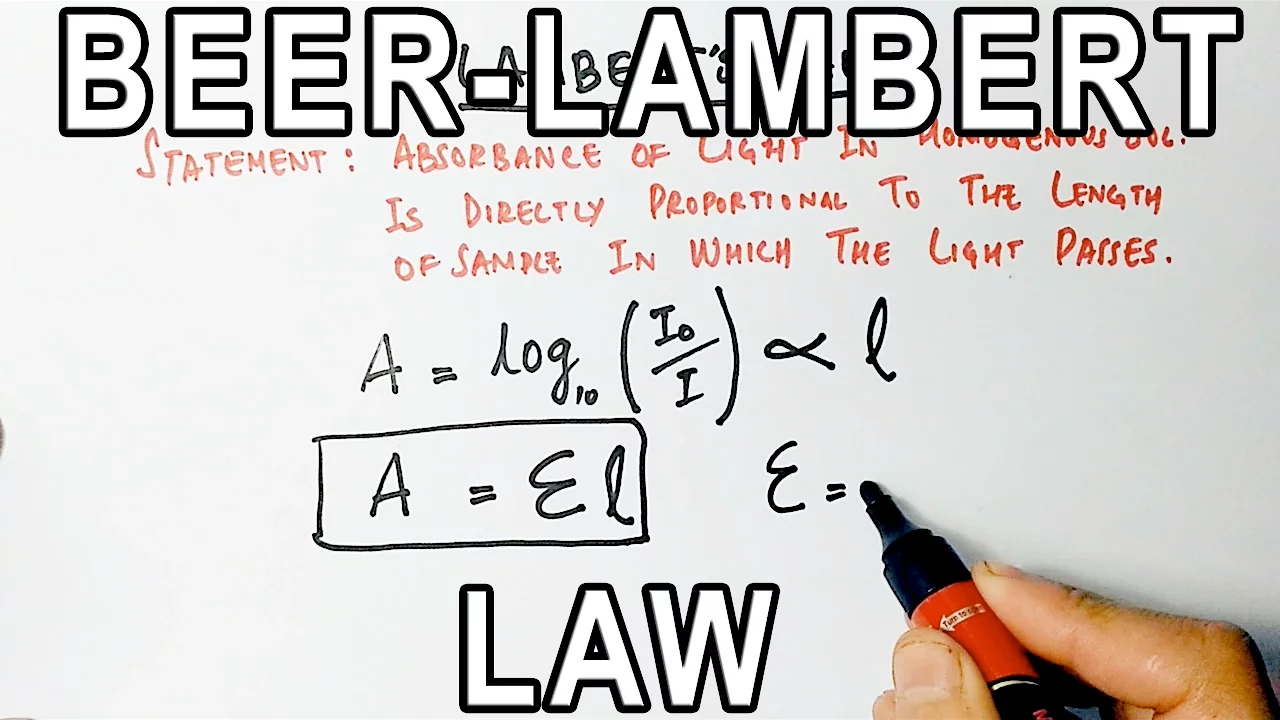
The principles of absorption spectroscopy and how it differs from emission spectroscopy, including the Beer-Lambert Law.
Advanced astronomical spectroscopy and how spectral lines are used to determine the chemical composition and velocity of stars.
Introduction to professional analytical instruments like Inductively Coupled Plasma Optical Emission Spectroscopy (ICP-OES) used in modern laboratories.
2.3K views78likes3:51Original Release: 2018-10-21
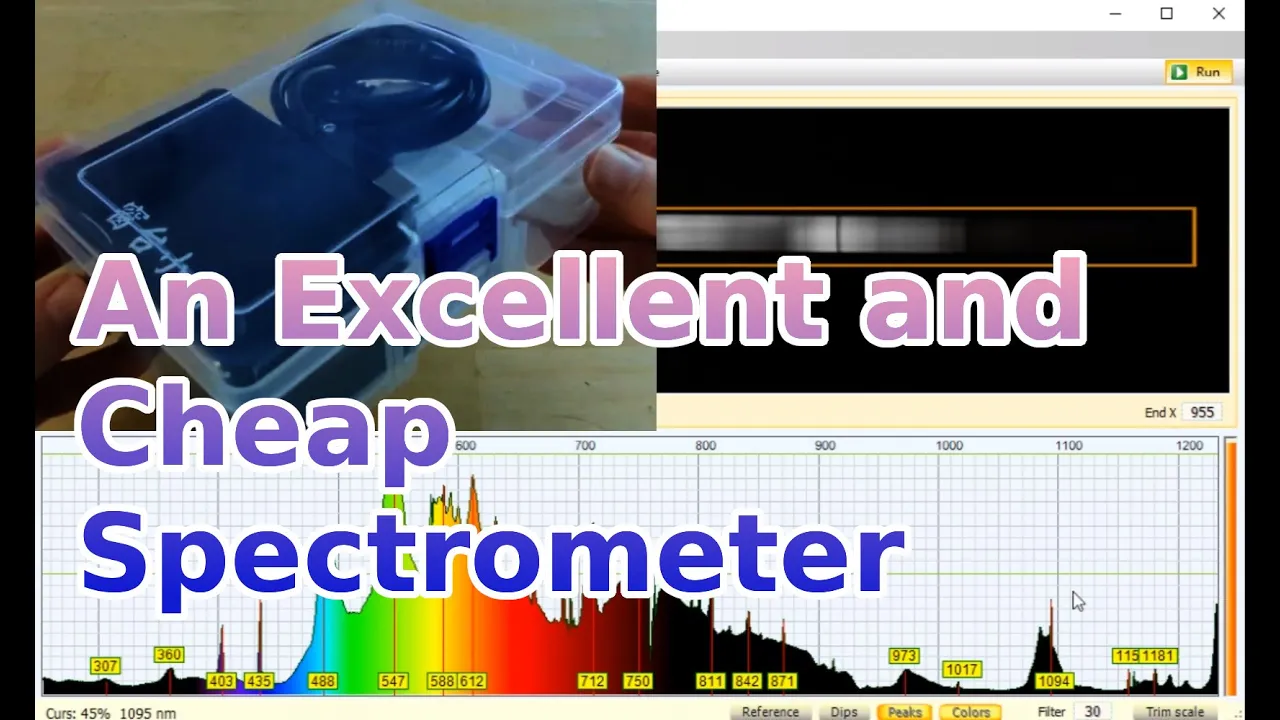
well hi everybody I know it's been a while I've been little cyclically but um I started this video with the intention of collecting rainwater and look at radio isotope after some contamination issue in my collection bucket I decided to do something else so this this video started like this and then then it cuts to something different so I'll change the grading on my year spectrometer so this is a 600 line four millimeters waiting it's made by your Thor lab they were super nice and shipper very fast they even included a bunch of treats and candies in the along with the grading so anyway we should see a broader spectrum and lose a little bit in the resolution but I think it's it's ok we really wanted to see a broader spectrum so after removing the old grading with some difficulties I installed the new one and I'm not going to get into the details of the whole alignment process which is long and tedious I mean there's plenty of videos and procedures available online for this so I already have a video on the calibration and we can see the the spectrum is love water then number four we can see on either side of the visible area closer to infrared and ultraviolet which is what I wanted so this pretty happy with this so I'll try to see the spectrum of a blacklight and sure enough the 370 nanometer main peak show up and even a tiny little one down here at four or five from Mercury so with that in mind I went to my local hardware store and purchased a few items mostly PVC pipes I thought I made a emission spectrometer so this is not too complicated all we need is a chamber under vacuum with a couple of electrodes sticking into it and the view ports to see what essentially is a plasma created inside so basically the atoms left in the chamber mostly oxygen and nitrogen are being ionized by the high voltage so ionization process evolved an atom losing or gaining electrons these electrons changed shells and either up or down we're moving up they absorb energy when they move in there closer to the nucleus they release some energy now the amount of energy involved is in a few Elektra volts so this is only the outer shell are being involved in those processes the energy released in the form of photon is specific to those atoms so we can determine what type of atom are present the spectrum can get very complicated so it's sometimes difficult to really identify any particular element so since we start from air we have mostly nitrogen and oxygen being ionized and here we have those Peaks being called out by the software so I thought hey why not give it a try with different substances so I have here some high purity lithium iodide and put it into the submission spectrometer and sure enough I'm totally able to see those lines albeit some of them with less confident than others but this right here is at 100% for lithium it's pretty good iodide is hiding throughout the spectrum here then I thought eh what about barium so here's a barium oxide I was hoping to see more from from barium but probably some of it fell off the electrodes so there's not much to be seen here and then I tried to see calcium and phosphorus from some some calcium phosphate to have and yes it's possible to see it now it all comes down to the calibration and the better the calibration the more accurate the test would be it's a spoke it's working pretty well so I'm very satisfied and very happy with this I hope you enjoyed this video stay tuned for more fun science stuff and I will see you on the next one don't forget to subscribe thanks for watching
Up Next

9:17
Plasma Physics: Definition, Temperature & Debye Shielding
@usyd-seniorplasmaphysicsle6653
124.6K views•2017-04-24

12:53
21cm Hyperfine Transition in Neutral Hydrogen: Radio Astronomy Basics
@AaronRobertParsons
12.4K views•2011-10-13

32:32
NMR Spin Physics I: Zeeman Effect, Resonance Condition & Larmor Frequency
@nptel-indianinstituteofsci8064
2.3K views•2024-01-17

27:14
Entropy and the Second Law of Thermodynamics Explained
@veritasium
27.5M views•2023-07-01
Related Study Plans & Knowledge Roadmaps
Structured learning paths in Physics
physics
Nuclear Physics (Decay, Fission & Reactors)
01Atomic Structure and the Binding Force
02Radioactive Decay and Half-Life
03Nuclear Fission Mechanics and Chain Reactions
+ 2 more learning modules
12h5 modules
Explore Roadmap
physics
Soft Matter (Polymers, Colloids & Rheology)
01Foundations of Soft Matter & Thermal Forces
02Polymer Physics and Macromolecules
03Colloids, Surfactants, and Self-Assembly
+ 2 more learning modules
38h5 modules
Explore Roadmap
physics
Analytical Mechanics: Lagrangian & Hamiltonian
01Mathematical Foundations: Calculus of Variations
02From Newtonian Mechanics to Constraint Dynamics
03The Principle of Least Action & Lagrangian Mechanics
+ 3 more learning modules
28h6 modules
Explore Roadmap
physics
General Relativity (Spacetime & Cosmology)
01Foundations of Relativity: Special Relativity
02The Geometry of Spacetime: Equivalence Principle & Curvature
03Einstein's Field Equations: The Mathematics of Gravity
+ 2 more learning modules
55h5 modules
Explore Roadmap