

























A plasma is a state of matter characterized by ionized particles that exhibit collective electromagnetic behavior; it differs from regular ionized gas through two key criteria: (1) quasi-neutrality, where the total positive charge equals the total negative charge, and (2) collective behavior where electromagnetic forces dominate over individual particle interactions. Plasmas can be fully ionized (containing only ions and electrons) or partially ionized (including neutral atoms and molecules). Temperature in plasmas follows the Maxwell-Boltzmann distribution, where particle speeds distribute according to thermal energy, and temperatures are commonly expressed in electron volts (1 eV ≈ 11,600 K). Debye shielding describes how free charges in a plasma redistribute to screen electrostatic potentials, creating a characteristic screening length called the Debye length that determines the spatial extent of charge separation.
Plasma Physics: Definition, Temperature & Debye Shielding
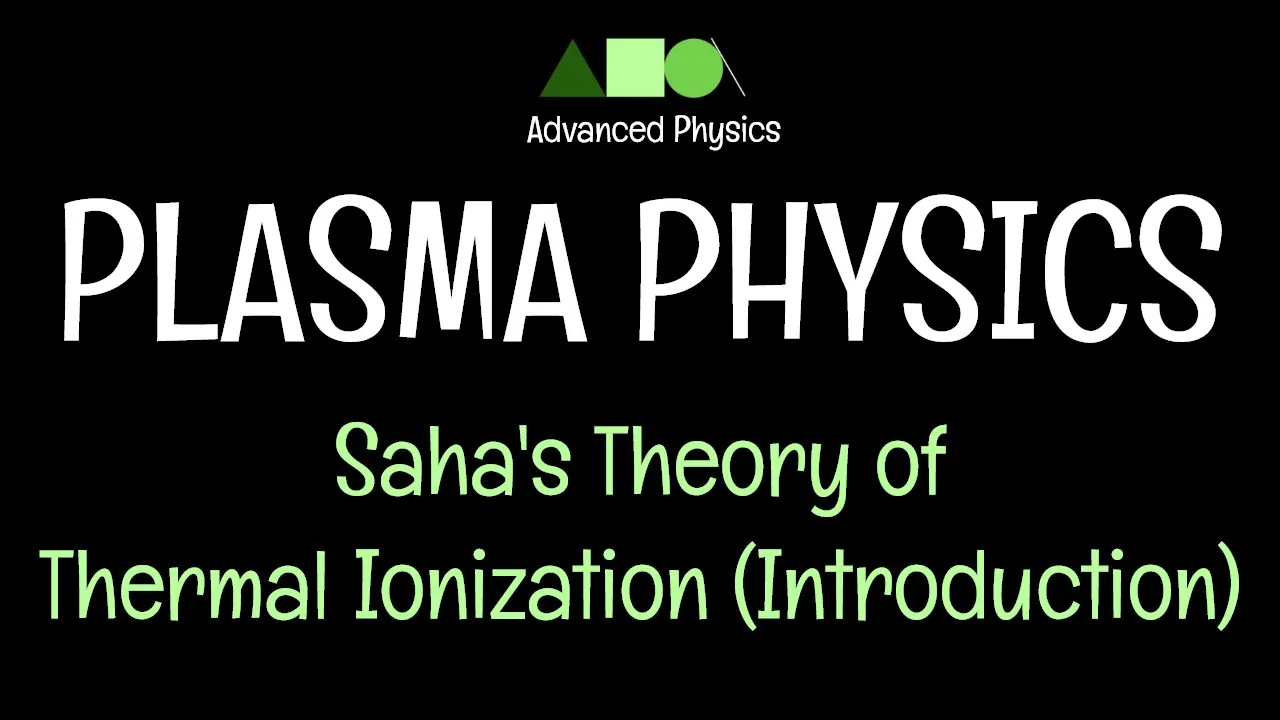
Added:Welcome to senior plasma physics lecture 1. As with most of the course, we follow closely the textbook by Francis Chen, an introduction to plasma physics, volume 1.
This lecture is contained within chapter 1 of that textbook. We'll start off by giving a basic definition of a plasma and give some examples. We then need to define the temperature as it applies to a plasma.
Finally, we need to talk about the type of electrostatic shielding that occurs within a plasma known as Dubai shielding and how this can be used in obtaining more quantifiable criteria for the definition of a plasma.
So, how do we define what a plasma is?
In short, you can say it's an ionized gas, but that's not a completely correct answer since there are some ionized gases that are not plasmas. By the end of this lecture, we'll present criteria that helps to distinguish between those two situations.
But you don't just need a gas to form a plasma. You can form a plasma from all three states of matter, solids, liquids, or gases.
You just need the right amount of energy added to a system such as heat. But there are many ways to impart energy to these states of matter to form a plasma.
As we'll see throughout this course, a plasma can be fully or partially ionized. So what does that mean? A fully ionized plasma means that 100% of the atoms are ionized. By implication, a partially ionized plasma isn't. only a fraction of atoms are ionized. That means the fully ionized plasma only consists of ions and electrons while the partially ionized plasma not only consists of ions and electrons but also of neutral atoms and molecules. A list of examples of plasmas can be quite long but here are some examples. Our sun is a plasma. Any sun is a plasma. the interstellar medium, fluorescent lighting, lightning, and the list goes on. I'm sure there are many examples that you can think of. One of the main parameters of a plasma is its temperature. The collisions between the particles in a plasma behave classically. That means they follow Boltzman statistics. The result is that you end up with a distribution of speeds known as a Maxwell Boltzman distribution for short. We call it a Maxwellian. The expression for the Maxwellian is given by this. Most of the variables there follow standard notation. But here are some definitions. V is the speed of the particles. N is the number density that is the number of particles per unit volume. This is another main parameter in plasmas. M is the mass of the particles. K subscript B is the Boltzman's constant. But the important parameter in this equation is T, the temperature. So what if you didn't have a Maxwellian distribution of velocities?
Then you can't really talk about a temperature. You may say talk about an average energy. A temperature following Boltzman statistics is the parameter that appears in the Maxwell Boltzman distribution. In the same way, temperature is defined for quantum systems depending on whether you had a firm direct distribution or a Bose Einstein distribution. The meaning of the function f of v is not obvious. It doesn't just mean the number of particles, although the number of particles can be derived from it. We're going to leave the discussion about what this means until we cover the kinetic theory part of the course. A plot of the Maxwellian is given by this for two temperatures 1,000 and 5,000 Kelvin.
Notice how the peak in the distribution goes to higher velocities with increasing temperature. As you might expect, it should be straightforward using calculus to obtain the speed at the peak VP. However, the average of the squares of the speeds known as root mean square speed is not so straightforward.
You need to know more about the meaning of the Maxwellian in order to derive the expression for the root mean squared speed. Plasmas can have temperatures in the thousands and millions of degrees.
So, it becomes inconvenient to keep talking about the temperatures in those units. It's much more convenient to express the units in electron volts.
Here is an example of how this is done.
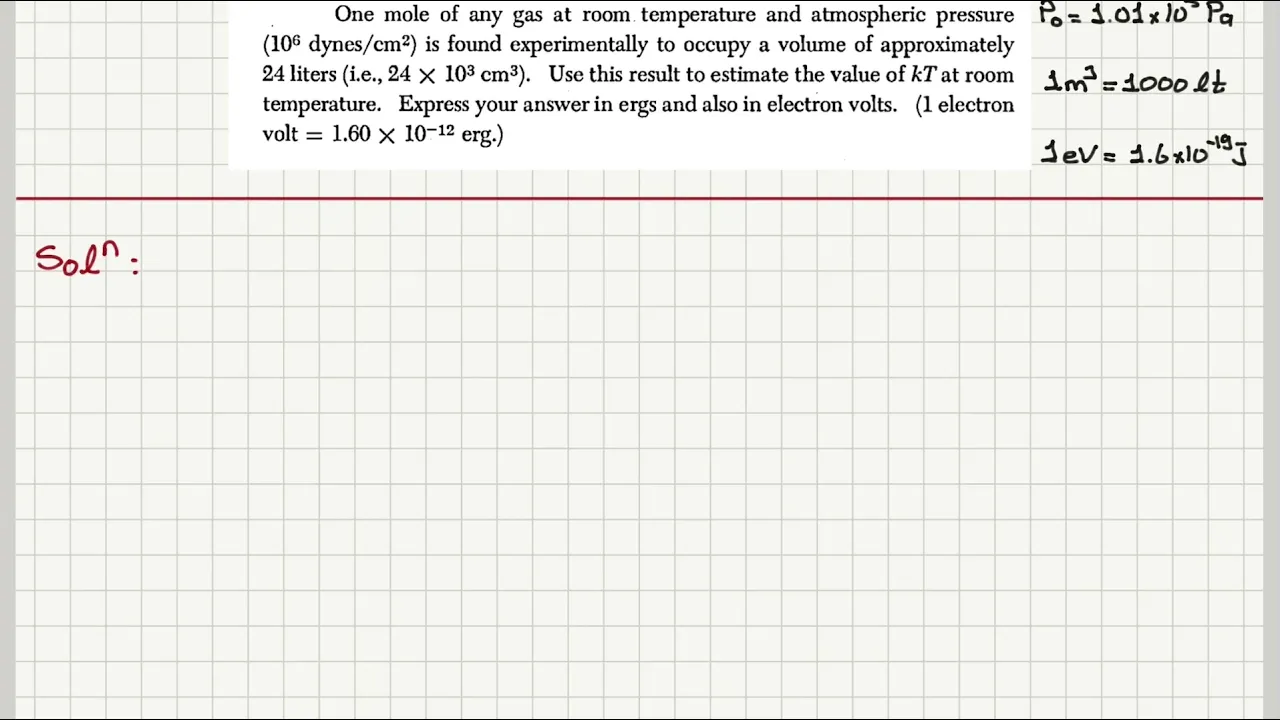
Assume we want to convert room temperature at 300 Kelvin to electron volts. We substitute the temperature T in this expression and obtain 0.026 electron volts. But plasma temperatures aren't really usually that low. Quite often they're much higher than that. So I'll leave it as an exercise for you to show that a 1 electronv temperature is equal to 11.600 6,000 Kelvin.
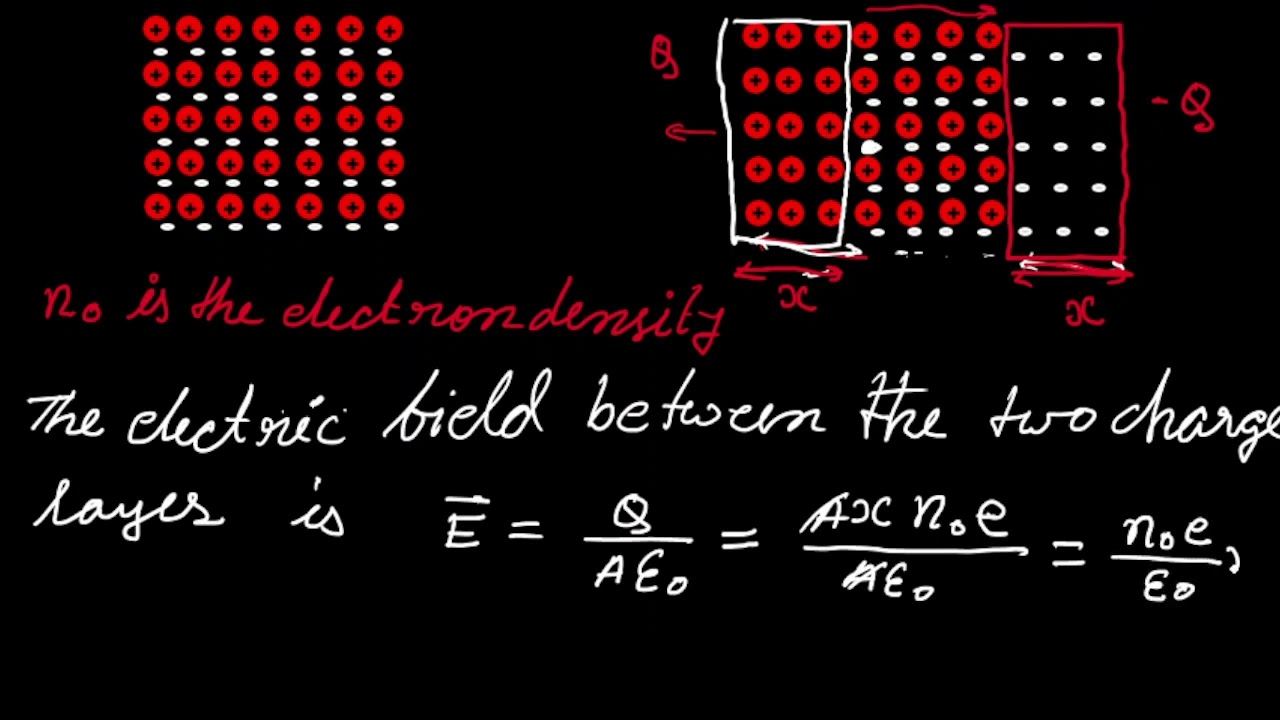
A plasma is made up of free charges, both negative and positive. So you can imagine if we insert in the plasma two oppositely charged conducting spheres, the negative charges and the positive charges will move to the spheres of opposite polarity to essentially shield the electrostatic potential from the spheres. This complete shielding of the charged spheres will only occur if the free charges don't have sufficient kinetic energy to overcome the attractive potential energy of the spheres. But as we've seen from the Maxwellian distribution of velocities that there are always charged particles in the high velocity tail of the distribution that have a sufficient energy that is greater than the attractive electrostatic potential energy to basically leave and so the shielding around the sphere is inherently incomplete. But we do introduce a length in the plasma whereby most of the charge is contained. This is known as the Dubai length. The symbols in this expression are as usual, but it's important to comment on one particular parameter, the density. This is the density at a much greater distance than the Dubai length because the density within the Dubai length does change. So within a Dubai length, changes in electric potential can be measured. It doesn't mean that changes in the potential outside the Dubai length can't be measured because as we said the shielding is not complete but the changes are much smaller. Quite often we do treat this Dubai length as a kind of a boundary but it's not really a boundary as we will show in later lectures when we derive the Dubai length. It's important to note that there is nothing special about the introduction of metal spheres. They basically represent an electrostatic pertubation of the plasma. The perturbation doesn't have to be from a physical object although it can be. It can be say from electromagnetic radiation passing through the plasma.
When we started this lecture we gave a very simplistic answer to what a plasma is. But there are actually quantifiable criteria that determine if an ionized gas is a plasma or not. Plasmas must be microscopically charged neutral also called quasi neutrality. There are however plasmas that are called non-neutral plasmas but we'll stick with the definition followed by chen that is of quasi neutrality. That means the total negative charge is equal to the total positive charge in the plasma.
This can be obtained by the following expression where the left hand expression is the total negative charge and the right hand expression is the total positive charge. Plasmas must also show collective behavior. What does that mean? It just means that the electromagnetic forces in the plasma dominate over normal hydrodnamics you might get in a gas. So how do we quantify these criteria? Quasi neutrality requires that the dimensions of a plasma LEA are much greater than the Dubai length. Otherwise, as you've seen from our metal spheres example, that there will be a space charge within the Dubai length. Obviously to have collective effects we need to be dealing with a large number of particles. So we end up introducing something called a Dubai sphere. A Dubai sphere is an imaginary sphere that has a radius of one Dubai length. So we want the number of charged particles in a Dubai sphere ND to be much greater than one and is given by this expression where we're basically multiplying the volume of the charged sphere with the number density of the charges. In this case it's the number density of electrons.
Up Next

Plasma Physics: Debye Shielding & Collective Interactions
@luciusfox9508
25.4K views•2015-12-24

21cm Hyperfine Transition in Neutral Hydrogen: Radio Astronomy Basics
@AaronRobertParsons
12.4K views•2011-10-13

Magnetohydrodynamics Lecture: Beta, Pressure, & Instabilities
@usyd-seniorplasmaphysicsle6653
20.8K views•2017-05-30

Entropy and the Second Law of Thermodynamics Explained
@veritasium
27.5M views•2023-07-01
Related Study Plans & Knowledge Roadmaps
Structured learning paths in Physics