














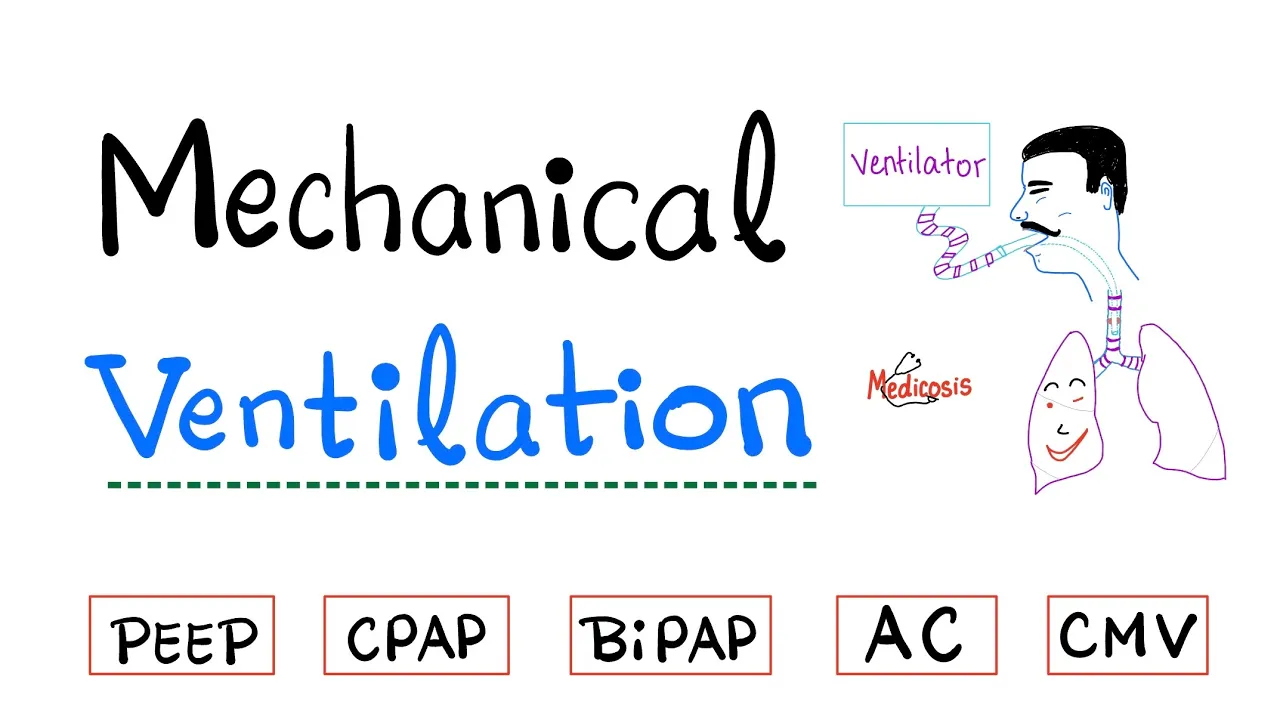










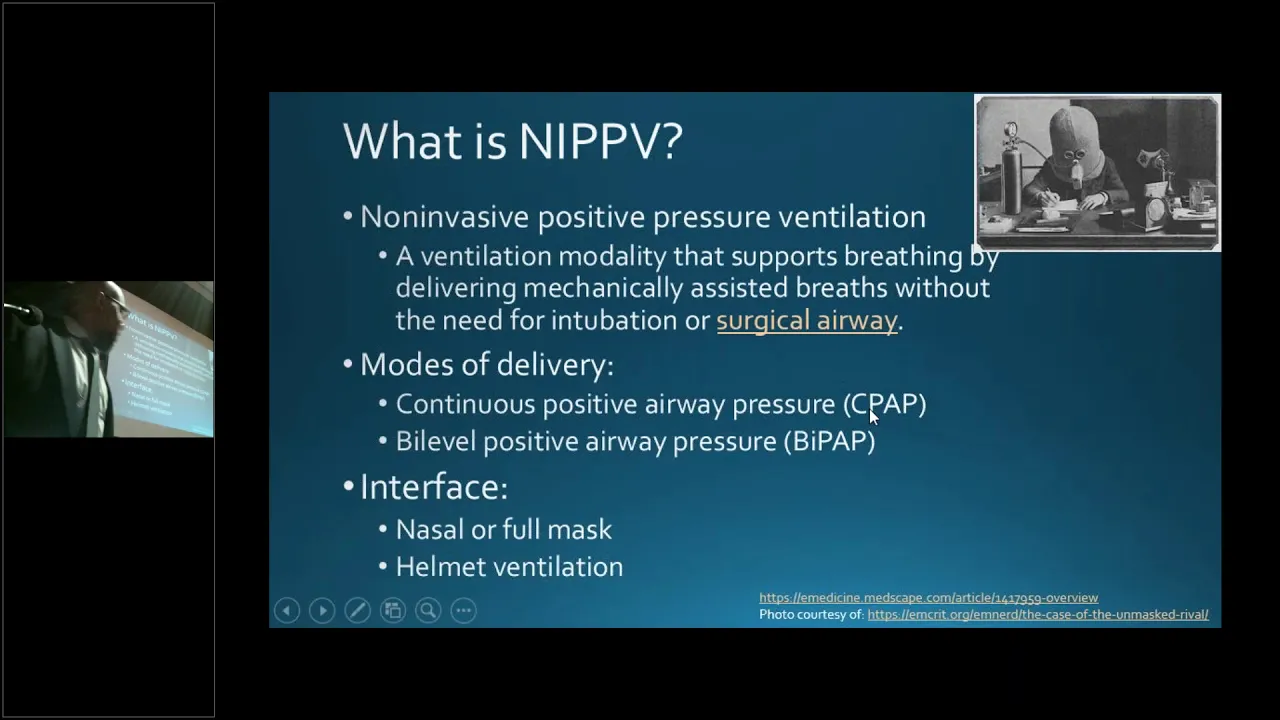


Non-invasive positive pressure ventilation (NPPV) delivers oxygen-rich gas under pressure without endotracheal intubation, offering benefits such as avoiding intubation trauma, reducing ventilator-associated pneumonia risk, and preserving patient communication and eating abilities; it includes two primary modes—CPAP (Continuous Positive Airway Pressure) which applies a single continuous pressure throughout both breathing phases to improve oxygenation in hypoxic respiratory failure, and BiPAP (Bilevel Positive Airway Pressure) which provides two different pressure levels (higher during inspiration, lower during expiration) to address both ventilation and oxygenation in hypercapnic or mixed respiratory failure—with CPAP typically starting at 5 cm H2O and BiPAP at 10/5 cm H2O, both titrated upward based on patient tolerance and clinical response.
Non-Invasive Positive Pressure Ventilation (CPAP & BiPAP) | Lecture 6
Added:[Music] hello I'm Eric strong from the Palo Alto veterans hospital and Stanford University this is the sixth lecture in this series on mechanical ventilation and the topic is non-invasive positive pressure ventilation here are the learning objectives of this lecture first to understand the indications and contraindications for non-invasive positive pressure ventilation second to understand the difference between CPAP and bpap as well as no typical starting settings for each finally to be familiar with some of the scientific evidence supporting the use of non-invasive positive pressure ventilation in specific situations so what is non-invasive positive pressure ventilation usually abbreviated nppv nppv is a means to support failing respiratory function by delivering oxygen riched gas Under Pressure without requiring endotracheal intubation it is best used as a shortterm strategy to buy time from medical therapy to treat rapidly reversible causes of respiratory failure these are some typical masks that can be used to deliver nppv because the positive pressure can leak Le out if there isn't a Tight Seal between the mask and the skin The Masks must be worn very tightly with straps wrapping around the back of the head between these three options the nasal mask is the best tolerated by the patient but the face masks have physiologic advantages for example with a nasal mask pressure can escape via the mouth in patients who are mouth breathers by habits in addition the nasal passages are relatively narrow and add significant amounts of resistance to air flow above that from the trachea and bronchial tree alone however the risk of aspiration may be diminished with a nasal mask compared to face masks here's an example of an unusual means to deliver nppv this helmet was designed within the last several years it actually allows patients to talk read and drink through a straw it is reportedly the most physically comfortable option for patients however it is also Extremely Loud here's a typical machine that can provide nppv this specific model is the BiPAP Vision produced by Phillips Respironics and is one of the most popular non-invasive positive pressure ventilators in the United States nppv can also be delivered by most full ventilators doing so provides the advantage of additional options and provides better monitoring however some hospitals may have policies in place restricting use of full ventilators in acutely ill patients to only in the ICU even if eventual ination is not expected there are a number of benefits of nppv over traditional invasive mechanical ventilation it avoids the potential for trauma secondary to endot tracheal intubation such as vocal cord injury it avoids the need for Sedation it allows the patient to maintain the ability to communicate it allows for intermittent eating and drinking if the mask can be briefly removed and if the aspiration risk is felt to be sufficiently low finally it avoids the risk of ventilator Associated pneumonia there are also a number of cont indications to nppv in other words situations in which the patient should be intubated and invasively ventilated cardiac or respiratory arrest hemodynamic or arhythmic instability facial trauma or deformity severe upper GI bleed severe incopy an inability to cooperate protect the airway or clear secretions upper Airway obstruction and finally High aspiration risk the two major options of non-invasive positive pressure are CPAP which stands for continuous positive airway pressure and Bap which stands for by level positive airway pressure we'll see what the differences are between these two options in a minute although most other modes of ventilation which will be discussed in lecture seven can also be delivered noninvasively I've observed this is rarely done in my experience you will likely become a bit confused by the terminology used when discussing non-invasive positive pressure ventilation I'd want to spend a minute clarifying two potential sources of confusion first you should be aware that some sources do not include CPAP under the general heading of non-invasive positive pressure ventilation and only use the term nppv to refer to modes of ventilation which provide additional positive pressure during inspiration while the physiologic effects of CPAP and bpap may be quite distinct from one another I personally believe that it makes more sense to group them together here as they use the same equipment have similar risks benefits and Contra indications and are considered in the same general type of patients a second potential source of confusion is regarding the term bypass unless you have absolutely no prior familiarity with this topic you probably pause for a moment when I listed the major options of nppv as CPAP or bpap instead of CPAP or BiPAP despite the term BiPAP being ubiquitously used to describe a general mode of ventilation the term bpap is technically the correct one what's the difference BiPAP with a little I and BiPAP with a big eye are both specific types of Bap delivered by specific ventilator models produced by individual corporations to further confuse you a minority of clinicians but a significant number of scientific papers use the term Bap and nppv fully synonymously when in doubt it's always best to describe the details of whatever mode of event support you wish to provide to prevent miscommunication on account of terminology to better understand the mechanics of non-invasive positive pressure ventilation let's first take a closer look at what occurs during normal spontaneous unassisted breathing here is a tracing of intraalveolar pressure relative to atmospheric pressure as a function of time during inspiration the diaphragm descends decreasing intraalveolar pressure whenever intraalveolar pressure is lower than atmospheric pressure the gradient between the two drives air into the lungs then as the diaphragm relaxes and ascends the intraalveolar pressure increases above atmosphere generating a pressure gradient which drives air back out again in CPAP ventilation a continuous unchanging positive pressure is applied to the Airways by mean of The Masks seen earlier this has a consequence of moving the intra alv pressure versus time curve up by approximately the same degree as the value of the extrinsically applied pressure however the mechanics of breathing are otherwise left relatively unchanged The Continuous positive AA pressure pressure acts similarly to positive end expiratory pressure or peep which is an important ventilator setting and using the approximately equal sign here not to express mathematical equivalence as much as conceptual equivalence a more complete discussion of the consequences of Peep will occur in lectures seven and eight for now be aware that CPAP maintains alveolar recruitment by preventing their collapse and can improve intrapulmonary shunting for these reasons CPAP is predominantly helpful improving oxygenation therefore it is indicated strictly for Pure hypoxic failure as might be seen with heart failure CPAP also has more mechanical benefits in heart failure by reducing afterload through a reduction in the trans mural pressure across the wall of the heart this effect will also be discussed more in lectures 8 and 11 Bap is significantly different with Bap there are two different pressures applied one is the IAP or in positive airway pressure the other is epap or expor positive airway pressure here's a tracing of intra alol pressure as a function of time for Bap the patient triggers an inspiration by a sudden downward deflection in the airay pressure caused by contraction of the diaphragm when the machine senses this it delivers positive pressure equal to the IAP since the ipap is higher than the intra alviola pressure air flows inward supporting the lung's ventilatory function as the intraalveolar pressure approaches IAP air flow drops expiration may be triggered either by the machine sensing the flow dropping below a certain threshold by the passage of a predetermined length of time or by the patient's voluntary control during expiration the intraalveolar pressure ASM totically approaches epap in the general sense the epap applied during expiration in bpap ventilation functions just like CPAP which also functions like peep that is it improves oxygenation ventilation is impacted by the difference between ipap and epap such that the greater the difference between the two values the greater the patient's title volume this difference between ipap and EAP is essentially equivalent to the pressure support which is an important ventilator setting also be to be discussed in more detail in lecture 7 and8 once again I'm using the approximately equal sign here to express conceptual equivalence not necessarily mathematical equivalence because the difference between IAP and epap can affect tital volume and thus Alvar ventilation Bap is indicated for hyperic respiratory failure where ventilation is the primary problem because Bap also includes expiratory pressure it is also helpful for oxygenation and therefore is indicated in mixed hypoxic and hyperic respiratory failure as well unlike with CPAP some machines that deliver Bap can also provide what's known as a backup rate whereby the machine itself will initiate an inspiration if a certain period of time has elapsed without a patient triggered breath a BAP mode with a backup rape is sometimes referred to as St mode for spontaneous or timed this is to distinguish it from S Mode or spontaneous only mode where inspiration can only be triggered by the patient and not the machine so here's a summary of CPAP and bpap CPAP consists of a single positive pressure that is continuous throughout both phases of respiration a typical starting setting is 5 cm of water and is typically titrated upwards as high as 12 CM until either patient intolerance occurs or O2 saturation is above 90% on inspired oxygen of 60% or less the reason to start with a relatively low setting for CPAP and for bpap as well for that matter uh isn't just to prevent physiologic complication it has also provides some time for the patient to adjust to the additional support breathing with positive pressure feels very unnatural at first and when combined with claustrophobia induced by the tight fitting mask patient intolerance can be a significant problem as mentioned previously CPAP is indicated for isolated hypoxic failure in contrast to CPAP bpap consists of two different levels of positive pressure with a higher level occurring during inspiration a typical value would be uh start at would be 10 over five where 10 refers to the ipap and five refers to the epap this is tit trated upwards as high as about 20 over 12 or so until tital volume minute ventilation and or arterial CO2 tension have reached desired goals or until patient discomfort develops Bap is indicated for either isolated hyperic failure or mixed hypoxic and hyperic failure now I'm going going to switch gears a bit and touch upon the evidence in the literature for using nppv first let's talk about CHF or slightly more specifically acute cardiogenic pulmonary edema there is a 2006 meta analysis of 17 studies comparing CPAP and/or bpap to standard therapy or each other here's a summary of the effects CPAP had on overall mortality based on 10 individual trials presented as absolute risk differences as you can see while seven of the 10 trials show no statistically significant effect or mortality when the data from all 10 trials are pulled together mortality was improved by 133% with CPAP an improvement that was statistically significant in other words this Improvement was unlikely to be due to chance alone but it came to the effect on the need for intubation and invasive mechanical ventilation CPAP reduced this by 22% over standard medical care also statistically significant there had previously been concern that CPAP might increase risk of M cardial esia when used during acute exacerbations of CHF but this meta analysis demonstrated that this did not occur when it came to Bap in CHF there was a statistically non-significant 7% reduction IM mortality and there was a significant 8 % reduction in the need for intubation so what's the bottom line in treatment of acute cardiogenic pulmonary edema use of CPAP is superior to use of bpap which is probably Superior to standard medical care alone there are some people who believe that patients with CHF Who present with concurrent hypercapnia comprise a specific subgroup which would benefit more from Bap than CPAP while this makes sense based on physiology there's only limited evidence supporting that hypothesis as of now what about Bap and COPD in 2008 chest published a metaanalysis of 14 studies involving 979 patients in which patients presenting with COPD exacerbations who did not need emergent intubation at outset were randomized to Bap versus standard care Bap reduced the risk of eventually requiring intubation it reduced inhospital mortality from all causes and it reduced Hospital length of Stay by almost two days per patient you could say that the impact of Bap on CBD exacerbations is quite dramatic I apologize that this graph may seem excessively busy and may be illegible depending upon the video resolution however essentially what it just demonstrates is that the reduction in risk of intubation was closely related to initial arterial p pH in other words if the initial arterial pH was normal there was no benefit from Bap but the benefit was more pronounced the lower the ph was the authors of the study didn't provide a specific cut off but from eyeballing the graph it appears to be about 7.35 in other words the lower limit of normal so what's the bottom line in COPD VAP improves risk of intubation survival and the hospital stay the greatest benefit is seen with the lowest initial arterial pH there are four more important indications for nppv of which you should be aware but which will not be discussed in detail at this specific point first use of nppv in the ICU has been associated with improved outcomes in certain populations of immune compromised patients presumably due to decreased risk of ventilator Associated pneumonia nppv is also used to facilitate extubation in some patients in order to limit the need for emergent reintubation this is most commonly done during treatment for COPD exacerbations and will be discussed more in lecture 10 discontinuing mechanical ventilation finally nocturnal nppv is standard of care in The Chronic treatment of obstructive sleeve apnea and obesity hypoventilation syndrome along with Advanced neuromuscular diseases such as ALS discussion of these indications Falls outside the scope of this lecture series which is focused on positive pressure ventilation in the management of acute respiratory failure only I hope you have found this lecture on non-invasive positive pressure ventilation to be both interesting and useful please continue to lecture 7 on ventilator modes [Music]
Up Next
Ventilator Settings Explained: AC, SIMV, RR & FiO2 Guide
@SimpleNursing
511.1K views•2013-03-02

Graphic Medicine: Comics for Collaborative Healthcare Communication
@nationalpatientadvocate
189 views•2023-12-04
Liver Function Tests (LFTs) Interpretation Guide for Medical Students
@StrongMed
386.9K views•2014-10-08
Stages of Labor and Vaginal Birth | Childbirth Animation
@nucleusmedicalmedia
52.1M views•2017-08-18
Related Study Plans & Knowledge Roadmaps
Structured learning paths in Medicine