













This video provides a comprehensive review of criminal procedure, covering Fourth Amendment search and seizure principles (including Katz v. US, US v. Jones, Kyllo v. US, Illinois v. Caballes, Carpenter v. US, Terry v. Ohio, Riley v. California, and the plain view exception), Sixth Amendment right to counsel (Powell v. Alabama, Gideon v. Wainwright, Strickland v. Washington), and Fifth Amendment protections (Miranda warnings, Massiah v. US, Brewer v. Williams), explaining how these constitutional protections limit government power and protect individual rights throughout the criminal justice process.
Criminal Procedure Final Exam Review | 50 Key Cases in 33 Minutes
Added:A foundational understanding of the Fourth, Fifth, and Sixth Amendments to the United States Constitution.
Familiarity with key constitutional law doctrines, such as the incorporation doctrine and the exclusionary rule.
Understanding basic legal terminology, specifically terms like 'reasonable expectation of privacy', 'probable cause', and 'custodial interrogation'.
Awareness of the hierarchy of the U.S. court system and how Supreme Court precedents bind lower federal and state courts.
Applying the established case law to complex, multi-issue factual hypotheticals (issue-spotting practice for law school essay exams).
Examining how traditional Fourth Amendment doctrines adapt to modern digital technology, such as cell phone data, encryption, and biometrics.
Studying the Federal Rules of Criminal Procedure and statutory law that govern the trial and post-conviction phases.
Analyzing the impact of judicial philosophy and Supreme Court ideological shifts on the evolution of civil liberties and police power.
207 views10likes33:29Original Release: 2025-12-08
Hello little towels. It is Monday, December 8th, 2025. I am off today.
Towels getting ready for a final in criminal procedure. But my name is Grant Smith Ellis. And in the absence of some coverage, I thought I would make a fun little video where I quickly teach for you what I'm going to be taking a final on. Why? Because I think the way the brain works is you're more likely to remember things that you teach. And so I want to test this out. And two, it's very interesting material. So, uh I'm not a lawyer. This is not legal advice, but this is criminal procedure review final time with towel. And so, the very basic uh premise we're starting from is what is a search? All right. And that takes us to the USV cat's case, which is the phone book case. And what we're really taking away from that case is that the warrantless wiretap of a phone book was a violation of the fourth amendment. Fourth amendment protects people, not places. what is the reasonable um expectation of privacy?
And here we're looking at an actual subjective expectation of privacy by entering a phone booth, closing the door, and then uh paying for the toll.
And we're juxtaposing or adding into that. Is the societal um expectation um of privacy sort of recognized and in this case it was. So cats is kind of the foundation a really good way to look at what is a search what is the fourth amendment how does it apply government actors all of that so cats is our foundational case we go on to USV Jones which has to do with attaching a GPS device to a car is a violation of the fourth amendment and without a warrant that attachment is indeed a violation.
Kylo Vus has to do with sense enhancing technology for like looking into a private area of a dwelling. Not really looking into but using like something that isn't normal h human senses like here a thermovision camera to detect changes in radiant temperature and then um determine whether there was um illegal activity going on due to the use of lights. That was a violation of the fourth amendment. There was no warrant.
The evidence was suppressed. And the reason why is that the device wasn't in general public use and it wasn't really it was very close to like sense augmenting or enhancing technology and it like wouldn't have been available to the view or the perception of the government agents or actors without the use um of uh physical intrusion or this device. So therefore it was impermissible. uh Illinois v. Kabayas is a very interesting case about drug sniffing dogs and the answer is basically because it's binary like yes drugs no not drugs it's allowed um so under Illinois v kabayas it's not a violation if the drug sniffing dog is used it's not a violation of the fourth amendment but it does have implications in terms of reliability these drug sniffing dogs are not accurate so um their reliability can be challenged um and then we go on to the third party doctrine so the first thing we want to think about is a pen registar like tracking the numbers. It's like a device that looks at the numbers you call and the numbers that call you. Is that a violation of the fourth amendment if it's installed at the telephone company's office without a warrant? And here the answer is no. Um, it's stuff something that you voluntarily give over to the cell company basically and it's information that's basically like um transferred in their internal service in a way that you wouldn't um have an expectation of privacy but we got to jutapose that with something like Carpenter VUS which has to do with historical cell site location. We see information um we see a lot of this in trials in the modern era. And what if they use like a robust um pull of the data from your cell site location history? Well, Carpenter says that in that case that's an unconstitutional search because you're going so far back.
Like the detailed historical cell site location is juxtaposed from the case we just learned about which was Smith v.
Maryland. You want to juxtapose Smith and Carpenter because Carpenter is more intrusive. It's not a pen registar. It's actual historical detailed cell site location that can track you. So that is impermissible without a warrant. Now, uh, USV place really pulls us into what is a seizure and it looks at um like kind of a correlary to Terry when you're doing an investigative detention at an airport or something. Um, I think it might have even been a car. Yeah, it was a luggage stop here. Um and in that case in USV place it was reasonable because there was reasonable suspicion even though there was no warrant and it was brief. Um so the temporal requirement under USV place is important because you can't have like an investigative detention search that goes on for 12 hours. It's got to be somewhat temporally limited. 90 minutes or something was the case here. But that's an important takeaway. Uh Scott V.
Harris. Uh, that had to do with whether some a police officer using force to ram a vehicle of a fleeing suspect was um an invalid seizure. The court ruled the other way. It was a valid seizure. It was reasonable. The officer was entitled to qualified immunity and it was a constitutional seizure because there was a severe intrusion on Harris by like the vehicle being pitted. It was like a pit maneuver or ram by the officer into Harris. But really the question was um the overwhelming public safety that was um balanced against the the ram. And here the court said it was reasonable to use ram a bad like a ramming technique to uh stop the vehicle and therefore there was no impermissible seizure even though ramming someone's car falls within the scope of what a seizure is.
So that's something that we want to take away. um the government action, the termination of the movement, the intentional means, but really like the seizure itself by pitting the car or uh ramming the car is not a problem. Now, we transition into probable cause to obtain a search warrant. This is very important because it looks at the foundation like Gates is the um the rule, the totality of the circumstances.
When you're getting a warrant, you want to look at reliability, basis of knowledge, and cooperation. Um, if you're executing a warrant though, it has to like specifically label the time or the pl the things to be searched and this is the loi sales. It was very broad warrant, very open-ended. Um, and didn't really specify which items um were going to be searched at this store. I for I forget what it was doing. It was selling obscene material or something. And the court found that the um search warrant and seizure pursuant to that warrant were unconstitutional. the open-ended warrant um was not appropriate. And then there was a um um requirement of impartiality. One of the town justices involved in issuing the warrant there wasn't impartial. Um now the we move to uh Olsen which is under um the same category which is executing a warrant.
But this is really a question of um whether overnight guests are entitled to the protections of the fourth amendment.
We're going to see this juxtaposed with another case where they somebody was like a temporary guest like manufacturing drugs. They don't get the protection. But Olsson's a case we want to think about if you're thinking about an overnight guest and whether they have fourth amendment um protections and here the court uh finds that they do. All right. So, Arizona v. Gant um was is about the search incident to arrest and basically like it's a very convoluted series of facts, but if they take you away from the car and you can't immediately reach for something, you can't use a warrantless search to search areas of the car. Basically, like you have to have someone who's going to be arrested that is unsecured in their car and within reaching distance of the passenger component at the time. And then you have to have a reasonable belief as a cop that there was potentially evidence of the crime in the ve of a crime in the vehicle. And here the court said that the search the rule holds that you can do a search incident to arrest in a vehicle but Gant was like taken away from the vehicle. He was secured and then he got um the drugs were found based on probable cause for like driving without a license or a suspended license. But they found the drugs which was unrelated to why he was stopped. So therefore, the fact that he was secured away from what he could reach and they found stuff unrelated to the primary purpose of the stop and had no reason to believe he had drugs, it was suppressed. But the rule holds that there is a search incident to arrest exception and that's how it functions.
Um now it this narrows it um a little bit obviously, but it's the rule the primary rule and the narrowing are both embodied in that case in uh Gant's case.
Riley v. Cal California is an important one. If you're talking about like if you arrest someone, can you search the contents of their cell phone? No. A warrantless search without a cell phone or like consent or something else is not permissible. Um because even during search incident or arrest and the reason why is unless you have exited circumstances, um it's not the same as like um just inventorying something on your person during um like an arrest.
It's very different. Um Horton v.
California is a great example of the plain view exception to the warrant requirement and basically lays out the test. Um you had to so you had to have lawful presence as a cop where you were when the item was found. You have to see the item in plain view and there has to be some argument under Horton that the um character of the item is immediately apparent like that it's drugs. So like a box that says this is drugs would be immediately apparent. a box that says like a shoe box like without any like identifiers, even though it may be known to the police to be a place where people store drugs and whatnot and money from drug sales is probably not enough. It's got to be immediately apparent. Maybe the cocaine's hanging out of the box from a hole. But it's all of those three clauses have to be met and then you can um apply the plain view exception under Horton. So in the Horton case um the it the I believe the the way they ruled was um it doesn't require inadvertent discovery. All right. So this is a very simplified and broad plain view exception and you don't need um this uh previous standard of inadvertent discovery. It's just the three prongs we went over. Uh you have to have lawful presence as a cop where you are. the item has to be in plain view and you need some indication under Horton that it's immediately apparent that it's part of like um uh criminal activity or in um probable cause in your mind that the item is like immediately indic indicative of criminal activity as I mentioned like this is drugs or drugs out of the hanging out of the box the box is open there's drugs you can see the drugs etc uh Minnesota v Dickerson I believe this has to do with the limit limitations of a terry stop. And what they basically said was that um there is a plain feel corollary to the plain view doctrine. You can't um you can't like pro around basically. And if I Yeah. So you can't do like tactile manipulation during a terry pat frisk. So you can kind of like do the outsides of the pockets. you can kind of touch but you can't really manipulate objects in um I think what is this case Minnesota v Dickerson so Olsen is one of the cases that involves Minnesota I'm going to have to remember this um and that's the one that has to do with overnight guests and then Dickerson also involves Minnesota but Dickerson is no kind of um internal manipulation of um items during a Terry stop so it's a limitation on the plane view/plain feeling exception, but it ties into Terry Patris as well. Uh Carney's the automobile exception, and it's basically the question of like if you're driving an automobile, like a mobile home, is that akin to um the a vehicle or a home in terms because you get way more Fourth Amendment protections um if you're in a home compared to if you're in an automobile.
And so here um it's like mobility, I believe, is part of the test. And then you look at the ready mobility and then determine that if there's a reduced expectation of privacy as a result. And here um it really looked at the automobile exception applying with a reduced expectation of privacy basically applying to any readily mo movable vehicle regardless of whether it looks as like a home as long as it's not a permanent re residence. So if you have like a mobile home with no wheels like just parked somewhere, okay, maybe that's a residence. But if you're if it can move it's if it's readily movable uh that is an automobile not a home under Carney. Uh the shekelesworth verse Bamonte is about consent and it's like the circumstances where someone can consent to um uh uh a search and you don't it kind of changed the previous um standard and you juxtapose it with like Miranda like you don't have to Miranda someone to get consent for a search under she's cloth vamonte you just look at the totality of the circumstances and I think it has to do with like voluntariness and um the primary it used to just be voluntariness but the primary takeaway um from Bamante is you want to look at um like the total circumstances like um I believe it's like is there coercion right is there what is the intelligence of the person what's the context of the um consent to do to do a search and then in that regard are um it doesn't matter if they didn't know they could refuse the search. As long as you have those three factors based on a totality of the circumstance test, then you have enough for uh the consent exception to the warrant requirement to apply. Um I think the next section is exigent circumstances. Yes. So in Kentucky v. We're looking in a case where like cops knocked on a door and the cops knocking on the door to execute a warrant cause suspects to commit the crime of trying to dispose of evidence which gave the cops more probable cause.
And it's um a situation here and maybe they didn't have a warrant. I think they did. No, it was a warrantless entry. So that's it. warrantless entry into a home where the police knock, they create exigent circumstances, the suspects disposes of drugs, they break in. And in this case, um the as long as the the the cops do not like make threats through the door or um anything else illegal or make an illegal entry, just knocking on the door and inducing an exigent circumstance and then doing a warrantless entry based on the exigent circumstance you create is permitted.
Um, in that context, you got to think like you go knock on the door without a warrant, you announce, you have probable cause to think they're disposing of evidence, you break down the door without a warrant, that's an exigent circumstance exception to the warrant requirement. Special needs circumstances, and that's under King, right? Yeah. Kentucky v. King. And then special needs searches are um pretty unique. These have to do with things like um suspicionless roadside checkpoints. You can't do them to like find drugs, but you can do them for public safety purposes, like stopping DUI. Okay, so that um you can't do it for crime control. You can do it for public safety. That's why they announced them ahead of time. Uh DNA cheek swabs under Marilyn v. King are not unconstitutional searches. Unlike the cell phone um case, when you inventory uh someone's cell phone, you can't search it without a warrant when they get arrested. The search incident to arrest exception doesn't apply. This a special needs search to swab your cheek DNA during an arrest uh is permitted.
Okay. For serious crimes. Terry stop has to do with like reasonable articulable suspicion. The guys were casing a joint to rob it. Uh the cops went up in pat frisk. They found a weapon. This is the seminal case saying that if you have reasonable articulable suspicion, you can do a PATF frisk um and then use the results of the PAT frisk for officer safety um in order to determine um in order to find the weapon. All right. So, um and that was Terry v. Ohio. Okay. And so the stop and frisk and the seizure of the guns was constitutional. The conviction was upheld. Wardlow has to do with um I if you what is enough reasonable articulable suspicion which is below probable cause to affffectuate a Terry stop and frisk. Um and the question in WLO was what if you run like if you do headlong flight in a high crime area and the answer was yes. Um that is enough for reasonable articulable suspicion. Um now if we take a look at the next case it's standing all right which is Rollins Rollins v.
Kentucky. Now, if we take a look at Rollins v. Kentucky, we see that um this has to do with whether you have a legitimate expectation of privacy if you're charged in your companion's purse. If you try to challenge the search um of your companion's pur purse because you owned like drugs inside of it. And the conclusion here is that under Rawlings, you can't challenge a purse search of someone else's purse, even if you had an item inside it. You don't have standing. Minnesota v.
Carter. Um, this was that one I was talking about earlier. We want to juxtapose this with Minnesota v. Olsen, right? So, we want to juxtapose it with an overnight guest. If you're just in someone's apartment for the purposes of like doing illegal things like packaging drugs, you have no expectation of privacy. And so um therefore um as short-term commercial v uh visitors any um evidence obtained as a result of an obser uh officer's observation can be used um against them. So you don't really have as much Fourth Amendment protections if you're in a house. Um and this seems very obvious, but if you're in a house for the purposes of packaging illegal drugs and not an overnight guest, you do not have Fourth Amendment protections. Um remedies for Fourth Amendment violations. So the first thing we have to ask is the exclusionary rule.
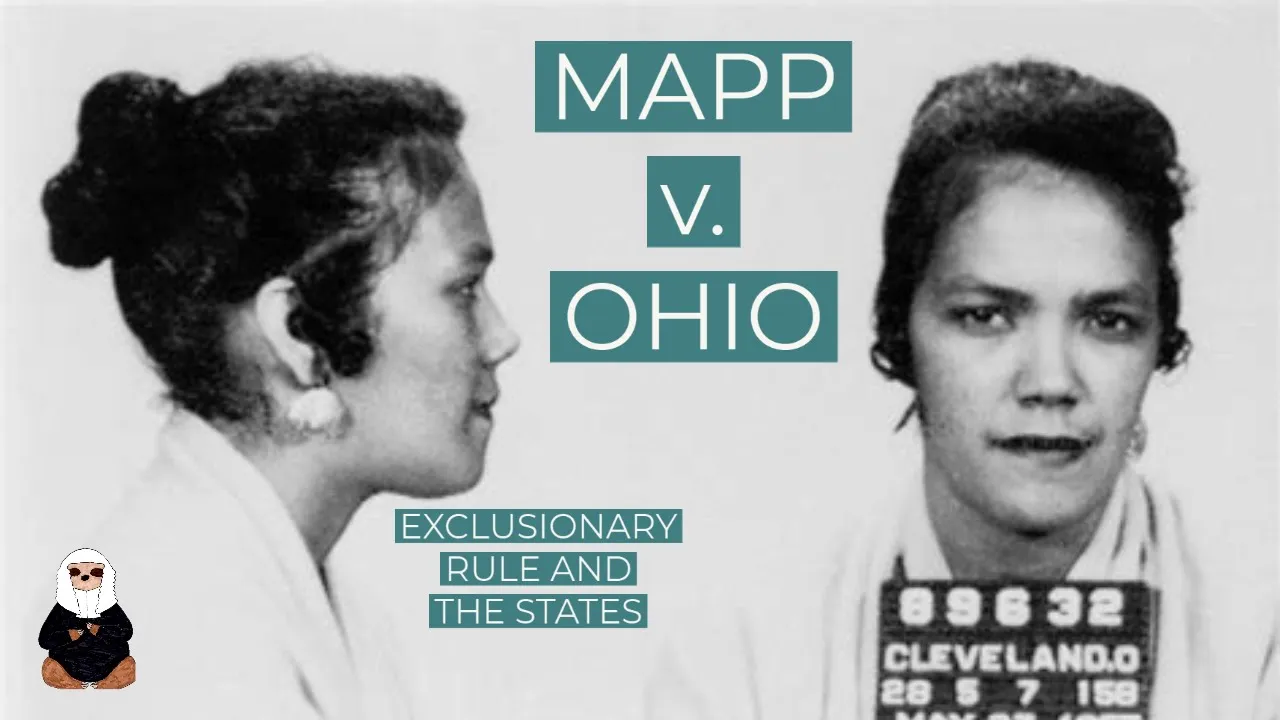
What happens if the state or the government actor violates your fourth amendment rights? Does the exclusionary rule also apply to state cases and not just federal cases?
MP v. Ohio says yes it does. If the state actor violates your fourth amendment rights, then you can have that evidence suppressed in a state level trial. Likewise, ladies and gentlemen, Herring v. United States has to do with what happens um and I believe this is a remedy. Um oh yeah, what happens if there's like an error in a law enforcement database and um there's a situation where like an officer relied on like a warrant or something that was not actually active. Um is that good faith? And yes, and the exclusionary rule is a last resort deterrent rather than an automatic remedy. And so the good faith exception um basically covers in the context of um like a remedy that you don't really have a remedy if there was an exclusion um that was triggered uh or excuse me there was a piece of evidence obtained on good faith by a police officer due to a faulty administrative record and that is what was that case herring vus that's a very specific case now we got to take a look at interrogations though and if we take a look at interrogations what we'll see is that We start with Famonte, okay? And that has to do with what if like you have a jail house informant who threatens a defendant into giving a confession. And there um the court found that um the co confession was coerced and involuntary and its admission was constitutional error. Um and then the court also took this. So you had that's like the standard. Okay. the co coerced confessions or involuntary confessions um are in are um not admissible. But then the court also looked at like whether this is a harmless error. Um but the the really primary point here is that it psychological coercion in prison prison settings can render confessions involuntary even if it's not a police actor involved. That's what we're thinking about when we're thinking about fulminant fulminatante and significantly ledied the limited the remedy because even if you we have this expanded definition of psychological coercion facilitating um um constitutional invalidity of the confession, you still have to show that it was um not harmless error, which kind of is a little bit like Strickland v.
Washington, which we'll talk about at the very end. Um, and then we got to talk about Chavez v. Martine Martinez under coerced statements. And here we're looking at um whether there's civil remedies for um a violation. And the answer is no. Um uh it coercive questioning um does um that produces an involuntary statement uh does that does not violate the fifth amendment unless the statement is actually used against the suspect in a criminal case. Um so um you there it basically limits the scope of civil remedies if there's like coerced confessions. Now we look at Miranda and the fifth amendment and Miranda is just a question of do you have to be read your Miranda rights?
You've seen them in every TV show. You have the right to remain silent. You have a right to an attorney if you cannot afford one. One will be provided to you anything can you say can and will be used against you in a court of law.
Do you understand these rights if I read as I've read them to you? Basically something akin to that. And this is basically an element of constructive waiver. So if you don't read this warning according to the Miranda case, then you can't get a voluntary waiver and anything you talk about after that point will not be admissible. So we originally Miranda was designed to be like a proylactic rule against abuses of the fifth amendment, but you're going to eventually find out Congress in another case tried to like write a law overturning Miranda and the court was like, you can't do that. It's prophylactic, but it's technically a constitutional right, and that's what the court finds. Now, Quarrel does make an exception to Miranda, and I think it has to do with like a public except safety exception specifically, and that's where um you have a situation where um when police are questioning someone and something they say prompts an immediate need to protect the public or officers from danger, then you have an exception to the Miranda requirement. And it's very, very narrow. Um, it's like, uh, what was the facts in this case? I think it was like police officers chased someone. Yeah. They apprehended him.
They found a holster and they asked, "Where's the gun?" And the guy said, "The gun is over there." Was it technically an unmarized statement? Yes.
But there was no time. He was fleeing.
They were apprehending him. Hot pursuit.
They said to him, "Where's the gun?" He said, "The gun's over there." They used it against him. Limited exception to the Miranda requirement because it's so pressing. Yes, they should have said the Miranda warning right before they asked him where's the gun, but they didn't have time. It was a public safety risk.
It was a supermarket. It was a gun. They had to find it. So, that's how you think of quarrels. It works within Miranda, but it's a very limited exception. And you got to be like chasing someone. A gun has to fall, something like that.
And then you can ask them the question without um Mirandaizing them. Now, um I think we the next case we look at is Dickerson vus. And this was that case I told you about. It's not that important, but you can't write a law that overturns Miranda's requirements is basically the basis for Dickerson. You could like Congress tried to change the Miranda warning requirement in certain cases and this court was like no as much as um we called it prophylactic. It's binding constitutional precedent under the fifth amendment and you can't just overturn it because statutes can't overturn the constitution. In fact, because of how Mayabberry v Madison works, the court's interpretation of the Constitution overrides statutes. That's why we say statutes can be unconstitutional. But that's a very different question because that's facial due process. That's a facial due process challenge versus an as applied. You can challenge a law as written, as applied, or as written and as applied. And that's what the court's talking about here. Facially, it's invalid to write a law, regardless of how you try to apply it, that attempts to change how Miranda functions because even though the court called Miranda prophylactic, for our purposes, we consider it a um a binding constitutional rule under the fifth amendment. Uh Vega verse TCO is again the no private civil remedy. We talked about this um above. you don't really have a private civil civil remedy for a violation of Miranda, just like you don't really have a private civil remedy for violations of like rules against coerc confessions. Um, and the court basically says no civil remedy. Uh, going to interrogations, uh, Messiah is the big case on interrogations. So, if you're thinking about interrogations, you want to be thinking about Messiah.
And this has uh specifically to do whether um uh the government deliberately elicitated um elicited incriminating statements from an indicted defendant outside the presence of counsel. And so what you're really thinking about is like when does the right to counsel attach? And in that regard, it's not just formal interrogation settings, but it's also any situation in where a law enforcement officer is attempting to deliberately elicit information post indictment from a defendant outside the presence of counsel. Um, and then where we talk about Brewer v. Williams in the context of Messiah as well because what Brewer is really looking at um is can you um initiate interrogation of the accused without the lawyer present without over questioning um if you're making statements that are reasonably likely to elicit incriminating information. Here the Supreme Court says um yes because if you use like psychological ps and indirect interrogation after the right to counsel is attached uh uh crucial stage you like it's like a very broad conception of interrogation. So if you like this is a heightened protection because you have the government can't just like manipulate you. All right. So if you like um have the right if the right to council attaches at the initiation of the adversarial process then once it's attached and invoked they can't just like say things that'll rile you up like oh isn't it so sad that this person died or ex or doesn't the family deserve justice. It's because like that's an extension of an interrogation.
It's psychological manipulation and so therefore it's um inappropriate to do so outside the presence of counsel. That's the big takeaway from Brewer V.
Williams. And we want to think of Brewer v. Williams as tied into Messiah because Messiah establishes the general principle that um you can't like start an interrogation by other means or even deliberately try to elicit information once the right to counsel is attached and it's been invoked. All right. So, it builds on Miranda. Uh and then I think that's the end of that section. And then we go to identifications. We're getting towards the end here, almost 30 minutes into our review with towel. And in identifications, we're really looking at um whether once you're indicted and the sixth amendment attaches and then like there's a lineup, do you have the right to have a lawyer at the um lineup? And it's basically saying that post-indictment lineups are critical stages and you need counsel. Um, so if you um have unconsled lineup identifications, like if you're there and the witness is there and there's a lineup without your counsel there postindictment, it can be suppressed and the government has to prove an independent source for subsequent courtroom identification. It really extends the sixth amendment rights protections to pre-trial identification procedures. Uh, this is later limited um later limited wage post-indictment charge lineups. Yeah. Okay. So, now we're going to also look at Neil verse uh biggers, which has to do with a one-person show up versus a lineup. And it's really a question of if you have one person come to the station versus a lineup and have the victim ID, one person versus a whole lineup, how does the court think about that? And here, the way that the court thinks about it is um suggestive identifications are not allowed. Now, um the court really favors lineups over showups, but anything that um induces suggestive identification, there's going to be a five factor reliability test that h um will then be used. And it has to do with like the opportunity of the vict witness to view the criminal at the time, the vict the witness's degree of attention, the accuracy of the witness's prior depiction, the level of certainty, and the length of time between the crime and the confrontation. Um, so if there's anything that's suggestive about that, it can kind of um, uh, oh, so the court is rejecting a per se exclusionary rule and instead putting in this five factor test and saying you can have some suggestive identification, but we'd really prefer you do a lineup, not a showup. Now, right to counsel heading into the last few sections. This was really fun. [laughter] Powell v. Alabama. This is the right to counsel attaches. is you you have a right to um appointed counsel. If you cannot afford it, it will be paid for.
Um uh in capital cases, uh that was Powell. And then in non- capital cases in Gideon v. Wayight, that's where that get gets extended. Very famous case.
Gideon employed the district court judge in Florida to give him a appointed counsel for a um felony uh B&E case at a pool room. The court wouldn't do it.
Gideon got convicted, appealed up to the Supreme Court. They appoint the court uh he hand appeal hand wrote an appeal up to the court. They granted his petition for cert appointed Abeforis a future justice and papa former and to represent Gideon. Gideon won this case and he was appointed a lawyer and on retrial he was found not guilty. And so this is the seminal case extending the uh sixth amendment right to council through the 14th amendment to the states in non- capital cases. That's a very important case. Towel loves Gideon. um great case.
And then we end with Strickland v.
Washington, which is the right to effective assistance of counsel. And for our purposes, this is a very simple overview, and it's just a two-part test, which is just um uh whether the um whether the lawyer standards whether the lawyer's uh behavior met like an objective standards of reason objective standard of reasonleness prevailing under the professional norms. So that's the basic standard. And then there's some stuff you can't challenge like you really assume that like trial strategy was reasonable etc etc. Uh but there's some stuff if there's less than complete investigation you're able to challenge but even if you prove the first prong that you had um a council who was um engaging in deficient legal performance.
You also have to meet the second prong which is but for causation which is that um but for the behavior of council that was deficient the outcome would have been different. So you have to show that not only um did your council perform efficiently but on that specific point of law they performed efficiently to the point where the outcome of the trial was affected. If you can do that under Strickland v Washington uh then you have met the test. So there you go 18,41 words ladies and gentlemen 55 pages it would have been 110 pages double spaced.
Times New Roman 12point font. My name is Grant Smith Ellis. You just went through criminal procedure review with Towel. We did it in 33 minutes. And I'm now going to test whether teaching something in this way helps with retention as a form of study aids. And if you're asking, Grant, did you just do a test on us and yourself in preparation for your final?
Yes, I did. And if you found this helpful and if you think I'm doing a good job, you know how to help. Little towel. I need it right now. I'm struggling, but I'm almost through school. All right, thanks for watching.
My name's Grant Smith Ellis. See you all after my final, which will be done very soon.
Up Next
13:04
Court Upholds Trump Liability in Carroll Case: Legal Analysis
@MeidasTouch
419.5K views•2024-12-31

4:27
US Secondary Sanctions Impact on EU Businesses and Blocking Legislation
@Bureauvandijk
1.6K views•2019-03-20
5:27
Forensic Phonetics: Speaker Identification in Legal Cases
@nptel-nociitm9240
539 views•2025-03-19

24:42
Police Interrogation Tactics: False Confessions & Legal Reform
@LastWeekTonight
7M views•2022-04-18
Related Study Plans & Knowledge Roadmaps
Structured learning paths in Law
law
Self-Defense Law: Imminence & Castle Doctrine
01Foundations of Self-Defense Law
02Imminent Threat & Reasonable Belief
03The Principle of Proportionality
+ 3 more learning modules
12h6 modules
Explore Roadmap
law
Defamation Law: First Amendment & Actual Malice
01Introduction to civil torts and the First Amendment
02Elements of Defamation: Libel and Slander
03Public Figures vs. Private Individuals
+ 2 more learning modules
8h5 modules
Explore Roadmap
law
Hearsay Rule: Trial Evidence & Exceptions
01Introduction to Trial Evidence & Courtroom Basics
02Demystifying Hearsay: The Core Definition
03Non-Hearsay: Exclusions Under FRE 801(d)
+ 3 more learning modules
14h6 modules
Explore Roadmap
law
Medical Malpractice: Law, Liability & Care
01Foundations of Tort Law and Civil Liability
02The Four Elements of Medical Malpractice
03Defining and Proving the Standard of Care
+ 2 more learning modules
12h5 modules
Explore Roadmap