




















Earth's magnetic field is generated by the geodynamo—a self-sustaining engine located in the liquid iron outer core that converts kinetic energy from convective fluid motion into magnetic energy; this process requires three essential ingredients: an electrically conducting fluid (liquid iron), an energy source to drive convection, and planetary rotation to organize the fluid motion into helical patterns that amplify and sustain the magnetic field over billions of years.
Earth's Geodynamo: Probing the Deep Interior
Added:Understanding the internal layered structure of the Earth, specifically the distinction between the solid inner core, liquid outer core, and silicate mantle.
Fundamental principles of electromagnetism, particularly how moving electrical charges (currents) generate magnetic fields and the basics of electromagnetic induction.
The concept of thermal and compositional convection, explaining how heat and density differences cause fluids to circulate.
The Coriolis effect and how the Earth's rotation influences the motion of fluids on a planetary scale.
Paleomagnetism and the history of geomagnetic reversals, including how magnetic signatures recorded in oceanic crust support plate tectonics.
The structure and function of Earth's magnetosphere, and how it shields the atmosphere and biosphere from solar wind and cosmic radiation.
Comparative planetology, exploring why other planetary bodies (such as Mars, Venus, or the Moon) lack active global magnetic fields.
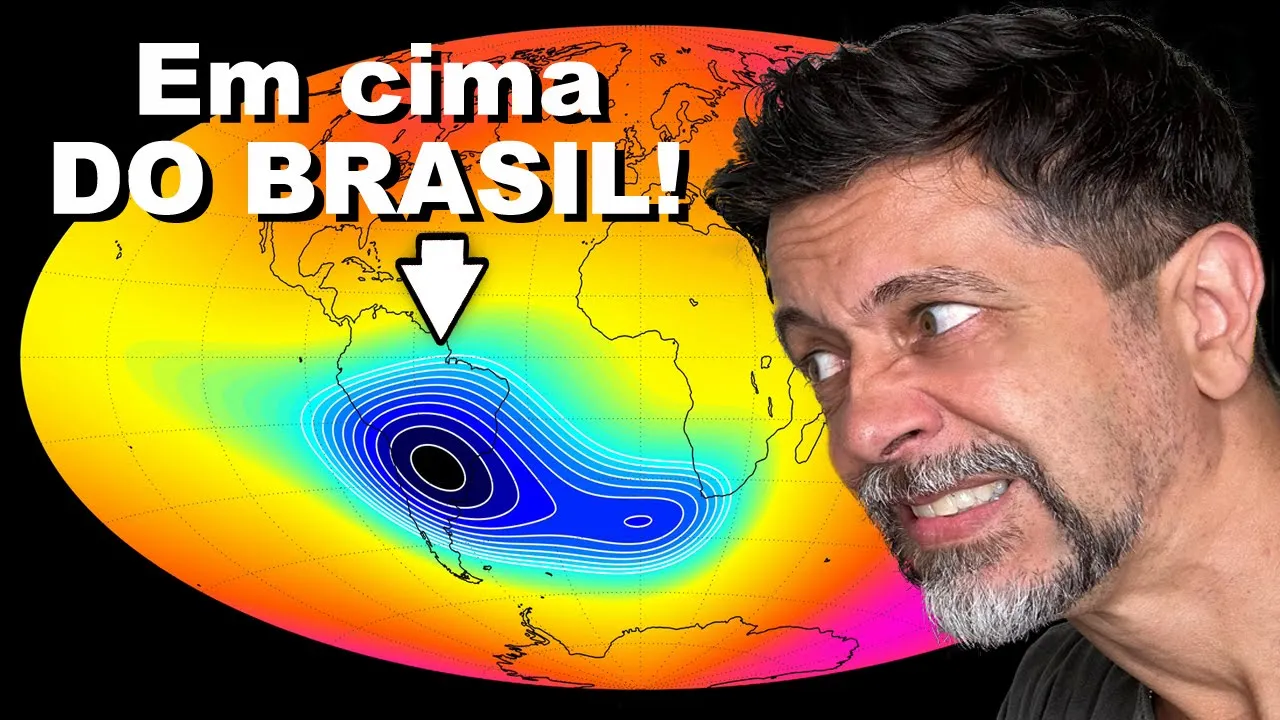
The study of geomagnetic secular variation, including the modern movement of the magnetic poles and anomalies like the South Atlantic Anomaly.
12.2K views0likes1:10:32Original Release: 2018-11-09
All right, I think we can get started tonight. Thank you all for coming. My name is Rick Carlson. I'm the director of the department of terrestrial magnetism. This is one of two uh departments of the Carnegie Institution that's on this campus here at Broad Branch Road. Uh the Carnegie Institution was founded uh by the philanthropy of of uh Andrew Carnegie. We have no relation to uh the other Carnegie establishments.
Carnegie Melon, Carnegie Library, a zillion other Carnegies. Uh Carnegie actually set us up as a as a private research institution uh headquartered in in Washington DC. We now have six departments uh scattered around the United States, two of which are on this campus. I had the pleasure today of being able to do uh Peter Driscoll uh as our speaker tonight. Uh Peter is one of our recent hires. Uh it's an interesting turn of events in our our history of the department. We are called the department of terrestrial magnetism because in 1904 we were founded to map the earth's magnetic field, understand its shape and size and strength and and changing uh with time. And we did that pretty much up through uh the beginning of World War II. And then after World War II, our interest uh shifted over to various other fields. So we now uh find ourselves uh interested both in planet formation uh and the evolution of planets. Peter came back to us as as a terrestrial magnetist. So we're actually back into terrestrial magnetism now. Uh he got his PhD at John Hopkins uh after uh and then went on to to posttos at Yale uh and also the University of Washington. Uh he actually had a longer association with Carnegie and that uh he was at the San Francisco State San Francisco University uh working with the Carnegie planet finding uh team out there back in 2005 I think it was. So uh Peter came to us three years ago uh as a staff scientist here after leaving his postto at the University of Washington and his talk today is on the geodamo a window in the dynamics of earth's deep interior.
[Applause] Thank you. Make sure I got this.
That was not it.
Okay. Uh yes. Oh, thank you all for coming. It's quite a crowd. Um, thanks Rick for the introduction. Um, I'm very excited to uh share with you some of my work here in uh in understanding the Earth's magnetic field and also share a little bit of the history, how the department's contributed. Um, and also I'm going to attempt to give you like a pretty solid background in how we know what we know about the Earth's magnetic field. So, I'm going to spend a fair amount of time doing that. Um, my title really means uh when I say a window, um, I'm of course mean metaphorically because we can't actually see down into Earth's deep interior. But by measuring the magnetic field here up at the surface, we can infer a little bit about, uh, fluid motion and what's going on uh, down in the very deep interior, which is a very unique way of of probing the deep interior. And we can do it back in time, too, as I'm going to get to towards the end. And um I also want to acknowledge a few people right off at the start. Uh Kian Wilson is a computational scientist here in the department has been instrumental in producing a number one number of my uh numerical simulations and he helped my summer intern produce figures like this.
So, Anisha Samath um who I'm not sure is here, but she um was here over the summer and she was basically getting through all of the work I gave her and eventually I tasked her with producing 3D images like this, which she did on her own, of course, and then taught me how to do it. So, um kudos to her for helping me put this together. You're going to see more like this later in the talk.
Okay, so let's start with the big picture. Um these are the things I like to think about uh on a daily basis.
Maybe not everybody else does. Um, but you're asking, okay, why care about magnetic fields? Well, they're they they operate your all your cell phones. Maybe that's a good reason, but beyond that, uh, where do and where do they come from? Um, they kind of seem magical. At least back in the day, people really didn't understand them. What do we know about Earth's magnetic field? Um, this is where the department plays a role.
Um, and are planetary magnetic fields common or rare?
um and and how special is the Earth?
Maybe put it in some context. What does the magnetic field tell us about the interior? That's sort of the the bottom of the list of we're really trying to probe the deep interior and there's really few ways of doing doing that.
So, here's the outline of my talk.
I'll start with the context. I'll I'll start from uh large scale and bring you all the way down to the center of the Earth. So, we'll start with an overview of some of the planetary uh magnetic fields we know about and then I'll come in and and and tell you even even more detail about the Earth's magnetic field, which of course we know much more detail than we know about the planets. And then I will describe some of my own um work about how the geodynamo works, how the magnetic field is generated, and then how we simulate this um using computational simulations. I should point out a little bit of jargon here. The phrase geomagnetic refers to the earth's magnetic field. Okay?
Sometimes I'll say paleomagnetic which means earth's ancient magnetic field.
And this word dynamo, a dynamo is an engine that produces a magnetic field. So in this sense, it's the earth the geodynamo is earth's engine that's producing the magnetic field. And that engine is in the liquid outer core as we'll find.
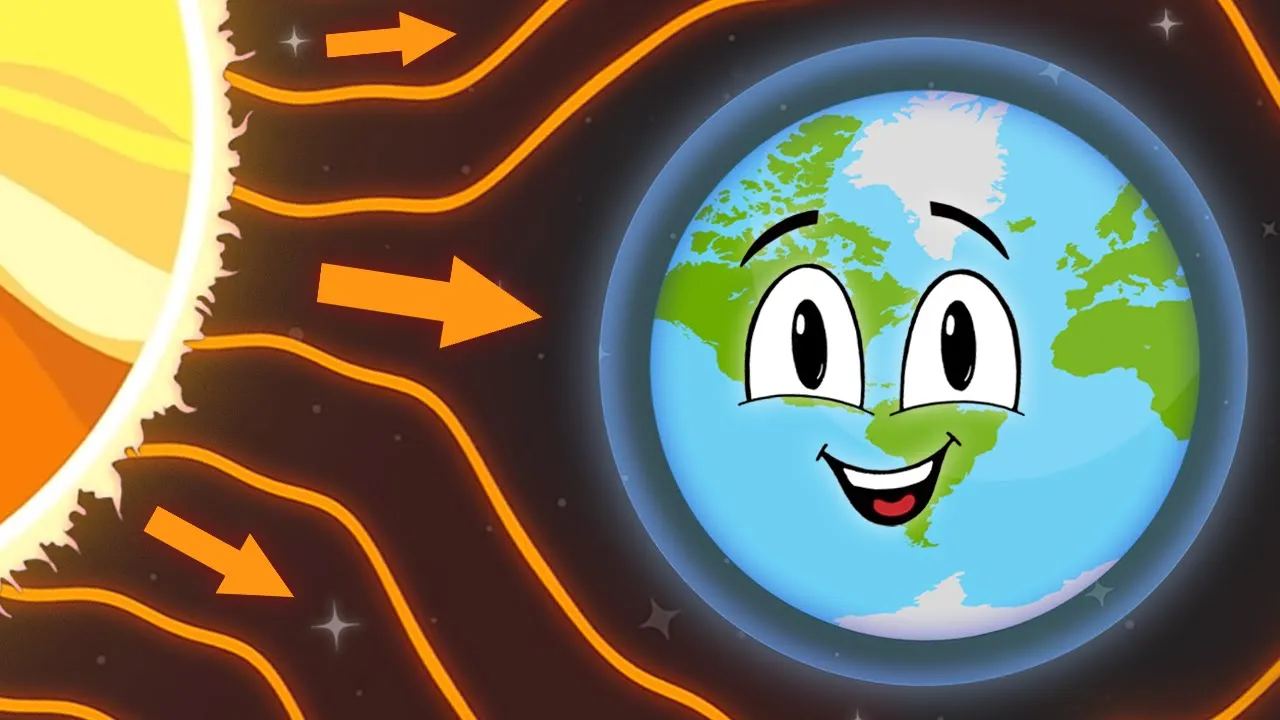
So I want to start with this schematic uh that Roberto here in the department put together for my talk. Um and it's not to scale of course uh we are not that close to the sun thankfully. Um but the the concept is is clear here that earth's magnetic field creates this shield. You can call it a magnetic shield uh that shields our planet from the solar wind. So there's there's a constant stream of high energy radiation protons uh and and electrons streaming through inter interplanetary space almost all of this which gets deflected along this magneto magnetos which is the boundary between earth's magnetic field and interplanetary space and the solar wind.
uh and the the bit of uh electrons and protons that do make it into this boundary which some do of course get funneled conveniently into the polar regions is illustrated here and they do are associated with producing the visible aurora that you see in the polar regions.
Now one import one very nice feature of the orientation of earth's magnetic field is it's a dipole which means there's two poles one positive one negative where the field comes out of the negative into the positive side and these poles are very closely aligned with our rotation axis or our geographic poles so that you know the north magnetic poles near the north geographic pole and so forth um and that I say that's convenient because that means all of this harmful radiation the bit that gets through is streaming down into these polar regions where there's not much for it to disrupt. There's no there's there's not much civilization there, not much life. But you can imagine it for a planet that maybe had a different orientation magnetic field where you're raining down particles constantly at mid latitudes or or equatorial latitudes. This could be bad for the evolution of life on a planet.
And furthermore, a planet with no magnetic field you would imagine is just being bombarded all the time, which can lead to atmospheric escape. It can disrupt the atmosphere. it can make it very hard for things to for life to survive for example. So this is the magnetic shield concept.
Okay. Now let's take a little survey through the solar system. Uh this this figure is a little dated but I think it's nice illustrating the sort of uh magnetic zoo that we have in the solar system. So here's uh a couple of the planets Earth, Jupiter, Saturn, Uranus, and Neptune that we know have magnetic fields. And here is their orientation in space. And um they're all ro they're all tilted um and then rotating on this rotation axis here. But the magnetic field is all tilted a slightly different amount compared to that rotation axis.
So Earth's tilted about 12 degrees compared to its rotation axis. And that tilt is wandering as I'll show you for the magnetic dipole. Jupiter's is nearly axial, slightly tilted. Saturn is to within about a percent of zero which means its magnetic field looks almost entirely axially aligned which makes it very hard for us to constrain the rotation rate of Saturn. Actually we don't know well the interior return rate of Saturn because that internal rotation rate comes from the differential motion of the magnetic field as the planet spins. Okay. So Saturn is is a bit of a a lot of people work very hard on Saturn getting Saturn's magnetic field measurements right. Uranus and Neptune are in a totally different ballgame.
Their magnetic fields are tilted way out of whack, the dipoles and um they're also very offc center from the center of the planet. So there there's a whole range of different kinds of magnetic fields and I should say their intensities also vary by quite a bit.
So this magneto standoff distance I just mentioned for the Earth is about 10 Earth radi for Jupiter it's about 65 Jupiter radi and so forth. So the size of this magnetic shield sort of um is different for each planet.
Now the magnetic field is generated in the interior as I said and these planets uh have very different kinds of interior. So the top row I'm breaking them into the terrestrial planets where you have a silicate mantle and crust and an ironrich core. It's in that ironrich core that is generating the magnetic field which we'll we'll get to in a bit more detail. and it's in the uh the gas and ice giants is being generated in a completely different material. Um so for Jupiter it's in the metallic hydrogen region. So this is a when you get to super high temperature pressure hydrogen it acts like a metal and by metal I mean it becomes very good at trans uh conducting heat and electricity. It just means there's charges that are free to float around. When you get into the deep interior of these giant planets even hydrogen can metalize. in Uranus and Neptune. It's yet another material. It's um it's water, ammonia, methane ices, other molecules that at high pressure temperature also ionize. Uh and they're flow they're flowing like liquids in the interior generating a magnetic field. So I've also noted here the planets that do and don't have dynamos. So let's go through that because that's interesting.
So Mercury actually has an active dynamo today which we have measured directly um in situ with probes. Um, it's actually quite strong and it's a little bit surprisingly strong given the size, the relative smallness of Mercury. Venus is nearly the same size as Earth, nearly the same density, no magnetic field whatsoever. That's a big mystery.
Earth, of course, has an active dynamo and has had one for possibly its entire history. Uh, the moon and Mars have something that's called a remnant custal magnetic field. So there's no active magnetic field being generated today, but the rocks on the surface preserve an ancient field that on the moon and Mars died about four billion years ago, more or less. So they had an early nent one that sort of dwindled and died off. We don't quite know why. And I want to point out another terrestrial object, Ganymede, has an active dynamo. This is one of the largest uh satellites in the solar system. It orbits Jupiter and it has an active dynamo. Okay. So, it's quite interesting to to think about that.
So, you can produce magnetic fields in a whole range of planets in a whole range of materials.
And as we just heard from Sean Hardy's introduction video, which is very nice.
He stole my thunder a little bit here, but that's okay. Um, DTM played a significant role. Uh, and I'm going to do the la the second role chronologically first. Uh, and that was in 1955. Burke and Franklin detected the first remote observations of emissions coming from a planetary magnetic field that was not Earth's. Okay. So they were in fact so the title of the paper observations of a variable radio source associated with the planet Jupiter. When they started this project they didn't they were not looking for Jupiter emissions. So they went out into the corn fields of Senica Maryland. This is about 20 miles up river road uh from here not far. They strung out, you can see this X here in this cornfield. They strung out this series of poles with just wires connected to them. And they connected this to their to their truck with all of their electronics. And this is a radio telescope. So you're used to seeing like a maybe a big dish for a telescope, but that's not what this is.
Okay, this is this is not it's just pointing straight up from the ground into the sky. They can't point it at all. The only change in direction it has is as the Earth rotates um through the through the sky. uh and they could see a variation in the radio waves hitting this from space. These radio waves have wavelengths of order meters uh or centimeters. So they're quite large wavelength meters. That's why you need such a big telescope to see them.
So they saw emissions. Um they were looking for actually an extragalactic radio source. Uh and they were seeing a periodic signal that they didn't understand what it was. And after a couple months of observation, they realized that it was Jupiter passing through their field of view. And so they put together this paper that was published in 55 claiming they were measuring emissions from Jupiter. It was later confirmed that Jupiter's magnetic field is producing these radio emissions. So the radio emissions themselves, I should say, are produced from uh solar wind electrons being trapped by the magnetic field line and they start to orbit in helix like motions. And as they orbit those field lines, they emit radiation. Whenever you put in charge in orbit, it emits a electromagnetic radiation.
So that's how they did it. There's a plaque if you want to drive up there.
It's still there um on the side of River Road um memorializing the site where they made the discovery.
And here is a NASA cartoon of well that's that's an actual image of Jupiter of course but they're superimposing here in false color what the radio emissions look like. They come from the polar regions because as I said that's where the uh electrons get funneled down and are most intensely gathered. Um and you see it's pretty sporadic. That's because the electrons are sort of raining down irregularly.
And you see this one trace bright spot here. That is Io, a large moon around Jupiter that emits quite a bit of material uh that's conductive and that material comes so that material is coming out. Io's somewhere out here.
It's kind of raining back down on a magnetic field line and tracing out a spot and so that eventually they could see modulations from Earth of Io modulating Jupiter's cyclone emission.
So that's that's effectively what Burke and Franklin were measuring at the time even though they didn't quite exactly understand it. So now we've gone through the solar system. We've got a fundamental obser observation here. We have to understand nearly all solar system objects have magnetic fields of their own as do some of the smaller objects. So many including the sun which I didn't even mention. The sun has a very strong magnetic field.
So why is magnetism so ubiquitous? How could it be that all of these objects just generate magnetic fields on their own? And the general answer to that from a theoretical point of view is that you only need three, I should say only, but you need three ingredients. And those ingredients are a large electrically conducting fluid in the interior such as iron for the earth, hydrogen for the gas giants, and so forth. You need an energy supply to stir up that fluid to get it convecting. And then you need some planetary rotation in order for that convecting conducting fluid to start to generate a magnetic field to start to swirl give you that swirling effect. And that's what that's what'll generate the magnetic field. So basically throw these three three uh if you if you meet these three criteria then you're on your way to generating a magnetic field. Of course, um there's a great diversity in the fields as I showed that is a lot harder to answer because that has to do with the details of these three components. Um and also how it changes with time is something we're going to get into especially for the Earth's magnetic field. We actually have data.
There's a huge amount of variability in time.
Okay. And now I have two slides for um how-to slides. Okay. give you some intuitive idea about how you generate a magnetic field if you were going to do it in the lab which I don't recommend because it's very difficult to do in the lab only a few times it has been done in the lab typically numerical simulations are much easier but here's what you would do you would get a rotating table and you would rotate this table um at some rotation rate capital omega here you'd put on that table um a big vat a big um container of your favorite electrically conducting liquid liquid.
So, at room temperature, you can't use iron, but you could use gallium, for example.
Um, or even water has a decent conductivity, probably not high enough for this experiment. Um, and you then you stick in a propeller that is rotating that you're going to have the capacity to rotate at a different rate or in a different direction. So, eventually you're going to be spinning up some turbulence in here. And the material properties matter, the density and the electrical conductivity. We're not going to go into that. and d is sort of the height of this material. So if you just spin the propeller and the table together, then you've got solid body rotation, if you impose an ambient magnetic field B knot, it's just going to go it's going to it's going to trace right through the material, come right out the bottom the way it came in because it's in solid body rotation. Not no funny business here.
Now spin the propeller counterclockwise or this is clockwise in fact but counter the direction of the ambient of the table. Uh and the propeller is start going to kick up some turbulence as you can imagine sort of like stirring uh creamer into your coffee. Um but now since it's a conducting fluid it's going to it's going to pull these magnetic field lines that were initially vertical and it's going to start to twist them up.
um and you'll twist them up as much as possible and that'll create a secondary magnetic field by the turbulence that you're generating called B1. Okay, B1 is our our generated field. B KN is our ambient applied field.
So, uh there are two possibilities here.
Uh the first possibility is if you turn off the ambient magnetic field B KN the first possibility is failure and that is the magnetic field B1 that you are generating by this fluid motion decays away and even though the fluid is still convectic. So we call this subcritical for dynamo action. So you're not stirring the material the the fluid fast enough to generate to keep the magnetic field generated faster than it's decaying out the sides of the material at the sides of the container.
The second possibility is that you are stirring it fast enough. Um and when you remove the ambient magnetic field you what remains is the induced magnetic field B1 from your convective stirring.
So we call this super critical for dynamo action.
There's a magical number called the magnetic Reynolds number RM that's proportional to the conductivity. So how well the material conducts electricity.
Um uh the fluid velocity U and the the the length of the of the the conduit that you're working in and multiply these quantities together. And if your magnetic Reynolds number is above about 40 then you're expected to be in this regime and below 40 you're over here more or less. the geometry changes this number a little bit but of order 40. So that's our magical we call that the dynamo number. That's the number you want to hit if you're doing this in the lab.
So um that was our laboratory experiment in a cylinder. Now the geometry in the earth is different. It's a spherical shell. So in the in the liquid outer core we have uh liquid surrounding a solid iron inner core. Okay. Um and so instead of a cylinder rotating on a tabletop where gravity in that case was always pointing down of course in the planetary condition, gravity is radial. So it's pulling down in all directions, but you're and you're rotating it around a rotation axis here. And what the fluid will tend to do is organize itself into these vortices. They're kind of like tornadoes or the eye of a hurricane or something. And they're very tall vortices like this schematic is depicting here. Uh, and these vortices will tend to generate magnetic field, vertical magnetic field, just the way that a a charge, an orbiting charge will generate a magnetic field field through its center. But in the Earth's core, where there's convection going on, these are constantly swishing around, appearing and disappearing, growing and shrinking and so forth. Um, and that also causes the magnetic field to sort of dynamically change rapidly in time as the fluid that's generating it changes.
So on the right here is a cartoon. The first the first simulation I'm going to show you uh from one of my models. And here I'm just trying to get across the idea that the magnetic field, let me run it. Um is very dynamic. So you're looking down um here's the rotation axis in the center. You're looking down into the equatorial plane. So, if I were to slice if I were to slice this globe um along the equator and just look down on the rotation axis, this is what you would see. The the red patches are positive magnetic field coming up towards you. Blue is magnetic field, negative magnetic field going down. Um and the takeaway here is that it's just very dynamic. You can see there's constantly field being created. Um the signs changing. It's it's being invected up, it's being invected down. There's no clear organization to the thing, right?
So down in the core, it's very complex.
But when you look up into space, uh when you get very far away from this region, it simplifies greatly and it tends to be that dipolar component that remains the strongest. We'll see that a little bit later. Okay, so part two, um observations.
So, here is our here's our uh a fairly recent map from 2000 from a satellite uh the Orststead satellite um that measured Earth's magnetic field out in space and projected that those measurements all the way down to the core mantle boundary because we know we we assume that there's no magnetic sources between the between those between the satellite and the core. There are small ones of course but nothing important. And when you do that exercise, you find the magnetic field at the Earth's core mental boundary looks like this. So it's not simple certainly, but it has this dipolar nature of being mostly one color or being mostly negative in one hemisphere and mostly red or positive in the southern hemisphere. And so you can imagine the magnetic field lines would come out and reconnect or actually come out of the blue and go into no come out of the red and go into the blue. Um but you also see there's patches of reversed polarity uh at points um in both hemispheres. So you're getting sort of a mixture of the really complex model I just showed you and and the simple dipolar um picture you get from space. This is what it looks like at the CMV. And I should say from these type of observations, we can infer the type of convective velocity in the core is about a millimeter per second. To give you some perspective, that's that's the rate that the second hand goes around your watch. Okay, about a millimeter per second. So that seems maybe that seems fast certainly compared to mantle convective velocities. So the rate that the seafloor is moving horizontally before it subducts that's much much longer. Okay, that takes millions of years. So this is relatively fast and you need these fast speeds to be generating this field constantly.
Okay. And this is my second bit on the history of the department that you've already seen heard a little bit about.
Um going back in time to DTM's initial uh contributions really really the foundation of the department was when Louis Bower proposed to Andrew Carnegie that his his gift uh to to the institution uh go to funding what was known what was uh proposed at the time as the magnetic bureau which eventually they changed the name to the department of terrestrial magnetism. Uh, but this is from the the second yearbook of the institution in 1903. And you can't read this. It's all garbled. But, um, I'll read it for you. Oh, it's garbled here, too. Um, the important point here is he's he's arguing that we need to investigate the magnetic field of the earth at a global scale. Okay? And the reason you need to do that um is that the magnetic field itself is a global phenomenon. And if you had a ship that could map out the magnetic field and the seas everywhere, then uh navigation um could be much improved at the time.
We didn't have GPS. Okay. At the time, you're relying on astronomical navigation or magnetic navigation and it the magnetic field was just not well mapped. So one re one reason to build the ship and and map map the magnetic field was for navigational practical purposes. The other reason is was and Carnegie was attracted to this was the fundamental science of understanding what was generating the magnetic field.
Was it changing? Where did it come from?
Was it a custal phenomena? Was it a space phenomena? Was it a core phenomena? What was it? There were there were several competing theories for several decades following this. Uh and this is a shot here of a couple technicians in one of the domes. There's two domes on the surface on the top of the ship where they do these careful magnetic measurements. They basically got a couple threedimensional compasses in there and they're trying to measure, you know, um a the careful dip of the of the ambient Earth's magnetic field while the ship is bouncing up and down, right?
So, they've got they have these very sensitive uh instruments in here. And as Sean said in the introduction, the ship is mostly wood. Even the nails were made of wood. The only there was only trace amounts of metal um for the anchor, I think, was copper or bronze. And the rope that held the anchor was hemp. Was like 10 10 inch hemp or something. So they really kept down as much metal as possible.
Made seven global geomagnetic surveys.
That's these tracks. Um they really tried to cover the surface of the earth as evenly as they could because they knew that all of these measurements would go into making maps as I've already shown you where you need to have good spatial coverage. They went on land. They did surveys to some of the remote places on Earth because they magnetic field had never been measured there. Um and then as Sean alluded to, of course, it all came to a fiery end. 1929, the Carnegie burned um following an explosion uh while docked in Apia Samoa.
story that I've read was the ship had just been outfitted with a very early uh fuel uh driven motor um gas a gas powered motor. Um and at the time they didn't understand the idea of fumigation. They didn't they really didn't understand that there was uh the possibility of of danger associated with this burning this gas.
And so the captain alt was underground under the in the in the hall of the ship um apparently while this motor's running and went to light up uh his pipe I think is the story and that was it.
So um there let's let's look at the time scale of the variability now going back from we were just looking in the early 1900s. Let's go back even further. So back in the 1840s, Gaus, who was an absolute genius, laid out all of the math, most of the math associated with this this field of physics, but was also making measurements, fairly accurate measurements of the intensity of Earth's magnetic field um and that were then published. and then subsequent measurements reveal that the intensity of earth's magnetic field measured at different points in the globe um was rapidly decreasing. I'll note that that this axis does not go to zero. Okay, so it was just going from about 8 to about seven and a half. Um, but the interesting thing here perhaps is that it's so fast because if there were no fluid motion in the core to generate the magnetic field, then it would freely decay at this rate of this red very slowly sloping line. It would just decay slowly over about 50,000 years. That's not what you're seeing here. You're seeing a dynamic process that's changing the intensity rapidly.
People have looked, of course, at this question of is the is the field dying?
What's going on? Is the field reversing?
what's going on. People don't think the field is dying. They don't think it's going to reverse. Contrary to the movie The Core you may have seen where they're trying to restart the magnetic field.
And I'll show you on the next slides.
You need to put this kind of variability in context because the magnetic field varies on many different time scales kind of like the weather. And over here you're looking down on the North Pole and you're looking at the location of the North magnetic pole and how it wanders. And over you know these these are over the centuries. So, um, 1950 and then so it wanders like this back to year zero, uh, and so forth. So, it it's it's remained, um, in the northern hemisphere for about the last couple hundred thousand years, um, wandering around more or less randomly.
So, as I've just mentioned, there's these two ways to probe what the magnetic field is doing. there's its intensity. That's the magnitude of the magnetic field. So, its amplitude, how strong is it? Uh, and its direction. So, there's two important things here that you actually measure differently.
Um, and here I'm showing uh some data that illustrates both the direction and the intensity. So, um, the direction, let me start with the direction. That's what these arrows are meant to indicate here. So the direction of this dipole field is normal over this black the black uh bars and then reversed during the white bars and this is over two the last two million years. Uh this data comes from seafloor records which I'll get to and in the red here is the intensity from uh cores seal uh sea drill drilled cores where they measure the magnetic field along the core. Um and this is a different use of the word core. I mean, they're drilling a a hole into the seafloor and pulling it out and they call that a core. Um, and here's the intensity as measured with a mag a sensitive magnetometer going back two two million years. And you can see um it doesn't maybe we're on an uptick, right?
But more importantly, it fluctuates on so many different frequencies. There's no obvious periodicity. It looks random.
And what look what may look like a temporary down tick may just be you know you know a decrease when it's on the high end of the intensity and so forth.
The present day intensity is about eight on this scale. So you know decreasing down to seven seven and a half is really nothing to worry about. It's still um very the way it's been over the last two million years is more or less um statistically stationary.
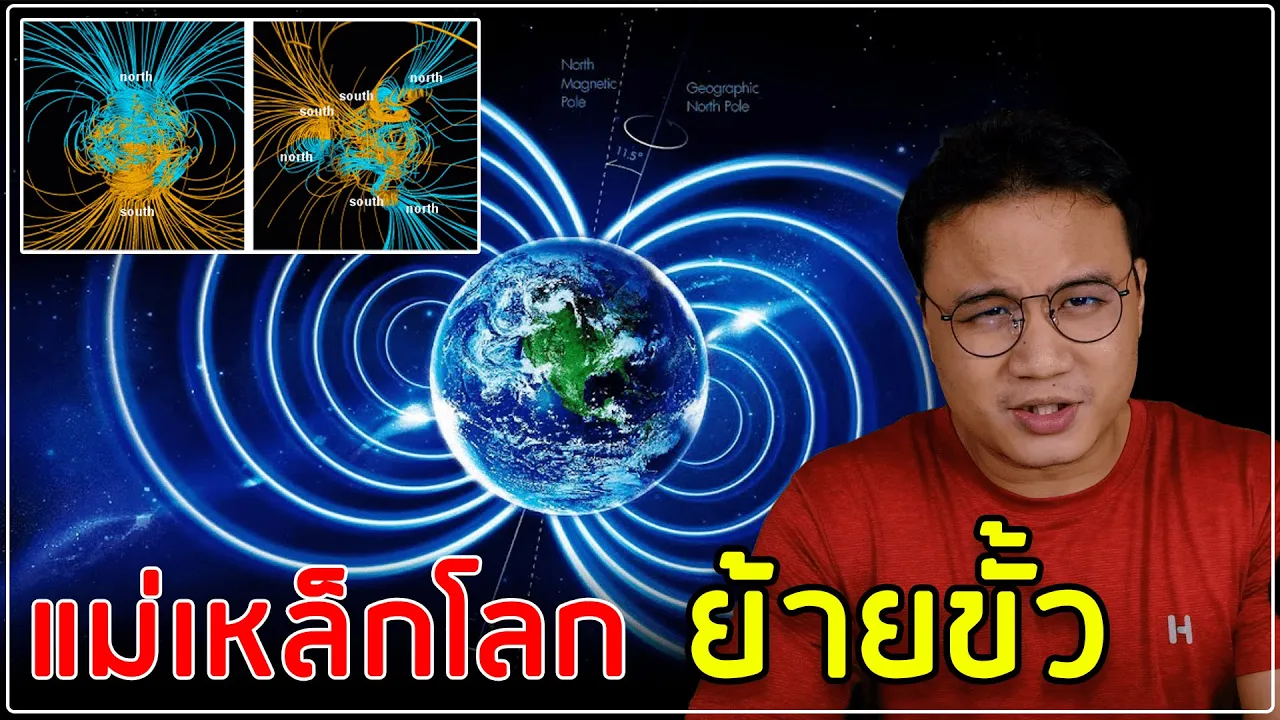
So these reversals are interesting. I'm going to show a number of these reversals. So what happens during a polarity reversal is that uh this dipole field which is oriented like this reverses polarity and the field lines will just go in the opposite sense. So this reversal process happens rather quickly over about 5,000 years and during that reversal the field morphology breaks down from a dipole into small scale field. And I'll show that.
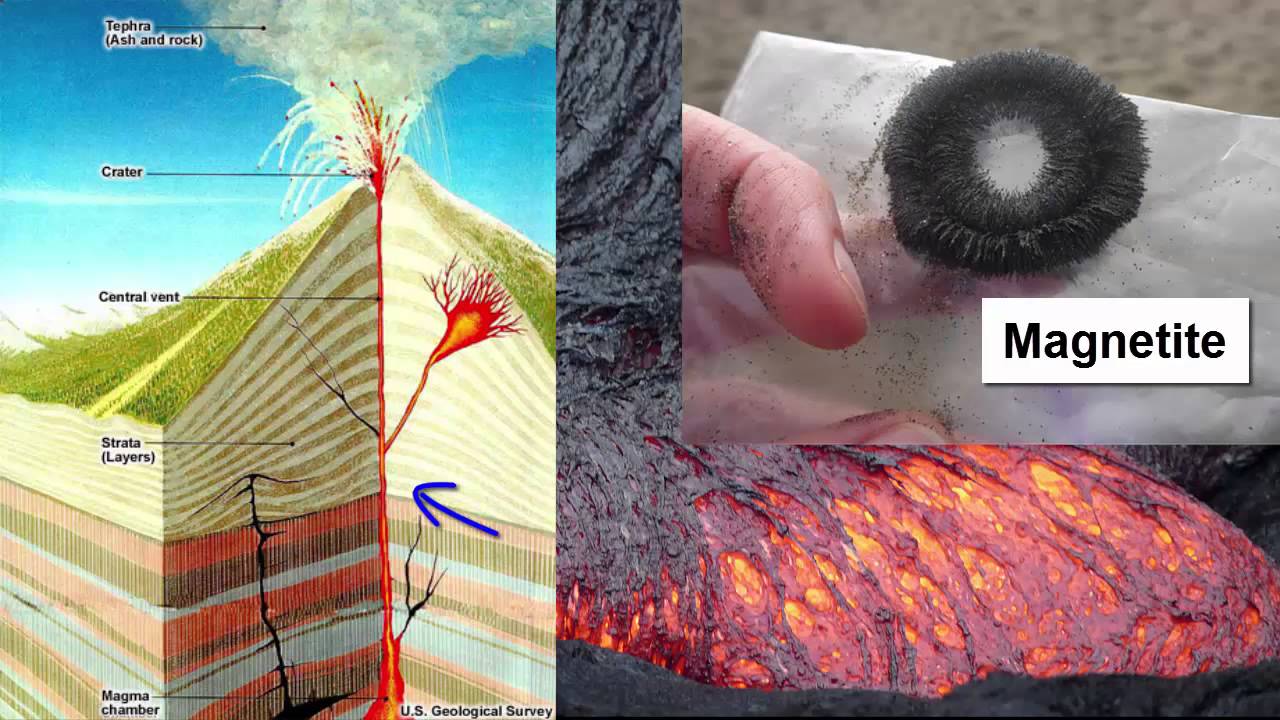
Okay. And I want to I want to tell you a little bit about how we measure these magnetic fields. So in a rock when the rock is still hot above its so-called cury temperature um there are magnetic minerals like iron and magnetite in the rock um that can carry some ambient magnetic field but above this temperature they're all randomly scattered just thermal energy is having them scatter around the magnetic field is not strong enough to align them and as soon as you cool them down they become more sensitive they become thermally calm down calm them down and they start to align themselves at the ambient magnetic etic field and when the rock solidifies they preserve they lock in that ambient field intensity. Okay.
And it and its orientations align with the ambient field. You bring this rock back into a lab and carefully measure its magnetic internal magnetic field uh and you know where it came from and so forth. You can extract its direction and its intensity. Okay.
At the time the rock cooled is the important point. So we have rocks that are 4.4 billion years old. Well, not rocks, but inclusions that are 4.4 billion, but rocks that are three, three and a half billion years old, where we see these kinds of effects.
Whoa.
And this is just to give you the idea that these rock samples are from all over the surface of the earth. And the idea is to get a good sampling. So you're not just sampling one location.
So as I mentioned, that core um that time series of the intensity came from the seafloor. Uh, and uh, and this is most easily done by a ship dragging a magnetometer behind it. And if if you let the magnetometer go down near the seafloor and it's very sensitive, you can actually pick up the magnet magnetic signal locked in the crust, the seafloor crust. Uh, these magnetometers were first developed in World War II to detect submarines. And that's to large part why this field of mapping the magnetic earth's magnetic field back in time didn't really happen until the 50s.
And that was key to proving that the continents had been moving back in time and really proving that continental drift and plate tectonics is a real thing. It's very hard to describe otherwise. So the way that the magnetic field gets locked into the seafloor is there's a hot upwelling mantle below a ridge. Um, and when those rocks solidify, as I just showed you, they will lock in the ambient field, and this ridge will spread out evenly in both directions, more or less. And so you'll lock in, you know, say you lock in the present day field today is normal. And then over here, this is 750,000 years ago when the field was reversed polarity, and you'll see an opposite. So you'll see the uh mag direction of the magnetic field will switch polarity in your mag magnetometer and you go to the next reversal and the next reversal. So and it's and it's mirror image on either side of the ridge because the ridge is spreading evenly in both directions more or less.
So it gives you a way to um document many things. The reversal record of the earth. Okay, if you know the age of the seafloor here, which of course they didn't know back in the 50s, then you could say what was the reversal rate?
When did the reversals occur back in time? Initially, this was used as a time scale. In fact, because this record was synchronous all over the surface of the earth because the refer if the field reverses in the center of the earth, it's going to reverse everywhere on the surface, right? And so you see these you people went around the surface of the earth mapping this stuff out and matching these stripes all over different seafloors everywhere at the same age. And so they could start to stitch together where is the seafloor the same age on top of that. And that's how you could start to reconstruct how the continents have been moving.
Okay. So now I'm showing you a polarity time scale. Again, black is regular or normal. White is a reversed polarity. So you see this, look at all these reversals. Okay. All of these are reversals going all the way to 160 million years ago. It's about the oldest seafloor that we have. 180 is about the oldest. But the the seafloor magnetic record goes about that far. Um and this is just um the uh signal you would measure in the magnetometer.
And I want to point out this trend of roughly uh quickly frequently reversing field to infrequently reversing field to no reversing magnetic field. For about 40 million years, we had a single polarity, a normal polarity that's known as the Cretaceous normal supercron because it was during the Cretaceous. uh we don't know, we think it's real, but we don't know exactly what's going on there. And then on the back side of that, you have the same process uh infrequent reversals to frequent reversals.
And so this is being one one of those mysteries and it actually can tell us something very uh um detailed about what's going on in the core or perhaps in the lower mantle. So here's that same data but now in terms of reversal rate over the last now I'm going 160 I'm going 500 million years. Okay.
And here's our we reverse about four times per million years today. Here's the cretational supercron. We have this oscillation. It's fascinating right?
This is not a core time scale. This 200 million year oscillation. The core fluctuates as I said a millimeter per second. It fluctuates on thousands of years. This fluctuation is likely something to do with convection in the mantle which operates on the 10 to 100 million year time scale.
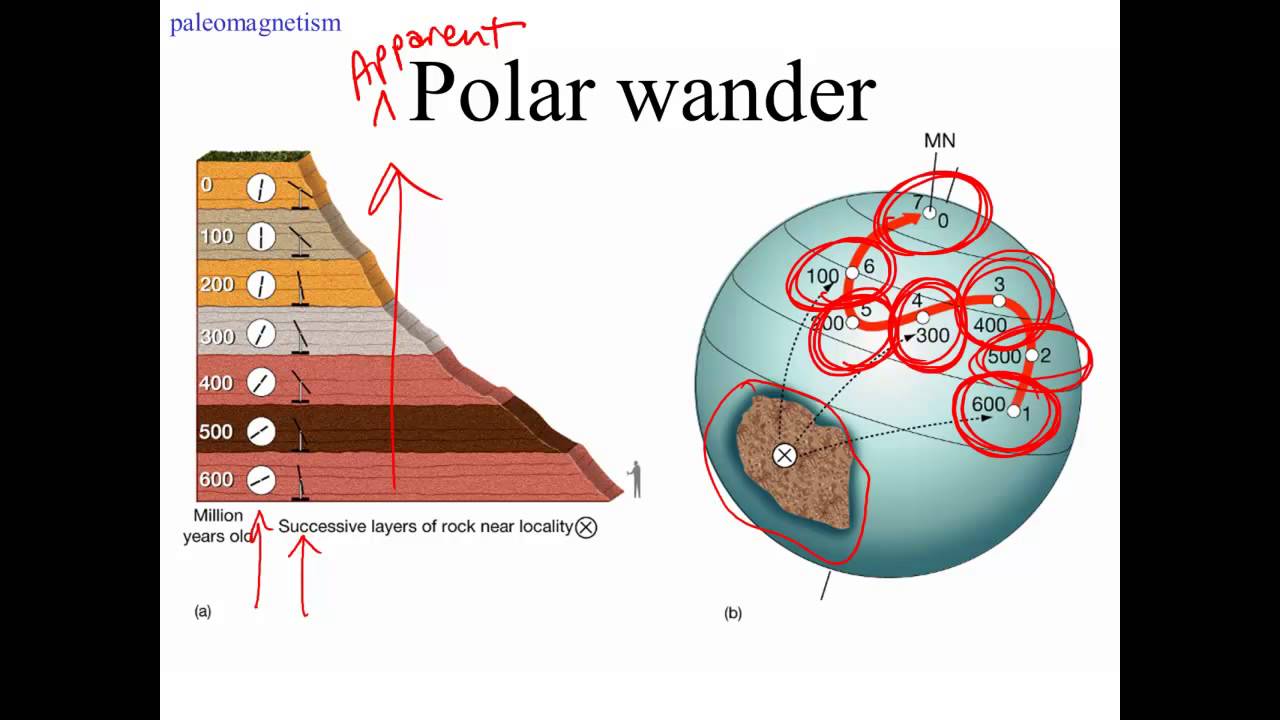
Um, something else we can do with the directions now is that if you see that the inclination or declination of a magnetic field on a continent is changing slowly as you go back in time, then you can infer that that continent has been wandering on the surface of the earth. Assuming the Earth has always been a dipole, which is a decent assumption if you time average the field. You should always get roughly a dipole. Uh, something we've been challenging recently. So you can actually reconstruct the continents just using the magnetic directions as well.
So this has been done. We're not going to go through these in detail. 50 million years, 150 million years, 250, 350, 450, 650. Okay. North America kind of wanders there to there to there down here. And most of this, not all of it, but most of it comes from magnetics, paleomagnetic signals locked in rocks. A lot of it, some of it does come from the geology, matching the mountain ranges as they've been broken up, matching the the sediment, matching uh the paleontology, the biology is is where it's matched up as well, but much of these reconstructions was done using paleomagnetic data initially. And here lastly is the intensity record of the Earth's magnetic field now going back 3.5 billion years. Remember we had Gaus at 1840. Now we're going back 3.5 billion. And we so we think the the field is at least 3.5 billion. People have argued 4.4 billiony old zircon inclusions contain ambient terrestrial magnetic field. So maybe 4.4 billion which is basically the entire age of the earth. So the magnetic field has been around continuously forever more or less. Its intensity looks scattered but more or less flat to my eyes which is a bit of a curiosity. All right. So how do you drive the dynamo? As I mentioned you need these three components.
electrically conducting fluid fluid motion and rotation. The dipole decay time scale is about uh 50,000 years as I mentioned, but it's been maintained for billions of years. So you need this mechanism to regenerate the field constantly. And so we're going to be going down into the liquid outer core here. Um these are profile. This is profile of the density. I just want to point out there's a big density jump here. Row is density as you're going down. This is radius of the planet. go through the mantle and at the core mantle boundary there's a huge density jump because it goes from silicates to iron iron and the silicates separated very early on in earth's evolution and there's a tiny little density tick up where the um iron solidifies at the center the inner core so the inner core is about 12 21 km today and growing we think slowly and here I want to show um also now as a function of depth in fact temperature profile so the black is what is sort of a rough estim what the temperature looks like in the Earth's interior. So in the mantle, it increases and then increases slowly and has a boundary layer, but it's all it's all solid. It's all below the melting curve of silicates, more or less. Now, in the core, because it's iron, it has a completely different melting curve. And in fact, at these temperatures, 4,000 Kelvin, iron is liquid at these pressures and temperatures, as we expect. And then when you get to about 121 km, it crosses this liquidous and it solidifies. So that's that's our basic understanding of why the inner core is solid is that you cross the liquidous at that depth. Oh and as the planet cools this black line is going to come down and so this intersection with the liquidous is going to come out. So the intercore is growing as the core cools down. That's the idea.
So convection just want to get give off a simple idea of how does convection work? You see this almost every day if you're boiling water for dinner or whatever. Why does water boil? Well, the the maybe one answer you might read in a textbook is that the hot water at the bottom is expanding and because it's lower density, it wants to rise. That's correct. But there's another way of thinking about it from an energetic point of view is that if the heat you're supplying at the base is more than what can be conducted by atoms knocking into each other up through the top, then you're going to have to drive fluid motion to get that heat out. That heat wants to go to the top. Um and this is an important principle for the earth's core because the the rate that heat can be conducted to the earth's core is quite high um almost too high to be driving convection and that's led to some problems in the field recently. So the CMBB the core mantal boundary heat flow uh to drive convection has to be above this conductive uh here I'm calling it adiabatic but that by that I mean a conductive heat how much heat can the core conduct out um this heat flow is determined by the mantle the slowly convecting mantle is the bottleneck for the cooling of the deep interior because heat transfers much more slowly through the silicate mantle experiments of iron indicate that this conductive heat flow is about 14 terowatts That number might not mean anything to you but 14 terowatts is what we about what we expect to be taken up into the mantle if not a little bit higher which means that there would be no convection in the core. So as these conductivities keep getting revised upwards we keep running into these problems of how is the core convecting if it's conductivity is so high.
There's also compositional convection.
So as the inner core grows it's rejecting all there's a few a few light elements in the core not much but just enough that when the inner core solidifies they get rejected they don't like to go into the solid and they are buoyant they want to go to the top of the outer core so we have compositional convection as well we think while the inner core is growing and here's just an example looking down on the rotation axis into the equatoral plane of an experiment of my PhD supervisors in his lab they're heating the fluid in the interior and rotating it and here's a numerical experiment numerical simulation that shows the similar kind of like finger finger-like convection features that you expect in a rotating convection system.
So let's get to some of the numerical models. So here is a a numerical simulation by Gary Glatsmeire, a very famous picture. It's been on the front of a number of textbooks. He's colored the lines by the direction of the field in the equatorial plane. But his the convection is only occurring in this bundle here of sort of spaghetti where it's all twisted up out here. It's very smooth because there's there's no because this is the core mental boundary and this is the the mantle here. So there's no convection there's no magnetic sources there. They're all here. So all the actions occurring here and that's what we're going to sim I'm going to show you some simulations of one ma major caveat is that we cannot simulate the conditions of the earth's core exactly and that's because it rotates so fast and uh I'm not sure there's a better way to depict this other than these non-dimensional numbers so I'm going to stick with these for now so on the y- axis here is the number which is related to the amount of convection going on and the x- axis here is related to the is thecman number which is related to the inverse of the rotation rate. So faster rotation is to the left. More convection is is up. The earth lives in this blue box up here.
Most of my simulations are down in near this green box. I'm pushing a little bit to the upper left as we can, but it's a little bit hopeless. One of my colleagues in the UK computed to get down to ECMA number 10 theus 9. here not even earth conditions using 54,000 cores in parallel to compute one magnetic diffusion time which is not very long you would need 35.6 six years of comput straight constant computation time which is a horrible PhD project.
So this is not happening. I mean sure 54,000 is maybe a little bit outdated.
Now we can do millions but it's an order of a couple orders. It's an order of magnitude effectively problem. Um so we have to rely on this dash dotted scaling law trajectory. We have to develop we have to see if we understand the physics well enough in this part of parameter space to scale up to the earth. That's the hope. That's what all of that's the mathematical part of what we do. Okay.
So here's some movies of some of my simulations. Now you're seeing again in the equatorial plane radial velocity. So red is is material coming out from from the inner core boundary out radially and blue is going down. Um and then here is vertical magnetic field. Um so the the fluid tends to circulate uh come up circulate and gather generate magnetic field um and then sort of dissipate at the boundary and go back down and repeat the process over and over again. So this is a super critical dynamo model here and here is a different model from a completely different perspective. Now this is that image I showed on the title slide but now in a movie form.
Interesting error.
Oh, my movie was too intense.
Hopefully it doesn't crash again. Okay.
Um, you're seeing the magnetic field contoured here and the temperature contour. Red is hot and red is positive magnetic field here. And the the the reason to show you this is to give you a sense that it's a really a three-dimensional process, right?
There's fluid motion in the equatorial plane as we've been seeing, but also along this vertical plane and the field is being generated all over the place effectively. Um, and here's the inner boundary. Um, so it's really a three-dimensional problem. Number one.
Number two, it's a very complex, highly turbulent fluids, so you really need to resolve smallcale convection. And three, it's really variable in time. So you really need to think about how the field is varying in time, how you're going to time average it. What would it look like at the surface of the Earth for this simulation?
Okay, here's yet another view of a simulation. You're seeing here's the cormental boundary in in gray. And these these are magnetic field lines I'm tracing through time. So this movie is running over about a thousand years or so. Um, and this black line is the Earth's surface. That's what you would see at the Earth's surface. This is during a reversal in my simulation. So you can see the field is going haywire here. It's not dipolar at all. This is sort of what you would see at Earth's surface during a reversal.
So the last topic I want to hit now in the last five minutes is what my research has been focused on the last couple years since I've been here at DTM. And that's been the search for the inner core. Of course, not literally because we've known there's an inner core now for about 100 years or so through seismic waves. But what I mean is the search for when did the inner core form? We really don't know. We really don't know. Was the Earth born with an inner core? Probably not. Uh if you heat the core by about 100 degrees, you would liquefy the entire core. So it's very so it's very close to being all liquid. So it's just been cooling slowly over time and growing. Um and we expect when the inner core grew has a big change on the structure and the flu the flu fluid uh flow. So did it affect the dynamo and if so is there a paleomagnetic signature? We've got all these great paleomagnetic rocks going back through time directions intensities.
Is there any signature in that record that the inner core nucleated at this moment in time? Okay, something people have been looking for for a long time without much luck. So here is the intensity record going back three and a half billion years. I showed you a plot similar to this earlier. Uh each blue dot is an intensity measurement and I'm showing here on this curve uh is my smoothed out uh so I run a running average and you can see it just kind of wiggles. Maybe it's trending up, maybe not. Here's kind of a bump, but there's no there's no feature.
Okay, my thermal history models predict this. They predict the magnetic field would be getting weaker and weaker and the inner core would nucleate about 650 million years ago. That's just when the temperature hits the liquidous in the center of the earth. The temperature comes down to the liquidous for iron right at about 650. Then the intercore grows progressively over the next 650 million years and it predicts a jump in the intensity. A very obvious detectable jump in the intensity. Right? So, this has been the prediction. I mean, mine's not particularly unique aside from the timing. My timing here is a bit younger.
Most people like to say 1 to two billion years ago. But this should be obvious.
And I would say that this is not that, right? If we saw this, it would not go back down and wander around some more.
It would come up, right? So, we basically don't see it is is is the bottom line right here. So, what's the next step? Well, I thought um why don't we do a full This is sort of unheard of in my community. Let's do an evolving dynamo model. These dynamo models are so expensive. You can't possibly do a billion-year dynamo model. You can do a couple thousand years at best. So, what I did was I broke up the last two billion years of Earth history into 25 sequential models where each model started from the initial conditions of the previous model, the fluid and the temperature field and all that.
But I'm supplying on the boundary a heat flux um that comes out of my thermal history model. So I model the entire cooling of the planet and I get this cooling rate that I apply on the core mantal boundary in black over the last four billion years and then right at 650 the inner core nucleates and I get a new energy source in red on the inner core boundary. So on this little inner boundary here and boom you get this new energy source. So what does that do to the convection? What does that do to the magnetic field? See and I want to point out this inner filled black circle is the size of the inner core with respect to the present day. So present day inner core is completely filled uh in this in this perspective. So the power is doing this and it jumps. Okay, that's not what I get. Interestingly enough, when I do the simulations um over the last 600 million years, I find you get a strong so I'm plotting here dipoleone intensity from these models over the last two billion years.
So present day is here and I find over the last 600 million years it's been more or less happy happy steady constant. It's been fluctuating and reversing but it's in a sort of a steady state uh intensity. And then right before the inner core nucleated here it was in a weak field.
Uh by weak field I mean really weak intensity and also non-dipolar.
Um and then before that it was back in a strong field again. And then before that back in a weak field or a strong multipolar brand. Okay. So there's a lot of stuff going on here. So here's what the field looks like. Here's the temperature field at just before the inner core nucleates. So I actually need numerically I need to put a little solid boundary in there because I have terms that have one over r and one over r equals z blows up. So I can't do that.
So I have a tiny tiny little core that doesn't do anything. It's passive. And then I grow it. I so I apply an energy source on that inner core boundary and you can see the the temperature field changes immediately. Right? Instead of there being gradients near the outer boundary, you get gradients near the inner boundary. This completely changes the flow the flow. Here's the magnetic field at the Earth's surface.
um before the inner core it's very non-dipolar right there's at least four poles you could count here and once the inner core nucleates it assumes this very dipolar state more or less so that's the prediction you get a big change in intensity and a big change in morphology so this should really be something we can see in the record so that was the prediction back in 2016 I published this in GRL our geohysical research letters this is a movie of the magnetic field at the surface surface um just before the intercore nucleates at 680 million years ago very non-dipolar you're looking at the north pole the south pole here and you're looking at the the side view here uh and then present day is very dipolar kind of wiggles and wobbles but it's dipolar it's stable it's not going anywhere you can imagine a time average of this would be a perfect dipole a time average of this would be who knows there's something I have to compute it okay so here's a comparison between the data which I showed you now put on the scale 0 to two billion years ago. Uh and do you see my prediction in the record?
No. I certainly don't think I would not claim you do. But uh I want to point out something. There's a big gap right where I expect these weak fields sort of bizarre sort of multipolar fields between 650 and and a billion years ago.
There's almost no data. Why? What's going on? I've been asking paleomagnetists this question for a while. They're finally starting to to ask the question themselves and they're actually going to start to revise the record. But there's something funny going on here. My hypothesis is that when the field is so multipolar, they have a hard time recovering from their samples. They have a hard time believing what they're seeing is true, that it's an actual primary field that they're measuring and not some ambient field like the rock gets struck by lightning.
It gets some random field oriented to it. They throw those out. They don't show up in this record. Okay, but that they might be throwing out data that's actually valuable. That's my hypothesis.
They don't like to hear that, but you know, time will tell.
So, this is getting along the same lines. Now, I'm going to go even a step further, really get myself in trouble.
Uh, the neoprotozoic, which is the time period we're now focused on, 500 between 500 million years and a billion years ago, is known as the near protozoic. Uh, there's this gap in there's there's three weird weirdnesses. Okay, there's the gap in the paleo intensity as I just pointed out. There's actually a gap in directions too sort of. There's rapid tectonic swing. So, it looks like the plates are fluctuating really fast over the surface of the Earth, like way like 10 times faster than normal tectonic rates. People have cooked up some possible ideas for what's going on here that include the entire rotation of the crust or the other two. I the last two explanations I actually prefer that there's an equatorial dipole or a non non-axial dipole or that there's a hyperactive dipole that's reversing all the time. So what might look like rapid plate motions might be the magnetic field just going wonky.
And thirdly during the same period there's a couple snowball earth events.
These are events where it looks like there are rocks that went through glacial cycles and tropical cycles uh at low latitudes, equatorial latitudes. So it looks like the whole earth froze over. These are the so-called snowball earth events. There's a number of problems. How do you get out of a snowball earth? How do you get into a snowball? Okay. Blah blah blah. But the latitudes of the rocks from which they use to get the paleo latitude um the paleo latitude comes into the paleo mag. Okay. So the if the if the magnetic field is doing something funny then they're going to get the paleo latitude wrong. So it could be that some of these glacial cycles they're seeing are not at the latitudes they think they're occurring. Not to say that none of these are real, but some of these might be off. Okay. Some of them may be unreliable.
Okay, so that's it. Um, a few takeaways for you before you go home. Magnetic fields are cool. I hope you got that across. Uh, they're important for shielding the surface, though they're important for habitability. Okay, we're really concerned with understanding life in the universe. This is one of those factors. They offer a window into the dynamics of the deep interior. Um, magnetized rocks are are fantastic tool going back through time in Earth's history. get intensities, directions, can do all kinds of fun things with them. Used to infer plate motions, paleolatitudes, numerical simulations are extremely valuable because we cannot do these things in the laboratory. You can't really make a laboratory dynamo very easily, but you can sort of do the numeric fairly easily. Okay, it's still expensive, but you can do it and you can study it. There's a lot to do. And then lastly, um looking to the future, um there are plans to in the future to hopefully detect exoplanet um terrestrialsized magnetic field emissions just the way Burke and Franklin did it. So they really pioneered it. Now NASA wants to take their approach and take it to space basically and put a an array of radio telescopes in space to detect earthlike magnetic field emissions from exoplanets which would be the only way to probe that I know of the deep interior of an exoplanet. This is so far away you can't you know you can't send a probe there can't send a seismometer there you can barely see the atmosphere but you could potentially see the dynamics in the core which I think is spectacular. So, I'll leave you with that. Thank you.
Thanks, Peter. Fascinating connection to the Earth's surface and it in its deepest interior. We'll take some questions.
Um, how much is it supposed that the collisional event that formed the moon might have imparted uh a lot of the maybe some shearing rotations and everything that might have gotten things started or certainly uh changed it? Like I guess it's suspected that the tilt of the earth was caused by that. Uh yeah I mean that the the giant impact that created the moon it was a first order effect in the earth's history right the c following that impact the mantle and core were still separating and that impact generated a deposited a whole bunch of heat into the deep interior so it's almost impossible to imagine the scenario where the core started solid because of that giant impact there's so much energy um it also spun up the planet yes that took a long time to spin down and the planet has slowly decreased Earth's decreasing its rotation rate as the moon recedes away from us, which is still a resonant effect from that giant impact event. That rotation rate is important. Um, but it's probably not like the detailed rotation rate at the time. It's probably not controlling the dynamics unless it's really kind of processing at a really quick rate, then you can have some weird dynamics. Yeah.
But um there's a lot of effects that the giant impact had terms of the magnetic field reversals.
Um what can you say about why, how quickly it happens, and what it would feel like if we experienced it?
So we think from observations it looks like it happens over about a couple thousand years. My simulations takes about 5,000 years in scaled time. Um what does it do? What does it look like?
Well, it looks like the di so the dipole field there's always a dipole field um you know where you have two poles and it during reversal flips polarity but during the reversal itself it can wander it can really just do all kinds of crazy things but more importantly it becomes secondary to smaller scale magnetic field. So what you see on the surface is more than two poles. you might see eight poles or 12 poles uh and they're changing quickly in time. So on the surface you get all kinds of magnetic activity at all different latitudes and longitudes. So it would be completely different. But the good news is that it's slow. It takes thousands of years and we don't think the field is reversing. But if it was, we'd have plenty of time to predict. People are now applying weather prediction mathematics to these numerical dynamo models to project what the field is doing thousands of years into the future.
Um, yeah.
Could Could the core or the magnetic fields be affected by climate change?
That's a tough one.
I want to say no. Um, it's a it is it's a tough one because climate change, when you use the word climate change, you're talking about a couple degrees, which has a spectacular influence on life on the Earth's surface. But a couple degrees is not gonna do anything to the deep interior. There's a big temperature increase as you go down in the deep interior. And if the surface is, you know, uh 70° outside versus 170 degrees outside, the mantle is not going to care. So I would say no to that.
Yeah.
Um what would happen during a uh reverse time when the poles reverse? So as I said the field could get very complex and it could be that solar particles start raining down everywhere or not everywhere but many places and it could disrupt satellites could disrupt uh electrical towers could disrupt your cell phone reception all these things that we rely on in modern day life could really get disrupted. In fact, when you have a a solar storm, when the sun erupts, emits some radiation, we do get disruptions even with the strong field that we have today. So, it' be even worse if the fields reversing.
Yeah.
Uh could this magnetic reversal um affectation?
That's a very good question. Um, I've seen talks where people propose try and correlate, you know, the end of Neanderthalss with magnetic events and so forth. There's no hard evidence.
There's a lot of evolutionary events documented through time. There's a pretty good magnetic record. Okay? If the two are strongly correlated, it would be known. It would be pretty obvious. So, there's no strong correlation in general. That said, there is some thought that um if my theory is right, that the field was weird um before the inner core nucleated.
That's around 600 million years ago.
You're getting close to the phenoroic, which is when um life came out of the water onto land.
So, so there's a pos possible connection there. At this point, it's very speculative, but people are thinking along those lines.
Is it possible that uh significant solar events could have an effect on the field reversal?
I would say no to that one as well because Earth's magnetic field is about the strength of the solar wind way up into space. So when you get down to the earth's core, it doesn't feel the mag the sun's magnetic field at all. Um, Mercury might be a different story.
Mercury is so close to the sun, we think there is possible induction effects. Io has a small induced field from Jupiter's magnetic field. So if yeah, if you bring your planet close enough to the to the to its neighboring field, you can have, you know, uh, induction effects. But the Earth field, it's too strong. It's probably not in that regime.
question here. I've been on this side too long maybe, but one back there.
Um, you talk about the inner core growing. Is it possible that it'll grow so large that that we will no longer have a liquid outer core?
Yes. Uh, I think so, but it's billions of years from now.
What would happen then? So if the c if it's solid, it's not going to convect on the same time scale. The magnetic field would decay away over a 50,000 year time scale. Um but leading up to that state, when the liquid outer core gets thinner and thinner and thinner, uh the field would start to do wacky things. It become very multipolar, probably get weaker.
Um, but that's that's a something like four to five billion years in the future when the sun starts to uh lose its luster. So, we don't have to worry about that either.
I just wanted to ask I'm sorry you covered this earlier and I missed it but uh about the status of the concept that the uh inner core is evaporate material into the uh outer core and that uh the outer core is condensing in blobs on the uh core mantel interface.
Well, you know what I mean? Initially when the when the core separated from the mantle, it separated that way. It probably came down in large iron blobs.
It differentiated and settled at the center of the planet. Now we think the inner core has been growing from the inside out because of the way the temperature curve I showed in and the iron liquidists are curved. They intersect um right at the inner core boundary and that's going to increase in radius as the core cools. So we think it's growing from the inside out. Other planets could inner cores could grow different ways. They can grow from the top down or they can grow from a shell out in both directions. Depends on what the liquidest looks like in the adabat.
The reason I wondered is is that you did a paper quite a few years ago uh inferring core surface motions from the magnetic field and we had with no better assumption we have assumed that the core manal interface was a smooth uh ellipoid. Uh but if if things blobs are are forming on the surface that would screw things up considerably in terms of noise and this and the signal of of the what the surface motions are.
So people do look at topography effects of topography um which I think is what you're getting at at the core mental boundary and that can affect the convection and your measurements of the magnetic field. So some people do take that into account.
And also the the change in the earth's rotation rate can be coupled to this topography.
Yeah.
Yeah, that's possible.
Last question down front there.
Does a strong magnetic field have any impact on human health? For example, scientists working at the poles, have they had any health repercussions?
I think you do receive high energy radiation, high high levels of radiation when you work at the poles, polar latitudes, just like, you know, um, airplane stewardesses, stewards, um, are limited in the amount of time they can fly because of radiation you get when you're up that high. Um, so I think it's, yeah, it's something they monitor, but um, you know, it's not, um, I I've not heard of any cases where people are suffering from it. Yeah.
Thank you, Peter. Before we thank Peter again, I'll remind you that uh, this is the last of the lectures for the fall season. Uh we have three lectures coming up from March to May uh of next year including one from our the new president of the Carnegie Institution uh who's uh interested in energy and energy storage sources. So it should be a very interesting schedule. If you you're not on our list uh there are some brochures outside that uh we'll give you the dates of those lectures and we'll be putting out the spring brochure. Uh actually they're not on the current brochure. The spring brochure will be coming out fairly soon. So sign up, you'll get the uh email notices uh and hopefully we'll see you back here. So, thank you very much for coming.
Thank you.
Up Next

3:17
Magnetic Reversals and Sea Floor Spreading: Evidence Explained
@KeithMeldahl
403.1K views•2011-12-17

12:53
21cm Hyperfine Transition in Neutral Hydrogen: Radio Astronomy Basics
@AaronRobertParsons
12.4K views•2011-10-13

32:32
NMR Spin Physics I: Zeeman Effect, Resonance Condition & Larmor Frequency
@nptel-indianinstituteofsci8064
2.3K views•2024-01-17

27:14
Entropy and the Second Law of Thermodynamics Explained
@veritasium
27.5M views•2023-07-01
Related Study Plans & Knowledge Roadmaps
Structured learning paths in Physics
physics
Nuclear Physics (Decay, Fission & Reactors)
01Atomic Structure and the Binding Force
02Radioactive Decay and Half-Life
03Nuclear Fission Mechanics and Chain Reactions
+ 2 more learning modules
12h5 modules
Explore Roadmap
physics
Soft Matter (Polymers, Colloids & Rheology)
01Foundations of Soft Matter & Thermal Forces
02Polymer Physics and Macromolecules
03Colloids, Surfactants, and Self-Assembly
+ 2 more learning modules
38h5 modules
Explore Roadmap
physics
Analytical Mechanics: Lagrangian & Hamiltonian
01Mathematical Foundations: Calculus of Variations
02From Newtonian Mechanics to Constraint Dynamics
03The Principle of Least Action & Lagrangian Mechanics
+ 3 more learning modules
28h6 modules
Explore Roadmap
physics
General Relativity (Spacetime & Cosmology)
01Foundations of Relativity: Special Relativity
02The Geometry of Spacetime: Equivalence Principle & Curvature
03Einstein's Field Equations: The Mathematics of Gravity
+ 2 more learning modules
55h5 modules
Explore Roadmap