



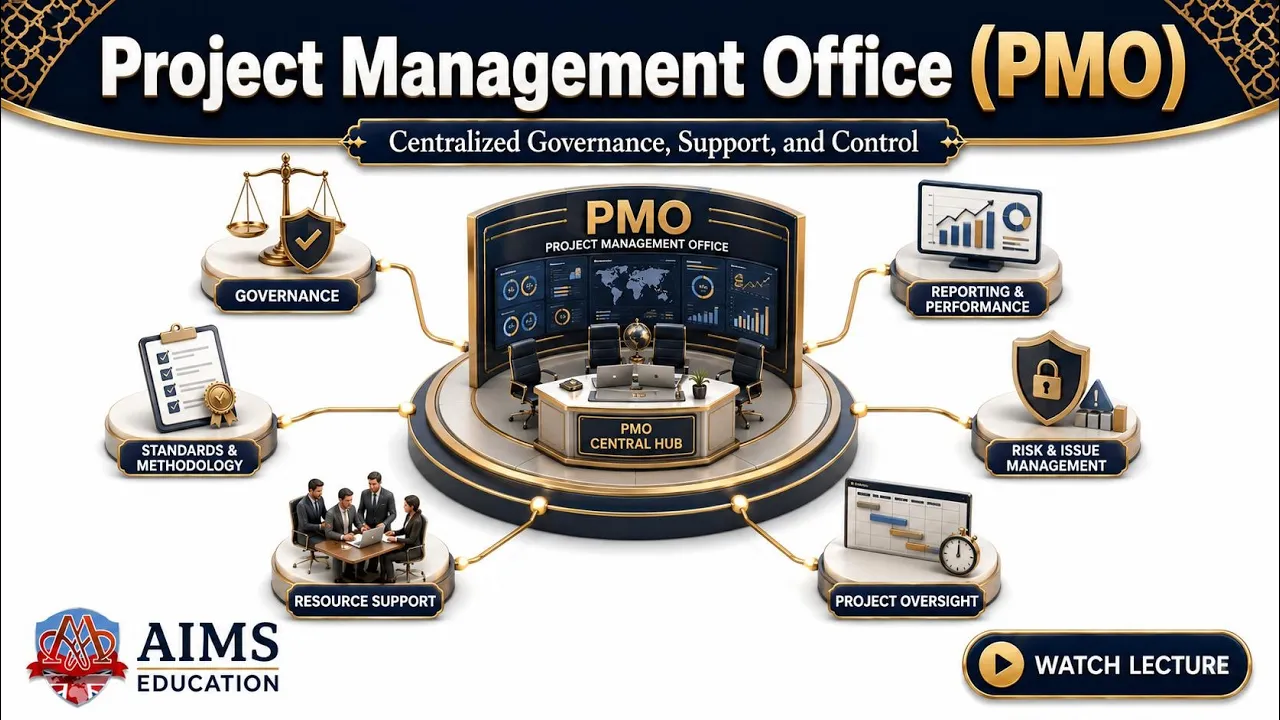














A PMO (Project Management Office) is a business unit that ensures the right things happen in the right way by the right people at the right time, consisting of three components: functional (standards, governance, strategy), structural (people, processes, tools), and disciplinary (schedule, budget, resources, stakeholders, risks). PMO leaders can follow conventional paths (technical backgrounds progressing through project management) or non-conventional paths (operations, strategy, or consulting backgrounds). The 100-day PMO transformation framework consists of four phases: Phase 1 (Assessing Maturity - identifying stakeholders and root causes), Phase 2 (Establishing Target State and Roadmap - defining scope and milestones), Phase 3 (Prioritizing and Implementing - piloting and full rollout), and Phase 4 (Striving for Continuous Improvement). Common reasons PMOs fail include lack of executive buy-in, perception of bureaucracy, and overemphasis on governance over execution. Success requires strong people skills, organizational awareness, and a can-do attitude.
PMO Setup Success: A 100-Day Framework for Leaders
Added:[Music] thank you welcome everybody to today's webinar setting up a pmo wow them in 100 days I'm Kevin iguano I'll be your host we run this webinar series roughly every two weeks uh one webinar roughly every two weeks throughout the year we have lots of fascinating topics on business management project management leadership development change management lots of fascinating topics and I encourage you to please subscribe and follow along to our series these are free it's give back to the community we bring a lot of Industry experts to the table so wherever you found out about this webinar keep an eye out to find out about the others that are upcoming and available in the series uh obviously if you are watching the recording of this off YouTube or some other website uh you know just keep poking around you'll probably find recordings of other past or upcoming webinars as we as we post them okay so a couple rules for today's session uh shortly our speaker will begin and as they're speaking please keep your questions until the end we'll have a q a session at the end however uh don't try to remember all your questions you'll probably forget them so type them into the questions window or the chat window you should see that on your web interface the questions window or the chat window just type your questions there and that way uh you don't forget them so just type them as you go along and we will get to those questions at during the Q a session at the end uh okay excellent and um there will be a couple interactions with the speaker during this session which we will ask you to type things in the chat or the questions window the access for that might be slightly different if you're viewing this on a cell phone app or if you're viewing it via your web browser so just keep an eye out see if you can find where to to type feedback or type questions or chat instructions excellent so let's begin our speaker today is Hussein bandukwala I have had the pleasure of needing Hussein a few years back just before kovid and uh he's an expert in project management offices pmos setting up the governance bodies that provide guidance and maybe some control over how organizations uh deliver their projects maybe provide some reporting and oversight as to how the the organization is doing in Project delivery that's the that's what a pmo is generally I'm sure Hussein will go a bit further into that so this session is intended for senior project managers pmo leaders people interested in how projects are governed within an organization these are uh sort of the intended audience for this session so the session will go for about 45 minutes or so and then we will have time for Q and A Hussein welcome to the call take it away Kevin thank you so much for having me thanks everyone for joining appreciate the the wonderful intro Kevin and I'm excited to go ahead and get started with our topic setting up a pmo wow them in 100 days as you mentioned Kevin I work with uh with folks I focus on on working with the tmos and pmo leaders and always the challenge for organizations and pmo leaders is really about how to make sure that the pmo is set up correctly with proper stakeholder buy-in without having any failures that can perhaps push the uh the concept for people within the organization or another three or five years down the line and so people start getting into things very very meticulously with a lot of analysis paralysis and then end up going ahead and putting together or you know getting into their own way if things don't go well they start looking at resources and associations and books and podcasts from other kind of piecemeable things together to see if it really works out for them I help them making sure that we are able to go ahead and make that uh journey in a in a smooth systematic methodical way which is what our webinar today is all about so I know Kevin gave us a give a quick overview on on a bit of my background but I've been doing this for about 19 plus years I've focused a lot on setting up pmos optimizing them and even resurrecting previously shutdown pmos I do that in negotiating Consulting and a workshop's capacity uh I you know speak often at events like this at BMI events and other appropriate events and if you have heard of LinkedIn learning which is linkedin's online education platform uh I have a couple of courses on pmos there as well where I have had the great pleasure of serving and helping about 120 000 pm1 project leaders uh focusing on setting up their pmos I've also had a great pleasure of working with Fortune 50 clients across the globe and within Canada as well so moving forward into our session what is a pmo and who is a pmo leader right so there are many many definitions of pmos out there but the way I really think of a pmo is that it is a role or a function or a business unit within an organization that helps you make sure that the right things are happening in the right way by the right people at the right time now that's a lot of Rights there um but it's all very very subjective to your organization and the stage at which your organization currently is but if I were to go ahead and treat a pmo as a sandwich and if I really slice that into three different ways there'll be three distinct components of the pmo that were spread out the first is the functional component what is the function of the pmo the other is the structural component and the third is the disciplinary component so when we're talking about the functional component is the pmo just a body focusing on creating standards for project management within the organization or is it a body or a role or a function that's not just focusing on the standards but as Kevin alluded to earlier also providing the relative governance to make sure that those standards are met or is it all of those and also responsible for making sure that the execution or delivery of those products are done based on the standards or is it all those and also sitting at the strategy table with the executives making sure that the right decisions are made making sure that there's active collaboration for prioritization of initiatives and the right things are happening at the right time so that's really the functional component and so understanding where your pmo is or what the expectations from your pmo are from its functionality is important the other piece is structural which is your people process tool the three legs on which the stats and finally the disciplinary component which is essentially all disciplines of project management it could be managing the schedule managing the budget managing the resources management stakeholders manage the reporting the risks and issues and so on and so which of the disciplines around project management is the pmo or should the pmo really be focusing on ultimately over time you want to go ahead and make sure that the pmo gets to a point where it is focusing on all those disciplines but when you're starting things off that may not be a possible or B the need and so determining that is really really important and so for those project management disciplines what are is your function of a pmo and what is the structure that you are using to make that happen that is what we'll be talking about through this webinar and then who is a pmo leader so a leader is someone who is responsible for the setup optimization and continuous Improvement of the oftentimes pmos start with a normal one where the pmo leader is responsible for setting up a pmo and running some projects making sure that you know he or she is showing the way and once the setup of the foundations are laid then further hiring is done sometimes pmo leaders take on existing pmos where project managers are actually reporting to functional units and they're needed an indirectly report into the pmos but really from a pmo leader perspective how does one really become a pmo leader I really categorize their journey into two different buckets the first is really the conventional bucket which is tied to someone's uh Association within the IIT or Technology field because pmos in general are associated with ID as is project management and so someone who has a background as a developer or a tester or a consultant or an analyst then becomes a project manager then a program manager and then a PM reader or you might have a coordinator who then becomes a project manager and then a pmo leader or a database administrator who then becomes a program manager and a pmo leaders many many you know permutations and combinations that that are possible there but essentially the thread of it is someone has you know comes from a deep Tech background gets into project management and essentially then eventually takes over the pmo right so that is one Journey the other journey is the non-conventional way right which is where someone who might be truly fed up with the way products are are being uh LED within an organization and have decided to roll up their sleeves and go about setting up a PML someone might be uh within an organization for quite some time know the people have built the relationships but have a business uh background or an Ops background and they've been asked to go ahead and set up for pmo or you might have someone who is just a strategy consultant uh and has been asked to set up a pmo so basically no one from a tech background but someone who's had the ability or shown in the past they can get things done and now it has been asked to go ahead and set up a pmo in some cases may not even have actual formal project management experience as well and so that to me is the non-conventional journey for someone to become a pmo leader and so what I want to do for a couple of minutes is just take a pause and put the spotlight on you and as Kevin mentioned earlier you know would love for you to go ahead and find where your chat buttons where your chat uh dialog boxes are for whether you're joining over the mobile phone or whether it's through the web browser uh I would love for you to go ahead and answer a couple of questions right in the chat right so the first question is why are you here why here on this webinar that's talking about setting up a pmo in 100 days are you here because you're a PM sponsor or are you setting up for pmo for the first time or do you want to become a pmo leader one day or are you just a project manager and a pmo or something else in the chat if you can go ahead and type that out that would be fantastic and I'm just looking left and right a bit because I have the chat box window popped up on the screen so I'm just waiting for people to go ahead and type their responses okay I'm seeing one response in the questions window uh buad says I want to be a pmo leader one day perfect yeah uh next one Mallory says setting up a pmo for the first time murtuza says I want to become a pmo leader one day perfect perfect any other responses Kevin a couple more just came in uh Joanna says I've set up a pmo in the past and expect again expect to again I'm a pmo analyst now Raya says applying for pmo jobs Ahmad Shah says I do not have access to chat but I got your I got your response in the questions window so keep plea please using that yeah Mayland says I want to be a pmo leader one day yeah chatal says my pmo is becoming ready to take a leap from PM Coe to epmo but need to build a structure and system to make it successful before we do that yep that's a very interesting use case if you have a question around that we'll take a take later as well sorry go ahead Kevin good Ahmad Shah got back and said I want to enhance my knowledge of project management from different perspective uh mashud says been in a pmo in the past LED and set a pmo would like to see how to do better next time perfect thank you for those responses and thank you for calling those out Kevin I have a couple more questions so bear with me uh what is your own project management experience are you new to the game have you been dabbling in it for a bit are you a pro or you don't dabble in project management at all again using the Q a box go ahead and please respond send your responses coming in Kevin yeah yeah I've got alright says medium fluoride says Pro Johannes is long time with a smiley yep so I would expect um a lot of this audience haven't sorry that's medium high chital says hi perfect perfect and then I'm gonna go ahead and skip the next one but I want to go ahead and go and get to my final question which is a lot of you talked about you are here because you want to become a pmo leader one day or you are a leader right now or you'll be setting up here for the first time and so if I asked you whether your journey to pmo leadership is or will be would it be a conventional one or would it be a non-conventional one so Joanna says conventional mm-hmm I'm still getting some answers to the previous question fuad says conventional chatal says conventional malloris is conventional lots of conventionals conventional Francis says conventional Raya says what do you mean by conventional and mashud says a combo says unconventional right Ellie says both interesting okay well this is a very good mix um a rather interesting mix and the reason why I say that is because one thing that I want to share as someone who is keep keeps an eye out on the industry pretty often is that more and more have I seen the gap between conventional and non-conventional Journeys come you know get to a close the more and more people are getting the opportunity to become a PM leader via the non-conventional way which is not having a bit of a Dead background um and in many cases not even having proper product management background um and being able to go ahead and set ask to go ahead and set up a pmo additionally I'm also seeing that people who are much earlier in their career so maybe around you know five six year mark are being asked to go out and set up a pmo within their organizations versus you know just you know a few years ago you'd probably have someone who uh wouldn't even be asked for that role uh if they had less than 10 years or 15 years of experience and so it's just a shift and Trend that I wanted to go ahead and share with everyone and also letting you know that if anybody here on the call is coming from a non-conventional or unconventional Journey know that you are not alone know that that is absolutely possible and relevant way for you to become a pmo leader and know that what you learned today in the webinar is something that you can use and leverage when time comes for you to go ahead and set up a so the one thing that I wanted to go ahead and share is that I'm saying before we go on there's two more comments that were made on the previous slide yeah Joanna says I think business doesn't understand the purpose of a pmo and Mayland says what are the pros and cons of conventional and non-conventional okay so Kevin we can go ahead and and so the first one is just a comment right um and if there's a question associated with that we can take that on at the end and I will go ahead and answer the second one right now so there is no pros and cons to one or the other it's just that what your journey has been I mean if you have been into operations or into strategy Consulting for instance you can't go back in time and show you those and become a tech you know get into Tech or you may and but but at the same time you don't necessarily need to get into Tech from that one onwards for you to become a pmo reader if you do want to become a pmo leader that is an aspiration you can certainly Leverage your existing experiences whether you've been an Ops in any sort of BAU or any sort of you know strategy or management consulting and go ahead and turn that around to bake make yourself a leader so it's there's no really pros and cons just to let the the idea for here is just to share that the possibility of becoming pmo leaders is immense and then that you know being a you know whatever background you have can certainly be leveraged to position yourself as become becoming a PM leader right and then that really leads into the the next slide that I have is is really talking about that's the beauty of this role that there are many ways to get this opportunity and it requires different facets uh you know I've had people who've just focused on you know work with people who were just business analysts and then they started to take project map you know I decided to go ahead and set up a PO within their organization and we're able to go ahead and do that I have worked with uh with with folks who've had just prior operations experience and uh were able to go ahead and turn around departments based on them and we're able to go ahead and uh you know move from region to region making those happen and they were just just thrusted into the the pmo leadership role with actually no formal project management experience uh I've had situations where someone who had a lot of project management experience uh in the HR domain um ultimately uh get called up to lead a global HR pmo within an organization even though they've had no pmo setup experience in the past and here they're here looking at a multitational uh you know massive you know complex sort of pmo setup just based on those experiences so whatever experiences you have can certainly be you know translated into the uh people leadership opportunity they have done in a systematic and methodical manner right and so the kind of skills or attributes that you generally do require you know are you know if you have project program management experiences always a plus but as I have already spoken about it you know it's not necessary you can benefit from having organizational skills so you know if you have business planning skills strategy skills regulatory skills uh those can be extremely beneficial for you to go ahead and turn things around when you're going ahead and being asked to become a pmo leader if you're asked to set up or lead a pmo within a department or a role so for instance whether it's an ID pmo or an HR pmo or a procurement pmo or a finance pmo just you know pmo that is specific just to that department having prior experience in that department can be hugely beneficial because here you're not just talking about making sure that you know project management within that department is uh is being set up as a formal function but rather you're also contributing to how things are happening you know within that department how you were able to go and talk the same language almost immediately and that gives you a huge boost of incredibility for what you're about to do and but one of the attributes that you absolutely must have and chances are if you don't have this you will not even be asked to considered to lead a pmo is people skills right so whether it's facilitation negotiation collaboration communication making sure that you have the initiating the drive to work with people to be inclusive and not divisive is what will help you become a solid strong piano leader right and so as we you know summarize all of that you know it's great to have project management skills you absolutely need to have people skills and your organizational and business skills are dependent on the role and so fantastic congratulations you've become a pmo leader but now what what happens now interestingly if you've been offered or asked and chosen to lead the pmo at that point or rather from that point onwards you are considered as an expert in the pmo and the project management domain even if even if you've never done this before even if you've never set up a favor before even if you've you've never had any sort of uh you know formal product manual experience even if you don't have any sort of project management uh education it doesn't matter you have that title by your name you are going to be considered as the expert and the organization is going to be looking at you to take the charge and lead the way right and so for that to happen you've got to go ahead and have the awareness that awareness that the organization is really expecting something off of you you've got to go ahead and step up your game and rise up to the occasion and have that can-do attitude to make sure that you know there is some level of positivity and action orientedness that will make uh make you successful and help the organization succeed in attaining the goals that it expects after the pmo setup and bring some sense of urgency to the game because we get into analysis paralysis uh there's a lot of elongated planning phases it is important to go ahead and make that happen but while that is to happening you've got to start in small steps to show that you're not just all talk but a man or a woman of action as well and so with that framework and that mindset and that approach in mind you are ready to go ahead and set up a so let's go ahead and do that right and so the key phases the key steps that you need to set up a pmo are listed here phase one is assessing the majority phase two is establishing Target State and defining the roadmap phase three is prioritizing and implementing and then finally phase four is striving for continuous Improvement now know that underneath all of the phases I have identified what are the number of days that you should take or have the duration that you should take underneath each phase know that this is a guide not a recipe this has been done I have also personally worked with clients to get them through this but it also depends a lot on what your where your organization is from a PM maturity perspective and an understanding of project management where your pmo is in terms of uh or where your organization is in terms of how it is it generally you know takes decisions what is the level of chaos or calm that currently persists within the organization what is your side of your organization and the complexity of the situations and the project management challenges that it's sort of engulfed within uh what is the political situation uh you know is there uh you know good camaraderie within the organization or there is some sort of stiff uh what is the uh the level of availability of the key stakeholders that we need to go ahead and work with uh what is your availability and you know are you do you have a team with you is it just you all of that matters a lot but again from a reference perspective uh know that this is possible but also know that one thing at least that you must do is by 100 days you've got to go ahead and get through phase two at the very least that means you've got to go ahead and have a definitive time frame and road map or project schedule for what the setup of your pmo is going to be all about now if you if it's taking you more than 100 days to get to that point that is an indicator that the scope of your current pmo is much too broad and that you've got to go ahead and refine it or reduce the scope so that you can go and meet that Target because if you start going ahead and and building such a massive entity from scratch chances are it will not succeed you've got to go ahead and focus on smaller buckets and then go ahead and permeate that across your organization right so perhaps it is instead of focusing on all project management disciplines you're focusing on some it's sort of focusing on all the entire organization you're focusing on a certain few departments or you got you may be focusing on you know all departments but focusing on maybe a couple of regions or a couple of cities within which our organization resides right that is how you can go ahead and focus on reducing the scope and making it containable and addressable to make that happen right because again think of this as a ship if it's a small boat and it's going ahead and you know heading in the wrong direction it's easier to stare and get it to the right path if once you know that path you can take a bigger boat and sail it on but if you start off with a massive ship it's going to be very very difficult to steer right and then your PMR is just going to start you know getting into reactive fire for fighting uh mode instead of the proactive entity that it needs to be all right so now what I want to do is I want to go ahead and take a bit of a a deeper look into each of the phases and so for each phase I'm going to be talking about what are the key steps you need to take and what are the top three checklist items for them right so the first phase is assessing maturity which is in other words it's really determining the current state of the pmo or the organization in which it resides so if you have a pmo or some set of project management function or just project managers happening within the organization or you know accidental managers leading projects or non-prem's leading projects taking us a a sort of a stake of the situation and seeing what is happening uh is the first steps of understanding what's working well what's not working well why is it not working well has anything been done to see uh to improve that why did that not work uh understanding that is extremely important and you know also putting the organization under the lens such as how is the cross collaboration however the synergies within departments what is the technology orientation uh and so forth right and so with that in mind you know the one thing that you absolutely must do is first identify who your key stakeholders are and speak with them on a one-on-one basis now to me there are three types of key pmo stakeholders the first one is people who the pmo reports to which is your executive leadership the second one is who the pmo works with which is your departmental peers and the third is who works or reports into the pmo which is your project managers your coordinators your analysts your pro you know your program managers and so on oftentimes none of them are approached to understand what is really happening if someone say someone might say hey you know what I've set up a pm1 another organization it's a very similar organization I'm just going to go ahead and go and start right now not going to work why not because you need to go ahead and not only understand what the problems and the root causes are within the current organization but rather make your stakeholders feel informed educated and engaged once you have them engaged and when you go ahead and you know once it's time for actually rolling out the pmo they will feel that they have been a part of the process they will feel that their voices have been heard they will feel that it is their problems you're actually looking to solve it so they will be on board with you so this is not really an exercise or not just an exercise in information gathering and Discovery but it's really a basic tenet of change management that we're putting in place where we want to make the people our stakeholders feel engaged so that they can participate in the change that is going to happen that will impact them but they know that that impact is for the benefit and therefore they will participate in it understanding that is the biggest most important aspect of setting up a pmo and so when someone under thinks about who would pmo stakeholders are it is important to go ahead and talk to all three of these categories all three of these categories like I said earlier sometimes TMO leaders don't talk to anyone more often than not they talk to just the pmo sponsor basically their boss and maybe if anything at all they talk to just their the executive leadership so it's important to go ahead and address uh the the pain points and challenges and keep all the three types of stakeholders engaged it's also important to know that you need to understand what the root causes of your challenges are don't just focus on the symptoms don't just focus on projects are getting delayed understand why are they getting delayed understand is it because of project managers not being up to the Mark is it because there are unrealistic deadlines is it because there are too many projects going on and people just don't have the time is it because resources are getting shuffled around is it because decisions are being delayed and therefore projects are getting impacted what are the drivers that are causing the projects to delay that is important to understand and so when you go ahead and do that uh you will start really understanding what are the challenges from project management perspective within the organization and you will get start getting a sense of how much work might be needed to actually turn things around and so have a good sense of what are the the resources and staff that you need to go ahead and help you with some of these things and then also identify the quick wins that you can actually achieve in the first 100 days so for instance you know if you don't have if you have a if you're an organization where people talk about I don't even know what's going on that means people don't even know what are the projects that are happening even creating a list of projects is a quick one because that's going to give them instant visibility and transparency to what's going on right people don't know the the status of situations coming up with just a a brief status template can be very very helpful right uh if somebody just needs a bit of help and a nudge in terms of uh uh you know project schedule support giving them some sort of coaching immediately can be a quick win right those are the things that you need to identify as well statue can achieve in the first hundred days so that again like I said earlier it's not just all planning and talking we are putting things into action and starting to have uh you know noticeable impact within the organization right off the bat so that is the first phase the second phase is really taking a good stock of what you've heard in the first phase and seeing what are the teams that are emerging are the teams really talking about making sure that the functionality of your pmo should be more along the lines of you know standardized just setting standards or just study standards and providing governance or providing the execution uh jobs as well right is it more aligned towards focusing on the schedule management discipline is it more focused around communication and Reporting is it more about Resource Management what is it you know and sometimes you may have a bit of all but a few of those themes will be more resonating more resounding than others and you will know that those are areas that you would need to go ahead and prioritize right and so based on that carve out the scope of your PM who what are the at you know what is the functionality what is it which discipline are you focusing on what are the regions what are the the Departments that we're focusing on what are the nature of projects that we need to address right and figure out how will you measure your progress based on those recommendations so whatever recommendations that you are making to go ahead and address the challenges that you were identified in Phase One in phase two identify the qualitative and quantitative indicators that will make this a success right and so for that you need to go ahead and review and finalize your pmo's business case if you do need help immediately such as a coordinator for an analyst or maybe even a project manager to support the work start going out and hiring people and then identify the one or two Milestones that you can achieve in the first hundred days so this is a bit different then the Quick Print that you identify in Phase One in phase two we were talking about Milestones right so for instance one of the biggest muscles could be is having this entire pmo roadmap setup done because that is essentially your roadmap your guide your compass to and your you know your your really also a key of expectation setting for your stakeholders in terms of what you need to do in some cases it might be you know a suite of to the templates that you can go ahead and create it might be an implementation of a SAS tool for from a private management perspective it might be uh you know a a a a project prioritization mechanism or a work intake for uh you know mechanism for projects to come in that can be prioritized which could be a milestone so I mean it again depends on the challenges that you've heard and what you were going to be doing about them moving on to phase three prioritizing and implementing right so not only do we want to go ahead and make sure that our scope is continuable but when we go ahead and start rolling that out we do go to go ahead and pilot it a bit right maybe for the first month or or a couple of months to see you know how quickly are people be able to uh you know uh get accustomed to the people process and tools how people what what sort of support do people need uh do you need to have some sort of a command center uh with FAQs uh or or someone who's ever present to respond to questions immediately or do you even need to conduct Road shows to make sure that people understand what a pmo is why the pmo is being created you know talk to when you're talking to people you know uh and if you've actually spoke with them in in Phase One you know try to go ahead and connect the dots of what you heard from them what you're doing about it and when will they actually get it right that's going to go ahead and make sure that that continuity and the fluidity of the process is coming through and people are on Long joining along the ride with you for the pmo setup and then once the pilot is done incorporate the lessons learned and go ahead for a full rollout based on the roadmap that you've created and though and so once the pmo is set up or or being rolled out know that it's always going to be a cyclical process there is always going to be an opportunity for improvement you may have just focused on the delivery aspects of project management from a proper from a functional perspective and now to add some sort of strategic cat or you may have focused on just a couple of disciplines around project management and you need to add more or you may want to go ahead and become even more mature or better in the project management disciplines that you have already uh you know implemented or you may want to go ahead and and uh start taking that impact to other departments or regions uh within the organization and so the pro the metrics that we identified in phase two in terms of how the progress of the PM was going to go how the pmo the project Management's performance is going to improve we need to evaluate that share that with our stakeholders and use that as impetus to see and how your continuous Improvement can be sorted out right this is also an opportunity for you to go ahead and make sure that you are continuously getting the buy-in from your stakeholders that you have earned through the first three phases one of the best ways to do this is to recognize success recognize the people involved with it recognize your pmo success whether it's you know through a cake and tea party or or sending out an email for the first project when or maybe you know having some uh printouts and pamphlets at posted next to the hallway elevators those are ways to go ahead and show and publicize what you have achieved and what is about to come one of the things that I usually tell pmo leaders is that one of the roles that you are doing is being the CMO of your pmo which is the chief marketing officer you've got to go ahead and carry the bug bombs you've got to go ahead and be the cheerleader you've got to go ahead and you know share the good news and let people know what the is up to and how well it's progressing because nobody else is going to do it for you so that is one of the biggest things that you want to make sure that the excitement resonates and that as the stories success stories keep on going uh more and more people want more of the pmo and then finally as your pmo is maturing when things work well people expect more from you and so in order for you to deliver things more and things better maybe there is room for professional development of your team as well and so that is something that you need to keep a solid eye on as well now one of the things that I do want to share is why I am in this business why I focus a lot of games this is my driver this is what motivates me is this stat on the screen right here which is 50 of pmos failed in three years of their creation 50 so if you were about to set up a pmo today and if I asked you hey Will your pmo succeed or fail like it's a whole world wait a minute I can answer that for you I'll flip a coin and say heads it's going to succeed Tails it's gonna fail in three years now you and I all know that the problem that the value of a pmo is far greater than the probability of a coin toss right and there are ways that we can go ahead and turn this stat around on its head so let's talk a bit about what are some of the common reasons why bmos fail what is the lack of executive buying so the of the process that we went through is not just to set up the pmo it's also educating the executives uh the stakeholders on what a pmo is all about what are risk benefits and how specifically it will help them because all of the time many of times all these people don't care how pmos have benefited others what they're really interested in is what's in it for me how will this really help me and that is what the process that we walk through the change management aspect that it has you know sitting on relying it is what is so critical and important making sure that you setting expectations on what the pmo should do is critical here as well and also one of the biggest things that we'll be doing in the first phase is building relationships through your interviews on a one-on-one basis with your key stakeholders whether it's happening in person or virtually you are setting the stage for building strong relationships and getting people to know you because they will first want to buy into you as a pmo leader before they will want to get be bought into any of your pmo related ideas and roadmaps so that is critical the second reason why pmos fail is their the perception that it will slow things down there's going to be bureaucracy uh and uh there's just going to be a lot of no no or no you can't do this you've got to do this you've got to do this you've got to jump through these hoops before you can go ahead and get this thing done and so when you're starting off setting up a pmo try to bend backwards to make sure that your processes meet organizational sculpture right and also make sure that you are leveraging the power users your advantages people who are loving the success of your pmo who really really engaged it's going to be a small bunch at the beginning but leverage them use their voices encourage them to share up their success stories with the pmo so you can go ahead and break down those perception barriers that exist within the organization and then the third most common student reason is is the policing the whole governance aspect where people think that pmos only exist if things don't go wrong it'll come with a uh you know a stick in their hand and then slap you uh on on your fist for someone not doing things in a certain way right so when you are starting things off yes governance is important but when you're starting things off you've got to focus on getting things done instead of completing documentations yes the PM was existing existing to make sure things are starting to getting done getting done things in the right way but let's focus on getting things done then let's get focused on getting things done uh consistently and then get let's focus on getting things done you know consistently and efficiently and effectively that is how we want to focus on things crawl walk run right so that is how we want to go ahead and and Target these common reasons why pmos failed and then finally just some tips on making sure that pmos succeed and your chances of making sure that u60 spmo leaders is is uh is really really important the first one is mindset just talking about you know what your value is to your leadership but also bringing in help to project managers don't just focus on the people who are just you're reporting it to also see who who are depending on you because no matter how fancy how amazing your roadmap is you need to execute that your PMS your analysts your coordinators are your front line make sure your PMS you have a safe haven uh four PMs and your your analysts and according to go to if they need help the second one is you've got to go ahead and find mentors and coaches who can help you get the job done because there's going to be a lot of learning on the job and so you can look at internal or external resources to help you people who are 5 10 20 steps ahead of you that you can learn from and finally get the right team on the ground right people who are not like you but are complementary to the skills that you have and people who have good knowledge of the organization and organization's culture and you know the politics that's going on and a good mix of people who are fresh and are motivated uh and have that eagerness to make a mark within the organization so skills attitude and experience within the organization a good mix of that can always help thank you so much for being a part of our uh webinar today I'm gonna go ahead and get and hand it off over to Kevin again to help us with the Q a Kevin over to you excellent thank you very much that was a fascinating session and I learned a lot listening to it that was really good okay everybody if you have questions for Hussein you can type them into the the chat window or the questions window and uh we can get uh him to respond okay we have a couple questions that have already been accumulated here that you might want to respond to uh first one is let me just scroll down a bit the first one is from Mallory who asks what is a simple list of criteria pmo may use to determine if a project may need project management support currently I'm the only project manager I need a way to appropriately select projects so is the question of whether some a project should be done or is a question that it needs help to get it done the right way the question appears to be I'll just sort of simplify it they want a list of criteria that a pmo can use to tell if a project is going bad that it's it's having challenges how do the pmo determine if a project is heading in the wrong direction absolutely I think I'm going to go ahead and turn that uh I'm going to go ahead and and uh and and Leverage The Iron Triangle uh of project management for that the very fundamental and basic thing that we can do is see whether the project is on time on budget and within scope this is the the absolute basic criteria that any pmo or any product manager can use to see whether a project is on track or not so whether you know based on the Project's budget uh that has been approved uh is have you spent too much uh or have you spent two less uh or are we too far behind uh then what we expect to do or are we and if you're far ahead that's perfect uh and are we still retaining the amount of work that we had said we would do as part of the project or how have over time we over committed to additional work uh that needs to be done for the project so those three credits list you know those three criteria are things that can be extremely helpful excellent thank you next question is from uh oops we've got a few jumped in all at once and it scrolled off my page just give me a second the next one is from Shola who asks how does a pmo work or support agile projects so for me a pmo is agnostic of industry company company size situation and yes even project management methodology so whether a project is happening in a waterfall agile uh hybrid whatever else methodology it doesn't matter where the pmo can help support any any sort of project irrespective of the methodology is keeping it you know it is asking the PMS what help do you need getting them that help is understanding where the project is again from a scope schedule uh and and budget and budget perspective and see whether it's on track or not again irrespective of the methodology is the project getting the right amount of support from sponsors and key stakeholders is the project manager struggling to you know keep this resources and our resources getting shot around and not getting the enough chance for the project uh for them to work on on that specific project again irrespective of the methodology these are some of the ways that a pmo can support uh you know a project whether it's agile or or some other methodology excellent thank you next question from Ahmad Shah looking at it from the pmo perspective is there a difference between leadership and management functions so a generally a pmo is generally led by um a person with a formal role of a manager or a director or a VP now to me a someone who is in charge of a pmo is is generally a leadership role right um and the reason why I say that is that I think of it as akin to any sort of departmental head so whether it you know if you compare that to a you know someone who leads an I.T Department someone who leads a an accounting department someone who needs a finance department someone who needs an HR department someone who leads a procurement Department would you call themselves would you call them as leaders or would you call them as managers right so I would say that project you know being in charge of pmos is more of a leadership function uh than a management function okay excellent next question from Nora what's the best way to generate a Project's weekly report um so that's a pretty uh uh I would say open-ended question uh lots of possibilities there but generally the process that I would suggest is making sure that everybody uh so all the PMS are understand what the cycle is for generating the the report all right so whether it's using any sort of project management tool whether it's updating Google Slides or PowerPoint or keynote uh uh you know and whether those templates have been circulated and understood you may want to go ahead and get those submitted before the due date so that you can have an opportunity to understand what is working well what has not been working well if the reports are actually you know communicating things in in a proper way or are they just filled with acronyms and project management jogging that your stakeholders may not understand and so having that timeline and process in place is important you may do that again just via uh via email where that people are saying of the reports or you may want to have a meeting with all the PMS so that they can walk you through their process their statuses and you can give them real-time feedback back the ones that feedback is incorporated you then go ahead and ship it off to all the stakeholders again that can be done over email or you can go ahead and have a meeting with the stakeholders where you're giving a state of the union portfolio view on where all the projects stand okay excellent uh next question from Reya how can the pmo help to manage a complex portfolio of multiple interrelated projects and programs so this is the beauty and power of a apmo right because when you have multi-related complex projects or programs chances are you know uh there is there are a lot of eyes on it uh you know multiple stakeholders involved uh you know probably a lot of shared resources in terms of team members and so being able to understand we where each of those projects stay are what is driving the uh Association of those resources to those projects are there any decisions that are or not being made by the stakeholders and pushing those along for on behalf of the project managers is what makes the pmo really really powerful know that the the stakeholders May generally have some sort of a bent some sort of a a if a I would say some sort of a underlying situation where they may be more affiliated with an IEP group or they might be more affiliated with the finance crew but a pmo needs to have a neutral Factor what is it the best interest of the organization what is it the best interest of the benefits that the all the projects that are interrelated are looking to get towards where do they are where are they and what means the priority Now versus later being able to go ahead and juggle through that collaborate with the stakeholders facility those discussions and get decisions out of them and also hold them accountable to that is where pmos can be so powerful and can fundamentally help project managers or program managers where their own um I would say accountabilities or sphere of influence gets limited to just their projects or their programs and and pmos have more of a overall View and and and so the PM pmos can really really help PMs and product managers program managers uh shout this out they can also go ahead and support the more interactivity and collaboration between the project management program managers themselves where it is it comes off as a unified team and approach versus the project managers and program managers having some sort of infighting incidences uh struggling over resources and getting decisions where success of one project uh maybe uh versus the other one of the other things that I want to make go ahead and share here before I finish this off is when the pmo looks at this it's really looking at it from a portfolio view right and so ultimately the pmo's goal is is in the best interest of the portfolio which is the best interest of the company that may mean that one of the projects or programs of some of the projects or programs may need to suffer to make sure that the other projects or programs to get you know Fair better because they have a more impact on the benefit for the portfolio and the organization and so making sure that that those decisions are done in a very conscientious Manner and that that has no barring or impact or no consequences on the PMS leading to those sort of projects as supporting those PMS along the way is very very critical as well okay excellent uh Mallory made a clarification Mallory said when we were talking about criteria for pmos deciding what's a troubled project uh Mallory clarified and said I am setting up a pmo but I'm also the only project manager and I need a criteria list to help me select which projects I should take on so I must I'm guessing there's lots of projects in the Enterprise but only one project manager and Mal is trying to decide which projects are should should be under I uh her guidance her guidance right okay so we're already talking about a project prioritization you know criteria uh versus the success of a project so great question you know I really think of this uh you know the uh think of this as a portfolio view uh battery and so and I think of the portfolio as a jar right and in a jar you know you can fill in rocks you can fill in Pebbles and then you can fill in sand right so for me you gotta go ahead and make sure that you the jar is filled to its most capacity where you can take on all the things while filling the jar and having some of the impactful things in there mixed with some of the other things that can be helpful um the Rocks here are your regulatory initiative so projects or programs that are mandated for regulatory reasons whether they might be you know Financial regulations it might be legal regulations um or you know audit requirements whatever else they might be those are your rocks those are the things you've got to do right and so those take highest priority and so once you've taken those on and your capacity is done you can't take on any more projects the organization has to make a choice whether they hire another product manager to take on the rest or they just stick with the most important the regulatory initiatives for the year if you still have some capacity then we start putting in some Pebbles which is your discretionary initiatives you know things that are that can should be done but if not done will not it doesn't really you know prevent the company from getting out of business so things like your strategic initiatives you know things that are important but not urgent uh you know those are your Pebbles and if you still have space if you still have capacity then you take on the Sands which are your Tech tactical initiatives you know projects that are are smaller in nature uh but it it you know it's going to be nice if you did that because it's going to make some things within the organization a bit more uh a bit more uh you know efficient or effective so that's really the mechanism that I would follow so focus on getting the most the mandatory projects first then your strategic initiatives then your Tactical emissions oftentimes it's good to have a mix of all of these in in a year but given that you're just one PM the organization needs to make a choice whether it's just going to focus on the monetary ones or you know add on more capacity to take on some strategic initiatives and tactical initiatives as well hope that helps out Mary okay excellent well we're out of time we're uh We've exceeded our our one hour uh time slot thank you very much everybody for attending this webinar um as I said we run these regularly the the next webinar is negotiate your adversary into your Ally and after that building quality in construction projects um one after that is the grown-up business analyst how the ba profession has evolved and where it's headed just look to register for those where you found out to register for this webinar uh you can collect pdus for attending and watching these webinars if you're not sure how to claim them you can always reach out to us at sales procepts.com thank you very much everybody and thank you Hussein thank you Kevin and thanks everybody okay bye for now [Music]
Up Next

Strategic Negotiation and Emotional Control: The Ethical Advantage
@brightmind023
550 views•2025-11-03
Retention Habits of Top DTC Ecommerce Brands Revealed
@SendItPodcast
44K views•2026-03-03

Decoy Effect: How Pricing Psychology Influences Consumer Spending
@bobinvestsUS
90K views•2026-01-05

The Planned Obsolescence of Light Bulbs and Tech
@veritasium
25.3M views•2021-03-26
Related Study Plans & Knowledge Roadmaps
Structured learning paths in Business