
























Unemployment is measured by the Bureau of Labor Statistics (BLS) through monthly surveys of people aged 16+, categorizing them as employed (have a job), unemployed (no job but actively seeking work in the past four weeks), or out of the labor force (not working and not actively seeking work); the unemployment rate is calculated as (unemployed ÷ labor force) × 100, and economists identify three main types: frictional unemployment (short-term job transitions like new graduates searching for work), cyclical unemployment (job losses during economic downturns), and structural unemployment (mismatches between workers' skills and job requirements due to economic changes).
Understanding Unemployment: Types and Measurement
Added:Definition of the labor force, specifically distinguishing between those who are employed, unemployed, and out of the labor force.
The concept of the business cycle, including the phases of expansion, peak, recession, and trough.
Basic supply and demand theory in the labor market, understanding wages as the price of labor.
The concept of the Natural Rate of Unemployment and the Non-Accelerating Inflation Rate of Unemployment (NAIRU).
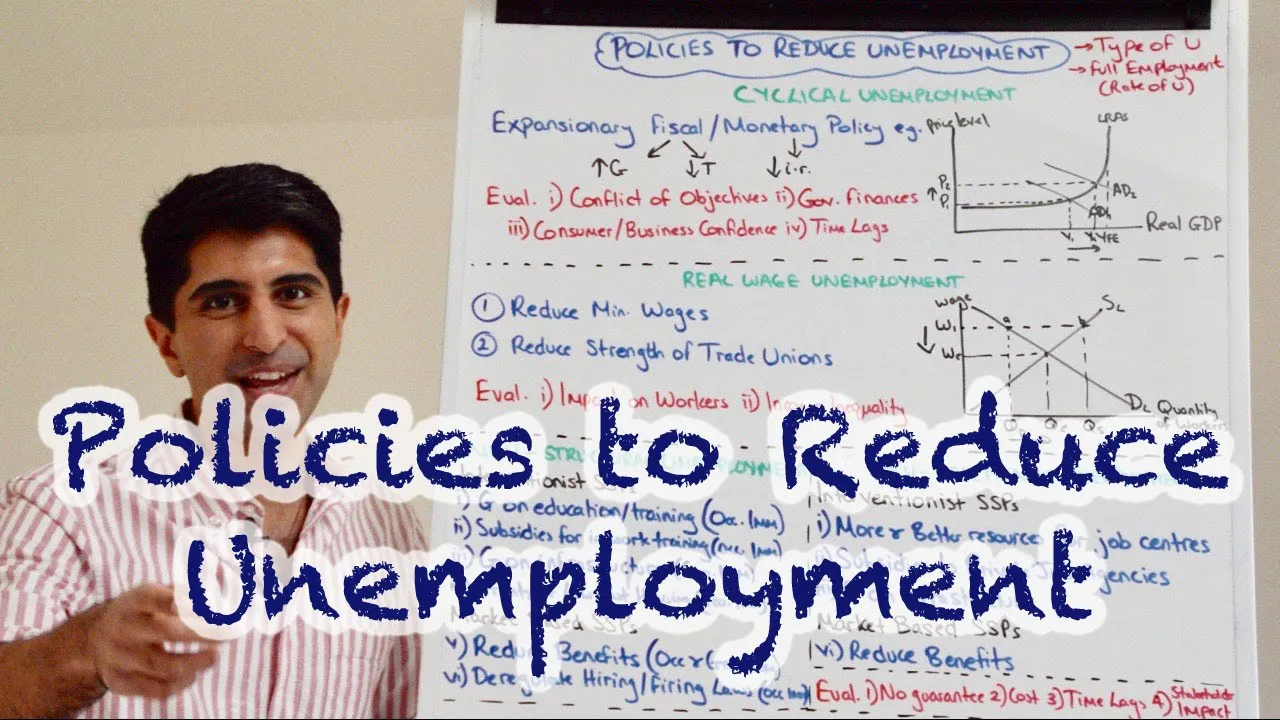
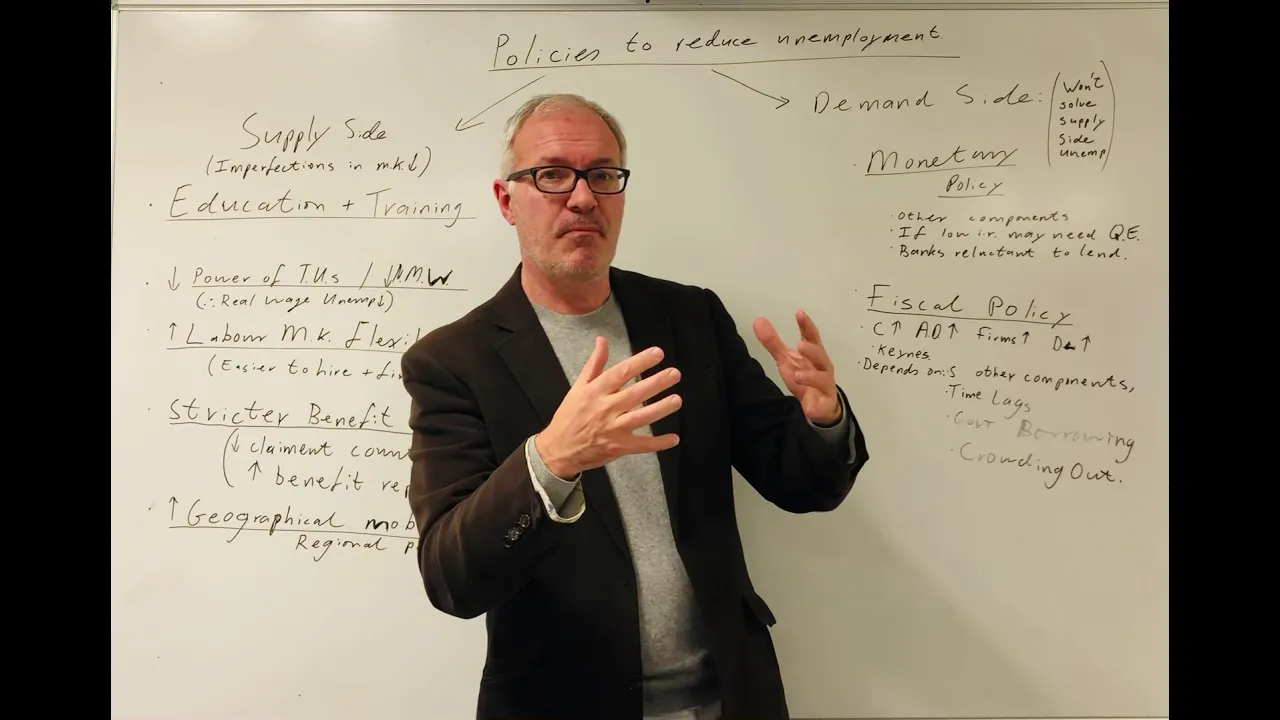
How macroeconomic policies (monetary and fiscal policy) are utilized to target and reduce different types of unemployment.
The Phillips Curve, which illustrates the relationship between inflation and unemployment.
Limitations of official unemployment metrics, such as the exclusion of discouraged workers and underemployed individuals (e.g., U-3 vs. U-6 rates).
176K views1.5Klikes7:20Original Release: 2018-05-03
>>Edward Heath, former prime minister of the United Kingdom, once said, "Unemployment is of vital importance, particularly to the unemployed."
It may seem that most people like to complain about work, but most do see having a job as a much better situation than the alternative—being unemployed.
Unemployment doesn't just harm the people who are out of work.
Economists warn that it is also harmful to society overall because it represents unused resources: The people who cannot find jobs represent goods and services that are not being produced.
To some people, an unemployed person is someone who doesn't have a job, but it's actually more complicated than this.
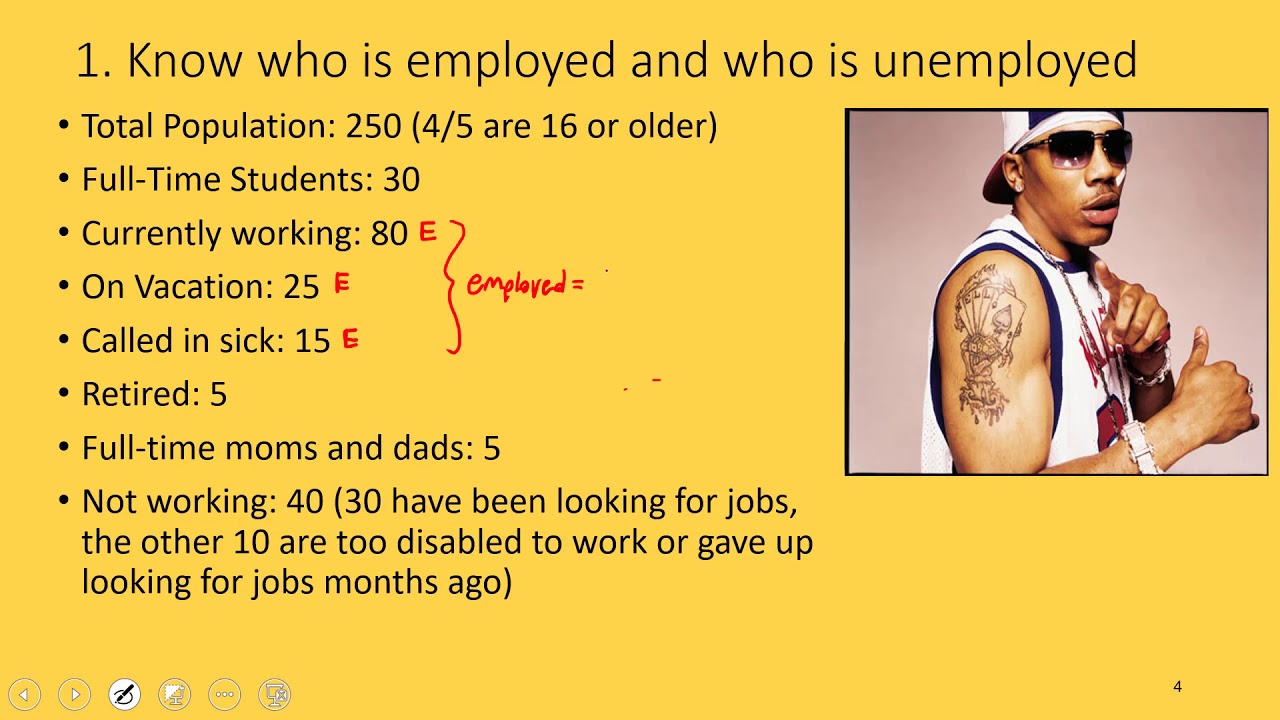
[Introduction] Each month the Bureau of Labor Statistics (BLS) polls people who are at least 16 years old about their employment status during that month.
The BLS uses the respondents' answers to divide people into three categories: Employed—someone who currently has a job; Out of the labor force—someone who doesn't have job right now but is not actively looking for a job; Unemployed—someone who does not have a job now and is actively looking for a job.
To be more exact, the BLS classifies persons as unemployed if they are 16 years or older, do not have a job, have actively looked for work in the previous four weeks, and are currently available for work.
Here is an example: Kris lost his job due to the recession.
He spends his mornings searching online for job openings and his afternoons filling out job applications.
Because Kris does not have a job and is actively looking for one, he is considered unemployed.
On the other hand, Mark stays home to care for his children; even though Mark does not have a job, he is not unemployed because he is not actively looking for work.
Instead, he is considered to be "out of the labor force."
Kris is a clear-cut example of someone who is unemployed, and Mark is an equally clear example of someone who is out of the labor force.
However, some people's official employment status doesn't tell the whole story.
Sometimes it's complicated.
Consider the following examples.
Josh is a recent graduate looking for a job as an accountant, but he is currently working at Burger Bin to pay the bills until he finds the right job.
Even though Josh is actively looking for work, he is not counted as unemployed because he has a job—he is counted as employed.
In fact, Josh is considered underemployed—which includes workers who are working part-time but would like to work full-time or those working in jobs for which they are overqualified.
Mako has been unemployed for 6 months; she has given up looking for work until she hears the economy may be turning around.
Because Mako is not actively looking for a job, she is considered to be out of the labor force.
In fact, because she has given up looking for work, Mako is considered a discouraged worker.
You can see that while both Josh and Mako are not happy with their employment situations, neither is counted as unemployed.
So calculating the unemployment rate is fairly complicated.
After categorizing people into groups based on employment status the BLS determines the unemployment rate, or the percentage of the nation's labor force that is unemployed.
The unemployment rate, considered one of the most important indicators of the health of the economy, is calculated by simply dividing the number of people who are unemployed by the number of people who are in the labor force and then multiplying by 100 to turn the decimal into a percentage.
The annual unemployment rate changes over time as the economy goes through its cycles.
The rate has been as high as 25 percent in 1933 during the Great Depression and as low as 2.5 percent in 1953.
You can find the current unemployment rate at the BLS website www.bls.gov and also at fred.stlouisfed.org.
Economists also divide unemployment into three categories.
Let's watch Morgan experience all three types of unemployment.
The first type of unemployment is frictional unemployment, which occurs when people take time to find a job.
It is the short-term unemployment associated with the process of matching workers with jobs.
This might be due to workers quitting one job to find one that is a better fit for their skills or lifestyle or perhaps students who have just graduated from college and are looking for their first job.
Frictional unemployment always exists because there are always some workers in transition.
If you are 16 or older, you would be considered frictionally unemployed this summer when you start looking for a summer job.
Morgan experienced frictional unemployment when she finished school and spent three weeks looking for a job driving a truck.
The second type of unemployment is cyclical unemployment, which is the type that rises during economic downturns and falls when the economy improves.
It is the extra unemployment that occurs during recessions.
During a recession firms can't sell as many goods and services as they had expected.
As a result, they must reduce their workforce.
Morgan lost her job as a truck driver when the economy went into recession.
People bought fewer goods so the demand for shipping services and therefore truck drivers went down.
As the economy grows and adds jobs, cyclical unemployment is reduced.
However, not everyone who loses a job during a recession finds the same type of job after the recession.
In this case, cyclical unemployment can turn into structural unemployment.
Structural unemployment the third type of unemployment occurs because of a geographic or skill mismatch between workers and employers.
This means workers must either learn new job skills, or they must move to a location where jobs that require their skills are more plentiful.
This might require an unemployed construction worker to retrain as a computer technician or an unemployed auto worker in Michigan to move to Tennessee.
As the economy changes over time, some industries fade while others are born and grow rapidly, which means workers need different skills.
Think of the entire "Internet economy" that didn't exist until the Internet went public in the early 1990s.
Now millions of people work in the Internet economy.
These structural changes in available employment mean that workers must be willing to acquire new knowledge and skills.
After looking for work as a truck driver for several months, Morgan realized that she was structurally unemployed and has decided to retrain as a web designer, a job with a promising future.
The unemployment rate is one of the most important pieces of economic data that economists study.
Now that you know the “ins and outs” of unemployment, you might appreciate this bit of wisdom: “The study of economics won’t necessarily keep you out of the unemployment line, but at least if you’re there, you’ll understand why.”
Up Next

11:35
The Shrinking Middle Class: Causes and Economic Impact | AltSimplified
@AltSimplified
69K views•2021-03-07

5:07
Impact of Yuan in Indo-Russian Trade Amid Sanctions
@WION
261.9K views•2022-07-01
10:33
Behavioral Economics Explained: Rationality, Nudges, and Risk
@crashcourse
1.1M views•2016-03-12

113:18
The Age of Easy Money: Fed & Inflation | Full Documentary
@frontline
21.2M views•2023-03-15
Related Study Plans & Knowledge Roadmaps
Structured learning paths in Economics
economics
Sovereign Debt: Defaults, IMF & Restructuring
01Introduction to Sovereign Debt & Government Bonds
02Debt Sustainability & Credit Ratings
03Anatomy and History of Debt Crises
+ 2 more learning modules
12h5 modules
Explore Roadmap
economics
Market Design: Matching Theory & Gale-Shapley
01Introduction to Market Design and Price-Free Markets
02Two-Sided Matching & The Gale-Shapley Algorithm
03School Choice Systems and Mechanism Design
+ 2 more learning modules
10h5 modules
Explore Roadmap
economics
Impossible Trinity: Forex, Capital & Policy
01Introduction to Monetary Policy and Central Banking
02Exchange Rates and International Capital Flows
03The Mundell-Fleming Model
+ 2 more learning modules
8h5 modules
Explore Roadmap
economics
Healthcare Economics: Market Failures & Systems
01Introduction to Healthcare Markets and Market Failure
02Asymmetric Information and Adverse Selection
03Moral Hazard and Insurance Design
+ 2 more learning modules
12h5 modules
Explore Roadmap