













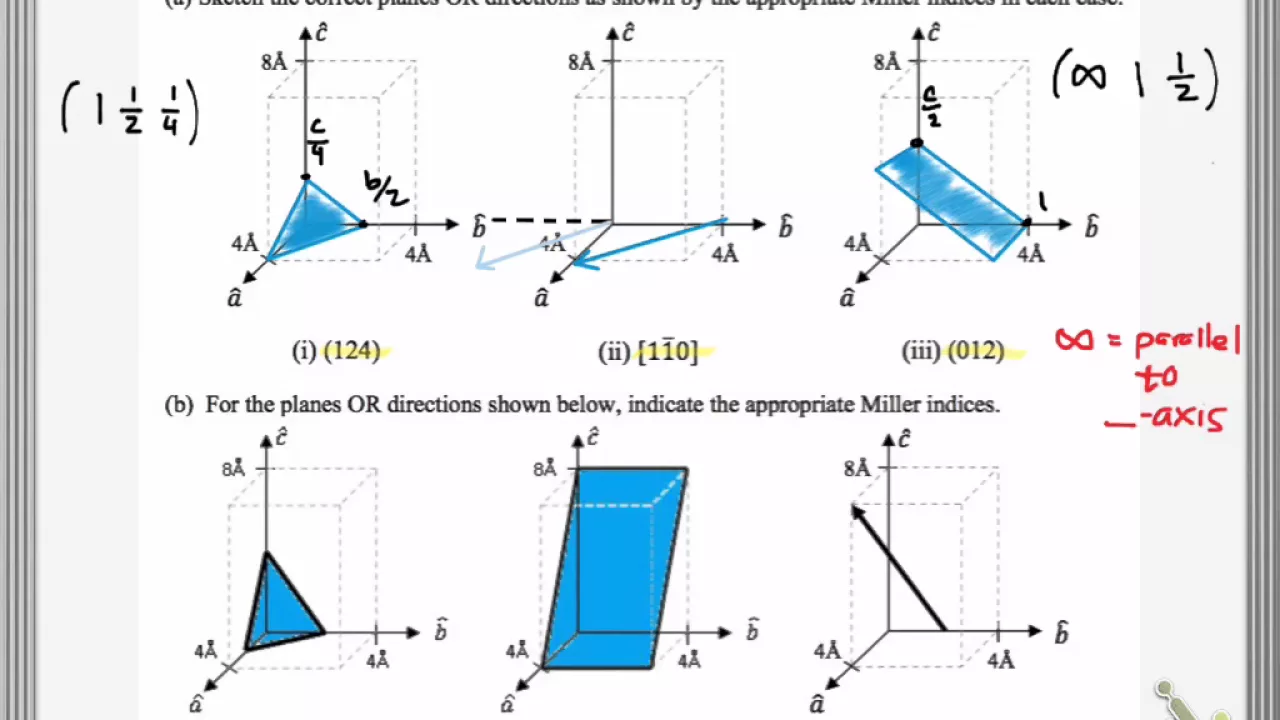
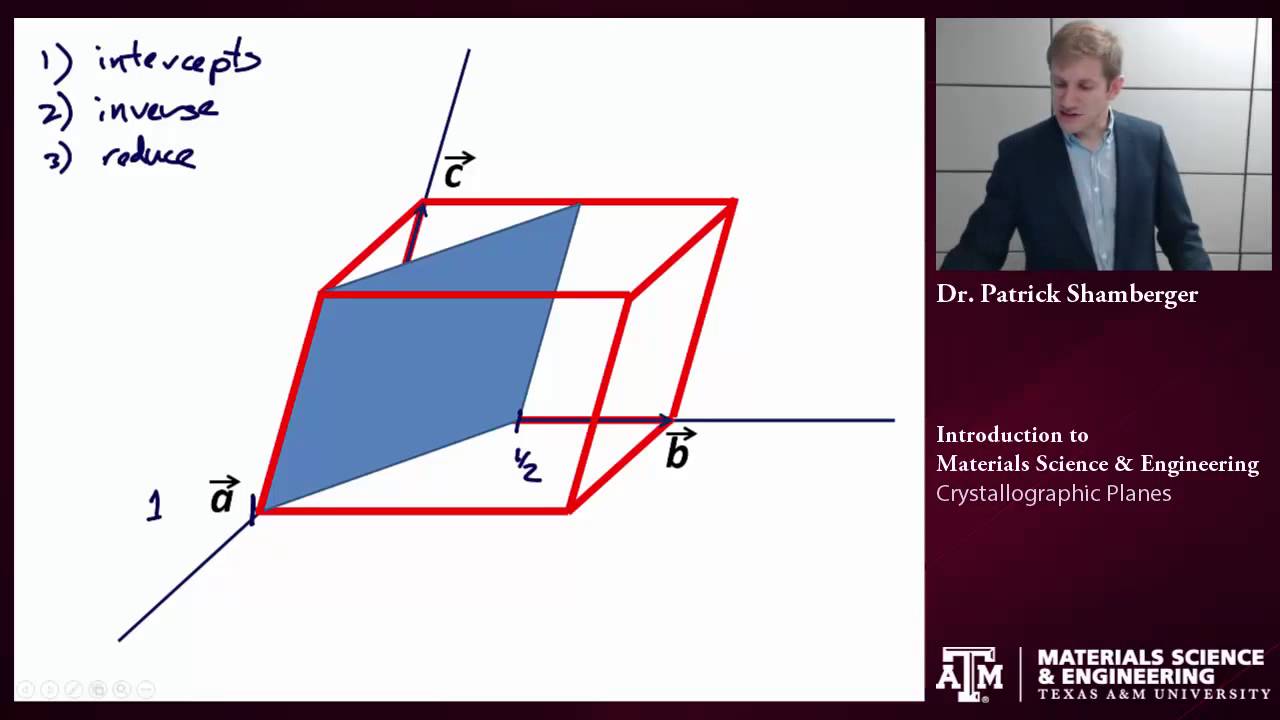










Miller indices are a standardized notation system for describing crystallographic planes using three integers (hkl) enclosed in parentheses, derived through three key steps: first, determine where the plane intersects the three principal crystallographic axes (a, b, c); second, take the reciprocal (inverse) of each intercept value; third, reduce any resulting fractions to their simplest integer form. Special cases include planes parallel to an axis (which yield a zero index for that axis) and planes passing through the origin (which require shifting the origin to properly define the intercepts).
Indexing Crystal Planes Using Miller Indices | Materials Science Tutorial
Added:Concept of a crystal lattice and unit cells (such as simple cubic, BCC, and FCC structures).
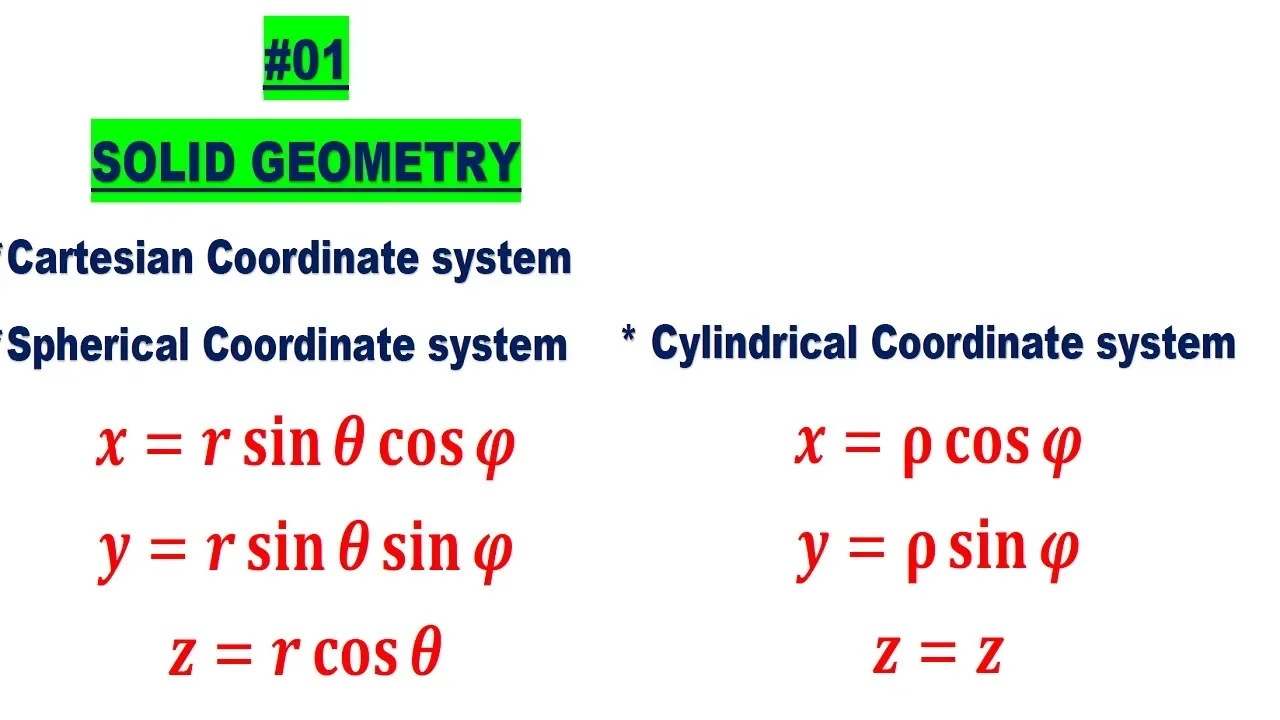
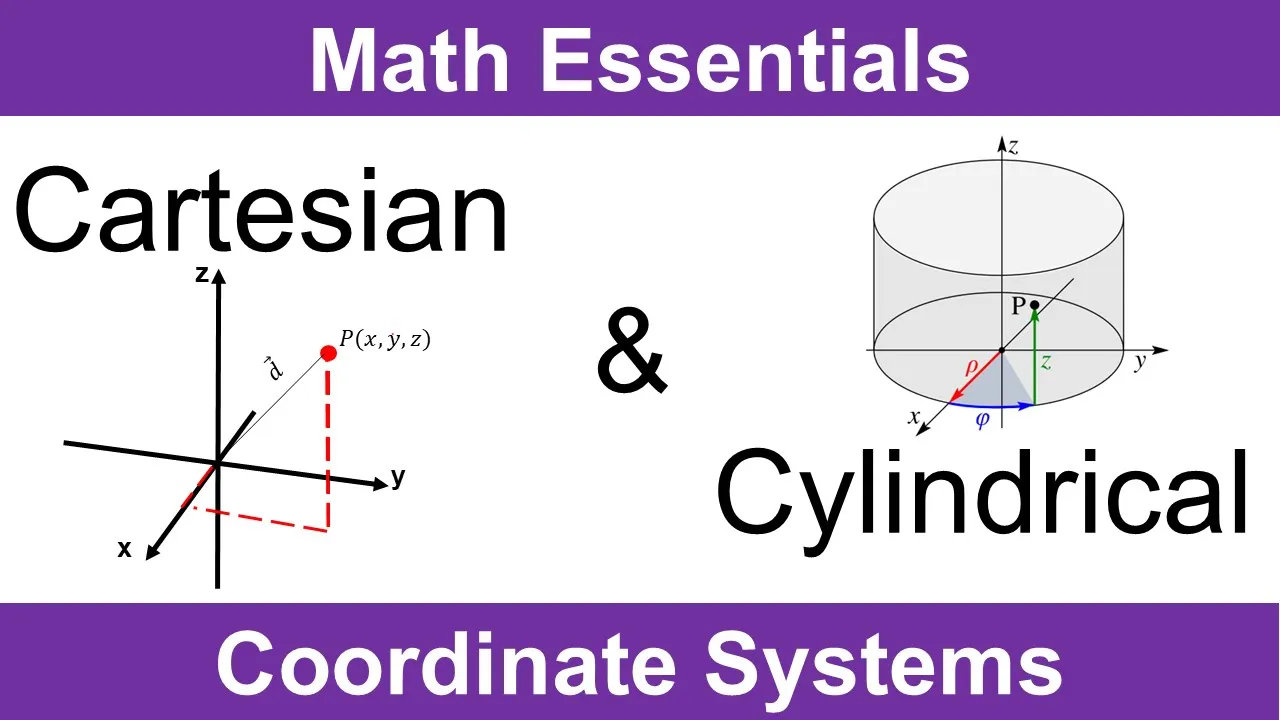
Basic 3D Cartesian coordinate systems, including identifying points and vectors in three-dimensional space.
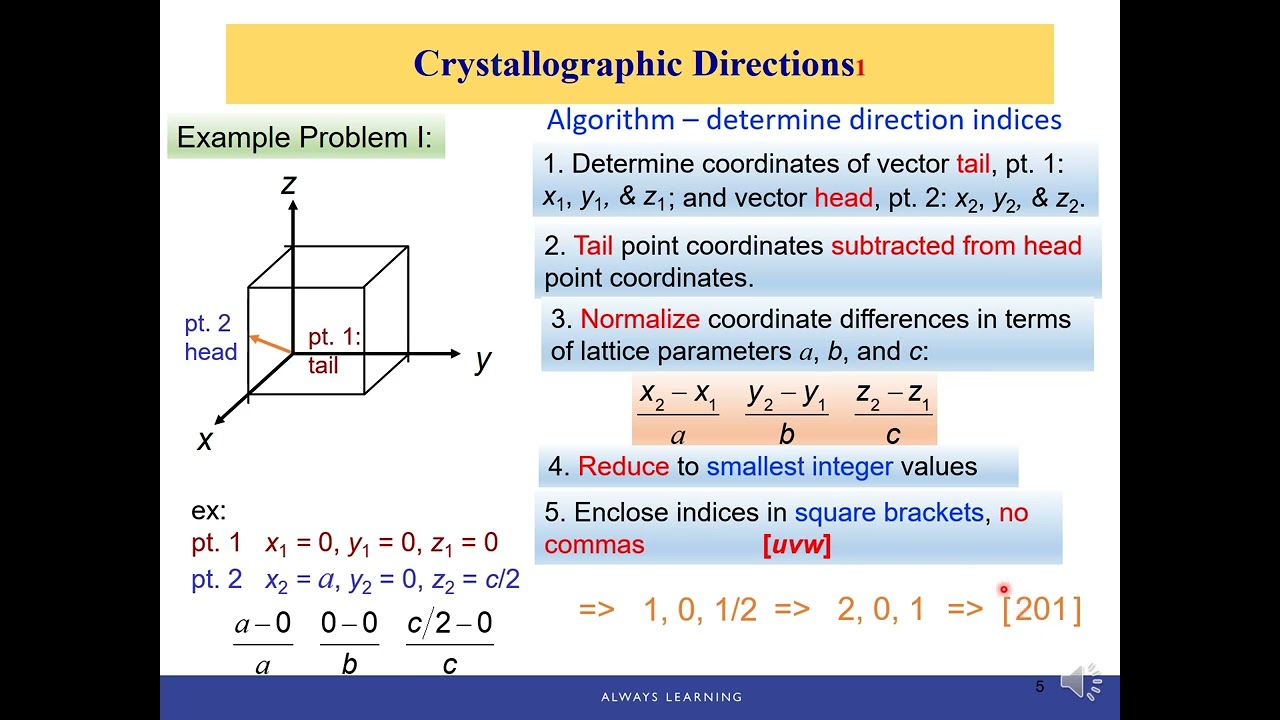
Understanding lattice parameters (a, b, c) and fractional coordinates within a unit cell.
Basic algebraic operations, particularly finding reciprocals and clearing fractions using the least common multiple.
Indexing crystal directions using Miller indices and understanding the geometric relationship between planes and directions.
Concept of families of planes {hkl} and directions <uvw> based on crystal symmetry.
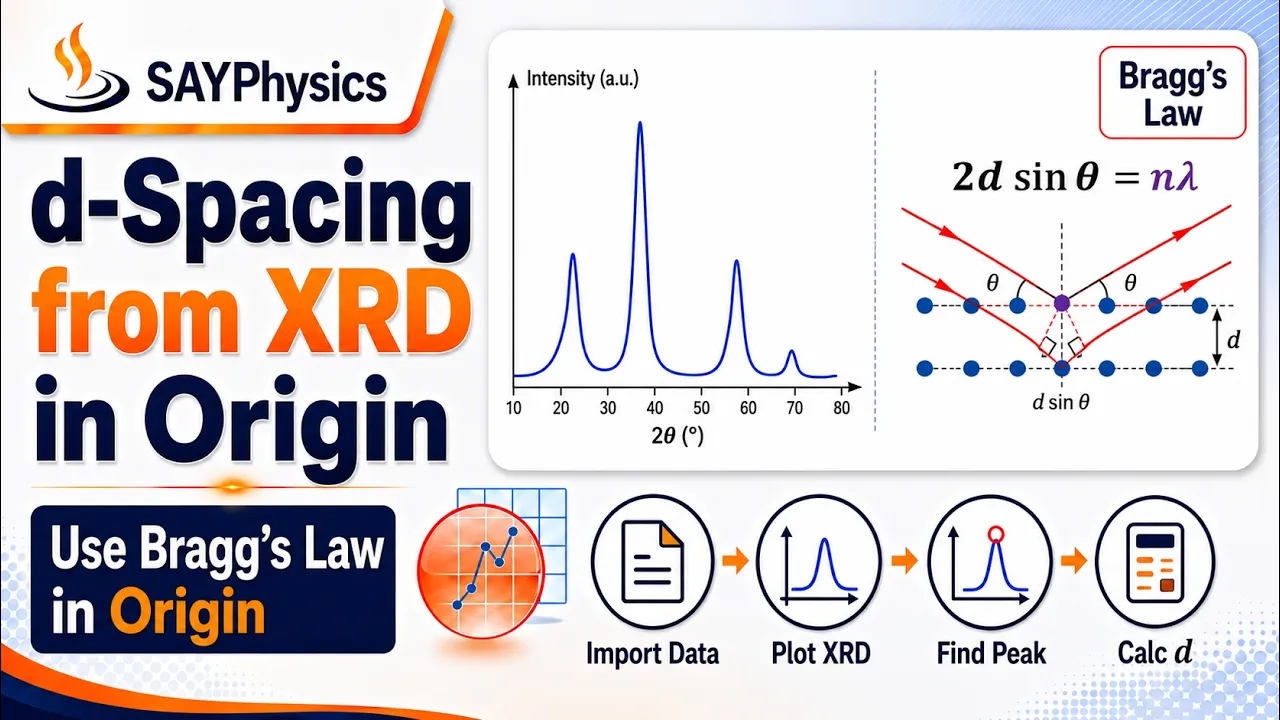
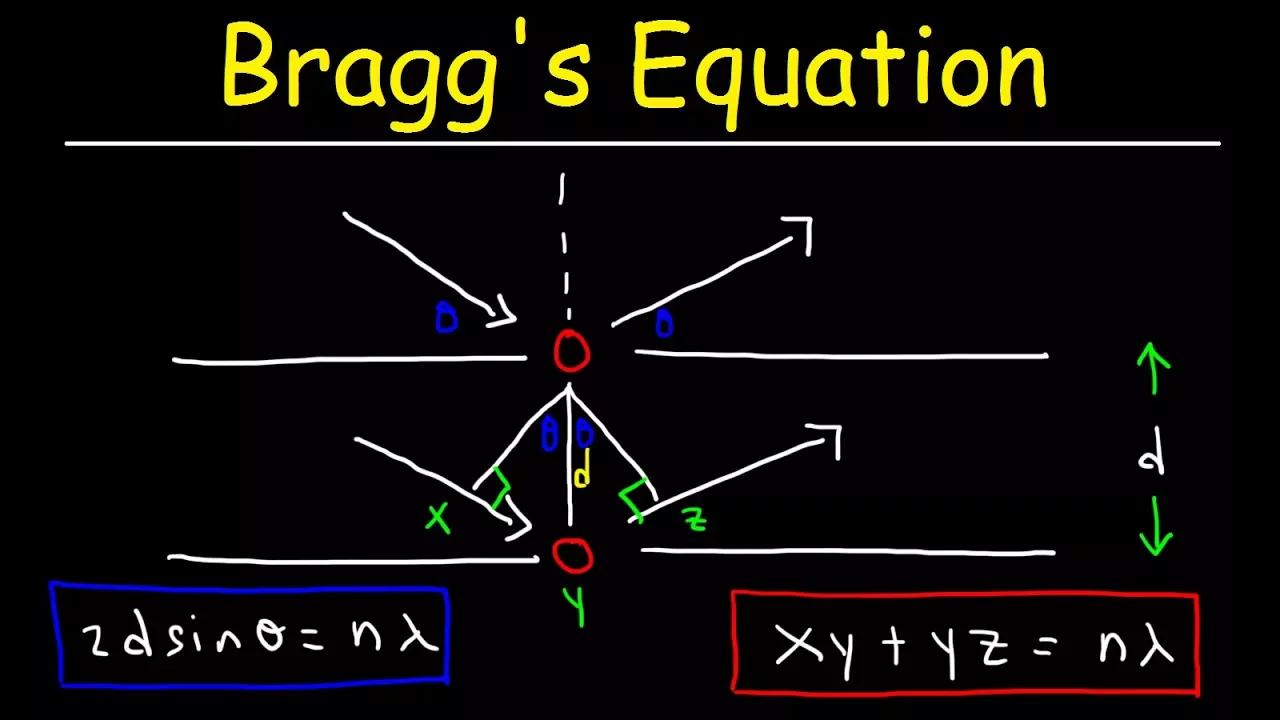
Calculating interplanar spacing (d-spacing) and applying it to Bragg's Law in X-ray Diffraction (XRD).
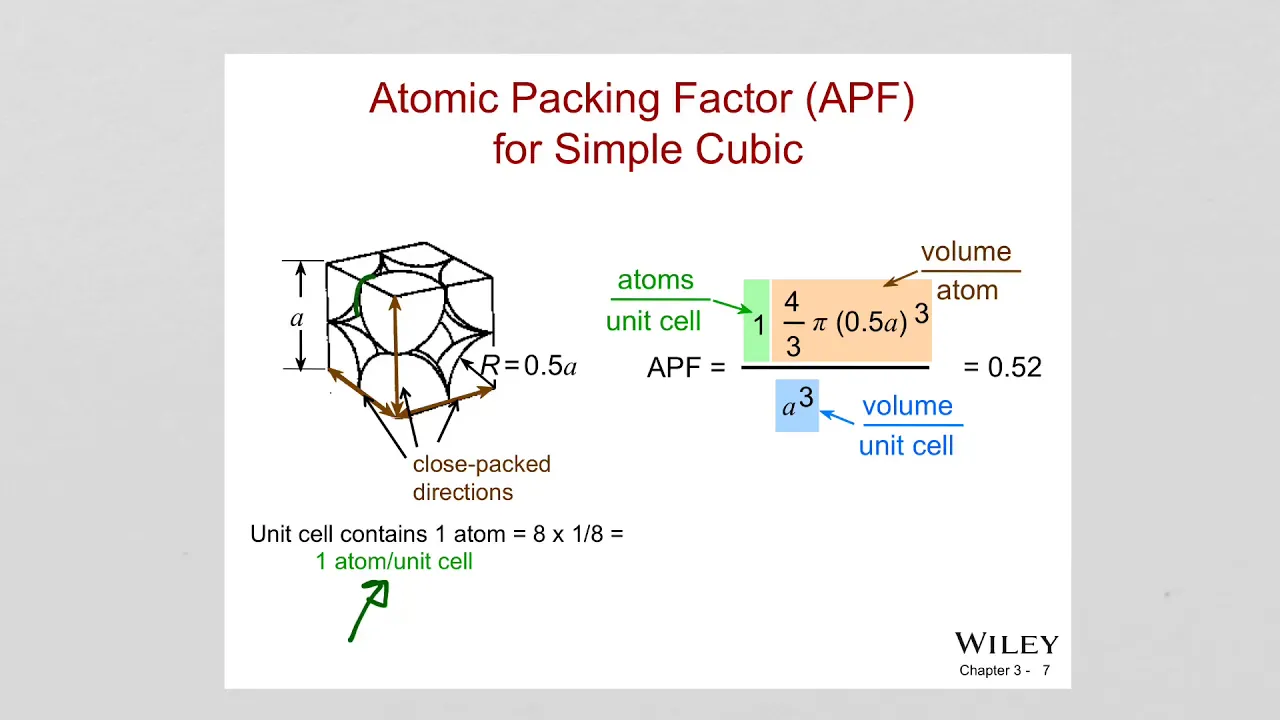
Calculating planar and linear atomic densities to analyze slip systems and predict plastic deformation in materials.
83K views538likes9:44Original Release: 2014-07-29
howdy the point of this video is to discuss how to index crystalographic planes using the Miller indices so why do I want to describe a plane well there are lots of two-dimensional features surfaces interfaces boundaries and Crystal structures that I'd like to be able to describe and Define here are a couple quick examples uh if I'm looking at Martin s sites so this is twinning in a Martin cidic structure and and the twinning is observed uh along very specific crystalographic planes uh in a structure another example would be if I'm looking at the grain boundary between two neighboring crystals so that is the interface uh separating two individual crystals each with their own uh unique orientation uh finally if I want to describe Crystal habits so these are free planes in a single Crystal uh as the crystal is growing uh so if I want to describe these surf I also need to describe them in terms of crystalic planes and we do this using the Miller notation so let's try some examples uh we're going to start off with a general triclinic axis so three lce vectors uh different lengths and not perpendicular to each other and say I have uh this particular plane that I want to describe so there are basically three steps that we need to do to index a plane we need to look at get the intercepts we need to take the inverse and we need to reduce any fractions okay what do these steps mean uh step number one intercepts where does this plane intersect with the three principal lce vectors um so or what are the what are the fractional coordinates of those intercepts so this is pretty obvious for one of them for B it intercepts at one but it's not so clear where it intersects the A and C axis and this is generally the case you know for the for the plane that's Illustrated in some unit cell uh you might need to extend that plane to figure out where it intersects these axes so we're going to do that I see that this line here if I kept extending it would intersect the C axis up at two uh similarly I need to draw an extended line here or I could come from this side uh through2 and I see that it intersects uh the a axis also out here too now this might be a little bit hard to visualize so take a moment and try and work it out for yourself um so I know the intercepts I would encourage you at this point to start with a table uh the intercepts here are two 1 2 the next step is to take the inverse of those 12 one 12 so one over two one over one one over two now this is kind of tricky and this is often times what people forget when we're doing directions uh we don't take the inverse at all when we're doing planes we do take the inverse so students often times confuse the two so uh just a word of caution um the third step is to reduce the fractions so here we see fractions I'm going to m mply this all through by two and I'm going to get 1 2 one so I have to multiply all three of these numbers through by the same number in order to reduce the fractions and if I were to write this in the standard Miller notation for planes that is one two one I don't use commas uh and I use round parentheses so a single plane is described by round parentheses so these are the Miller indices of this particular plane let's try a different case and this is is going to show us um one uh one tricky thing you might encounter so again my three steps find the intercepts find the inverse and reduce the fractions so what are the intercepts it's intersecting a over here at one it's intersecting B over here at2 but it never intersects B uh C so this plane is parallel to the cais uh in this case I would say that the intersect is at infinity and to to convince yourself why that is think of two planes that are not parallel but I'm rotating them so they're getting closer and closer to parallel as I do that that intersect point is going to get further and further away and so when they are actually parallel to each other they never intersect or that intersect point is at Infinity so in my table x y z the intercepts are 1 12 Infinity I'm going to take the inverse of these that's the next step one uh 1 over 1 12 is two one over infinity equals zero oneid by an infinitely large number is zero um I would then reduce but I notice I'm already uh I'm already using uh integers only so I'm all set the indices of this plane are one two Z using uh the Miller notation so note if I'm parallel to the C plane my uh my c Index uh is zero these are actually usually called hkl indices so the L indic uh would be zero let's try another tricky one um again I'm always going to do these three St same steps I look for the intercepts I take the inverse and then I reduce my fractions so where are the intercepts in this case well to me it looks like it intercepts a at zero it intercepts B at zero and it intercepts C at zero so if I were to take the inverse of 0 0 I'm going to get infinity infinity infinity uh and this is not a really well-defined plane so the problem is uh that I'm passing through the origin so anytime the plane is passing through the origin you need to do something to figure it out you can either move the plane in the unit cell or you can move the origin um the two are identical uh again when you're indexing planes just like directions the absolute position does not matter uh it's just the orientation of this uh with respect to the uh origin so I am going to shift the origin so it's up here in the back left upper corner of this unit cell so again I'm going to take the intercepts it intercepts a at one it intercepts B at one and it intercepts C at negative 1 so if I write my table at 1 1 1 The Next Step would be to take the inverses um but the inverse of one is one inverse of one is one inverse of Nega 1 is 1 so I don't need to do anything I also don't need to reduce because these are all already integers um so the Miller uh indices for this particular plane are one one bar one so this is pronounced bar one uh and this is the uh notation crystalographic notation for uh negative one some uh usually it's written like this sometimes when uh your professors are giving you homework assignments or making tests uh It's tricky to get that bar in exactly the right place uh so they will write something like this with the negative one sign but the proper uh notation is 1 one bar one okay the next kind of a challenge would be if you were given the indices and asked to draw a plane uh so here we're given hkl of two bar one so again that's negative one and two um now because this is a negative number uh I know one of two things are going to happen either I'm going to be uh intercepting uh somewhere out of the unit cell off in the negative Direction um well that is going to happen so the alternative would be to redefine to shift our axis off to the side um this is you don't have to do this you can just extend your unit cell outwards I find this to be easier sometimes so we're going to do the exact opposite of the process from before so I know the final notation uh essentially I need to take the in inverse of these so the inverse of this is 121 12 and then these are uh now the intercepts uh so The Intercept with the a axis is 12 The Intercept uh with the B AIS is1 and The Intercept with the c axis is 1 12 and so this plane is going to look like this again you only need three points to define a plane um and because I shifted that origin at the beginning it's a little bit easier because now it's all falling within that original unit so with planes remember um that second step taking the inverse uh we need to do that when we're indexing planes uh but that's not a step uh that's used when we're indexing directions
Up Next

53:50
A Taste of Type Theory: Understanding Identity Types in Programming
@GOTO-
11.8K views•2022-12-18

4:43
Elliptic Curve Cryptography Explained: ECC, ECDSA, ECDH
@PracticalNetworking
28.5K views•2024-10-21
10:44
Fourier Series Introduction: The Big Idea Explained
@DrTrefor
387K views•2021-05-03

6:00
The Mathematical Impossibility of Accurate World Maps
@Vox
23.3M views•2016-12-02
Related Study Plans & Knowledge Roadmaps
Structured learning paths in Mathematics
mathematics
Tensor Calculus: Vectors to Riemann Curvature
01Mathematical Foundations: Linear Algebra & Calculus
02Covectors, Dual Spaces, and Tensor Basics
03The Metric Tensor and Index Gymnastics
+ 2 more learning modules
40h5 modules
Explore Roadmap
mathematics
Gödel's Incompleteness: Logic, Proofs & Limits
01Introduction to Formal Systems & Hilbert's Dream
02Set Theory, Cardinality, and Cantor's Diagonal Argument
03Arithmetization and Gödel Numbering
+ 2 more learning modules
14h5 modules
Explore Roadmap
mathematics
Galois Theory: Fields, Groups & Solvability
01Foundations of Abstract Algebra: Groups & Fields
02Polynomials & Field Extensions
03Splitting Fields & Symmetries
+ 2 more learning modules
24h5 modules
Explore Roadmap
mathematics
Non-Euclidean Geometry: Models & Geodesics
01Euclid's Fifth Postulate and the Birth of New Geometries
02Hyperbolic Space and the Poincaré Disk Model
03Geodesics: Defining Straight Lines in Curved Spaces
+ 2 more learning modules
15h5 modules
Explore Roadmap