




















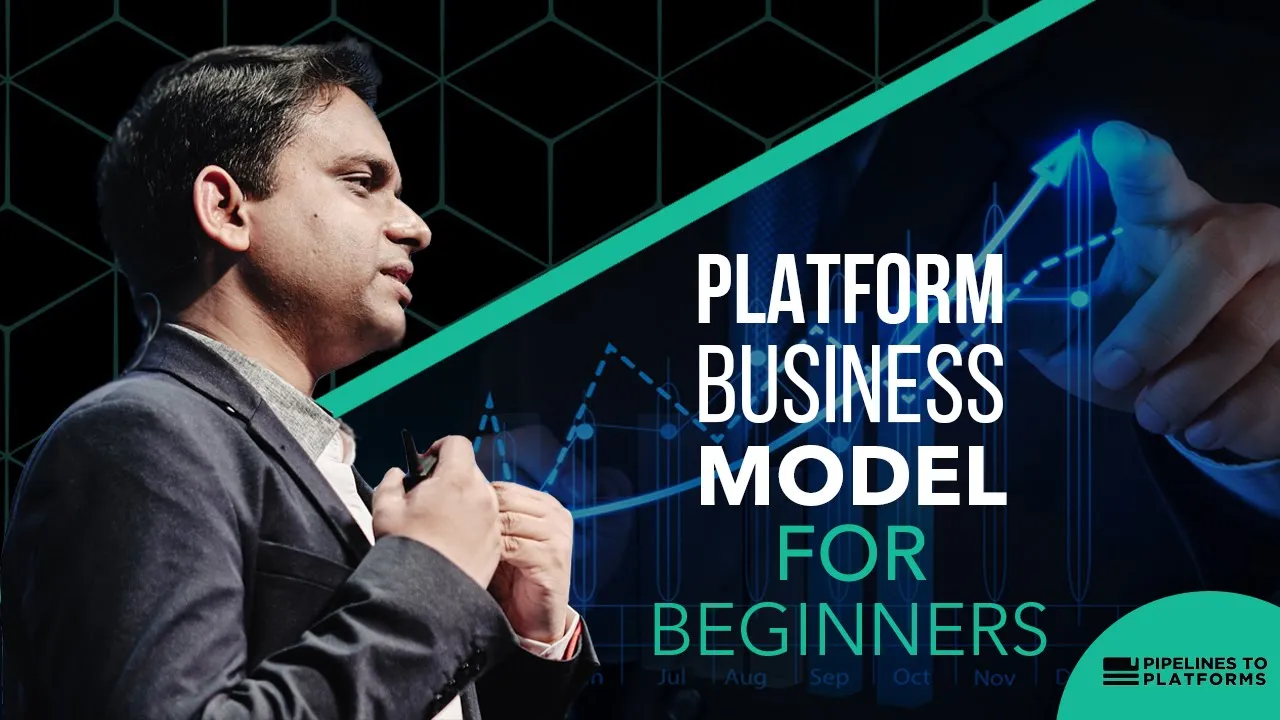




A platform business model is a digital infrastructure that facilitates value exchange between producers and consumers through specialized tools and services; unlike traditional businesses where value is directly exchanged between company and customer, platforms profit by charging fees for enabling these interactions, creating incentives to continuously improve the matching and transaction processes between participants.
Digital Platform Business Models: Core Concepts (Ep. 1)
Added:Understanding of traditional linear business models (pipeline models) and how they differ from network-centric models.
Basic concept of network effects, specifically how the value of a service increases with the number of participants.
Fundamental business concepts of value proposition, customer segments, and value creation.
Elementary understanding of digital systems, including APIs and cloud-hosted environments that enable online interactions.
Strategies for overcoming the 'chicken-and-egg' problem when launching a new multi-sided platform.
Designing platform monetization models, including transaction fees, subscription fees, and freemium structures.
Platform governance frameworks, including rules for user behavior, quality control, and trust-building mechanisms.
Advanced network economics, such as multi-homing costs, disintermediation risks, and winner-take-all market dynamics.
279 views6likes4:21Original Release: 2022-05-05
have we been trying to understand platform business models but got stuck in all the theory well in this video we will be introducing the five core concepts that all platform business models are based on hey there my name is quinton martinez and i conceptualize design and develop meaningful web experiences for organizations with character in this series i will be explaining how to design your own platform business model and today's episode we will be exploring the five core concepts that all platform business models are based on these five concepts will always be the starting point for a platform no matter the size and complexity of the project let's start with academics what is a platform well a platform is a digital infrastructure which facilitates the exchange of value through interactions between producers and consumers of value it's quite a mouthful i know let's break it down value exchange is the heart of all businesses no matter what business model we discuss at the heart of it there is always a core value that is being exchanged this typically happens in the form of currency in exchange for a product or service this is the end result both parties are looking for the business wants currency and the customer wants a product however in a platform business model this exchange of value is the service the end result that we are looking for as a platform is the successful exchange of value between platform participants because as a platform we can charge a fee for facilitating these interactions for transactions this creates an incentive for the platform to invest in making these interactions easier and more valuable for the producers and consumers of value this investment goes into the platform's digital infrastructure and this infrastructure is typically a website or an app but it includes all the tools services and technologies the platform uses to facilitate interactions between the participants to better understand this concept let's use a simplified version of airbnb as an example this simplified airbnb platform has two digital spaces infrastructures where they facilitate their core value these are a website and an app an app and a website can function as separate infrastructures which facilitate different interactions but for this example we will consider them to be identical and have the same ecosystem this means that together they provide the core value of matching the supply and demand of the rooms for rent in this case the producers of value are owners of rooms that are willing to rent it out and the consumers of value are the people that are looking for rooms to rent in order to facilitate this exchange of value airbnb had to develop ways to make this interaction possible but also easy and relevant how did they do this well if you open the airbnb website you'll quickly see some of the tools that they have invested in the first thing the producers and consumers of value needed was a way to easily find each other so they developed a search system in order to help participants find a match then they added a filter system in order to increase the relevance and quality of the matches being found you don't want to be matched with the space and then realize that they have no availability when you have a vacation order they are in a completely different location from you for airbnb the filters are the location the check in and checkout dates and the amount of people you are taking with you because of these the consumers of value can easily figure out whether there's a room available for them so if the platform is implemented correctly everybody wins the producers of value property owners in this case get their rooms rented out and the consumers of value find a place they can stay but the key word here is correctly when is a platform functioning correctly to understand this we need to dive deeper into the ecosystem of a platform that will be the topic of our next episode like if you liked it and dislike if you didn't but let me know in the comments why you did so also you can always subscribe subscribe and hit the bell icon if you want to be notified when the next episode comes out i'm quinton martinez and let's make this happen
Up Next

5:28
Pipeline vs Platform Business Models: Key Differences
@PantVik
13.1K views•2017-03-23

66:41
Web3 Social Decentralization: Farcaster Co-Founder on Crypto Social Networks
@levychain
1.5K views•2022-10-18

15:23
Decoy Effect: How Pricing Psychology Influences Consumer Spending
@bobinvestsUS
90K views•2026-01-05

17:30
The Planned Obsolescence of Light Bulbs and Tech
@veritasium
25.3M views•2021-03-26
Related Study Plans & Knowledge Roadmaps
Structured learning paths in Business
business
CPG Retail Strategy: Pitching & Trade Spend
01Foundations of the CPG and Grocery Ecosystem
02Retail Math and Designing the Pitch
03Securing Shelf Space & Category Reviews
+ 2 more learning modules
12h5 modules
Explore Roadmap
business
Pop-Up Retail: Strategy, Design & Execution
01Introduction to Pop-Up Retail & Strategic Goal Setting
02Budgeting, Site Selection, and Legal Essentials
03Experiential Retail Design & Visual Merchandising
+ 2 more learning modules
15h5 modules
Explore Roadmap
business
Reg CF: Startup Funding, Marketing & Launch
01Introduction to Equity Crowdfunding & Reg CF
02Platform Selection & Legal Preparation
03Crafting High-Converting Campaign Assets
+ 2 more learning modules
14h5 modules
Explore Roadmap
business
Productized Services: Scaling Solo Freelance
01Foundations of Productized Services
02Packaging and Scope Definition
03Pricing and Subscription Models
+ 2 more learning modules
15h5 modules
Explore Roadmap