


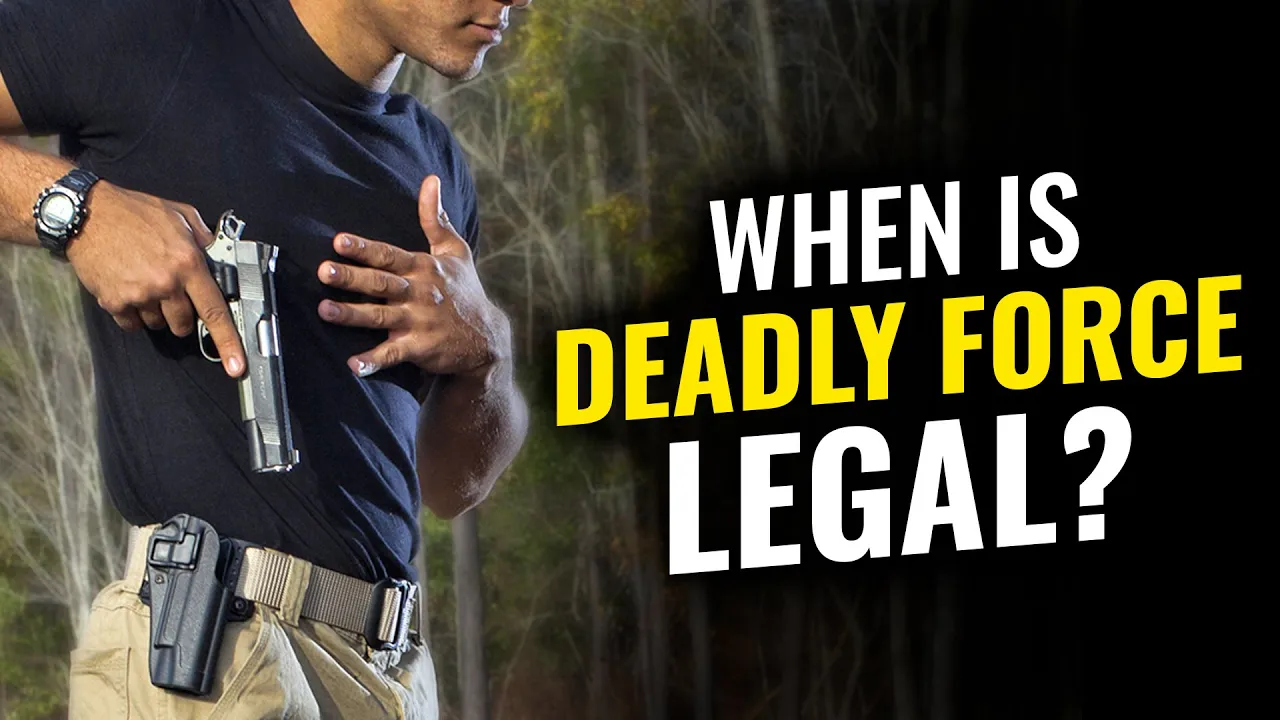



















Stand your ground laws exist on a spectrum with three distinct levels: duty to retreat states require individuals to attempt escape before using deadly force; stand your ground light states eliminate the duty to retreat but allow juries to consider whether retreat was possible when evaluating reasonableness; and true stand your ground states prohibit juries from considering retreat entirely. Louisiana exemplifies this progression, having transitioned from a light state (pre-2006) to a true stand your ground state after legislative changes. Regardless of which type of law applies, deescalation remains the safest legal strategy, as even legally justified force results in significant legal and financial consequences including bail costs and lengthy court processes.
Stand Your Ground Law: Self-Defense and the Duty to Retreat Explained
Added:I'm James Reeves. I'm not your lawyer.
This is not legal advice, but I really want to help you motherers stay out of jail today. I'm willing to bet a lot of you live in stand your ground states.
But I'm also willing to bet that most of you don't know how stand your ground your stand your ground state is. Let me explain. Bit of background. George Zimmerman, Trayvon Martin, you guys remember that? Of course you do. Very controversial stand your ground case where someone got shot to death in a physical altercation. The shooter walked on stand your ground. The facts weren't exactly favorable for the defendant.
Plus, you of course had like a race factor, socioeconomic disparity in play, which meant the media went wild over the story. At the end of the day, defendant walks and just like that, stand your ground becomes thrust into the national spotlight. It becomes a political football. Opponents say it's like the right to shoot anyone whenever you want for whatever reason. Proponents say that they should be allowed to defend themselves in public without being saddled with liability if a biased jury or a politically motivated prosecutor felt like they didn't do a good enough job trying to deescalate the situation and they were just defending themselves.
As with everything, it's a little bit more nuanced than that. Truth is somewhere in the middle. Here's some free legal advice for you. If you're not going to rely on your moral compass and you need a lawyer to tell you what to do legally, maybe consider therapy or watch a few Lifetime movies to kind of bump up your EQ. Until then, I'm more than comfortable telling you legally deescalation will save you a lot of headaches. The mindset of I'm going to shoot because I can should be inverted to I'm only going to shoot when I have to. Because even if you don't have to retreat and you may come out on top legally with stand your ground if you shoot someone, you're probably going to be punished by the process. You're going to be ridden really hard through the justice system. If you don't have US Law Shield, well, first of all, sign up. Use NGC as a signup code. That's my range, Neutral Ground Gun Company. I get like 20 or 30 bucks. You get a few months free membership. Everyone wins. But if you don't have a legal defense program like Law Shield or whatever, you're going to shell out a ton of money for a lawyer. The one that really gets you is your bail bond. If you don't have like bail insurance, I can tell you story after story of US law shield members that I represented who did absolutely nothing wrong, but they had to throw away between $10,000 to $70,000 of their own money for a bail bondsman. Money they don't get back, only for me to get the charges dropped weeks later. The point is that even if you did everything right like I've had many clients do, even if you're legally in the clear, that ain't going to stop you from getting jailed and bailed and having to pay a scumbag lawyer. Okay, unnecessarily long introduction to get to our lesson today. But the good news is the lesson is short and I think easy to understand. I'm going to describe the three levels. There are three levels of stand your ground. First, well, duty to retreat, which is not stand your ground more or less. The first question that the juryy's going to answer is, could he have gotten away and avoided the conflict? If the answer is yes, you're probably going to be found guilty of something. Now, there are two other levels. And I think this is the part that's going to surprise some of you.
You have what I call true stand your ground states and what I call stand your ground state light. I use an example in my classes. I made a nifty little slideshow that I'm going to show you here. when I was teaching a room of about 50 or 60 US law shield instructors in Texas last month. Here I am. It's a beautiful day in the Microsoft Windows 95 wallpaper world. I pull over on an empty highway. I'm taking in the view.
My car is still running. I can just pull back on the road, drive off whenever I please. I haven't seen another car for over an hour. There's no traffic. I'm listening to the aside of no jacket required. And I am at total peace. But way off in the distance, way way way off, I see someone running towards me, not just someone. Peak 1994 Terminator 2. Arnold Schwarzenegger running at me full speed. Now I'm about to embarrass myself here. My impression is not as good as Taran Butler's. One of the best, by the way. Arnold Schwarzenegger impressions, oddly enough, Taran Butler, but I see Arnold Schwarzenegger and he's running at me and I can hear off in the distance he says, "James, I'm going to kill you." And he's running towards me full speed. It's terrifying. Also kind of weird that he knows my name, but you get the point. He's closing fast. I'm thinking when he gets here, he's going to rip my skull off my body. Early9s Arnold was a monster. He's shirtless.
His pecs are rippling like lead jello-.
He's coming right after me. I've only got a 9 millimeter. Oh my god. You know, like I I hope it's loaded. I'm going to check the mag. Like I I press check it, man. Uh you know, I hope he's not really a T800. I hope this gun will will do the trick. I shut off the radio to concentrate. He's still running at me. I roll the window down and I kind of take my aim and then whenever his feet hit the pavement. Boom. I just shoot my childhood idol. Did I just commit a murder? Pause the video. Tell me what you think in the comments. Now, now morally, of course, that's between me, YouTube commenters, and God. But legally, just like any good legal analysis, it depends. Are you in a true stand your ground state or are you in a stand your ground light state? What is the difference and why does it matter?
Great example is Louisiana. One of the four states I practice in until 2006.
Louisiana was stand your ground light.
The law read something like, "A person who's not engaged in illegal activity and who's in a place where he or she has the right to be will have no duty to retreat before using deadly force and may stand his or her ground." And I think it's and meet force with force.
I'll put the statute up here. But the way cases played out, the jury could still hear evidence about your ability to retreat when deciding whether or not your actions were reasonable. In other words, in stand your ground light states, the prosecutor can tell the jury, "Of course, he had the right to stand his ground." But was he really in fear if he could have just driven away?
Was it reasonable for him to shoot Arnold Schwarzenegger when he could have just stepped on a pedal and driven off into the sunset? Those are all factors a jury is allowed to consider in stand your ground light states whenever they're determining whether or not you're acting reasonably. Now, Louisiana tightened it up in 2006. Here's the new language. No finder effect shall be permitted to consider the possibility of retreat as a factor in determining whether or not the person who used deadly force had a reasonable belief that deadly force was reasonable and apparently necessary. It's something like that. I'll have it up on the screen here. What does that mean? Before 2006, Louisiana wasn't a duty to retreat state, but juries could still consider whether or not you could have retreated if they were judging whether or not you were being reasonable. After 2006, Louisiana juries are told that they can't consider retreat at all. In my Arnold Schwarzenegger example, in a stand your ground light state, the prosecutor can say, "This wasn't reasonable fear. He wasn't afraid uh or he wasn't reasonably afraid. He didn't respond reasonably. The reasonable thing to do would be to drive away. He's allowed to say that in a true stand your ground state. Probably grounds for a mistrial if the prosecutor brings it.
They're not allowed to say, "Oh, well, he could have gotten away. He could have done something else instead." We're a true stand your ground state. Did he stand his ground? Yes. Which one of those approaches is better for stand your ground? Light or true? You may be morally conflicted by my Arnold example.
And that's the point. In a true stand your ground state, I would walk. In a stand your ground light state, I'd probably go to prison. Do you know your state's law? Are you in a stand your ground light state like we were pre206?
Are you in a true standard ground state?
I would find out. But even when you do, don't be thinking, "Oh, oh, I'm in a true stand your ground state. I can just shoot someone instead of deescalating because I won't be convicted." Don't be that guy. There's a lot of legal and moral overlap here. End of the day, no matter where you live, stand your ground. Stand your ground light.
Deescalation, smartest legal strategy.
When you land in a situation that truly can't be deescalated, you'll know without knowing it. If that makes sense.
Thank you for watching. I'm not your lawyer. This is not legal advice. Have a great night.
Up Next

Stand Your Ground Laws Explained: Legal Analyst Overview
@9news
900 views•2023-05-01

US Secondary Sanctions Impact on EU Businesses and Blocking Legislation
@Bureauvandijk
1.6K views•2019-03-20

Forensic Phonetics: Speaker Identification in Legal Cases
@nptel-nociitm9240
539 views•2025-03-19

Police Interrogation Tactics: False Confessions & Legal Reform
@LastWeekTonight
7M views•2022-04-18
Related Study Plans & Knowledge Roadmaps
Structured learning paths in Law