











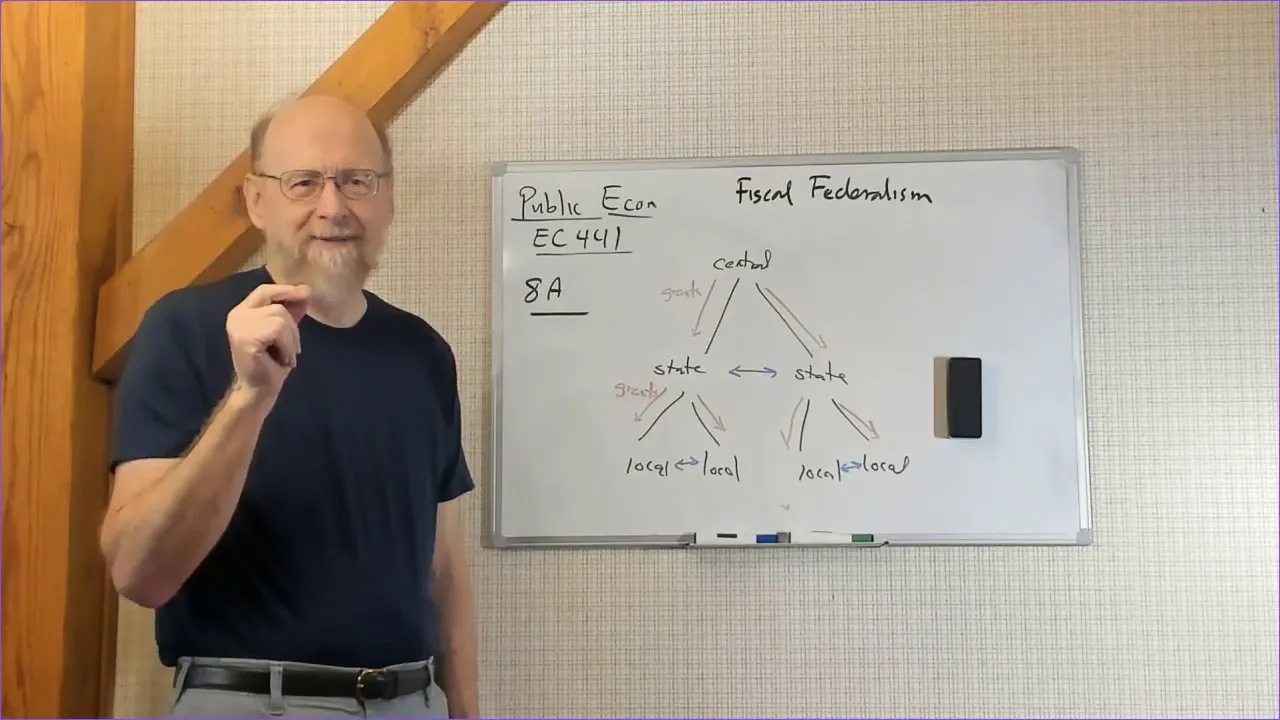


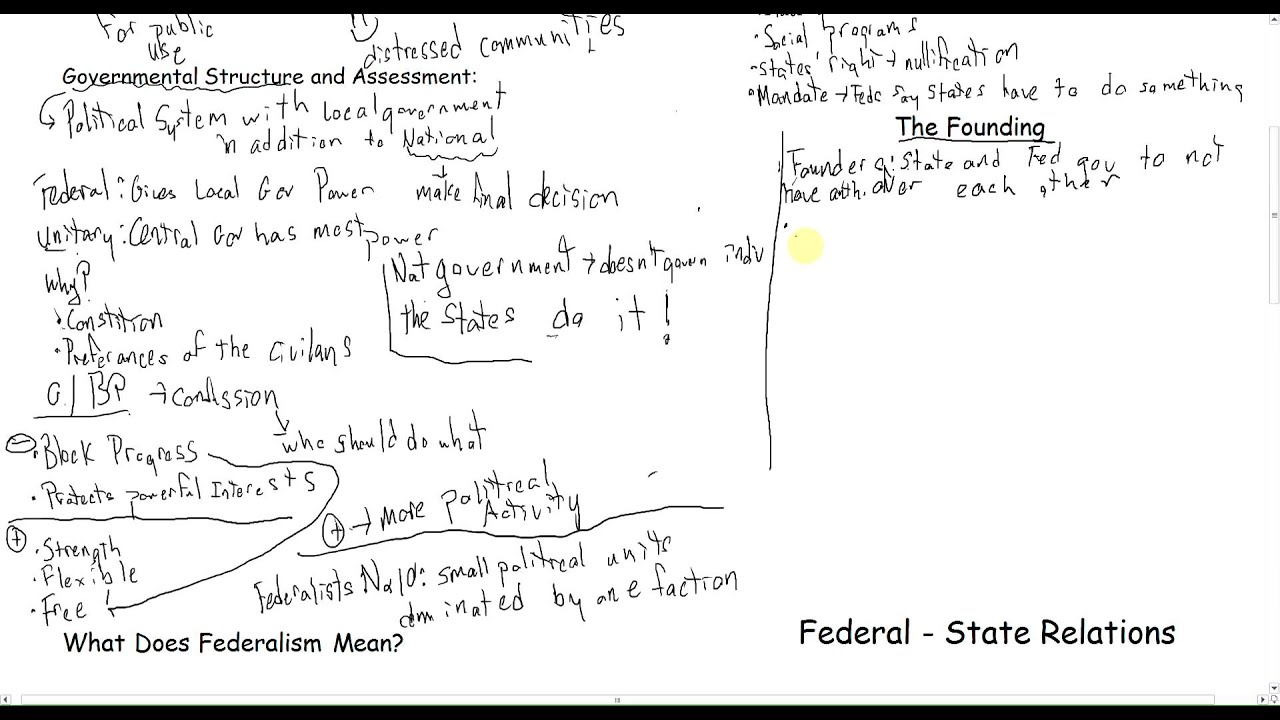








Fiscal federalism is the economic framework that analyzes how responsibilities should be assigned across different levels of government based on efficiency considerations. Key principles include: (1) Wallace Oates' decentralization theorem, which states that when citizens have different preferences for public services, local governments can better accommodate these differences; (2) the Tiebout model, which shows that competition among local governments drives efficient public service delivery as mobile populations vote with their feet; (3) fiscal equivalence, which suggests that services whose benefits are concentrated locally should be provided at the local level, while national defense and redistribution should be handled centrally due to mobility challenges; and (4) the observation that progressive taxes are more efficiently implemented by higher levels of government. In practice, the US system aligns reasonably well with these principles, with the federal government handling national defense and social insurance, states managing education and healthcare, and local governments providing day-to-day services like police protection and schools.
Fiscal Federalism Explained: Federal vs State Power (Economics Primer) | HISPBC Ch.1
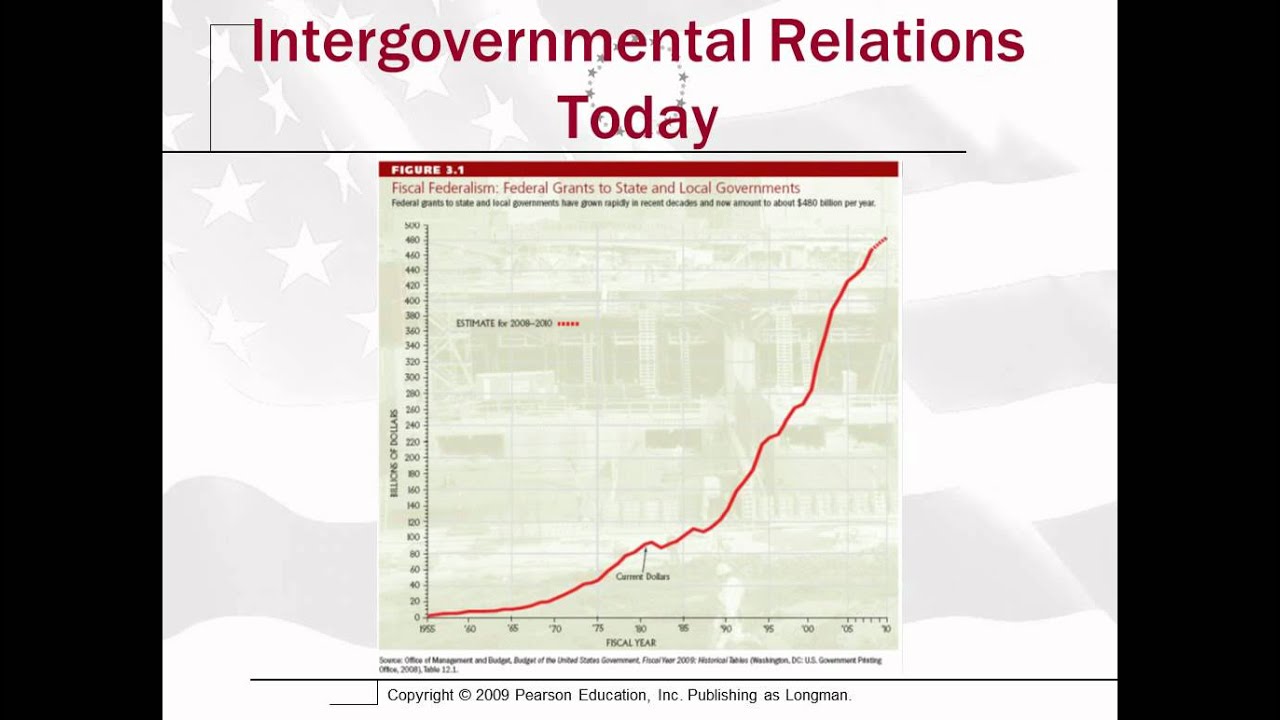
Added:so my my goal for the next hour with you is to provide a primer on fiscal federalism which you can think of as the economics disciplines toolkit or apparatus for making sense of the design of federal systems so let's let's dive in with some big picture facts on the US system of fiscal feder ISM which we're attempting to understand so first is just a Topline fact there's there's a genuinely astonishing number of government entities in the United States over 90,000 there's of course the one unitary federal government 50 state governments but also 3,000 counties 35,000 plus cities and towns 13,000 independent school districts and 39,000 so-called Special Districts many of which you could think of as the providers of for example electrical water and gas utilities around the country in in addition to being numerous these government entities are also engaged in a substantial amount of activity so two Topline facts on that governments adding up across federal state and local levels account for roughly two fifths of economic activity within the country and employ roughly one in seven workers one of which is yours truly as an employee of the University of California system down in San Diego so confronted with this kind of tremendous role of government in this relatively complex design of the system of governments there are some questions that we should be asking such as how should we think about the pros and cons of the US system as it's constituted and what responsibilities would best be designed from the perspective of making optimal economic policy to higher versus lower levels of government as the next step what I'd like to do is provide sort of a brief look at three policy spaces in which we can kind of nicely see conflicts between levels of government emerging emerging which can help us to focus our attention on the question of where we might optimally think of various functions as being assigned across levels of government so let's start with with the minimum wage so first four facts about minimum wage policymaking in the United States first minimum wage laws vary dramatically across the United States the federal minimum wage is currently $725 an hour some state and local minimum wages are now in excess of $15 an hour so tremendous variation in what the effect of law is in various labor markets around the country second congressional Democrats recently proposed a $17 an hour federal minimum wage escalating a bit from the previous kind of fight for 15 Mantra third many cities in the state of California also elsewhere around the West Coast also New York City also Chicago have their own minimum wages and fourth in some States state governments have actually taken efforts to block cities from enacting minimum wages in excess of the state minimum wage and so you you can see that there are tensions within the system of government on the one hand the states want to do their own thing on the other hand some federal policy makers are sort of trying to push up a federal uh common standard similarly at the state level on the one hand there are a bunch of cities around the country that would like to do their their own thing and in some of the States state level policy makers are pushing back against those efforts and so this raises the natural question where should authority to establish a minimum wage lie and of course different academic disciplines are going to have different takes on this question so you'll get different answers if you speak with a professor of a professor of political science or a professor of economics in economics it's this toolkit that we call fiscal federalism which provides us with a coherent framework for thinking about efficient policym in this sense of who should have Authority or who might best have Authority for making policy in a particular space second policy space Medicaid or publicly financed health insurance for low-income individuals some facts about State Medicaid programs so first Medicaid is jointly financed by the federal government and by state governments second in 2010 with the passage of the Affordable Care Act the federal government sought to induce states to expand their Medicaid programs by threatening to take away a substantial amount of federal funding in particular the form of the threat was if you do not expand your Medicaid Program in compliance with the particular rules laid out in the Affordable Care Act all of the funding associated with your Medicaid Program would have been withdrawn third the Supreme Court although it upheld the Affordable Care Act as a whole deemed this particular provision to be unduly coercive in a sense that I have no expertise to adjudicate as an economist but that was applying sort of previous readings of constitutional law as relates to the relationship between the state governments and the federal government and that was in the case n nfib uh versus cilus okay and as a result of that the generosity of States programs diverged in a pretty significant way in coming years in a way that hadn't been intended by the Congress and so again we have this question where should authority to design this particular policy in this case public health insurance for the poor lie and again the law political science and economics are going to have their own ways of answering this question and fiscal Federalism is going to be the toolkit that economists would apply for thinking about good policymaking in this important economic space okay third and last is a kind of motivating example School finances so schools are of course primarily controlled at the local level by school districts about half of their financing comes at the local level second substantial funding for school districts also comes from state governments so again very close to half or about 45% of the funding for school districts comes from state governments third the federal government also kicks in some funding for school districts along with some rules that are attached to kind of qualifying for receipt of those funds and fourth state courts have historically deemed the finances of many states low resource schools to fail what's called an adequacy standard as embedded in the state constitution not the Federal Constitution and that's led to requirements that resources be either redistributed or at least increased in those relatively low re resource schools and so once again we have the question you know where should the Authority for financing school districts lie once again different academic disciplines will have different ways of thinking about this problem and fiscal Federalism is going to provide some guiding principles for economists as we consider this third important policy space okay so now let's get into the Public Finance perspective on federalism modern Public Finance has a framework for analyzing how Federal systems can usefully be arranged from an economic perspective and that framework is the theory of fiscal federalism now of course in this hour we can only scratch the surface on the details of the theory of fiscal federalism but what I'm going to do in the next four slides is sort of quickly introduce you to some of the core forces or core considerations that sort of are key parts of that theory some of which are going to push in the direction of highlighting when decentralization would be preferred I.E when responsibilities will most effectively be carried out at lower levels of government and some of which are going to highlight the sets of circumstances or the types of policy space cases in which centralization might be preferred and we'll start with the for with the latter or former and then move to to the latter so a first rationale for decentralization is just going to reflect the simple fact that people differ in their preferences so the general Insight of Wallace oats in his decentralization theorem is is is quite straightforward so it's simply that if people difference differ in their preferences for public services you know do we want to spend a lot on education or policing or a little do we want conservative social policy or Progressive social policy then it would of course be inefficient for all of them to receive a uniform package of both social and economic policy from the federal government and by extension this implies that there would be potential gains from letting local governments tailor benefits so again this first consideration is quite straightforward Wallace oats famously wrote the book called fiscal federalism and so he go he comes first he gets top billing and talking about some of these some of these factors but Additionally you know if you think about policy debates as they kind of unfold in major newspapers in an academic discourse there's a lot of pressure that pushes in the direction of federalizing federalizing or centralizing policy and making things more uniform and so it is important to keep in mind this basic fact that if people differ in their preferences that the kind of centralized or fully standardized approach may not be U may not be the optimal approach second rationale for decentralization which gets more more nuanced and and in some ways much more kind of compelling from a purely economic perspective is what we call the the Tio model which highlights the important role for competition across local governments which of course the federal government does not face you know by the very fact that it is the uh federal government so the the T the tboo model is is sort of truly profound and that it highlights that even if you make economists sort of favorite assumptions about both politicians and about taxpayers I.E that they're self motivated and hence aren't thinking directly about the common good but are trying to you know taxpayers are trying to get social services without paying taxes and politicians are running around looking for opportunities to potentially skim a little bit off the top or sort of push things in their preferred Direction so what TBO showed in his classic 1956 paper is that competition across governments creates pressures that these sort of standard human motivations notwithstanding push in the direction of efficient delivery of Public Services is when it is done at a relatively local level so that different localities have to compete against one another and the logic here is the same standard Logic for why prices get driven to marginal cost in standard consumer markets which is to say if I'm considering a move to either you know Chicago or New York and I see that the politicians in Chicago are skimming an extra 2% off the top relative to the politicians in New York but they're providing the same overall package of Public Services then I'll vote with my feet and I'll go to New York and so to the extent that the populace is mobile and is actually putting this pressure on politicians to deliver Public Services efficiently we can see relatively efficient outcomes again if we have decentralized so that the local governments are actually competing against one another if we centralize that force that Force goes away TBO also analyzed consistent with the forces from O's decentralization theorem that doing things at the local level of course also allows for kind of differences and preferences for public services to be to be expressed that also comes with some competitive forces I.E local governments kind of tailoring benefit packages to attract particular types of people who have particular wants in terms of what's provided by their governments uh and so that that Force remains relevant in the TU model as well okay what about pushing in in the other direction so what are the forces that might give rise to centralization as opposed to decentralization so a first Insight involves the fact that the benefit of some public goods are dispersed in a way that means that they flow to individuals that go outside of relatively local uh jurisdictions what's the general Insight here well the general Insight is that economic efficiency in the sense typically analyzed in in the fiscal federalism literature requires that boundaries be drawn so that taxes are drawn from precisely the set of residents who benefit from the relevant public goods now of course this isn't an argument for centralizing per se so to the extent that the benefits of local you know policing Services Fire Protection Services and the like are indeed very concentrated locally this would highlight that those Services should indeed be provided at the relatively local level but to the extent that you have sort of truly National or even Global public goods like National Defense or say like knowledge production um generating you know new technologies new new Innovations to the extent that the benefits of those services are not captured at any particular local level what the what the theory of fiscal federalism highlights is that there's a rationale and a reason for those those services to be provided at a relatively um Central level and in in maner Olson's uh 1969 Classic on the principle of of fiscal equivalence he you know highlighted or sort of Drew out this logic a bit further to point out that you know given the different scopes of the benefits associated with say police and fire protection versus Road and transportation networks versus National Defense versus utilities you could actually see a rationale for a system that might not look so different from the US system of fiscal federalism which should be clear it's not to say that the US system is operating at some hyper efficient level but is to say that you can you can plausibly rationalize the complex web of government entities that we have in the US by applying this this powerful uh line of logic okay finally there are factors that are related to social desire for for redistribution the topic of the previous talk by by Josh which also tend to involve rationals for having activities operated by the federal government the general Insight here is that local governments might be ill equipped to engage in redistribution precisely because they are small and because their populations can flee to other jurisdictions and you can think about this as potentially operating with respect to both inflows of people seeking to take advantage of the benefits and outflows of the people who are being taxed in order to finance those benefits so if a small state that's located near a large metropolitan area like Delaware with its proximity to un knowed New York and Washington DC was operating an extremely generous welfare program relative to all its neighbors you could imagine that its finances might eventually be overwhelmed by immigration of low-income individuals you know making the rational decision to try to take advantage of those benefits and similarly if that small state was attempting to enact a highly progressive tax on its high-income residents in order to finance that benefit you might imagine that they might say gez I can get a much lower tax rate if I just move across state lines over to Pennsylvania and you might see the tax base um evaporate um under Delaware's feet and so this is going to create a force that you know that's going to highlight that to the extent that we're kind of taxing and redistributing that that may may tend to be sort of better operated at the federal level of government than at relatively local levels of government so to summarize some broad implications of these these sort of major uh pillars within the theory of fiscal federalism first services for which benefits are locally concentrated will tend to be best financed and delivered by the state or local governments second redistribution and the provision of goods like National Defense will tend to be best financed and delivered by the federal government third on the revenue raising side of the equation Progressive taxes like the income tax will tend to be more efficiently implemented by higher levels of government and fourth getting a little more subtly into the interactions between layers of government if key features of redistributive programs are best designed locally it might be ideal to generate the required revenues ferally and then to distribute those revenues to the state or local governments for the implementation phase and that's where intergovernmental grants come into the picture so how do things look in practice well as kind of highlighted when I was talking about the um the Third Kind of pillar of fiscal federalism and Carlson's Insight there's a key sense in which the complex web of governments in the US you know plausibly aligns reasonably well with some of these basic um or core insights so first the federal government is indeed The Entity that finances and provides both National Defense and social insurance for the elderly second the state and local governments are indeed the entities that tend to deliver police and fire protection education uh utilities Parks things of this nature third the federal government provides some of the financing for Interstate public goods like Highway infrastructure fourth the federal government also provides partial financing for redistributed programs like low like health insurance for low-income individuals through Medicaid cash welfare assistance and recession specific supplements to unemployment and benef unemployment benefits and fifth the federal government relies on individual income taxes I.E the most Progressive of the major tax bases to a much greater extent than do the state or local governments okay the remainder of the talk is largely going to be now a dive through data to get a sense of how things have kind of evolved over time in the US first in terms of the kind of aggregate roles of the local state and federal government and then in terms of sort of breakdowns in terms of the the major activities um in which in which they're engaging so as we look at things over time expressed as a share of GDP what we see in the graph that you're looking at now is a few a few kind of broad um and important points so first the federal government has always been the largest of the layers of government but its share of overall government activity has tended to shrink over time Rising during crisis so Rising you know massively during World War II moderately during the Korean War um moderately during the Great Recession and again pretty substantially in the context of the recent covid-19 um pan pandemic second it's interesting to note that local governments have actually been pretty stable in their overall size expanding a bit as a share of GDP but having been quite substantial even if one looks all the way back to the 1930s to the to the great uh depression period and then third we see that over time the place where growth has really occurred has been in the this is expenditures but you would also see on the financing Side Of The Ledger that the state governments have really really grown so they were between three and 4% of GDP of economic activity if we go back to mid-century to the to the 1950s and now are are accounting for for roughly 10% of GDP and are actually I believe in these last couple of years in part because of the way that financing for the covid-19 pandemic expenditures has been handled will actually exceed local government in terms of their their total expenditures um for for the first time so that's how things have kind of been evolving broadly now to some extent as we'll see when we look at some of the details you'll see that the growth of state governments is driven in in meaningful part by the fact that they are the primary Finance or they they are the kind of the entity that operates the Medicaid program health insurance for low-income individuals and that program has expanded substantially over this time period and so that's where a substantial amount of that growth is going to show up but you know in general you can see sort of a moderate increase in decentralization over this time period in the sense that the federal government's share of total government activity has kind of moderately declined as it's remained relatively stable over the last half century and state governments have have substantially expanded okay next we're going to look at at sort of three snapshots of the federal spending pi and there's kind of a long a long running way of sort of equipped to describe the federal government which is that it's a combination of an army and an insurance company if you go back to 1952 during the Korean War before the Medicare and Medicaid programs had been legislated which occurred in 1965 at that time the federal government is basically just an army let's go to 1972 Social Security is now sort of Aging into something that's you know starting to starting to approach substantial expenditures Medicare and Medicaid both exist and so we see that the healthcare and the pension component of federal spending have risen substantially as a share of the total pie defense still remain substantial you could think of this as the period where you could describe the federal government as being an army that also happens to operate an insurance company on the side and now we get to the last year prior to the the pandemic we see that that the healthcare piece of the p and the pensions piece of the pi have expanded pretty massively the Army is still substantial but is declined and so now this is the phase where we think of the federal government is basically being an insurance company that happens to have a pretty substantial and impressive standing military okay let's look at the states states in some in some ways are sort of less interesting in the sense that the things that they do have not sort of changed as substantively as the shift away from defense and towards the uh retirement and health benefits on the federal side so States for sort of for this full 70-year period over which I'm showing you data will have been substantially involved in distributing welfare benefits in financing Transportation infrastructure and in delivering some mix of Education and healthc Care Services but we will see as we come to 2019 that the healthcare piece and the pension piece for the state the state's own workers have have expanded substantially um over over this time period education has remained substantial transportation and cash welfare assistance have declined substantially as a share of the total P part of what's going on here is that redistribution today is being done to a much greater degree through the provision of health insurance benefits than through cash assistance and so one of the key phenomena here is a decline in the cash welfare slice of the pie and an increase in the in the healthc care slice of the pie turning finally to the to the local governments we'll see that local governments have been involved in a pretty pretty common set of services consistently over this 70-year period key pieces of the pie coming from education transportation and Protection Services again that's that's fire and police protection we dial it up to to 2019 we continue to see substantial piece of the pie involving Education Services fire and police protection and transportation services so state and local governments both in terms of their share of total economic activity and how that's distributed across activities has been been pretty stable over the over the Long Haul okay another piece in which I've taken particular interest in the context of my own research is the role of the Federal Government in generating financing that that's then used to provide funds to State and local governments and also to try to kind of cajo state and local governments to do particular things that the federal government um wants them to do what we can see in this graph is that these intergovernmental grants that is the revenues that are sent from the federal government to the state and local governments have grown pretty substantially over the last um 70 years so if we go back to the 1950s these grants accounted for less than 1% of GDP we look at the bulk of the 2010s they're starting to approach 4% of GDP and if we look down to during the pandemic they've escalated to reach as high as 5 and a half% of GDP so it's a substantial amount of economic resources involve money that's either generated or debt financed by the federal government and then sent along to to the state and local governments and what functions has that has that been serving well if you go back to the middle of the 20th century what you'll see is that the primary role of intergovermental Grants was to finance cash welfare assistance and the highway Network so you think Eisenhower Administration and the building of the American highway system along with cash welfare assistance as I've mentioned cash welfare assist Assistance or income security has kind of declined in importance over time and what's really expanded in importance over time has been the Medicaid Program health insurance for the poor which again is jointly financed by the state and federal governments and you can see that that Federal contribution to State Medicaid programs has pushed up in into the order of Two and a half% of of GDP in recent years so accounting for a pretty substantial chair of these intergovernmental grants which in their own right are now in these pandemic years accounting for you know for for $120 slashing around in the in the US economy okay so what are the broad Trends here over the last 70 years local governments have been quite consistent in their focus on education transportation and Protection Services second the role of States has expanded substantially over this time period and again this largely reflects their role in financing health insurance for the poor which has become substantially more expensive over time and that's worked along two axes one is that the Medicaid Program has become more generous and its El ility rules so that a much larger fraction of the population is eligible for that for that free coverage and the second is that healthcare for the poor has become more expensive just like healthcare for the elderly or healthcare for Middle to high- income individuals and so the cost of each beneficiary has also escalated substantially over time third the federal government's core functions have not changed super meaningfully although on the health and retirement side the Medicare program of course did not exist in 1950 it was Ina Ed in 1965 so that that piece is certainly new but its role as a provider of military defense and of social insurance in the form of retirement benefits and health benefits has been kind of constant in some sense the composition however changing radically with the spending on defense declining as a share of the federal pi and the spending on health and retirement benefits expanding uh substantially and fourth there's a growing tendency for the federal government to exert influence over this spending of state and local governments with this coming in large part through the incentives that are embedded in some of these intergovernmental grants but has also come in the form of of kind of of mandates and other Provisions that are a bit more difficult to track in terms of what their actual economic bite might be from year to year and this highlights an important sense in which although when we looked at the evolution of State local and federal spending over time it looks like the state share has increased quite substantially and indeed it has but in terms of thinking about where the Nexus of control truly lies it's a little difficult to parse because much of that expenditure is incentivized by the federal government or controlled through mandates that are um that are enacted by the federal government okay in terms of data let's close out by taking a look at the taxation side of the picture starting with federal taxes snapshots from 1952 and 2009 the key there are two key takeaways here so first as we'll see the federal government as suggested by some of the kind of core you know tenants or pillars of fiscal federalism will indeed emerge as the government entity that relies to a sign significant degree on the relatively Progressive individual income tax base so when we look at Federal revenues in 1952 we see the progressive income tax accounting for 75% of federal revenues when we bring it forward to 2019 we see that that share has declined to 56% but still accounting for a majority of those revenues and where has that decline come from well it's come in large part from the fact that the payroll taxes that are used to finance a portion of the Medicare program and all of the Social Security program have increased substantially because the cost of those programs have also escalated substantially and so we see the social insurance contributions Rising quite quite substantially as a piece of the federal revenue raising picture when we look at the at the states we see that large chunks of Revenue flow to the states in the form of AD valorum valorum taxes so you think of those in the state context as primarily being sales taxes that category also includes property taxes which is going to show up in a big way when we look at the at the local governments we also see that there are social insurance taxes there are some income taxes and there are also a variety of miscellaneous charges and fees which you can think of as creating sort of relatively direct linkages between the services that individuals consume and the the payments that they make to the government so think of school you know School tuition for example in the in the college or university context sort of an interesting tension here shows up in terms of the overall theory of fiscal federalism which is that we see that over this 70-year period there's actually been a a non-trivial rise in the use of income taxes by by state governments and so although the theory of fiscal federalism highlights that there is you know indeed kind of a pressure that would tend to discourage at least small states from trying to use progressive tax bases that pressure being that their high- income residents might flee the scene and and pursue high standard of living in relatively low tax jurisdictions it nonetheless turns out to be the case that some states you can think California New York are in fact able to operate kind of non-trivial income taxes and some of the some of the research from Josh Ral the previous speaker has indeed kind of been trying to sus out the you know the extent to which states like California have pushed the envelope too far in terms of creating a scenario in which when they have an opportunity to leave the relatively wealthy residents of the States you know might indeed take that up and a lot of the Empirical research that we do in public finance that kind of fits into this overall frame of fiscal Federalism is kind of trying to sort out you know how how activated are these pressures that you know root out inefficient Service delivery or that kind of prevent state or local governments from engaging in some of these relatively redistributive activities it's obviously costly to move so not everyone just gets up and fleas the scene when their tax goes up by a dollar more than what was truly necessary to deliver public services but figuring out kind of when states have gone too far when they push the envelope too far or simply become too corrupt or inefficient to keep their tax base around is one of the things that we actively research in this area and in the context of the shakeup from the covid-19 pandemic I would I would speculate that this will be a very interesting area of research kind of in the in the in the coming years it it remains fresh okay finally looking at the local tax picture we see that local governments are sort of even less reliant on these relatively progressive tax bases so the income tax it exists you know New York New York City has its own income tax but in the National picture it's just a sliver in the pie the majority of of local government revenues come from adoram taxes in this in the local context that's primarily the property taxes that are used primarily to finance um school districts and local governments are also doing a substantial amount of you know raising revenue through um you know through fees you could think of tolls for using um for using roads fees collected for you know for using public street parking things uh things of that of that nature and again the local governments have really been stable relative to the state governments or the federal government in terms of how things have evolved uh over the last 70 years okay so that's it for the kind of meat of the the facts in in the presentation I'm not just going to quickly summize and then I'll turn it over for for a good 30 um or 25 minutes of of Q&A so just by way of of closing thoughts you should think of fiscal federalism as being a framework in particular it's the framework that's applied in the discipline of Economics for analyzing a bunch of recurring debates that involve the design of federal systems and the assignment of responsibilities across layers of government within Federal systems you read the New York Times sort of other policy Outlets proposals that we see in the political space often come in the form of asking the federal government to do more to either centralize or standardize or take on new functions Public Finance as a field within economics as a whole teaches us to stop and ask two questions the first is is there a rationale for government to undertake that activity at all that's the kind of domain of Public Finance RIT large the second is if so is the federal government actually the most sensible entity to take on the particular function in question and that's what we've been we've been talking about here in the context of of my lecture which which is the theory of fiscal federalism which is the toolkit that Public Finance brings to the table for trying to answer this this important question about the design of the US Federal systems and federal systems around the globe so I will close out there and I'm happy to open it up for Q&A for the remainder of the session [Music]
Up Next

Public Economics and Finance: Intro to Public Finance
@newyorkuniversity
107.1K views•2013-01-02

Impact of Yuan in Indo-Russian Trade Amid Sanctions
@WION
261.9K views•2022-07-01

John Taylor and Taylor Rules in Monetary Policy: A Panel Discussion
@HooverInstitution
902 views•2025-05-19

The Age of Easy Money: Fed & Inflation | Full Documentary
@frontline
21.2M views•2023-03-15
Related Study Plans & Knowledge Roadmaps
Structured learning paths in Economics