





![8. Funções Inorgânicas - Sais (2/3) [Química Geral]](https://i.ytimg.com/vi_webp/FNmpw31UI-E/maxresdefault.webp)












![[1] Thermodynamic & Kinetic Aspect of Metal Complexes | Inorganic chemistry | BSc 3rd year](https://i.ytimg.com/vi/JYqT6Bx7wkg/hqdefault.jpg?v=607d6f37)




Coordination compounds consist of ligands (neutral molecules or anions) attached to a central transition metal via coordinate covalent bonds, where the ligand supplies both electrons; when naming these compounds, ligands are listed first in alphabetical order with quantity prefixes, followed by the metal name and Roman numeral indicating oxidation state, with 'ion' added for anionic complexes, while formulas are constructed by identifying ligands, determining the central metal's oxidation state through charge balance, and adding counterions to achieve electrical neutrality.
How to Name Coordination Compounds | Chemistry Nomenclature Guide
Added:Understanding transition metals and how to calculate variable oxidation states/numbers.
Familiarity with Lewis acid-base theory, specifically how coordinate covalent bonds are formed by ligand electron donation.
Basic knowledge of chemical nomenclature rules for simple inorganic ionic compounds.
An introduction to coordination chemistry terminology, including the difference between the coordination sphere and counter ions.
Exploring isomerism in coordination compounds, including structural (linkage, ionization) and stereoisomerism (geometric, optical).
Studying bonding theories in transition metal complexes, such as Crystal Field Theory (CFT) and Ligand Field Theory (LFT).
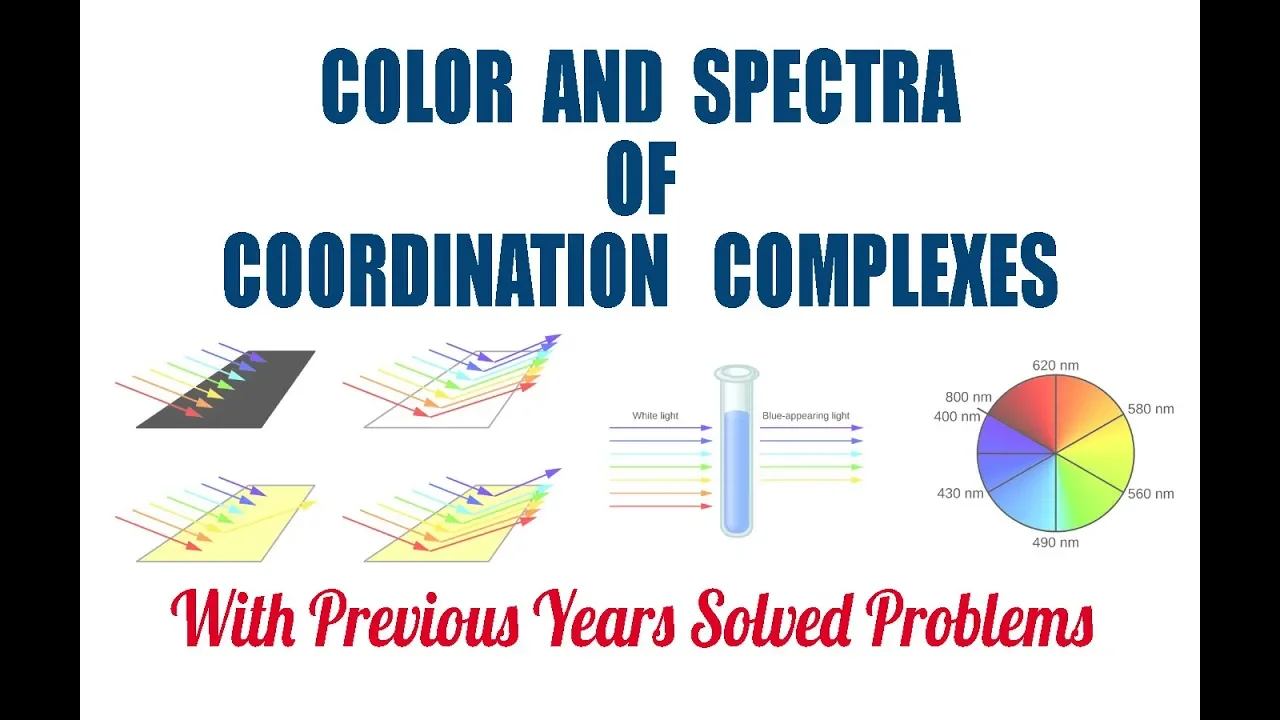
Analyzing the magnetic properties and electronic spectra (color absorption) of coordination complexes based on d-orbital splitting.
Investigating the thermodynamic stability and kinetic labilities of complexes, including formation constants ($K_f$).
Applying coordination chemistry concepts to real-world biological systems (like hemoglobin and chlorophyll) and industrial catalysis.
108.9K views1.5Klikes11:02Original Release: 2017-08-16
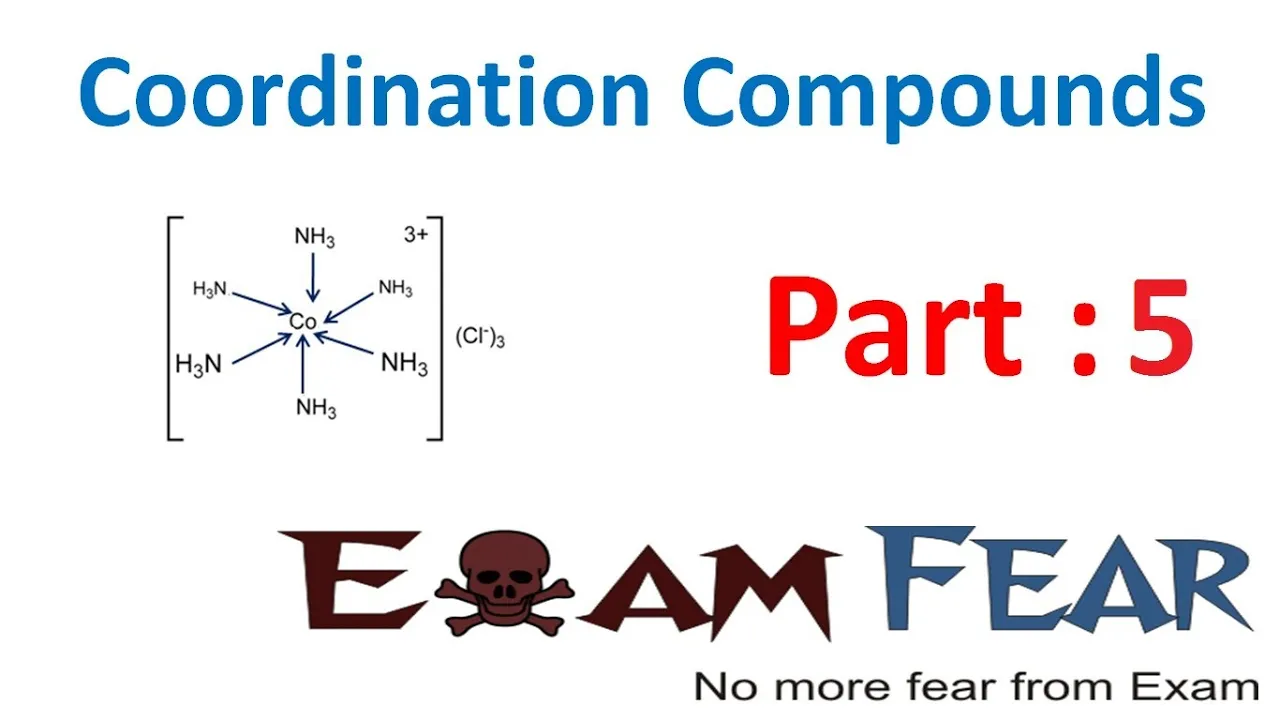
coordination chemistry is all about nomenclature or naming compounds and really that's all you need to know for coordination chemistry but first things first what is the coordination compound basically it's a compound in which you have these neutral molecules or anions they can be either/or and they're attached to a central atom via a unique set of bonds called coordinate covalent bonds now there are some terms you need to know so the first is ligand all right and so these neutral molecules or ini ons are called ligands or ligands alright and they're attached to the central atom which is always going to be a transition metal so I'm going to call it TM for short the bonds that connect them are called coordinate covalent bonds which are different from regular covalent bonds regular covalent bonds have each of the two atoms contributing an electron to the bond whereas a in a coordinate covalent bond it's the ligand that supplies the electron so Ligon supplies both electrons to create the bond so an example of a coordination compound is shown here and so the central elements here is cobalt it's a transition metal so this is your TM your central atom and then all these guys around it are your ligands and so here there are a total of six ligands so it creates this sort of octahedral shape and you over the overall charge of the coordination compound is +3 all right so like that VSEPR theory I would have to say that there's a lot of memorization for coordination chemistry and I think the best way to do this is flashcards so on the left hand side here you see the formula and on the right you see the name this is something you have to memorize you won't be given this on an exam notice that some of these ligands are neutral so these first guys are neutral and then when you hit some of these halogens they have a minus 1 charge and then all these guys a lot of them are polyatomic ions they have negative charges of either minus 1 or minus 2 I would say that the easiest way to learn coordination chemistry is just to practice and do problems at first you should have these tables in front of you I would say after a while you should try to do these problems without the tables all right so let's go from chemical formula to name which i think is actually a bit easier than the rivers so we're going to start with a formula and we're going to give it its name so going to start with nickel and we have the CN for them and the overall charge is to minus so the easiest way to go about this is to start with what's in the brackets here in some of using this first example there's only one guy in the brackets here in Part C we have something in brackets as well something outside of brackets start with what's in the brackets what's in brackets represents the coordination compound so this is your coordination compound and you can probably already guess which one is going to be the ligand in which one is going to be the middle right the middle of the nickel when we name coordination compounds we start with the ligand so this CN is called a cyano group I afford them so I call that tetra cyano and then I write my nickel right so because the overall charge of this is a minus 2 it's an anion and so whenever it's an anion you write it at the end so instead of just writing nickel I write tetris I know nickel eight I'm not done because I need to actually specify the charge of my nickel and I can figure that out fairly easily because I know that cyano has a minus charge of one minus one charge I have four of them so the cyano is minus four four before them into in order to make it this entire thing in brackets have a total charge of minus two my nickel needs to have a charge of plus two right because a positive 2 minus 4 is a negative 2 and so I write in bracket in these parentheses Roman numeral 2 right and so I can do the same thing for B so right start with the ligands which are in this parenthesis and I always name in alphabetical order right so the Oh H is a hydroxyl group voh 2 in other words in h2o is an aqua group and I write that first I have five of them so I write Penta aqua and then I write hydroxyl because H become comes after it so I write a head drop so next I just have one of them and then I go ahead and write nickel so here the overall charge is not a negative instead it's a positive and so what I'm going to write is nickel I'm not going to need the eight I'm just going to write nickel I'm going to save room for the charge and then ion so whenever it's the overall positive charge you just write ion at the end and now we have to figure out what charge the nickel has right so hydroxo has a charge of minus one right this is something you get from the table water is neutral aqua is neutral and so in order to make this overall coordination compound having a charge of 2 plus the nickel needs to have a charge of 3 plus and so then I write nickel 3 I write and then this last example okay so we start with what's in the parenthesis that's inside the brackets that's the coordination compound I name things in alphabetical order so here I have a choral group I have an amine and I have an aqua and in comes first so I'm going to write die and means that two of them I have one aqua so I write aqua and then I write tricor o because I have three of those guys and then chromium and then now I have to figure out the charge of chromium right and so notice one thing here is that I have a chlorine after right before I had actually charges and nothing attached here I have a chlorine and the chlorine is going to be an anion remember it's one of the halogens it has a minus one charge whatever it's an anion I instead of writing chlorine alright chloride right what that tells me is that the overall charge of what's in the brackets has to be plus one because I know that the chlorine has an overall minus one charge and overall this thing is neutral right and so I can figure out its is a total charge of plus one I can figure out the charge of chromium right chlorine is minus three because each one is minus one and a have three of them a mean is neutral and so is water right and so if my overall charge is plus one what charge is chromium app top it has to have a charge of plus four and so I read chromium for chloride and here I don't need an ion Athens of the word ion after chromium because I have the quarry the chloride after that so the second way that you'll be asked these types of questions is to be given the chemical name and write the formula right so I think this is a slightly more tricky but it's the same logic right so we'll start with diamine dye aqua dye bromo nickel three ion so I start by writing out my brackets I know that my coordination compound is what I write first the the transition metal is what I write first so I write a nickel and then I write my ligands in parenthesis and so the first one is I mean I have two of them so mu n is nh3 and I have to written I have two aquas so that's h2o and then I also have two bromine so I'm going to write B are two the last thing after figure out is what the overall charge of this coordination compound is so I know that nickel is plus three I know that nh3 amine is neutral aqua is also neutral but bromine is minus one and apt two of them so it's minus two right so if 3 positive 3 minus 2 is going to get me a positive one charge and so that's the coordination compound as well as its charge right we can do the same thing for Part B so trace oxalate cobalt 8 3 so we'll start with our brackets and our transition metal which is cobalt and then here are only legen is oxalate which is you can either write as Oh X or you can also write it as C 204 again something you should memorize and I have three of them Triss so here it you would say try but because there's a value-add the best or triste oxalate and i have three of them and i know that the overall charge of CTO for oxalate is - - I have three of them so that's minus six and then my cobalt has a charge of plus three because when Roman numeral is three and so my overall charge of this guy is going to be minus three and that's why the eight is here because my overall charge is negative and it's a anion okay so the last example diamine dye aqua ethylene diamine chromium - bromide so we're going to start with our brackets as always our transition metal is chromium so I'm going to write chromium here and then I'm going to write in my ligands right so the first one is nh3 I mean I have two of them I also have two waters so I'm going to write H 2 O 2 and then I have ethylene diamine right so you can actually just abbreviate ethylene diamine as en you don't have to write the entire structure that you saw on the table ok so then I want to figure out the overall charge of this guy so NH 3 is neutral h2o is also neutral and actually en ethylene diamine is also a neutral my chromium has a +2 charge and so the overall charge of this guy is going to be +2 it's attached to a bromine but remember that each bromine only has a minus 1 charge so in order to make this entire thing neutral I need to have two bromine and so my final answer is the following really in your final answer you don't need these guys right these numbers right here that I drew that's just to help you with your work your final answer you would write this the reason you have two bromine is to cancel out the two plus charge from the coordination call
Up Next
19:24
Ligands, Denticity & Chelating Agents | Coordination Compounds
@LearnoHubClass1112
84.1K views•2014-06-09
83:56
Biocatalysis and Catalysis in Islatravir Synthesis | Merck Webinar
@SCIwheresciencemeetsbusiness
675 views•2020-10-08
10:06
1H NMR: Determining Number of Peaks from Structure
@MSJChem
59.2K views•2017-04-06

17:31
Edible Water Bottles: A DIY Guide to Sodium Alginate Spherification
@ryan
10.5M views•2019-06-21
Related Study Plans & Knowledge Roadmaps
Structured learning paths in Chemistry
chemistry
Nuclear Chemistry: Decay, Meds & Fuel Cycle
01Introduction to Nuclear Structure and Radioactivity
02Decay Dynamics and Kinetics
03Radiation Interaction and Detection
+ 2 more learning modules
24h5 modules
Explore Roadmap
chemistry
Supramolecular Chemistry: Forces & Machines
01Foundations of Chemical Bonding and Intermolecular Forces
02Introduction to Host-Guest Chemistry
03Thermodynamics and Dynamics of Self-Assembly
+ 2 more learning modules
16h5 modules
Explore Roadmap
chemistry
Photochemistry: Excited States & Reactions
01Foundations of Light-Matter Interactions
02Molecular Orbitals and Electronic States
03Photophysical Processes and Jablonski Diagrams
+ 2 more learning modules
18h5 modules
Explore Roadmap
chemistry
Coordination Chemistry: Bonding & Properties
01Introduction to Transition Metals and Ligands
02Crystal Field Theory (CFT) and Geometry
03Magnetic Behavior and Spin States
+ 2 more learning modules
14h5 modules
Explore Roadmap