


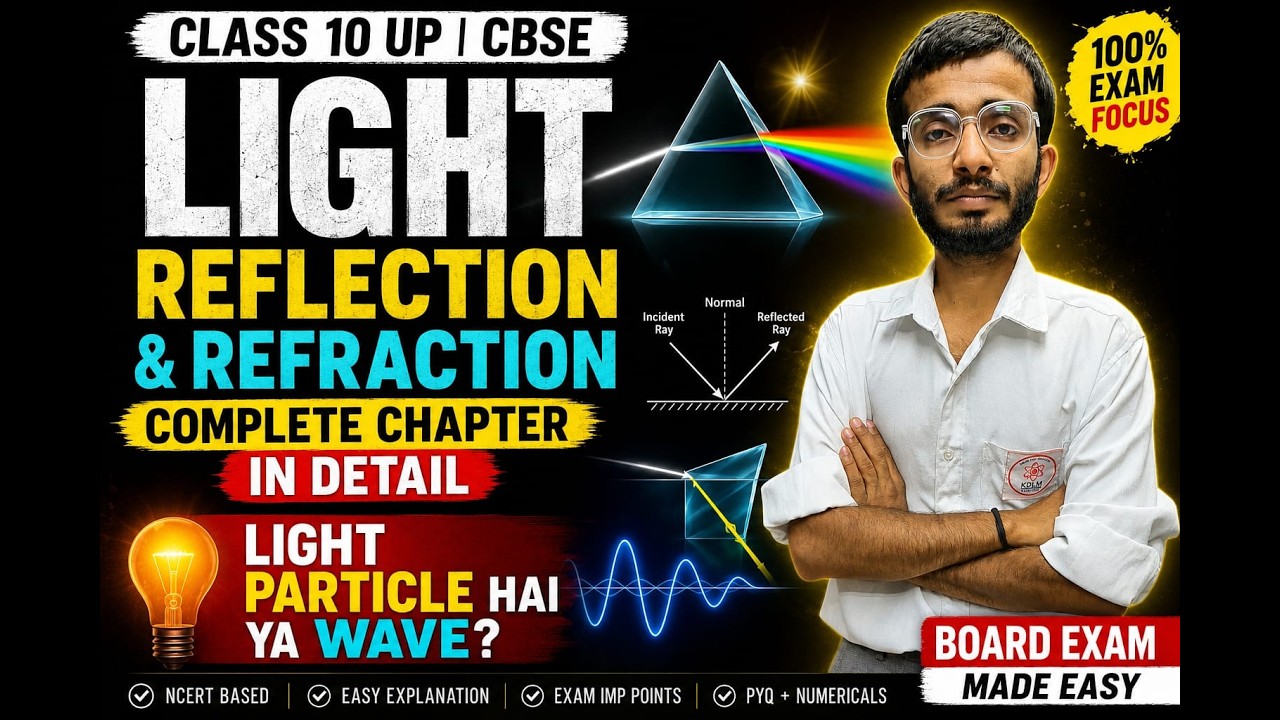














This video covers essential concepts in ray optics including the law of reflection (angle of incidence equals angle of reflection), refraction of light when passing between media, refractive index as the ratio of light speed in vacuum to speed in a medium, and total internal reflection occurring when light travels from denser to rarer medium at angles greater than the critical angle. The video derives the lens formula (1/v - 1/u = 1/f), magnification formula (m = v/u), and lens maker's formula (1/f = (n2-n1)/n1 × (1/R1 - 1/R2)). It also explains the combination of lenses formula (1/F = 1/f1 + 1/f2), prism deviation, and minimum deviation conditions, along with applications in microscopes and telescopes.
Plus Two Physics: Ray Optics & Optical Instruments Revision
Added:Basic laws of reflection and refraction of light, typically learned in secondary school science.
Fundamental geometric concepts, particularly trigonometry, angle relationships, and properties of triangles.
The concept of refractive index and how light changes speed and direction when transitioning between different media.
Familiarity with the Cartesian sign convention used for coordinate geometry in optics.
Wave Optics (Physical Optics), exploring wave fronts, Huygens' principle, interference, diffraction, and polarization.
The Dual Nature of Radiation and Matter, focusing on the wave-particle duality of light and the photoelectric effect.
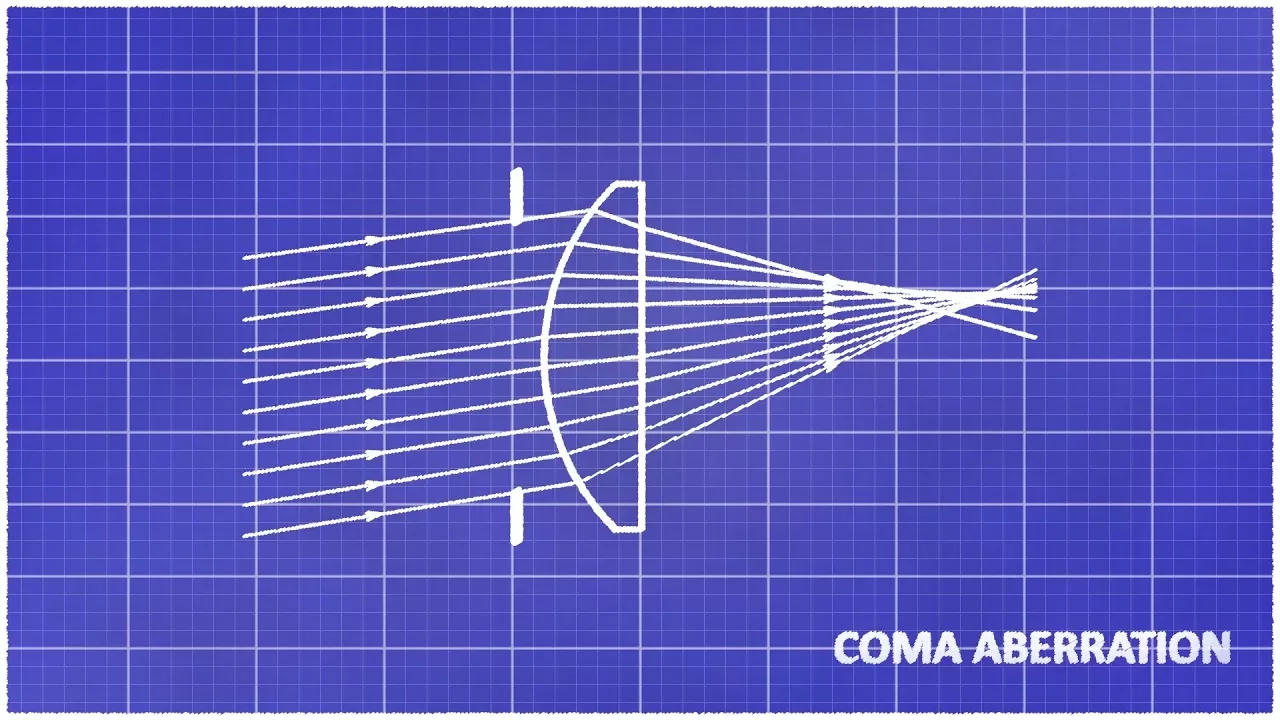
Advanced study of optical engineering, including lens aberrations and the design of complex multi-lens systems.
The principles and applications of fiber optics in modern high-speed telecommunication networks.
268K views13.5Klikes2:27:20Original Release: 2023-03-11
questions [Music] [Applause] [Music] good morning all hello foreign foreign apples so organically screenshots I am not nitin right so inside okay okay 500k celebrations okay all right confidence happiness is everything right yes foreign it is foreign foreign [Music] [Applause] all right foreign foreign [Applause] foreign unboxing yes yes yes yes important crystal clear Ultra enormous angle of Reflections according to loss of reflection angle of incidence will be equal to angle of reflections foreign okay foreign thank you two Theta is very very small honor So Tan 2 Theta is approximately equivalent clearly a trigonometric functions NP divided by yes foreign clearly okay 2f r equal to 2 f Crystal clearly crystal clear from there initiations right yes foreign foreign object foreign it is foreign foreign ready okay okay ready is p are similar are similar triangle is random similar triangles sides are in same ratio same ratios okay foreign foreign right Opie Nissan set equation number one equation number one clearly questions so triangle I I Dash f and n f p are similar so in the example so sides are in same ratio said yeah is come on come on guys foreign foreign come on guys foreign FP i f divided by yes equating okay equating equation 1 and 3. equations foreign foreign yes yes yes yes you are so divided by minus U negative signs minus of V minus so minus equation number four five minus F by f V by U equal to V by F minus one equal to 1 by f all right set up ready ready yes yes image divided by height of the object divided by height of the object height of the image divided by the height of the object height of the image equations foreign foreign foreign foreign minus V by U and the way down minus V by clearly right yes different so overall equations okay [Music] magnified foreign foreign yes yes yes yes yes yes yes yes yes yes yes yes refraction of light and download fractions from one medium to another medium the bending your flight take place this bending is called a refractions foreign refractive index is the ratio of speed of light in a free space to Freedom speed of light in a particular medium um foreign Indiana yes yes clearly right foreign angle of refractions foreign yes okay clear clear clearly total internal Reflections formula combination of lenses light foreign security foreign here the angle of incidence refractory random media the name separation is angle of incidence foreign if I increase the angle of incidence above the critical angle the light table the light will comes to the same medium or reflected back to the same medium reflected total internal Reflections okay right yes on the light rays should travel from denser mediums should travel from denser medium to Prior medium clearly clearly right the angle of incident should be greater than critical angle angle of incidence foreign foreign then one okay clear fine put a particular angle of incidence sine I divided by sine R equation sine I divided by sine now equation is come on yes yes yes yes yes yes so it is equal to 90 degree it is [Music] marijuana is foreign sine c equal to 1 by n so n equal to 1 divided by sine C critical angles applications ready ready what is right yes yes yes yes yes yes yes yes devices foreign foreign foreign foreign foreign foreign [Applause] information is foreign foreign better Market s foreign [Applause] yes yes yes yes yes yes yes yes yes right now bye so yeah very small very small numbers right yes yes yes yes next one is foreign next triangle NCI triangle n c I normally beta is so exterior angle equal to sum of the Interior opposite interior angles so beta equal to R plus gamma is equal to R plus gamma beta equal to R plus gamma so R equals beta minus gamma equation number three number two minutes right yes so substituting equation 2 and 3 in equation 1.
substituting 2 and 3 in equation 1 random movement equations minus gamma clearly into Alpha plus beta equal to N2 into beta minus okay set foreign foreign clear set clear crystal clear all right by PC seriously so beta equal to NP divided by P C equation number six beta equal to NP divided by PC equation number six clearly clearly yes next one similar way tan gamma equals equation number sir equation number seven crystal clear it is substituting substituting equation 5 6 and 7.
in equation 4.
n 1 into um is foreign foreign minus minus n 1 by uh plus n 1 by r equal to N2 by r minus N2 by B clearly is okay confidence sense afternoon yes I can subscribe lens May goes forward speakers for eign foreign foreign clearly clearly right right right anyways [Applause] yes yes you don't worry guys yes sovereign I don't know foreign foreign foreign number one clear equation number one clear crystal clearly yes applying the curved surface formula on Surface 2.
curved surface we are going to apply the curved surface formula on equation number two equations foreign foreign minus foreign right right right right right okay equation one plus equation two random equation best Plus paste equal to next station copy paste Plus okra minus n 1 by U minus n 1 by U equal to divided by R2 plus minus I minus M2 minus 1 by V minus 1 by U equals so 1 by R 1 minus 1 by R2 clearly one by V minus 1 by U equal to N2 minus n 1 divided by N1 into 1 Pi R1 minus 1 by r clear degrees yeah yes yes okay ready okay ready ready lenses better decision right okay foreign okay when the object is at Infinity object Infinity object Infinity learning is F equal to n 2 minus n 1 divided by n 1 into 1 by R1 minus 1 by R2 1 by R 1 minus 1 by R 2 anything else foreign foreign objectives thank you foreign clearly clearly clear lenses foreign foreign so combination okay objectives [Music] foreign foreign Parada yes yes yes yes yes yes yes yes MBP hearing this in the fourth time ready ready ready so first lens um foreign Adam you are the objectives minus one by U equal to my one by F in a second replace him Soviet yes yes just go right just sit equal to one by f 1 plus 1 1 by f 1 plus 1 by F2 is 1 by V minus 1 by U equal to 1 by f 1 plus 1 by F 2.1 by B minus F2 foreign important language foreign put somebody up hello guys thank you foreign foreign fine foreign yes a b c is okay okay foreign foreign foreign foreign [Applause] I don't know angle of incidence angle of refractions foreign right or the angle of angle of refraction second phase of angle of refraction that would become I2 I2 is yes yes yes yes yes so it is an imaginary concept okay ready minutes foreign yes yes yes yes angle of deviation angle of deviation yeah right yes I one minus R1 i1 minus r seriously I 1 minus R1 I2 minus R2 I2 minus r clearly foreign foreign angle a plus angle Cube plus angle n plus angle r equal to 360 degrees normal song 180 degrees foreign but yes yes yes triangle q n r triangle qnr and the ultra angle q a yeah so angle n plus angle R1 plus R2 comparator is equations yes all right yes foreign I 2 minus R2 Plus I 2 minus R2 clearly is R1 plus R2 minus R1 plus R2 so Delta equal to R1 plus R1 plus replaces yeah sorry i1 plus I2 minus angle a angry i1 plus I2 equal to in the volume Delta plus angle equation number three three non equation number three I one plus I 2 equal to Delta plus angle clearly is foreign angle of incidence at the minimum deviation foreign [Applause] foreign equation yes clearly B plus angle a by two I wonder what m d plus angle a by two a plus d by two clearly a plus b by two a plus d by 2 okay next one next one even if it is a byte numbers right confidence yes set foreign clearly foreign simple micro foreign 1 by U B into one by your number one by F equal to 1 by V minus 1 by U1 by U equals 1 by V minus 1 by f 1 by F equal to 1 by V minus one by U1 angle one by U equal to 1 by V minus one by Flex 1 by V minus 1 by F on the way multiplayer so B by V minus 1 by sorry minus B by f V by f clearly V by B minus yes d by f image formula is foreign if you objective foreign is foreign foreign yes never look telescope foreign refinery foreign Alpha tan Alpha is equal to foreign second expensive foreign okay otherwise derivations love you foreign
Up Next

108:40
Wave Optics Class 12 Physics | NCERT Full Chapter for NEET
@bestforneet
334.2K views•2017-11-13

4:32
How Tuned Mass Dampers Stop Structures from Shaking
@MinutePhysics
573K views•2018-08-28

32:32
NMR Spin Physics I: Zeeman Effect, Resonance Condition & Larmor Frequency
@nptel-indianinstituteofsci8064
2.3K views•2024-01-17

33:44
The Blue LED: A Decade-Long Scientific Challenge Explained
@veritasium
46.5M views•2024-02-08
Related Study Plans & Knowledge Roadmaps
Structured learning paths in Physics
physics
Medical Physics: Imaging, MRI & Radiotherapy
01Foundations of Radiation and Matter Interaction
02X-Ray Imaging and Computed Tomography (CT)
03Magnetic Resonance Imaging (MRI) Physics
+ 3 more learning modules
15h6 modules
Explore Roadmap
physics
Nuclear Physics (Decay, Fission & Reactors)
01Atomic Structure and the Binding Force
02Radioactive Decay and Half-Life
03Nuclear Fission Mechanics and Chain Reactions
+ 2 more learning modules
12h5 modules
Explore Roadmap
physics
Soft Matter (Polymers, Colloids & Rheology)
01Foundations of Soft Matter & Thermal Forces
02Polymer Physics and Macromolecules
03Colloids, Surfactants, and Self-Assembly
+ 2 more learning modules
38h5 modules
Explore Roadmap
physics
Analytical Mechanics: Lagrangian & Hamiltonian
01Mathematical Foundations: Calculus of Variations
02From Newtonian Mechanics to Constraint Dynamics
03The Principle of Least Action & Lagrangian Mechanics
+ 3 more learning modules
28h6 modules
Explore Roadmap