









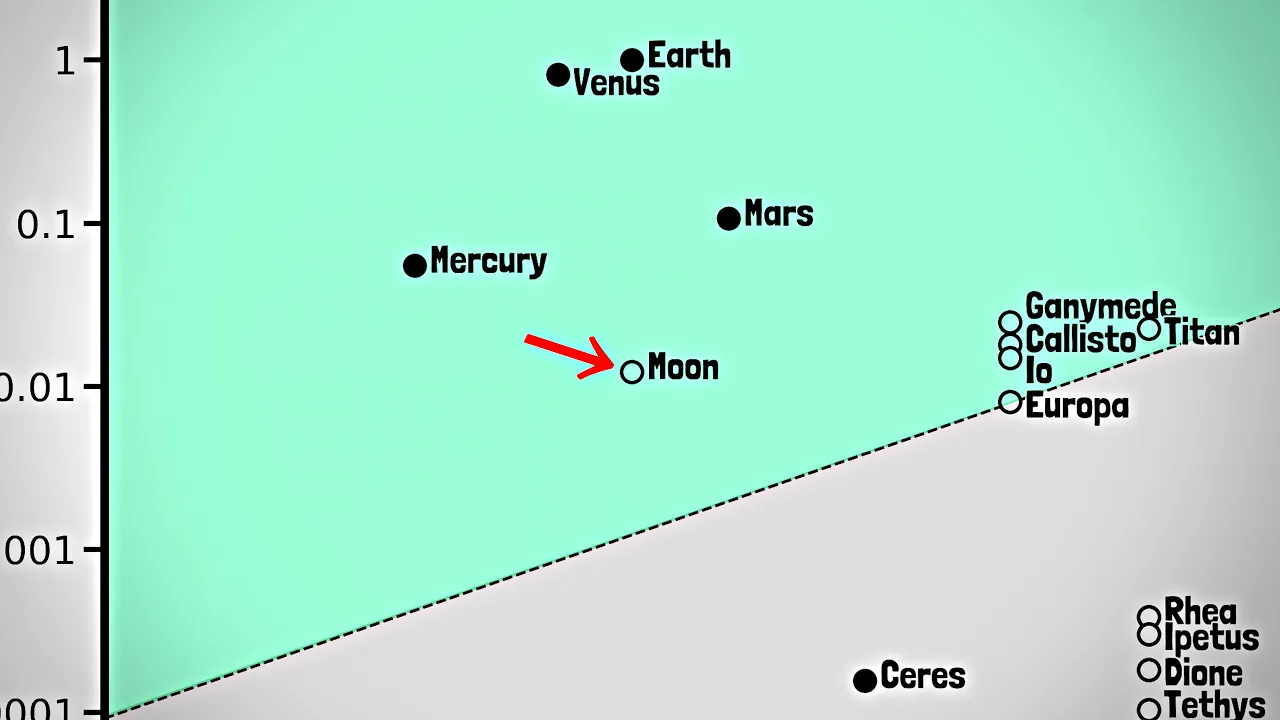





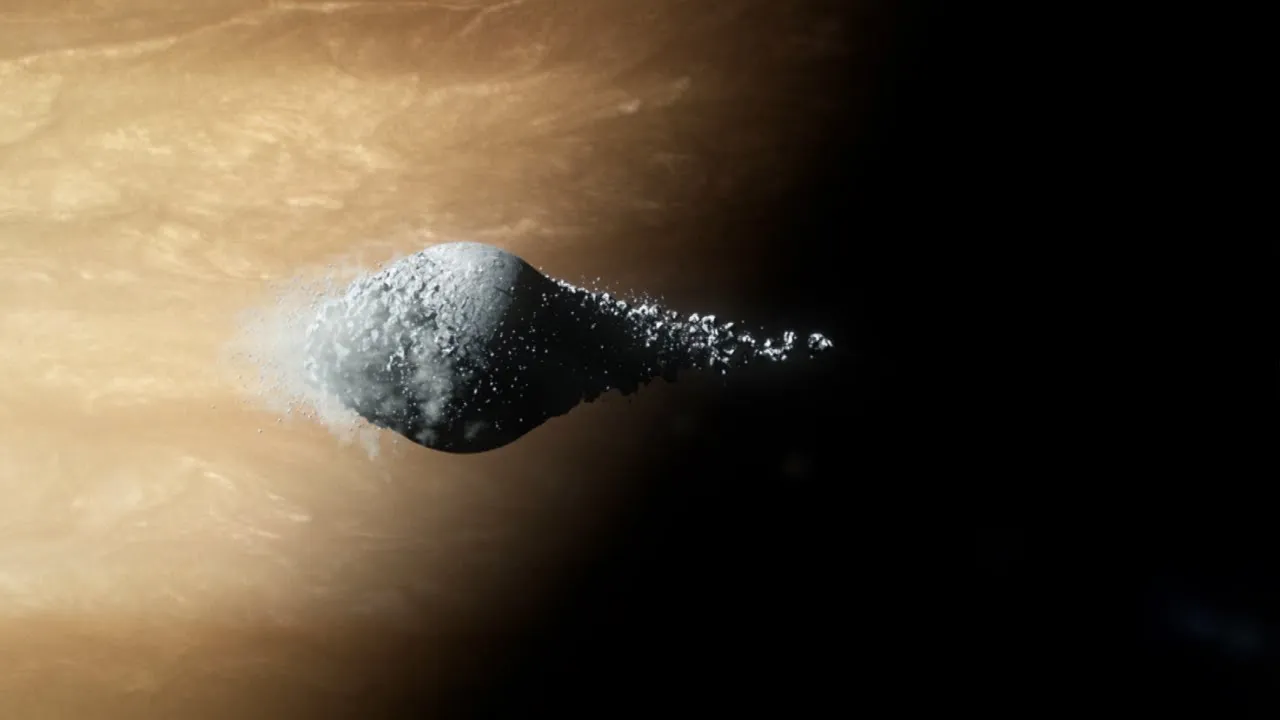






The Roche Limit is the minimum distance at which a smaller celestial body (like a moon) will be tidally torn apart by the gravitational forces of a larger body (like a planet); it is derived by balancing the tidal force from the planet against the self-gravity of the satellite, yielding the formula d = 2.44 × R × (ρ_planet/ρ_satellite)^(1/3), where R is the planet's radius and ρ represents density.
How to Derive the Roche Limit: A Step-by-Step Physics Guide
Added:Newton's Law of Universal Gravitation and the mathematical formulation of gravitational attraction.
The concept of tidal forces, specifically how differential gravity affects extended celestial bodies.
Basic rotational mechanics, including centripetal force and analyzing systems in a rotating reference frame.
The concept of self-gravity and how a celestial body's own gravity holds its mass together.
The mathematical and physical differences between the rigid Roche limit and the fluid Roche limit.
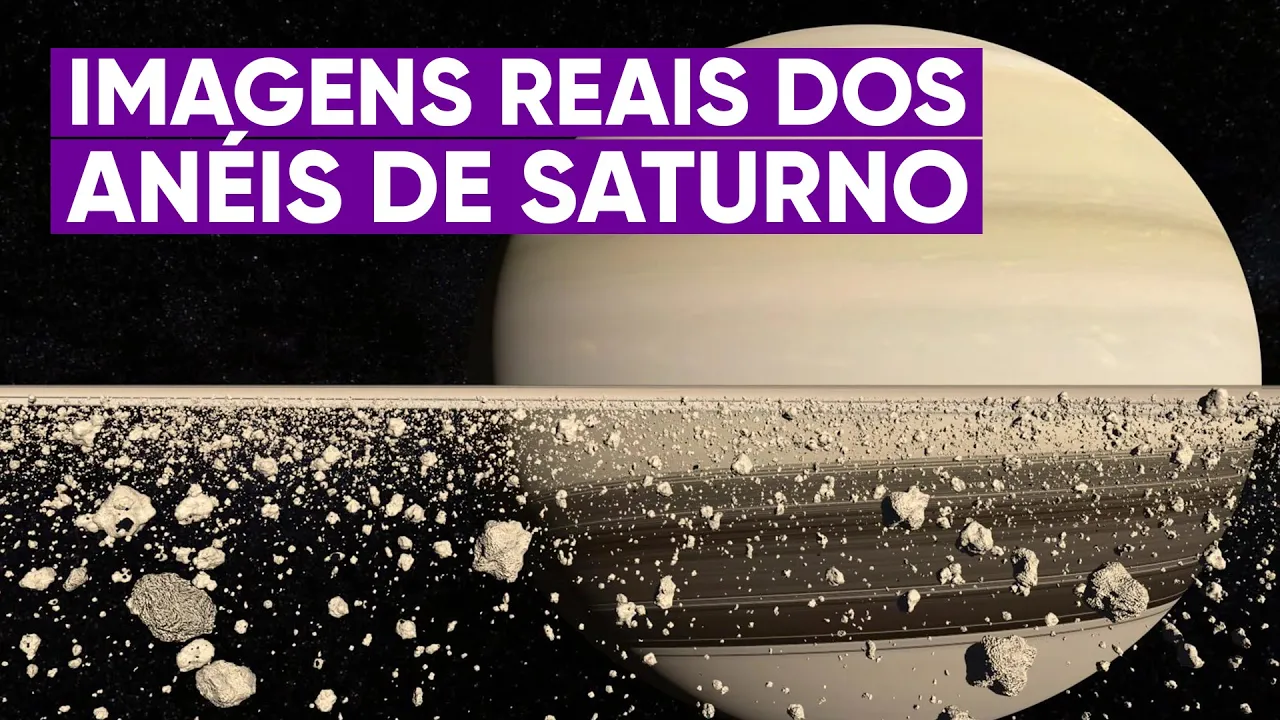
How the Roche limit explains the formation and structure of planetary rings, such as those around Saturn.
The concept of Roche Lobes and mass transfer in binary star systems, including Lagrangian points.
Extreme tidal phenomena, such as Tidal Disruption Events (TDEs) near supermassive black holes.
10.5K views261likes8:22Original Release: 2021-06-17
welcome to this video and in this video i want to have a look at deriving the roche limit so firstly let's define what the roche limit is so this is a limit where you have a smaller object like a moon and a larger object like a planet and at some distance between the two the satellite will be tidally pulled apart by the gravitational forces of the planet so it's no longer able to gravitationally hold itself together and the tides from that planet will pull it apart and there's a set distance that that will occur at depending on the relative densities of the two and the sizes involved and what we're going to have a look at is deriving an expression to find that distance but before we do that there's some pretty good examples in the solar system of where this occurs so comet shoemaker levy 9 impacted jupiter in 1994 now it was a comet which was uh pretty much a single object traveling through space when it got too close to saturn as it was approaching to impact it was tidally pulled apart into many pieces and then those individual pieces impact the jupiter but this is what happens when a smaller object gets close enough you know within that limit that is actually pulled apart and which is a pretty good example and another one is saturn's rings so the edge of saturn's rings pretty much sits at the roche limit for water ice and anything inside that limit it's not able to hold itself together for its own self-gravity so you can't have moons inside the rings if they're water ice and outside of the rings you're going to have moons so this limit is pretty much at the edge of the ring system so it's a good physical representation of that you can have a go at working out approximately where that is now if we had a different material like rock or something was a bit denser then that limit would be closer to the planet but for water ice it's kind of at the ring edge so before we go through the derivation and have a look at how we get there to find this distance there are a few versions and you can do it for a rigid satellite or a fluid satellite now you should note that the fluid version is approximately twice as well it would be located twice as far away than the rigid one and if you think about physically what's happening there a rigid satellite is able to support itself better than the fluid one so the fluid one would be entirely distorted before the more rigid one so that's why you've got a difference there but the one we're going to have a look at in this video is the rigid expression for the roche limit now in the in both of them there's three variables really the first one is the density of the larger object the density of the planet you then have the density of the smaller object the satellite or the moon and then you have the radius of the larger object which is the planet in this case so let's start off with a planet and a moon so we've got this larger object which is the planet and then the smaller object which is your satellite full moon and they have a mass of capital m and a massive lower case m and they are separated by some distance and what we need to do is consider the gravitational force is acting on some object u located on the surface of the satellite and we need to balance some forces to work out where d they become unbalanced and it's essentially poured from the surface so acting on you you've got a tidal force from the larger object from the planet and this tidal force is basically the the difference of the gravitational force acting on you from the planet at the surface and from the center so the difference in gravitational force between the center and the surface is our tidal force we then have this gravitational force acting um from the smaller object so this is from the actual moon itself this is the gravitational force pulling it down in the opposite direction you got these two forces balancing what each other at so there we go we actually put the equations for both of those there so we've got the tidal force on the left and then we've got the gravitational force on the right now since at the roche limit both of these forces are equal so they're balanced when they're at the roach limit if it goes within it then the tidal force is going to win and if they're outside of it then the gravitational force is going to be greater but at the limit they're equal so we can basically equate these two to one another and what we can do there is we can start to rearrange it so we can get an expression for d so to start off with we can divide through by g u r and what that will do is it removes the gravitational constant it will remove u and we remove r from the left hand side you can do this a few different ways but this is one way to do it we can then multiply through by d cubed and what that does is it removes the d cubed underneath the 2m on the left hand side and we move it on to the right now if we then divide through by the mass of the satellite again we can remove it from the right hand side and then we end up with it being divided with dividing the 2m on the other side now we will multiply through by the radius of the satellite cubed that removes our r cubed from the right hand side and leaves us just with the rotation of it cubed then we can flip it around actually and take the cube root of both sides and then we have an expression for the rotal of it now that final expression there was not necessarily the final one but it's got the radius of the satellite in there the mass of the planet and the mass of the satellite but we don't want the mass also the radius of the satellite in this expression we want to exchange it for the radius of the planet instead so we don't want that satellite radius in there so what we can do to do that is we can rewrite the mass in terms of density and radius for both of the planet and the satellite and then we get these expressions because we know how mass density and radius or what together we're assuming that these are spheres we can go back to our expression we had before now the 4 pi over 3 cancels out straight away because it's top and bottom and we just left with the density times the radius cubed of both the planet and the satellite now we can bring the both the radiuses cubed over one another outside of the brackets and what that will do is it removes the radius of the satellite and we're just left with the radius of the planet instead and then one final thing we can actually do there is we can just approximate it i'll bring in the two out and we're left with this approximation here and this is our final roach limit for a rigid satellite and you can have a go at calculating certain limits for the planets in our solar system and you can have a go with saturn and see where you get this limit is compared to the actual ring systems that we know where they are see how close you can actually get so thank you for watching and if you enjoyed the video then check out some of the other ones
Up Next

10:01
Why Earth Has No Rings: The Roche Limit Explained
@ScienceAsylum
97.3K views•2023-06-12
61:17
First Billion Years of the Universe with the Square Kilometre Array
@iaaudc
121 views•2022-05-26

6:25
Kepler's Laws of Planetary Motion Explained (Educational Astronomy Video)
@Peekaboo_Kidz
404.9K views•2023-02-17

6:10
Gamma-Ray Bursts: Cosmic Snipers Explained | Astronomy
@kurzgesagt
15M views•2016-07-31
Related Study Plans & Knowledge Roadmaps
Structured learning paths in Astronomy
astronomy
Reionization: Pop III Stars, IGM & 21cm Line
01Foundations of Cosmology & the Early Universe
02Population III Stars & Cosmic Dawn
03Physical Mechanisms of Reionization
+ 2 more learning modules
17h5 modules
Explore Roadmap
astronomy
Planetary Rings: Dynamics, Roche & Resonances
01Foundations of Gravity and Orbital Mechanics
02Tidal Forces and the Roche Limit
03Structure, Composition, and Collisions
+ 2 more learning modules
10h5 modules
Explore Roadmap
astronomy
Asteroseismology: Stellar Waves, Ages & Cores
01Foundations of Stellar Astrophysics & Wave Mechanics
02Stellar Oscillation Modes: P-modes and G-modes
03Mathematical Framework of Asteroseismology
+ 2 more learning modules
35h5 modules
Explore Roadmap
astronomy
Adaptive Optics: Physics, Engineering & Control
01Foundations of Wave Optics and Wavefronts
02Atmospheric Turbulence & Optical Distortion
03Wavefront Sensing Technologies
+ 3 more learning modules
35h6 modules
Explore Roadmap