Agreement verbs in American Sign Language are directional verbs whose meaning changes based on the direction of the sign, indicating the subject and object relationship; examples include 'tell' (I told you, you told me), 'call' (I called you, you called me), 'send' (I send to you, you send to me), 'inform' (I inform you, you inform me), and 'pay' (I pay you, you pay me), where the signer points to different recipients to indicate who is performing the action on whom.
ASL Agreement Verbs | Signing Naturally Unit 8.3 Guide
Added:Deep Dive
Understanding the five parameters of ASL (handshape, location, movement, orientation, and non-manual signals) to properly execute signs.
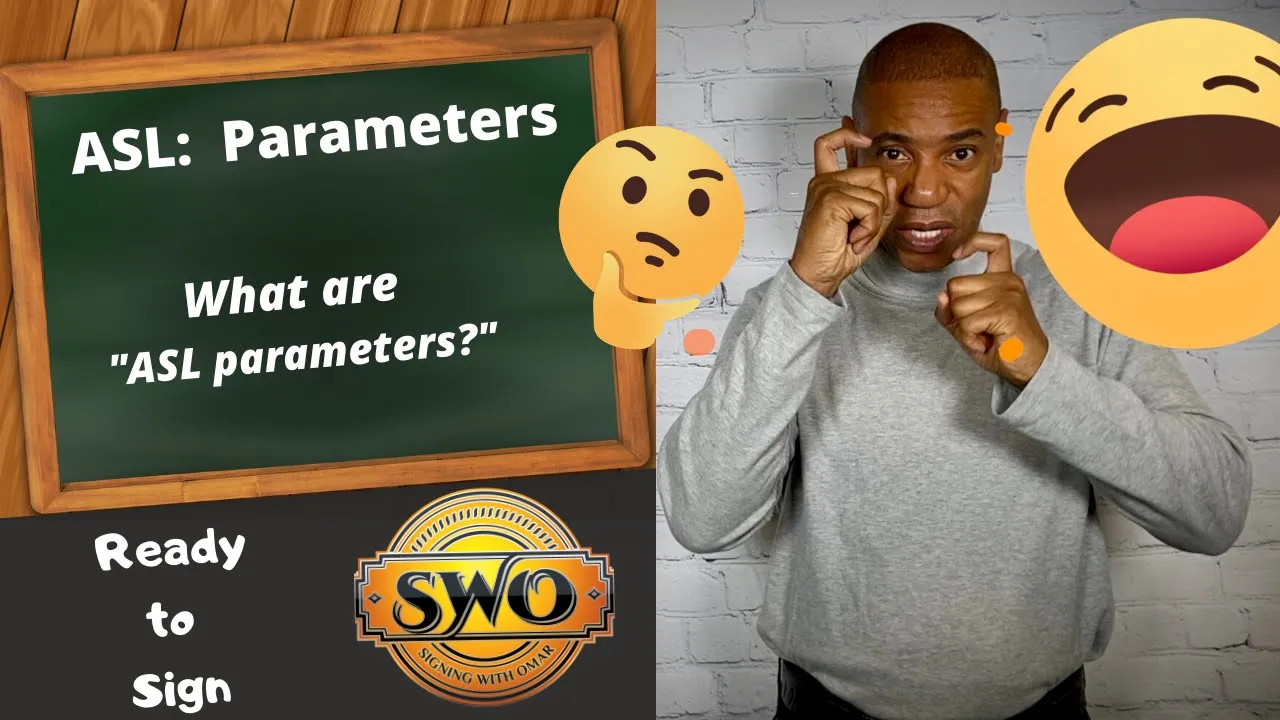
Why You Need to Know "ASL Parameters": IMPORTANT! | Signing for Beginners | American Sign Language
20.4K
American Sign Language (ASL) is a visual language governed by five essential parameters: handshape (the physical configuration of the hand), location (where the sign is performed on the body), palm orientation (the direction the palm faces), movement/motion (how the hand moves), and facial expressions/non-manual markers (facial cues that modify meaning). These parameters work together to create distinct signs; changing any single parameter while keeping others constant produces a different sign. For example, the signs for 'insurance,' 'infection,' and 'emergency' share identical movement and location but differ in handshape; similarly, 'mother' and 'father' use the same handshape and movement but different locations. Understanding these five parameters is fundamental to learning and mastering ASL as a complete linguistic system.
Click to watch →
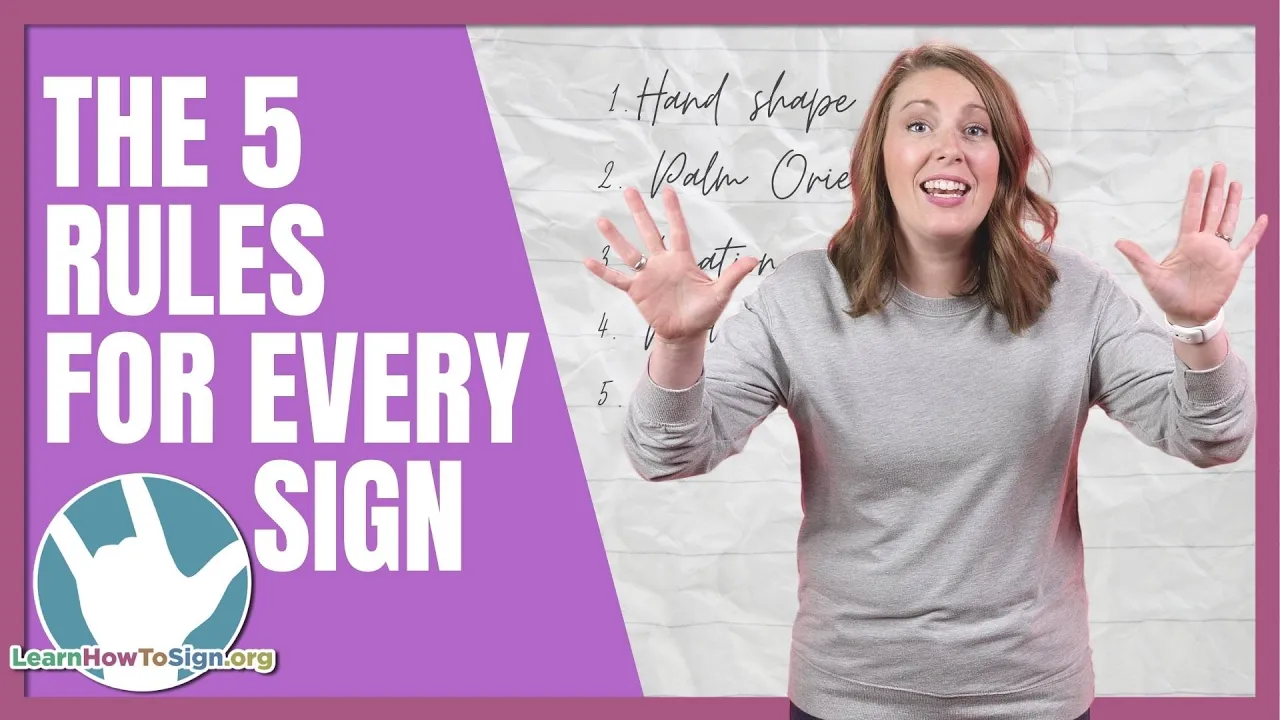
The 5 Rules for EVERY Sign in ASL | 5 Parameters of Sign
63.4K
American Sign Language signs are composed of five essential parameters: hand shape (the physical configuration of the hand), palm orientation (the direction the palm faces), location (where the hands are positioned relative to the body), movement (how the hands move during the sign), and non-manual signals (facial expressions and body language). Understanding and correctly applying all five parameters together is crucial for accurate sign production and comprehension.
Click to watch →

ASL Series: Classifiers for Beginners
271
ASL sign production follows five essential parameters that apply to every aspect of signing, including numbers, time, age, finger spelling, lexicon, space, size description, and directions. These five parameters are: (1) Hand shape - the physical configuration of the hand; (2) Movement - how the hand moves through space; (3) Location - where on the face, body, or in space the sign occurs; (4) Palm orientation - the direction the palm faces; and (5) Non-manual signs - lip movements and facial features that coordinate with signs to create complete and clear sign production.
Click to watch →
![[AO VIVO] BANCA DO CAS MG: COMO SE PREPARAR? DICAS E DETALHES - FELIPE SABARÁ](https://i.ytimg.com/vi/Qow5gBDjIp4/hqdefault.jpg?v=59bf18e0)
[AO VIVO] BANCA DO CAS MG: COMO SE PREPARAR? DICAS E DETALHES - FELIPE SABARÁ
39.5K
The five parameters of sign language are: 1) Movement, 2) Point of Articulation, 3) Handshape, 4) Facial Expression, and 5) Non-manual markers. This is a fundamental question that may appear in the CASS exam and requires memorization.
Click to watch →

CORSO di LIS PER PRINCIPIANTI | I CINQUE PARAMETRI | Da cosa è formato un segno? | la_LISegnante
3.7K
Sign language is defined by five key parameters that distinguish each sign. First, hand orientation refers to whether the palm or back of the hand faces the viewer. Second, movement describes how signs move—directional, circular, or alternating. Third, articulation location indicates where signs are produced: on the body, near the body, or in neutral space. Fourth, hand configuration is the shape the hand assumes, often corresponding to letters or numbers. Fifth, non-manual components include facial expressions and body movements that add meaning. Together, these parameters create a complete system for understanding and producing signs.
Click to watch →
Deep Dive
The concept of indexing and establishing referents (pronouns) in the physical signing space.

Morphology of Sign Language
415
Localization introduces references to discourse, with subsequent indices to the local locus referring to the same referent. Indexation to the signer and addressee functions as first and second person pronouns respectively. Indexation to ipsilateral or contralateral referents is analyzed as third person, using G or V handshapes for singular, padule for dual, and arc/G/B for plural. Pre-nominal indexation functions as demonstrative (e.g., 'this book'). This system provides multiple strategies for referring to participants in discourse, distinguishing between self-reference, addressee-reference, and third-party references with varying grammatical marking.
Click to watch →

Kuliah DKV 1 - Bahasa Gambar dan Persepsi Visual (Ikon, Indeks, Simbol, Gestalt)
781
An index is a sign that has a physical, existential, sequential, or causal relationship between the representamen and the object. The connection is concrete and actual rather than based on resemblance. Examples include smoke as an index of fire, dark clouds as an index of rain, footprints as an index of someone who walked there, and warning colors on poisonous animals (bright colors indicate danger). Indices can also be auditory, such as the sound of waves indicating the presence of the sea. In language, indexes appear through demonstrative words like 'ini' (this), 'itu' (that), 'sini' (here), and 'di situ' (there), which point to specific things or locations. Personal pronouns like 'aku' (I), 'saya' (I), 'kamu' (you), 'dia' (he/she), and 'mereka' (they) are also indexes because they point to specific people in the conversation.
Click to watch →
Syntax - Morphosyntax: Crash Course Linguistics #3
364.4K
Signed languages use spatial strategies to distinguish subjects and objects. In ASL, speakers establish referents in space and then sign verbs from the subject to the object. For example, signing 'I saw Gav' involves pointing to oneself, then pointing to Gav, then signing the verb 'see' from the self-point to the Gav-point. English retains traces of morphological strategies in phrases like 'I see them' or 'the employer hired the employee.'
Click to watch →

「カタ・クロック・コーパス:ろう者と聴者が共生するコミュニティーの手話を記録する」コニー・ドゥヴォス
440
This section covers fundamental concepts of person reference in sign languages. Across sign languages, anaphoric pointing in neutral signing space creates loci that acquire referential meaning through discourse. First and second person reference is marked by pointing at the signer's body versus the interlocutor's body, with Japanese Sign Language uniquely pointing to the nose. First person uses the B hand rather than the index finger. Loci are crucial for discourse coherence and can locate nouns, whole sentences, and indicate agreement between subjects and objects of transitive verbs. The section introduces the hypothesis that rural signing varieties may lack spatial verb inflection, a feature claimed as universal but absent in Bedouin, Katakulok, Inuit, and Adobe Robe Sign Languages.
Click to watch →

ESPAÇO MENTAL REAL, TOKEN E SUB ROGADO-EM LIBRAS, COM DIOGO SILVA
2.3K
The Token Space involves pointing to establish references to imaginary locations. It is fundamental for bringing imagery from text into the real signing space. The interpreter should avoid excessive pointing at the same location once established. When signing about multiple people or elements, the interpreter must maintain consistent spatial referencing throughout the discourse. This technique is used for people, animals, and locations, requiring the interpreter to organize their discourse and establish references before beginning to sign.
Click to watch →
Deep Dive
Familiarity with basic ASL sentence structure (such as Subject-Verb-Object and Topic-Comment).
Sign Language Sentences- The Basic Structure
186.7K
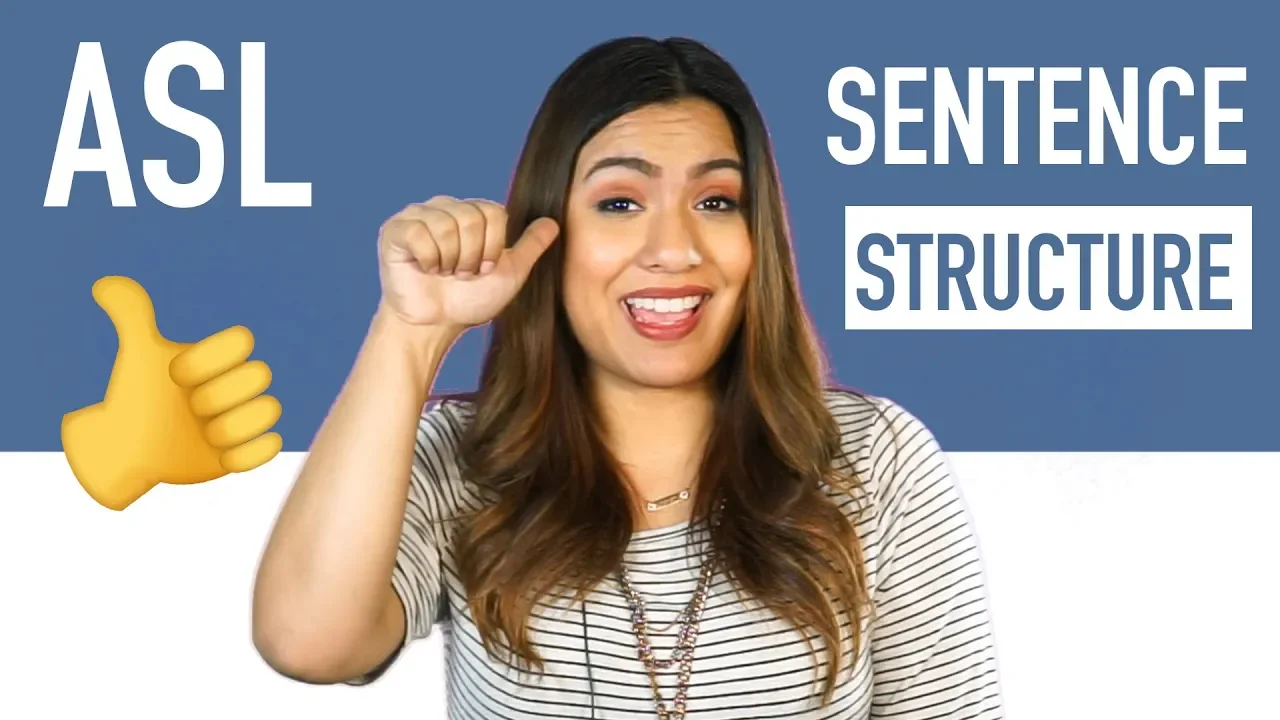
ASL sentences follow a fundamental structure of Time + Topic + Comment, where Time indicates tense, Topic identifies the main subject, and Comment describes what is happening to or about the topic; additionally, referents (pronouns pointing back to the topic) enhance clarity and can be positioned at various points in the sentence, including before, after, or sandwiched within the comment to ensure the listener understands which subject is being discussed.
Click to watch →
ASL Sentence Structure: Word Order in American Sign Language l ASL Lessons
585.8K
This section covers the core difference between English and ASL grammar. While English places adjectives before objects, ASL uses a topic-comment structure where the object or subject is established first, followed by description. The general ASL sentence structure follows time-topic-comment order, with time words placed at the beginning since ASL lacks auxiliary words like 'is' or 'at.' Practical examples demonstrate this structure: 'Next year city big I'm moving,' 'This morning class great,' and 'Yesterday my brother got sick.' This foundational understanding is essential for all subsequent ASL learning.
Click to watch →
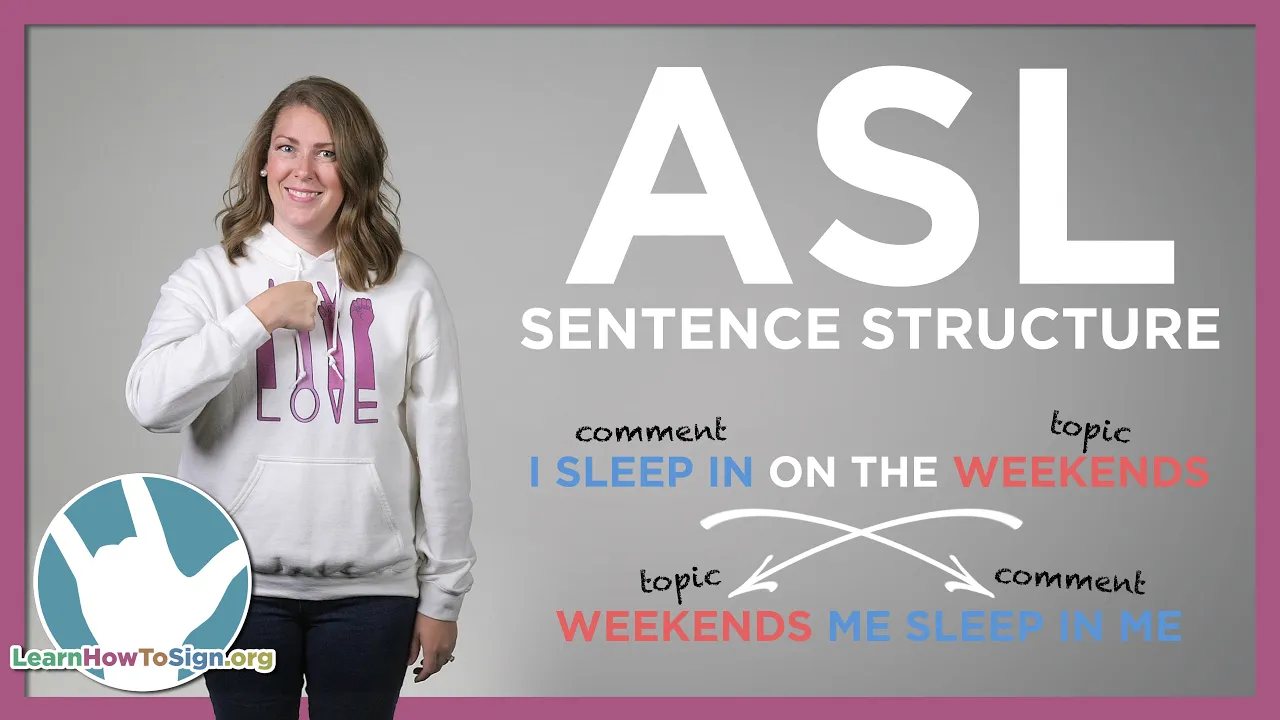
ASL Sentence Structure Explained | American Sign Language for Beginners
311K
ASL sentence structure differs significantly from English, following four main patterns: (1) Topic/Comment Structure places the topic first, followed by a pause and comment, with affirmations using head nods and negations using head shakes; (2) Rhetorical Questions use wh-words (who, what, when, where, why, which, how) as bridges, requiring the signer to lean forward and raise eyebrows; (3) Yes/No Questions require the signer to lean forward, raise eyebrows, and end with the sign 'you'; (4) Wh-Questions place the wh-word at the end of the sentence with eyebrows lowered. All sentence types use closing signals (pointing back to oneself or the listener) to indicate completion.
Click to watch →
7 Essential Rules for ASL Sentence Structure | Topic-Comment
14.9K
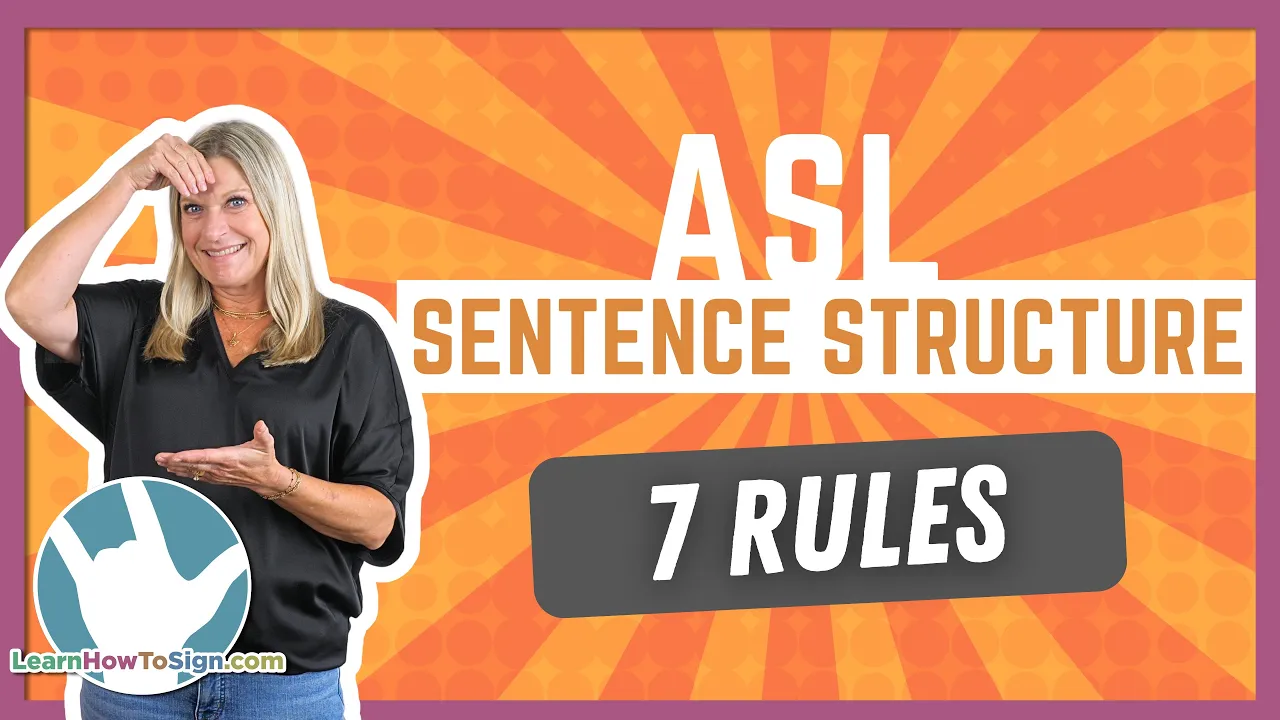
ASL uses a topic-comment sentence structure where the topic (subject) is presented first, followed by the comment (action or description), differing from English word order. The seven essential rules are: (1) Identify the topic first, (2) Place action signs at the end after the topic, (3) Position negation comments at the end after the action, (4) Put descriptions before the topic, (5) Use raised eyebrows as a topic marker, (6) Place WH-signs at the end of sentences, and (7) Position time signs before the sentence structure.
Click to watch →

Basic ASL Sentence Structure: How to form ASL Sentences | Video 1 | American Sign Language |
6.5K
American Sign Language uses two primary sentence structures for communication: Subject-Verb-Object (SVO) and Object-Subject-Verb (OSV). In SVO structure, the signer introduces the subject first (who is performing the action), followed by the verb (what is being done), and concludes with the object (what is being acted upon). When distinguishing between multiple people, the signer specifies the subject by signing the noun form and pointing to the specific person. In OSV structure, the order reverses to object, subject, and then verb. Both structures allow the signer to point back to the subject pronoun after signing the verb to emphasize or clarify who is performing the action. These two formats provide flexibility in how speakers convey information in conversational ASL.
Click to watch →
Deep Dive
An introductory understanding of 'plain verbs' (verbs like 'know' or 'love' that do not alter their movement to show who is doing what).

अंग्रेजी कैसे सीखें | Basic English grammar| How to learn English
66K
Stative verbs describe states, conditions, or mental states without movement: 'know', 'understand', 'believe', 'love', 'hate', 'seem', 'appear', 'like', 'want', 'need'. They typically do not have continuous forms. Action verbs describe physical or mental activities with movement: 'run', 'walk', 'dance', 'sing', 'write', 'read', 'play'. To identify transitive verbs, ask 'what?' or 'whom?' after the verb. If an answer exists, it's transitive; if not, it's intransitive. Examples: 'I play cricket' (transitive), 'I sleep' (intransitive). Understanding these distinctions helps in proper verb usage.
Click to watch →
STATIVE VERBS in English
654.6K
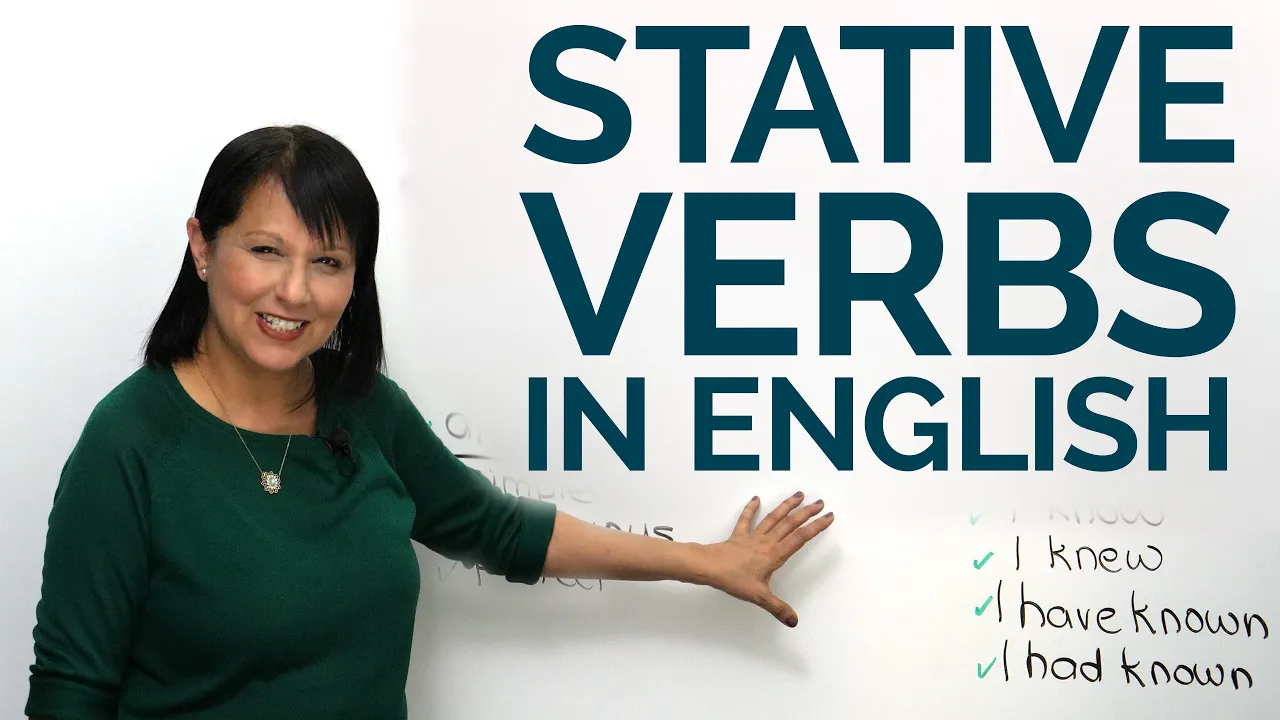
Stative verbs describe states, feelings, or conditions (such as love, know, understand, need, believe, realize, recognize, and belong) and cannot be used in continuous tenses; they are only appropriate in simple present/past tenses and perfect tenses, unlike dynamic verbs which describe actions and can be used in all tenses.
Click to watch →

مراجعة ليلة امتحان الانجليزي ٢ ثانوي أزهر | ترم تاني | مستر محمد الجلاد | أزهراوي انجلش
66.4K
This section covers stative verbs: Stative verbs describe states rather than actions and cannot be used in the present continuous tense. Examples include: believe, know, think, like, love, hate, own, possess. When used in present continuous, they change meaning to become dynamic verbs. For example, 'I am seeing' means 'I am meeting' (dynamic), while 'I see' means 'I perceive' (stative). The verb 'have' can be stative (possess) or dynamic (eat/drink). Stative verbs are used in present simple tense, not present continuous.
Click to watch →

شرح unit 9 تانية ثانوي انجليزي (منهج جديد) 💌 شرح stative verbs الافعال التقريرية و action verbs 💯
28.1K
Verbs are divided into two main categories: action verbs and stative verbs. Action verbs (like 'play', 'watch', 'fight') represent dynamic actions with clear subjects and can be observed. Stative verbs (also called verbs of perception, feelings, senses, love, hate, possession, and measurement) describe states or conditions rather than actions. The instructor explains that stative verbs cannot be used in continuous tenses because doing so would create logical contradictions—for example, saying 'I am loving you' implies love is temporary, which contradicts its nature as a permanent state.
Click to watch →

VERBS KI PLIS ITLIZE NAN ANGLE
506
This segment covers state verbs describing conditions and movement verbs indicating direction. State verbs include 'to be' (to be a doctor, to be a nurse, to be a cook, to be a lawyer), 'to know' (I know French, I know Spanish), and 'to have' (I have a car, I have a chair, I have a guitar). Movement verbs include 'to go' (I go to the store, I go to the laundry) and 'to come' (she is coming, La Vini she is coming). These verbs help learners express identity, possession, and directional movement.
Click to watch →
Prerequisite Knowledge
- Concept 01Understanding the five parameters of ASL (handshape, location, movement, orientation, and non-manual signals) to properly execute signs.
- Concept 02The concept of indexing and establishing referents (pronouns) in the physical signing space.
- Concept 03Familiarity with basic ASL sentence structure (such as Subject-Verb-Object and Topic-Comment).
- Concept 04An introductory understanding of 'plain verbs' (verbs like 'know' or 'love' that do not alter their movement to show who is doing what).
Subsequent Learning
- Step 01Mastering advanced directional and spatial verbs (such as 'give', 'show', 'throw', and 'take-from') that require precise physical placement.
- Step 02Applying number incorporation and plural distribution rules to agreement verbs (e.g., modifying the verb to show 'I tell all of you' versus 'I tell each of you individually').
- Step 03Integrating role-shifting (using body agreement and eye gaze shift) to represent dialogue and interactions between multiple established referents.
- Step 04Combining agreement verbs with non-manual signals (NMS) to convey adverbs, showing the manner or intensity of the action (e.g., 'paying reluctantly' or 'calling repeatedly').
Agreement Verbs
Agreement Verbs
0:00Playing Section
- 1
Explains directional verbs: tell, call, send, inform, pay.
- 2
Shows how the sign's movement changes to show subject and object.
- 3
Distinguishes 'pay' from 'buy' and 'inform' from 'let me know'.
The Gestural and Spatial Mapping Analysis of ASL Verbs
While traditional ASL curricula like 'Signing Naturally' teach 'agreement verbs' as a formal grammatical system of subject-object agreement, some cognitive linguists, most notably Scott Liddell, challenge this framework. Liddell argues that the spatial modifications of these verbs are not grammatical markers of agreement in the linguistic sense. Instead, he proposes that they represent a fusion of lexical signs and gestural pointing directed toward real or imagined physical loci. According to this view, ASL signers use mental spaces and conceptual blending to direct signs toward referents, meaning this directionality is a form of pointing (deixis) rather than syntactic agreement morphology comparable to spoken languages. This alternative perspective shifts the understanding of ASL from a purely formalist grammar model to one deeply integrated with human gesture and spatial cognition.
Deep Dive
Mastering advanced directional and spatial verbs (such as 'give', 'show', 'throw', and 'take-from') that require precise physical placement.

TWA Unit 2.3 video lecture cc (Nehring)
473
This section covers agreement verbs and directional verbs that involve different people or directions. The put sign involves grabbing an object and placing it where desired (under, on top, next to, behind, inside). Lift and carry involve moving objects, while give changes direction based on who receives the item. Enter is used for birthdays and turning things on. The instructor emphasizes that these verbs change based on context and spatial relationships, requiring students to understand both the action and the directional component of the sign.
Click to watch →

Advanced English Speaking Skills | Pronunciation, Phrasal Verbs & Fluency
381
When using verbs like 'give', 'send', and 'show' with objects, there are two possible sentence structures. The more common structure (70%) is to place the object after the pronoun: 'Give you the money' 'Send you an email' 'Show you the room'. The less common structure (30%) is to place the object before the pronoun: 'Give the money to you' 'Send an email to you' 'Show the room to you'.
Click to watch →
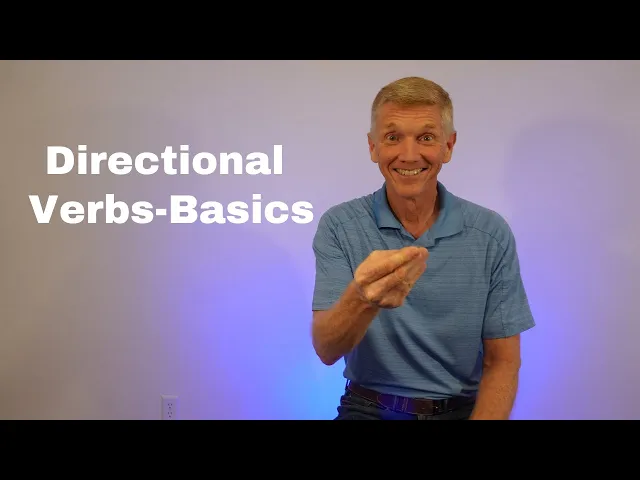
What do the Signs Borrow, Give and Show Have in Common? | American Sign Language
958
Directional verbs in ASL (Choose, Borrow, Take, Give, Tell, Show) use space and body orientation to indicate who is involved in an action, with the signer's hands moving toward or away from different people to show who is giving, receiving, or performing the action.
Click to watch →

【脱英語難民】言語学者が教える「単語も文法もすべて支配するたった1つの原理」とは?
2.5K
The words 'give' and 'take' are best understood through spatial movement between territories. 'Give' means moving something from one's own territory to the external world, representing voluntary release with positive connotation. 'Take' means pulling something from another's territory or external world into one's own territory, representing acquisition with inherent negative connotation (something is lost from the source).
Click to watch →

Programa 20
2.3K
This segment teaches the verbs 'to give' and 'to show'. 'To give' means to transfer possession or ownership to someone (I'm giving you this book). 'To show' means to display or demonstrate something to someone (I'm showing you the blue pencil). These verbs are followed by an object (the thing being given or shown) and often a recipient (to whom it is given or shown). The teacher demonstrates through repeated practice with various objects.
Click to watch →
Deep Dive
Applying number incorporation and plural distribution rules to agreement verbs (e.g., modifying the verb to show 'I tell all of you' versus 'I tell each of you individually').

Subject Verb Agreement Practice Part 2 II Uday Sir
1.4K
'Each of' always takes a singular verb because 'each' is singular. For example, 'Each of us has to remember the duty' uses 'has'. 'A number of' takes a plural verb because it means 'several' or 'many'. For example, 'There appear a number of new faces' uses 'appear' (plural). The distinction between 'a number of' (plural) and 'the number of' (singular) is important for correct subject-verb agreement.
Click to watch →

SSC CHSL English Classes 2026 | Subject Verb Agreement in English Grammar | English by Bhragu Sir
1.3K
When 'each of', 'either of', 'neither of', 'one of the', and 'more than one' are used, the verb must be singular because these words are singular. The distribution rule means that 'each' distributes the action to each individual, requiring singular verb agreement regardless of the number of people or things being referred to. Fractional numbers require the verb to agree with the denominator: if the denominator is 1, use singular verb; if greater than 1, use plural verb. Collective nouns like 'police' can take singular or plural verbs depending on context.
Click to watch →

Tense Practice Set for All Competitive Exams | Fill in the blanks with correct form of verbs | Tense
126.4K
When cardinal numbers are used with plural nouns and the context involves distribution among different individuals, the verb should be plural. For example, '100 rupees are distributed among the students' uses plural verb 'are' because the context involves distribution among different students.
Click to watch →

Subject - Verb Agreement | English Grammar For All Competitive Exams | English EP-71 | By Ravi Sir
379.6K
When a sentence contains a plural number (2, 3, 4, 5, 10, etc.) along with a plural noun, the verb should be singular because the entire quantity is treated as a single unit. Similarly, collective nouns representing a group as a single entity (committee, council, crowd, family, army, class, team, mob, jury) require singular verbs, but when referring to individual members within the group, plural verbs are used. Indefinite pronouns like everybody, anybody, nobody, someone, everything, anything, something, and nothing always take singular verbs.
Click to watch →

ENGLISH /SUBJECT VERB AGREEMENT Part-4
742
Collective nouns (family, team, audience, staff) take singular verbs when the group acts as a unified unit, but plural verbs when individual members act independently. For example, 'My family is going on vacation' uses 'is' because the family acts as one unit. However, 'My family are arguing about where to go' uses 'are' because members act individually. Proper nouns for countries and organizations are treated as singular even when they contain plural words: 'The United States is a large country' uses 'is' because 'United States' refers to one nation. When 'number of' is followed by a plural noun, the verb should be plural: 'The number of students are absent today' uses 'are' because 'students' is plural.
Click to watch →
Deep Dive
Integrating role-shifting (using body agreement and eye gaze shift) to represent dialogue and interactions between multiple established referents.
Anirban Dasgupta & Amy Milau Dasgupta (@Italkilanguage) - Introduction to ASL
847
Roll shifting (changing the orientation of the hands) and eye glances help establish where people are located, what they look like, and how interactions take place between people or objects. Looking up indicates someone who is tall, looking down indicates someone who is short, looking to the right indicates one speaker, and looking to the left indicates another speaker. These visual cues provide important contextual information that complements the signed message.
Click to watch →

10comICAR - Journée 2 - Lorenza MONDADA : La parole et le corps en interaction
199
Speakers coordinate their gaze with co-participants during complex turns. Before speaking, speakers monitor where others are looking, then use pseudo-cleft constructions to draw attention to themselves. The turn progresses through stages where participants gradually align their attention and physical positioning. The speaker monitors co-participants' positions and movements, and the turn concludes when participants have physically oriented themselves toward the described referent, enabling responses. This coordination between syntax, gaze, and body positioning creates coherent communicative actions.
Click to watch →

What is Role shift
659
In BSL, when representing multiple characters in a conversation, the signer uses roll shift to switch between characters by changing their signing style, facial expressions, body orientation, and hand movements. The example shows a mother and daughter having a dialogue where the signer alternates between the mother's and daughter's perspectives, demonstrating how one person can portray multiple distinct characters in a single conversation.
Click to watch →

Role shifting
39.6K
Role-shifting is an essential ASL grammar technique that allows storytellers to embody different characters by using body shifting, body language, head tilt, eye movement, and behavior characteristics, enabling clear character distinction without pronouns and creating immersive narratives.
Click to watch →

Atividade em vídeo
198
In Libras, when characters change who they are speaking to, the signer's body position and orientation change accordingly. When the sun and cloud talk to each other, they face each other. When they talk to animals below them, they look down. When animals respond, they look up. This spatial positioning helps convey the dialogue flow and relationships between characters in a story.
Click to watch →
Deep Dive
Combining agreement verbs with non-manual signals (NMS) to convey adverbs, showing the manner or intensity of the action (e.g., 'paying reluctantly' or 'calling repeatedly').
![Learn 25 Adverbs of Manner in German - B1 [with Jenny]](https://i.ytimg.com/vi_webp/EGxGIcxll0Q/maxresdefault.webp)
Learn 25 Adverbs of Manner in German - B1 [with Jenny]
249.4K
'Mutually' means shared or reciprocal between parties. Example: 'We mutually solved the problem' indicates cooperation. 'Reluctantly' means doing something unwillingly or with hesitation. Example: 'He only accepted that reluctantly' shows resistance to the action.
Click to watch →

အင်္ဂလိပ်လိုရေးတတ်ချင်သူများ မဖြစ်မနေကြည့်ရန် 📚
329.2K
Adverbs of manner describe how actions are performed, including slowly, quickly, softly, politely, and patiently. These adverbs modify verbs to indicate the way an action is carried out. Frequency adverbs like always, often, and sometimes indicate how regularly actions occur. For example, 'My father always goes quickly' combines a frequency adverb with an adverb of manner. Understanding both types helps learners describe actions with greater precision and detail.
Click to watch →

Começando do Zero INSS 2022: Preparação Completa - Língua Portuguesa
59.8K
Adverbs of intensity modify adjectives or other adverbs to indicate degree or extent (e.g., 'muito comprida' - very long, 'tão bom' - so good). Adverbs of manner indicate how an action is performed and are equivalent to expressions of 'modo' (manner), 'jeito' (way), or 'forma' (form) (e.g., 'ruidosamente' - noisily, 'desesperadamente' - desperately).
Click to watch →
Nano Medi English Course।।DAY-5।।Adverb,Conjunction,Interjection।।#NanoMediEnglishCourse
32.6K
Adverbs of degree express intensity or extent (e.g., 'only very slightly' in 'his grades have improved but only very slightly'). Adverbs of manner describe how an action is performed (e.g., 'hard' in 'he works hard'). These adverbs help convey the manner, intensity, and extent of actions in sentences.
Click to watch →
(ENGLISH) What is an Adverb of Manner? | #iQuestionPH
120.9K
An adverb of manner is an adverb that describes how and in what way the action of a verb is carried out, answering the question 'how?' and typically appearing after the verb or direct object; most are formed by adding the suffix '-ly' to adjectives (e.g., graceful → gracefully, quiet → quietly), though some adjectives like 'hard', 'straight', and 'fast' remain unchanged when used as adverbs.
Click to watch →
Agreement Verbs
Agreement Verbs
0:00- 1
Explains directional verbs: tell, call, send, inform, pay.
- 2
Shows how the sign's movement changes to show subject and object.
- 3
Distinguishes 'pay' from 'buy' and 'inform' from 'let me know'.
The Gestural and Spatial Mapping Analysis of ASL Verbs
While traditional ASL curricula like 'Signing Naturally' teach 'agreement verbs' as a formal grammatical system of subject-object agreement, some cognitive linguists, most notably Scott Liddell, challenge this framework. Liddell argues that the spatial modifications of these verbs are not grammatical markers of agreement in the linguistic sense. Instead, he proposes that they represent a fusion of lexical signs and gestural pointing directed toward real or imagined physical loci. According to this view, ASL signers use mental spaces and conceptual blending to direct signs toward referents, meaning this directionality is a form of pointing (deixis) rather than syntactic agreement morphology comparable to spoken languages. This alternative perspective shifts the understanding of ASL from a purely formalist grammar model to one deeply integrated with human gesture and spatial cognition.
Understanding the five parameters of ASL (handshape, location, movement, orientation, and non-manual signals) to properly execute signs.
The concept of indexing and establishing referents (pronouns) in the physical signing space.
Familiarity with basic ASL sentence structure (such as Subject-Verb-Object and Topic-Comment).
An introductory understanding of 'plain verbs' (verbs like 'know' or 'love' that do not alter their movement to show who is doing what).
Mastering advanced directional and spatial verbs (such as 'give', 'show', 'throw', and 'take-from') that require precise physical placement.
Applying number incorporation and plural distribution rules to agreement verbs (e.g., modifying the verb to show 'I tell all of you' versus 'I tell each of you individually').
Integrating role-shifting (using body agreement and eye gaze shift) to represent dialogue and interactions between multiple established referents.
Combining agreement verbs with non-manual signals (NMS) to convey adverbs, showing the manner or intensity of the action (e.g., 'paying reluctantly' or 'calling repeatedly').
10.8K views77likes2:52@SignWithCourtneyOriginal Release: 2017-03-04
this video focuses on 8.3 from signing naturally agreement verbs so the first one is the sign tell so you'll go here tell so I told you you told me or you tell him or told him okay so from here going under tell you told me or you tell or told him okay so it can go all different ways that's what an agreement verb is a directional verb they're also called okay the next one is call okay so I called you you called me or he called her okay the next one is send so I send so it's an S to a five so I send to you you send to me send to me or he sends to him okay the next one is inform so this is an information information or to inform okay so I will inform you will inform or he will inform sometimes you'll see it with just one hand as well this can also be translated let me know okay so I let him know you let me know we let everyone know that specifically me to you you to me or that person to that person and then last we have pay so this is the same pay so you'll notice that it's different than buy so buy is when you're holding money and you're going forward and then it can become shopping if you do it multiple times so to buy something but this is the sign to pay with your index finger so I pay you you pay me um he pays her okay it can also be I pay pay pay all my bills you can do it that way and have different places than I'm paying so pay pay pay pay or I already paid all of you you can go that way as well so again tell tell or tell call or call send send inform inform or inform and pay pay or pay there are your agreement verbs keep up the good work
Up Next

14:24
Stokoe Notation System: Writing American Sign Language (ASL) Symbols
@kathyh.1720
971 views•2021-09-07
36:52
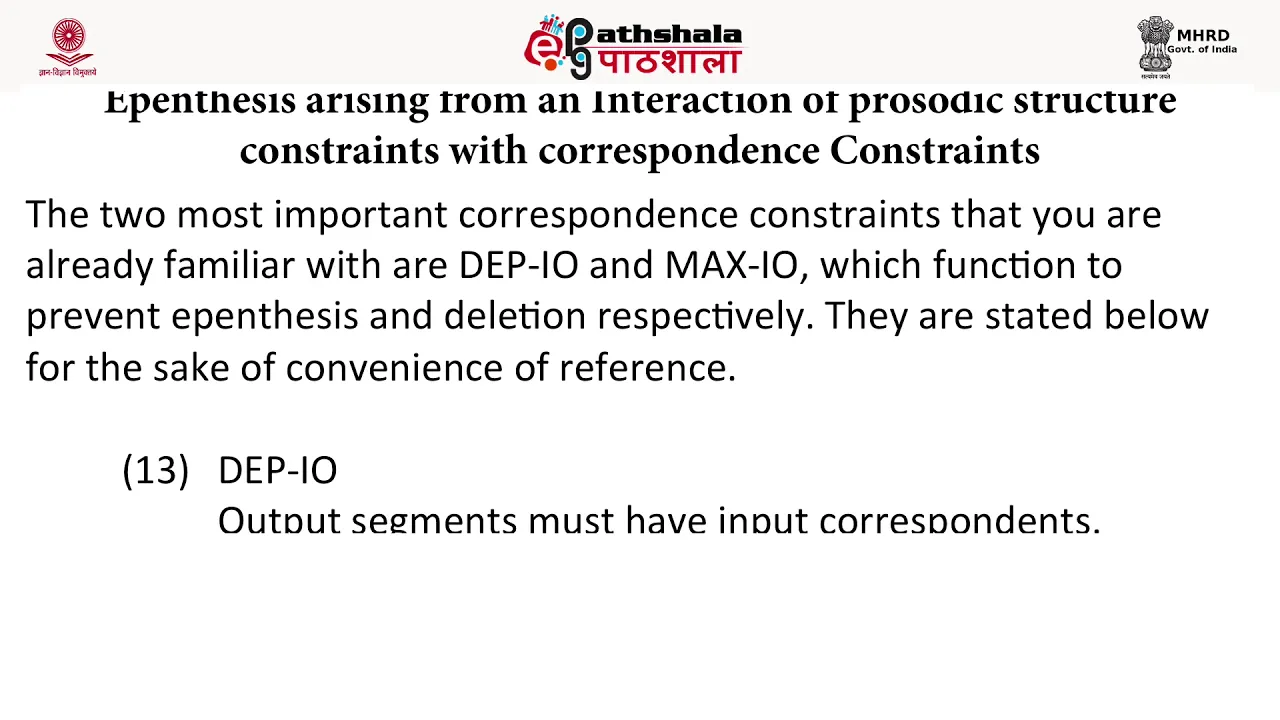
Constraint Interaction in Optimality Theory: Epenthesis & Deletion
@Vidyamitra
180 views•2018-08-20

19:33
ASL Common Sentence Structures: Conditional Sentences Explained
@SignWithCourtney
2K views•2012-04-25

21:32
Accent Expert Explains U.S. Regional Dialects | Part 1
@WIRED
9.3M views•2021-01-21
Related Study Plans & Knowledge Roadmaps
Structured learning paths in Linguistics
linguistics
Optimality Theory: Tableaux & Constraints
01Phonological Basics: Sounds, Syllables & Rules
02Foundations of Optimality Theory: GEN, CON, and EVAL
03The Constraint Inventory: Markedness vs. Faithfulness
+ 2 more learning modules
15h5 modules
Explore Roadmap
linguistics
Morphosyntactic Alignment: S, A & P Systems
01Foundations of Syntax: Transitivity and Arguments
02The Linguistic Variables: Mapping S, A, and P
03Nominative-Accusative Alignment
+ 3 more learning modules
12h6 modules
Explore Roadmap
linguistics
Analyzing Sign Language: Phonology & Syntax
01Foundations of Sign Language Linguistics
02Phonology: The Five Parameters of a Sign
03Morphology: Word Formation and Classifiers
+ 2 more learning modules
14h5 modules
Explore Roadmap
linguistics
Pragmatics: Speech Acts, Grice & Politeness
01Introduction to Pragmatics: Meaning in Context
02Grice’s Cooperative Principle & Implicature
03Speech Act Theory
+ 2 more learning modules
14h5 modules
Explore Roadmap