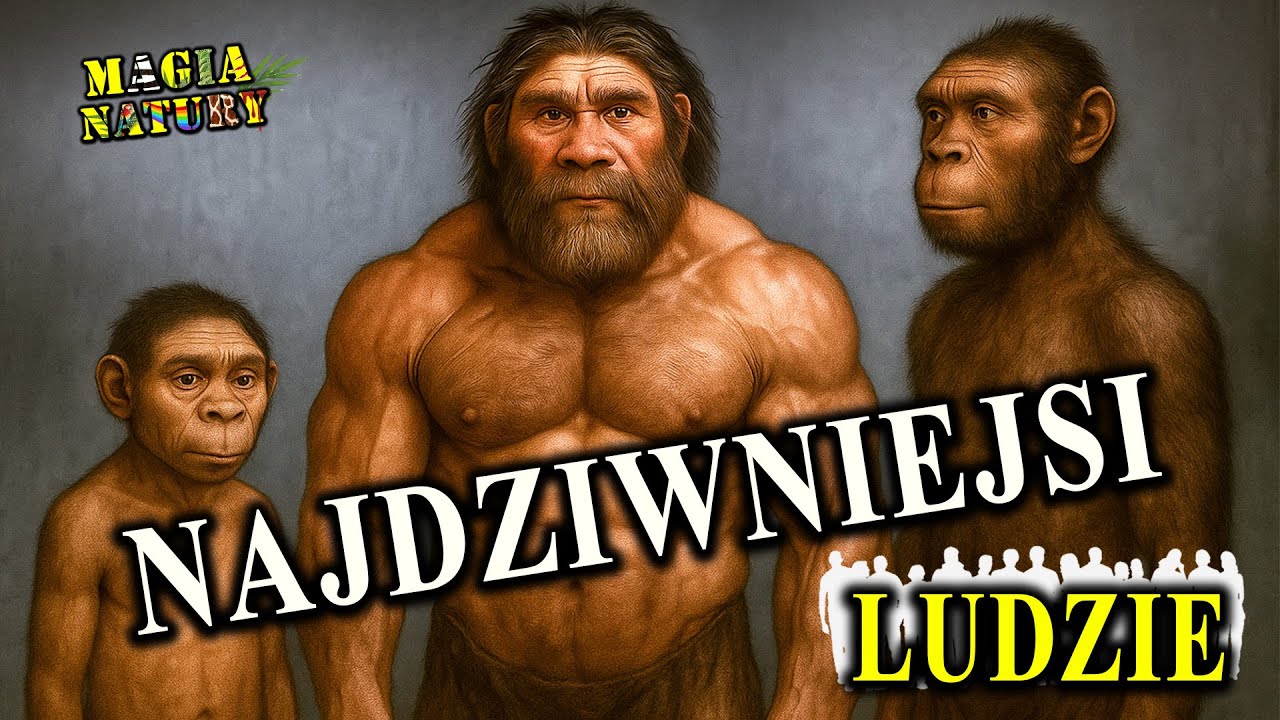






















Homo erectus, living approximately 1.9 to 1.17 million years ago, represents the first true humans in human evolution due to their combination of key traits: significantly larger brains (growing from 540cc to 1200cc over half a million years), the ability to run (evidenced by their short, bowl-shaped pelvises), hairlessness (supported by genetic evidence of dark skin evolving 1.2 million years ago), advanced hunting skills (demonstrated by access to nutritious animal parts), and sophisticated tool-making technology including Acheulean handaxes requiring complex planning and visualization. These innovations enabled them to migrate across three continents and laid the foundation for all subsequent human evolution, ultimately giving rise to Homo sapiens, Neanderthals, and Denisovans.
Homo Erectus: The First True Humans in Human Evolution
Added:What defines a human?
We're obviously hairless, bipedal apes. We're good at running, at least some of us. We have a very sophisticated language, not just one of them hundreds maybe even thousands depending on how you define it. We're obligate tool users. We basically can't accomplish anything without them. We're creative. Our tools and our language have allowed us to express really complex and abstract ideas, and of course we have spread across the entire globe.
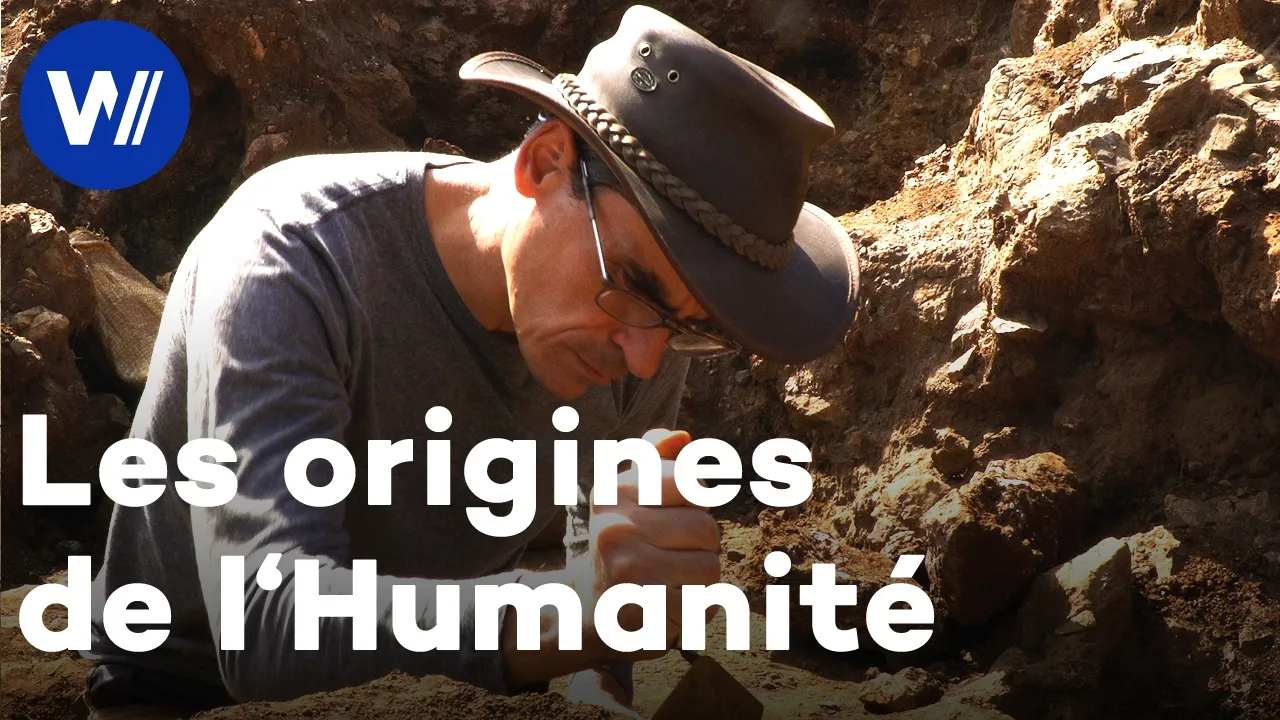
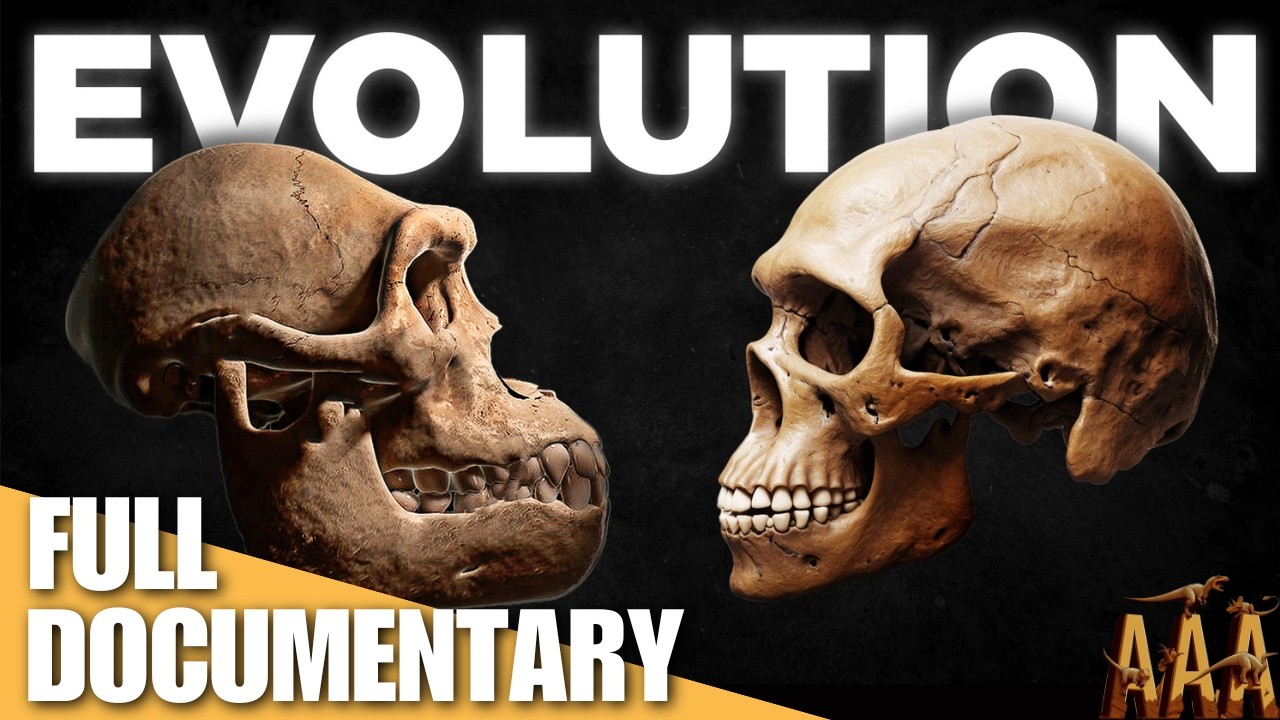
I believe we can trace all of these defining features back to owners of skulls like this. This is Sangiran 17, or at least a plastic copy of it.
It was excavated on the island of Java, Indonesia and it belonged to someone who lived about 1.5 million years ago. Today we call these hominins homo erectus.
In my opinion they're the first hominins who truly deserve to be called human. From their biology, to their technology, their globe spanning reach, maybe even artistic and linguistic abilities, these chaps and chapettes were an absolutely huge leap forward in human evolution, and today I just want to break down what it is that is so special about them, why I think they are the first true humans.
Homo erectus is a really well studied fossil specimen but despite that its origins remain basically unclear. After a major glaciation 2.5 million years ago there were multiple species of early homo and australopithecus that all overlapped in time in east africa, but the identities of these species are still debated.
Homo habilis has been considered for a long time the first in our genus homo because it was found with the stone tools, but some anthropologists think it's actually too primitive to really be in our genus, to really be homo and uh is more likely some sort of australopithecus.
Homo rudolfensis seems to be a larger version of habilis but whether or not it's a distinct species is still up for debate as well. Most anthropologists recognize habilis and rudolfensis as being distinct but because it's still debated it's easier just to call them both early homo. With the separation between australopithecines and early homo still kind of unclear it's hard to know exactly when and where homo erectus originated.
The oldest homo erectus fossil that the scientific community agrees upon are around 1.9 million years old and come from Koobi Fora in Kenya, overlapping in time with both habilis and rudolfensis, but one of the most famous early homo erectus fossils actually comes from outside of Africa from Georgia and dates to 1.8 million years ago.
Incredible! Really old!!
This showed that homo erectus had made long migrations out of Africa very shortly after it evolved and that it didn't need a big brain to do it. It really was an incredible discovery.
"whoa steady on" I hear you say. Small brains? Stefan these are supposed to be the first humans.
What are we if not, you know, big walking brains? Well within the species that we call homo erectus there is actually a ton of variation. They lived for 1.8 million years across three continents.
There's so much variation that you might find them referred to as a different species like homo ergaster. We're gonna ignore that convention today, it's perfectly acceptable to lump them all in as homo erectus. Despite this variation and this huge time span that they were around, there are some key uniting features that we can point to as definitively erectus.
Compared to early homo and australopithecines they had larger bodies, smaller teeth, smaller jaws, but the first major change were these big brains. Early erectus, who we could call homo ergaster, like the ones found in Dimanisi, Georgia only had a brain size of about 540 cc's.
Bigger than a chimpanzee but not by a lot. If we compare that to erectuses like Sangiran 17, that lived half a million years later in Indonesia, they had brain sizes of about 1200 cc's. To put that into perspective a modern homo sapiens, like me or you, might have a brain size of around 1350 cc's. So within that half a million years they had basically tripled to modern levels.
That's huge! That's really significant!
Erectus was also the first hominin that had the ability to run. We can tell this from their short bowl shaped pelvises. Mathematical models indicate that they may have been able to run for five hours straight, which is way beyond my abilities in my current state.
Obviously you can't run that long if you're covered in hair, it's kind of hard. Interestingly, studies of our genetics have shown that the genes for dark skin evolved around 1.2 million years ago meaning that our skin had been exposed to the sun by then. So erectus was almost certainly the first kind of hairless hominin. These traits are obviously abundant across the entire world, across our entire species, so you might be inclined to think "uhhh yawn fest, big deal" but uh in reality it would be hard to underestimate their importance.
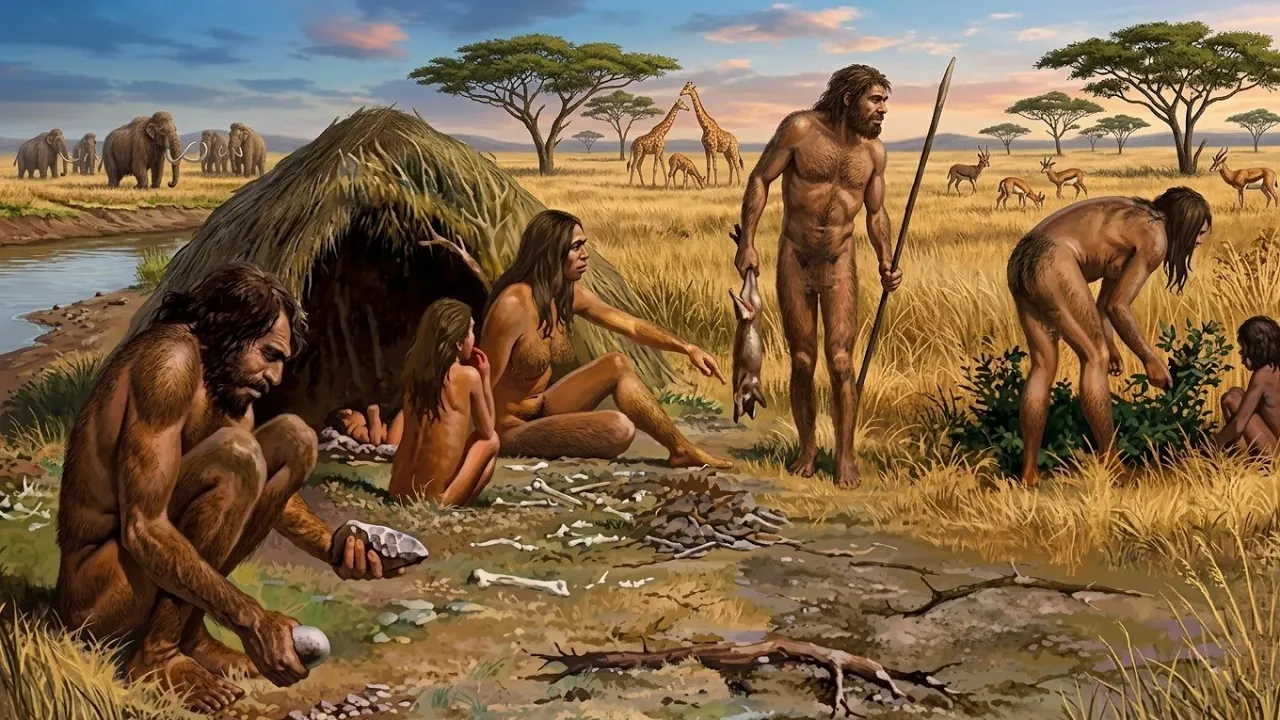
Together all these things signal major changes to the morpho-behavioral package that homo erectus had. Homo erectus didn't just look like an upright walking chimpanzee they would have looked much more like us. They would have walked further to get their food and the food they were eating was much higher quality, to fuel this huge brain expansion. Erectus wasn't just an upright walking ape they'd have lived a lifestyle that was familiar to humanity for the rest of the paleolithic.
It's obviously difficult for us to say exactly how homo erectus went about hunting animals but we can tell from the bones that they left behind and the marks on them that they were getting primary access to the most nutritionally dense parts of the animal. They weren't just scavenging. And that these were big animals too, really big animals like hippos and giraffes things like that. So, however they went about it they were certainly capable of some pretty advanced hunting skills.
Now running and hunting is all well and good, definitely a major leap forward in our evolution but a defining feature of our morpho-behavioral package as homo sapiens is language. So could homo erectus talk? That's kind of a difficult question to answer.
For language to exist of course there needs to be certain biological preconditions that have to be met. The first would be larger brains which as we've discussed later erectus certainly had, but just because it's big doesn't mean it's wired correctly for language. You also need the brain to function at a much higher cognitive level. Now believe it or not, the guy sat in his garage talking to a spoon is not Mr.brain scientist, but according to the source in the description the evolution of genes srgap2c and srgap2d, I had to look at my notes there for that one, these genes in the lab were associated with higher brain connectivity.
Intriguingly it seems that these genes evolved at the same time erectus appeared in the archaeological record. Now I'm not saying erectus had a language as complicated as ours, far from it, but like all things language is a trait that we have evolved to have. It's unlikely that it appeared fully formed just in us homo sapiens. It's not unreasonable to think that the building blocks of language could be found in homo erectus, that they had some sort of linguistic capability maybe some sort of a sophisticated sign language say. I don't know it's hard to say for sure because words and gestures aren't uh preserved in the archaeological record but if we look at the tools they left behind, the technology they left behind, it certainly indicates that these chaps and chapettes were very smart indeed.
The technology that homo erectus is most known for and one which likely gave them a distinct evolutionary advantage, is fire. The main idea is that earlier hominins spent a ton of time and energy digesting raw meat and difficult to eat foods. It's why the australopiths have such thick sturdy jaws. But once we developed fire it did much of this work for us. It allowed our guts to take it easier and our brains to absorb that extra energy, allowing them to grow to the size that they are now. This is a great theory, it's a very nice theory. There's a serious problem with it though in that the earliest evidence for controlled fire that most archaeologists would agree with is only 780,000 years old, from Israel. Much later than when we see big brains appear in the fossil record. Earlier possible sites are being unearthed, such as Koobi Fora, in Kenya, which could push back the evidence for controlled fire use to 1.5 million years ago.
The only problem is it it's just difficult to say for sure. Humans don't have a monopoly on starting fires, they can occur perfectly naturally on their own. Considering the sparse evidence for deliberate fire use, it does raise interesting questions about how they expanded into a new territories, colder territories. How did they do this?
oooff made jump then.
How did they do this without fire to keep them warm? Perhaps they huddled together?
Perhaps they had some form of rudimentary clothing? Perhaps both of those things?
Perhaps neither? Maybe our ancestors weren't even cooking with fire at all? Analysis of soils from Olduvai Gorge, dated to around 1.7 million years ago, suggest that the area might have had natural hot springs. This led the investigators to wonder, what role did this hot water play in our evolution? Instead of roasting meats and plants and seeds, were we boiling them instead?
I, I absolutely love this idea. I can't help but compare it to those Japanese monkeys that live around those hot springs.
Just, just imagining like an ancient homo erectus sitting in the hot spring, chilling, just having an absolutely fantastic time the same way that you or I would. It's so humanizing! I, I hope that that was how our evolution went down, that we evolved in hot tubs, I really hope that.
Whilst we're on the subject, there is another big debate around homo erectus and water. Now obviously homo erectus or the hominins that left Africa didn't do it consciously. They were almost certainly just following animals, taking advantage of ecological niches that they could fill, just following their food and as a result they passively spread across the world. But they may have genuinely made some more deliberate migrations over in southeast Asia.
Recently a new hominin has been found on the island of Luzon in the Philippines and a few years ago stone tools dated to around 700,000 years ago were also found in the Philippines. What's so special about these discoveries is that the islands of the Philippines were islands when this was going on. There is no plausible way a hominin could have walked to these islands. At the very least they would have had a short sea crossing of a few miles. Though I actually haven't been able to find out exactly how far, but a few miles. So, the debate is now of course how did these hominins get there? Was it accidental? Were they swept up in some sort of tsunami or was it deliberate?
Did they deliberately set out to cross these few miles of sea and exploit a new territory?
This is a paleolithic hand axe, Acheulean handaxe. Not plastic this time.
The evolution of homo erectus coincides with the sudden appearance of this new type of tool in the archaeological record. Although it appears simple this is actually a giant leap forward for humankind. Before this, hominins were producing Oldowan style tools, and they seemingly when they made those made no effort to shape the core of the tool. They simply produced a cutting edge and uh that was it. Acheulean tools on the other hand were flaked on both sides, it was a real revolution and as you can see it required the removal of a lot of flakes to get it into this nice shape. Even a simple one might remove 20 or 30 flakes, something like that. This really shows a degree of creative thinking on the part of homo erectus. To be able to take a rock and visualize and understand that through this process of knapping, through many steps, this handaxe was inside it. It's quite frankly ingenious, very intelligent indeed, shows an absolutely remarkable degree of of creative thinking that is unique to our genus.
Acheulean handaxes probably did not have one single purpose. They must have been used to hunt, they were certainly used to butcher I'm sure, and uh perhaps even work wood and bone. They're really the original swiss army knife. These things are very heavy, you could certainly butcher an animal with this you could certainly kill something with it no doubt about that.
How much homo erectus worked with wood and bone is difficult to say. The oldest wooden spears that have been found so far are the the 500,000 year old or so uh Schoningen spears, which really have just survived in the archaeological record through a through sheer luck and fluke. They were probably produced by a Neanderthal or proto-Neanderthal but it is within the same time span as homo erectus and I personally believe erectus would have been more than capable of of producing something similar. If you can take 20 or 30 steps to turn a rock into a hand axe for sure you can sharpen a stick in my opinion.
As for bone tools again the record is sparse but it's not incomplete.
Some of the most distinctive come from Olduvai Gorge and include this absolutely stunning potential barbed point. Now that is really incredible. If homo erectus did produce this tool, and evidence suggests they did, then that again is an absolutely brilliant example of their intelligence. If producing tools and working with tools is a sign of humanity, is a defining feature of ours, then for sure homo erectus was uh in the human club no doubt about it.
oh [_] hell my legs are so stiff. Bloody hell!
Out of all of the defining features I've mentioned today, producing art is probably the most defining out of all of them. No other animal produces art quite like us homo sapiens. So if I'm trying to decide if if homo erectus was a human or not whether they produced art is key to that. The best and perhaps only example of creative expression by a homo erectus hominin is this shell found in java.
The layer containing the shell was dated to between 500 and 400,000 years ago roughly.
So there's absolutely no question it's in the time span of homo erectus not homo sapiens and as you can see someone has drawn some lines on it, they've scratched lines into the shell. Do these simple lines count as a creative expression, as a symbolic act or are they just a careless moment by some ancient hominin? In my opinion it doesn't matter. It's, it's incredible either way. As with language our artistic expression is also something that I believe we've learned, that we've evolved to do, and the seeds of all this creativity that we see around us every single day may have begun with just a simple careless act. A slip of the hand scratched a shell and maybe that scratch caught the eye of the hominin that did it and they did another and another and another. In my personal opinion just these simple acts could have been the spark, could have connected a couple of neurons in the brain that weren't connected before and and led to absolutely all the beautiful things we see around us today.
Not bad if I do say so myself. Eat your heart out Ettore. There's a new artist in town.
Everywhere we find erectus we see that it lived for a really long time. Its fossil record spans almost two million years, from sort of that two million year mark uh in Ethiopia to 117,000 years ago in Java, Indonesia. So what caused erectus to meet its ultimate demise? Again, we're not 100% sure but it's likely that the changing climate played a part. For example, in Indonesia the woodlands were rapidly becoming rain forest as we know it today and as the conditions became hotter and more humid maybe erectus uh couldn't adapt to the changing climate there.
Erectus's legacy has lived on though. As it traveled the globe it may have left behind populations that eventually evolved into new species through isolation. One prime candidate is homo floresiensis, found on the island of Flores in Indonesia.
The fossils that we found so far date to between 700,000 and 70,000 years ago, which in the scheme of human evolution in prehistory is really recent. I mean this is the only chapter of human history where we go "70,000 years it's so recent!" but it's true that is very recent. The adults seemingly were only one meter tall which has led to them being nicknamed the hobbits.
Different studies have arrived at different conclusions, most would probably say that floresiensis descended from erectus and experienced a phenomenon we call island dwarfism.
Not everyone agrees though. Others would argue that they probably derive from an even earlier unknown species just due to some primitive traits that they have. Maybe some form of australopithecus actually made it out of Africa. Considering the fact that we know homo erectus was in that region for a very long time they are the most plausible ancestor but the fact that floresiensis probably suffered from island dwarfism does suggest that if erectus was able to travel across water, and I believe they did, they could not do it habitually, they couldn't just choose to do it any time they wanted. Otherwise they could have just upped and left, they could have got resources from somewhere else.
This pressure towards dwarfism would not have been so pronounced.
The really weird homo naledi has been proposed as a potential erectus descendant. I've also made a video on those guys, check it out. Naledi was found deep in a south African cave in 2013 and so far 15 individuals were recovered just within one single cave chamber.
Tres mysterious!
While we don't know for sure if erectus is their director ancestor it's a solid bet given the temporal ranges overlapping and the really modern features that naledi has which just aren't present in early homo or australopiths.
We are pretty confident though that it gave rise to at least three species, us neanderthals and denisovans. The identity of the last common ancestor between us neanderthals and denisovans is still highly debated. We know that an ancestor was erectus, they're certainly on our family tree but did we descend directly from it? Some, a minority, but some anthropologists think so. One theory, called the multi-regional hypothesis, argues that despite the huge geographic distance between homo erectus it could have sort of simultaneously evolved into homo sapiens across the globe through continuous gene flow. As I said, that is definitely the minority opinion at the minute.
Let me add a little bit more information as to why that is because some of you might be thinking, now that we know that homo sapiens interbred with neanderthals and denisovans that the multi-regional hypothesis is therefore correct and, you know, yes and no is basically the answer to that.
Because of that genetic research we now know that human evolution took place in multiple regions, Africa, Europe and Asia so in that sense our evolution is multi-regional. But specifically the multi-regional hypothesis gave no special place to Africa, but what the fossil record and the genetic evidence suggests is that we are still predominantly an African species.
Most of our evolution took place there but it didn't happen exclusively there. There were very small amounts of absorption you could say of other archaic hominins. It's just really about the the degree of how much interbreeding happened. Not that much in the grand scheme of things.
Others think that there might have been an intermediate species. The argument is that erectus that stayed in Africa evolved into a species called homo heidelbergensis, sometime around 800,000 years ago roughly. Homo heidelbergensis then also migrated out of Africa.
The ones who stayed in Africa evolved into homo sapiens and the ones that made it to Europe and Asia evolved into neanderthals and denisovans. The exact nature of all of the relationships between these various species is not clear and this debate is famously called the muddle in the middle.
flalalalala it's taken me so many takes to say that.
because it's just so difficult to solve. There aren't that many fossils that we've found that date to that crucial time period of sort of 800 to 500,000 years ago and each time we do find one, in that very rare event it just complicates the picture further. It's just difficult to say. It's difficult to talk with any certainty about complicated events that happened half a million to one million years ago, naturally that's just a difficult thing to do.
I'd love to finish this video with an analogy. Whenever we see chimpanzees or gorillas playing, interacting as a family we can't help but see ourselves in them. Their mannerisms, their expressions, their games, it's just all too familiar to us. Now imagine we could travel back in time a million years to some cave in Indonesia and watch a family of erectuses sitting around a fire, cooking, making tools, laughing, maybe even talking, we would certainly recognize them as human. Their relationship to us, their inherent humanity, would be obvious. Despite all the differences between us, despite the huge amount of time they would be unmistakably human.
You could say that there's a little erectus in all of us. Thanks for watching guys, see ya!
Up Next
QAM Modulation Explained: Principles and Applications
@WirelessExplained
122.1K views•2025-03-17

Triumph of Orthodoxy Icon: Byzantine Art & History Explained
@BenCallan
2.1K views•2024-08-06

FastAPI vs Flask vs Django: Choosing the Right Python Web Framework
@TechWithTim
302.5K views•2024-05-26

Game of Thrones Opening Credits: A Cinematic Analysis
@gameofthrones
46.3M views•2011-04-18
Related Study Plans & Knowledge Roadmaps
Structured learning paths in General & Interdisciplinary Studies