




![[Week 10] ISM Heating and Cooling](https://i.ytimg.com/vi/_wfZWe8tsWE/maxresdefault.jpg)












Molecular clouds are the primary sites of star formation in galaxies, characterized by a power-law mass spectrum where most mass resides in large clouds, surface densities around 100 solar masses per square parsec, and virial ratios near unity indicating they are neither fully collapsed nor completely non-self-gravitating; these clouds form through multiple mechanisms including local converging flows, cloud collisions in spiral arms, gravitational instability, and Parker instability, and their low star formation efficiency (~1%) is regulated by turbulence and stellar feedback rather than magnetic fields, with the overall galactic star formation rate correlating linearly with molecular gas surface density at intermediate densities but becoming superlinear at high densities due to metallicity-dependent effects.
Molecular Clouds & Star Formation: Mark Krumholz, Protostars & Planets VI
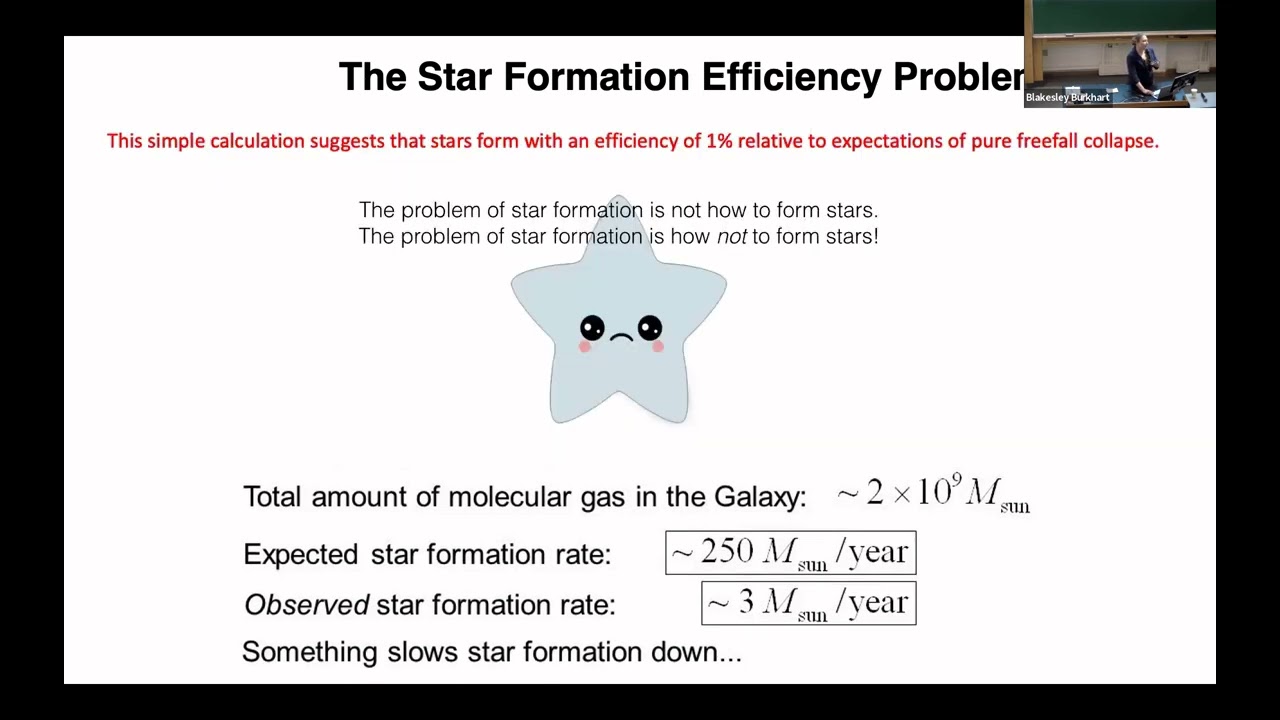
Added:open the first science session of pb6 and please welcome Mark kumol who will speak about formation of molecular clouds and Global conditions for Star [Applause] formation thank you see this on how about now wow that was deafening well that's probably not so bad con considering that I'm sure my audience consists largely of the jet lagged and The Hungover and that those two groups are not exclusive um so I have the honor of speaking on behalf of this diverse cast of characters and I'm going to try and tell you a little something about molecular clouds where do they come from where do they go how do they evolve all right so here are the four questions I am going to organize this talk around I'll start with a review of what the observations tell us and then I'll get into the science questions the questions of how do molecular clouds form how do they evolve and what determines their structure and what regulates the rate at which stars form within them because that's really the big question we're after now some of these topics are going to be dealt with at length by other talks and the goal of this talk is to sort of put it all together and set the big stage and then you'll hear a lot more in detail about some of these questions later on today all right so let's start with the first question what do the observations tell us well let's start at the biggest scale let's start at the scale of galaxies and ask what do we know about the relationship between molecular clouds and star formation well actually let's start with the history all right so here is the first detection of a CO line all right so the history of molecules in the ism started with Optical absorption in the 30s but then in the by the 60s we got radio telescopes and people started finding all sorts of molecules but the really big breakthrough came with the detections of H2 and in particular the co line so this is from Wilson 1970 and once this line was discovered in Fairly short order people started making maps of the entire sky in Co so here is an image from Tom Dame's 1987 survey it's a map of the galactic plane in the co molecule all right and from that people sort of went to town by the '90s we started getting Maps like this of external galaxies we started getting higher resolution Maps using interferometers and people started using an entire alphabet soup of molecules to trace all sorts of conditions inide molecular clouds so that's the state of the observations all right but let's start with again the galactic scale now the most obvious thing about molecular clouds and the reason we care so much about them is that they are the places where stars form all right and that's demonstrated beautifully here in this work coming out of the things group The Things survey this this is from Leroy at all so on the top here you have gas in galaxies that's the H1 the 21 cm emitting gas there's the co emitting molecular gas and there's the sum all right and here's the star formation in the galaxy and the Striking thing about the map is how close this is to this it's very very clear that star formation is associated with molecular gas simply the visual impression of this map tells you that but of course you can make it a much more quantitative statement if you pick iiz these maps and simply plot some correlations all right so here is that exercise all right so on the x-axis here is the surface density of atomic gas here's the surface density of molecular gas the y- axis is the surface density of star formation in both these plots all right now from these plots it's immediately apparent a few thing conclusions you can draw the correlation between Star formation and H1 is very poor all right you you don't see much of a correlation here in fact really what you're seeing is there's a wall the H1 surface density seems to have a maximum of about 10 solar masses per square parac H1 surface densities don't exceed that value on the other hand there's this beautiful correlation between between H2 and star formation rate now the index of this fit is one all right that's a slope of unity there whether that's truly the slope is somewhat debated because there are certainly technical issues involving Co H2 conversion factors involving exactly how you measure star rates that can maybe change this slope by a few tenths of a DEX but regardless of these technical issues it's clear that there's an extremely strong correlation between the presence of molecular gas and star formation all right so this correlation of course defines a time scale that is if the index is Unity I can say well all right how long at this star formation rate does it take to turn all of the molecular gas into stars and we call that the depletion time and this is a depletion time for the molecular gas if 2 G years all right so that is at The observed star formation rate it would take 2 gig years to turn all the molecular gas to given point in the Galaxy into stars now that doesn't mean that that's actually what happens and we'll talk about that in a moment but that's the star formation rate all right so that's the galactic scale all right now if we zoom in and look at the properties of individual molecular clouds all right the individual clouds that are going in this plot all right we see a couple of things so first of all they've got a huge range of masses so the here is a survey of the Milky Way showing Mass on this axis versus number of clouds on this axis here is comparable data for an external Galaxy m33 this is a cumulative distribution function this is a differential one but they're showing the same basic quantity so there's a wide range of molecular cloud masses and the Mass Spectrum is roughly describable by a power law right the index of that power law in the regions where most of the molecular gas lives the index of that power law is between aboutus 2 and- 1.5 all right what that means is that most of the mass is in the big clouds so most of the mass is in the biggest clouds now that's only true in the more molecular Rich regions if you go to H2 poor regions like the outer Milky Way or m33 or the maganic clouds there's some evidence that that index is steeper all right and that's actually what's being shown in this plot so the different colors here correspond to different radi within m33 and at small radi where you've got the highest molecular fraction the power law is the shallowest most of the mass is in the big stuff as you go to the more H2 poor regions in the outer Galaxy it get steeper most of the mass is in the small stuff all right but since most of the mass is in the H2 Rich regions of course that means if you look at galaxies as a whole where there's a lot of moleular molecular gas most of the mass is in the big stuff all right now you can also ask about other properties of the individual clouds that go into this relation all right surface densities typically they have surface densities of around 100 solar masses per square parsec now this depends a little on what Tracer you use to define the cloud exactly where you draw the Contours but regardless you get a number that's a little bit like that now there is possibly some weak environmental dependence to this number that is whether it's 100 solar masses per square parsac or a little higher or a little lower may depend on what sort of Galactic environment the cloud is living in all right here is an extra Galactic observation again showing you that generally speaking you're around a constant value of 100 solar masses per square Parc but there are these clouds Illustrated in red here that go a little higher and those are clouds that are in arm regions where the overall Galactic surface density is a little higher all right you can also within individual clouds ask about the probability distribution function of column densities and what it looks like is roughly log normal but with a power LW tail now there's a big caveat I should put on all of this which is sensitivity bias all right that is if you're using a tracer like CF well there may well be material at a column density of 30 solar masses per square Parx but you're not going to see that in Co because there simply won't be any Co at that surface density so there could be material at lower surface densities than what's Illustrated here and you simply wouldn't be able to detect it using CO as a tracer all right you can ask about the velocity dispersions of molecular clouds what about their linewidths all right so here is a plot in the Milky Way surface density on this axis and on this axis this combination Sigma over R 12 all right now why would you be interested in that particular combination well the reason is that that combination is what makes the verial ratio all right so the velocity dispersion seems to obey Sigma V goes like Pi gr over 5 to the 1/2 power and this quantity Alpha G is the varial ratio I'll come back to that in a moment but that's of order unity all right and here's in the Milky Way that's Alpha G of one and you see here two different interpretations of this same data all right now the fact that the varal ratios of order Unity tells you something interesting it tells you that molecular clouds can't be way far away from being self-gravitating they can't be totally non-self-gravitating objects but a wide range of scenarios are consistent with this observation all right they could be in complete freef fall collapse something that's in freef Fall collapse will have Alpha G of about two that's this interpretation here by bostos parus they could be marginally self-gravitating but pressure confined that's this interpretation from field or they could be viralized objects in veral equilibrium and that's Mark H's interpretation the difference between all of these is a factor of root2 in the velocity dispersion and you should not believe any of these data points to within a factor of root2 all right the data is just not that good so you can't tell which of these interpretations is correct you can tell that most of the power regardless is on large scales so most of this velocity dispersion is on the largest scale now this is just giving you one number but I should make clear the velocity structures of these clouds and their physical structures are incredibly complex so this is basically an excuse to show pretty data this is the Taurus Cloud all right and it's been colorcoded by velocity so here's the overall velocity distribution all right and arbitrarily it's been divided into red green and blue channels just by a third a third a third roughly and so you can see there is this large scale velocity gradient across this thing but there's this highly complex filamentary structure within clouds now I'm a theorist and being a theorist what do I love better than anything I love dimensionless numbers all right so all of these physical quantities are irrelevant what are the dimensionless numbers that describe these clouds and you can come up with a bunch of them but two of them that are of particular concern are first of all the vial ratio the verial ratio I already alluded to it tells you about the ratio of kinetic energy to gravitational potential energy and this ratio is about one all right so here's a distribution of veral ratios from Raman Duval for Milky Way molecular clouds and what you can see is that the median value is something like 0.5 all right now again don't believe this to better than a factor of two there's enough uncertainty on this that you shouldn't take the difference between 0.5 and one seriously all right nonetheless these things are about veral have veral ratios of about Unity whether that means they are viralized is a debate will get to in a few minutes all right something else you'd like to know is the ratio of magnetic energy to gravitational potential energy and that can be parameterized by this ratio M over M crit where M crit is the magnetic critical mass which is determined by the magnetic flux all right so this tells you are the magnetic fields In This Cloud strong enough that they could potentially hold it up all right the answer appears to be not quite all right so here's a plot from dick crutcher's review in 2012 and on the x-axis is column density and on the y- AIS is line of sight component of the magnetic field all right and this blue dashed line here is the line that separates magnetically subcritical and supercritical objects all right and the significance of this is that if you are above this line if the magnetic field is above that line then the magnetic field is strong enough that it's capable of preventing a cloud from collapsing under gravity if you're below that line it is not capable of preventing collapse all right and what you should notice here is that all of these points at relatively High column densities are below the line that is molecular clouds are magnetically sub are magnetically super critical magnetic fields cannot hold them up against collapse they're within a factor of two but in general they're below the line now Atomic clouds to the left here are magnetically subcritical so your typical H1 Cloud can be held up against its own Gravity by magnetic fields your typical molecular cloud cannot be all right now those are the easily observable properties now we have to be a bit more clever one other thing we're interested in about molecular clouds is how long do they live and you can't directly observe that because of course the lifetimes are longer than human civilization has existed in some cases they're longer than well they're probably not longer than Homo sapiens have existed although I'm not an anthropologist don't actually know what that is what you can do to try and infer that is you can look at the spatial distribution of molecular clouds and try and use Galactic Dynamics as a clock that's what's been done here here's M51 all right and the color codes are just telling you about the positions of molecular clouds of different masses now what I want you to notice here in this plot is the molecular clouds are indeed concentrated in the spiral arms but there are plenty of interarm clouds particularly the small one and what that tells you is either those clouds formed in situ in between the arms or they're formed in the arms but then they survive passages between the arms all right if you adopt the latter interpretation that implies that some of these clouds must survive for of order 100 million years to get to where they are between the arms on the other hand here's the LMC all right now this is work from camura at all and what they did is they used star clusters as their clocks you can't age datea molecular cloud but you can age data star clust cluster and then you can ask statistically about the associations between molecular clouds and star clusters and by doing this statistical analysis you can deduce an age and what you find is the typical molecular cloud survives about 30 million years all right now the interesting thing is you can also try and do observations of molecular clouds in the Solar neighborhood and there you can put stars on an HR diagram and use that HR diagram to try and estimate an age spread all right and that's in this work from Hartman at all and from this HR diagram and in particular from the fact that you don't see post T Towery Stars they conclude that the age spread here is at most about 3 mega years what the hell is going on how do we reconcile this well not totally clear but one thing to keep in mind is that these are not giant molecular clouds for the most part these are little dinky 10 to the four solar mass things this object plotted here this is this is Taurus would not even be detectable to these extragalactic surveys all right so one possible explanation indeed perhaps a likely explanation is simply you shouldn't look at Absolute lifetimes you should look at lifetime normalized to the Natural time scale of a cloud which is the freef fall time the freef fall time is a dynamical time for a cloud depends on its density and it's of order a few million years but it's not the same for these big clouds it is as it is for these little clouds all right and so well the absolute difference in lifetime seems very large here the difference in lifetime measured in freef Fall times isn't necessarily so large here so that could be what's going on in this discrepancy between the local and the extra Galactic data that it could be a selection effect that when you do this local analysis you're looking at little clouds that have little Free Fall times whereas in the extra Galactic work you're looking at Big clouds that have big Free Fall times what we do know is for all of these clouds they form stars with very low efficiency now efficency is one of these words that I hate but I'm settling on it for lack of a better one because people get angry about any other term it's a weasel word but it's the weasel word we agree on what I mean by this is that the rate at which this molecular gas converts itself into Stars averaged over many clouds is very very low all right so on this axis and this is some of my work surface density divided by Free Fall time and on this axis is star formation rate all right now you'd think the fastest a cloud could convert itself into Stars would be about Sigma over TF is the star formation rate that is everything just Falls and turns into Stars well then you get a star formation rate of Unity on this scale this quantity Epsilon FF star formation rate divided by m gas over Free Fall time should be about one observationally on the other hand it's about 1% not one so that is clouds turn themselves into Stars much much more slowly than you would expect if they were in free fall collapse and there's sort of a factor of three uncertainty on this result that gray band on that left plot is a factor of three range here is something similar shown in this survey using hcn by by Garcia Brio at all showing again Epsilon FF is of order of percent and they do see a trend with total infrared Luminosity of a galaxy so that's not to say that it's universally it's universally 1% there may well be some small Trend with Galaxy types but the important thing to take away from this is it cannot be Unity it is much much less than Unity it probably can't even be 0.1 all right so you need a low rate of star formation all right now a final thing I should mention Oh and before I go on I should mention the fact that the lifetime is a lot less than 100 freef fall times then implies that most clouds don't turn most of their Mass into stars that is it would take 100 freef fall times for a molecular cloud to turn all its mass into Stars but they don't live 100 free fall times so instead what must happen is a small amount of a Cloud's Mass turns into stars and the rest then gets dispersed somehow before forming stars now you can also ask how do these things vary with Galactic environment and you can do this an infinite number of studies but two things I'll highlight is near Galactic centers and in Starburst galaxies you find significantly higher surface densities this is work in m64 by rosowski and Blitz and what you see is there's this population of molecular clouds with masses of 10 the 7 solar masses and surface densities approaching a thousand solar masses per square Parc much higher than you find in any Milky Way Cloud except near the Galactic Center the other thing I'll highlight is if you go to a low metallicity environment like the small melanic Cloud all right so this is the total gas versus Star formation rate relation for normal parts of Galactic discs and you see that there's this break at about 10 solar masses per square parsec corresponding to where you go from H1 dominated to H2 dominated but if you make this same plot for the SMC this break isn't at 10 solar masses per square Parc that's there is it more like 50 solar masses per square Parc so in this low metal aity environment something is different all right so that's my quick coverage of the observations now let's talk about how do we get molecular clouds how do they come into existence and here I have no conclusions I have only stories all right and some of these are mutually exclusive some of them are consistent but I'm going to tell you the dominant stories we have about how molecular clouds might come into existence and probably all of these happen at some level and which one dominates may depend on what sort of Galactic environment we're talking about all right so so fairy tale number one all right think of this as the Grims fairy tales all right Grim because we have no idea which of these is correct all right Grim fairy tale number one local converging flows the idea here is that you have two warm H1 streams that collide with one another as a result of turbulence or Star formation feedback that Collision triggers a conversion from warm H1 to cold H1 when you raise the density the gas can go into a cold H1 phase and then go molecular and then everything rapidly collapses because once the gas turns from warm H1 to cold H1 the temperature dropped by a factor of 100 the Gene's Mass drops by a factor of 10 and as a result all of a sudden this gas finds itself wildly gen's unstable and under goes a nearly freef fall collapse all right and here's a simulation from vesus seeden at all showing the scenario at work all right so the idea is local turbulence triggers a collision of warm H1 streams that Collision triggers a transition to cold H1 and then to molecular gas all of this happens simultaneously with star formation so as soon as you get this for as soon as you get this cold phase everything collapses form of H2 is simultaneous with formation of stars this process probably can't make big clouds all right and the reason is that the mass scale you can get out of this is limited to basically the mean ISM surface density times the scale height of the Galaxy squared all right and that gives you about 10 to the four solar masses so local converging flows can maybe make clouds like Taurus it cannot make the big clouds that contain in molecule Rich regions most of the mass all right so this can be a story for local clouds it can't be a story for the big clouds all right here's another story what if I take some of those small clouds and I put them together all right so these are two simulations from CLA dos here's a galactic scale simulation here is a simulate here is a region that is zoomed in around a particular spiral arm and what I want you to notice is the colors here showing gas that's probably going to be molecular you see these clouds sort of coming together in the spiral arm arms all right similarly here you see little red clouds that in the spiral arms wind up converging together all right so the story here is that if I have a bunch of little molecular clouds maybe 10 the 3 10 the four solar mass things made by local gravitation made by local colliding flows or something like that in most parts of a galaxy the Collision times between these clouds are very long and so I don't have to worry about them colliding but near a spiral arm the or get crowded together and that orbit crowding greatly reduces the time scale for cloud collisions such that it becomes possible to build up 10 to the six solar mass clouds in the Stellar spiral arms now this has some nice features it can explain why many giant molecular clouds are observed to be counter rotating relative to the galactic rotation axis and that's because when they Collide you wind up with a sort of random angular momentum it's unclear if this mechanism can work in flocculent gall es which don't have big organized Grand Design spiral potentials all right so this mechanism to work relies on there being a stellar spiral potential to make the orbits crowd together and it's not clear if it'll work in the absence of something like that all right two other mechanisms gravitational and Magneto genes instabilities so these are large scale ways of gathering lots of mass together all the idea is you can have gravitational instability in a disc perhaps aided by a magnetic field is in this simulation from Kim and Striker and this is a top- down mechanism for collecting a lot of mass together you can either do it in spiral arms as in this simulation from leod all or you can do it in Spurs that form behind the spiral arms all right now this is a mechanism for making clouds all right the key parameter that controls this instability is the tumay Q and this instability will set in once Q drops to a value of about 1.5 all right gravitational instability will make only very big clouds it makes clouds of order 10 the 7 or 10 e solar masses if you want to then make smaller clouds you need to have fragmentation or you need to have the instability operating in a spiral arm region where the surface density is higher and so that lets you get instability producing smaller clouds it very naturally gives you the beads on a string morphology you often see in Grand Design spirals where the H2 regions are spaced out along a spiral arm it very naturally produces that it also naturally produces low spins in giant molecular cloud molecular clouds have much less angular momentum than you would expect if you simply gathered that much mass out of a galactic disc if you take 10 the six solar masses of the Milky Way's disc and just glom it together into something the size of a molecular cloud it would have way more angular momentum than typical molecular cloud does the answer here is that the magnetic fields magnetic breaking remove the excess angular momentum whether this can give you the full giant molecular cloud Mass Spectrum has yet to be determined there are no galaxies scale simulations of these models yet that are capable of going to resolution such that you can see can I get a power law that goes from say 10 to the 4 to 10 the 7 solar masses all right a final mechanism is Parker plus thermal instability the idea of Parker instability is an old one for how to make GMC it's that you have an instability where magnetically buoyant regions rise out of the galactic plane and then gas settles in The Valleys created by these buoyant bubbles Now by itself this instability only gives you factor a few density contrasts but if you then have thermal instability on top of that the gas that settles in The Valleys can undergo a warm to cold phase transition and you can get a much much larger density contrast and that's what's shown in this simulation from musia set all and this makes of order 10 to the five solar mass clouds now what's unclear in this story is whether it will work if the ism is turbulent there are no simulations of this operating in a turbulent ISM all right now the final thing I want to say about GMC formation is that all of these are dynamical mechanisms but in order to make something that you can observe as a molecular cloud you need a chemical transition to take place too you need the atomic ISM to turn into H2 and the carbon to go from carbon plus to co so here's a cartoon of what happens I've got the atomic ISM and the reason most of the ism is atomic is because there are fuv photons throughout space that dissociate molecules all right H2 is a lower energy State than H1 the reason the ism isn't mostly H2 is because of all these fuv photons flying around destroying H2 molecules all right but in regions of high Extinction you can get this layered structure where the fuv gets attenuated and you can have a transition first from H1 to H2 and then from carbon plus to co all right now what mediates this transition is the dust because the dust is both what absorbs photons and what provides the seeds for the chemical reactions that give rise to H2 all right and the structure you tend to get out of this is a layered structure where the first say 10 solar masses per square Parc of material are Atomic and after that everything is molecular and that's Illustrated here in this work from lead all here is total column density and on the Y AIS is H2 to H1 ratio and what you see is that at low column s the H2 to H1 ratio is basically zero it's all H1 and then there's this special column of about 10 solar masses per square parsec where all of a sudden you become H2 dominated and you simply have a 10 solar mass per square part like H1 layer on the surface of your H2 dominated Cloud all right and that's the same thing we saw in the galactic scale observations all right now how is this related to Star formation do you need to have this chemical transition occur in order to have star formation that's a tricky question for Co the answer appears to be no you can have star formation without Co theoretically you see this from Models where if you don't get Co formation the gas can still get cold and can still form stars and observationally You observe that the correlation between Co and star formation excuse me fails in low metal acity galaxies Co and star formation do not remain correlated at low metallicity H2 on the other hand still does remain correlated with star information now what's going on here well here are two theoretical results trying to explain this and the basic story seems to be it's not that H2 causes star formation it's that H2 and star formation are both caused by the same thing and that thing is a high Extinction that blocks out the interstellar fuv radiation field blocking out the fuv radiation field both allows H2 molecules to form and causes the temperature of the ism to drop precipitously so that it comes gravitationally unstable all right and here's some numerical work from Glover and Clark showing here is the density versus temperature distribution you get in simulations if you just turn off the shielding effect you don't get any dense cold gas and so you get no star formation versus if you allow shielding but make completely different assumptions about the chemistry you get the same basic answer for all of these you get star formation here's some work of mine showing that cold gas a low Bon reir mass is correlated with the H2 fraction you expect and not with the co fraction all right so that's all I have to say about molecular cloud formation let's move on and talk about what processes control GMC structure and evolution and eventual dis dissolution all right so one way you can approach this problem is morphology you can look at clouds and say well is the morphology consistent with various evolutionary scenarios for what could be going on the problem is this approach is very difficult to use because there are often many many different wildly inconsistent physical scenarios that give you about the same morphology all right and they Illustrated this with this paper by Schneider at all all right so it's shown here is this particular filament dr21 all right so the color is showing the integrated intensity The Contours are showing the velocity structure and what you see is this offset between the highest intensity regions and the highest velocity dispersion regions so you'd think all right ah well the regions of the highest column have the lowest velocity dispersion maybe that's a morphological signature I can use to figure out what's going on the problem is here are two different simulations this is one from Kristoff federo showing purely hydrodynamic turbulence this is one showing mhd collapse I believe this is uh Patrick Anabelle simulation this has no magnetic fields and no gravity this has magnetic fields and gravity and after an initial seed no turbulence they both fit the data equally well so morphology doesn't really work you need statistical measures all right so a second thing you want to do is understand the origin of the non-thermal Motions in GMC's all right you observe these sort of 1 to 10 kilm perss velocity dispersions where do those come from now before I ask get to that I want to point out regardless of where you think they come from molecular clouds are in fact invariably turbulent even if you think that these motions just represent freef fall collapse the Reynolds number of molecular cloud is about 10 to the 9 doesn't matter if it's freef fall collapse doesn't matter if it's random motion at a reyolds number of 10 to the 9 it's turbulent all right but we know turbulence decays so why are these velocity dispersions so large there are three basic possibilities Global gravitational collapse external driving of the turbulence or internal energy injection from Star formation feedback so here is the collapse scenario and you already saw a movie of this from Enrique and the idea here is that what you're basically seeing is that the gas is simply falling and that's where the velocity dispersions come from it's simply Free Fall collapse all right the idea is you have colliding flows you get instabilities at the interface like nonlinear thin shell instability but eventually gravity takes over and the large linewidths mostly reflect collapse all right and here is a simulated observation from Fabian height showing that you can reproduce the structure of things like Taurus from this scenario whether you can get the right star formation right efficiency is a separate issue and we'll come back to that all right a second possibility is that you can have clouds that are embedded in a larger Galactic scale environment and that is capable of driving turbulence within them particularly for big clouds you have these Galactic scare scale Shear flows around them you have accretion flows so you have this external energy injection that can produce turbulence all right and that can be accretion energy it can be large scale Galactic shear and this seems to be able to explain both the large linewidths of clouds and their observed lifetimes whether it can explain Epsilon FF depends on what the feedback does the final possibility is that you can have turbulence driven by Stellar feedback for example H2 regions all right up here's a simulation from Matias griter and what it's showing is an H2 region blowing away parts of a molecular cloud but what I want you to notice is that even in the part that wasn't getting blown away or that hadn't been blown away yet you saw these clumps of gas getting ejected like rockets into the dense molecular region and that ejected material is turbulent here you see a simulation from gendel Lev showing an mhd turbulence or showing mhd simulation you see the magnetic field lines getting distorted by the photo ionization and that stores energy that can later be used to drive turbulence all right so the energy budget here does seem to work out but the big challenge is is it possible to drive turbulence in clouds without disrupting them completely all right now GMC disruption all right except perhaps in M51 we know that GMC's don't turn most of their Mass into Stars so we need to disrupt them if they're in global collapse we need to disrupt them very rapidly we need to disrupt them in less than a free fall time all right but regardless we need to disrupt them in no more than about 10 and the same candidate mechanisms that could drive the turbulence like H2 regions in Supernova could be what's disrupting them there are very few first principal simulation of this process this is something that we very much need simulations where GMC's get disrupted really where the feedback is followed and not treated by a subgrid model all right what regulates star formation in GMC's final topic remember for uninhibited collapse you'll get Epsilon ff of about one but the observed value is much less than one in the Milky Way if Epsilon FF were one you'd have a star formation rate of about 100 solar masses per year the actual star formation rate is about one solar mass per year the classical explanation for why star formation is so inefficient is magnetic fields but observations seem to now rule that out the magnetic field strengths aren't high enough so the remaining contenders all rely on feedback in some form or another but the basic idea of is either clouds are in freef Fall collapse but then feedback blows them up before they turn much mass into stars or there's turbulence which can be driven by feedback potentially and that's what keeps the star formation rate low all right so here is a semianalytic model by Zamora AES showing the rapid disruption scenario and the basic idea is that as you begin to form stars and the number of massive stars grows all of a sudden the amount of dense gas stops growing because photo ionization starts driving it away and that may work for clouds up to 10 to the 5 solar masses but it depends on the subgrid bottle it is not clear if this will work for the million solar mass clouds that's an open question the other possibility is that turbulence could keep things low and here's a simulation from Kristoff thedo showing a turbulent region and gravity is turned on Stars start forming within it but they do so at a very very moderate rate Epsilon FF in this simulation is about 10% and when you put in Star formation feedback of which there's none in this simulation that probably bumps it down by another factor of two or three all right so this is another way of keeping the star formation rate low but it requires that you maintain the turbulence either due to feedback or due to external driving and in reality it's probably somewhere in between these two extremes of global collapse and turbulence regulation that is clouds do overall probably get denser over the course of time perhaps they get less dense too as feedback pushes them apart but at the same time star formation within them is regulated and here are two models trying to show that one by Zamora VZ one by gold B showing the time evolution of clouds their surface densities their masses their varial parameters and their star formation rates and indeed there's a net increase in the star formation rate with time until clouds are finally disrupted all right the sort of final topic I want to talk about is the connection to back to Galactic scales how do we put all of this back together how do we get back to the galactic scale all right now at Galactic scales we saw that between 10 and 100 solar masses per square par there's this nearly linear correlation between Star formation rate surface density and surface density of molecular gas that's probably just Cloud counting that is on average all molecular clouds are the same and this correlation is telling you well you have 1 2 3 four five clouds in your beam and on average they're all the same that's what gives you the correlation at high surface densities things get more interesting all clouds are not the same once the galactic surface density seems to exceed the surface Sensi an individual GMC and then the correlation becomes superlinear and that's probably because the densities within the GMCs are going up below 10 solar masses per square par SEC all hell seems to break loose all right and star formation rate is no longer a solely a function of molecular of surface density it now starts depending on other things like metallicity and the mass of the old Stellar population and things like that all right so three possible explanations gravitational instability here's work by lead all showing this dying off at 10 solar mes per square par SEC and this dying off of the star formation rate is caused by gravitational instability shutting down here's some work of mine showing how you get this turned down because the ism is transitioning from molecule dominated to H1 dominated but in a metallicity dependent way so what causes this all hell breaking loose at low surface density is metallicity dependence all right and here's a model from Eve a striker and and uh Kim show a sort of intermediate picture where feedback driven turbulence is the key and Stellar gravity is the thing that's controlling what goes on at large surface densities all right so let me end what do we have to look forward to all right well the observations are going to get better all right I thought about putting an alma picture there but decided like you people are going to hate Alma pictures by the end of this meeting so I shouldn't speed up the hatred um we're going to get better sensitivity in able to survey GMC structure in external galaxies which we can't really do right now we can get bulk properties but not internal structure all right we'll also get large area maps of the Milky Way and of nearby galaxies and we'll get Big Sur bigger surveys of the Milky Way on the theory side the main thing we need to do is combine the large and small scales so here's just an example this is a large scale simulation by Hopkins at all in which radiation pressure feedback is the dominant effect Drive ding GMC Evolution all right but that's handled by a sub grid model this on the other hand is a simulation that does the radiation Hydro right but this is a one parsec scale box what we need to do is embed this in this and I'll end there do we have questions for mark thank you uh you mentioned the star formation sorry could whoever is speaking raise their hand so I can see I over here up up up ah okay I see yeah so you mentioned the correlation and non-correlation of star formation rate with Co and H2 mhm has there been any studies with any other molecules right yes there have been so the only other molecule for which there are extensive large scale surveys is hcn and star formation is also very well correlated with hcn now there are not spatially resolved maps of hcn the way there are with Co so what I can simply say is that there's very good correlation with the total amount of hcn and the total amount of star formation and that's true either for entire galaxies or for individual clouds within the Milky Way all right but but hcn and are really the only two molecules for which we have big surveys okay thank you another question here hi Mark uh just wanted a comment and a question really um so the comment is that with Elizabeth tasa with a model which was very perfectly AIS symmetric we did demonstrate that GMC collisions could happen on relatively short time scales and that if that is true in fact that could affect these issues of GMC lifetimes maybe the cloud suffers a major Collision before it has a chance to be disrupted but my question was when you showed the evidence for magnetic fields being relatively weak it was only by a factor of two and yet you told us not to believe things at a factor of two for example if they're viralized so can you be really so sure magnetic fields are not uh perhaps also controlling okay so on your work with Tasco I'm aware of it is mentioned in the review I left it out of the talk because I went over even as is I'd say that those frequent colloud collisions in the absence of a large scale spiral structure like in CLA simulations require that the surface density be fairly High that's potentially a mechanism that could work in a galaxy in the inner Milky Way or an M51 it's not a mechanism that can work in say m33 or the LMC the clouds are simply too far apart there aren't enough of them all right so as for the magnetic fields so if there were only a few measurements I'd agree with you but we're now in the range where there are literally 100 measurements all right so well you shouldn't believe individual measurements to factors of two the fact that every single one of those points was below the line and when you do your best statistical analysis you find that the ratio of Mass to Magnetic critical mass is you know sort of the the highest value you ever get is about critical and a lot of clouds are very very subcritical that tells you that it cannot be the case that star formation rate overall is controlled by the magnetic field there may be individual clouds that are over the line and they're magnetically regulated but I think we can very strongly rule out the possibility that the typical cloud is magnetically regulated now okay a question over here uh Mark a comment more than a question you you you mentioned this this difficulty in reconciling the ages has a really strange Echo effect here um reconciling the ages of the say measurements made in the lmc's of molecular clouds versus in the local regions and you mentioned maybe this is a difference of size but it's also a measure a fun of the way we measure it in the LMC you measure OB associations which are basically stars outside the clouds but are associated with them in the local regions you actually measure the ages of the stars that are inside the clouds and if you actually look next to the clouds and the adjacent regions you find OB associations which have ages of five or 10 million years so I think you have to be very careful of how you measure the ages whether it's objects inside the clouds or objects that are associated but from a previous Epoch of of star formation well okay now so so now you get into a question of well what do you want to call a cloud right this is you know this this turns into clumpy so there's a cloud of molecular gas here and there's an OB Association next to it is that the same cloud and it's simply the part of it that was covering that molecular gas is has been blown away now or the cloud is moved or is that actually a totally separate Cloud all right now so this depends on are you a lumper or a splitter and how do you like to classify things I think probably it makes more sense to say well this is really the same cloud and you're looking at one part of it was star forming before now here's another part of it because these things are not sort of randomly placed galactically they clearly had to be assembled together the fact that there's a molecular cloud here and an OB Association right next to it is not random so probably what that means is that for the galactic stuff you shouldn't just be using the age spreads of the stuff in the cloud you should be using the age spreads of the stuff around it and maybe that is answer okay we had time for a very quick question and answer yeah so so my quick my quick question to you um is should we really stop using the term varal equilibrium and start talking about equip partition since never did you actually show me that these clouds ended up in an equilibrium they always were evolving and the like it seemed to me that the equip partition is probably a more important term in all of that well okay so equa partition is so equa partition is something you can get out directly they probably are in equal partition are they in varial equilibrium that depends actually on Whose model you like so I mean just to put this up again all right so here are two different models for how GMC's might evolve they're both based on subgrid physics all right which is right depends on Whose subgrid model you like better but in one case all right so here's the star formation rate versus time here's the star formation efficiency versus time and everything's monotonically increasing until clouds blow up they never reach any sort of equilibrium here well they don't reach a true equilibrium you can see the surface density bouncing up and down but in a statistical sense there is an average sort of equilibrium state they're bouncing back and forth around so here clouds are sort of vial equilibrium maybe it's a quasi equilibrium here they're never even close which of those is right I think isn't that because I'm moving so so most part of it well not necessarily so equ partition is interesting but that's not the whole story after all I mean so if I drop this pen all right or this laser pointer there will be an equip partition between its gravitational potential energy and its kinetic energy right if I if I allow a bunch of stars to collapse in on themselves in freef Fall I get equal amounts of energy in kinetic and gravitational potential that's just a consequence the veral theorem but that's a very very different situation than veral equilibrium so it is an interesting question whether there is something like a varal equilibrium That clouds approach or there never anywhere near equilibrium we don't know the answer to that question but it's an interesting question to ask all right let's thank Mark [Applause]
Up Next

How Chemistry Builds Habitable Planets: A Space Chemist's View
@TED
60.3K views•2020-05-05
First Billion Years of the Universe with the Square Kilometre Array
@iaaudc
121 views•2022-05-26

Kepler's Laws of Planetary Motion Explained (Educational Astronomy Video)
@Peekaboo_Kidz
404.9K views•2023-02-17
Gamma-Ray Bursts: Cosmic Snipers Explained | Astronomy
@kurzgesagt
15M views•2016-07-31
Related Study Plans & Knowledge Roadmaps
Structured learning paths in Astronomy