









![УДИВИТЕЛЬНАЯ ПЛАНЕТА КОДЗИМА -1 [Секрет обнаружения Kojima-1Lb]](https://i.ytimg.com/vi_webp/6Xs9AbdAtjo/maxresdefault.webp)
![(3시간) 이 영상 하나로 우주 지식 완전정복! 천문학부터 물리학까지 ✨우주✨ 명강의 모음.zip [어쩌다어른D]](https://i.ytimg.com/vi/JU9vb2mbY20/maxresdefault.jpg)











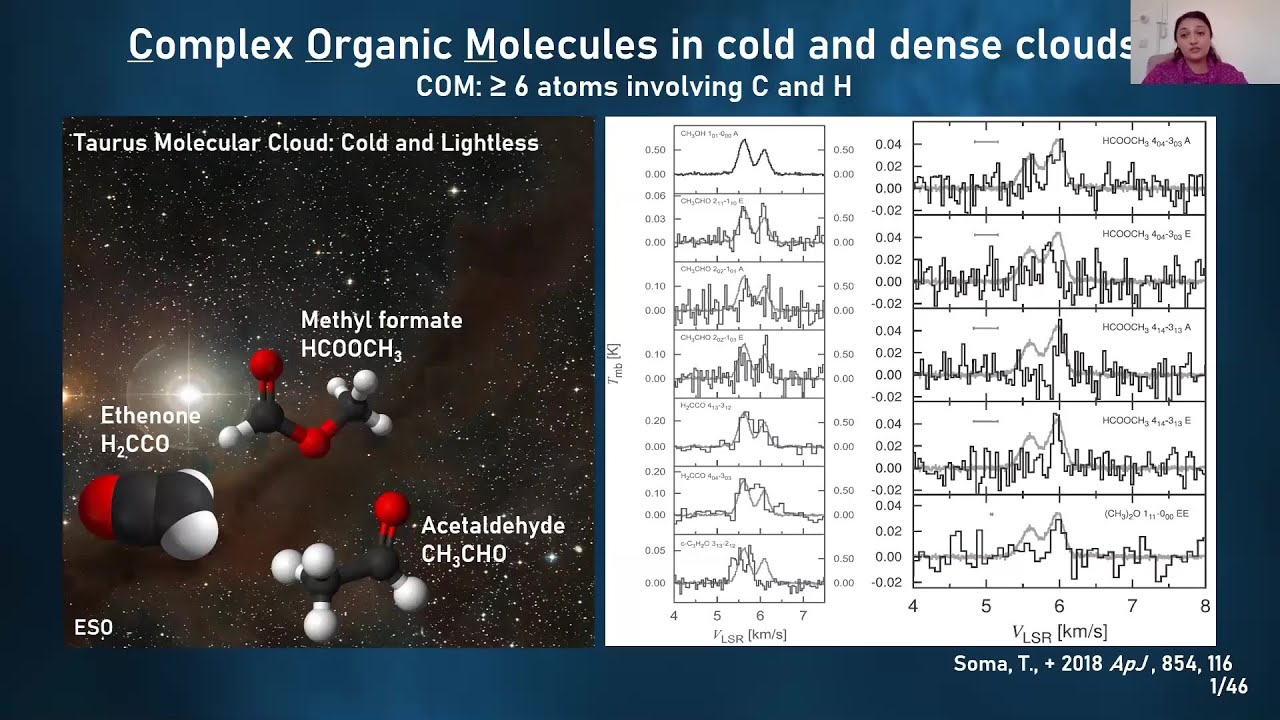






A living planet requires three essential ingredients: a temperate planet with liquid water, water molecules (which are abundant and robust in space), and hydrogen cyanide (a paradoxical molecule that is toxic to advanced life but essential for initiating the chemistry of life). Astronomers using ALMA have detected hydrogen cyanide in planet-forming discs, showing that these key ingredients often come together in regions where planets form, suggesting that potentially living planets may be common throughout our galaxy.
How Chemistry Builds Habitable Planets: A Space Chemist's View
Added:Basic chemical bonding and molecular structure, specifically polar molecules like water (H2O) and simple organic compounds like hydrogen cyanide (HCN).
The nebular hypothesis and the general structure and evolution of protoplanetary disks (accretion disks) surrounding young stars.
The concept of 'snow lines' (or condensation fronts) in astrophysics, which dictate where volatile compounds freeze out in a protoplanetary disk.
Fundamental astronomical concepts regarding planetary habitability, including the liquid water habitable zone.
Prebiotic chemistry pathways, specifically how hydrogen cyanide acts as a fundamental building block for amino acids and nucleic acids (RNA/DNA).
Observational astrochemistry techniques, focusing on how radio interferometry (e.g., ALMA) and infrared spectroscopy (e.g., JWST) detect molecules in deep space.
Exoplanet atmospheric characterization and the modeling of biosignatures in the atmospheres of distant rocky planets.
Cosmochemistry and the physical analysis of carbonaceous meteorites and cometary samples to trace the delivery of prebiotic organic matter to early Earth.
60.3K views1.6Klikes13:32Original Release: 2020-05-05
Transcriber: Ivana Korom Reviewer: Krystian Aparta So I'm pretty sure that I'm not the only one in this room who at some point have found myself, you know, looking up towards the stars, and wondered, you know, "Are we it, or are there other living planets out there such as our own?"
I guess it is possible that I'm then the only person who has obsessed enough about that question to make it my career.
But moving on.
How do we get to this question?
Well, I would argue the first thing to do is to turn our eyes back down from the sky to our own planet, the Earth.
And think about just how lucky did the Earth have to be to be the living planet it is.
Well, it had to be at least somewhat lucky.
Had we been sitting closer to the Sun or a bit further away, any water that we have had would have boiled off or frozen over.
And I mean, it's not a given that a planet has water on it.
So had we been a dry planet, there would not have been a lot of life on it.
And even if we had had all the water that we have today, if that water had not been accompanied by the right kind of chemicals to get life going, we would have a wet planet, but just as dead.
So it's so many things that can go wrong, what are the chances that they go right?
What are the chances that the planet forms with at least the basic ingredients needed to have an origins of life happening?
Well, let's explore that together.
So if you're going to have a living planet, the first thing you're going to need is a planet.
(Laughter) But not any planet will do.
You're probably going to need a rather specific and earthlike planet.
A planet that is rocky, so you can have both oceans and land, and it's sitting neither too close nor too far away from its star, but at the just-right temperature.
And it's just right for liquid water, that is.
So how many of these planets do we have in our galaxy?
Well, one of the great discoveries of the past decades is that planets are incredibly common.
Almost every star has a planet around them.
Some have many.
And among these planets, on the order of a few percent are earthlike enough that we would consider them potentially living planets.
So having the right kind of planet is actually not that difficult when we consider that there's about 100 billion stars in our galaxy.
So that gives you about a billion potential living planets.
But it's not enough to just be at the right temperature or have the right overall composition.
You also need the right chemicals.
And what the second and important ingredient to make a living planet is -- I think it's pretty intuitive -- it's water.
After all, we did define our planet as being potentially living if it had the right temperature to keep water liquid.
And I mean, here on Earth, life is water-based.
But more generally, water is just really good as a meeting place for chemicals.
It is a very special liquid.
So this is our second basic ingredient.
Now the third ingredient, I think, is probably a little bit more surprising.
I mean, we are going to need some organics in there, since we are thinking about organic life.
But the organic molecule that seems to be at the center of the chemical networks that can produce biomolecules is hydrogen cyanide.
So for those of you who know what this molecule is like, you know it's something that it's a good idea to stay away from.
But it turns out that what's really, really bad for advanced life forms, such as yourselves, is really, really good to get the chemistry started, the right kind of chemistry that can lead to origins of life.
So now we have our three ingredients that we need, you know, the temperate planet, water and hydrogen cyanide.
So how often do these three come together?
How many temperate planets are there out there that have water and hydrogen cyanide?
Well, in an ideal world, we would now turn one of our telescopes towards one of these temperate planets and check for ourselves.
Just, "Do these planets have water and cyanides on them?"
Unfortunately, we don't yet have large enough telescopes to do this.
We can detect molecules in the atmospheres of some planets.
But these are large planets sitting often pretty close to their star, nothing like these, you know, just-right planets that we're talking about here, which are much smaller and further away.
So we have to come up with another way.
And the other way that we have conceived of and then followed is to instead of looking for these molecules in the planets when they exist, is to look for them in the material that's forming new planets.
So planets form in discs of dust and gas around young stars.
And these discs get their material from the interstellar medium.
Turns out that the empty space you see between stars when you are looking up towards them, asking existential questions, is not as empty as it seems, but actually full of gas and dust, which can, you know, come together in clouds, then collapses to form these discs, stars and planets.
And one of the things we always see when we do look at these clouds is water.
You know, I think we have a tendency to think about water as something that's, you know, special to us.
Water is one of the most abundant molecules in the universe, including in these clouds, these star- and planet-forming clouds.
And not only that -- water is also a pretty robust molecule: it's actually not that easy to destroy.
So a lot of this water that is in interstellar medium will survive the rather dangerous, collapsed journey from clouds to disc, to planet.
So water is alright.
That second ingredient is not going to be a problem.
Most planets are going to form with some access to water.
So what about hydrogen cyanide?
Well, we also see cyanides and other similar organic molecules in these interstellar clouds.
But here, we're less certain about the molecules surviving, going from the cloud to the disc.
They're just a bit more delicate, a bit more fragile.
So if we're going to know that this hydrogen cyanide is sitting in the vicinity of new planets forming, we'd really need to see it in the disc itself, in these planet-forming discs.
So about a decade ago, I started a program to look for this hydrogen cyanide and other molecules in these planet-forming discs.
And this is what we found.
So good news, in these six images, those bright pixels represent emissions originating from hydrogen cyanide in planet-forming discs hundreds of light-years away that have made it to our telescope, onto the detector, allowing us to see it like this.
So the very good news is that these discs do indeed have hydrogen cyanide in them.
That last, more elusive ingredient.
Now the bad news is that we don't know where in the disc it is.
If we look at these, I mean, no one can say they are beautiful images, even at the time when we got them.
You see the pixel size is pretty big and it's actually bigger than these discs themselves.
So each pixel here represents something that's much bigger than our solar system.
And that means that we don't know where in the disc the hydrogen cyanide is coming from.
And that's a problem, because these temperate planets, they can't access hydrogen cyanide just anywhere, but it must be fairly close to where they assemble for them to have access to it.
So to bring this home, let's think about an analogous example, that is, of cypress growing in the United States.
So let's say, hypothetically, that you've returned from Europe where you have seen beautiful Italian cypresses, and you want to understand, you know, does it make sense to import them to the United States.
Could you grow them here?
So you talk to the cypress experts, they tell you that there is indeed a band of not-too-hot, not-too-cold across the United States where you could grow them.
And if you have a nice, high-resolution map or image like this, it's quite easy to see that this cypress strip overlaps with a lot of green fertile land pixels.
Even if I start degrading this map quite a bit, making it lower and lower resolution, it's still possible to tell that there's going to be some fertile land overlapping with this strip.
But what about if the whole United States is incorporated into a single pixel?
If the resolution is that low.
What do you do now, how do you now tell whether you can grow cypresses in the United States?
Well the answer is you can't.
I mean, there's definitely some fertile land there, or you wouldn't have that green tint to the pixel, but there's just no way of telling whether any of that green is in the right place.
And that is exactly the problem we were facing with our single-pixel images of these discs with hydrogen cyanide.
So what we need is something analogous, at least those low-resolution maps that I just showed you, to be able to tell whether there's overlap between where the hydrogen cyanide is and where these planets can access it as they are forming.
So coming to the rescue, a few years ago, is this new, amazing, beautiful telescope ALMA, the Atacama Large Millimeter and submillimeter Array in northern Chile.
So, ALMA is amazing in many different ways, but the one that I'm going to focus on is that, as you can see, I call this one telescope, but you can there are actually many dishes in this image.
And this is a telescope that consists of 66 individual dishes that all work in unison.
And that means that you have a telescope that is the size of the largest distance that you can put these dishes away from one another.
Which in ALMA's case are a few miles.
So you have a more than mile-sized telescope.
And when you have such a big telescope, you can zoom in on really small things, including making maps of hydrogen cyanide in these planet-forming discs.
So when ALMA came online a few years ago, that was one of the first things that I proposed that we use it for.
And what does a map of hydrogen cyanide look like in a disc?
Is the hydrogen cyanide at the right place?
And the answer is that it is.
So this is the map.
You see the hydrogen cyanide emission being spread out across the disc.
First of all, it's almost everywhere, which is very good news.
But you have a lot of extra bright emission coming from close to the star towards the center of the disc.
And this is exactly where we want to see it.
This is close to where these planets are forming.
And this is not what we see just towards one disc -- here are three more examples.
You can see they all show the same thing -- lots of bright hydrogen cyanide emission coming from close to the center of the star.
For full disclosure, we don't always see this.
There are discs where we see the opposite, where there's actually a hole in the emission towards the center.
So this is the opposite of what we want to see, right?
This is not places where we could research if there is any hydrogen cyanide around where these planets are forming.
But in most cases, we just don't detect hydrogen cyanide, but we detect it in the right place.
So what does all this mean?
Well, I told you in the beginning that we have lots of these temperate planets, maybe a billion or so of them, that could have life develop on them if they have the right ingredients.
And I've also shown that we think a lot of the time, the right ingredients are there -- we have water, we have hydrogen cyanide, there will be other organic molecules as well coming with the cyanides.
This means that planets with the most basic ingredients for life are likely to be incredibly common in our galaxy.
And if all it takes for life to develop is to have these basic ingredients available, there should be a lot of living planets out there.
But that is of course a big if.
And I would say the challenge of the next decades, for both astronomy and chemistry, is to figure out just how often we go from having a potentially living planet to having an actually living one.
Thank you.
(Applause)
Up Next

66:26
Exoplanet Atmospheres: Protoplanetary Disk Chemistry
@cfacolloquium3139
2.3K views•2017-12-14
61:17
First Billion Years of the Universe with the Square Kilometre Array
@iaaudc
121 views•2022-05-26
4:40
Cosmic Rays: Messengers from Deep Space | Science Explained
@TEDEd
198K views•2014-09-23
6:10
Gamma-Ray Bursts: Cosmic Snipers Explained | Astronomy
@kurzgesagt
15M views•2016-07-31
Related Study Plans & Knowledge Roadmaps
Structured learning paths in Astronomy
astronomy
Reionization: Pop III Stars, IGM & 21cm Line
01Foundations of Cosmology & the Early Universe
02Population III Stars & Cosmic Dawn
03Physical Mechanisms of Reionization
+ 2 more learning modules
17h5 modules
Explore Roadmap
astronomy
Planetary Rings: Dynamics, Roche & Resonances
01Foundations of Gravity and Orbital Mechanics
02Tidal Forces and the Roche Limit
03Structure, Composition, and Collisions
+ 2 more learning modules
10h5 modules
Explore Roadmap
astronomy
Asteroseismology: Stellar Waves, Ages & Cores
01Foundations of Stellar Astrophysics & Wave Mechanics
02Stellar Oscillation Modes: P-modes and G-modes
03Mathematical Framework of Asteroseismology
+ 2 more learning modules
35h5 modules
Explore Roadmap
astronomy
Adaptive Optics: Physics, Engineering & Control
01Foundations of Wave Optics and Wavefronts
02Atmospheric Turbulence & Optical Distortion
03Wavefront Sensing Technologies
+ 3 more learning modules
35h6 modules
Explore Roadmap