

















Rotational spectroscopy studies molecular rotational motion using microwave radiation, where the energy levels follow the formula E_J = (ħ²/2μR₀²)J(J+1) with quantum number J, and the selection rule ΔJ = ±1 applies; the spacing between rotational energy levels increases with J, described by ΔE = 2hcBJ(J+1) where B is the rotational constant, and only molecules with a permanent dipole moment can undergo rotational transitions.
Rotational Spectroscopy: Quantum Rigid Rotor & Selection Rules
Added:Basic concepts of classical rotational mechanics, including moment of inertia, reduced mass, and angular momentum.
Fundamental quantum mechanics principles, specifically energy quantization, wavefunctions, and solving the Schrödinger equation.
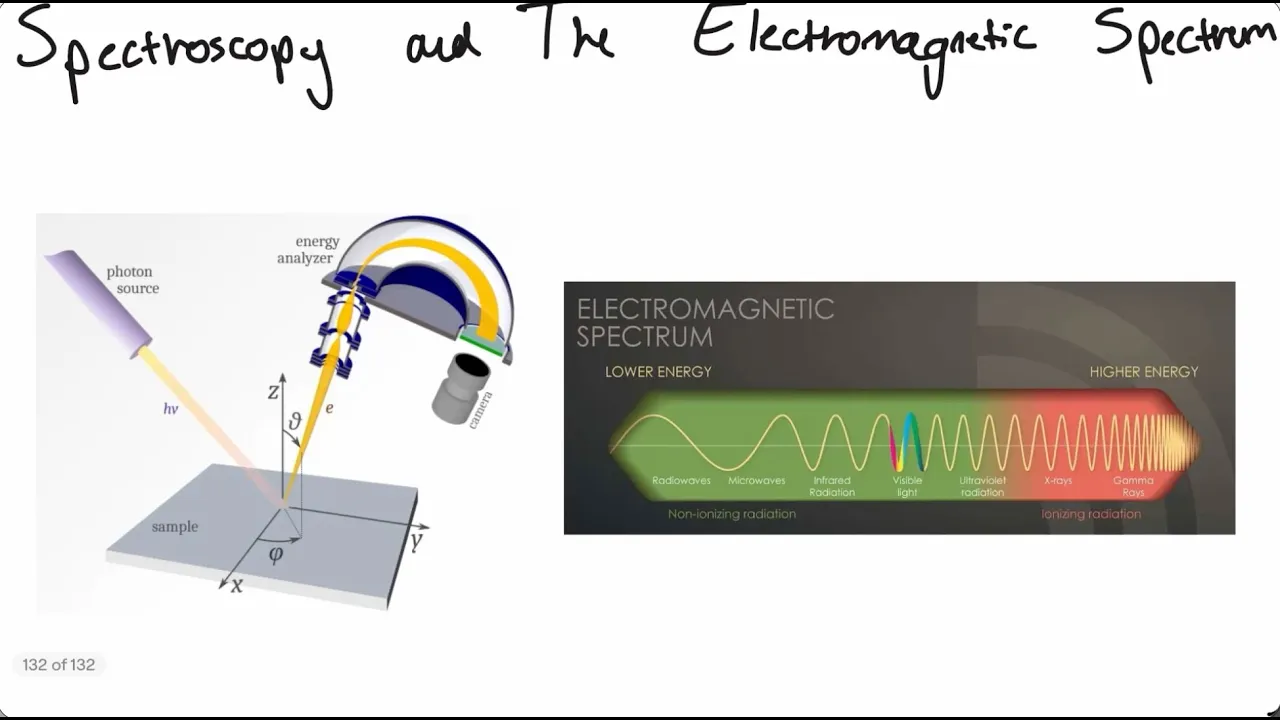
The electromagnetic spectrum, specifically understanding the energy scale of microwave radiation and the basics of photon absorption.
Molecular structure of diatomic molecules, including the concept of permanent electric dipole moments.
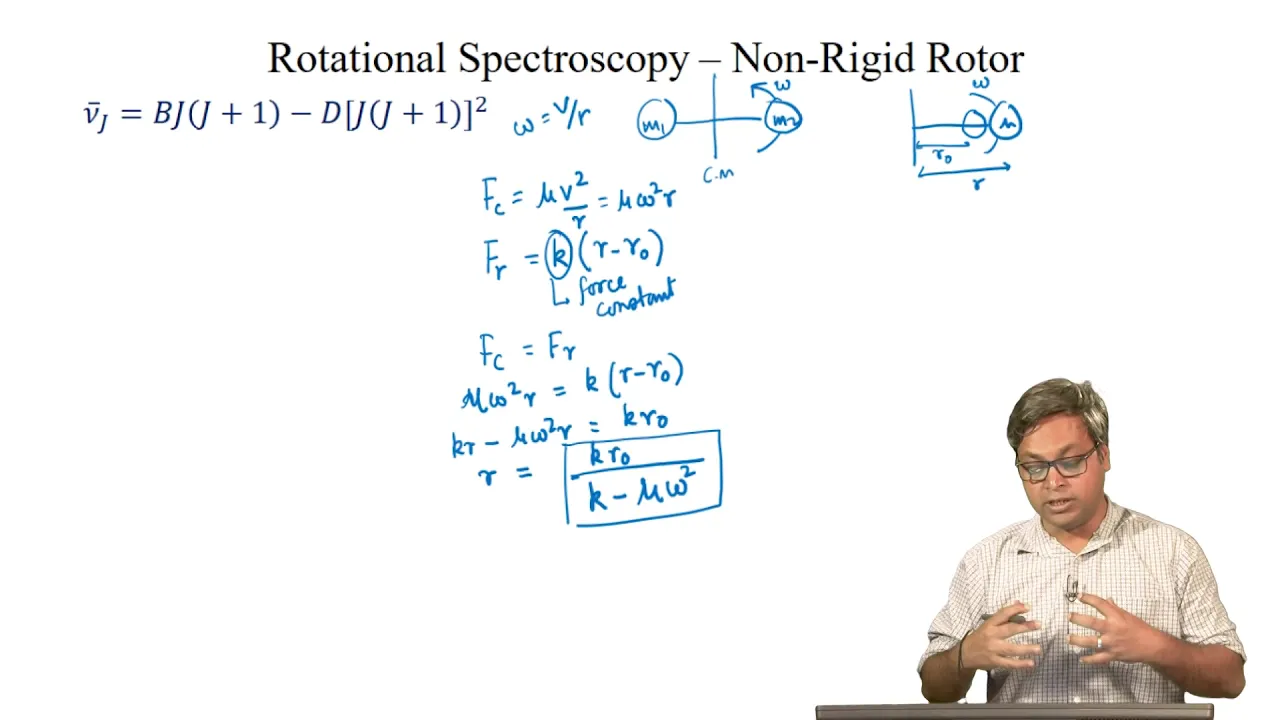
The Non-Rigid Rotor Model: Learning how centrifugal distortion affects rotational energy levels at high rotational states.
Rovibrational Spectroscopy: Examining the simultaneous transition of vibrational and rotational states (resulting in P, Q, and R branches in IR spectra).
Rotational Spectroscopy of Polyatomic Molecules: Classifying and analyzing linear, symmetric top, asymmetric top, and spherical top molecules.
Real-world applications of microwave spectroscopy, such as determining precise molecular bond lengths and identifying molecules in interstellar space via radioastronomy.
7K views87likes22:30Original Release: 2020-04-22
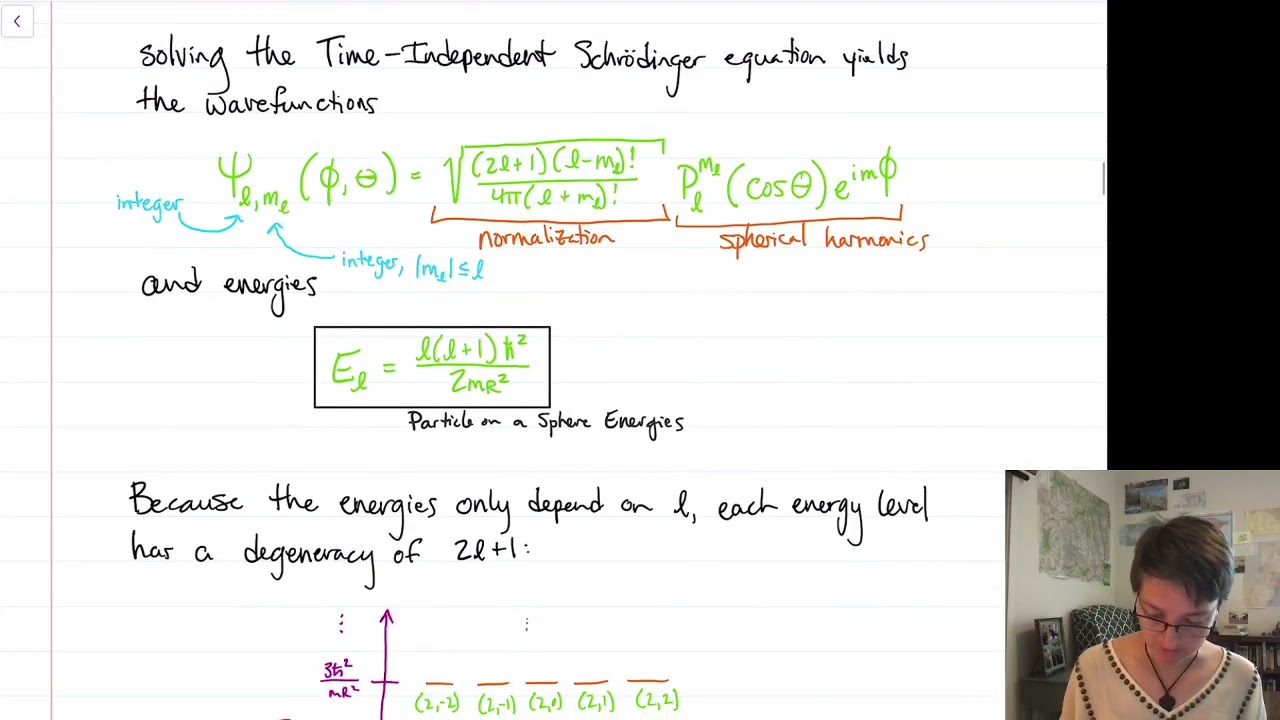
okay in this lecture we're going to start describing rotational spectroscopy how we think about rotational motion how it's based on the 3d rigid rotor and quantum mechanics what the selection rule of the rotational spectroscopy looks like and we'll get into rotational constants and the spacing between energy levels in rotational motion and rotational spectroscopy so maybe we can begin here by thinking something about how light's induces rotational motion okay so how could you change rotational motion and indeed that's what you're doing and purely rotational spectroscopy so in previous lectures we described electronic spectroscopy which is the change in organization of electrons we described vibrational spectroscopy the change in vibrational amplitudes for given frequencies of a molecule and now we're going to talk about rotational spectroscopy okay and rotational spectroscopy uses microwave radiation and you don't have enough energy to change vibrational state or change the organization of electrons so you're only changing the rotational motion so how does light change this rotational motion well we consider not this particle but this wave picture of light where you have a molecule we've often talked about HCl so maybe again here's a CH ears CL and imagine this between a set of plates right and these plates have charge and a negative charge and while there's a dipole here so chlorine is negative hydrogen is positive and so there's going to be a net motion this way and this way now if I'm going to then change the electric field to negative and positive on these plates right well sometime later this has moved I should actually show this having moved in the first case there's the motion this thing moves and if I time it right such that after the chlorine gets up here it should be bigger chlorine gets up here and the hydrogen is down here if I now change it to negative and positive right well now there's a repulsion of the chlorine here and a repulsion of the hydrogen here away from the positive turns the negative or it's the negative and so now there's this rotational motion that I'm inducing it has everything to do of when I switch these right when I switch the signs of this electric field and so it's no surprise that it depends on you know this time barring electric field that is light so if this light generates this changing electron electric field at the right frequency it can induce this type of motion and so what are the energies of rotation okay and the energies of rotation while we've solved the eigenenergies from solving shorteners equation near the hamiltonian for rotational motion was built out of our 3d rigid rotor and the eigenenergies we got out we're following this formula h-bar squared over 2 mu R naught squared L L plus 1 right the wavefunctions here we're spherical harmonics so you can go back and review our lecture on 3d widget rotors and spherical harmonics and solving the Schrodinger equation but these are the eigen energies you get out for the spherical harmonic wave functions that describe three-dimensional rotation so we solved the Schrodinger equation with our appropriate Hamiltonian the potential energy Hamiltonian part of that was zero because it's free rotation in two dimensions we use polar coordinates and three-dimensional we use spherical coordinates and so we had this solution of what the energies are for this 3d motion now importantly this 3d rigid rotor just to review all of this math we did applies to talking about here right rotating with respect to one another you but it also applies to and this is the first time we talked about it it applies to electrons orbiting the nucleus as we were trying to understand what that motion looked like as we were building the hydrogen atom in quantum mechanics so when the electron was orbiting the nucleus we called that angular motion and angular momentum l and the energies that led to H bar squared over 2m you are not squared R is the bond distance here right of this rigid bond and mu is the reduced mass okay and Eldon is the quantum number that stands for angular motion angular momentum okay now in atoms rotating with respect to each other we give this angular momentum a different letter so it's not quite as confusing and we call this J okay so this is really going to be H bar squared over 2m you are not squared J J plus 1 it's the same formula we're just swapping out L for electron orbits and atoms for J rotational motion it's the same kind of physics so we get the same exact solution to Schrodinger's equation okay so that's a little bit of review of for where we came up with these rotational energies that we're going to think about in rotational spectroscopy as a brief aside here I probably should mention that you know this J here is not the same as the term symbols from lectures we gave not too long ago right for atomic term symbols this is not angular momentum this is a total angular momentum different J and I know it's confusing but just keep in mind that this is not the same J as this this is a quantum number or the rotational energy state this has something to do with the total spin orbit coupling G the momentum okay so just make sure we're keeping this rotational J different it's the quantum number for rotational energy of molecules so let's think about labeling these J levels on our Morse potential again this Morse potential represents a given organization of electrons who knows what it is but maybe the term symbol that we've talked about in previous lectures that describes this organization of electrons is 3 Sigma G plus fine this is a potential energy surface which tells us the energy as a function of this bond distance R there are different vibrational energies of the nuclei within of course this organization of electrons and we call that N equals zero we can look at an excited vibrational state N equals 1 and now we can think about for this vibrational motion and this organization of electrons how does the molecule rotate well there are different energy levels we can call them J equals zero equals one equals two equals three etc keep going up so this is how we would label them with that rotational quantum number now how do we derive the selection rule if I want to think about one of these energy levels down here that I'm rotating with what other J states can I go to and I go from J equals 0 to J equals 2 can I go from J equals 0 to J equals 3 which ones are allowed that is what a selection rule tells us and we derive this explicitly for vibrations and we talked about doing this for vibrations based on this transition dipole element from state M of the molecule to state M of the molecule with regard to some variable X where I guess X here were talking about R instead that's this bond distance here so you could say this is a function of R if you wanted the book that I use uses X instead so use whatever you want okay but this transition dipole has to do with this singular dimension because this is a diatomic there was only one distance that matters the distance between the atoms so for deriving the selection rule well it's going to be the same exact formula we use for the vibrational case right where we're doing an integral or the wave function of the second state em complex conjugate of the dipole moment of the molecule mu then the original state n where the dipole is a function of this distance X DX okay now this dipole moment we approximated and used a Taylor series to get to the vibrational selection rule in terms of a rotating molecule a simple approximation is that this dipole moment is some permanent dipole moment but is dependent on the angle of rotation not too important to worry about now that's the functional form we're going to use the functional form of the wave functions here and the vibrational case we used harmonic oscillators but here of course we're using the spherical harmonics that is our wave function for rotational motion you can go back and watch the previous video where we talked more about deriving selection rules or harmonic oscillator and the transition dipole moment for vibrations you can do the same thing here for rotations using the spherical harmonics using this functional form and what you show in the end is that the change in J has to be plus or minus 1 although this will only work for the case here like we've done a diatomic for a linear molecule okay so no need to go through all the math at this stage that's what you get to in the end okay for linear molecules and that's basically what we're going to focus on today we can also show during this right extrapolation if I wanted to that a dynamic dipole that we talked about mu Prime this is the one that matters for vibrations okay this falls out when we do this integral and the only thing that matters is mu not this permanent dipole moment we talked about this a few lectures ago we we sort of foreshadowed this that the permanent dipole matters for rotations and the dynamic one does not and the opposite is true only the dynamic matters for vibrations go back and watch the previous lecture to learn about the implications of that but here it's the permanent dipole that matters for rotation but dynamic dipole drops out completely and so for purely rotational transitions like this one J equals zero to J plus one or this purely rotational transition you have to have a permanent dipole okay now if we were doing something with IR light where we're changing rotational state and vibrational state well all bets might be off there but for just microwave spectroscopy I are light which is higher energy but just microwave light we're obeying this and the molecule must have a permanent dipole in order to be subjected to the influence of that micro microwave radiation now one thing you might notice here is that when I drew these rotational States they're getting further apart okay so as I'm thinking about this spacing of J equals zero the J equals one to J equals 2 I'm going to exaggerate it here a little bit to J equals 3 and so on the spacing between these is changing this Delta e is different than this J plus 1 Delta e remember here the energies that I'm caring about is H bar squared over 2m you are not a squared J times J plus 1 so maybe as an exercise we can think about and walk through why is this increasing okay so that's maybe derived LTE what is the change in energy or J 2 J +1 okay well I can think about it's going to be final minus initial so put in 4j j plus one okay the energy of this excited J plus one state will look like this J I have J plus 1 instead of J I have J plus 1 and then there's another plus 1 alright so I'm just substituting each J here I'm substituting in J plus 1 so that's the final - my initial state where J is just J now I can expand this this of course is j+ too and I can foil this out my Delta energy here will be H bar squared over 2m you are not squared J squared plus 3 J plus 2 and down here I have J squared plus J you so this will end up dropping out one of these J's will cancel one of these here and in the end by combining all this I'll have a spacing between energy levels that looks like this UJ + 2 factor out of two which will cancel with this too and I'll get H bar squared over mu R naught squared J +1 okay thereby proving that the spacing between energy levels here depends on J the energy level I'm starting at okay so what is going to be the lowest delta e well it's when I'm starting with J equals zero the spacing of the next is going to be when J equals one the spacing of these two is when J equals two and so this amount of separation between the states okay Delta e increases with increasing J okay so the spacing delta-t depends on J and it increases as J increased creases which if you look back and think about the spacing of vibrational states is exactly the opposite vibrational states actually end up getting spaced closer together as you go up and well it depends on the functional form of the eigenenergies and you can go back and derive this that they get so close spaced together here that they all converge up here and they're basically a bunch of closely spaced States yep so that's one difference between strictly rotational and strictly vibrational energy states yep now usually instead of these types of formulas with J you're going to see formulas that might look like this you might encounter a rotational constant B or Bey depending on how much you like it so usually you're going to encounter things in terms of B which sort of wraps up a lot of these constants in the eigenenergy formula so B we're going to set equal to 8 pi squared see mu R naught squared okay now these rotational constants obviously it's a lot of constants but it does depend on the exact molecule you're talking about alright because it depends on the bond length and V reduced mass right but you can plug all this in to sort of show that the eigenenergy instead of this you can also write by lumping a lot of these constants together and get something that looks like H C rotational constant that is all this wrapped up times J plus one we still have to have the quantum number J in there as well okay this is just much more concise when you look up a rotational constant okay it's not a constant universally but it's a constant for that molecule for that reduced mass where you are assuming again this rigid rotor right this constant bond length okay so the bond length actually is not constant and that will explain some sort of deviation from you know ideal behavior we might expect in rotational spectroscopy but we'll talk about that in a future lecture the next one I believe we can then also change our Delta energy formulas it looks something like this to HC be J plus 1 this is actually for absorption and the change in energy is going to be - to HC E J or omission okay so this top formula here is the one we derived by putting in j j plus 1 here and coming up with this formula and then substituting in our new rotational constant b that is sort of the way it's usually written and expressed okay so for absorption when i'm going up in energy right from here to here what is the space and energy well that space in energy is going to be 2 times H times C times B times J plus 1 in this case J is 0 or this transition right J would be 1 for this transition J would be 2 for this transition ok or emission right it's always the one I'm starting from J equals 3 to 2 or 2 to 1 one to zero and what is that change in energy well that's going to look like this for a mission okay and again we care about these energies because this is exactly what we're seeing it's this change in energy we're seeing in a city versus frequency or versus energy rotational spectrum right so the peaks I'm going to see in my rotational spectrum are at the frequencies that correspond to these changes in energy right that is what a spectrum is when it's involving light you can have mass spectrum but a light spectrum it's about that molecule that atom that entity changing quantum energy levels making that quantum leap and so it's the difference in that energy that corresponds to the energy of the peak on here okay so this is not a static thing right this peak here is about a transition between two different energy levels and this change in energy level here is exactly what you're seeing H nu or HC over lambda if you prefer wavelengths so now we have to take this and sort of start to understand what the spectrum looks like cuz it doesn't look like this that's just you know meant to sort of visualize what the Delta e is but what is our rotational spectra really going to look like and that is what we were going to talk about in the next lecture so look forward to that that'll do it for this video and see you next time for more rotational spectroscopy
Up Next
10:54
Freezing Moving Water: Low-Temperature Physics Experiment
@TheActionLab
4.7M views•2021-02-28

12:53
21cm Hyperfine Transition in Neutral Hydrogen: Radio Astronomy Basics
@AaronRobertParsons
12.4K views•2011-10-13

32:32
NMR Spin Physics I: Zeeman Effect, Resonance Condition & Larmor Frequency
@nptel-indianinstituteofsci8064
2.3K views•2024-01-17

27:14
Entropy and the Second Law of Thermodynamics Explained
@veritasium
27.5M views•2023-07-01
Related Study Plans & Knowledge Roadmaps
Structured learning paths in Physics
physics
Nuclear Physics (Decay, Fission & Reactors)
01Atomic Structure and the Binding Force
02Radioactive Decay and Half-Life
03Nuclear Fission Mechanics and Chain Reactions
+ 2 more learning modules
12h5 modules
Explore Roadmap
physics
Soft Matter (Polymers, Colloids & Rheology)
01Foundations of Soft Matter & Thermal Forces
02Polymer Physics and Macromolecules
03Colloids, Surfactants, and Self-Assembly
+ 2 more learning modules
38h5 modules
Explore Roadmap
physics
Analytical Mechanics: Lagrangian & Hamiltonian
01Mathematical Foundations: Calculus of Variations
02From Newtonian Mechanics to Constraint Dynamics
03The Principle of Least Action & Lagrangian Mechanics
+ 3 more learning modules
28h6 modules
Explore Roadmap
physics
General Relativity (Spacetime & Cosmology)
01Foundations of Relativity: Special Relativity
02The Geometry of Spacetime: Equivalence Principle & Curvature
03Einstein's Field Equations: The Mathematics of Gravity
+ 2 more learning modules
55h5 modules
Explore Roadmap