













This webinar presents strategies for optimizing homology-directed repair (HDR) efficiency in CRISPR-Cas9 genome editing, emphasizing that HDR success depends on balancing three key factors: Cas9 activity at the target site, guide RNA specificity, and the distance between the double-strand break and the insertion site (HDR efficiency drops from 83% at 10 nucleotides to ~13-16% at 100 nucleotides away). The presenter recommends using synthetic dual RNA approaches for easier guide RNA generation, employing 30-40 nucleotide homology arms for oligo donors and 500-1000 nucleotide arms for plasmid donors, and always disrupting the Cas9 target site in the donor template to prevent secondary cleavage. HDR efficiencies range from 1-5% for GFP tagging to over 20% for short insertions when using integrated Cas9 cell lines.
Optimizing Homology Directed Repair (HDR) with CRISPR-Cas9 | Webinar Insights
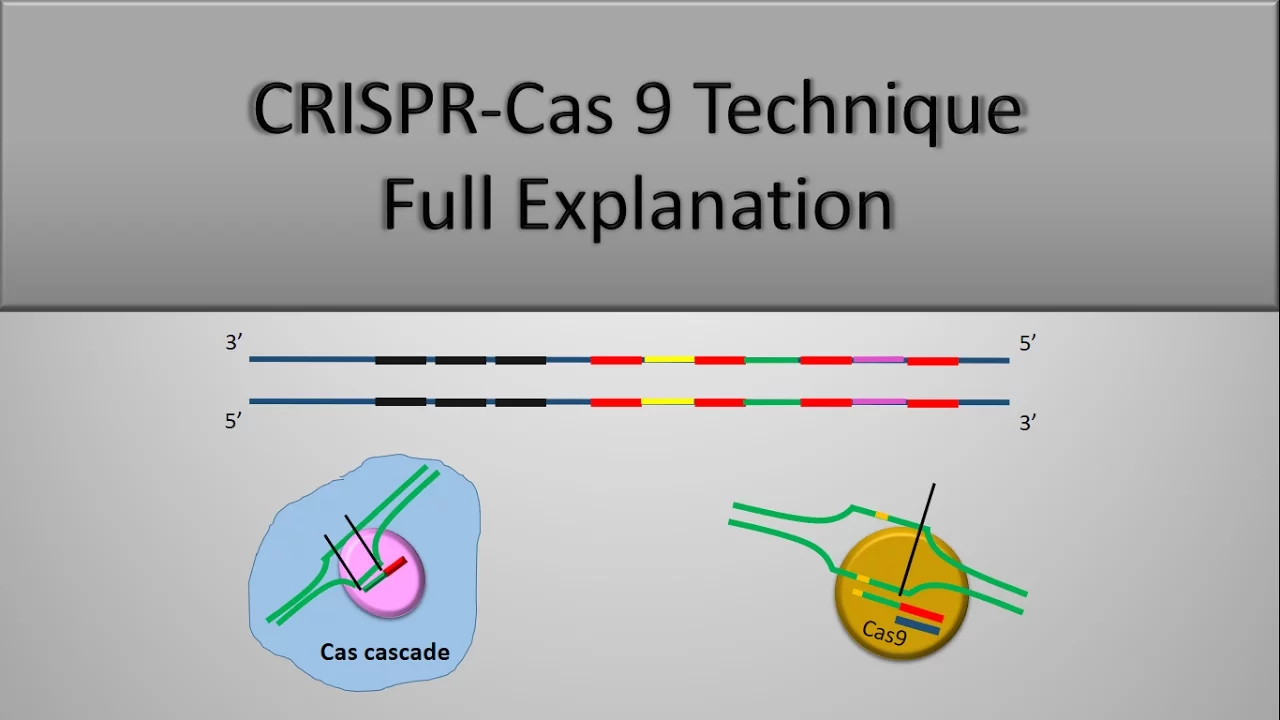
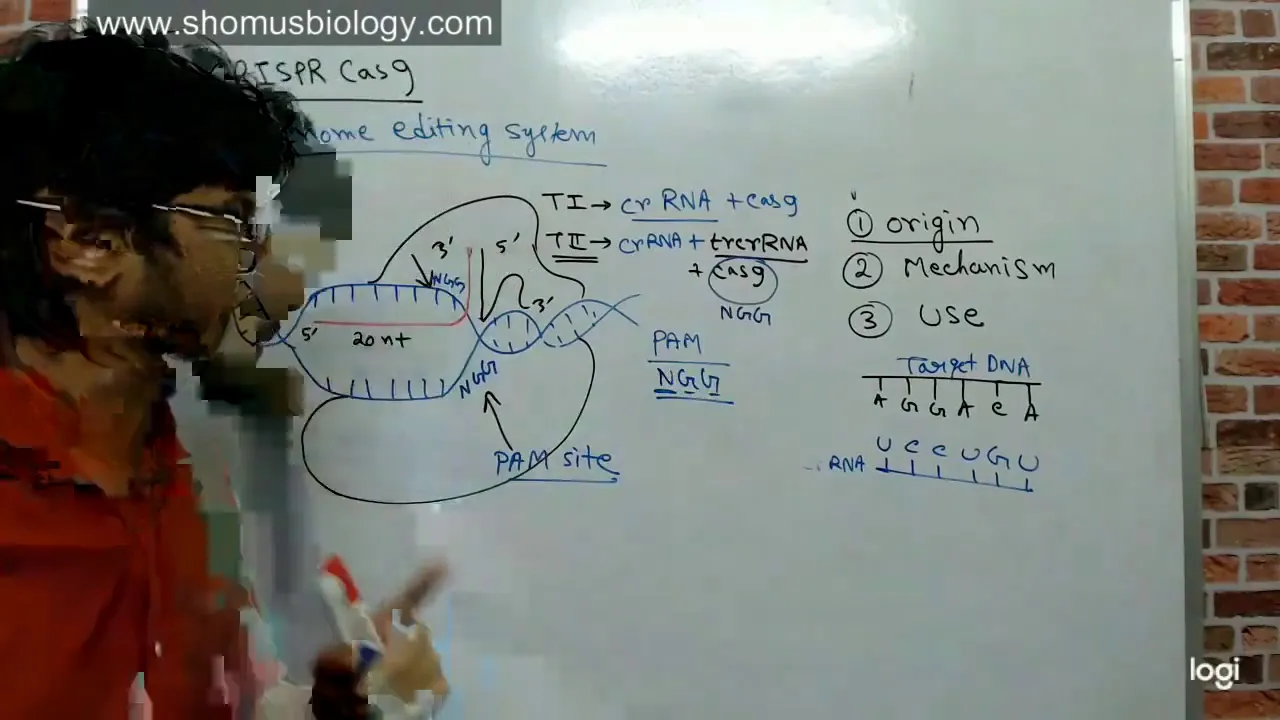
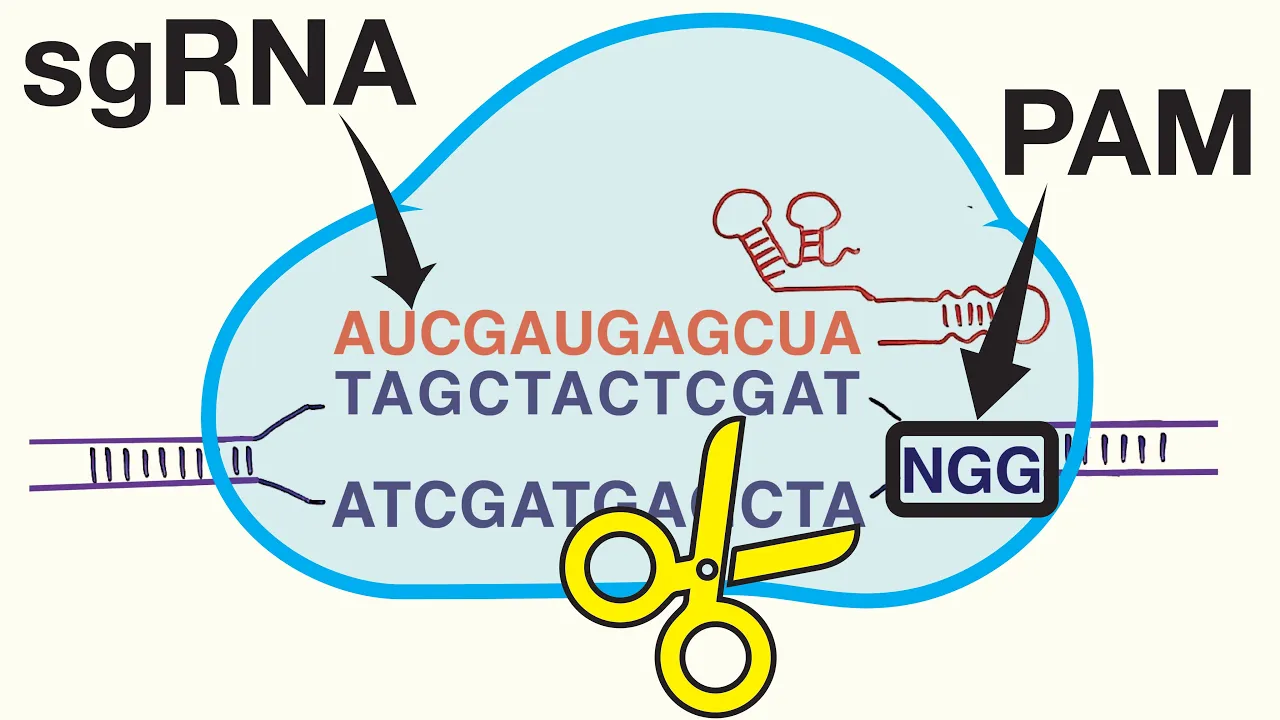
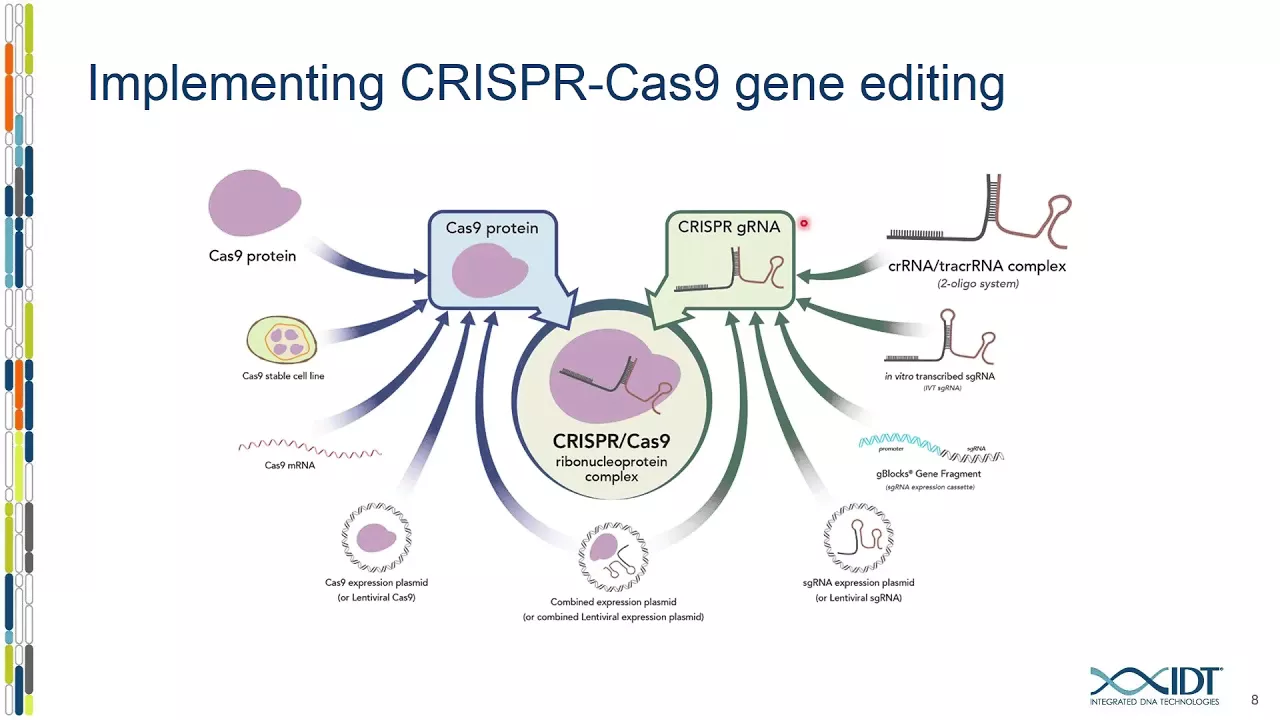
Added:hello everyone welcome to today's live broadcast optimizing homology directed repair results with crisper cast 9 I am Brenda Kelly Kim of labroots and I'll be your moderator for today's event today's webinar is presented by labroots and sponsored by GE Healthcare GE Healthcare continues to be an innovator in the field of Gene editing and crisper cast 9 research launching the very first synthetic crisper cast 9 guide RNA solution and now offering one of the most comprehensive Gene editing portfolios in the industry GE remains focused to developing the most effective research tools for their customers for more information about ge's crisper cast 9 Solutions please visit www.g Lifesciences docomo you can submit questions during this interactive event by typing them in the Q&A box which can be found by clicking on the green Q&A button at the lower left of the presentation window we'll try to answer as many questions as we can you can enlarge the slide window by clicking on the screen icon in the lower right hand corner of the slide window if you have any technical problems viewing or hearing this presentation please click on the support button at the top right of your presentation window or submit your problem through the green Q&A button lower left this webinar has been approved for continuing educational credits please click on the C button at the bottom left corner and follow the process to receive your credits I would now like to introduce today's speaker Dr John shial John shial is a research scientist at dharmacon part of GE Healthcare and develops research tools for RNA interference and crisper cast 9 genome engineering he received his Bachelor of Science degree in Biochemistry at Colorado State University and his PhD degree in cell biology at the University of Colorado he also completed a post-doctoral fellowship at the University of Massachusetts Medical School I will now turn it over to Dr sheeld for his presentation hi and welcome everyone thank you Brenda for that introduction and thanks to everyone for joining us today as Brenda said I'm a research scientist here at GE Healthcare and today I want to talk to you about optimizing homology directed repair result with Christopher cast 9 for today's webinar I'll be discussing crisper cast 9 and the Dual synthetic RNA approach I'll go into homology directed repair also known as HDR and I'll do this with crisper cast 9 I'll go into some of the background uh with HDR and crisper cast 9 and then also go into some examples uh such as insertion of short DNA sequences with HDR and a synthetic DNA aligo and then also an example where we insert an N terminal gfp tag uh by using a donor plasmid okay so on to our first topic crisper cast 9 and the Dual synthetic RNA approach many of you have likely done a lot of Gene editing using crisper cast 9 but I want to describe the mechanism to be sure that we are all using the same words and definition there are three important components the crisper RNA the transactivating small RNA or Tracer r RNA and the cast n nucleas the active crisper RNA is comprised of 20 nucleotides of spacer derived sequence and 22 nucleotides of repeat derived sequence as depicted in the cartoon off to the right of this slide each crisper RNA hybridizes to a transcribed Tracer RNA through a repeat derived sequence found on the crisper RNA to form a crisper RNA Tracer RNA hybrid now it is this hybrid RNA complex that loads into C9 and guides the C9 protein to cleave the DNA Target site adjacent to the protospacer adjacent Motif also referred to as a Pam site as we all know by now chrisper cast 9 Gene editing was demonstrated in human and mouth cells starting in 2012 with several important Publications from Dr sharpener DNA church and Zang on the top right of this slide is an interesting concept that was demonstrated by these groups whereby the crisper Arna and Tracer RNA were actually fused together by a Linker Loop to form a single guide RNA molecule that was able to be expressed on a plasmid since then there have been hundreds of Publications utilizing crisper cassine system in Mamon cells as well as many other organisms such as zebra fish seelan and pigs and the goes on and on the utility of Christopher cast 9 has revolutionized how quickly we can knock out genes to address our biological question at GE Healthcare we offer the editor line of products that enable researchers to use cast n to induce a double strand break within your Genome of Interest once a doubl strand break is generated by cast 9 the cell can initiate various DNA repair repair mechanism a common repair mechanism that is used by the cell is nonhomologous enjoining or nhj for short this repair pathway is often imprecise as it joins the two broken ends of DNA and forms various size insertions and deletions also known as endel an alternate repair pathway that the cell is able to employ is homology directed repair this repair pathway is a precise repair pathway that needs a donor template to guide the broken DNA back into place this donor template can come endogenously from the cell in the form of a sister chromatid or can also be introduced into the cell in the form of a synthetic DNA oligo or a donor plasmid researchers have utilized HDR to make precise modifications in different cell lines and model organisms they are correcting mutated genol knocking in large expression cassettes into OMC Safe Harbor sites and even tagging their genes of Interest with the gfp or other fluorescent proteins when designing a crisper experiment for nhj the researcher needs to decide the source of cast n and also the source of guar there are many different ones to choose from so I want to go over those now here at GE we offer cast nine in several forms such as pre-made lentiviral particles that Ena the creation of a stably expressed ing C9 line these linty viral particles come in different promoter options as depicted here these different promoters will help ensure maximum expression in your cell line of Interest similar to our cast 9 lentiviral particles we also offer cast 9 expression plasmids that have these same promoter options these cast 9 plasmids have the additional benefit of having the flexibility of expressing either MK2 so a far red fluorescent protein or a pyosin resistance Gene with a t2a fusion so a self-cleaving peptide with cast 9 we also have two C9 DNA free options in the form of cast 9 mRNA and casine recombinant protein When selecting a source of the guide RNA we also have a few different options to decide between utilizing our experience at making synthetic RNA we are able to make synthetic crisper RNA and synthetic Tracer RNA I'll go into this a little bit more detail later on we also offer single guide rnas as lentiviral particles for difficult to transfect cells lastly we're able to leverage our patented chemistry to be able to synthesize this long synthetic single guide RNA it is important to say that any of our cast 9 products on the left hand side of this slide are compatible with any of the guide RNA sources on the right hand side of this slide all these different choices are important because as you will see later on maximizing double strand braks in your system will increase chances of getting your desired HDR modification now when performing an experiment that will utilize HDR you also need to consider the source of the donor template common DNA templates that are used are synthetic DNA oligos and donor plasmine again I'll talk a little bit more about these later when I get into specific examples utilizing a single stranded DNA oligo and utilizing a DNA donor plasmid but first I want to get back into choosing guide RNA so let's discuss this in a little bit more detail currently the guide RNA is offered either as a single molecule Vector Express single guide RNA or as an RNA based guide RNA that can be in the form of a single or dual RNA system as I list on this Slide the vector-based single guide RNA expresses crisper RNA and Tracer RNA as a single molecule which enables enrichment for the sgrna when introduced into cells you can also use this sgrna system to perform lenty viral pooled screening on the other hand RNA based guide rnas have transient activity that do not have a risk of DNA integration these are easily transfectable and can be used to perform aray screening in 2014 we were the first company to deploy the synthetic dual RNA approach for crisper cast 9 guide rnas with the launch of our editor product line This synthetic dual RNA system is exactly like the natural bacterial system with a custom synthetic RNA comprising the 22 20 nucleotide Target sequence and the 22 nucleotide fixed ESP pyogenes repeat sequence this crisper RNA will bind to our Tracer RNA which we also make synthetically We Believe believe this approach makes it easier for the researcher because it does not require cloning to generate your guide RNA additionally with this being a synthetic RNA system it provides the possibility of chemical modifications to enhance functionality and to perform arrayed screens using phenotypes that are not amenable to pooled screens now paying attention to the Tracer R name here at GE Healthcare dharmacon our patented two prime Ace chemistry is really ideal For the synthesis of long RNA such as this 4074 nucleotide Tracer RNA this chemistry provides fast coupling rates high yields and greater Purity than traditional RNA protection strategies on the left hand side of this slide is a UPL trace of our editor Tracer RNA demonstrating the highquality RNA that is routinely synthesized by dharmacon so with all of these re in mind I would like to speak about using them to perform homology directed repair one thing to note though in many cell types natj dominates DNA repair during G1 s and G2 phases of the cell cycle whereas HDR is restricted to late s and G2 phases of the cell cycle when DNA replication has completed and sister chromatids are available to serve as repair templates however even in late s and G2 NJ is still active still competing with HDR and it is often more efficient at repairing double strand DNA breakes now when the crisper craze began in 2012 and 2013 researchers were able to demonstrate the utility of using crisper cast 9 with HDR for example ran it all uh so the tart the chart at the top left of the screen shows varying levels of HDR efficiency at different crisper sites and these levels varied between the wild type cast 9 and the cast 9 nicas additionally rats at all and other researchers have been able to knock in GSP tags under the expression of the endogenous Gene targets and so this is shown in the the top right part of this slide and these groups were also able to show that the advantages over these methods over traditional gfp overex expression plasmid and lastly at the bottom of this slide ly at all were able to synchronize cells in various stages of the cell cycle using nool synchronization and they synchronized these cells at the g2m boundary of the cell cycle and they were able to show that HDR Knockin rates across all donors tested were increased when thinking of designing an HDR experiment you will need a method to determine whether or not your HDR experiment worked I'm sure many of you are familiar with most of these methods but here I have listed some of the most common methods used to identify successful HDR Gene editing the first method I list is PCR based detection assays that require the amplification of specific genomic regions around your HDR Target site junctional PCR requires PCR primer specific to the HDR change that you are making and another primer to a nearby genomic sequence amplification with this primer pair allows you to gauge if your experiment has worked or not the restriction fragment length polymorphism assay or riff lip for short requires a restriction enzyme site to be present in the PCR product and successful HDR will either create or remove the Restriction enzyme site and this can be easily detected when the PCR product is digested with the Restriction enzyme and ran out on an auros gel next florescent reporters are pretty straightforward you just need to visualize to confirm uh the correct localization and lastly Sayer sequencing of the genomic region involved in your HDR experiment will also allow you to identify if you have performed successful HDR now I want to get into some of the details about choosing a crisper Target site for HDR Gene modification you need to consider three factors when picking this target site the first one the cast N9 activity at the Target site the second the specificity of the crisper Target site and finally the double strand break distance from the insertion site on the right side of this slide Elliott at all has performed an experiment looking at HDR repair events at varying distances away from the double stranded breake as they show in this graph HDR repair drop off quickly as you move away from the same HDR insertion site and the double strand brake site at an approximate 10 nucleotide distance between the HDR insertion site and the double strand brake site the detected HDR conversion percent is 83% of the original activity this activity drops considerably as soon as this distance is around 100 nucleotides and this detected HDR conversion percent is around 13 and 16% with this in mind it is recommended to balance these three factors Again cast nine activity at the Target site specificity of the guide RNA and the double strand brake distance from the insert site and these will allow you to maximize your chances for a successful HDR genan editing event now you need to design a crisper RNA for your genomic site of Interest by identifying crisper sequences near your HDR site all the while keeping in mind the distance between your cast 9 cut and your intended HDR insertion site also keeping in mind crisper RNA specificity and functionality and some of these factors might require a trade-off in some experimental design cases we provide a tool on our website that allows you to input a specific genomic sequence to identify crisper sequences and design crisper rnas the link to this tool is at the bottom of of this screen so for example I have chosen the se61 beta Gene you'll see more on this Gene later on and I have copied and pasted a 40 nucleotide genomic region where I would like to cut with cast 9 and within this region it contains the genan start codon and it is highlighted here in yellow if I want I can enable a rigorous specificity check using the enable specificity check checkbox this ensures that only the most specific crisper sites will be returned back to me with all this information put into the design tool I can click on the generate designs button and our crisper design tool identifies six different crisper rnas that are located within this region I am now able to easily order these synthetic Cris bares and move on to my transactions now I would like to get into the examples that we have performed demonstrating insertion of short DNA sequences with HDR as and a synthetic DNA aligo here is a workflow that we use to maximize the outcomes of our experiments for HDR of short inserts first design crisper rnas in your region of Interest second test each crisper RNA to determine which crisper RNA has the highest Gene editing efficiency in some cir cumstances this can be just more than one or two crisper rnas the third step is to design and Order synthetic DNA donor oligos with homology arms surrounding your HDR Target region the fourth step is to optimize your transaction conditions of your cast n your crisper RNA and Tracer RNA and your donor aligo to ensure maximum Gene editing results lastly it is strongly recommended to always verify that your intended h spere modification is incorporated into your cell line as you have planned it when designing synthetic oligo donors you need to locate your Gene Target and determine where it is you want to make this HDR modification in the cartoon at the top of this slide I have drawn out a design example where three blue rectangle shaped exons are spaced out by introns let's say I want to Target an Exxon 3 and here I list the target region sequence below the top cartoon on this sequence the crisper RNA location that I have previously determined to be the best for this experiment is shaded in the gray box next to the Pam in the red text I've also colored the stop C on in green that I'll be using for this example next you will need to identify the type of HDR modification that you will want to introduce near the crisper RNA site two examples demonstrated on this slide are replacing a snip or inserting a c terminal epitope tag such as a 1x flag tag and you would do this right before the Gan stop code on we then Place homology arms specific to the gene of Interest surrounding the HDR modification that we want to introduce another DNA donor design aspect that you need to consider is the need to modify the cast 9 Target sequence and the donor to prevent subsequent cast 9 cleavage in your HDR repaired Al in this same generic Gene example we need to focus on the crisper RNA sequence in the Pam sequence the first way to prevent cast 9 cutting is by placing the desired HDR modification somewhere in your crisper RNA sequence or in the Pam sequence as demonstrated in design example one so in this design example one we have placed a 12 nucleotide insert at the end of the crisper RNA sequence preventing the crisper RNA from recognizing this site if it were uh HDR to were to occur so the casine won't be able to cleave the site once HDR occurs so the second design example or another method of disrupting a crisper RNA site is by making nucleotide substitution within the Pam or the crisper targeting region as Illustrated here and so I've marked these by purple nucleotides and also emphasized them with asteris below and so this design example is most often encountered when one of your homology arms contains the Full crisper RNA targeting sequence next to a paym site now with all these design considerations taken to account let's move into some of the experimental data and look into how to maximize crisper cast 9 doubl strand brakes the gene for this example that we are targeting is vcp and the sequence that we'll be targeting is shown at the top of this slide the crisper RNA Target sequence is highlighted by the gray box and again next to the Pam in red we use different cast N9 sources for the experiment uh a cast 9 plasma that was not selected for after transection a cast 9 plasma that was selected for with pyin and a C9 stably integrated cell line with these different C9 sources we also transfected in synthetic crisper RNA and Tracer RNA to determine which method generated the most indels as we see in this mismatch detection essay ran out on in auguro gel 72 hours after transection inel amounts are increased as we used the pure me selection or our cast 9 integrated cell line over the the cast 9 plasma transfection that was not selected for now with this knowledge we wanted to perform HDR with the indicated donor template here so this donor template is 10 nucleotides that we're trying to insert H six of which create an nh1 restriction enzyme site so we use the synthetic DNA aligo and we'll Place 30 nucleotide homology arms surrounding this 10 nucleotide insert and so our intended HDR edited Locus is shown here in the middle of this slide when performing the same transfection as before with cast 9 crisper RNA and Tracer RNA we now include our donor DNA template into this transection mixture and performed a riff lip assay with the nh1 Restriction enzyme what we saw is that as you increase the number of double strand brakes available for HDR you get an increase in HDR with the cast 9 integrated cell line having the highest percentage of indels and HDR and so by looking at this just comparing the t71 data on the left and also the hdr on the right you see that the cast n with no selection and pure selection and the integrated line increase as you go from left to right and the same thing happens when you perform the HDR transection so in our second example we wanted to introduce an nh1 restriction enzyme site and the C terminal tag at emx1 and the targeted sequence is displayed here we wanted to place this insert just before the stop code on in green to make a c terminal epitope tag We performed our transections in our M9 integrated line with synthetic crisper RNA Tracer RNA and donor template again we waited 72 hours post transfection and plated out single cells into individual Wells of a 96 well plate and subsequently we Sanger sequenced all these cells once they grew to sufficient size the type of data that we get back in this experiment is displayed here the wild type sequence in at the top of this Slide the intended h HDR edited sequence is below that and four chromatograms from selected individual clonal lines are aligned to the HDR edited sequence the first clone is the wild type sequence that does not contain an intended HDR insertion the second clone contains an insertion in some but not all of the alals you can see that on the right of this chromatogram is a clear sequence identical to the wild type sequence however once you get within the crisper RNA and Pam region you start to see multiple nucleotide Peaks if you look carefully you can identify the flag insertion the third clone is an example where all alals in this cell line have integrated the flag tag insertion lastly which is actually really interesting for us is a fourth cell clone that contains an incomplete insertion of the flag tag and actually has a single nucleotide deletion lastly we wanted to determine the optimal hology arm length for maximal Knockin to do this we used our two previously targeted Gene targets mx1 and vcp with a 10 or 12 nucleotide insert and so with each insert we have pended on different homology arm lengths starting with 10 nucleotides per homology arm and then we increased this all the way up to 70 nucleotides per homology arm and as this graph shows uh we performed a riff flip aay with that nh1 restriction enzyme and look cell population and plot HDR as a percent of the total cell population so with 10 nucleotide homology arms we are unable to detect HDR but as soon as you increase These Arms to 20 nucleotides per arm you begin to see HDR occur at these sites you add an additional tin so 30 nucleotide homology arms you see this become less variable and then these results or the efficiencies remain consistent until you get up to the 60 or 70 or the longer homology arms and so we were unable to confirm why we had this drop off but it seemed consistent with the literature so we recommend homology arm lengths between 30 and 40 nucleotides now I'd like to transition into performing HDR with larger inserts such as a gfp tag the workflow for this example is mostly the same as the short insert workflow except for step three here instead of ordering a synthetic donor construct you actually have to do a little cloning and construct a donor plasmid containing homology arms flanking the gfp tag to perform this we used PCR homology arms of a thousand nucle tiddes from UTA cells and it is the same cells that we intended to perform our HDR genus editing in we utilized ligation free methods to directionally assemble our donor plasmid so that turbo gfp is right in the middle of the five Prime and three prime homology arms we have designed our PCR primers to the five Prime homology ends right after the start the start codeon and the three prime homology arm begins with the first base normally after the start codon we constructed one such donor using this approach to Target the sex 61 beta Gene when performing our transections with only this donor plasmid we noticed cytool turbo gfp expression from the donor plasmid as seen on the left hand side of the slide to be clear this transection did not contain cast 9 nor crisper RNA or Tracer RNA to get around this plasmid based turbo gfp expression we monitored the turbo gfp fluoresence over the course of a week and found that at day s post transfection turbo gfp expression was less than 0.5% thus we use this time point for our future transactions to try and tag se61 beta with turbo gfp in our subsequent experiments we use flow cytometry to sort our fluorescent cells when performing facts we first gate for healthy cells as depicted on the left scatter plot whereby we isolate the healthy cells away from the dead cells and small cell debris once we have this healthy cell population the right hand side of this slide shows the second gating step that we perform where we select for single cells and avoid any clumps uh of two or more cells now that we have the desired healthy cell population we can sort based off of fluorescence here is slow citometry data from untransfected uos cells showing G of this negative population to separate true gfp positives from the natural autof fluoresence that can be detected and the negative population when we look at data from our donor only control which is the scatter plot to the left hand side of this slide this scatter plot shows the minimal background fluorescence coming from the donor plaset that we previously determined would be there from the data a few slides ago now on the right hand side of this slide we show the scatter plot of cells transfected with cast 9 mRNA crisper RNA Tracer RNA and our donor vector and we see that 5% of the cell population now expresses turbo GSP but the next question we wanted to answer was whether or not this turbo GSP expression was localizing to the correct place we find that sex 61 beta a component of the protein translocation apparatus of the ER membrane does in fact localize to the correct place we fluorescently sorted over 130 turbo gfp positive cells and found that 98.5% of the single cell clones displayed the right localization we further confirmed this correct localization with imof florescent staining of se61 beta as pictured on the lower left hand side of this slide lastly we harvested genomic lysate from a handful of these clonal cell lines and designed PCR primers to amplify the region containing the intended turbo gfp insert as depicted on the top part of this slide these primers span the turbo gfp insertion site and if we successfully get integration into this site the size of the PCR amplion increases by approximately 700 base pairs when looking at untransfected cells and turbo gfp sorted cells that actually lost turbo gfp expression after Floy ometry the PCR band sizes display the predicted non-inert PCR band size of 507 base pairs now let's take a look at clone number two that shows correct localization of Turbo gfp and 661 beta here we see an increased PCR amplion size where Turbo gfp was integrated at all alals present this was further confirmed via Sanger sequencing at the the bottom of this slide clone three and four contain some extra Gene editing events that underscore the need to carefully characterize your resulting cell line after performing your desired Gene edit VI s of sequencing we determined that in addition to the desired turbo gfp integration at least one of the alals in Clone 3 contains 107 base pair deletion that's the band about a 100 base pairs lower than the wild type band as you see in this gel we found that clone 4 contains an Al with an incomplete addition of Turbo GSP again an additional band running lower than the expected size of the turbo GSP Insertion I would like to conclude with these General tips for performing HDR workflows with crisper cast 9 when picking a crisper RNA you need to balance location functionality and specificity often times you need to test two to three or sometimes more crisper rnas to do this secondly you need to optimize your transfection the more double strand brakes will give more DNA ends to be repaired with HDR third disrupt your crisper site in your donor DNA you can do this by changing the Pam site or disrupting the crisper RNA Target site and lastly always sequence your resulting HDR cell line here are our list of resources that we provide on our website that will hopefully be helpful for those looking for more information about Christoper cast 9 and HDR so we have various application notes with detailed protocols and recommendation we have other webinars uh such as two listed here uh topics include uh improve chrisper C9 experiments with rationally designed gu rnas and also a crisper cast 9 Gene editing with synthetic RNA from start to finish webinar and lastly we also have a couple posters as we attend acad mic conferences uh one such listed here where we talk about designing highly functional and specific guide RN for knockout and achieving precise Knockin using the homology directed repair pathway and with that I'd like to hand it back to Brenda at lab thank you thank you John for that informative presentation while we're getting ready for the Q&A session two polling questions will appear on the screen we'd appreciate your answers to these questions so we can follow up a appropriately with you for the question and answer session I'd like to remind our audience how to submit their questions you can submit questions by typing them in the Q&A box which can be found by clicking on the green Q&A button at the lower left of the presentation window we'll try to answer as many of your questions as we can today and we do have our first question if you introduce a mutation can you transfect the donor DNA together with the crisper RNA or in a different transection and so that is a good question and one that we uh wondered as we started these uh experiment so in our experimental workflows we do transfect the donor DNA template either the synthetic oligo or donor plasmid with our cast 9 and guide RNA all at the same time in fact now we actually highly recommend people to do this to ensure that the donor temp template is inside the cell at the time the cine cuts the DNA Target because if it's added after this cut then it it's too late and the cell can't use that template great our next question is the C9 ni better than wild type C9 for HDR purposes so I like using the wild type cast 9 uh this is mostly due to the increased activity of creating a double strand break you can use the C9 nickas uh but as many of you know it would require two different crisper sequences to generate a double stranded break and this is where it might be difficult depending on what sequence uh you're trying to Target so the sequence surrounding your genomic Target might not always be uh efficient to use this two crisper sequences with the C9 nickas I see we have another question how long do the homology arms have to be okay so I I presented data on this uh and it was a question we had as well so for synthetic DNA oligos uh we have found that 30 to 40 nucleotide homology arms uh are sufficient to do these Knockin experiments and then when using donor plasmas homology arm lengths between 500 to a th000 nucleotides have really worked well for us great another question what if there isn't a Pam site near where I want to do my insertion okay well with seeing the sequence of your intended Gene Target I can only provide some general guidance uh I do like the insert and the cast n cut site to be as close as possible this is to ensure maximum efficiency of HDR however several Publications have had successes with the distance uh between the insertion site and the cast n cut site when this is a large distance in these examples the labs used a donor plasma design with a positive selection marker so this selection marker was either a fluorescent protein or a different antibiotic resistance so that they could select for these cells however every HDR experiment is unique and so you will have to adapt uh potentially a different approach depending on what your specific experimental requirements are great our next question what is the estimated percentage of HDR Knockin with crisper cast 9 I say so in our experiments and just reading through literature uh for short inserts using synthetic donor templates we here have seen Knockin efficiencies greater than 20% of the cell population containing at least a one modified Al for larger knockins uh using a donor plasmid we have seen this efficiencies drop uh but they are greater than 10% when trying to insert a GSP tag and this is when using an integrated cine cell line so more regularly uh we see that gfp tagging efficiencies around 1 to 5% when not using a cine integrated cell population but with that I do want to caution that we have seen efficiencies across the board and they're highly variable and some genomic positions will have much less than 1% Knockin efficiencies okay our next question how how close should the homology arms of the repair template V to the cut site should it be immediately flanking the cut site or could it be 15 to 30 VP away from the cut site and still Ensure High homologous recombination okay so a two-part question uh I'll I'll go after the first question and then I'll go to the second so for the first question I always recommend that homology arms be as close as possible to maintain maximum HDR efficiencies as so leading into that second part uh it can be possible 15 to 30 base pairs away from the cut site and I'll say that we have succeeded at detecting an insertion of a gfp tag into the C Terminus of a gene as far away as 50 nucleotides uh but this Knockin efficiency was reduced uh but we're able to select for our cell line using that positive selection marker so a gfp floressence using flow cytometry so it it is possible thanks we have another question if you are using a donor DNA sequence do you see more consistent results for the heterozygous edits yes I guess simply put uh this is largely dependent upon your cell line so we do like to caution that you need to know your cell line because as uh we all know many cancer cell lines do have more than two alals so determining copy number of the the gene that you're trying to Target within your cell line will help uh temper expectations of your HDR experiment okay we do have time for just one more question um does dharmacon have a protocol for knocking in specific substitutions yes uh so we do have a general uh protocol or or workflow that people can follow so this is an app note that we made available on our website last year so this is for HDR mediated insertion of short DNA sequences and so this workflow can be followed to optimize HDR based unting in your cell line of Interest so I'd say take a look at that and then really just apply the principles there such as optimizing your transection determining the the the best criser to use and and so on some of the things I've presented here to really try to help get that HDR editing event in your desired cell line okay that is all the time we have for questions i' like to remind our audience if you've submitted a question through the Q&A button and it was not answered someone will get back to you regarding your inquiry if you have further questions that you did not submit during this broadcast please email them to ps. dharmacon ge.com today's webcast will be available for on demand viewing through October of 2016 you'll be receiving an email from labroots to alert you when this webcast will be available for replay we invite you to forward that announcement to your colleagues who may have missed today's event I'd like to once again thank GE Healthcare for making this webcast possible and Dr sheeld for bringing this information to us see you next time goodbye
Up Next

Designing High-Specificity CRISPR/Cas9 gRNAs: Principles and Tools
@GenScriptUSAInc
31.8K views•2014-11-10
Quantitative Real-Time PCR (qPCR): Principle, Method & Data Analysis
@animatedbiologywitharpan
129.2K views•2023-09-06

PROTACs Explained: Chemistry of Targeted Protein Degraders
@Labroots
2K views•2021-03-16

CRISPR and Genetic Engineering: How Gene Editing Works and Why It Matters
@kurzgesagt
30.5M views•2016-08-10
Related Study Plans & Knowledge Roadmaps
Structured learning paths in Biotechnology