This tutorial demonstrates how to create ambient drone music using the Behringer JT-4000 Micro and Roland Aira S-1 synthesizers by combining the hold function (which sustains notes indefinitely) with the arpeggiator (which creates continuous melodic patterns), allowing musicians to produce rich, evolving soundscapes without needing a sequencer.
Ambient Drone Synthesis with Roland S-1 & Behringer JT-4000
Added:Deep Dive
Basic principles of subtractive synthesis, including the roles of oscillators (VCO/DCO), filters (VCF), and envelope generators (ADSR).
Synthesis for beginners
65.6K
Subtractive synthesis generates sound through three core components: the oscillator produces continuous raw tones, the amplifier controls volume, and the keyboard provides real-time triggering. The ADSR envelope (Attack, Decay, Sustain, Release) shapes sound evolution over time, with three primary shapes covering 90% of production needs: piano-style (immediate response with natural sustain), drone/atmosphere-style (gradual evolution with maximum sustain), and pluck-style (sharp attack with rapid decay). Filters sculpt frequency content, with low-pass filters emphasizing lows and rolling off highs. Combined envelope applications to both amplitude and filter parameters create dynamic, evolving sounds that transform harsh oscillator tones into musically expressive timbres.
Click to watch →

Intro to Subtractive Synthesis
63.4K
Subtractive synthesis forms the foundation of 99% of synthesizers, enabling musicians to understand any new instrument immediately. The process begins with an oscillator generating continuous sound, which is then shaped through amplitude control, keyboard triggering, and filtering. The ADSR envelope system (Attack, Decay, Sustain, Release) controls how sounds evolve over time, with Attack and Release measured in milliseconds and Sustain as a percentage of maximum volume. Two common envelope types exist: sustain at maximum (sound stays at full volume) and sustain at zero (sound decays completely). The signal flows through Oscillator → Filter → Amplifier → Output, with filters (typically low-pass) shaping frequency content by removing unwanted frequencies. This systematic approach transforms raw sound into musical tones through strategic subtraction of frequencies and dynamics.
Click to watch →
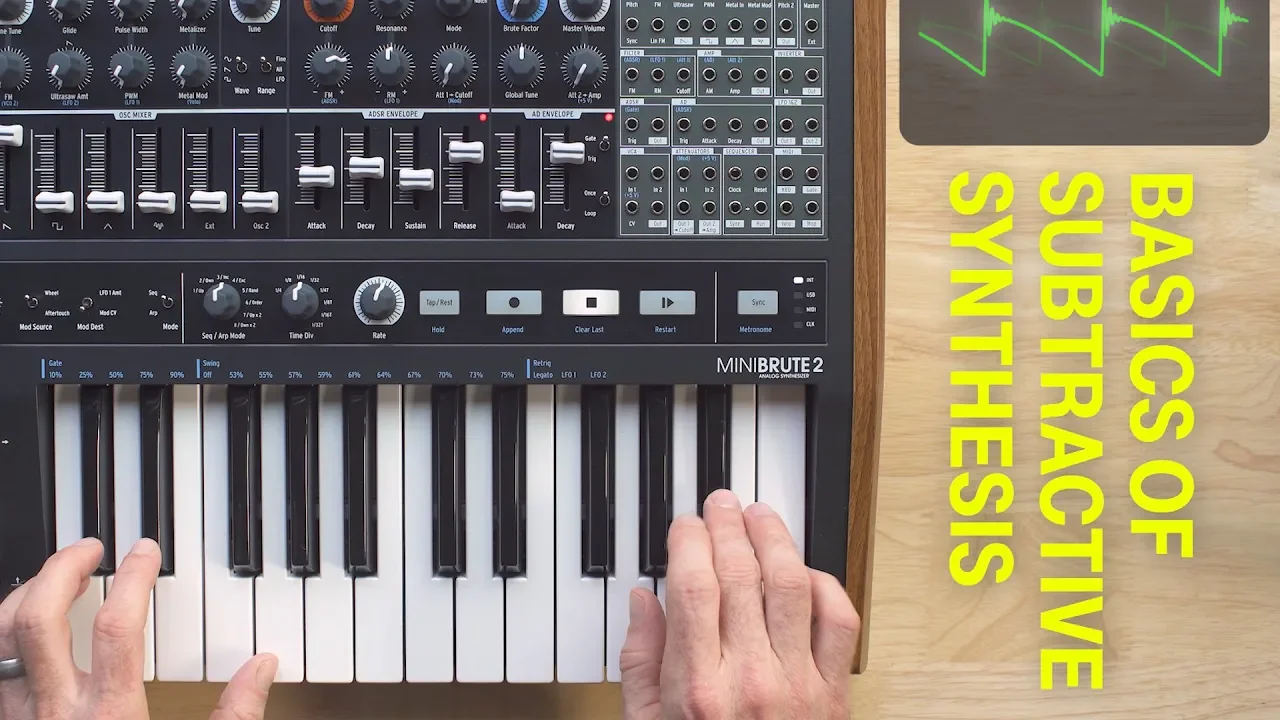
Basics of Subtractive Synthesis With the Arturia MiniBrute 2
106.7K
Subtractive synthesis creates sounds by starting with harmonically rich oscillators and removing frequencies. Oscillators generate waveforms: sine (smooth, least harmonics), triangle (slight buzz), square (more harmonics), and sawtooth (most harmonics, buzzy). Filters remove specific frequencies: low-pass removes highs, band-pass isolates mid-range, high-pass removes lows. Cutoff frequency determines where filtering begins, while resonance adds a resonant peak. Envelopes shape sound evolution: attack controls onset, decay brings sound down, sustain holds level, and release controls fade-out. Envelopes can modulate both volume and filter cutoff, enabling dynamic timbre changes. These three components form the foundation of subtractive sound design.
Click to watch →
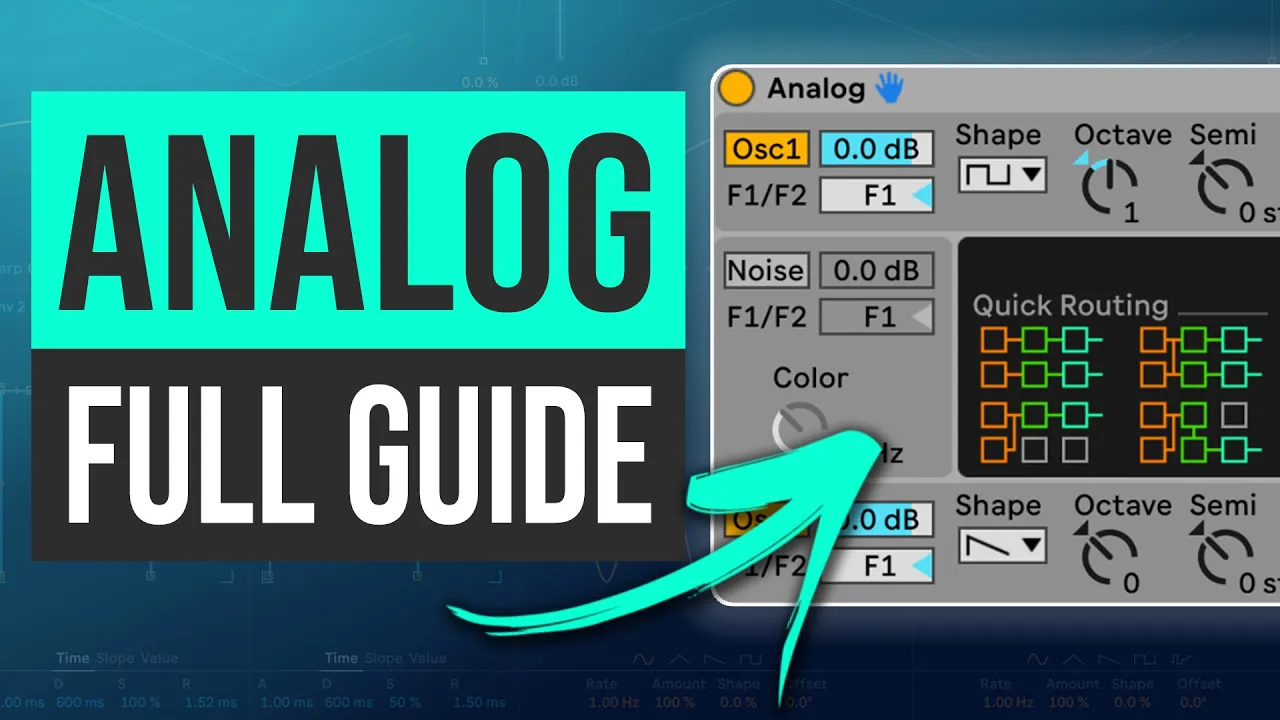
Ableton Analog Synth - Full Guide for Beginners | Ableton Tutorial
63.9K
Subtractive synthesis relies on three fundamental components: oscillators (generating raw sound waves), filters (shaping frequency content), and amplifiers (controlling volume). Oscillators alone cannot produce audible sound—they require amplification. The ADSR envelope (Attack, Decay, Sustain, Release) controls how loud a sound is over time, with each parameter governing different aspects of the sound's dynamic envelope. Understanding these core principles provides the foundation for all subtractive synthesizer design.
Click to watch →

Beginner-Friendly Live Stream with VCV Rack
36.1K
This comprehensive section covers the foundational principles of subtractive synthesis. Oscillators (VCOs) generate movement with four waveforms: sine (pure, few harmonics), triangle (brighter, spiky), sawtooth (very bright, many harmonics), and square/pulse waves. VC (Voltage Controlled) enables manipulation of pitch, pulse width, filter frequency, resonance, and drive. A low pass filter allows low frequencies to pass while attenuating high frequencies, reducing brightness. A VCA controls amplitude over time, functioning primarily as an attenuator. The envelope generator creates CV with four stages: Attack, Decay, Sustain, and Release. A gate triggers envelopes and controls sound duration. Pitch is directly related to frequency, with the volt per octave (V/Oct) standard meaning one volt changes pitch by one octave. Subtractive synthesis typically uses two envelopes: one for amplitude and one for filter cutoff frequency. An attenuverter combines attenuation with inversion, allowing filter movements to move opposite to amplitude envelopes. Resonance creates feedback at the cutoff point, adding emphasis. Mixing multiple oscillators creates richer sounds, with each having its own waveform, pulse width, and level. Detuning oscillators slightly creates beats from interference patterns. LFO (Low Frequency Oscillator) generates oscillations below 20 Hz for modulation like vibrato (pitch) or tremolo (amplitude). PWM changes square wave pulse width over time, adding movement.
Click to watch →
Deep Dive
Understanding MIDI routing and audio signal flow to connect and synchronize multiple hardware synthesizers.
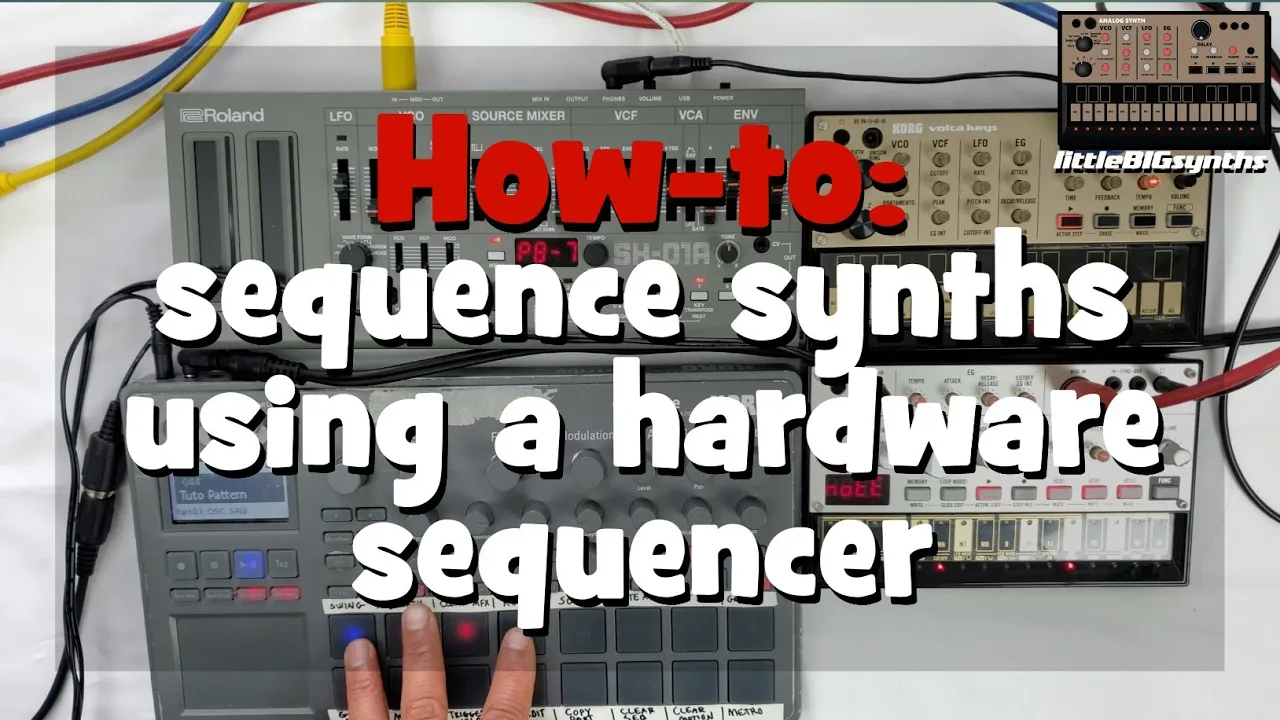
How-to: Sequence synths using a hardware sequencer | ft. The Korg Electribe 2
63.9K
To connect multiple synthesizers to a single sequencer, use a MIDI through box (such as the MIDI Solutions Quadra Through) which has one MIDI input and multiple outputs. Connect the sequencer's MIDI output to the through box's input, then connect each synthesizer's MIDI input to a separate output on the through box. Each pad or part on the sequencer is preset to specific MIDI channels (1-16), so assign each synthesizer to a different channel.
Click to watch →

HOW TO BUILD A SYNTHESIZER SETUP with Circuit Tracks + Korg Minilogue & Volca NuBass
194.3K
There are two main ways to route audio between hardware synths. First, you can send audio outputs from each synthesizer individually to an external mixer (like the Blue Box) for recording. Second, you can route audio from one synth (such as the Minilogue) into another device (like the Circuit Tracks) to apply internal effects such as reverb and delay. Use balanced TRS cables for audio connections.
Click to watch →
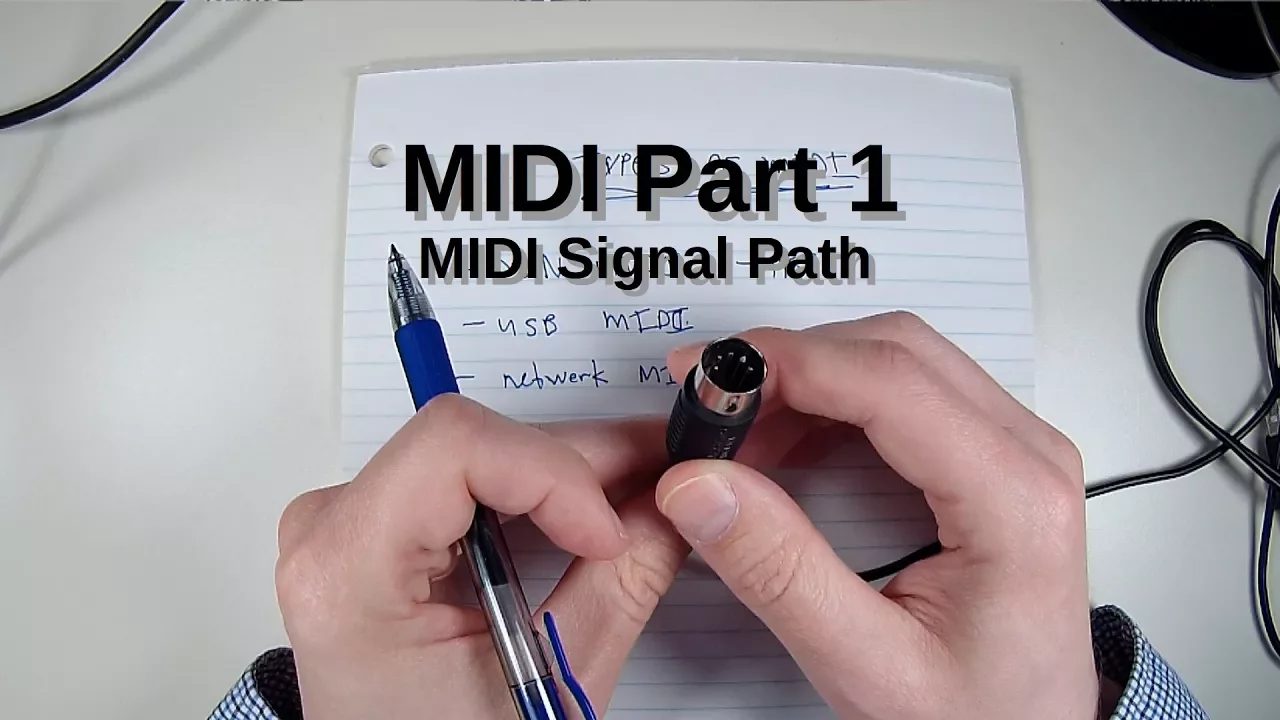
MIDI Part 1 - MIDI Signal Path
103.5K
MIDI enables communication between musical devices. In a typical setup, a computer (DAW) receives MIDI signals from a controller keyboard, processes them, and sends them to a synthesizer for sound generation. The DAW can route MIDI signals to different tracks and devices, allowing one keyboard to control multiple synthesizers. MIDI is unidirectional, meaning signals only flow in one direction. The IN port receives MIDI signals from external devices (like keyboards), while the OUT port sends signals to control external equipment. The THROUGH port provides a copy of incoming signals, enabling daisy chaining to multiple devices. This allows one MIDI interface to control multiple devices by connecting them in sequence: OUT → IN → THROUGH → IN → THROUGH. However, excessive chaining causes electrical signal distortion that can lead to data errors. Devices may need configuration to handle different types of MIDI data (notes vs. clock signals) when sharing connections.
Click to watch →

How I record the modular, other gear, and keep everything in sync with MIDI
23.8K
When recording modular synthesizers, which produce 'hot' signals (typically 10V peak-to-peak compared to standard line-level equipment's 3.5V), always use attenuators or VCAs to reduce signal strength before connecting to audio interfaces; route signals through a mixer for individual channel processing, EQ, and multi-track recording capabilities, then connect the mixer to an audio interface (like MOTU Ultralite MK3) via USB for recording to your DAW, while using MIDI controllers (such as Akai APC Key25) and MIDI splitters to synchronize all gear and control sequencing from your DAW.
Click to watch →

MIDI In, Out, and Thru | What's the Difference? – Daniel Fisher
46.9K
MIDI In receives and plays sounds from external controllers, MIDI Out sends the keyboard's played notes to other devices, and MIDI Thru provides an exact copy of what enters the In jack without incorporating the keyboard's own input, enabling daisy-chaining multiple synthesizers from a single controller.
Click to watch →
Deep Dive
Familiarity with basic music theory concepts such as chord structures, scales, and how arpeggiators function.
O MÍNIMO QUE UM GAITEIRO PRECISA SABER | FLAVINHO ALVES
363.3K
Scales are ordered sequences of notes with specific intervals (whole tone, semitone). Musicians must master 12 major and 12 minor scales for improvisation. Chords are simultaneous notes: major chords have root, major third, perfect fifth; minor chords have root, minor third, perfect fifth. Arpeggios play chord notes sequentially rather than simultaneously. These three elements form the foundation of musical understanding.
Click to watch →

Soloing Over The Chord Changes Masterclass With Guthrie Trapp - Chords, Scales, And Arpeggios
183.3K
The chord serves as the foundation of any musical piece, providing the first tonal information listeners hear. An arpeggio is the notes of a chord played separately (root, third, fifth, and octave). Triads are three-note chords (root, third, fifth) that form the basis of chord progressions. The chord, arpeggio, pentatonic scale, and full scale are all interconnected - they are just different ways to play over a chord. When learning, you may need to look at them separately, but the goal is to understand they are unified concepts.
Click to watch →
![Gam / Arpej / Kırık Arpej / Akor / Kadans Nedir ve Nasıl Çalınır? [ Piyano Dersi #1 ]](https://i.ytimg.com/vi/B-lWVwrFwSU/maxresdefault.jpg)
Gam / Arpej / Kırık Arpej / Akor / Kadans Nedir ve Nasıl Çalınır? [ Piyano Dersi #1 ]
31.4K
This comprehensive section covers the foundational concepts of music theory. The instructor introduces five essential concepts: scales, chords, arpeggios, broken arpeggios, and cadences. The lesson explains that an octave is an 8-note interval, and demonstrates the major scale construction formula (2-2-1-2-2-2-1). The instructor shows how to construct scales starting from any note and explains that both major and minor forms can be chosen. The section covers the relationship between major and minor scales, demonstrating how to find the related minor at the 6th degree of the major scale. Both scales share the same key signature. The natural minor scale construction formula (2-1-2-2-1-2-2) is demonstrated. The section covers chord construction using the 1-3-5 fingering pattern and chord inversions. The instructor then introduces arpeggios as the sequential playing of chord notes one at a time rather than simultaneously, and broken arpeggios that start from a note other than the root. The section covers specific fingering patterns for both hands, emphasizing practicing slowly and gradually increasing speed.
Click to watch →

Taking Your Bass Arpeggios from (Beginner to PRO)
190.9K
Arpeggios are chords played one note at a time, creating melodic sounds unlike simultaneous chord playing. Triads (three-note chords) form the foundation: major triads use root, major third, and fifth (1-3-5), while minor triads use root, flat third, and fifth (1-b3-5). Four-note chords add color: major 7th (1-3-5-7), minor 7th (1-b3-5-b7), dominant 7th (1-3-5-b7), and diminished 7th (1-b3-b5-b6). Five-note chords add even more tension: major 9th (1-3-5-7-2) and minor 9th (1-b3-5-b7-2). Understanding these structures helps you see arpeggios as note groupings rather than just chord shapes.
Click to watch →
What Are Chords, Scales, and Arpeggios?
86.2K
A chord is any group of notes played simultaneously, a scale is a musical alphabet that enables improvisation and technique development, and an arpeggio is the notes of a chord played sequentially one at a time in order.
Click to watch →
Deep Dive
The concept of low-frequency oscillation (LFO) and modulation to create movement within a static sound.
Learn SOUND DESIGN in 46 Minutes
19.7K
A Low Frequency Oscillator (LFO) operates below the audible range (typically below 20 Hz) and creates movement in sounds. When applied to amplitude, it creates pulsing or throbbing effects. The LFO's speed determines how fast the pulsation occurs. LFOs are commonly used to create the classic dubstep wobble effect. LFOs are found alongside envelopes in most synthesizers.
Click to watch →
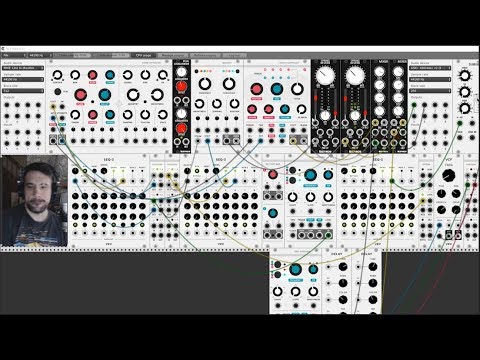
VCV - Open source, FREE modular software. First look and noob tutorial.
251K
A Low Frequency Oscillator (LFO) generates slow, cyclic modulations that are too slow to hear as pitch changes but can modulate other parameters like filter cutoff, amplitude, or pitch. LFOs create rhythmic, pulsating, or sweeping effects by continuously cycling through their range, adding movement and life to otherwise static sounds.
Click to watch →
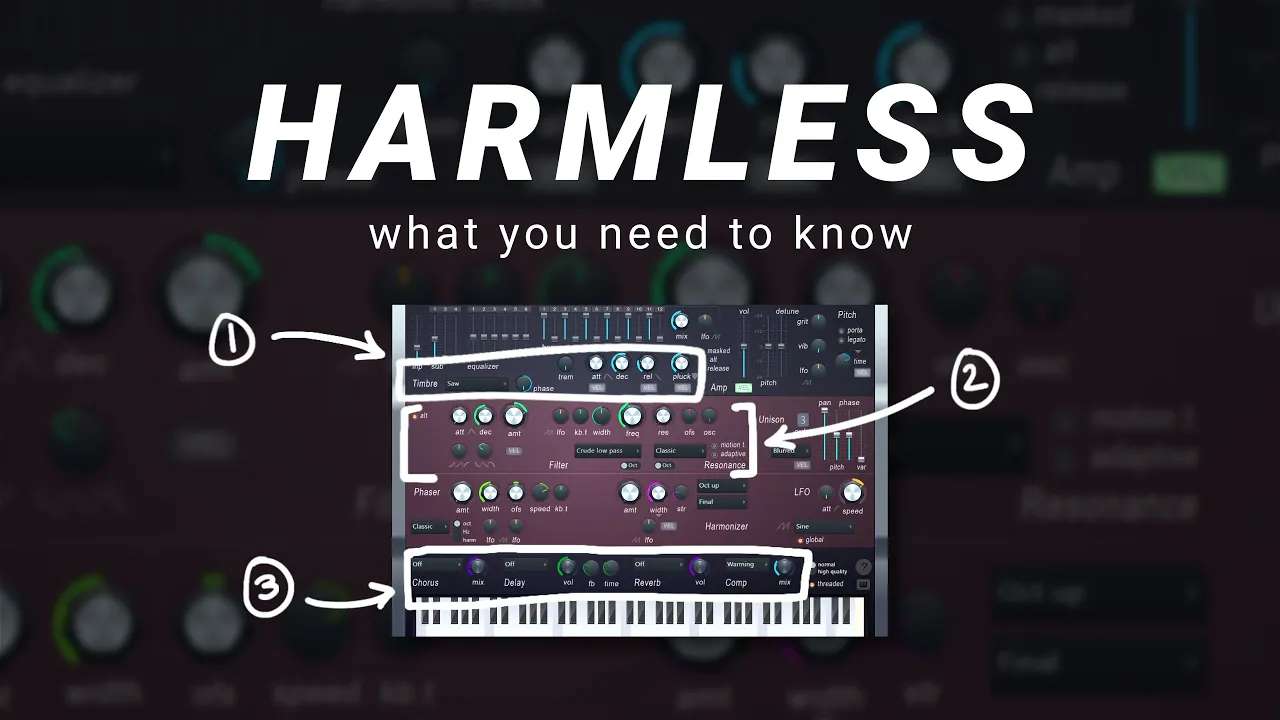
FL Studio Harmless Synth Tutorial
235.2K
The final stage of sound design involves effects processing and modulation. Standard effects include phasers, delay (classic, ping pong, stereo), reverb (with various room sizes), and compression. The grit control adds subtle detuning for metallic textures, particularly useful for percussion. LFOs (Low Frequency Oscillators) modulate almost any parameter using wave shapes (sine, pulse) at controlled speeds, creating movement and interest in static sounds. These tools transform basic synth tones into complex, evolving sonic landscapes.
Click to watch →

SUBTRACTIVE SYNTHESIS SOUND DESIGN // DETAILLED // ONE BY ONE // PART 1
270
A Low Frequency Oscillator (LFO) operates at frequencies too low to hear directly (below 20 Hz) and is used for automatic parameter modulation. LFOs are cheaper than audio oscillators because they don't require precise pitch tracking. They offer waveforms like sine, triangle, sawtooth, and pulse for creating rhythmic movements, vibrato, filter sweeps, and automated effects. LFOs add life and movement to static sounds, making them essential for dynamic synthesizer patches. The choice of waveform affects the character of the modulation.
Click to watch →

How to use a Synth - Create your own sounds ! - Nord Lead 2X Tutorial
69.2K
LFOs are low-frequency oscillators that modulate other parameters to add movement and life to sounds. They operate at sub-audio frequencies (typically below 20 Hz) and can modulate various targets including FM amount, pitch, filter frequency, and pulse width. The rate knob controls how fast the LFO cycles, while the amount knob controls the depth of modulation. Unlike high-frequency sounds where small frequency changes are imperceptible, low-frequency sounds require more dramatic changes to be noticeable, making LFOs ideal for adding subtle variations to basslines and pads.
Click to watch →
Prerequisite Knowledge
- Concept 01Basic principles of subtractive synthesis, including the roles of oscillators (VCO/DCO), filters (VCF), and envelope generators (ADSR).
- Concept 02Understanding MIDI routing and audio signal flow to connect and synchronize multiple hardware synthesizers.
- Concept 03Familiarity with basic music theory concepts such as chord structures, scales, and how arpeggiators function.
- Concept 04The concept of low-frequency oscillation (LFO) and modulation to create movement within a static sound.
Subsequent Learning
- Step 01Integrating external spatial effects processors, such as delay and shimmer reverb, to expand the stereo field of the ambient drone.
- Step 02Exploring generative music techniques, including modular synthesis patching, random LFOs, and probability-based sequencing.
- Step 03Recording and multitracking hardware performances into a Digital Audio Workstation (DAW) for advanced mixing, EQing, and mastering.
- Step 04Deep-dive sound design utilizing the specific architectures of the Roland S-1 (ACB modeling) and Behringer JT-4000 (hybrid digital synthesis).
Setup & Sounds
Add Drone
Resonance FX
Final Tips
Setup & Sounds
0:00Playing Section
- 1
Selecting sound programs and configuring oscillators for a rich tone.
- 2
Adjusting filter, reverb, and envelope for a deep ambient texture.
- 3
Enabling hold and chord functions on the JT-4000 for continuous play.
The Limitations of Compact Hardware vs. Generative and Granular Synthesis
While compact hardware synths like the Roland S-1 and Behringer JT-4000 offer portability, critics in the ambient music community argue that these fixed-architecture instruments are fundamentally limited for complex drone synthesis. Relying on standard hold, arpeggiator, and chord functions often results in predictable, repeating patterns rather than truly organic, non-repeating, and deeply evolving textures. Opposing viewpoints advocate instead for generative modular synthesis (like Eurorack) or software-based granular environments (such as Max/MSP or VCV Rack). These platforms allow for complex modulation routing, chaotic feedback loops, and micro-sound manipulation where parameters modulate one another over hours rather than seconds, preventing the rhythmic predictability of hardware arpeggiators. Furthermore, the tiny interfaces and menu-diving of ultra-compact gear restrict real-time tactile expression. For serious ambient soundscapes, critics argue that modular or software-based generative systems provide the infinite variability and sonic depth that compact budget hardware simply cannot replicate.
Deep Dive
Integrating external spatial effects processors, such as delay and shimmer reverb, to expand the stereo field of the ambient drone.

Make Your Own Drones - CYHMN#66
2.3K
Spatial effects like delay and reverb give sounds a sense of place and atmosphere. Applying these liberally to drone compositions creates immersive sonic environments. Integrating processed sounds into samplers allows them to function as playable instruments within DAWs. This workflow transforms one-time recordings into reusable musical assets that can be triggered and manipulated like traditional synthesizers.
Click to watch →
No Other Modeler Can Do This... // Full Fractal Axe-FX III Preset Build
26.4K
The Plex delay block has ambient reverb algorithms like the Plex verb and ambient depths. The Plex verb creates huge, ambient reverb sounds that are particularly effective for atmospheric guitar playing. The ambient depths algorithm creates another type of very ambient reverb. The Plex delay block also has a shimmer algorithm that creates beautiful, ethereal textures. These algorithms are particularly useful for ambient guitar playing and can create textures that are impossible with standard delay and reverb blocks. The Plex shift algorithm creates delay and pitch shifting happening simultaneously, moving around in the stereo field with diffusion.
Click to watch →
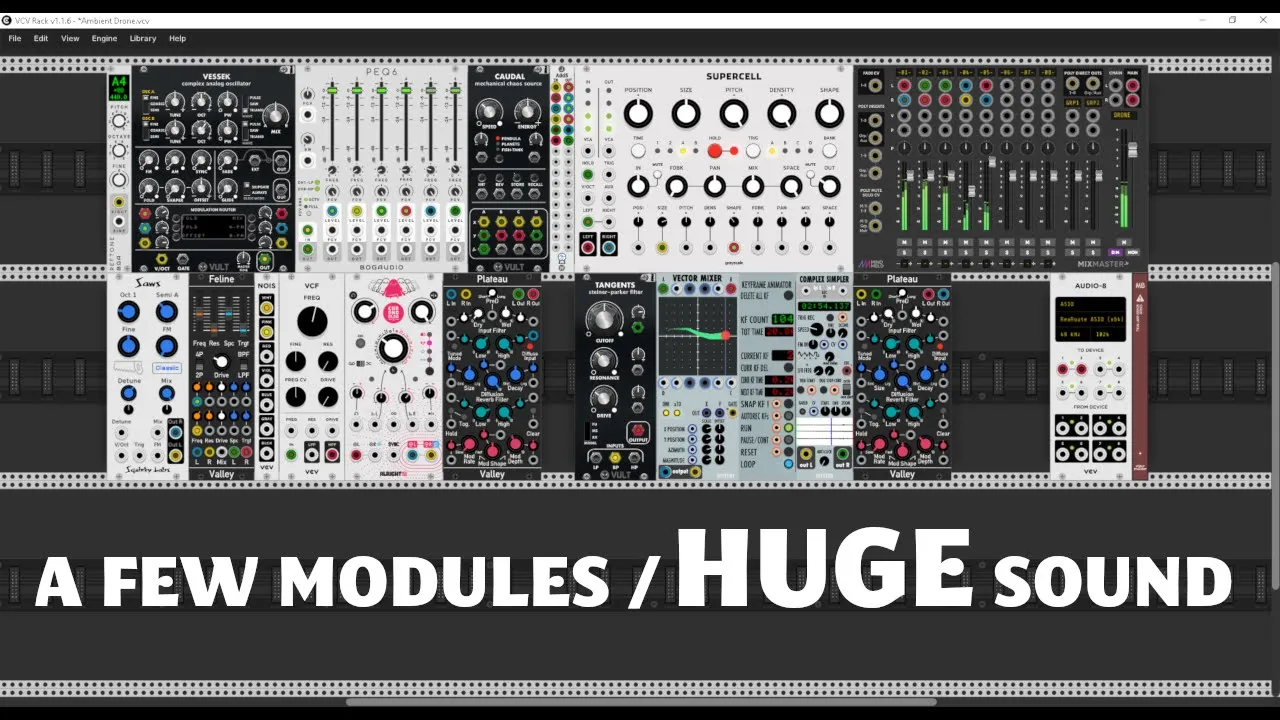
Building an Ambient Drone in VCV Rack
45.6K
This segment focuses on adding spatial depth and enhancement to the ambient sound. The VCV VCF filter routes high frequencies to delay and reverb while keeping lower frequencies dry. The delay is set to 100ms with feedback for rhythmic repeats. Ping-pong mode creates stereo alternation between left and right channels. Reverb (Plateau) is modulated to add movement to the wet signal. The reverb filter can be modulated to affect the entire sound, not just the delayed portion. Field recordings (birds, passing cars) are loaded into Complex Simpler, transposed two octaves down, played in reverse, and routed through heavy reverb to add organic texture. The vector mixer pans sounds left and right with recorded movement for dynamic spatial effects.
Click to watch →
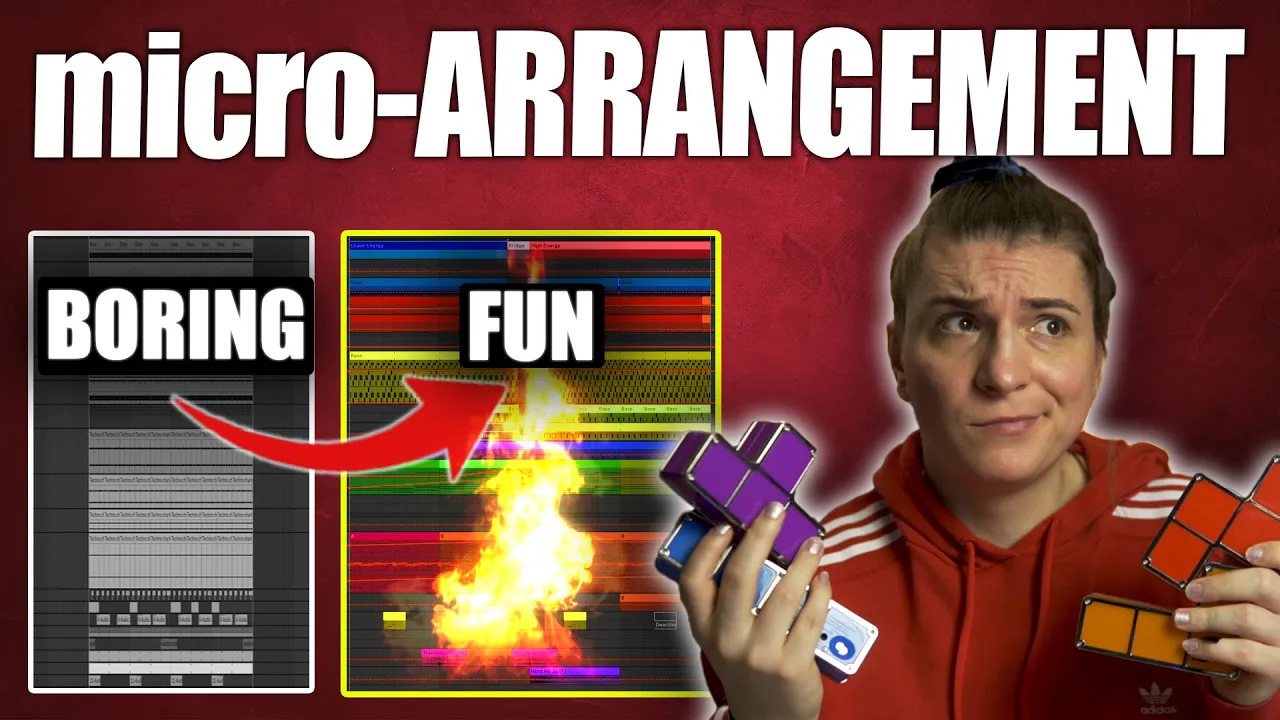
Make any loop more interesting - micro-ARRANGEMENT
67.1K
Effects processing enhances the spatial qualities of a track. Techniques include using shimmer reverbs (pitched up with large decay) for dramatic transitions, applying vintage EQ settings for character, filtering effects to avoid being too obvious, and timing effect sends before energy buildups for smoother transitions. The key principle is restraint—adding too many effects makes tracks feel cluttered and less coherent.
Click to watch →
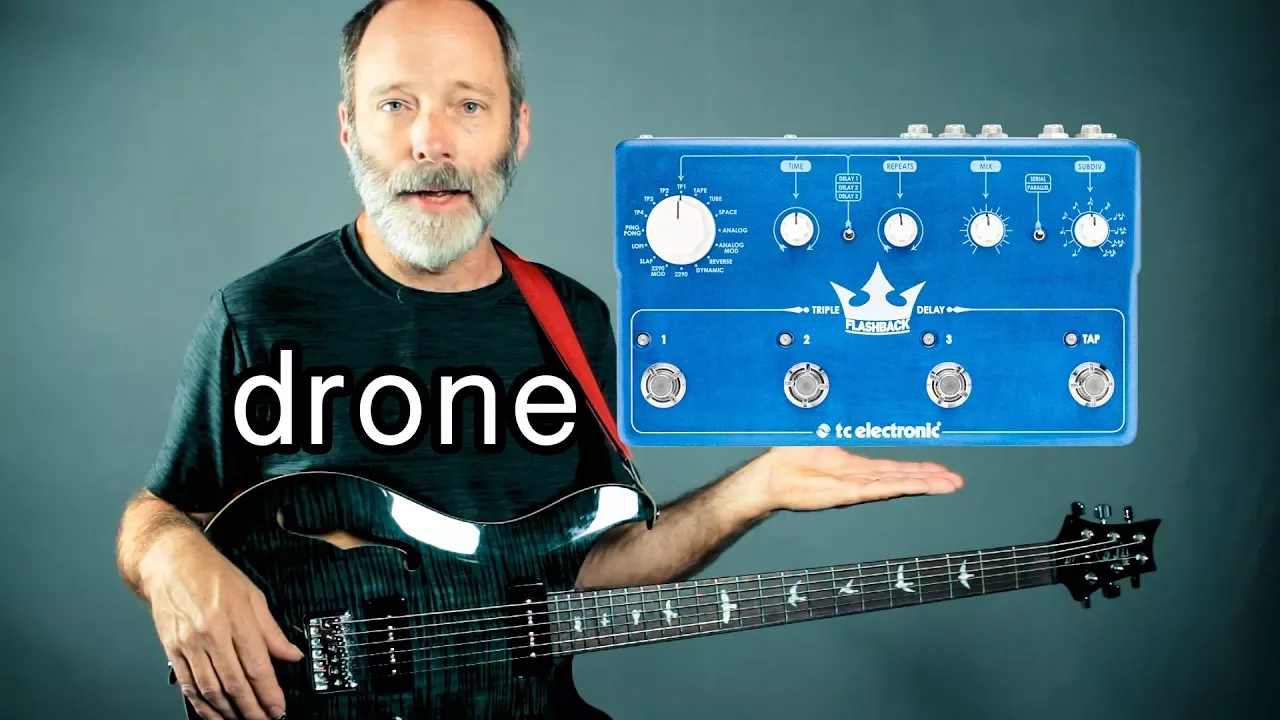
The Flashback Triple Delay is an Ambient Drone Machine!
87.3K
Creating ambient drone music requires a carefully ordered signal chain: start with a compressor (like the Wampler Ego Compressor) to control dynamics and add sustain, followed by an overdrive pedal (such as the Strymon Sunset) for subtle crunch, then a volume pedal, and finally a multi-delay unit like the TC Electronic Flashback Triple Delay. Running this setup in stereo (using an amp modeler with stereo effects loop) creates a wider, more immersive sound compared to mono operation. The video demonstrates configuring delays in series, where the output of one delay feeds into another, adding complexity and depth to the overall effect.
Click to watch →
Deep Dive
Exploring generative music techniques, including modular synthesis patching, random LFOs, and probability-based sequencing.
5 Generative Patching Tips and Tricks
18.7K
Generative patching in modular synthesis creates evolving, unpredictable musical patterns through several key techniques: (1) Modulating modulation by using LFOs to control the amplitude or rate of other modulation signals, creating constantly changing movement; (2) Using clock dividers to divide random triggers or clocks, making event timing unpredictable and preventing repetitive patterns; (3) Applying logic gates (AND, OR, XOR) to control when events occur based on multiple input conditions; (4) Adding probability through Bernoulli gates or random switches to introduce chance-based routing and triggering; (5) Using dedicated generative modules like random samplers or sequencers with probability per step. These techniques combine to create generative patches that continuously evolve without repeating themselves.
Click to watch →
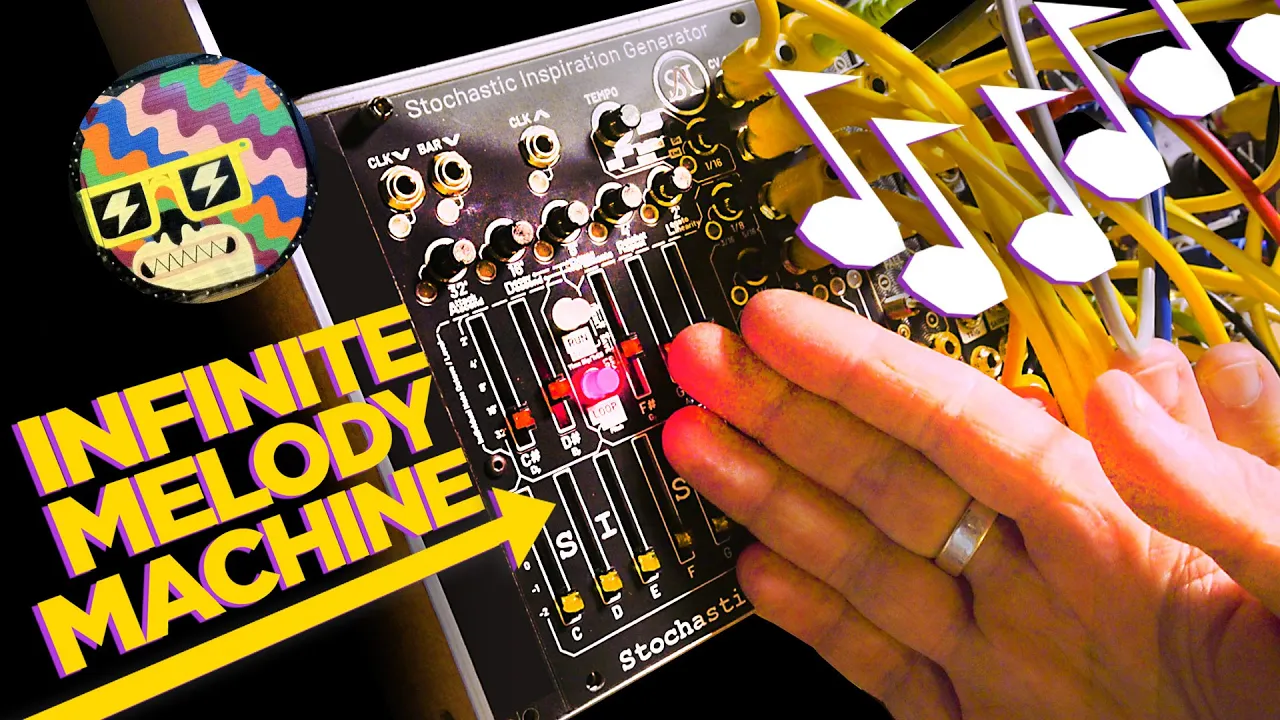
This module makes infinite music | Stochastic Inspiration Generator Demo
31K
The SIG+ stochastic inspiration generator is a 4-part modular sequencer that uses probability-based controls to create generative music, where users adjust faders to emphasize certain notes, dials to set note durations and rests, and various parameters like linearity, repeats, ascend/descend, ratcheting, attack/decay, and portamento to shape melodic and rhythmic characteristics; the module allows users to capture and loop desirable passages while maintaining background improvisation, enabling both spontaneous composition and retrospective editing of musical sequences.
Click to watch →

STUDIO TIME S2 EP6 - Make Playable Instruments Out Of Anything
97K
This section explores generative sound design using random modulators. Face Plant offers unlimited random modulators that can provide different random curves per voice. Techniques include modulating LFO speed randomly so each note in a chord gets different envelope behavior, creating evolving sounds. Random panning modulators create stereo movement. Bipolar LFO settings create more drastic volume modulation. These techniques enable building generative patches where notes have individual random behaviors, creating organic, evolving musical textures.
Click to watch →

The Secret to My Latest Bitwig Grid Patch
271
This segment explores generative music creation using probability systems. Key techniques include: (1) Scale steps modules for selecting specific notes from scales; (2) Clock and sample and hold modules for rhythmic sequencing; (3) Probability sequencers using chance modules to randomly select notes based on defined probabilities; (4) Waveform switching with probability for evolving timbres; (5) Nearest interpolation for smooth transitions between values; (6) Creating generative arpeggios with timing and chance modules; (7) Adding pitch glide and randomization for organic sounds; (8) Octave randomization for dramatic pitch changes; (9) Envelope-based modulation timing for dynamic effects; (10) Filter placement decisions affecting sound character.
Click to watch →
Celldweller - StudioTour
176.7K
Modular synthesis allows patching control voltages into other modules to control various parameters. Oscillators can be tuned low enough to become low frequency oscillators (LFOs) that create different slopes affecting parameters. The Make Noise Waggle Bug generates random stepped voltage outputs that can randomly control filter frequency and other parameters. The Expert Sleepers hardware integrates modular and DAW systems by sending master clock from QBase to modular systems, ensuring synchronization. The process involves creating patches where sequences control oscillators, filters, and envelope generators, with random modulation adding unpredictability. The Intelligel Metropolis sequencer drives a Pittsburgh oscillator into a 2040 filter, with envelope generators controlling volume. The filter can be set to self-oscillate, producing tones that can be modulated by control voltages. The process involves creating patches where sequences control oscillators, filters, and envelope generators, with random modulation adding unpredictability. The Intelligel Metropolis sequencer drives a Pittsburgh oscillator into a 2040 filter, with envelope generators controlling volume. The filter can be set to self-oscillate, producing tones that can be modulated by control voltages.
Click to watch →
Deep Dive
Recording and multitracking hardware performances into a Digital Audio Workstation (DAW) for advanced mixing, EQing, and mastering.

2 ways to record multitracks to a DAW from a digital mixer
12.9K
To record multitracks from a digital mixer (such as the M32 or X32) to a DAW, connect the mixer's USB card to your laptop, then route the desired channels from the mixer to the USB card inputs using either direct input assignment or custom user output banks, ensuring the DAW is configured to receive signals from the corresponding card inputs; this allows you to capture individual performance elements like drums, vocals, or instruments into separate tracks for post-production editing.
Click to watch →

Powerful Dawless Recording Setup (For Any Genre)
24.7K
DAW (Digital Audio Workstation) and hardware recording represent two different approaches to music production. Full DAW means music never touches a computer. Full hardware recording involves recording each instrument to its own separate track for final mixing in a DAW. The hybrid approach combines both: recording instruments to separate tracks using hardware, then mixing in a DAW. This hybrid method works well for publicly released music that will be listened to many times, while full DAW or full hardware recording may be better suited for live performances heard only once.
Click to watch →

Recording and Production DAW Software Comparison
438.1K
A Digital Audio Workstation (DAW) is software for recording, producing, arranging, mixing, and mastering music. Essential hardware includes a computer with adequate processing power and RAM, an audio interface with I/O connections, and studio monitors for accurate mixing. DAWs serve two primary user groups: recording artists/bands needing multitrack capabilities, and electronic music producers using them as composition tools. All DAWs share core components including a timeline/arrangement window, multi-track editor, inspector/channel strip, browser, piano roll, sample editor, and plugin support for effects and instruments. Key plugins include effects (reverb, delay, EQ) and instruments (synthesizers, samplers). The mixer window provides digital representation of traditional studio consoles with automation capabilities.
Click to watch →

UNBOXING AND REVIEW AUDIOBOX 96 Aprende a grabar en 10 minutos
24.1K
Multi-track recording enables musicians to capture layered performances by recording each instrument or voice on separate tracks within DAW (Digital Audio Workstation) software. Despite having only two physical inputs, DAW software provides multiple virtual tracks for individual recording and mixing. Professional DAWs include built-in audio processing tools such as compressors, equalizers, and effects processors. The software interface features keyboard shortcuts for efficient workflow, buffer size settings for balancing latency and system performance, and automatic device detection upon connection.
Click to watch →
ಸ್ಟುಡಿಯೋದಲ್ಲಿ ಹಾಡು ರೆಕಾರ್ಡಿಂಗ್ ಹೇಗೆ ಮಾಡ್ತಾರೆ ನೋಡಿ..| Palani D Senapathi Studio Tour | E Maaye
318
A digital audio workstation (DAW) is a computer-based system for recording, editing, and mixing audio. It can accept hundreds of audio tracks (1000+ tracks mentioned). Each musical element in a song gets its own dedicated track: flute, tabla, violin, voice, chorus, and guitars. The DAW functions like a kitchen where different ingredients (audio tracks) are combined to create the final dish (finished song). Engineers listen to each track individually to determine what adjustments are needed, then mix them together to achieve the desired sound quality.
Click to watch →
Deep Dive
Deep-dive sound design utilizing the specific architectures of the Roland S-1 (ACB modeling) and Behringer JT-4000 (hybrid digital synthesis).
The Roland S-1 synthesizer complete Deep Dive guide tutorial
112.3K
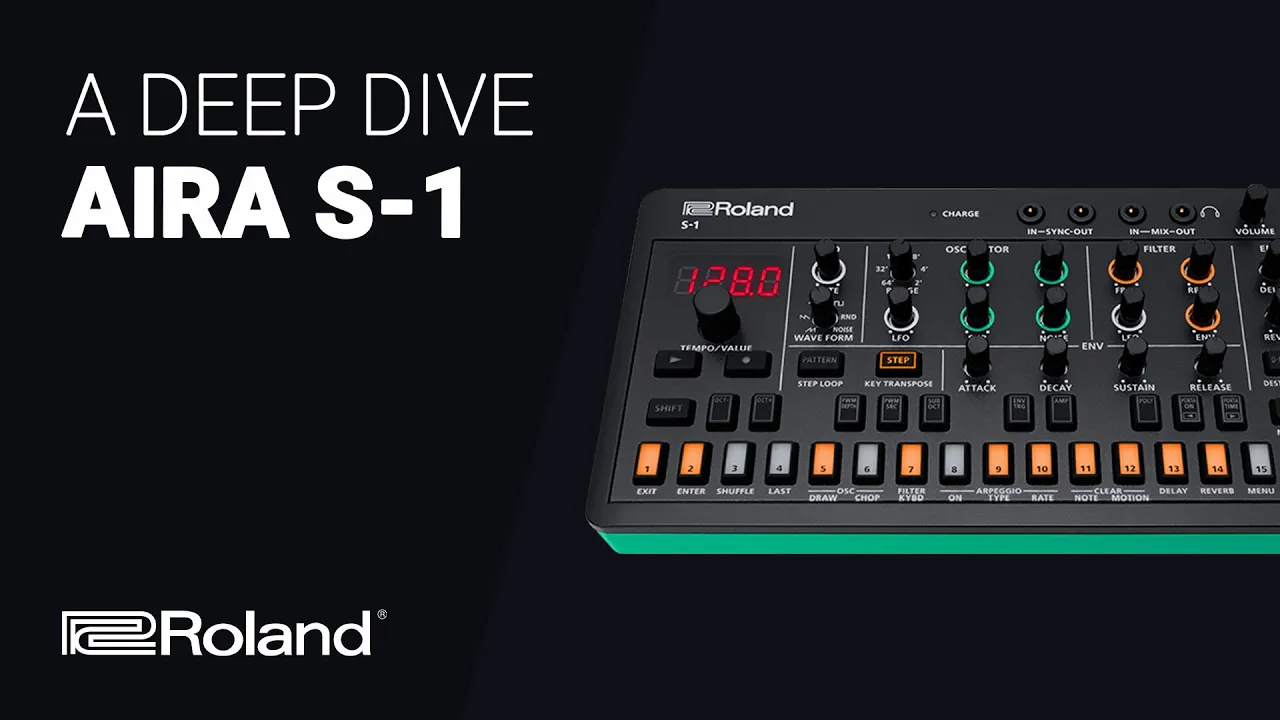
This comprehensive guide covers the Roland S-1 synthesizer, covering its core components including oscillators (square, saw, sub, noise), filter section with resonance, ADSR envelope for amplitude and filter modulation, four polyphony modes (poly, mono, unison, chord), LFO for modulation, effects (delay, reverb, chorus), and the powerful sequencer with step recording, motion sequences, and arpeggiator. The guide demonstrates how to navigate presets/patterns, configure oscillator draw and chop functions, and utilize the sequencer's various modes (step, chord, edit, real-time) for creating and automating musical sequences.
Click to watch →

Roland S -1 | Interstellar Tutorial | Sound design, pattern programming, & performance
50.6K
This tutorial demonstrates how to create a dynamic electronic music cover using the Roland S-1 synthesizer, covering three key areas: (1) Sound design using saw, sub, and square oscillators with specific ADSR settings (attack=40, sustain=255, release=111), LFO modulation at ~105Hz for pulse width, and reverb with spring type, 200ms time, and 12.5kHz high cut; (2) Pattern programming by setting pattern length to 44 steps and inputting notes across octaves (octave 0: E, B, C, D; octave -1: F, G, A) following a specific sequence structure; (3) Performance techniques including increasing filter cutoff and resonance for dynamic expression, switching envelope trigger from note to LFO for wavy modulation effects, and using motion recording to add performance variation.
Click to watch →

Roland TB-03 Bass Line In Depth Review
327.9K
Roland's ACB technology models the actual components in original analog hardware rather than just waveforms. This approach provides a more authentic recreation of the original sound compared to other analog emulations that only model waveforms, which often result in issues like step filters that don't sound truly analog.
Click to watch →
Roland TR-1000 Rhythm Creator | Everything You Need to Know
182.1K
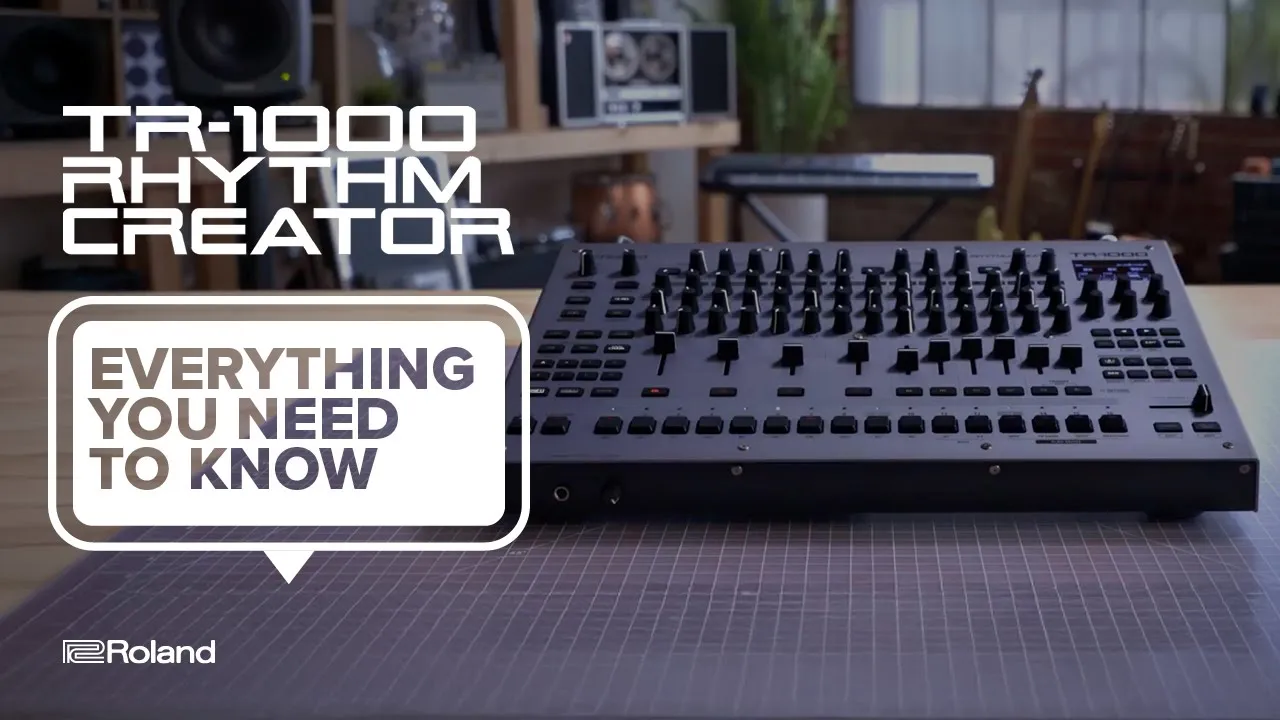
The TR-1000 represents Roland's first drum machine using analog sounds in over 40 years, combining vintage circuitry with modern digital capabilities. The design team took the most coveted analog circuits from the classic 808 and 909 and gave them new life through parameter expansion and dynamic improvement. Digital sound engines provide ACB, FM, and PCM tones, while digitally circuit-bent 808 and 909 models offer creative percussion synthesis. The comprehensive sampling engine supports stereo recording, non-destructive chopping, and time stretching with up to 16 slices per instrument, each having independent settings. With 48GB user storage and thousands of pre-loaded samples, this hybrid architecture enables both authentic analog tones and modern production flexibility.
Click to watch →
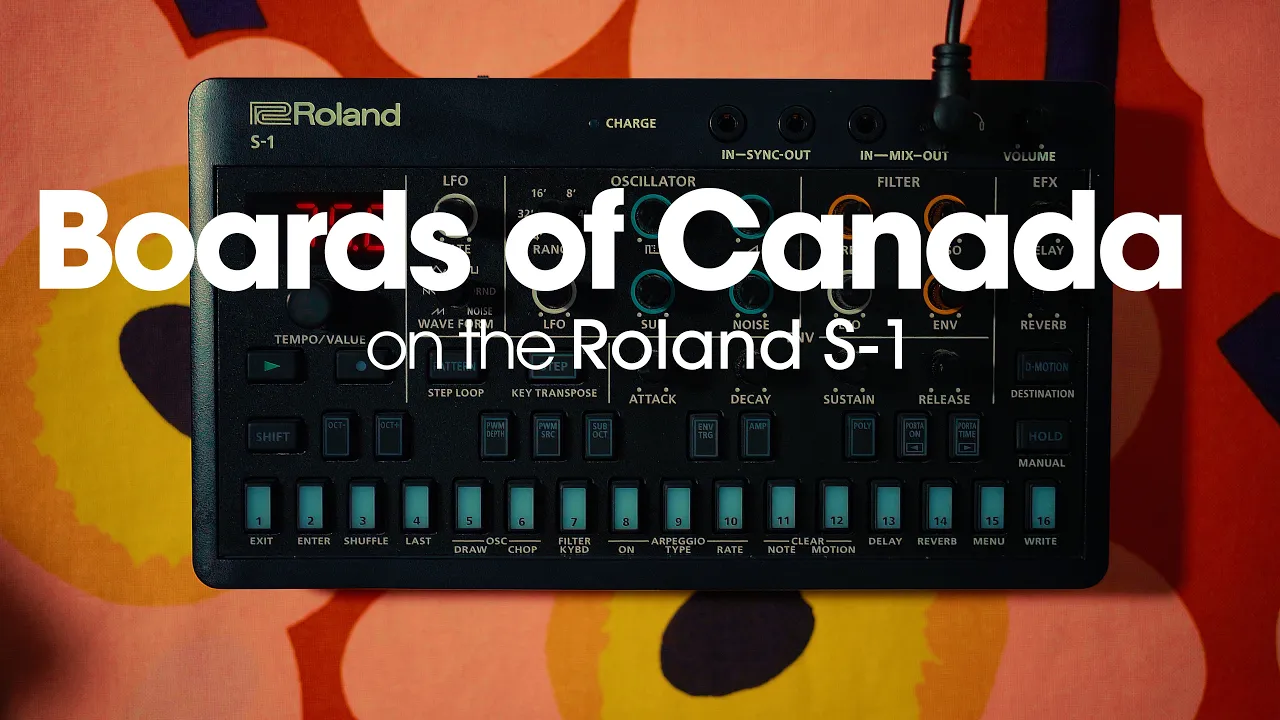
Roland S-1 | Kaini Industries - Boards of Canada | Tutorial
9.7K
This tutorial demonstrates how to recreate the Boards of Canada track 'Kaini Industries' using only the Roland S-1 synthesizer, covering pattern creation with specific BPM (76), step sequencer configuration (64-step pattern), note holding techniques, and detailed sound design including oscillator settings (sawtooth at 255, pulse at 0), filter parameters (frequency 130Hz, resonance 100Hz), and reverb settings (spring reverb with time 200ms, pre-delay 20ms, low-cut 250Hz, high-cut 12.5kHz).
Click to watch →
Setup & Sounds
Add Drone
Resonance FX
Final Tips
Setup & Sounds
0:00- 1
Selecting sound programs and configuring oscillators for a rich tone.
- 2
Adjusting filter, reverb, and envelope for a deep ambient texture.
- 3
Enabling hold and chord functions on the JT-4000 for continuous play.
The Limitations of Compact Hardware vs. Generative and Granular Synthesis
While compact hardware synths like the Roland S-1 and Behringer JT-4000 offer portability, critics in the ambient music community argue that these fixed-architecture instruments are fundamentally limited for complex drone synthesis. Relying on standard hold, arpeggiator, and chord functions often results in predictable, repeating patterns rather than truly organic, non-repeating, and deeply evolving textures. Opposing viewpoints advocate instead for generative modular synthesis (like Eurorack) or software-based granular environments (such as Max/MSP or VCV Rack). These platforms allow for complex modulation routing, chaotic feedback loops, and micro-sound manipulation where parameters modulate one another over hours rather than seconds, preventing the rhythmic predictability of hardware arpeggiators. Furthermore, the tiny interfaces and menu-diving of ultra-compact gear restrict real-time tactile expression. For serious ambient soundscapes, critics argue that modular or software-based generative systems provide the infinite variability and sonic depth that compact budget hardware simply cannot replicate.
Basic principles of subtractive synthesis, including the roles of oscillators (VCO/DCO), filters (VCF), and envelope generators (ADSR).
Understanding MIDI routing and audio signal flow to connect and synchronize multiple hardware synthesizers.
Familiarity with basic music theory concepts such as chord structures, scales, and how arpeggiators function.
The concept of low-frequency oscillation (LFO) and modulation to create movement within a static sound.
Integrating external spatial effects processors, such as delay and shimmer reverb, to expand the stereo field of the ambient drone.
Exploring generative music techniques, including modular synthesis patching, random LFOs, and probability-based sequencing.
Recording and multitracking hardware performances into a Digital Audio Workstation (DAW) for advanced mixing, EQing, and mastering.
Deep-dive sound design utilizing the specific architectures of the Roland S-1 (ACB modeling) and Behringer JT-4000 (hybrid digital synthesis).
12.8K views517likes7:28@ElectroMagnetic_AmbientMusicOriginal Release: 2024-09-30
hi today I'll show you how you can create a nice and Rich ambient music with the simple and affordable setup without even using the sequencer we'll take advantage of the hold function that both these devices have to create infinite drones and arpegios let's dive into it first thing that we want to do is to choose some sounds so I'll pick up this program number 23 on the JT 4000 and then on the uh roll and this one I just uh decided to use the triangle oscillator and the sub oscillator no LFO modulation and then we can twe the filter I add a bit of Reverb to have a nice uh deep sound and then slow attack almost to the maximum Decay doesn't matter because we'll keep the sustain up to the maximum and also very long release uh it will be useful when we want to switch between nodes so we have a long tail and have time to change our uh note uh you will see later so let's uh start by setting up the JT 4000 first thing we want to do is to activate the hold function inside the settings menu this way we can sustain notes endlessly and then we can also activate the chord function here and we can choose our uh set of course I will use the Jets one and then we can activate the arpegiator in the ARP section and this way we will have an endless RPG playing let me reset the [Music] filter nice okay now that we have our arpeggio going let's add some drone we push the hold button here uh let's set the uh range to 32 [Music] nice big more sub we can easily change notes with this uh setup for example [Music] nice and easy [Music] n [Music] [Music] and uh with extreme resonance settings we can achieve some interesting whistling kind of effect let's remove the sub for a moment [Laughter] had some noise [Music] [Laughter] nice you have to be very gentle when you tweak the filter uh with the high levels of resonance uh go very slowly and uh find The Sweet Spot more base [Music] I hope you enjoyed the ideas and let me hear what you think in the comments see you next time
Up Next

7:19
From Tree Sap to Rubber: The Latex Manufacturing Process
@Factora_eng
76.1K views•2024-05-07

12:54
Triumph of Orthodoxy Icon: Byzantine Art & History Explained
@BenCallan
2.1K views•2024-08-06

9:49
FastAPI vs Flask vs Django: Choosing the Right Python Web Framework
@TechWithTim
302.5K views•2024-05-26

1:42
Game of Thrones Opening Credits: A Cinematic Analysis
@gameofthrones
46.3M views•2011-04-18
Related Study Plans & Knowledge Roadmaps
Structured learning paths in General & Interdisciplinary Studies
general-studies
Elevator Engineering: History, Physics & Cities
01From Hoists to Safety Brakes: The Dawn of Vertical Lift
02Hydraulic vs. Traction: The Engineering Physics of Elevators
03Modern Speed, Safety, and Algorithms
+ 2 more learning modules
12h5 modules
Explore Roadmap
general-studies
Rubber: Material Science, History & Geopolitics
01Origins of Natural Rubber & Mesoamerican History
02The Chemistry of Natural Rubber & Vulcanization
03The Geopolitics of the Rubber Boom & Colonization
+ 2 more learning modules
12h5 modules
Explore Roadmap
general-studies
Containerization: Evolution, Logistics & Trade
01Ancient Trade & Bulk Cargo: Amphorae to Barrels
02The Industrial Revolution & Cardboard Packaging
03The Containerization Revolution: Malcom McLean
+ 2 more learning modules
12h5 modules
Explore Roadmap
general-studies
Textile Tech: Evolution, Labor & Global Impact
01Pre-Industrial Textiles: Handloom & Cottage Industry
02Mechanization: The Spinning Jenny to the Power Loom
03The Factory System & Global Labor Transformation
+ 2 more learning modules
10h5 modules
Explore Roadmap