





![[Science & Tech ]Quarks, Neutrinos and other Fundamental Particles with PYQs | UPSC Prelims'24](https://i.ytimg.com/vi/v6HOnauSGxM/maxresdefault.jpg)













The Standard Model Lagrangian is a single, complex equation that encapsulates our best understanding of the subatomic world, explaining how all known particles and their interactions emerge from fundamental symmetries of nature (U(1) for electromagnetism, SU(2) for the weak force, and SU(3) for the strong force). It describes fermions (matter particles with half-integer spin) and bosons (force-carrying particles with integer spin) through kinetic terms, interaction terms, and the Higgs mechanism that gives particles mass. While the equation achieves extraordinary predictive precision, it still cannot explain dark matter, dark energy, or the matter-antimatter imbalance, leaving room for deeper theories beyond the Standard Model.
The Standard Model Lagrangian: The Equation Explaining Particle Physics
Added:Classical Field Theory and the Lagrangian Formalism: Understanding the principle of least action, Euler-Lagrange equations, and how fields are mathematically formulated.
Fundamental Special Relativity and Quantum Mechanics: Familiarity with Lorentz covariance, four-vectors, wavefunctions, and the Dirac and Klein-Gordon equations.
The Taxonomy of Elementary Particles: Distinguishing between matter particles (fermions like quarks and leptons) and force carriers (gauge bosons).
Symmetry and Group Theory in Physics: A conceptual grasp of continuous symmetries, Noether's theorem, and gauge groups like U(1), SU(2), and SU(3).
The Higgs Mechanism and Spontaneous Symmetry Breaking: Exploring how the electroweak symmetry is broken to grant mass to W and Z bosons and fermions.
Quantum Field Theory (QFT) Calculations and Feynman Diagrams: Learning how to derive scattering amplitudes, cross-sections, and decay rates from the Lagrangian terms.
Renormalization and Running Coupling Constants: Understanding how quantum corrections introduce infinities and how physical constants change with energy scale.
Beyond the Standard Model (BSM) Physics: Investigating unresolved phenomena such as dark matter, gravity (general relativity integration), neutrino oscillations, and supersymmetry.
1.5M views39.7Klikes16:43Original Release: 2022-10-19
The Standard Model of particle physics is arguably the most successful theory in the history of physics. It predicts the results of experiments with a numerical precision unmatched by any other branch of science, and it does so almost unfailingly. The theory is encapsulated in a single equation known as The Standard Model Lagrangian. It's probably the second most famous equation in physics, next to good ol’ E=mc^2.
The latter’s popularity is aided by its brevity and elegance. No problem getting it on a coffee mug.
But to fit the standard model lagrangian on a coffee mug you need to condense it massively.
In its full glory it is neither brief nor elegant. And yet this monstrosity is far more important than E=MC2. It represents our best understanding of the entire subatomic world.
Today we’re going to explain the entire thing.
We have been laying the groundwork for this episode for a while now, with episodes on all of the individual components of the Standard Model. We finally have what we need to bring it together. Let’s start by recalling how the standard model itself got started. One of the most important founding insights was the idea that the symmetries of nature give rise to the fundamental forces. Gauge invariance says that the laws of physics should not care how certain properties of the world are defined or measured.
For example, if we insist that the phase of the quantum wavefunction is fundamentally unmeasurable, then we need to add a term to the Schrodinger equation to make that the case. That term turns out to be the electromagnetic field.
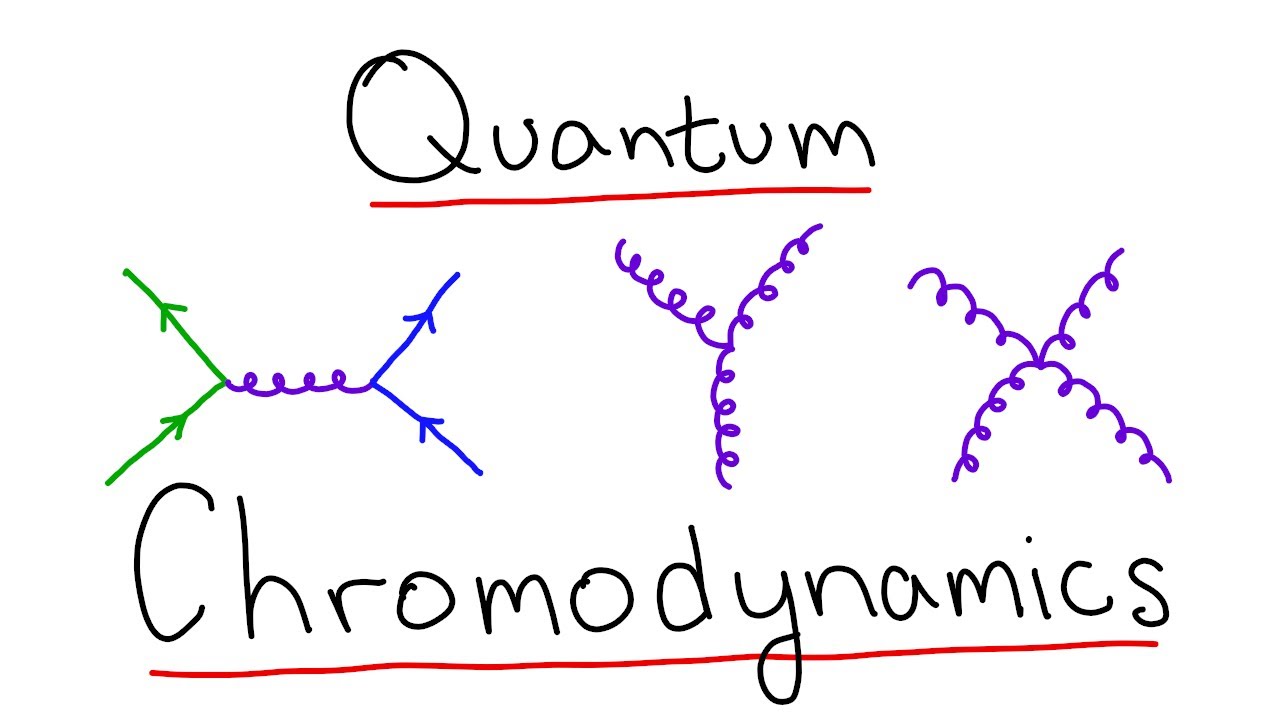
So electromagnetism can be explained as being due to the fact that the universe has this particular rather simple symmetry - which we call a U(1) symmetry. That incredible success led many physicists over the following decades to try to explain the other forces of nature in terms of gauge symmetries. And they succeeded. The weak interaction arises from a slightly more complicated SU(2) symmetry, while the strong interaction is a consequence of the rather more complex SU(3).
These symmetries also come from the fact that the wavefunction can be distorted in different ways that have no effect on the laws of nature. It’s just not as straightforward to say exactly what is being distorted, as it is with the phase invariance of U(1). You may have noticed I skipped gravity. We’re still working on that one, although it may have nothing to do with symmetries at all.
It’s a nice idea for all the forces of nature to arise from the same underlying mechanism.
But how do you go from that to actual equations describing how the forces behave? And how do you wrap it all up in a single equation that is the Standard Model Lagrangian? The key is this Lagrangian thing, so let’s talk about it.
This is all possible due to an extremely powerful concept in physics called the Principle of Least Action, which we’ve talked about in detail. It says that Nature will always try to follow the path that minimizes rate of change of a certain quantity called the Action.
This tendency can be used to figure out how pretty much any process will play out - whether we’re calculating the path traveled by a ball through the air or the probability that two quantum particles will interact.
The Lagrangian is the part of this action quantity that we actually work with. We can think of it as the distance an object or system travels through the space of all possible quantum states. For classical physics it simplifies to just Kinetic Energy minus Potential Energy.
If we plug the Lagrangian of a system into the Euler-Lagrange equation and the result will be equations describing how that system will move and change over time.
There are other ways to get these equations of motion, but Lagrangian is especially powerful because of how it respects symmetries. If the system that we are studying has a certain symmetry then the Lagrangian will have that symmetry too. And by applying the principle of least action to a Lagrangian with a continuous symmetry will reveal the existence of a conserved quantity like energy or momentum. And this is Noether's Theorem, and we also have an episode about that.
So it seems like it might be a good idea to figure out the Lagrangian for a wavefunction that has our symmetries of interest. And that is exactly what the Standard Model Lagrangian is.
I’m obliged to point out that this is technically not a Lagrangian, but rather a Lagrangian Density, which is like the building block of a Lagrangian. To get the real Lagrangian that describes the behavior of particles in a certain volume, we have to add up infinitely many Lagrangian Densities over that volume. Although in practice everyone calls Lagrangian Densities "Lagrangians."
The Standard Model Lagrangian is … complicated. It has several different terms that each account for different ways the particles of both matter and force interact. And each of these terms is actually short-hand for a lot of other stuff. Before we dive into what all this means, let’s go over what it has to describe - namely, the particles of the standard model and their interactions with each other.
The symmetries I mentioned allow the particles to have two different types of spins. They can either have an integer amount of spin, like 1, 2 or 3, or even 0 they can have a half integer amount of spin, like ½, 3/2 or 5/2. It turns out that spin determines what might be the most fundamental nature of a particle - whether it represents matter or force.
Particles with half integer spin are called Fermions, and they are stuff, literally, they are what stuff is made up. Electrons, quarks, neutrinos, they are all just different kinds of fermions. Meanwhile particles with integer spin are called bosons. They transmit energy and momentum according to the symmetries of each force. Some parts of the standard model lagrangian deal with bosons, other parts with fermions, and still others - perhaps the most important parts - deal with the interactions between the two. So let’s now take a tour through the standard model lagrangian and see what it’s all about.
First we have this term with two Fs, this is known as the kinetic term, and it tells us how the bosons will behave and how they’ll interact with each other. Alone, this describes a universe with no matter whatsoever. The Fs are actually shorthand for the separate interaction of each of the three quantum forces.
First we have the photon field which is usually represented with a capital A, this is the field that preserves the U(1) symmetry of electromagnetism, and the kinetic term for photons is made of the derivatives of the A field. In other words, this is like the energy of the photons as they change in space and time, and this is true for all the derivatives we are going to see here, they are analogous to the kinetic energy of that object in every direction of space and time.
This is where these mu/nu symbols come from. The kinetic energy of the field in one direction may depend on what is happening in the other direction, which means we need to take a lot of derivatives of the field in every direction. Instead of writing each one we just write these symbols which basically mean: first x, then y, then z, then do t for time.
Indices are gonna be a running theme here. Whenever you see them it means that whatever was written has to be repeated several times depending on the dimensions of spacetime, the number of charges, the number of different particles, or things like that Next we do something similar for the fields of the other two forces, we also need their kinetic energy in every possible direction. Except if two photons come close they'll just pass through each other, but if two say gluons come close, they will interact.
We need an extra term to describe the potential energy of that interaction, which we add to the kinetic term. Here we see a connection to the classical Lagrangian, with is kinetic and potential energies.
The many indices you see here come from the complex symmetries of SU(3), and account for all the different types of gluon. The bosons of the Weak force get a term like this also, although its SU(2) symmetry leads to different behavior.
The weak force also has a second kinetic term that looks a lot like electromagnetism; a consequence of the fact that the weak force and electromagnetism used to be components of the one force.
These complex kinetic terms are multiplied with themselves in a matrix multiplication because that turns them into the appropriate units of energy - or something close to energy - because that’s what the Lagrangian needs.
All these kinetic terms are summarized with the F’s, representing the motion of the bosons and their interactions with each other.
Let’s make the universe more interesting by introducing some matter. That’s what the second term in the Lagrangian represents. The psi is the wavefunction of the fermion fields. Strictly speaking there are 12 fields for the 12 kinds of fermions we have discovered so far, but again they're squished them together into one symbol.
Let's look at this weird D thing. The slash is a shorthand that Richard Feynman came up with it because he was tired of always having to write gamma D where gamma is a series of matrices to ensure everything stays compliant with general relativity The D itself is made of two parts. We have a derivative, which as we mentioned tells us the energy of the field as it changes, but we also have this part with the field of the bosons. This tells us how fermions are gonna interact with the fields that preserve the symmetries of nature. This is the piece that tells us that matter and forces interact.
The part with the EM field is equivalent to the piece added to the Schrodinger equation to ensure phase invariance. And now we have to add the pieces for the other fields also.
Here each field is preceded by a new symbol which represents the charge that field interacts with: electric charge, isospin, hypercharge, and color charge, and the more complex the symmetry the more indicies you need. Also, next to the charges are the coupling constants which represent the strength of each interaction.
And here we this "h.c." thing and well I didn't want to scare you earlier but, this Lagrangian is haunted, it has ghosts. There are ghosts of particles that cannot be measured, and of infinities that make no sense. But it turns out that if you add a copy of the matter term but switch the sign in front of every imaginary number, all of the problematic ghosts cancel out.
This process may sound a bit forced, and it kinda is. It would be nice to have a Lagrangian without ghosts and perhaps we will. But until then this process gives an equation that describes Nature very well. By the way, the h.c. stands for hermitian conjugate, which is the process of flipping the signs of imaginary components. And it can also stand for hot coffee, because this is the point in reading the Lagrangian where most people need a coffee break.
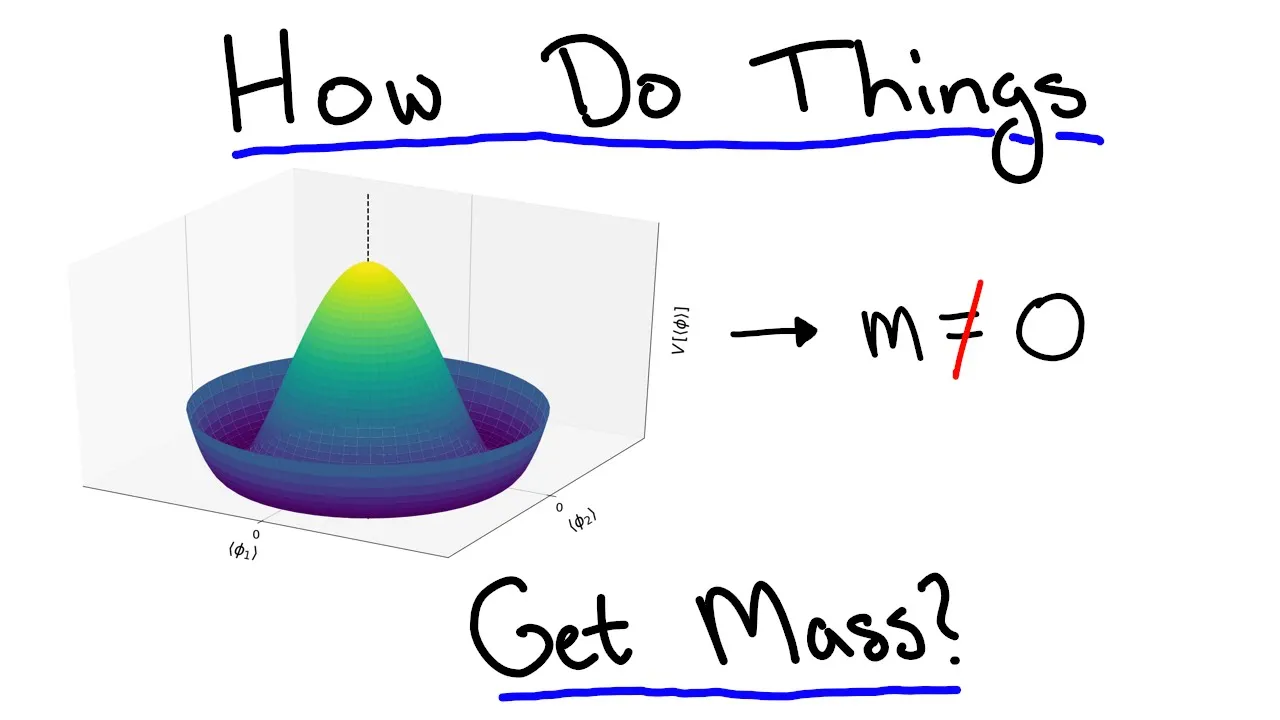
OK, bear with me. We’re getting there. The particles described by the Lagrangian so far are massless. To add mass we need the Higgs field - and that’s what the rest of the Lagrangian deals with. We have episodes on the Higgs mechanism if you’re interested.
This term is like the previous - fermions interacting with a bosonic field, but now that’s the Higgs field, represented by this Phi.
y is a matrix with the square of the mass of each different fermion. This equation doesn’t actually predict the particle masses - that’s still an unsolved problem. Instead, we have to measure those masses with experiments and write them into this matrix by hand.
And we have another "h.c.", but this time hermitian conjugate tells us how antimatter picks up mass from the Higgs field, and it's pretty much the same as regular matter, as far as we know.
We’ll zip through the rest of the Lagrangian. We have another one of these derivatives - D, now applied to the Higgs field. It tells us how that field changes in space and time and how it interacts with the massive bosons of the weak force.
Finally the last term refers to the potential of the Higgs field. This is like the kinetic terms for the other bosons, but now just for the Higgs. The Higgs gets all its own terms separate from all the other terms because its special and weird. Really, though this term describes the Higgs boson itself. That particle was the last prediction of the Standard Model to be verified, and that happened 10 years ago at the large hadron collider. The discovery of the Higgs boson “completed” the standard model, just as we’ve finished the standard model lagrangian.
Now, just for fun, let's look at the full Lagrangian, unsquished. Yeah, it’s a lot.
But it works. Putting in your particle wavefunction and setting your indices right and including the correct masses, you can calculate behavior of any known particle in the universe.
Note that I said “known particle”. There may be unknown particles that are not covered by the standard model or its lagrangian. In fact there probably are - whatever makes up dark matter for example. And there are other mysteries that this doesn’t explain. It doesn’t tell us how nature chooses different particle masses, or chooses coupling strengths like the fine structure constant we discussed recently. And it doesn't explain dark energy or the matter-antimatter imbalance, among other things. And it is a bit of a mess. Many physicists feel that the equation that truly underlies everything, if it exists, should be at least as elegant as E=mc^2.
But despite all this, the standard model lagrangian is an insane victory for physics. It predicts the behavior of the subatomic world with truly astonishing precision, and physicists are having a very difficult time finding situations where it fails. Because it will be a glitch in the predictions of the standard model lagrangian that could lead to an equation that is easier to fit on a coffee mug, and to a deeper description of the mechanisms ruling space time.
Before we get to comments, for all the space time fans who are also history buffs, we’d like to let you know about a new pirate-based history show called Rogue History. Over on the PBS Origins channel Rogue History unravels the historical myths, unearths lost narratives, and champions the unsung heroes of piracy. There’s a link in the description and if you check it out, tell them, politely that Space Time sent you!
The support we get from Patreon is a big part of what makes this show possible. So thank you to everyone who donates. Seriously even a few bucks a month goes a long way. But today, I’d like to give very special thanks to Vivaan Gupta Vaka, who’s supporting us at the Quasar level. For those you who don’t know, quasars are the most brilliant objects in the universe. They are the hearts of galaxies. Maelstroms of power and mystery shining out to us from across space and time, just like you Vivaan. We wish you a most luminous future.
Up Next
105:22
The Dark Universe: Dark Matter & Dark Energy Explained
@fermilab
7.7M views•2016-06-06

12:53
21cm Hyperfine Transition in Neutral Hydrogen: Radio Astronomy Basics
@AaronRobertParsons
12.4K views•2011-10-13
6:59
Understanding Geodesics and Curvature in Spacetime: Clarifying Parallel Transport
@pbsspacetime
341.3K views•2015-07-08

27:14
Entropy and the Second Law of Thermodynamics Explained
@veritasium
27.5M views•2023-07-01
Related Study Plans & Knowledge Roadmaps
Structured learning paths in Physics
physics
Nuclear Physics (Decay, Fission & Reactors)
01Atomic Structure and the Binding Force
02Radioactive Decay and Half-Life
03Nuclear Fission Mechanics and Chain Reactions
+ 2 more learning modules
12h5 modules
Explore Roadmap
physics
Soft Matter (Polymers, Colloids & Rheology)
01Foundations of Soft Matter & Thermal Forces
02Polymer Physics and Macromolecules
03Colloids, Surfactants, and Self-Assembly
+ 2 more learning modules
38h5 modules
Explore Roadmap
physics
Analytical Mechanics: Lagrangian & Hamiltonian
01Mathematical Foundations: Calculus of Variations
02From Newtonian Mechanics to Constraint Dynamics
03The Principle of Least Action & Lagrangian Mechanics
+ 3 more learning modules
28h6 modules
Explore Roadmap
physics
General Relativity (Spacetime & Cosmology)
01Foundations of Relativity: Special Relativity
02The Geometry of Spacetime: Equivalence Principle & Curvature
03Einstein's Field Equations: The Mathematics of Gravity
+ 2 more learning modules
55h5 modules
Explore Roadmap