
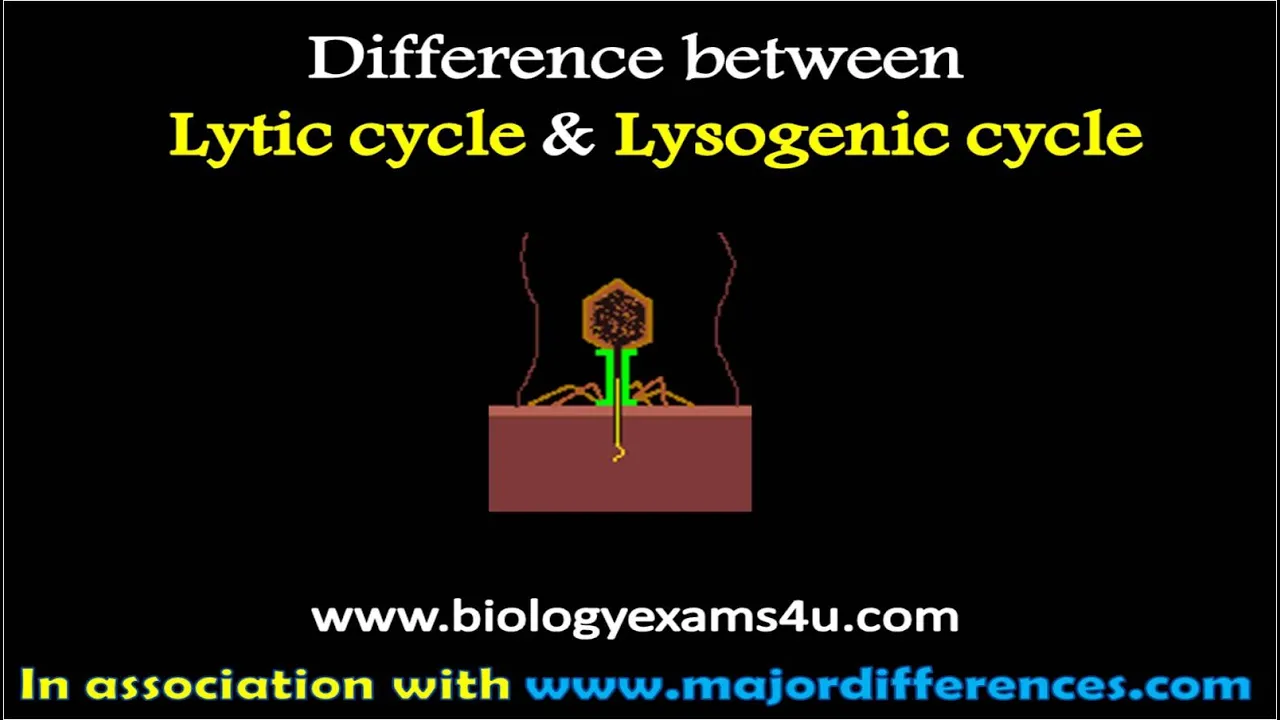






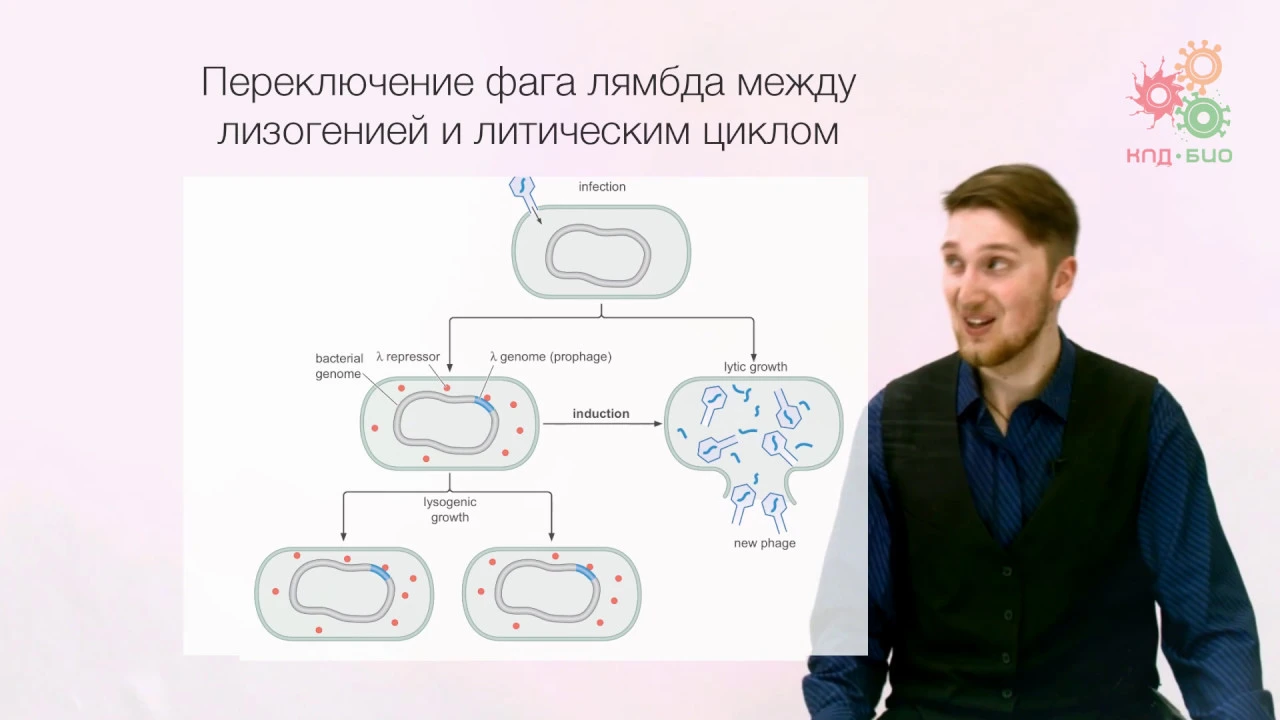






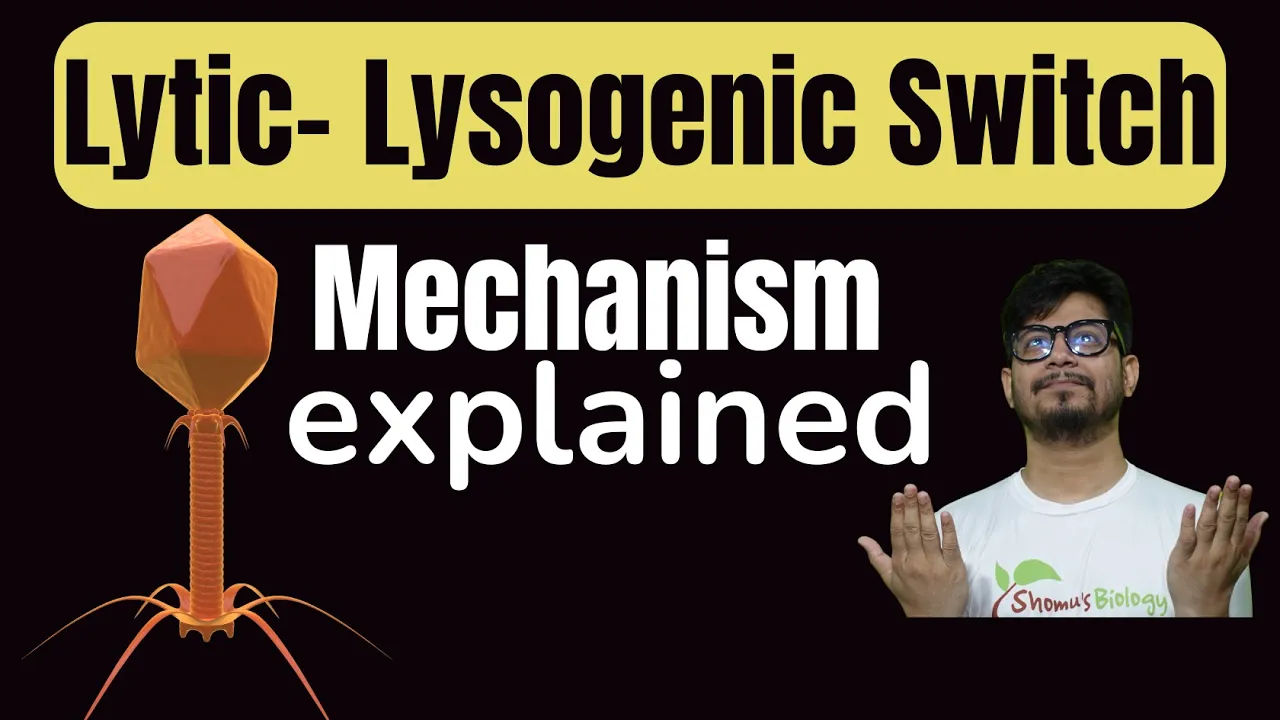




The choice between lytic and lysogenic cycles in lambda phage is regulated by the balance between Lambda repressor (CI) and Cro proteins, with CI promoting lysogeny by inhibiting lytic genes and Cro promoting lysis by inhibiting CI; this decision is environmentally responsive, as cellular proteases degrade the unstable C2 protein under good growth conditions, reducing CI and favoring the lytic cycle, while poor conditions preserve C2 and promote lysogeny.
Lambda Phage Gene Regulation in Lytic vs Lysogenic Cycle
Added:Basic understanding of bacteriophage biology, specifically the general differences between the lytic and lysogenic life cycles.
Fundamentals of prokaryotic gene regulation, including the functions of promoters, operators, repressors, and RNA polymerase.
The physiological response of E. coli to environmental stress and nutrient availability, particularly the role of host proteases like FtsH.
Concepts of protein-DNA interactions, specifically how competitive binding at operator sites influences transcriptional activation or repression.
The molecular mechanism of prophage induction, focusing on how DNA damage triggers the host SOS response, RecA activation, and CI repressor cleavage.
Mathematical and systems biology modeling of genetic switches, using the lambda phage as a classic example of bistability and feedback loops.
Practical applications of lambda phage genetics in biotechnology, such as lambda red recombineering and the design of expression vectors.
The broader ecological and evolutionary implications of the lysis-lysogeny decision in viral-bacterial dynamics and horizontal gene transfer.
45.2K views467likes4:58Original Release: 2015-02-27
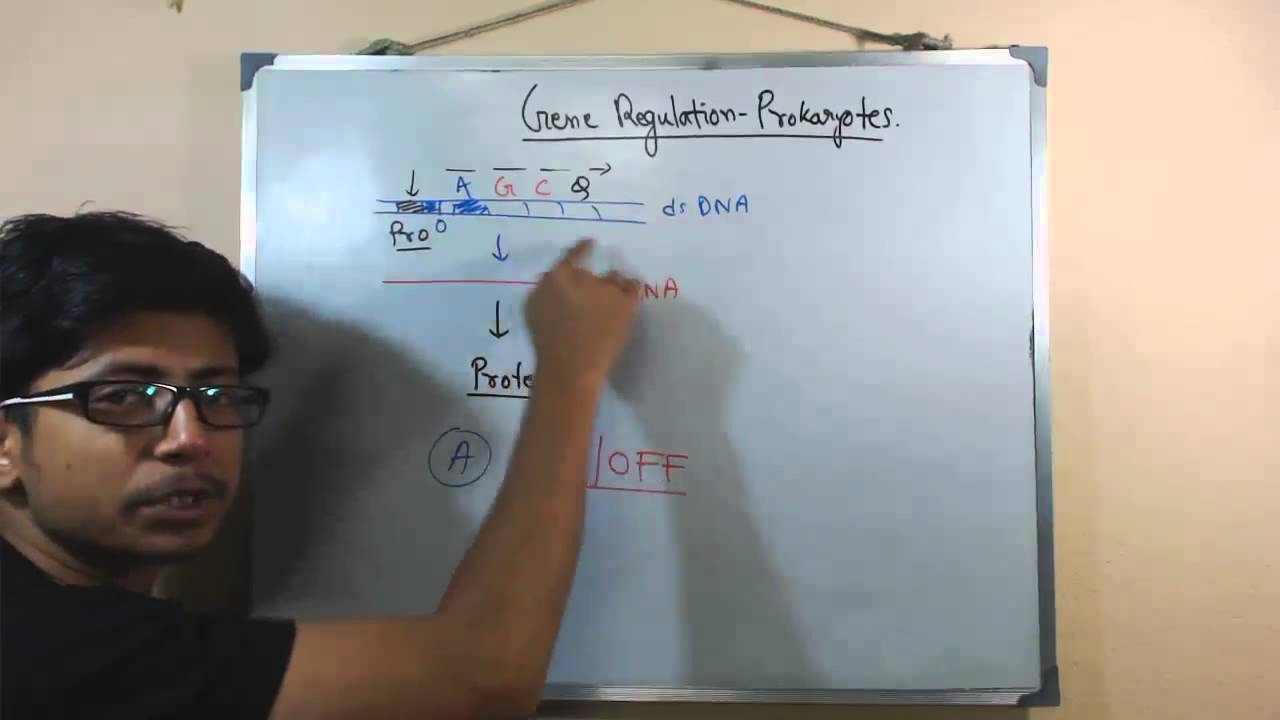
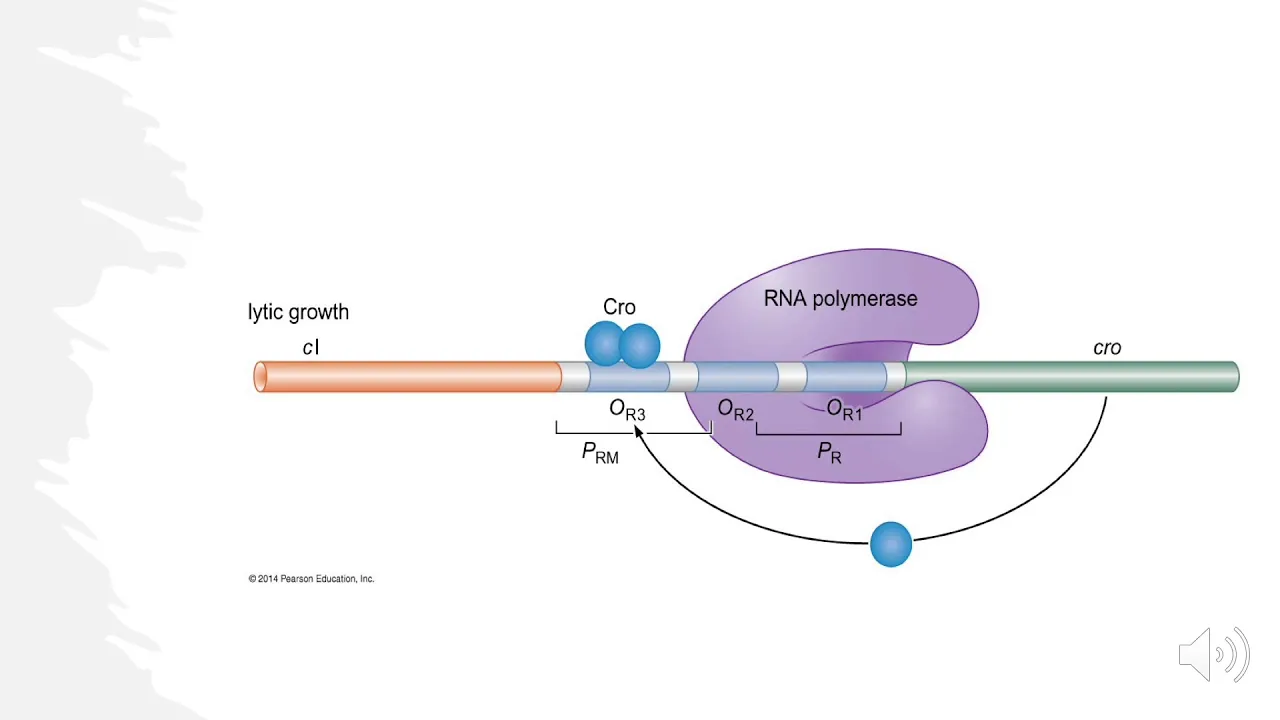
so that's the lysogenic cycle or the choice to go into the lysogenic cycle and the litic cycle is going to be a little different so in the litic cycle excuse me excuse me in the litic cycle we're going to have more Crow around and this Crow protein is going to also be able to bind to o r and O just like C1 was able to but now instead of activating transcription of PL and PRM like Lambda did it's now going to inhibit those so now we're going to have inhibition of PL and inhibition of PRM this is going to have the effect of lowering the amount of Lambda protein in the cell and since Lambda protein isn't around to inhibit anything else we're going to have the production of lots of these litic cycle genes so these litic cycle genes are going to go up so the choice between the litic cycle and the lysogenic cycle is really going to be ruled by how much lamp do we have around versus how much Crow we have around and all of this is going to be dependent on the amount of C2 if we have a lot of C2 around we're going to upregulate Lambda and if we don't have a lot of C2 around then the crow that is normally made is not going to be inhibited the C2 is a very unstable protein and the C2 like I mentioned before need C3 around to help activate it or to help sorry keep it stable so this C2 protein is easily degraded by cellular proteases and these cellular proteases normally get made by eoli the C3 can help stabilize this but it can't stabilize all of the C2 so the C2 can still get degraded by these cellular proteases so the system seems a little bit crazy you have proteases around and this is going to make this actual liic versus lysogenic cycle decision but it actually makes sense because we actually get higher amounts of proteases when there are good eoli growth conditions growth conditions so when there are good ecoli growth conditions we tend to see more proteases in the eoli and these more proteases in the colite will degrade C2 and that will lead to low production of lamb that means that there's going to be more Crow around and this will go into the liic cycle so higher levels of proteases due to good ecoli growth conditions leads to the conditions that give us the liic cycle for our bacteria Fage and this makes sense when we've got favorable conditions for ecoli growth this Lambda Fage can make lots and lots of copies of itself and go infect lots of other healthy ecoli cells on the other hand when nutrients are limiting we under starvation conditions for eoli the cellular proteases are really more or less inactive and so they don't degrade C2 very much we make a lot of Lambda protein we have very low amounts of crow this is going to be regulated both by the um both by the uh operator region um as well as by this anti-ro that's being made over here off of PR so under these conditions we have our high C2 we repress Crow with Lambda as well as with anti-ro and this all makes sense now we go into the lysogenic cycle where uh we can have the bacteria phage sitting as a proage waiting for good environmental conditions to be um to to come about
Up Next
18:43
Lambda Phage Lytic vs Lysogenic Decision Explained (Microbiology)
@brainbooost_edu
83.1K views•2021-01-16
50:12
Bacterial Communication: Quorum Sensing and Biofilm Formation Explained
@JHUAAP
12.6K views•2011-06-28

5:35
Enteric Nervous System Explained: The Gut's Brain | Neurobiology Lecture
@alumniu6029
438 views•2018-09-12
7:08
Bacteriophages: Earth's Deadliest Killers and Future Antibiotics
@kurzgesagt
34.6M views•2018-05-13
Related Study Plans & Knowledge Roadmaps
Structured learning paths in Biology
biology
RNAi: Biogenesis, RISC & Gene Silencing
01Molecular Biology Foundations: DNA to Protein
02Introduction to RNA Interference (RNAi)
03Molecular Biogenesis of miRNA and siRNA
+ 2 more learning modules
10h5 modules
Explore Roadmap
biology
Mycorrhizae: Signaling, Biophysics & Ecology
01Foundations of Mycorrhizal Symbiosis
02Molecular Signaling and Root Colonization
03Biophysics and Bioenergetics of Nutrient Exchange
+ 1 more learning modules
11h4 modules
Explore Roadmap
biology
Circadian Clocks: TTFL, SCN & Periphery
01Foundations of Molecular Biology & Gene Expression
02Introduction to Chronobiology and Actograms
03The Core TTFL: Molecular Architecture of the Clock
+ 3 more learning modules
14h6 modules
Explore Roadmap
biology
Population Genetics: Math, Drift & Selection
01Genetic & Probability Foundations
02The Hardy-Weinberg Principle and Baseline Models
03Mathematical Modeling of Natural Selection
+ 3 more learning modules
18h6 modules
Explore Roadmap