
























Reading one book per month (approximately 1 million words annually) in your target language is an achievable goal that dramatically improves language skills by connecting reading with listening and speaking, as the same brain regions are activated during all three activities; to succeed, learners should connect audio with text, choose content of interest, ignore unknown words during reading, and combine reading with listening to build phonemic awareness and vocabulary efficiently.
How to Read 1 Million Words Annually in Your Target Language: Proven Strategies
Added:Stephen Krashen's Input Hypothesis, specifically the concept of 'Comprehensible Input' (i+1), which explains how language is naturally acquired.
The fundamental distinction between intensive reading (detailed, analytical study) and extensive reading (reading for speed and general meaning).
Basic vocabulary acquisition theories, including the distinction between active and passive vocabulary size.
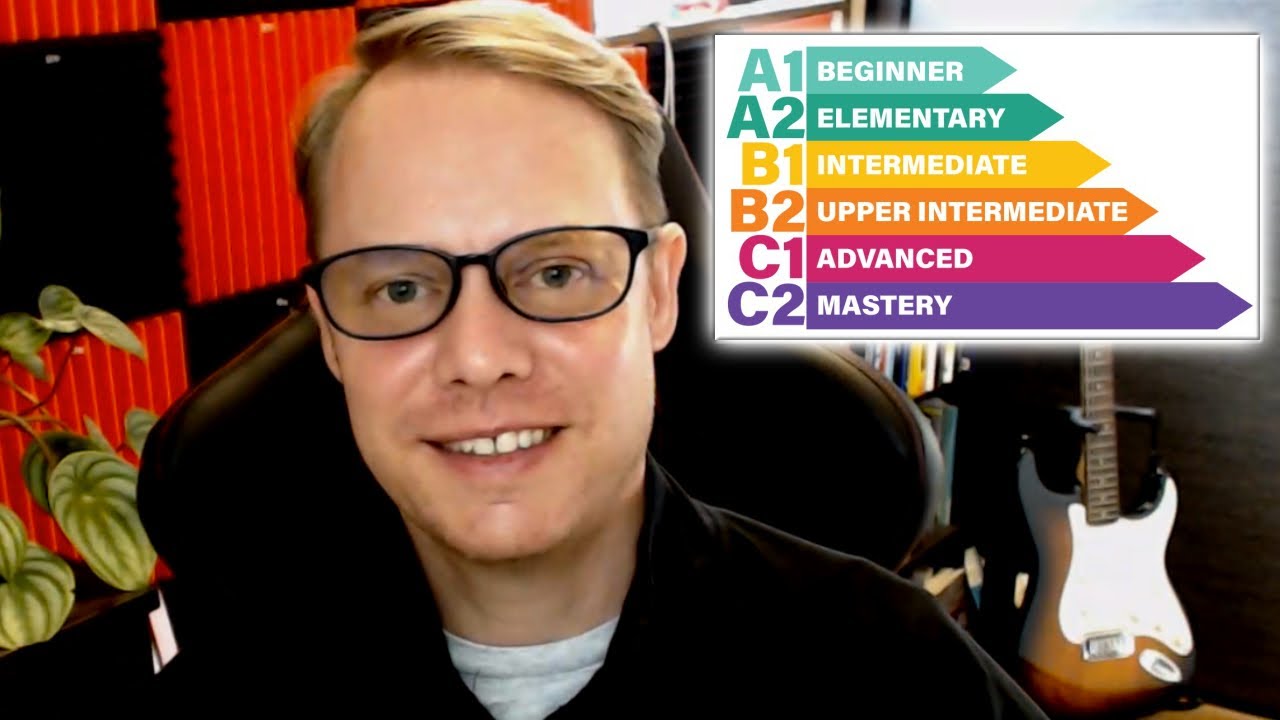
An understanding of your current CEFR (Common European Framework of Reference) language level to properly select appropriate, low-friction reading materials.
Advanced strategies for transitioning from graded readers to complex, unadapted native literature and authentic media.
How to integrate Spaced Repetition Systems (SRS), such as Anki, to systematically capture and retain low-frequency vocabulary encountered during extensive reading.
Methods for bridging the gap between passive reading comprehension and active output skills (speaking and writing) through sentence mining and output practice.
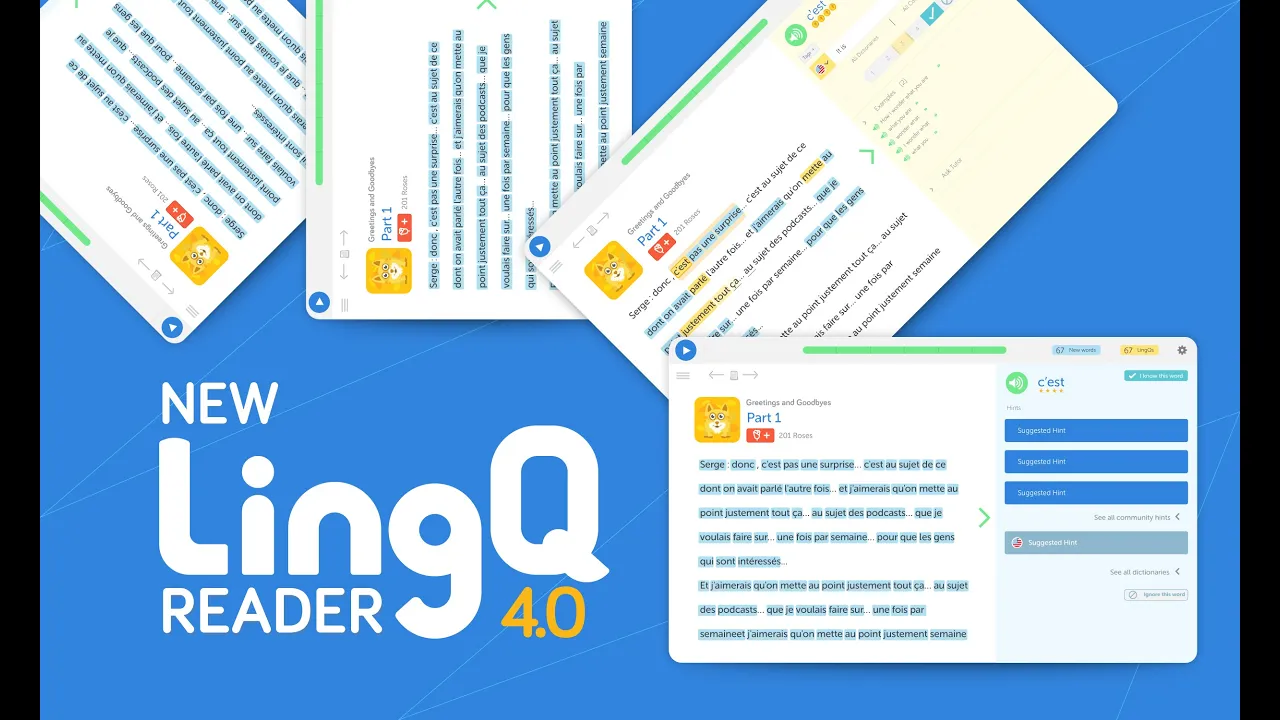
Utilizing reading tracking software and digital tools (like LingQ, LWT, or e-readers) to analyze personal reading metrics, vocabulary growth, and reading speed (WPM).
Cognitive techniques for increasing reading speed in a second language while maintaining a high level of comprehension.
490.4K views2.7Klikes11:22Original Release: 2023-07-13
How do you get to reading more than a million words a year in the language you're learning?
Is that even possible?
Reading is key to so many things in life.
In our own language, people who read well have more socioeconomic success.
The statistics prove this.
We have the case of Elon Musk, who apparently read two books a day.
I think the average book has 70-, 80-, 90,000 words in it.
250, 300 pages or so.
Apparently Warren Buffet reads 500 pages a day.
So those two gentlemen read 30 plus million words a year.
The average person, according to statistics, reads—in the US or in typical European country—14, 15 books a year, a little more than one a month.
This works out to a little over a million words a year.
Just in terms of books. But, of course, we read all kinds of other stuff.
We read newspaper articles online.
We read Twitter, Facebook, and so forth.
So we easily read more than a million words a year in our own language.
But how does this relate to language learning?
I think reading is tremendously powerful in language learning.
I always feel that when I get to where I can read a book away from the computer without the help of LingQ, or, you know, online dictionaries.
That's a major milestone in my learning activity.
So what about the strategy of reading a million words in a language that we're learning?
Obviously it's much more difficult to read in the language we're learning.
The more different the language is, and especially if the writing system is different, it's a lot more difficult.
So if we say that the average person reads, say, a book a month, and some people read a book a week, if I get to where I, you know, this milestone of reading a book in the language that I'm learning, I'm not reading a book a week or even a book a month.
In that language, at least not for a long, long time.
So I would say, first of all, we have to make a distinction between someone like me who is a bit of a dilettante, and I'm working on Persian and Arabic, and I throw in some Polish, versus someone who's learning English.
I think for those of you out there who are learning English, who are working on improving your English, you want to be as good as possible in English.
Maybe you need it for school or you need it for work.
Then I think the objective is trying to read at least one book in English a month.
It's realistic and it would be very beneficial to your language skills.
And the same is true for someone who is dedicated to one language, French, Spanish, German, Chinese.
If you can get yourself to where you can read a book a month in your target language, it'll have tremendous benefits. Because reading is connected to listening and speaking.
We have to remember that for most of history humans didn't—and whatever animals preceded us on the evolutionary scale—obviously didn't read.
It's not something natural to human beings.
And for most of that period of history, when we had writing, most people didn't read.
So the fact that we are able to read is a tremendous achievement. And all kinds of research shows that it's connected with sound. That when we develop our ability to read, we first have to develop this— what they call "phonemic awareness" The connection between the written word and the sound.
And this takes time to develop.
Struggling readers don't hear the sounds very well, so in dealing with dyslexic people, or people who struggle to read in their own language, increasingly educators are using teaching methods that connect the sound to the written word. It's extremely important.
So as a language learner, we are in the situation of a struggling reader.
We're not struggling to read in our own language with all of the consequences that has for socioeconomic success.
And it's a major problem in societies.
You know, weak readers have difficulty. They're overrepresented in prisons, and so on and so forth.
Not always, like I know people who don't read well, who are very successful at what they do. But largely speaking, reading is considered a shortcut to greater socioeconomic success.
If we can improve the performance of poor readers, it'll have a major impact for those individuals and also for society as a whole.
But getting back to language learning. We want to use the same approach in order to improve our language learning skills.
So connect audio with text as much as possible.
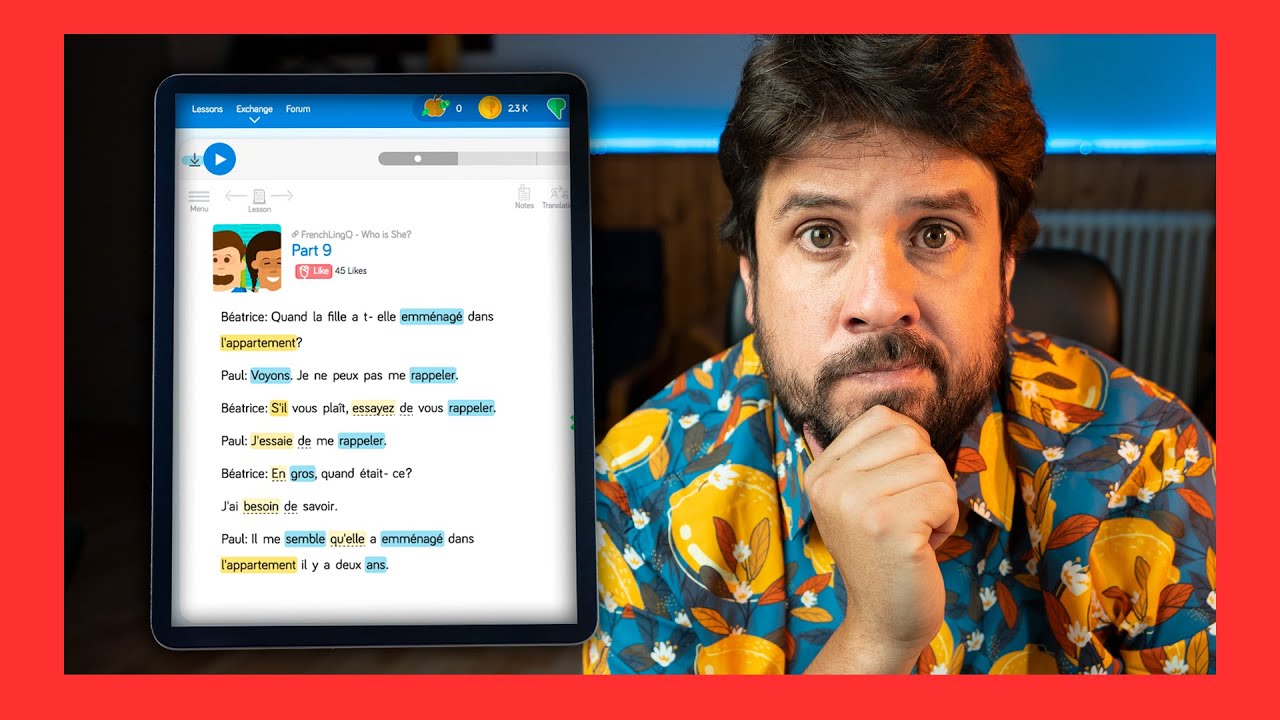
That's why at LingQ, for every item that we have in our libraries, there is audio and text.
That's why we now, we enable people to grab an MP3 file somewhere or from a YouTube video, or whatever, for their own use.
Of course, there's a limit to what they can share.
Bring it in.
There's an automatic transcription created, which then you can study as a lesson.
The idea is that if you're focused on one language, you want to get to a level where you can read a book a month.
That will really propel your language skills forward because whenever you read, you are subvocalizing.
We know, science tells us, you know, MRIs of the brain tell us that the same portion of our brain is activated when we read as when we speak or listen. And this is true whether the writing system is a pictographic system like Chinese characters or a syllabary like the Japanese writing system or a pure alphabet like Hangul in Korean or the Latin alphabet or the Arabic script. The brain performs the same way.
Text connects to audio.
Certainly if we're fairly good in the language we can follow along at LingQ.
I very much encourage people to import content of interest to LingQ where they also have the audio.
Remember that one key to reading success is that the content be of interest.
So just as I say at LingQ, we want people to learn the language from content of interest.
If you want to increase your reading, go find things that are of interest to you.
And I know that kids, there are books that they like for whatever reason they like them, like books by Roald Dahl that are very popular with kids. And now they're fussing about the wording in those books, which is so silly because really all you want is to encourage kids to read.
Nothing that is offensive to any particular group in any particular book is gonna have a lasting impact on the reader.
The most important thing is to get the reader reading, and the same is true in language learning.
Read things that you enjoy and you will improve your skills at reading.
You will improve your skills if you listen to the same content.
You will improve your listening skills. But there are steps, and if you look at my statistics at LingQ, you'll see, first of all, that it's much easier for me to read in Polish than to read in Persian or Arabic, even though I have spent far more time on Persian than on Polish.
So it's not difficult for me to get up to 50-, 60,000 words a day of reading in Polish when I'm really on it, whereas it's much more difficult to do that in Persian.
In fact, in Polish, I can simply read through the text, listen to it while reading if I want, or listen to it when I'm away from the computer, come back and read it again to pick up the words that I missed.
But when I'm in Persian, I prefer to go through the lesson in "sentence mode" where the audio is timestamped to the sentence.
I can closely connect the words to the audio because I don't yet have that phonemic awareness in Persian because the writing system is more obtuse to me. I'm not so used to it as I am to the Latin alphabet. And I should add that in Polish— and I haven't spent much time in Polish, but I was over in Poland and so I imported this ebook into LingQ and I also was given a copy.
In fact, I was first given a copy of the book in sort of book form, traditional book form.
Then I found the ebook and I imported it.
So now I can go through reading it on LingQ, looking up words, and then I can sit down and enjoy the book in a traditional book format.
And I think this is something well worth doing, even if you read the same thing in different formats.
It all contributes.
It's all part of reading.
Can I get in polish to where I read a million words a year?
In other words, a book a month or a little more than a book a month?
If I lived in Poland, if Polish were the only language I was learning, I think I could get there. And I think I would make it an objective to get there.
Now, if we step back to Persian, it's so much more difficult for me.
If I lived in Iran and if I had to get to that level, I think I would set myself the goal of trying to read a book in Persian, you know, as a goal, one a month.
I think I could get there.
Part of it is, when reading away from the computer, as I did with this other book on the, the History of Krakow, ignore the words you don't know.
In other words, get yourself to a level using, you know, reading online, looking at words.
Get yourself to a level where you can still more or less follow the gist of what you're reading without having to look up words.
Because looking up words very much slows you down and it's much faster to do that reading online where you have, you know, a quick reference to an online dictionary and the other functionality that's available in an application like LingQ, to acquire vocabulary.
But the goal, if you are dedicated to one language and you genuinely want to become fluent in that language, the goal of reading a million words a year is attainable.
And I should add, because not everything you read is gonna be a book.
So if you read a book a week, You don't have to get to the level of Elon Musk or Warren Buffet, and I might add in there Bill Gates, who claims, I think, that he reads 50 books a year, which isn't in the 30 million words a year, but it's in more than 3 million words a year.
You don't even have to get to that level.
If you read a book a week in your target language, you will definitely surpass a million words a year because you do reading of articles, of newspaper articles, social media.
But if you are committed to becoming, call it "C1" in your target language, then you should be able to read a book a week.
And if you can combine it with listening, so combination ebook-audiobook, if you can combine the two, Because reading is so intimately—in our brains—connected with listening, then you are going to dramatically improve your ability to read, your familiarity with the language.
All of those things in your brain are gonna be activated.
So I think that's a laudable goal and an achievable goal.
Although I admit that with me in Persian, it's still a long way away.
And because I'm not dedicated to one language, I probably won't achieve it.
But for those of you who are, you know, determined to really kind of ratchet up your skill level in a language, a million words a year is not a difficult goal for you to achieve.
And there will be many, many benefits across your language skills.
Thank you for listening.
Bye for now.
Up Next
74:01
Express JS Framework Tutorial - Building Web Apps & REST APIs
@TraversyMedia
991.5K views•2019-02-22

12:54
Triumph of Orthodoxy Icon: Byzantine Art & History Explained
@BenCallan
2.1K views•2024-08-06

9:49
FastAPI vs Flask vs Django: Choosing the Right Python Web Framework
@TechWithTim
302.5K views•2024-05-26

1:42
Game of Thrones Opening Credits: A Cinematic Analysis
@gameofthrones
46.3M views•2011-04-18
Related Study Plans & Knowledge Roadmaps
Structured learning paths in General & Interdisciplinary Studies
general-studies
Elevator Engineering: History, Physics & Cities
01From Hoists to Safety Brakes: The Dawn of Vertical Lift
02Hydraulic vs. Traction: The Engineering Physics of Elevators
03Modern Speed, Safety, and Algorithms
+ 2 more learning modules
12h5 modules
Explore Roadmap
general-studies
Rubber: Material Science, History & Geopolitics
01Origins of Natural Rubber & Mesoamerican History
02The Chemistry of Natural Rubber & Vulcanization
03The Geopolitics of the Rubber Boom & Colonization
+ 2 more learning modules
12h5 modules
Explore Roadmap
general-studies
Containerization: Evolution, Logistics & Trade
01Ancient Trade & Bulk Cargo: Amphorae to Barrels
02The Industrial Revolution & Cardboard Packaging
03The Containerization Revolution: Malcom McLean
+ 2 more learning modules
12h5 modules
Explore Roadmap
general-studies
Textile Tech: Evolution, Labor & Global Impact
01Pre-Industrial Textiles: Handloom & Cottage Industry
02Mechanization: The Spinning Jenny to the Power Loom
03The Factory System & Global Labor Transformation
+ 2 more learning modules
10h5 modules
Explore Roadmap