





![1.1 Symbolic Method [Lecture 1 - Combinatorial structures and OGFs]](https://i.ytimg.com/vi/ULpHNFtOBBI/sddefault.jpg?sqp=-oaymwEmCIAFEOAD8quKqQMa8AEB-AHUBoAC4AOKAgwIABABGC4gQSh_MA8=&rs=AOn4CLCS0jUeXbkfhVW7cn825-olLGXd0w)















![5.2 Other Familiar Examples [Lecture 5 - Applications of Rational and Meromorphic Asymptotics]](https://i.ytimg.com/vi/SLDCLSv3rn4/sddefault.jpg?sqp=-oaymwEmCIAFEOAD8quKqQMa8AEB-AHUBoAC4AOKAgwIABABGDkgRih_MA8=&rs=AOn4CLA-YcAJgR4SPkBMpr7HNxrSP-onrA)
![5.1 Bitstrings [Lecture 5 - Applications of Rational and Meromorphic Asymptotics]](https://i.ytimg.com/vi/xJ3_8Yg6PYQ/sddefault.jpg?sqp=-oaymwEmCIAFEOAD8quKqQMa8AEB-AHUBoAC4AOKAgwIABABGDggRSh_MA8=&rs=AOn4CLCqZR2oNxXdLYSd8pSeZuxHatTHdg)
![1.6 Exercises [Lecture 1 - Combinatorial structures and OGFs]](https://i.ytimg.com/vi/ux8UCjYDKPw/hqdefault.jpg?sqp=-oaymwEmCOADEOgC8quKqQMa8AEB-AHUBoAC4AOKAgwIABABGCwgPSh_MA8=&rs=AOn4CLC6kNq4x6sYx0CkkWZB697S2aiUgA)


![3.1 Basics [Lecture 3 - Combinatorial Parameters and MGFs]](https://i.ytimg.com/vi/EOboiOlUGMo/hqdefault.jpg?sqp=-oaymwEmCOADEOgC8quKqQMa8AEB-AHUBoAC4AOKAgwIABABGD4gRyh_MA8=&rs=AOn4CLCQDNERjIw9ssOgaevP-3EIs9JZFg)
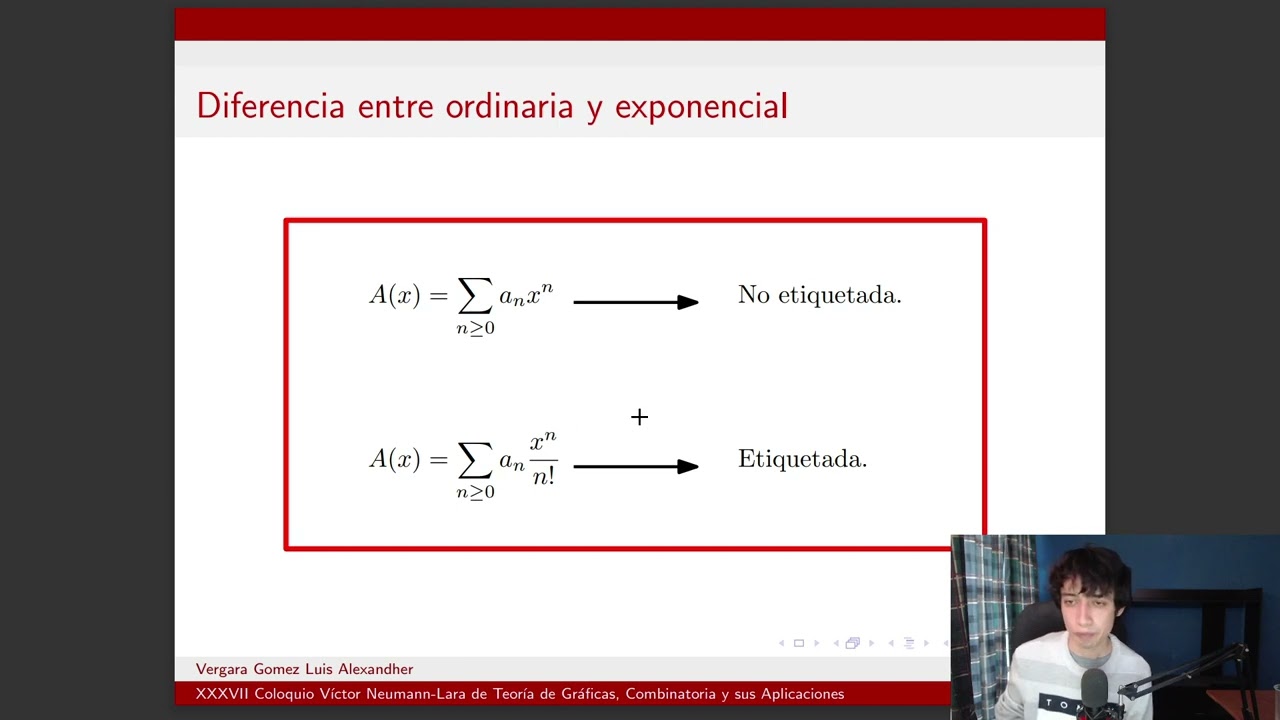
Exponential generating functions provide a powerful method for counting permutations and arrangements, where the exponential enumerator for permutations of n distinct objects is (1+x)^n, and for unlimited repetition, it is e^(nx). These functions allow systematic counting of combinatorial arrangements by encoding sequence information in power series coefficients, enabling solutions to complex counting problems such as finding sequences with specific digit constraints or distributions of objects into cells.
Enumerators for Permutations: Examples & Exponential Generating Functions
Added:Fundamentals of combinatorics, including permutations, combinations, and basic counting principles for sequences.
Ordinary Generating Functions (OGFs) and how they represent unlabelled combinatorial structures using formal power series.
Basic calculus and Taylor series expansions, specifically the series expansion of the exponential function e^x.
The conceptual distinction between labelled and unlabelled combinatorial objects, as exponential generating functions specifically enumerate labelled structures.
The Exponential Formula (Compositional Formula) for counting complex labelled structures built from connected components (e.g., cycles of permutations, connected graphs).
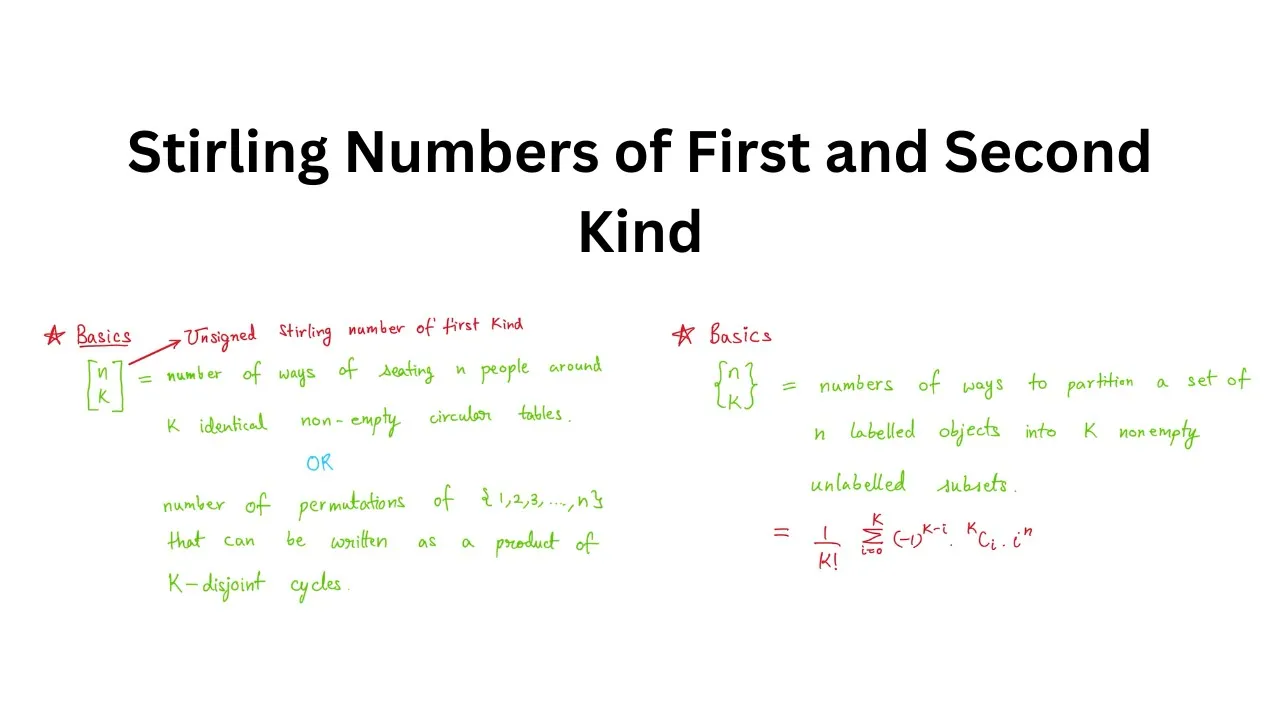
Stirling Numbers of the first and second kind, and their algebraic relationships to permutations and set partitions via generating functions.
Analytic Combinatorics, using complex analysis on generating functions to estimate the asymptotic growth and behavior of combinatorial sequences.
Bivariate Generating Functions to analyze permutation statistics such as descents, runs, and inversions (e.g., Eulerian polynomials).
711 views9likes28:56Original Release: 2022-07-22
so generating function for the combination of two objects [Music] a plus b into x plus a b plus b into x squared [Music] a naught by zero factorial into mu naught of x plus a one by one factorial into mu one of x plus etcetera plus a r by r factorial into mu of x plus etc uh generating function of r factorial so one plus x whole power n is the exponential generating function of p of n comma r with the power of x as the integrator function okay next in the example show that the exponential generating function of the sequence p of 0 comma 0 comma p of 2 comma 1 comma p of 4 comma 2 etc p of 2 or comma r is 1 minus 4 x whole power minus 1 by 2 in the 1 minus 4 x whole power minus 1 by 2 path i'm a combination of the expression so you don't want [Music] exponential enumerator so 1 minus 4 x whole power minus 1 by 2 has the exponential enumerator p of 0 [Music] 1 x by 1 factorial plus x square by 2 factorial plus x cube by 3 factorial plus x on point which is nothing but e power x the remarks one more purpose so exponential generating function of the sequence one one one is nothing but e power x raymadry the exponential generating function of the sequence one one into three one into three into five and then an odd number multiplied by t four one there is nothing but one minus two x whole power minus three by two next the exponential enumerator for the permutation of a single object with no repetitions foreign enumerator for the permutation is one plus x not selector selected either total i n objective one plus six whole power n selector not selected sorry one another not selected [Music] the exponential enumerator for the permutation of two objects of one kind and the three objects of another kind is so trend object 1 plus x by 1 factorial plus x square by 2 factorial 2 object of now on the coefficient of x x square x cube x four four x power five are correct for of or permutation of n distinct object with unlimited repetition by using exponential enumerators number already or permutation of n objects with the unlimited repetition path if by using exponential enumerated mentioned panagna in the unity so that the solution first the number of our permutation of n distinct object with unlimited repetition unlimited repetition ah upon one length and x whole square by two factorial plus exception summation formula summation r equal to zero to infinity in next whole power by r factorial in the factoring of split panel n power r r so the exponential enumerator for unlimited repetition is n power r they resulted in the first unit limit using exponential energy next example 2.12 find the number of or digit quaternary sequence in which each if the digit 1 2 3 appears at least one sorry also if career of each of the digit one two and three appears at least once find the number of all digit quaternary sequence in which each of the digit one two and three appears at least once one of the important problems unlimited reputation than any of the line of 190 and then the e power x minus one so this expression is nothing but e power x minus one so you know digits minus one current one minus e power x minus three e power three x plus three e power two x and another people don't know exponentially exponentially first plus 3 into e so the answer is 4 over r minus 1 minus 3 into 3 power r plus 3 into two power r either answer from the easy problem but it's very very important for next example find the number of or digit quaternary sequence that contains an factorial the term under nothing but e power x plus e power minus x by two they look good so even numbers expression find the number of or rigid quaternary sequence that contain even number of zeros and even number of ones last sum even number of zeros expression oh find the exponential enumerator for the number of ways to choose r or less object from or distinct objects and distribute them into n distinct cells with objects in n into n plus 1 etc n plus m minus 1 ways to arrange them in the n distinct cells in the distribution of distinct cells cellular since the values of m ranges from 0 to r the total [Music] r into n into n plus one etc n plus r minus one and one so it is foreign foreign foreign thank you girls
Up Next

16:11
Exponential Generating Functions Explained | Combinatorics Tutorial
@TertiaryCourses
165 views•2022-09-25

4:43
Elliptic Curve Cryptography Explained: ECC, ECDSA, ECDH
@PracticalNetworking
28.5K views•2024-10-21
10:44
Fourier Series Introduction: The Big Idea Explained
@DrTrefor
387K views•2021-05-03

6:00
The Mathematical Impossibility of Accurate World Maps
@Vox
23.3M views•2016-12-02
Related Study Plans & Knowledge Roadmaps
Structured learning paths in Mathematics
mathematics
Tensor Calculus: Vectors to Riemann Curvature
01Mathematical Foundations: Linear Algebra & Calculus
02Covectors, Dual Spaces, and Tensor Basics
03The Metric Tensor and Index Gymnastics
+ 2 more learning modules
40h5 modules
Explore Roadmap
mathematics
Gödel's Incompleteness: Logic, Proofs & Limits
01Introduction to Formal Systems & Hilbert's Dream
02Set Theory, Cardinality, and Cantor's Diagonal Argument
03Arithmetization and Gödel Numbering
+ 2 more learning modules
14h5 modules
Explore Roadmap
mathematics
Galois Theory: Fields, Groups & Solvability
01Foundations of Abstract Algebra: Groups & Fields
02Polynomials & Field Extensions
03Splitting Fields & Symmetries
+ 2 more learning modules
24h5 modules
Explore Roadmap
mathematics
Non-Euclidean Geometry: Models & Geodesics
01Euclid's Fifth Postulate and the Birth of New Geometries
02Hyperbolic Space and the Poincaré Disk Model
03Geodesics: Defining Straight Lines in Curved Spaces
+ 2 more learning modules
15h5 modules
Explore Roadmap