
























Productivity (A) in the production function q = A × f(k, l) represents how effectively inputs are used and can increase over time through technological improvements, overcoming the diminishing marginal product of labor that Malthus incorrectly predicted would lead to mass starvation. In cost analysis, marginal cost equals wage divided by marginal product of labor (MC = w/MPL), and firms minimize costs by equating the marginal rate of technical substitution to the input price ratio (MRTS = w/r), meaning they choose input combinations where the marginal product per dollar spent is equal across all inputs.
Productivity and Costs | Principles of Microeconomics
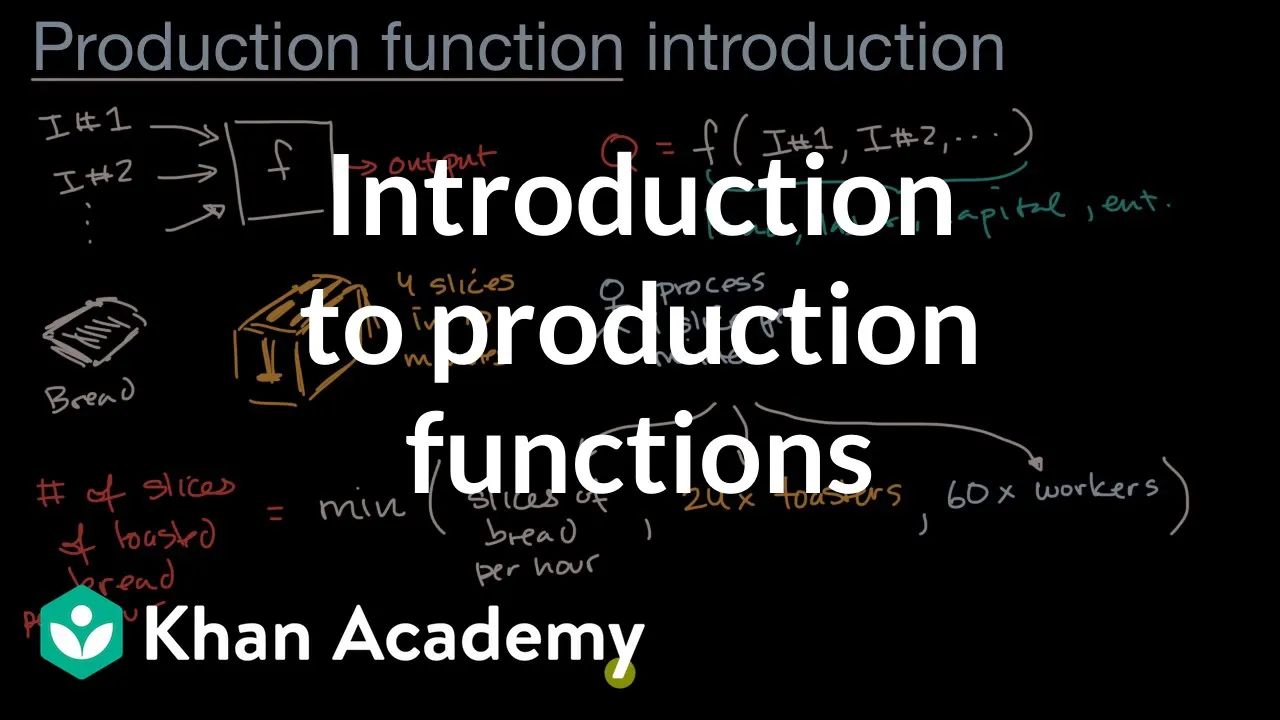
Added:The concept of a production function, including how inputs like labor and capital are transformed into outputs.
Basic cost classifications in economics, specifically the distinction between fixed costs and variable costs.
The economic principle of marginal analysis, which involves analyzing the additional benefits or costs of a one-unit change.
The Law of Diminishing Marginal Returns, explaining how adding more of a variable input eventually yields smaller increases in output.
Deriving and graphing short-run cost curves, including Average Total Cost (ATC), Average Variable Cost (AVC), and Marginal Cost (MC).
Analyzing how a firm determines its profit-maximizing level of output by equating Marginal Revenue (MR) and Marginal Cost (MC) under perfect competition.
Exploring long-run costs, including the concepts of Economies of Scale, Diseconomies of Scale, and Constant Returns to Scale.
Applying cost structures to analyze firm behavior and market supply curves in various market structures, such as monopolies and oligopolies.
130.2K views783likes47:31Original Release: 2012-01-24
The following content is provided under a Creative Commons license.
Your support will help MIT OpenCourseWare continue to offer high quality educational resources for free.
To make a donation or view additional materials from hundreds of MIT courses, visit MIT OpenCourseWare at ocw.mit.edu.
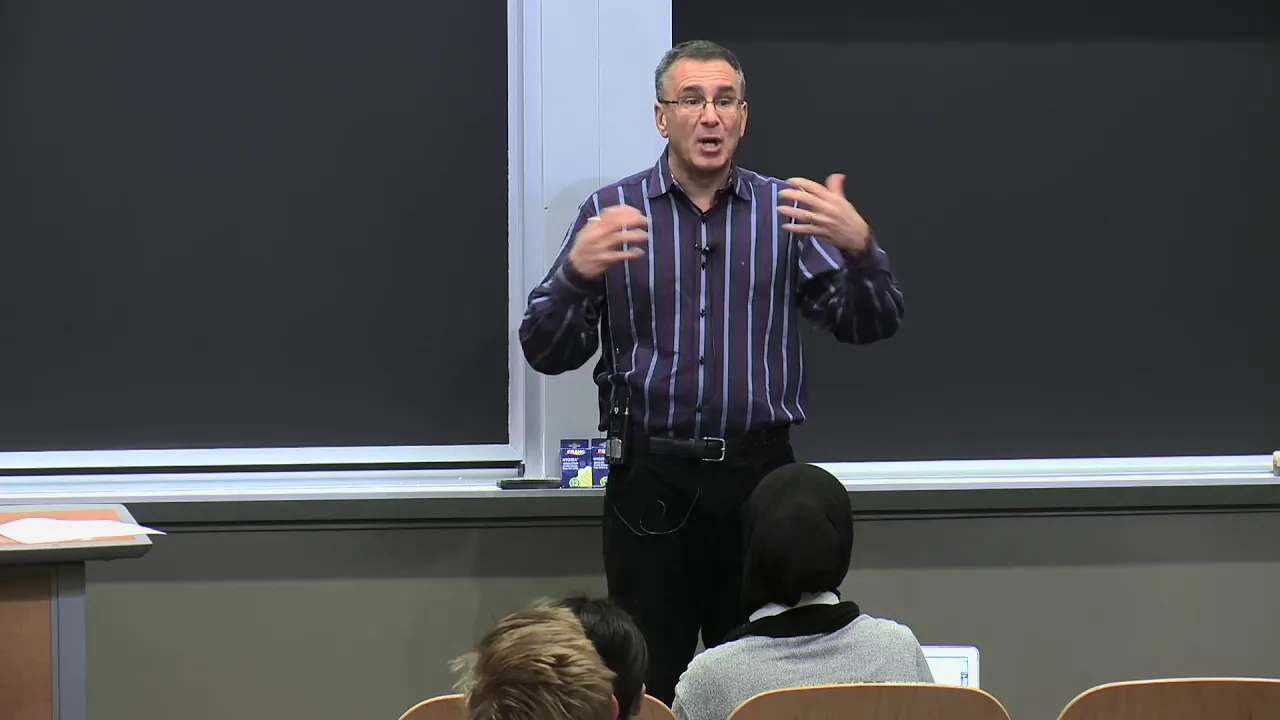
JON GRUBER: At the beginning of the lecture, we're going to actually talk about productivity, one of the most important topics in economics.
And really one of the most famous applications-- or, more generally, misapplications-- of the principles of diminishing marginal product in the history of economics.
Many of you may have heard of a guy named Thomas Malthus.
He was a famous philosopher who, in 1798, posited the theory that we're all in big trouble.
And he did so following the basic tenets that I've taught you so far.
Malthus pointed out look, we've got-- he said, think about production of food.
He said, with the production of food you've got, as with any other production process-- he didn't put it in these terms, but basically he was appealing to what we learned last time.
He said, like any other production process you've got two inputs, labor and capital.
But with food, the capital is land.
And unlike other kinds of capital, it's fixed even in the long-run.
That is, we talked about the long-run being defined as the period of time over which all inputs are variable.
Well, land is never variable.
There's a certain amount of land on earth, that's not variable.
And at the end of the day, production of food is essentially just short-run, there is no long-run.
At the end of the day, production of food, capital's fixed, it's only labor.
Moreover, in that situation labor has diminishing marginal product with a given amount of land.
It doesn't matter how many workers you have, there's only so much you can grow on it.
Obviously, as you increase workers you can grow more originally.
But eventually, you'll run out of useful use for those workers, yet the demand for food will not stop growing.
So basically, the demand for food is going to continue to grow unabated over time as population grows.
Demand for food [? it fuels?] proportional to population, so it's growing over time.
Yet the production of food eventually has to slow down, because there's a diminishing marginal product of labor without an increasing capital.
So basically what you've got is a forever growing demand, but a gradually slowing production, because the marginal product of labor's diminishing with this fixed capital or land.
The result is mass starvation.
So Malthus predicted that by about where we are now, if not before, the world would be suffering from mass starvation.
Through the basic principles-- not because he's a crazy nutcase-- but the basic principles we've studied so far.
Which you've got ever-increasing demand, but diminishing marginal product of producing food.
And in the end you get mass starvation.
Well, as we all know Malthus was wrong.
World population has risen about 800% since he wrote his article at the end of the 18th century, and yet we're fatter than ever.
Our problem is we eat too much, not enough.
Now that's not true around the world, there's starvation elsewhere.
But there's clearly no more starvation worldwide than there was at his time despite the fact that the world population has grown eight-fold.
So what did Malthus get wrong?
What Malthus got wrong is what I haven't taught you yet.
Which is that aggregate production is not just about k and l, but also about productivity.
It's also about productivity.
That the production function really looks like-- the form of the production function, which we wrote last time as q equals f of k and l.
Really more generally, can be written as q equals A, times f of k and l, where A is aggregate productivity.
Really, let's say that this is big Q. If we think about the big Q for society, now let's think of aggregate quantity for society or else we wouldn't talk about a specific firm.
But if we think about aggregate product, aggregate quantity produced in society, it's a function of the aggregate capital and labor of the society, but also a function of productivity.
It's also a function of the fact that we use our inputs more effectively over time.
So for example, one thing Malthus missed is that the acreage of land-- it's an empirical fact, the number of acres of land on Earth are fixed.
Earth is not growing-- but the arability of that land is not fixed.
We get better and better at figuring out how to grow more and more stuff on the same amount of land.
That's the factor A, that's a productivity improvement.
Likewise, agricultural technology has improved.
We have disease-resistant seeds, we have better land management.
The bottom line is we are making more and more of a given plot of land compared to what Malthus saw in his time.
So while k if it's defined as land may be fixed, and l therefore there's diminishing marginal product of a given production function, the production function itself is improving over time because of productivity improvements.
Productivity, the arability of land, disease-resistant seeds, and other things are making that given quantity of land more productive over time.
So effectively, in the long-run if A goes up faster than the marginal product of labor diminishes, then overall quantity can increase even though k, the underlying level of land, is fixed.
That's what Malthus missed, is that there's two factors going on over time.
The marginal product of labor's falling, it's true, for a given plot of land.
But we're making each plot of land so much more productive, it's overcoming that.
And as a result, food production is actually rising per capita.
So since 1950, world food consumption per capita has gone up 40%.
Despite the fact that the Earth's not gotten any bigger, and despite the fact the population's grown a lot over that time.
And basically this huge increase of agricultural productivity has overcome the diminishing marginal product of labor.
There's actually a great little box in the Perloff Text about a single individual and his contributions to that.
A scientist who led what's called the Green Revolution.
He experimented in Mexico with different methods of improving agricultural productivity, and then essentially brought those to Southeast Asia-- India, Pakistan and other places.
And they estimate, saved about a billion lives through the increase in agriculture productivity he made possible for this Green Revolution in Southeast Asia.
Really, just changed the entire trajectory of that part of the world through the agricultural productivity improvements that he put in place.
So it's very interesting putting a personal face on this impersonal letter A, how one scientist can really make a difference in that case.
This also leads to the larger question which this course doesn't spent a lot of time on, but which is more of a macro question, which is what determines the overall standard of living in our country?
The standard of living in our country, that is basically for a given level of labor we supply, what determines the level of our utility, of our social welfare, given how much labor we can supply?
Well, ultimately, what's going to determine-- or another way to think of it is what determines the amount of stuff we can have for a given amount of labor effort we put in?
Well, that's society's productivity.
Society's productivity is how much more we can have for each given level of labor input.
So what determines how much stuff we can have?
Well, it's k and A. Given a fixed amount of labor input, given how much we work, what determines how much stuff we can have, with how much capital we have, and how productively we make use of it?
Now, productivity in the US has followed a very interesting trend.
So productivity, which is how much we produce for a given amount of inputs, has followed an interesting trend.
From World War II until about 1973, productivity grew rapidly in the US.
Productivity grew at about 2.3% per year-- 2.4% per year-- from the end of World War II through 1973.
That is, working no harder and having no more machines, we can consume 2.4% more stuff every single year.
That's pretty impressive.
That means we can just sit around, work no harder than we were, and have no more machines, and produce 2.4% more per year.
Now, of course, over time we worked harder and had more machines, so overall output in US economy grew much faster than 2.4% a year.
It grew more like 7-10% a year over that period.
Yet, the point is that a lot of that we can get for free, essentially, without any harder work or any more capital.
However, starting in 1973 until the early 1990s, productivity growth fell dramatically to 1% per year.
That is literally we lost 1 1/2% per year of stuff we were getting before.
We were getting 2 1/2% a year up to '73, all of a sudden it's down to 1%.
That's 1 1/2% a year less stuff we can get unless we work harder to make up for it.
Why did this happen?
Well, we don't exactly know, but there's two good candidates.
We know the two candidates, we just don't know the right proportions.
One is that we have less capital in our society because savings fell.
The amount of savings US households do fell dramatically.
And the US has a very low savings rate.
The US savings rate over this period averaged about 3%.
That is, every dollar we earned we saved about 3% as a society.
Compared to countries like Japan, where it's more like 20%.
Every dollar they earn they save about 20%.
Now why does that matter?
Well, we'll talk about this later in the course, but essentially the amount we save determines the amount of capital we have in society.
Because essentially, where do firms get the money to build machines?
They get it by borrowing from households who save. And the less we save, the less money there is that firms could invest in building machines.
And we'll talk about that at length later in the semester.
But the bottom line is, the more we save as a country, the more money we have available, the more firms can take that money and build machines that improve our standard of living.
And that saving fell a lot, and that's one reason.
And the other reason is that productivity fell for reasons we don't quite understand.
We know that productivity slowed down, but we don't quite understand why that is.
But then in the 1990s, productivity shot up again.
So productivity went back up towards our historic levels, from 1% back up to over 2% a year.
Why is that?
Well, it's unclear, but we think it's basically the IT revolution.
Essentially, we think that the slow diffusion of computers, which people were predicting should increase productivity as way back as the 1980s, suddenly in the 1990s it really happened.
And this IT revolution led to a big productivity increase.
It's not clear if that's dying down now again, or if it's going to continue.
It'll be interesting to see what happens over the next 15 years.
So we have this period of high productivity growth, slowed down from '73 to the early '90s and then picked up again.
We're not quite clear if that year's coming to an end or not, but that's sort of where we are now in that time path.
What's very interesting-- so that's what happens to productivity, that's all I'll talk about it for this course, it's more of a macro topic.
But I will mention an interesting micro spin on that.
Which is, if society's more productive, that's like found money for society.
That's like saying with all our resources we suddenly get extra money.
Society then has to decide what to do with that.
The US and Europe have followed very different paths in what to do with that money.
In the US, we've taken that money and bought a lot more stuff.
We have the highest standard of living in the world.
We buy the most stuff per capita of anyone the world.
In Europe, they took a lot of that money and took more leisure with it.
They decided we're not going to quite have as much stuff, but we're going to have six weeks a year of vacation instead of two weeks a year of vacation.
So if we go back to our discussion of what determines labor supply is the choice between leisure and consumption, and you think of the wage as the opportunity cost of leisure, well, what they've decided in Europe is to choose more along the leisure axis, and less along the consumption axis.
In the US, we've chosen less among the leisure axis-- we work way harder than Europe-- but we have more stuff.
And the question is, how do we feel about that choice?
Has that been ultimately a welfare maximizing choice?
Now an economist will say of course it's been, because it's a choice we made.
Of course, it's been welfare maximizing.
We talk about revealed preference, and people's choices reveal what they prefer.
So our revealed preference, we just prefer stuff more and leisure less than Europe.
But in fact, it's not clear that that is each individual's optimal choice.
If a given individual says, look, I'd rather have less stuff and more time off, it may be hard to find the job that lets them do that.
So while that may be the choice we've made as a society with our social institutions, that may not serve the interests of every individual in society.
And that's the kind of trade-off we need to think about.
So anyway, that's sort of what I wanted to say on productivity.
Yeah, question?
AUDIENCE: Does higher productivity translate into more income, or more income for individuals who will buy stuff [INAUDIBLE] taking more leisure?
JON GRUBER: Because basically the point is think of our economy as a pie.
That basically the idea is let's think of you have a start up, and your start up is such that you can make this product, and you could make $1 million a year with 10 workers.
You could make $1 million worth of stuff with 10 workers.
So each of your workers takes home $100,000.
Now imagine that you discover new technology which lets you, with the same amount of workers, make $2 million a year.
Well, some of that you'll keep, but some of it you'll pay your workers more.
So suddenly they have more money, because you've suddenly managed to make twice as valuable stuff with the same amount of resources.
So that's the situation which improves our standard of living.
Other questions about that?
Comments?
OK, so the bottom line, coming back to sort of micro-theory we're talking about, is we have to think about production functions as having a productivity adjustment.
Macro raises these big issues about sort of ultimately what determines our standard of living in this country, and how do we want to spend that money?
So, with that as background, we're now going to stop talking about production and move on to cost. Cost is-- quite frankly this is perhaps my least favorite thing in the whole course.
It's a little bit boring, but you need to understand how cost structure in a firm works to understand how firms make the decisions that ultimately get to be a lot more interesting again, so just sort of bear with me.
Now, so we talked about costs, let's start with a couple of definitions.
Basically, let's back up, where are we coming from?
I talked about what the firm's decision is, the firm has to maximize profits, which is revenues minus cost. So we have to ask what are costs if we're going to make this profit maximizing decision.
Well, costs are going to have a few components.
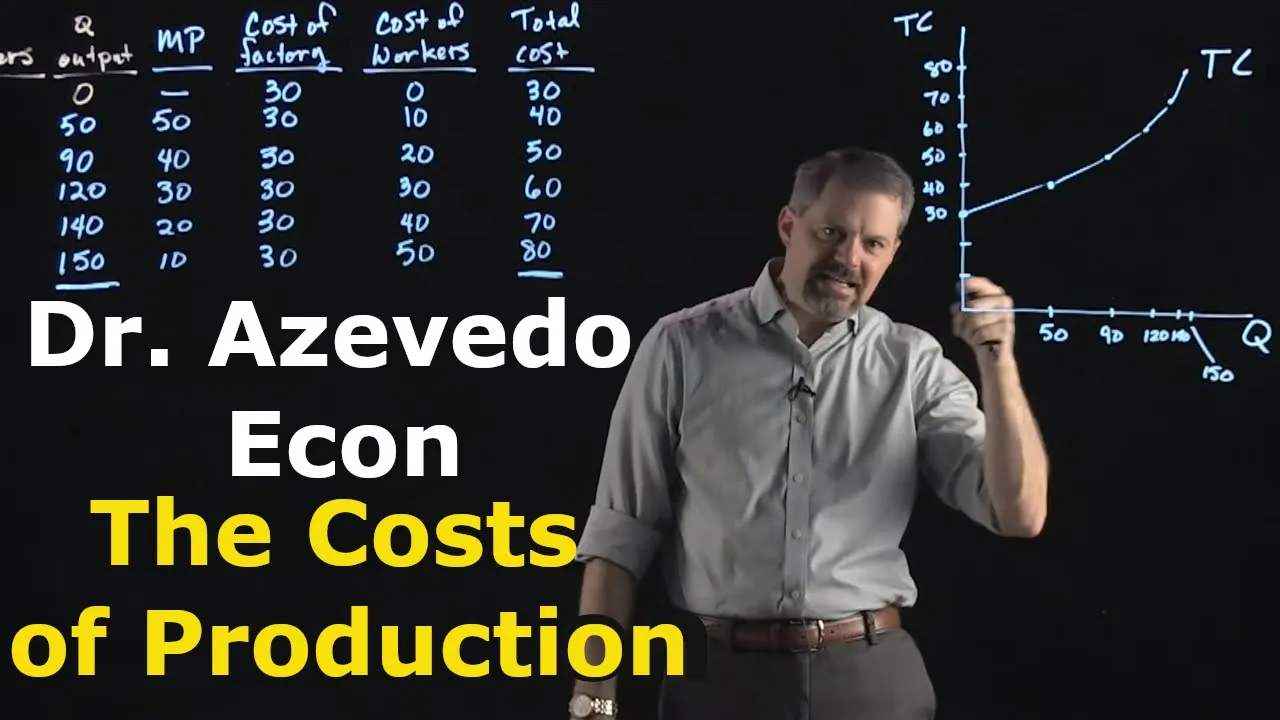
The first component, costs are going to have really two major components-- fixed costs, and variable costs.
Fixed costs and variable costs.
Fixed costs are the costs of inputs that cannot be varied in the short-run.
Remember, I said that the short-run is defined as a period over time which only some inputs can vary.
Well, fixed costs are the costs of those inputs that can't vary in the short-run.
Variable costs-- so that's like capital in the short-run-- variable costs are the cost of goods that can vary in the short run, that's like labor.
So total costs is the sum of these two, so total costs equals fixed cost plus variable cost.
Finally, another definition that's important is marginal cost, which is the change in cost with a change in output.
So the marginal cost is just like-- remember, we want to think in terms of marginal decision making in this course.
So the marginal cost is the change in cost with the change in-- actually, that should be a little q.
The change in a firm's cost with the change in the firm's output is marginal cost.
And then finally, average cost is just what it sounds like.
Average cost is just c over q, it's just the average.
So the difference between marginal and average cost, is basically average costs is the average over the whole set of goods produced.
Marginal cost is the cost of that next unit of production.
So those are our key definitions.
Now with those in mind, let's ask how do we get costs?
And the answer is we get them from the production function.
Once we do a production function, we can derive costs.
So if we have some production function, q equals f of l and k, then we can say the cost of producing q is equal to f of wl plus rk.
Where w is the wage rate, or the rate you pay per unit of labor, and r is the rental rate, or the rate you pay per unit of capital.
Now, let me just pause here for a second to talk about pricing capital.
It's easy to think the cost of an hour of labor, it's the wage you pay for an hour.
It's harder to think about the cost of a unit of capital.
Because we buy the machines, right?
So how do we think about the cost?
I'm going to cover this later in the course, for now imagine all machines are rented.
Imagine you rent every machine you use.
And think of r as the rental price of that unit of capital.
So with buildings it make sense, firms often rent the buildings they're in.
Think of r as the rental price of that unit of building, or that unit of machine.
We'll come back later to see why that's a sensible way to think about it.
The key point is, the reason we have to do this is the wage is a flow measure, every hour I pay you a new wage.
If I use the cost of buying the machine, that be a stock measure, so you couldn't really compare it to wages.
So we want to use a flow measure.
The flow measures is what we have to pay every period to rent the machine.
Yeah?
AUDIENCE: [INAUDIBLE] just take the cost of the machine and estimate the amount of time we want, and then divide it?
JON GRUBER: Sure.
No, and I'll cover that later.
You could think of the rental-- if I bought the machine today and sold it tomorrow, that'd be like I rented it.
And this would be the cost difference between what I paid for it and what I'd sell it for.
But it's just easier to think of it as the rental, because the flow measure-- like the wage-- is a flow measure.
Now, in the short-run, capital is fixed.
So in the short-run, our fixed costs are rk bar.
That's our fixed cost, the rental rate times the fixed amount of capital in the short-run.
And our variable costs are w times l, which is a function of q.
That is, the more you produce the more labor you use in the short-run.
So total costs in the short-run, short-run total costs, are rk bar plus wL of q.
k is not a function of q because k's fixed in the short-run, but the amount of labor used is a function of how much you produce.
This implies that the marginal cost, the key concept we want to work with, marginal cost, which is the derivative of total costs with respect to quantity.
So dc dq is going to be equal to w-- or, let's do it in deltas, because we're not doing calculus here.
Delta c delta q is going to be w times delta l over delta q.
That's going to be the marginal cost.
The marginal cost-- so I'm just differentiating the total cost function-- is going to be the wage times delta l delta q.
So the marginal cost of producing the next unit is going to be how much labor I have to produce to produce the next unit, times the wage I pay per unit of labor.
Now, does anyone remember what we call this?
I know this wasn't on the exam last night, so you may not-- cast your mind back to the lecture on Monday.
Do you remember what we call delta l over delta q?
Anyone?
Bueller?
No?
It's the marginal product of labor.
Remember from Monday?
So this is the wage times the marginal product of labor.
So what we say is that the marginal cost is equal to the wage times the marginal-- I'm sorry the wage over.
I'm sorry, it's one over.
That delta q does-- l was the marginal product.
The wage over the marginal product of labor.
So marginal cost is the wage over the marginal product of labor.
Marginal product of labor was delta q delta l, so wage over the marginal product of labor is the marginal cost.
So think about this intuitively.
What we're saying is the cost of the next unit of production is declining with the marginal product of labor, it sort of makes sense.
The more productive is a worker, the less expensive is producing the next unit.
The less productive is the next worker, the more expensive is producing the next unit.
So it's an inverse relationship between the marginal cost and the marginal product where the wage is the constant that scales that relationship.
So basically, when workers are very, very high marginal product, then it's going to be cheap to produce the next unit.
When workers have a low marginal product, it's going to be expensive to produce the next unit, and that's going to depend on what you actually have to pay the worker.
Questions about that?
So basically, the first key thing we want to derive here is that the marginal cost is directly related to the marginal product of labor, and the marginal product of labor we saw last time comes out of production function.
So if you're given a wage, and given a production function, you should be able to derive the short-run marginal cost.
You might someday be asked to do that.
Now what about the long-run?
The short-run's no fun, what about the long-run?
In the long-run, firms can choose their mix of labor and capital.
Remember, in the short-run the capital is fixed, so fixed costs rk bar.
The only thing they could change was the amount of labor, so we could derive their marginal costs.
What about in the long-run?
Well, the long-run's a little more interesting because in the long-run firms get to choose their input mix to maximize their production efficiency.
So input mix is chosen to maximize production efficiency which equates to minimizing costs.
Maximizing production efficiency equates to minimizing costs.
So we talked last time about isoquants, and the notion that isoquants were combinations of labor and capital that delivered the same output.
Just like indifference curves are combinations of pizza and movies that deliver the same utility, isoquants are a combination of labor and capital that deliver the same output.
The key point is that, technologically, any choice of labor and capital produces the same q, so there's nothing that tells you technologically which of those to use.
We just know, technologically, there's a set of choices which deliver the same q.
Well, how do we tell which to use?
Well, we want to choose the one which is minimizing costs.
So to do that, we're going to have to bring in the cost of those inputs.
Just like we said there's a set of pizza and movies, all of which leave you indifferent.
How do you decide which pizza and movies to choose?
Well, you bring in the relative price of pizza and movies.
Here, we're going to bring in the relative price of capital and labor to determine how we choose between capital and labor.
So to do that, we're going to draw isocost lines which are going to be just like our old budget constraints.
Isocost lines which represent the cost of different combinations of inputs, just like our old budget constraint represented the cost of different consumption goods.
So if you look at figure 9-1, here we're going to have isocost curves which are going to represent-- and we're going to assume here that the wage is $5 an hour, and the rental rate is $10 per unit of capital.
So, in other words, the $50 isocost line in figure 9-1 shows all combinations of labor and capital that cost $50.
So you could spend $50 in production if you had 10 units of labor, and no units of capital.
Or five units of capital, and no units of labor, or any combination in between.
These are all the combinations of labor and capital that cost $50.
Likewise, the $100 isocost is all combinations of labor and capital that cost $100.
So each of these isocosts give you the combination of inputs that cost a certain amount.
Just like a budget constraint gave you the combination of pizza and movies on which you spent your income.
Now, you may have said well, wait a second, the difference with consumers is we knew their income so we knew what their budget constraint is.
Here we don't know whether to choose the $50 cost, the $100 cost, $150.
We don't know what the total amount is.
That's what makes firms hard, that's why we have an extra step.
So hold that thought, we'll come back to that next lecture.
For now, let's just say there's a set of trade-offs that the firm can choose from, and a set of isoquants that they have.
And what's the slope of this isocost line?
It's the negative of the wage rental ratio.
The slope of the isocost is minus w over r.
The slope is minus w over r.
It's basically the trade-off between labor and capital's going to be determined by the relative prices of those inputs, so slope is going to be minus w over r.
So basically, how many units of capital do you have to give up to get the next unit of labor?
Well, what this isocost tells you is you have to give up 1/2 a unit of capital to get a unit of labor.
So the slope is minus 1/2.
Likewise, you could say you have to give up two units of labor to get one unit of capital.
So that's why the slope is minus 1/2, that's what it's telling us.
Once again, budget constraints are about opportunity costs.
How much labor do you have to give up to get another unit of capital?
Or how much capital do you have to give up to get another unit of labor?
Now, armed with isoquants, which are like indifference curves, and these isocosts which are like budget constraints, we can then figure out what is the economically efficient combination of inputs for the firm to use.
The economically efficient combination of inputs for a given level of output.
So the economically efficient input combination for a given level of output is going to be determined by the tangency of the isoquant with the isocost, as you see in figure 9-2.
Here we're going to use our same isoquant we had before, which is we're going to assume that q equals square root of k times l.
So same production function we had before, which gave a series of isoquants last lecture.
So basically, what we see is that the efficient-- if you want to produce a given amount of q, then basically what you're going to do is you're going to look for the tangency of that isoquant with the isocost. And you're going to say that the efficient way to produce that is going to be to use 2 1/2 units of capital and 5 units of labor.
It's going to say look, given the relative prices that are given to us by this budget constraint, the production technology is given to us by this production function from which we derived isoquants last time.
So the optimal combination of inputs to get this level of output is going to be 2 1/2 units of capital and 5 units of labor.
And that will produce basically square root of 12 1/2.
So basically the quantity will be equal to the square root of 5 times 2 1/2, or the square root of 12 1/2 units of production.
So basically, that is going to give us the efficient way to do that.
Now, once again as always, we want to think about things intuitively, graphically, and mathematically.
Let's think about for a second the mathematics.
We know that the slope of the isoquant-- we talked last time-- the slope of the isoquant at any given point.
The isoquant slope was the marginal rate of technical substitution.
We defined that last time.
The slope of the isoquant was the marginal rate of technical substitution which is the marginal product of labor over the marginal product of capital.
And what we're saying is we want to set that marginal rate of technical substitution equal to the input costs ratio w over r.
That's what we're saying, the efficient thing to do is to set the marginal rate of technical substitution equal to the price ratio.
That's what happens when the slopes are equal.
Now, once again, I find it easier to rewrite this equation-- once you've developed the intuition, I find it easier to think of it this way.
Rewrite this as the marginal product of labor over the wage, equals the marginal product of capital over the rental rate.
What this is telling us is the efficient place is where essentially for every dollar you spent on workers, you're getting the same return as a dollar spent on machines.
The marginal product of labor over the wage is sort of the bang for buck of workers.
What are you getting for your next dollar of wage?
The marginal product of capital over r is the bang for the buck of machines.
What are you getting for your next dollar of rent?
And the efficient point is where these are equal.
If they're not equal, then you have too much of one and not enough of the other.
So basically, what we can do is we can solve in this example-- in this example, we could say the marginal product of labor is 1/2 k over the square root of k times l.
The marginal product of capital from this production function is-- once again I'm using this production function q equals square root of k times l.
Marginal project of capital is 1/2 l over square root of k times l.
So the ratio of the marginal products is simply k over l.
The marginal rate of technical substitution, given this production function, is k over l.
That's the marginal rate of technical substitution.
So this says that given this production function and these prices, at the optimum you should set k over l equal to w over r, which equals 1/2.
So what this says is given this production function, these price ratios, the optimal thing to do is to use half as much capital as labor.
Half as much capital as labor is the optimal thing to do, and that's what we see in figure 9-2, is the optimal thing to do is use half as much capital as labor.
Now, in other words, let's say, to now develop the intuition.
Imagine you told me no, I should use as much capital as I should use labor.
As much capital as I should use labor.
Imagine I told you that.
Imagine I said no, in fact, the efficient thing to use is why not have one machine for every worker?
How would you tell me intuitively why that's wrong?
Why would I be wrong to say use one machine for every worker?
Why would that be wrong, given the prices prevailing in the market?
Someone can tell me this.
Yeah?
AUDIENCE: Well, renting machines is a lot more expensive than paying more workers.
JON GRUBER: Twice as expensive to rent a machine as get a worker.
AUDIENCE: So it would be more cost-effective to have the workers share machines rather than get a whole new machine.
JON GRUBER: The key point is the machine costs twice as much, but the machine doesn't do twice as much.
The machine and the worker do the same thing.
The marginal rate of technical substitution is one.
You're indifferent between one more machine and one more worker, but the machine cost twice as much as the worker.
So you want more workers and fewer machines, right?
Given the machines and workers, this is a perfectly substitutable production function.
The marginal rate of technical substitution is k over l.
You're perfectly indifferent between these two, given that-- not perfectly substitutable, but at this point you're indifferent between the two.
So given that you're indifferent and the machines cost twice as much, why not buy half as many machines?
Yeah?
AUDIENCE: But then, if the machines cost twice as much, why buy any machines?
JON GRUBER: Oh, that's very good point.
Because it's not a perfectly substitutable function.
My bad.
If it was, if the production function-- great question.
Let's say the production function was of the form q equals k plus l.
That's perfectly substitutable production.
Then you're right, in that situation you should only buy workers because they do exactly the same thing.
But that's not the case here.
This exhibits diminishing marginal product.
So if you only bought workers, eventually each worker would do so much less that you'd be better off getting a machine.
It's not perfectly substitutable, I misspoke before.
At the margin they have an equal effect.
But as you get more and more laborers, they'll be less and less productive, so eventually you're going to want to buy a machine.
But you're only going to buy half as many machines as workers.
You never want to buy one machine per worker.
But you also don't want no machines per workers, because the workers won't have anything to do then.
Here you'd want no machines per worker, right?
The optimal thing to do, if you have a perfectly substitutable production function, you'd only just buy the cheaper input.
But that's not the case when you have diminishing marginal products, then you're going to use a combination of inputs.
But the combination used will be determined by the prices in the market.
Other questions about that?
So now we can ask, just as we asked in consumer theory, how does a price change in the price of goods affect your consumption decisions, we can ask how does a change in the price of inputs affect your production decisions?
You could see that in the next page, figure 9-3.
Imagine that wages went up.
So imagine now wages, instead of being $5 an hour, are $7.50 an hour.
They pass a new minimum wage, and wages go up to $7.50 an hour.
What does that do?
Well, that steepens the isocost. Your trade-off is now you're going to get fewer workers for every machine you give up, or more machines for every worker you give up.
And so at the same isoquant, that's going to shift you to using less labor and more capital.
By the same logic as before, you're going to use less labor and more capital, because you're going to see this shift in relative prices.
This figure shows why the minimum wage leads to unemployment.
We talked about it last time.
We did in a graph, we just said supply and demand and showed you.
But actually this is the underlying mechanics of how minimum wage leads to unemployment.
Because the minimum wage, by change, is relative input prices.
If the only way you could produce things was with labor, there wouldn't be much unemployment for a minimum wage because basically you wouldn't have anything else you could do.
You'd still have to hire the workers.
But, in fact, that's not the only way to produce things.
You can substitute to capital.
As a minimum wage goes up, firms will substitute towards capital, and that's why the minimum wage will lead to unemployment.
So this is sort of the underlying mechanics of how that happens.
All right, now armed with that-- so basically when we did consumer theory we were done here.
We basically said, look, we now know you have a budget constraint, you have indifference curves, you're fine with their tangent, you're done.
The reason firms are one step harder is you don't have a budget constraint.
q is not given to you, q is ultimately decided by you.
You the firm are going to decide on little q.
With our example for consumers, your parents gave you $96, you had no choice.
Well here the firm isn't given little q, it's going to decide little q.
What that means is we're not done yet.
There's one extra step we need to do with firms, which is figure out where little q comes from.
So to do that, we're going to have to then say well, how does a firm think about the set of choices of little q?
And how does it think about how it changes production as little q changes?
So to see that, go to figure 9-4a.
This shows the long-run expansion path for a firm.
This shows how, as it produces different amounts of goods, it will choose different units of inputs.
So for the first level of production, it chooses five machines and 10 workers.
Then if it wants to double production, it chooses 10 machines and 20 workers.
So if it wants to increase production by another 50%, it chooses 15 machines and 30 workers, and so on.
This is a linear expansion path.
This says this firm is a production function, and prices are such that basically they always want these inputs in fixed proportions.
So it would be a fixed proportional expansion path.
No matter how much you choose to produce, you always want to use twice as much labor as capital.
However, that doesn't have to be the case.
So this long-run expansion path is going to be what becomes our underlying cost curve.
This is where underlying cost curves are going to come from, and hopefully where supply is going to come from, is this long-run expansion path.
This long-run expansion path is going to show us how much more we have to spend to produce different amounts of quantity.
Now in this case, what you see here is that you have these fixed proportions.
That as you increase quantity, that the input portion stays the same, but that doesn't have to be.
For instance, figure 9b, you can imagine a world where, as you produce more units, capital becomes less productive.
So you want more and more labor, but not that much more capital.
So this might be the example of like McDonald's.
If McDonald's wants to produce more burgers, ultimately there's only so many fryolators it can use.
Ultimately, it needs more people to package up the burgers and sell them.
So you might think that capital becomes less and less productive.
And as a given McDonald's franchise expands its sales, it might want to increase the ratio of labor to capital.
So this is a case where capital's becoming less productive.
And as you see, as you expand production you're going to more labor and less capital.
In other words, the marginal product of labor is still steep, and the marginal product of capital is flattening.
So you want more and more labor, and not as much capital.
That's one kind of expansion path.
Figure 9c shows a different kind of expansion path.
Here's one where labor becomes less productive.
So this might be, for example, something which is a mass production process, like producing automobiles.
Where basically as you produce more and more automobiles, you need more and more machines to produce them.
The people just run the machines.
So it's much more efficient to have to do it through more machines and less through more workers in automobile production.
So in that case you could have a steeper expansion path, where basically the marginal product of labor is falling relative to the marginal product of capital, so you want to increase the ratio of capital to labor over time.
The bottom line is as firms produce more, they may hold constant or may change the ratio of their inputs, but they'll clearly use more inputs.
They're going to use more inputs, but the mix of the inputs they'll use will change with their production levels.
So the question we have to ask is, well, what's going to determine their production level?
Where does q come from?
I'll have to leave that as a teaser for next time.
Let me just say where q comes from, is q is going to come from market competition.
We're going to get q-- I'm not done, I have one more thing to cover.
But we're going to get q from market competition.
Now there is one other thing I want to cover though related to costs.
Which is an important concept that we have to have in the back of our mind, which when we come back, we think about competition.
Which is fixed versus sunk cost. Fixed-- my wife always thought I was saying some costs, I'm not.
I'm saying sunk costs.
Fixed versus sunk costs.
Fixed versus sunk costs.
Sunk costs are costs which are fixed even in the long-run.
Fixed costs are costs which are fixed in the short-run, and variable in the long-run, so capital.
Sunk costs are costs which are fixed in the long-run.
That is, they're foregone once you produce.
The minute you produce one unit, those sunk costs are gone forever, and they cannot be changed even in the long-run.
In other words, importantly, they cannot be changed by how much you produce.
So in the long-run, you can change the cost of capital by building bigger or smaller plants, producing more or less.
But some costs cannot be changed.
So what's a classic example?
Well, the classic example for example would be medical education, or any professional education.
Once you've gone to med school and done all your grueling years of staying up all night, you've paid those costs.
They're now paid for, and it doesn't matter if you see three patients the rest of your life or three million patients the rest of your life, you've already paid those costs.
Think of that as the capital of a doctor's office.
Now when you take your office as a doctor, if you want to see more patients in the short-run, they might be crammed into your office, and in the long-run you might build a bigger office.
So in the short-run, how hard you work is variable.
In the long-run, how big your office is is variable-- how many secretaries you hire, et cetera.
But your medical school spending is gone.
That's not variable in the long-run, that's sunk.
And that's a very important distinction is between basically these fixed costs, what we call fixed costs.
Which are costs where, like the costs of the office and the machinery the physician uses, which can be changed over a 10-year period, versus sunk costs which once paid are gone forever.
And the key reason, just to give you a hint about why these will matter, is because when firms set up this-- we may see firms in the market losing money.
You may see firms in the market losing money.
In fact, in any point in time we see lots of firms in the market losing money.
You might say, why don't they go out of business?
The reason they don't go out of business is because they've already pay huge sunk costs.
It's not efficient to go out of business.
They've already invested a certain amount.
It's not going to be efficient to go out of business, because then they'll give up the cost they've invested.
So if you're a doctor, and you've spent all this money on med school, and you're not making money as a doctor in the first couple of years.
If you quit and go do something else, you've just given up all the investment you made in med school.
So if there's any prospect that eventually you'll make money, you might want to hang on and keep being a doctor.
So that's the difference between a fixed cost and a sunk cost.
So I'm going to come back to that, but it's important to remember that distinction when we talk about competition.
So let me stop there, and we'll come back on Wednesday, I guess.
Have a good three-day weekend.
We'll come back on Wednesday and we'll talk about competition.
Up Next
75:42
Economic Trends, Inequality, and Policy Solutions with N. Gregory Mankiw
@claremontmckenna
18.5K views•2018-03-08

5:07
Impact of Yuan in Indo-Russian Trade Amid Sanctions
@WION
261.9K views•2022-07-01
48:22
Market Failures II: Informational Asymmetry | MIT 14.01
@mitocw
59.2K views•2020-07-16

113:18
The Age of Easy Money: Fed & Inflation | Full Documentary
@frontline
21.2M views•2023-03-15
Related Study Plans & Knowledge Roadmaps
Structured learning paths in Economics
economics
Sovereign Debt: Defaults, IMF & Restructuring
01Introduction to Sovereign Debt & Government Bonds
02Debt Sustainability & Credit Ratings
03Anatomy and History of Debt Crises
+ 2 more learning modules
12h5 modules
Explore Roadmap
economics
Market Design: Matching Theory & Gale-Shapley
01Introduction to Market Design and Price-Free Markets
02Two-Sided Matching & The Gale-Shapley Algorithm
03School Choice Systems and Mechanism Design
+ 2 more learning modules
10h5 modules
Explore Roadmap
economics
Impossible Trinity: Forex, Capital & Policy
01Introduction to Monetary Policy and Central Banking
02Exchange Rates and International Capital Flows
03The Mundell-Fleming Model
+ 2 more learning modules
8h5 modules
Explore Roadmap
economics
Healthcare Economics: Market Failures & Systems
01Introduction to Healthcare Markets and Market Failure
02Asymmetric Information and Adverse Selection
03Moral Hazard and Insurance Design
+ 2 more learning modules
12h5 modules
Explore Roadmap