












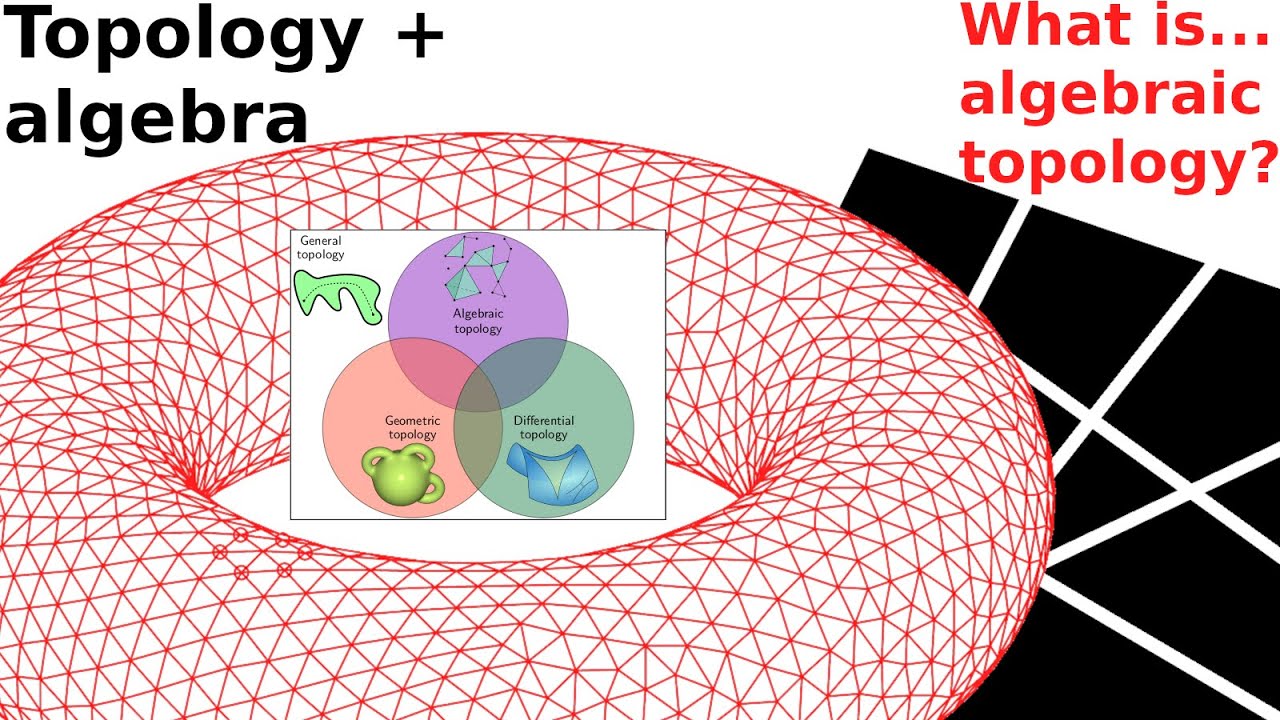



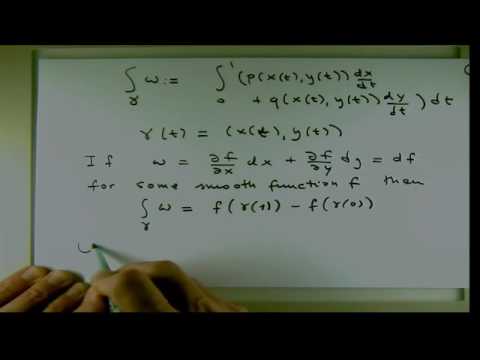


Homology is an algebraic tool in topology that rigorously defines and counts holes in geometric spaces by analyzing cycles (closed paths) and boundaries (filled-in areas); holes are detected by identifying cycles that cannot be shrunk to a point or expressed as boundaries, with homology groups H₀ counting connected components (zero-dimensional holes), H₁ counting one-dimensional holes like necklaces around a space, and H₂ counting two-dimensional holes like the air inside a donut, computed through linear algebra on chains and boundaries.
What is Homology? An Intuitive Introduction to Algebraic Topology
Added:Basic Linear Algebra: Familiarity with vector spaces, linear transformations, kernel (null space), image (range), and quotient spaces.
Introductory Topology: Understanding topological spaces, continuous functions, and the intuitive concept of homeomorphisms (stretching/bending shapes without tearing).
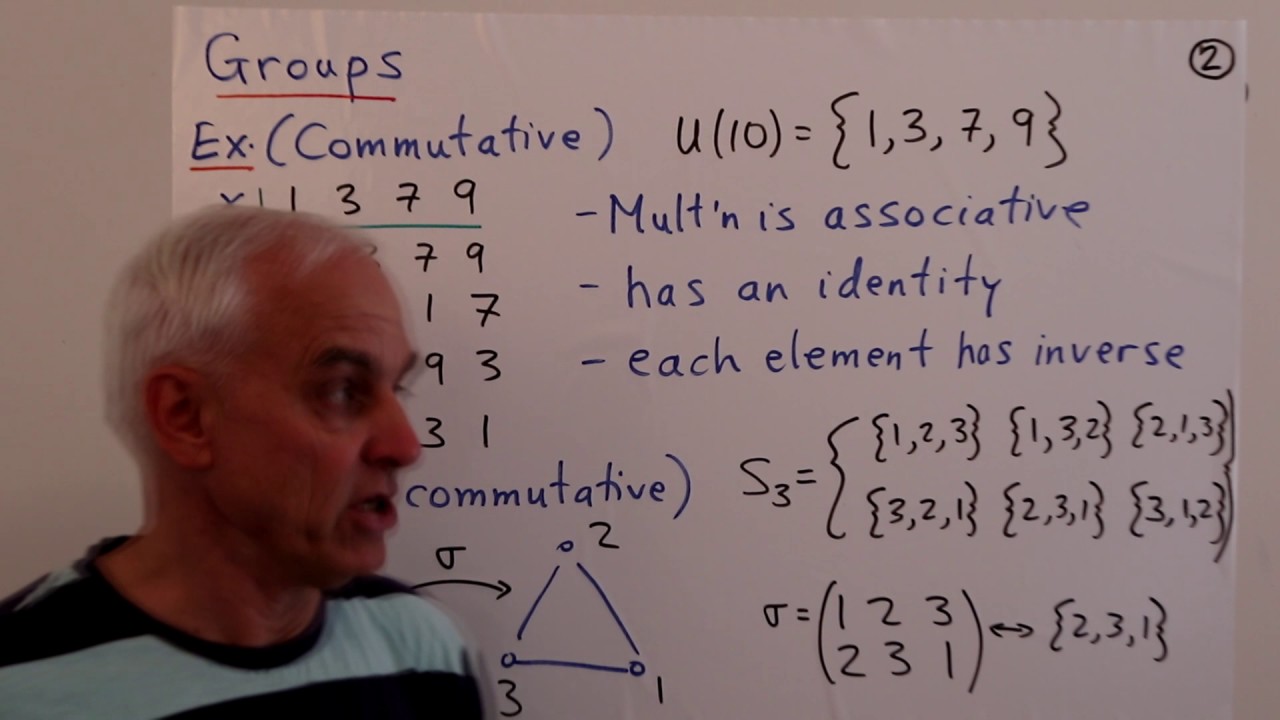
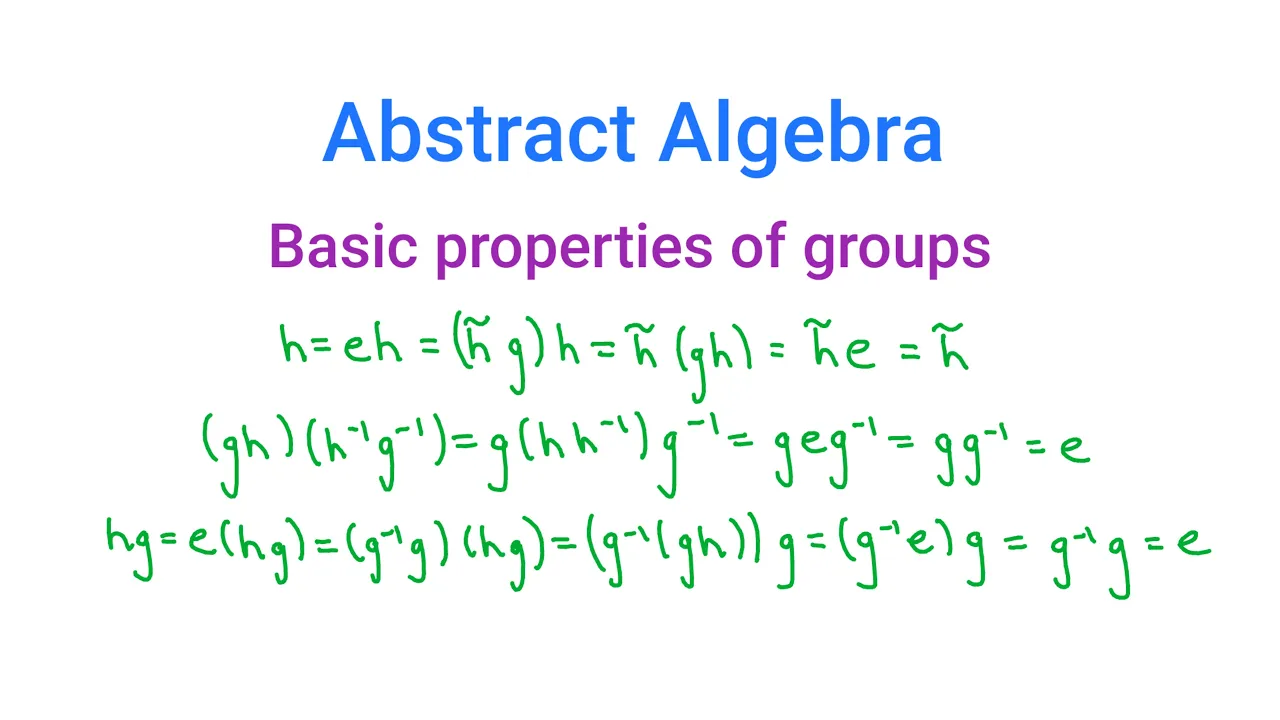
Basic Abstract Algebra: Comprehension of algebraic structures, particularly groups, subgroups, quotient groups, and homomorphisms, which form the algebraic foundation of homology.
Geometric Simplices: The concept of simplicial complexes, which involves representing complex shapes using fundamental building blocks like vertices, edges, and triangles.
Topological Data Analysis (TDA) and Persistent Homology: Applying homology algorithms to analyze the shape, structure, and noise of high-dimensional datasets in data science.
Cohomology Theory: Exploring the dual concept of homology, which introduces richer algebraic structures (like the cup product) to form a cohomology ring.
Homotopy Theory and the Fundamental Group: Studying the path-based classification of loops and higher-dimensional spheres in a space, and learning how it relates to homology.
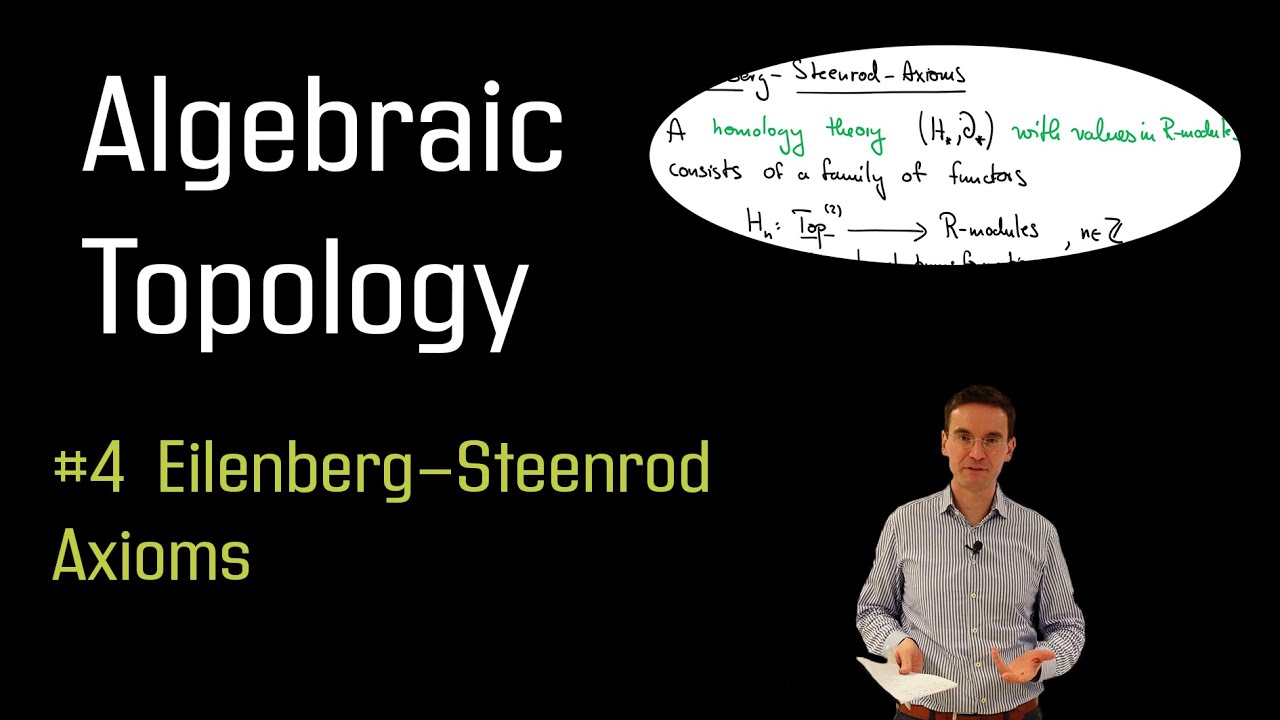
The Eilenberg-Steenrod Axioms: Examining the formal axiomatic framework that defines homology theories, leading to singular, cellular, and extraordinary homology.
20.6K views518likes17:59Original Release: 2021-08-24
okay welcome everyone to my continuation of what is algebraic topology today i would like to explain what is a hole so what is a hole we'll see or more strictly speaking i will explain what is homology intuitively so the whole problem a little bit with homology is that the definition um is a little bit scary it takes you a while to digest it it takes me a while to write it down and it took me a long time to digest it i'm not even sure whether i have to adjust it in any way so today is more like an informal definition an intuitive definition a workable definition in some sense but not a strict definition and the whole question is what is the whole so let's get started with what is a hole so here's this topological object which we'll see in a second again and how many holes does it actually have well certainly there's this hole which in some sense is a how many dimensional hole it's a one-dimensional hole but why not quite clear but you can uh at least from the picture but the point is you can kind of rub a circle around it if you can't shrink strings a circle then you might say okay but the second one-dimensional hole which goes around like this you also can't shrink you go around the swim ring you also can't shrink the circle so it is a second one-dimensional hole sure yeah maybe but this is certainly harder to see right so this is a hole or not who knows is this a hole what is the hole anyway um in some sense the torus itself is a zero dimensional hole so this is one one and the volume in here in some sense in one it's a two-dimensional hole it prevents the torus from being shrunk to a point uh so let's have a look so here's my swim ring again and in some sense what i want so this is my taurus t i'm going to the solid taurus in the second the doughnut ts in my notation i don't have a good notation for the solid taurus ts anyway um in some sense a whole should be the dimension of homology so homology should be the definition of all in some sense the problem with the notion of a whole is that i'm always illustrating those nice pictures in r3 but these are not spaces that live anywhere they're abstract spaces in abstract in the abstract limbo what is a hole right hold today as a definition for me at least it's the dimension of a certain normality group this dimension of a certain vector space and i've written down the dimension sequence here as i said i would like the taurus to have a zero dimensional hole the green one i would like the taurus to have two one dimensional holes a red one and i would like to have it a two dimensional the purple one so the purple one was the air is the inside um it's a little bit harder towards the inside of a of a uh whatever of a swim ring um there's a hole in there in some sense right so the one dimensional ones were this one and this one going around and the zero dimensional one is basically the beast itself whatever what is zero dimension the whole is a little bit a matter of taste anyway i in with contrast the on the right hand side uh the solid taurus it's filled so it doesn't have any zero damage uh two dimensional holes um but it's also it also this circle doesn't doesn't is it's now contractible you you can just contract it because my top so my doughnut is solid inside but this one still exists and of course the object still exists so it should have one zero dimensional hole and one one directional and yes homology will spit out exactly those answers uh which you can think if this is great or actually strictly speaking some sense of biology was invented such as you get those answers so homology is a way to make precise the notion of a whole so a zero-dimensional whole informally speaking is like it's a connected component what is the zero dimensional hole anyway it's a matter of convention you use that one no convention will be intuitive anyway so you use that one that works best in practice and this one is the best the one that works best in practice the one-dimensional is really like you could put a necklace around it one of my circles and that's good so like like in this picture two necklaces the red ones and a good picture for the two-dimensional one is um it's in the number of plugs you need to to inflate it right i don't need any plug to inflate my my donut because i don't know where you buy your donuts but i hope it's filled but i need one plug to inflate my swimmer so in some sense a mathematical object has a hole if you can prevent it from shrinking to a point right so let's try to motivate now the definition of homology based on the idea that we want to measure holes and the space without holes i like to consider here is a triangle that you can see here it certainly has no holes so it's really this filled triangle um but it will play an important role but because it kind of gives us already a way to see what a hole should be so the whole idea is based on what is called chains cycles and boundaries in this case just of triangles so what is a chain a chain is just an edge of my triangle so my triangle has those vertices it has edges and has a face in the middle and a chain is just one of those guys uh strictly speak that's not quite true a chain should be a linear combination of edges but anyway let's think of this as being edges themselves a cycle a cycle is now anything that goes along the edges and comes back to where it started and you think of these as being linear combinations so there's some linearity going on so instead of writing the cycle itself as a cycle i write it as i go h a i go hb and i go hc and i denote it by a plus b plus c and there is some orientation that plays a role for example if i would go a and then i would go b in the opposite direction and i would go c i would write down a minus b c but for for now let's ignore the orientation there's some orientation of the edges but anyway it doesn't really play a role for the experts if you like to work with z-mod 2 coefficients it really doesn't play all of that anyway so cycles right cycles should pick out our holes so cycles in those um homology groups that we are trying to produce should be kind of the generators for holes so this should be potentially interesting in whatever we do and what kills holes is if you glue in uh a disc into my cycle so if you fill the triangle that kills souls and these are boundaries these are linear combinations that go around the filled triangle in this example both are cycles and boundaries so a plus b plus c is a cycle in the boundary because it goes around that's a cycle condition and it goes around the filled space that's a boundary condition but on the next slide they won't be the same anymore so um anyway i would like to stress the strategy here take cycles they go around something they should kind of measure holes but you don't want to take all cycles in some sense because this cycle for example it goes around and it doesn't create any hole it doesn't see any hole so you want to get rid of boundaries that are filled spaces they go around fill spaces so let's have a look at a slightly different example so i take my space now which is a triangle which is a little uh missing triangle in the middle and i took this triangulation of this triangle triangulation of a triangle um very good of this whole triangle if you think of this x as being a1 for example and a2 a3 e4 then this edge this is a1 plus a2 plus a3 plus a4 because i get it's kind of the strategy i go along those cycles each edge is a cycle i just gave the names a1a2 a3a4 and going along is taking the sum similarly here i just gave them different names similarly here i just gave them different names and in the middle you also have the little cycle that goes a little bit around around the middle hole and both of them are now on the cycles they detect the hole and we would like to see that in some way and the point is if you take now an equivalence relation on your set that you mod out by boundaries so you mod out by those guys here and go around uh so you kill all of those um all of those cycles you kill all cycles that go around the filth triangle then you can actually show that these two paths are equal which is extremely good because we only want one one hole here and we found one hole we found many ways to go around this hole or two ways to go around this whole you can find many ways of course but both of them are equivalent if we factor out boundary so they're they're congruent mod boundary that's what i write here congruent mod boundary congruent modular boundary right and the thing you use here is that you can redirect edges and that's where this where this nice linearity comes in so abc is zero abc is zero and this just means that a b is minus c so there's sign somewhere but so a b is c so you can redirect edges right so now you can redirect this path so here you roughly you go around almost around a filled area so you can actually shortcut up to a sign you could shortcut up to a sign you could shortcut up to a sign and then you success successively push your way inwards and actually you will see that those two paths those two cycles are the same and that's great news because now we have found the method to well detect the hole in the middle you can also show that those cycles are not trivial so you found a way to detect the hole in the middle and this funny procedure taking everything modulo filled areas module boundaries will actually identify all ways to go around in one clockwise direction around the whole which is really great so the dimension of this beast will be one in the following slightly naive but good definition in some sense of homology so i take some reasonable space whatever that is cw complex for example and i take my group of chains or in this case i don't even want to go to a billion groups i just want to go to vector spaces so i take a vector space of chains and it just has the same dimension as an amount of chains if everything is finite let's say everything's fine at every reasonable space after all right so the dimension is each chain is a v is a basis vector in my vector space very good and you have this funny map delta and this funny map delta this is so called chain map and it goes from ci these are i dimensional chains right so i dimensional um cells right so edges were one dimensional chains now you can think of higher dimensional versions of those they're one dimensional i dimensional cells and you can set the i dimensional cells to the i minus one dimensional cells by taking the boundary so you set everything to the boundary i'll give you an explicit example in a second and well the kernel of this map is what you call cycles we'll see in a second why we want to do that the images of the map before that's what you call boundaries that's how they are constructed right delta is the boundary of something we'll see that in practice in a second and what you check is that images are is a sub-vector space of of of the kernel of the cycle so boundaries uh all boundaries are cycles not all cycles are boundaries so what you can do is you can just take the vector space quotient and or the billing group doesn't really matter and you get well the homology is this vector space quotient of this ability given by cycles modular boundaries cycles modular boundaries how does this look at practice so let me give you an example so the triangle we wanted the triangle to be trivial right the triangle should have no holes at all except that it exists so what we want is h0 is one dimensional let me write that right down the dimension uh dimension of h1 is so how many one dimensional holes do you see i don't see any how dimensional two how many of them two dimensional holes do you see i don't see any so that's what we want and that's indeed what we get um except that i have a typo here and this should be q not c mod 2c anyway so i have some back to space q floating around it can be anything you want doesn't matter in this case just come back to space so what are now are the chains well what are the zero dimensional same chains they are the vertices of my triangle i just gave them some names x y and z so c zero is just three dimensional vector space given by basis vectors x y and z um as in my notation before i have my a b c going around with a certain orientation the orientation will play a role in the second you will see uh so this is also a three-dimensional vector space abc and then i have a face in the middle which i call t like the triangle so uh the two chains is just a qt and then you have those maps um which well you have a delta three map well you might say now you don't have any three dimensional things yeah the data three map is just zero and you have a delta zero map which goes to the zero space so everything is kind of flagged flanked with maps from zero into the first one that is interesting and at the very end you have a map from something in the middle happens and at the very end you again have a map to zero kind of as a starting point so the highest one um it's not last one zero one and the other ones are zero so you kind of kind of can ignore those so let's have a look at delta two well what is delta 2 well delta 2 takes a triangle t and sent it to its boundary so it sets it to a plus b plus c in matrix form because this is a one dimensional vector space this is a three-dimensional vector space and i've chosen the basis for both you can actually think of this as just being the vector one one one very good so what is the map delta letter one well it goes from c one to c zero so it associates to each edge its start vertex and its end vertex just with the sign in my notation the end vertex gets the sign so x a for example is x minus y b is y minus z and c is z minus x again this is a three dimensional vector space this is a sweet i made so vector space so actually this is a matrix and i've just written down the matrix for you so x y z x y z the image of x is x minus y the image of y is uh the image of b is so so a b c x y z the image of a is x minus y the image of b is y minus z the image of c is z minus x you get this matrix and now you're in business you know what the kernel of a matrix is you know what a image of a matrix is you just compute those uh in other words homology is nothing scary it's just a way to associate matrices uh vector spaces and matrices to a given topological object by using this philosophy of cycles and boundaries and of course if you would do this calculation you get the result the expected result with the corresponding dimensions so the dimension is then the number of volts anyway this was not so much worthless in my usual videos maybe maybe not so much but anyway so homology intuitively is a way to rigorously define holes because what a hole is is a little bit well it's not really well defined right a whole doesn't need to live anywhere it's defined as a dimension or at least in this video it was defined as a dimension phenomology group and kind of the point is the termology groups are built from this idea of building everything basically by the skeleton of your space the zero skeleton the vertices the one skeleton the edges the two skeletons the faces and so on in a precise way that you can take cycles and boundaries and all of that sounds very scary but actually secretly it's just a a good notation for there are certain matrices in there so vector spaces so this is definitely computable because they're just matrices and vector spaces in the end you do linear algebra you take images you need to compute images and kernels of matrices anyway i hope homology is not too scary or doesn't sound too scary i also hope you enjoyed the video and i also hope to see you next time
Up Next
9:40
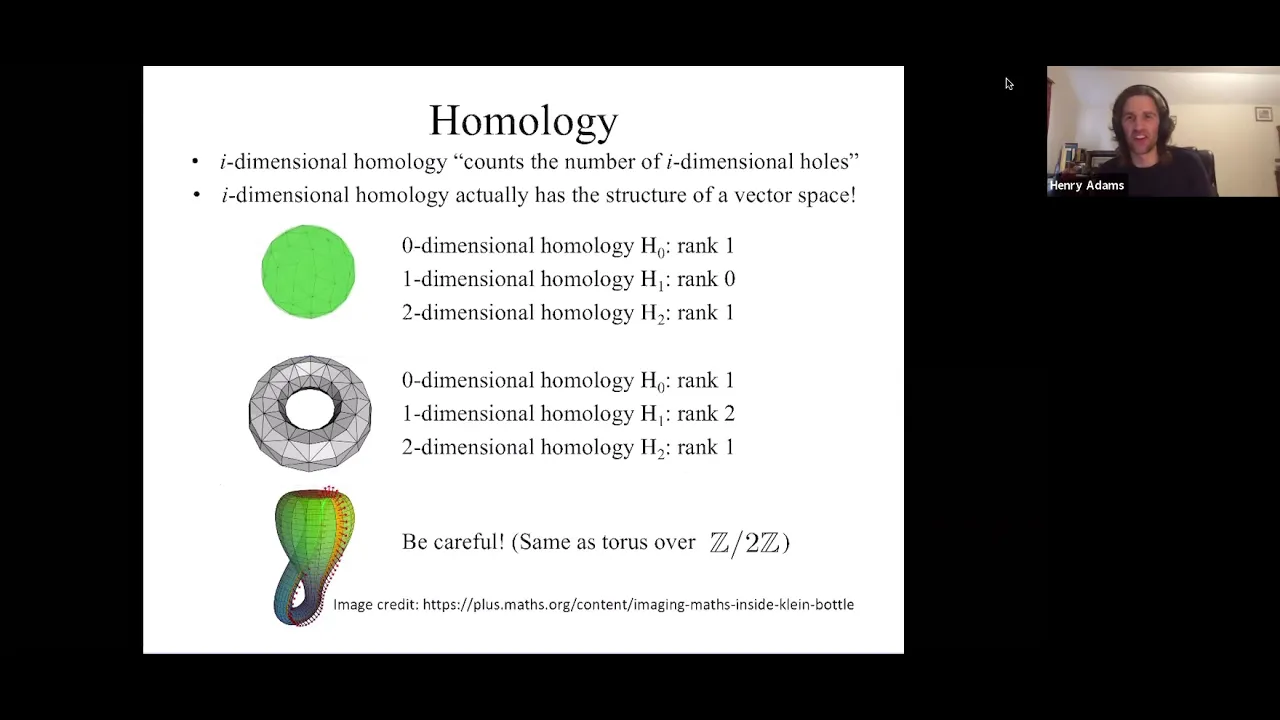
Applied Topology 6: Homology and Holes
@aatrn1
7.1K views•2021-02-05
4:43
Elliptic Curve Cryptography Explained: ECC, ECDSA, ECDH
@PracticalNetworking
28.5K views•2024-10-21
20:20
Normal and Separable Field Extensions Explained | Abstract Algebra
@VisualMath
957 views•2021-07-13

6:00
The Mathematical Impossibility of Accurate World Maps
@Vox
23.3M views•2016-12-02
Related Study Plans & Knowledge Roadmaps
Structured learning paths in Mathematics
mathematics
Tensor Calculus: Vectors to Riemann Curvature
01Mathematical Foundations: Linear Algebra & Calculus
02Covectors, Dual Spaces, and Tensor Basics
03The Metric Tensor and Index Gymnastics
+ 2 more learning modules
40h5 modules
Explore Roadmap
mathematics
Gödel's Incompleteness: Logic, Proofs & Limits
01Introduction to Formal Systems & Hilbert's Dream
02Set Theory, Cardinality, and Cantor's Diagonal Argument
03Arithmetization and Gödel Numbering
+ 2 more learning modules
14h5 modules
Explore Roadmap
mathematics
Galois Theory: Fields, Groups & Solvability
01Foundations of Abstract Algebra: Groups & Fields
02Polynomials & Field Extensions
03Splitting Fields & Symmetries
+ 2 more learning modules
24h5 modules
Explore Roadmap
mathematics
Non-Euclidean Geometry: Models & Geodesics
01Euclid's Fifth Postulate and the Birth of New Geometries
02Hyperbolic Space and the Poincaré Disk Model
03Geodesics: Defining Straight Lines in Curved Spaces
+ 2 more learning modules
15h5 modules
Explore Roadmap