












![Smith Normal Form and Homology computation [Weiyi Xiao]](https://i.ytimg.com/vi/OzyG1NUQ0xU/maxresdefault.jpg)





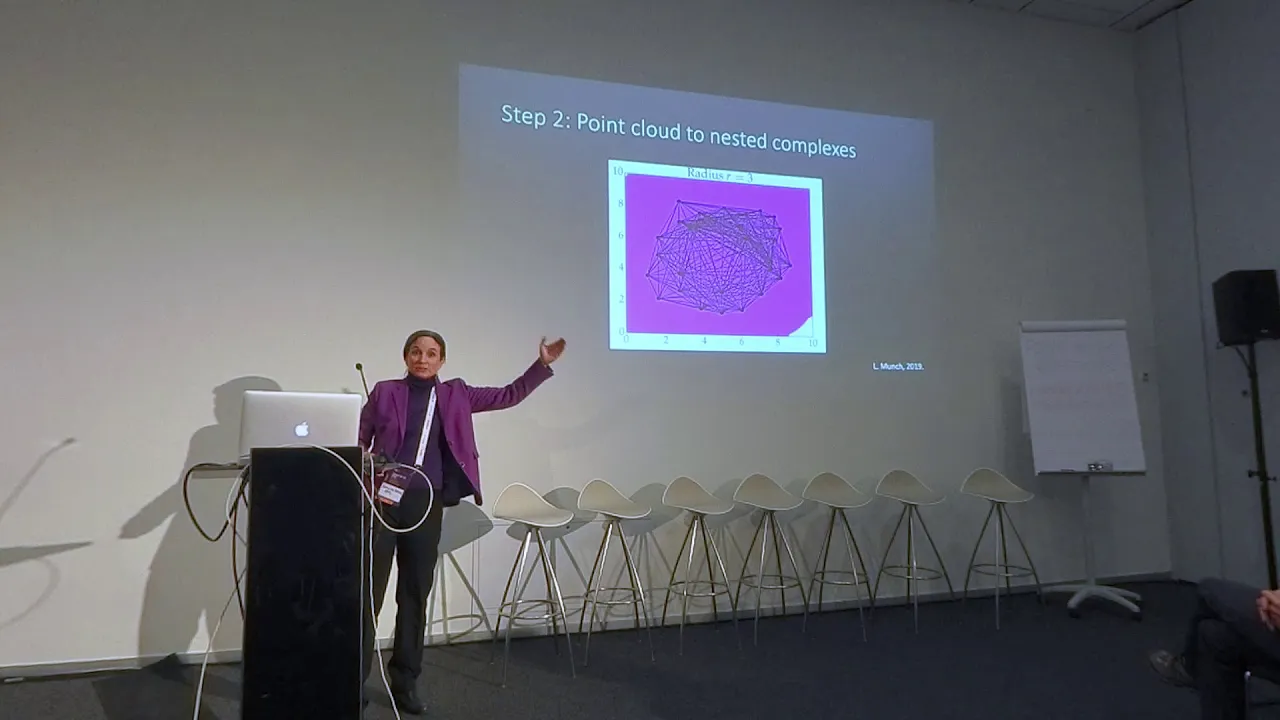


Homology groups provide a mathematical framework to count the number of i-dimensional holes in a topological space, where 0-dimensional homology counts connected components, 1-dimensional homology counts loops, and 2-dimensional homology counts voids that enclose air; homology groups form vector spaces whose dimension (rank) reveals the number of holes in each dimension, enabling computational analysis of complex shapes and data sets.
Applied Topology 6: Homology and Holes
Added:Basic topological concepts such as topological spaces, homeomorphisms, and the qualitative properties of manifolds like spheres and tori.
Fundamental concepts of abstract algebra, specifically abelian groups, group homomorphisms, and vector spaces.
The definition and structure of simplicial complexes (vertices, edges, triangles, and higher-dimensional simplices) as a way to discretize continuous spaces.
An intuitive geometric understanding of boundaries (e.g., how the boundary of a solid disk is a circle, which itself has no boundary).
Persistent Homology, the core tool in Topological Data Analysis (TDA) used to analyze data across multiple spatial scales.
Computational methods for homology, including boundary matrices, Smith Normal Form reduction, and algorithms for finding generators of homology groups.
Cohomology theory, which is the algebraic dual of homology, and its richer multiplicative structure (the cup product).
Practical applications of topological data analysis in fields such as machine learning (e.g., dimensionality reduction), sensor networks, and structural biology.
7.1K views199likes9:40Original Release: 2021-02-05
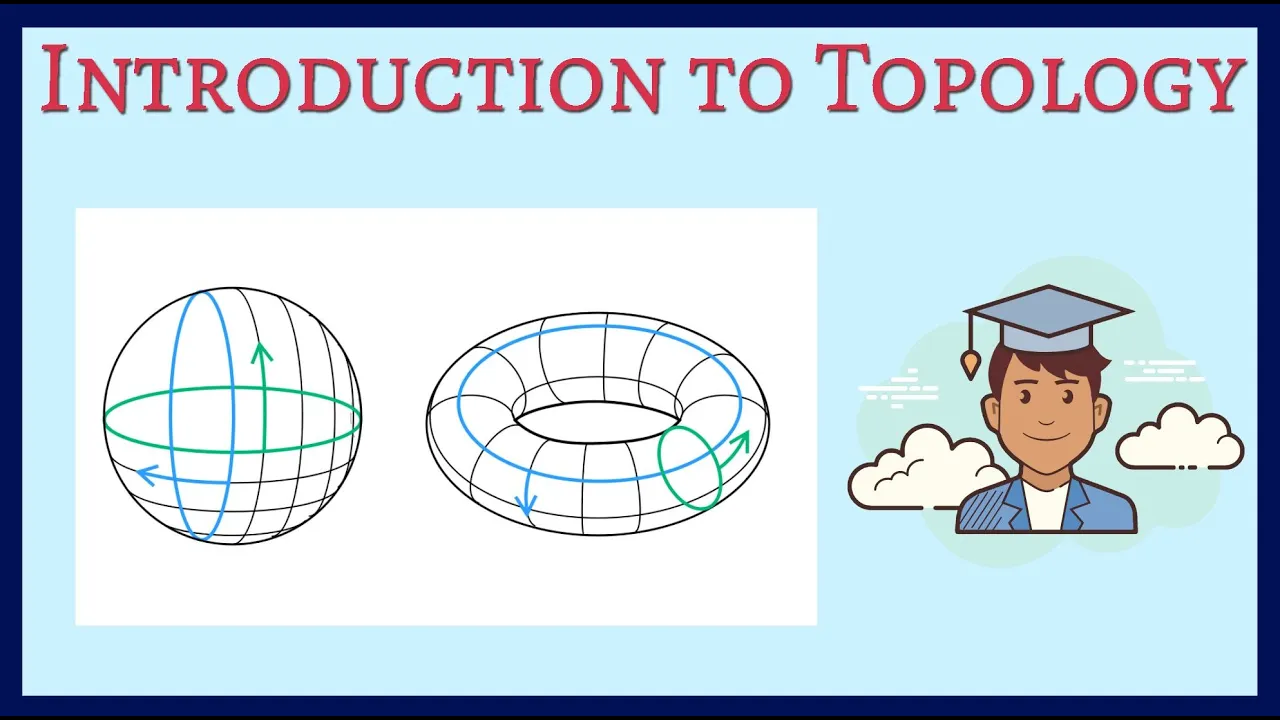
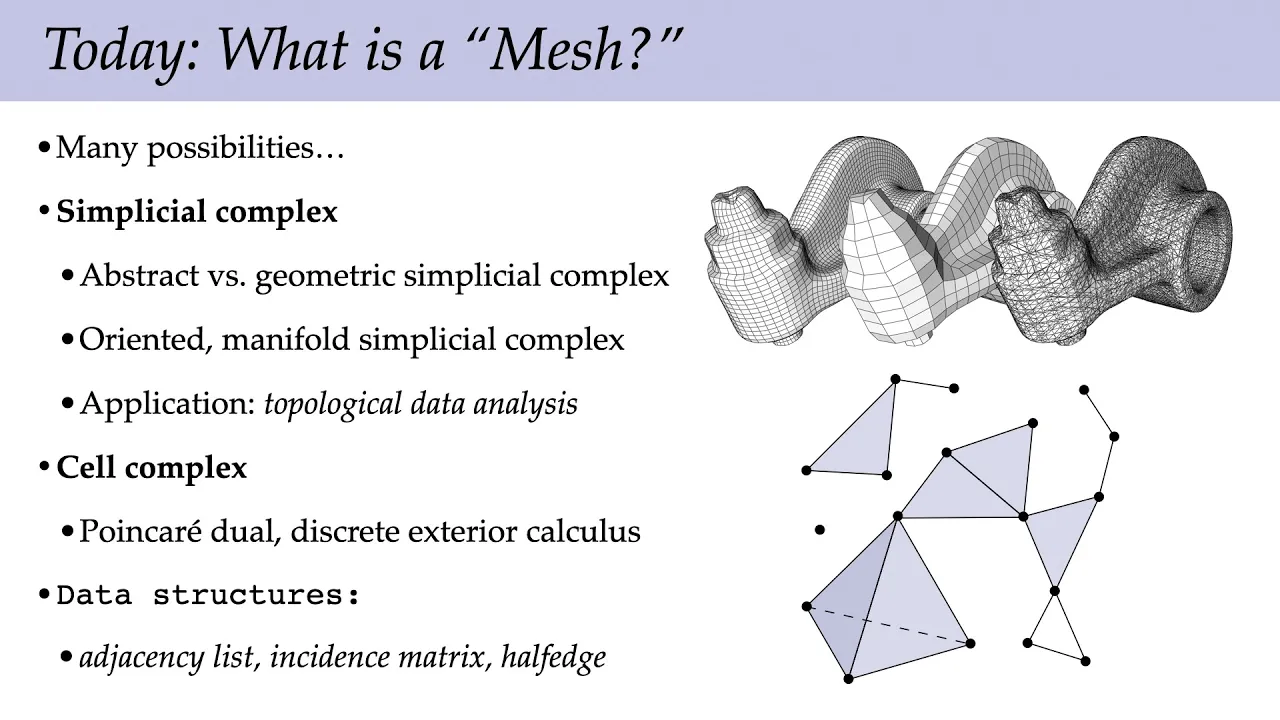
hey everybody i wanted to give an introduction an introduction to homology much like our discussion of homotopia equivalences we're not going to define things rigorously but we're going to give you a working definition to hopefully make you feel a little bit comfortable with it the basic ideas so that if you want to learn more you're perhaps inspired to do so alright so i'll say this again after doing examples but roughly speaking i dimensional homology counts the number of i dimensional holes in a space let me try to explain what i mean by that here i have three different examples you know let's talk about this example on the top so zero dimensional homology counts the number of zero dimensional holes and the number of zero dimensional holes is just the number of connected components so in this particular example i have six different connected components one two three four five six and and they're different connected components because i can't walk inside the space from from one connected component to a different one right there they're split apart if if my space actually looked like this if there was a bridge here now i would have only five connected components you know and if i had this other bridge now in this space i would only have four connected components etc so forget about this word these words rank that i've put here trying to block them from view okay but but do focus on these numbers so that 6 is there because 6 is counting the number of zero dimensional holes or connected components this space is just one connected component i can walk from anywhere on the space to any other spot on the space so that's why i have um uh um one zero dimensional hole and what even is this space here i think of the space as the union of all the black vertices and black edges and red triangles or you know think of the space as the union of all the blue balls this is also a connected space there's a single connected component i could walk from anywhere in the space to anywhere else so all right so that's that's what zero dimensional holes measure just connected components and these three examples have six one and one connected component let's talk about one-dimensional homology dimensional homology is a loop so my top space has zero loops in it this space in the middle has three one dimensional loops you know either around this hollow triangle or this hollow triangle or this pentagon so that's why this number three is here and the space on the bottom it has six one-dimensional holes this whole two um three four five and six so in green i've drawn loops around the six one dimensional holes in this space if you've heard of vector spaces before um vector spaces are something they're very computational oftentimes linear algebra you're you're working in vector spaces it turns out that homology does more than just count the number of holes it has a homology group has a structure of a vector space and the rank or dimension of that vector space returns for you the number of holes so that's why i have this word rank here homology groups you should think of as vector spaces and the dimension of that vector space actually tells you the number of holes in your space so you have a homology group for one-dimensional holes and in this example it has uh dimension six and you have a homology group for zero dimensional holes a vector space and in this example it has dimension one let's not talk anymore about vector spaces though let's talk about two dimensional homology so you have zero dimensional holes one dimensional holes you also have two dimensional holes two dimensional holes are voids that enclose air you can sort of think of them so this first example is a hollow sphere and it has a single two-dimensional hole because you can fill this hollow sphere with jelly and the jelly doesn't spill out here we have a hollow taurus and it also has a single two-dimensional hole you can fill your doughnut with jelly and the jelly doesn't spill out you also have three dimensional holes in four dimensional holes although i haven't tried to draw them here to get some more practice um let's talk about the zero and one dimensional homology of this sphere and tours so the sphere has one connected component so it has one zero dimensional hole and the taurus has one connected component you can get anywhere on this taurus from anywhere else so yeah it has one zero dimensional hole what about the one dimensional holes so on the sphere i have zero one dimensional holes and the reason is any loop that i try to draw on the sphere i could continuously shrink down as if it were made out of a rubber band and just shrink it down to a point so i could draw a loop but that's not a very um it's not an essential loop because i should just shrink that loop down by contrast the taurus has two different one-dimensional holes you could loop around this way or since it's hollow you could loop around this way right and and this would be another hole that can't be shrunk down [Music] um you might ask what about the loop that does the following what about this red loop that starts that's a little too big starts here it loops around it goes to the back side of the tour so that's why i'm drawing it and dotted and it comes back up to the front like that why haven't i con counted that loop right this loop in red um is not the same as as this loop just that just goes around on the top and it's also not the same as this loop it goes around here okay i haven't counted that red loop because it can actually be thought of as a linear combination of this loop that goes around the top and this loop that goes from the top to the bottom back up to the top so that that's really using the structure of the vector space in this torus there are really two main loops that one and this one and any other loop you can draw on the torus can be represented as a combination of those two main ones all right so homology tells you the number of holes in each dimension in a space and for example this torus has a single connected component and it has two one-dimensional holes going around this way or that way and it has a single two-dimensional hole because you could fill it with jelly and the jelly doesn't spill out so even shapes that you can't quite visualize yet like a data set you can compute their homology group sometimes and they tell you some information about the various holes in a space i've hidden lots of the subtleties about homology and so for example i i haven't really mentioned the homology of the klein bottle towards you um for one version of homology the homology of the klein bottle is the same as that of the taurus but for other versions of homology the homology of the clan bottle is different than that of the taurus so it does get complicated but it's really beautiful math and and i like the intuition something computable on a computer that can tell you the number of holes of each dimension in space public questions thanks so much you
Up Next

87:00
Symplectic Geometry & Classical Mechanics: Lecture 6 - Manifold Integration
@tobiasjosborne
9.2K views•2017-11-26

4:43
Elliptic Curve Cryptography Explained: ECC, ECDSA, ECDH
@PracticalNetworking
28.5K views•2024-10-21
5:04
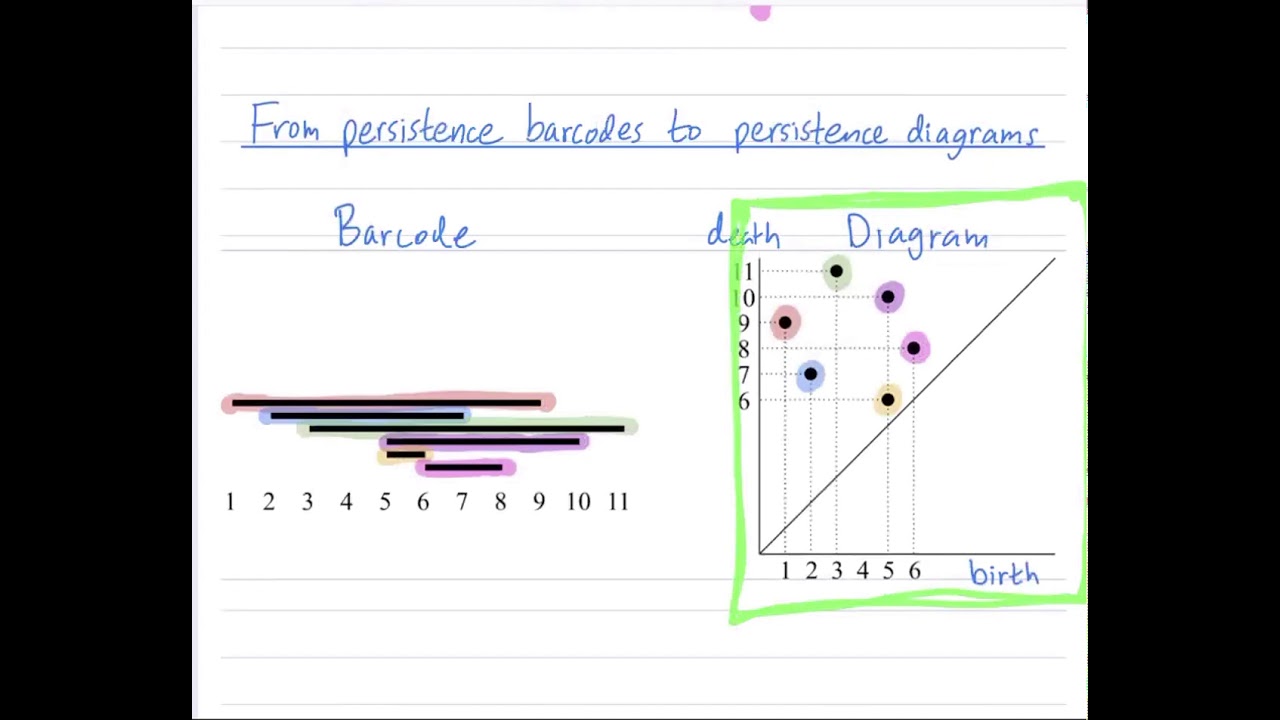
Persistence Barcodes vs Diagrams Explained | TDA Tutorial
@aatrn1
4.9K views•2021-02-18
6:00
The Mathematical Impossibility of Accurate World Maps
@Vox
23.3M views•2016-12-02
Related Study Plans & Knowledge Roadmaps
Structured learning paths in Mathematics
mathematics
Tensor Calculus: Vectors to Riemann Curvature
01Mathematical Foundations: Linear Algebra & Calculus
02Covectors, Dual Spaces, and Tensor Basics
03The Metric Tensor and Index Gymnastics
+ 2 more learning modules
40h5 modules
Explore Roadmap
mathematics
Gödel's Incompleteness: Logic, Proofs & Limits
01Introduction to Formal Systems & Hilbert's Dream
02Set Theory, Cardinality, and Cantor's Diagonal Argument
03Arithmetization and Gödel Numbering
+ 2 more learning modules
14h5 modules
Explore Roadmap
mathematics
Galois Theory: Fields, Groups & Solvability
01Foundations of Abstract Algebra: Groups & Fields
02Polynomials & Field Extensions
03Splitting Fields & Symmetries
+ 2 more learning modules
24h5 modules
Explore Roadmap
mathematics
Non-Euclidean Geometry: Models & Geodesics
01Euclid's Fifth Postulate and the Birth of New Geometries
02Hyperbolic Space and the Poincaré Disk Model
03Geodesics: Defining Straight Lines in Curved Spaces
+ 2 more learning modules
15h5 modules
Explore Roadmap