

















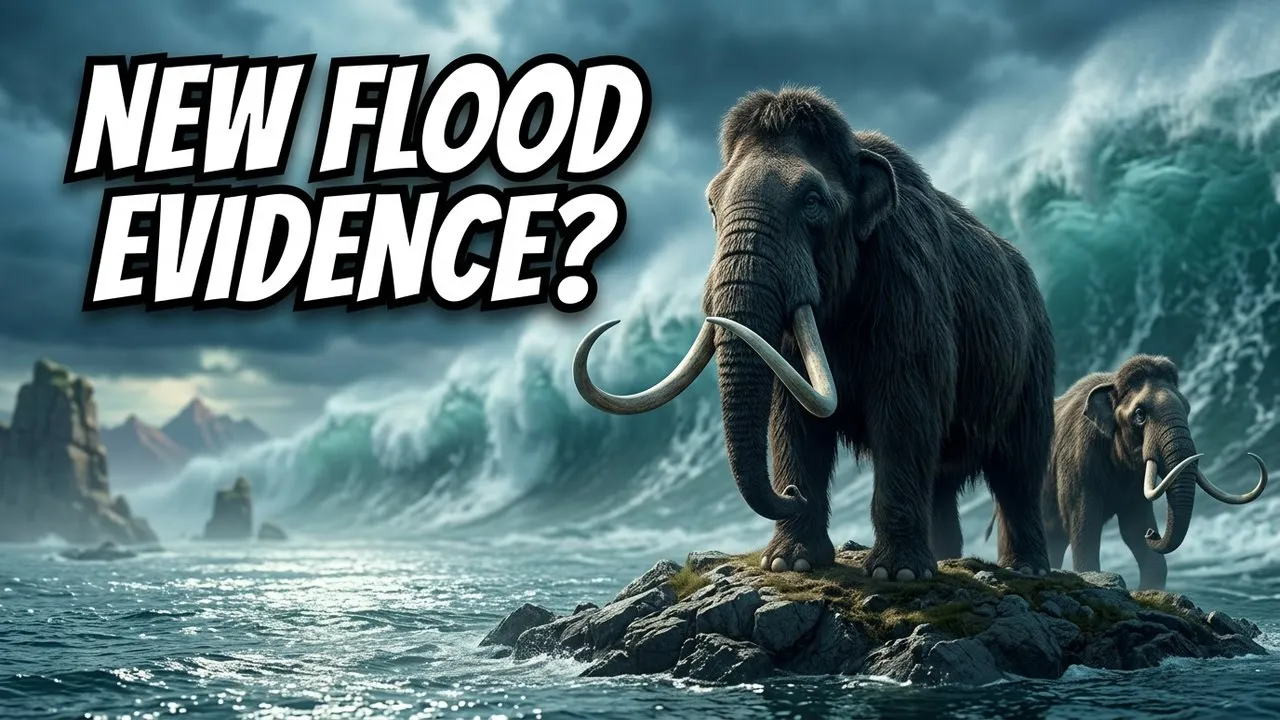
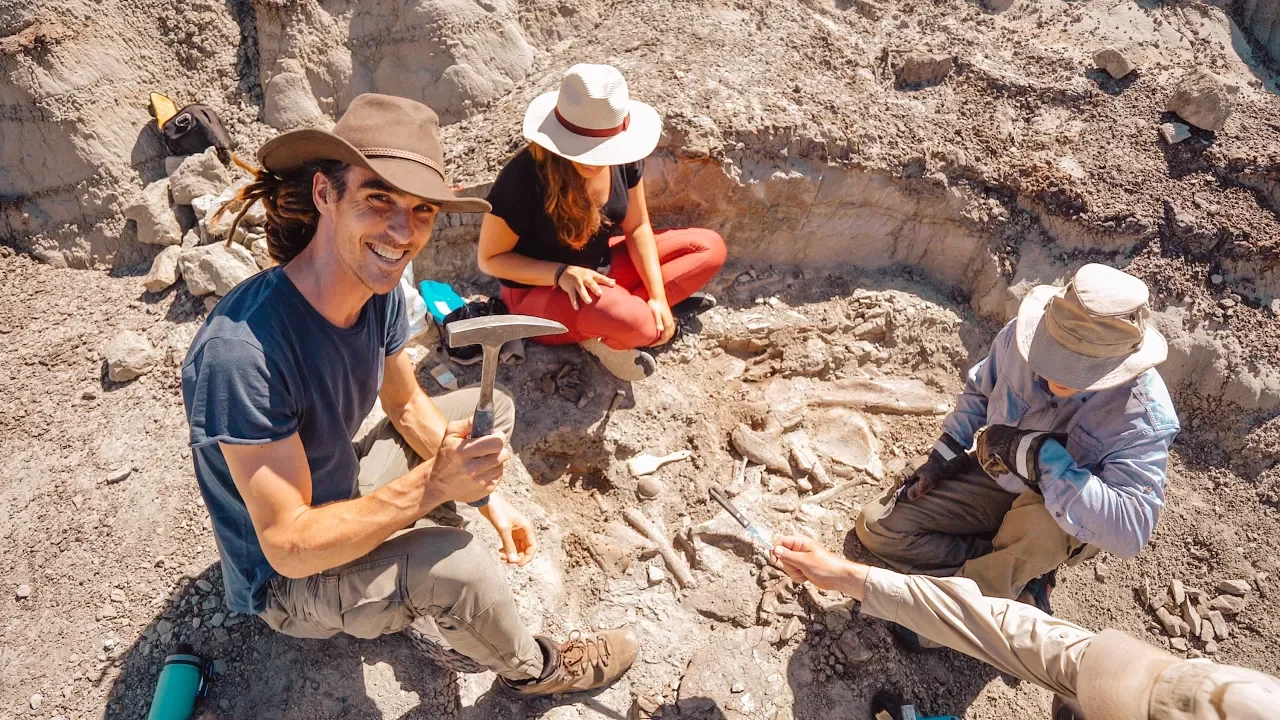


Dr. Arthur Chadwick, a taphonomist and paleontologist at Southwestern Adventist University, presents evidence from the Hanson Ranch site in Wyoming where between 10,000 and 25,000 individual dinosaurs were buried during a single catastrophic flooding event. His research reveals that dinosaur fossils are found in structured bone beds across extensive geographic regions (Wyoming, South Dakota, Montana, Canada, and Alaska) within the Lance Formation, indicating continent-wide catastrophic processes rather than gradual accumulation. The presence of associated scavenger marks, the separation of bones indicating transport, and the lack of time-related disruptions in sediment layers all point to rapid, large-scale flooding events that overwhelmed vast areas of North America during the Cretaceous period.
Dinosaur Graveyard in Wyoming: Evidence of Noah's Flood?
Added:So, Art, this is where all these bones end up, huh?
Yes.
After… after we come back from the field this is where the….
Oh my goodness sakes!
What in the world?
Yeah, this is a very large triceratops.
These are the two brow horns, Yes.
And this is the nasal horn here.
And actually it has a nose that projected over a foot beyond that, so that the total length of the skull from here to the back is about seven feet.
That is a huge skull.
Art, this is amazing.
I mean this is huge!
This is where you classify all the bones?
This is where the bones end up being stored.
And, for example, these are sorted by size — so these are small vertebrae here, down to little, tiny ones like that.
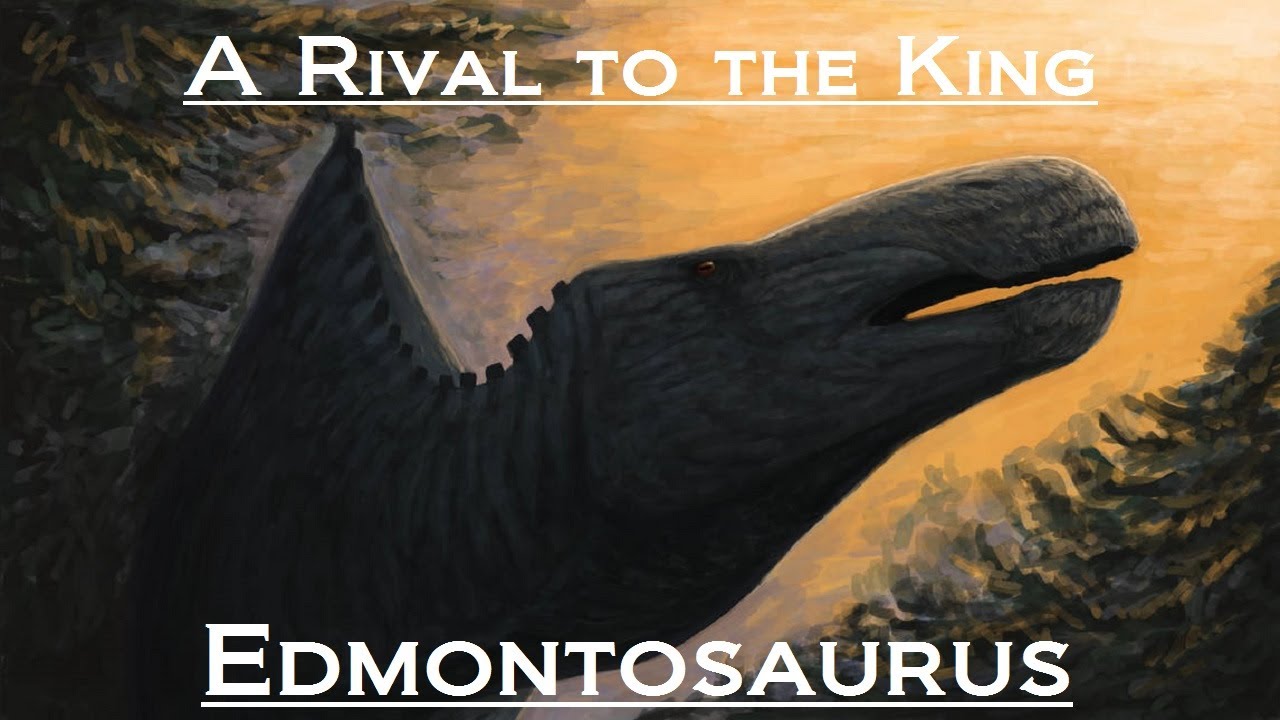
And these are from a variety of species, but the predominant species is edmontosaurus — the duckbilled dinosaur.
And these are tail vertebrae from a little farther forward.
These are all vertebrae right here.
This section here is… is the hand.
This is the wrist bones here.
And you can see they're… they're really unique and they're wonderful bones to find because almost always they have integrity.
They're very large.
This is… this is the bone of the wrist — this would be equivalent to the back of your hand, yeah.
These duckbill dinosaurs had quite robust front limbs.
They didn't walk on all fours — they probably ran on two feet — but they had the ability, their front limbs were strong enough, to support the body.
A little bit like the kangaroo?
Yeah, kind of like a kangaroo.
These are the terminal phalanges.
These are called unguals.
So….
The very end of the….
That's just like… just like each of the ends of your fingers.
This would have been from a toe.
These projections are where the tendons attached that allow your fingers to move.
And then down here at the bottom — I won't pull it out — there's the metatarsals, that's the bones in your foot.
That's hard… hard to imagine, isn't it?
It is.
But while we're over here, let's take a look at these bigger bones.
These are massive.
These are the tibias — the lower leg bone and….
Just the lower leg?
Most of these are from duckbilled dinosaurs, yes.
This is a very beautiful example.
It's got a lot of integrity.
This area of the bone is usually crushed because of the oppressive sediment.
So….
Is that because it's… it's more hollow here?
Yeah, it would have had more space in there.
This is an ulna.
So that would be the lower… lower arm.
It gives you an idea — this is a large one — but it gives you an idea of just how big these… these animals were.
This one's unique because it has a tooth mark right there … is that right?
…where some tooth got caught in it and you can see the drag mark coming out of it.
Is that unusual?
Obviously you're pointing to some sort of a battle that was going on.
[Chuckles] More likely it's a scavenger….
Scavenger after the their dead?
All of these bones have come from the Hanson ranch.
That's right.
These are all from that one site.
Do you have any idea how many?
Well, we have upwards of 20,000 in the collection.
And how long a time is it taking?
It's been over 20 years.
Yeah.
This has been your life work almost, hasn't it?
Well, I didn't plan it that way, but that's how it turned out.
It's turned out that way.
Wow.
Over here on the table we have a couple of more.
Those are the upper leg bone.
These are monsters.
They are.
And that's the largest — the longest — bone in the body and usually the largest, and these weigh a couple hundred pounds.
So you can imagine — you take one of those large tibias that we just looked at, added to this, and you're dealing with… over here somewhere, and then you've got the foot below that, and the hip above that.
Just hard to imagine.
These are… these are really big animals.
This case has the remains of nanotyrannus.
Nanotyrannus is one of the rarest dinosaurs.
And these are….
Is that when you say tyrannus … so is this similar to the T-Rex?
Similar to T-Rex, and there's a big dispute in the scientific community about whether it is T-Rex or not.
So the problem is there are no juvenile T-Rexes; or if there are, they're very, very poorly understood, very poorly known.
So you can't have a dinosaur that's 30 or 40 feet long without having something smaller.
And so they said, well, this must be a juvenile one; but the characteristics don't match with… with T-Rex.
So you see them as fairly different.
It's a different taxon, yeah.
What do we have here?
This is….
This is the….
Teeth?
This is the upper jaw.
And then the lower jaw is here — this happens to be from the other side of the body, but you can visualize this.
So it would have been a… it would have been a fearsome animal.
It would.
It's a kind of animal I think it would run from.
[Chuckles] Here's… here's the tooth — and that brings us to teeth.
These… teeth are very important because one tooth can tell you a taxon.
So if you find a single tooth, you know that that particular kind of animal was there, because you can identify the teeth.
For example — well, let's just take this one, this is a tyrannosaurus rex tooth.
And how do you know that?
It's a massive, crushing tooth.
It has serrations on the edge and is bigger than it could be in any other dinosaur that's around.
And that's… that's a tyrannosaurus, and here is a nanotyrannus for comparison.
And you see how that's blade-like, Oh, it is, yeah.
and the serrations line up on the front and back of the tooth.
It's a very different tooth, then.
And this one, yeah, this is a crushing tooth.
And when this thing bit into bone, the teeth would break off, sometimes — and that's okay for the dinosaur because he has an infinite supply — a new one will grow up.
Is that right?
Now the fact that we find so many of these associated with these duckbilled dinosaur remains, suggests to me that after they died, they were available for scavenging for some time — long enough for tyrannosaurs and other animals to be able to get in and enjoy the feast.
Now this drawer down here has a bunch of unique stuff, full — grab that side.
These are the mostly nondinosaur materials: you can see here are shells, here's some dinosaur egg shell.
Oh my.
Goodness.
These are from these are scoots from the skin of a crocodile — really beautiful fossils — and we have a lot of turtles in the site.
These are all water animals.
This is a… this is an example of a turtle shell.
And you can see on the inside we have the rib cage.
Turtles are unique among all the animals because their pectoral and pelvic girdles are inside the rib cage.
So in order to develop a turtle you would have to figure out a way to move its pectoral and pelvic girdles inside it's rib cage.
It seems backwards.
But it just can't.
It's a real enigma for evolution.
Art, that brings me, then, to another question that's associated with the layer that you were finding all of this in — was that called the Lance Formation?
Right.
Is that correct?
That's the unit.
And if I remember correctly, it's not as if these bones are random.
It seems that there is some sort of structure.
What does that show you?
Well, this certainly is what's called a fossil graveyard.
It's a place where many hundreds or thousands of dinosaurs or animals died.
They didn't die where they are because I think we've discussed already they were transported… yes.
…to where… where we find them.
But they died somewhere and they were catastrophically killed — they all died about the same time because the bones are all in about the same shape.
And so we have this massive number of bones, and there had to be some event that was significant enough to kill that many animals all at once.
So that certainly brings up the idea of a global, catastrophic process.
Bone beds that we find in the fossil record are really much more pervasive and extensive than they are today.
You can get a bone bed if you have, for example, a catastrophic flood and it covers an area where people and animals live.
Then if you came back years later, you'd find some bones there, but you wouldn't find anything like the scale that we find in the fossil record.
When you find a bone bed like these and there are many of these in the Cretaceous it certainly pushes you to the conclusion that there was a major, catastrophic process going on.
This is not just life as usual.
And that layer that you're finding these bones in, if I remember correctly, we were talking about how that appeared to be more of a mud layer.
Is that right?
Yes.
This particular place we have the bones in a clay stone to mud stones, so it's very fine material.
In other places they're found in sandstone.
So there are a variety of different sedimentological environments you find bone beds in.
This one we're very fortunate because it's easy to get the dirt off because it's not rock it's… it's unconsolidated sediment.
But you still are dealing with massive numbers of animals being killed.
How big is that formation?
Well, the last formation extends most of the way across Wyoming, and then it goes into South Dakota, and the names change to Hell Creek Formation, and then it goes into Montana and… so South Dakota, Montana, and Wyoming.
And then there's an equivalent formation up in Drumheller, in Canada, where they find the dinosaurs up there.
And they're also finding these same dinosaurs up in Alaska.
So we're talking about a large part of North America.
So this… this one is extensive on its own.
This is an extensive, upper Cretaceous bone bed.
Yes.
And then there are many of them, it's not just one, but they're not connected.
But there are many bone beds in the upper Cretaceous.
That means these layers are striated that we call them.
These are the layers like you saw in Grand Canyon, where you have one unit that has some integrity and also has some extent, and those layers are one above another.
So if you go down farther, you find another layer, and then you go down farther, you find another layer; and these have different kinds of fossils in them, all through the geologic column.
Wherever you find fossils, the same question arises.
How did you get all these fossils there, and how do you preserve a fossil, and what kinds of processes are involved in fossil preservation?
Art, it's… it's obvious that what you are doing there at the Hanson Ranch is… is digging in a huge mortuary.
I mean it's a huge death bed.
And that's what taphonomy is about.
Taphonomy is the science of finding out what happens to an animal from the time it's alive until it's excavated.
So it includes a cause of death.
What happened after it died?
Did it lie around and… and… and decay, or did it get buried quickly?
And the evidence that it got buried quickly is the preservation of the integrity of the organism.
Now in the case of these dinosaurs, their original death was followed by a period of time during which we assumed they were scavenged and where… where they were rotting.
And then after they were pretty much rotted — maybe a few days, or weeks, or even months — the whole mass of bones was… was picked up and transported out into deeper water and buried.
And… and that burial is what preserved the bones.
That's indicated by the fact that these bones are all separated.
If we find a whole dinosaur that's still together, we know it had to be killed and buried in very short order.
And to bury an animal this big requires very rapid burial.
For example, we were studying whales down in Peru.
Yes.
And whales are pretty big animals.
So when you find a whale that's been buried quickly, and all its bones are still in place, you know that there was sedimentation — the dirt that covered them up was coming in very quickly.
These whales still have the baleen in their mouths: the protein that comes out in just a few days is still in their mouths.
So we know they were buried quickly and… and when we wrote this up in scientific journals, we drew people's attention to the fact that this was rapid burial.
Well, Art, these… the dinosaur fossils that we're… we're finding.
You say that they are pretty much found in the same layer.
They're not found throughout that whole system of layers.
Give me the perspective of that.
In the… in the Cretaceous, we find specific kinds of dinosaurs — we find these duckbilled dinosaurs, we find Tyrannosaurus rex, we find dromaeosaurs, raptors.
That's typical of what you find in the upper Cretaceous.
If you go into the next layer down, the next set of layers down called the Jurassic — that's where they got the name for the famous dinosaur movies — that's where you find these big apatosaurids and the other long-necked dinosaurs, and some other typical kinds of dinosaurs including stegosaurus.
And then if you go down below that, you find some dinosaurs that aren't so familiar in the Triassic.
If you go down below the Triassic, you'll find other layers of rock and these kinds of layers of rock don't have any dinosaurs in them.
They have some reptiles — and if you go down a little farther there's some amphibia and fish — and we get more and more marine as we go down in the layers until, finally, what we have at the bottom is entirely the kind of animals that would live in the ocean.
So this whole scene, from bottom to top, is an orderly distribution of forms of animals and that's what we're… that's the fossil record.
Well, let me take you back to the dinosaurs, then, for a second, because one of the big questions, again, was what caused all the dinosaurs to go extinct?
You mentioned the… the asteroid.
But now let's talk about from a Genesis paradigm.
How do we explain that?
When we look at the fossil record of dinosaurs, we find that they are killed off in layers.
Also, we have… we have the Triassic kinds of dinosaurs here.
And then we have the Jurassic kind of dinosaurs higher up, and then we have the Cretaceous kind of dinosaurs at the very top.
And right at the very top, we find Tyrannosaurus rex, and these duckbilled dinosaurs, and the kind of things we're studying in Wyoming because we're just right below that layer which ends the Cretaceous.
And so, I think, this process of burial couldn't just be explained by a single asteroid.
It has to involve something — dare I say — much bigger than that.
And certainly on a grander scale that encompass the whole earth.
And we find evidence for this in the… in the direction of currents that are flowing over the surface of the earth.
For example, in the rocks, if you've ever seen crossbedded sandstone — it's sandstone that lies at an angle like this — that sandstone tells us which direction the current was moving that deposited that sand.
If we look at these flow of currents over the surface of the earth — and in all these different layers of rock, from the Cambrian all the way up to the… to the top — we find out that it seems to be going the same way over wide areas of the earth, like there's some kind of flow taking place that's different from anything we have today.
Today we have a basin, the settlements go into that basin from all sides, and we would see evidence of currents flowing in that basin.
In the fossil record, what we see is the currents tend to ignore the basins.
They tend to go right across the basins, and they tend to be looking at something much bigger than just a part of North America, for example.
And, in fact, the currents in North America and South American behave the same way, just to give you one example.
So that, to me, suggests that in the development of the fossil record, we had processes going on that were bigger than anything we can imagine today.
It doesn't say today's processes, continued over a long period of time, would have produced this.
It says the only reasonable way to produce this is to have processes that are not going on, on the earth today.
When you look at the rocks themselves, you don't see evidence for the passage of a lot of time.
Dr. Brand and I have been working on this for the last 15 years, just going through tens of thousands of meters of sediment, looking for evidence of the passage of time between the layers.
And the evidence would be that the layers have been disrupted or re-suspended or moved around by organisms, or roots, or… or whatever processes.
Once you deposit a layer, if it's just sitting there for a year — say nothing of a hundred years, or a thousand years — that layer is going to be affected by its environment.
So, in the current process today, if we have some sediment that gets laid down, what you're saying is that there are processes going on that would radically change that layer.
Sure.
Roots penetrate soil and move it around.
Organisms if it's… well, even above sea level, but below sea level you have worms that live all over the bottom and other organisms, and they're burrowing constantly in the sediment — that's where they get their food.
And so if you bring in a new supply of food for them, they're going to devour that and they're going to mess up all the internal structure.
So we look at these layers and we say is the internal structure still there, or has it been disrupted by organisms which equals time?
Not a lot of time, necessarily, but time.
If you see no disruption, then you're going to have a hard time explaining that sediment in a long period of time.
And what did you find down in the fossil record?
We found tens of thousands of meters with no disruption whatsoever.
One layer, after layer, after layer, after layer — and we were looking at it in a centimeter scale.
We were walking through thousands of meters of sediment looking at centimeter-level disruptions.
And they were very difficult to find.
You can find them once in a while.
But not the kind that we would expect if there'd been the passage of a lot of time.
Up Next
Forensic Anthropology: Solving Crimes Through Identity
@TheRoyalInstitution
283.1K views•2019-10-02

Triumph of Orthodoxy Icon: Byzantine Art & History Explained
@BenCallan
2.1K views•2024-08-06

FastAPI vs Flask vs Django: Choosing the Right Python Web Framework
@TechWithTim
302.5K views•2024-05-26

Game of Thrones Opening Credits: A Cinematic Analysis
@gameofthrones
46.3M views•2011-04-18
Related Study Plans & Knowledge Roadmaps
Structured learning paths in General & Interdisciplinary Studies