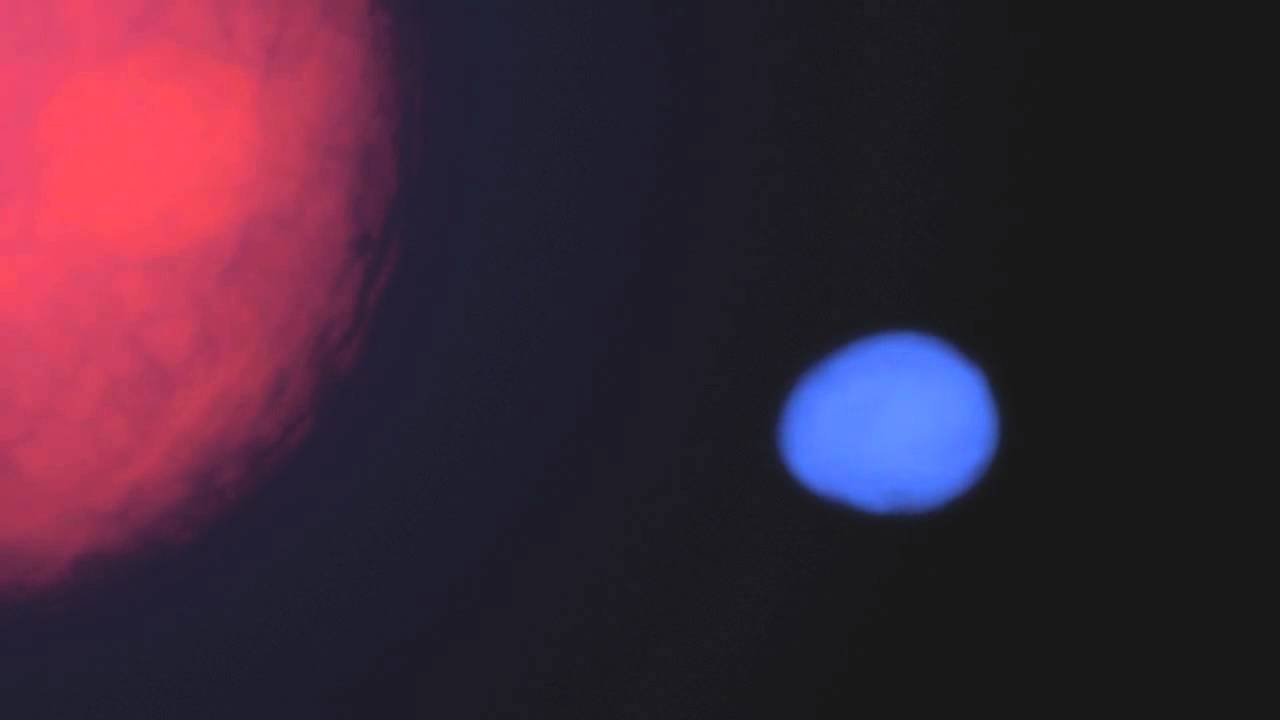
The Bullet Cluster collision provides compelling evidence for dark matter's existence and properties: observations from Chandra X-ray Observatory and Hubble Space Telescope revealed that hot gas (pink) separated from galaxies and dark matter (blue) during the collision, demonstrating that dark matter interacts only gravitationally without electromagnetic interactions; refined gravitational lensing measurements from the Webb telescope confirmed no significant self-interaction among dark matter particles, as no offset between galaxies and their associated dark matter was detected.
Dark Matter in the Bullet Cluster: Evidence Explained
Added:Deep Dive
The fundamental concept of dark matter as an invisible, non-baryonic form of matter that interacts primarily through gravitational forces.

Katherine Freese (U Texas Austin): Dark Matter in the Universe, APS Meeting, Denver CO
209
Each fundamental force has a mediating particle: photons for electromagnetism, gluons for strong interactions, W/Z bosons for weak interactions, and hypothetical gravitons for gravity. Dark matter interacts only via gravity and possibly the weak force, explaining invisibility. This selective interaction is why dark matter remains undetected despite its gravitational influence.
Click to watch →

Вот почему мы можем обнаружить темную материю только с помощью гравитации.
1.3K
Modern physics recognizes four fundamental interactions governing everything in the universe: strong nuclear force (holds atomic nuclei together, acting only at tiny distances), electromagnetic force (responsible for light, electricity, and chemical bonds), weak nuclear force (responsible for radioactive decay and stellar processes), and gravity (the weakest force but the only one acting over infinite distances). Ordinary matter interacts with all four forces, but dark matter does not participate in strong nuclear or electromagnetic interactions. This makes it invisible because everything we observe with telescopes is based on electromagnetic interaction. If something doesn't interact with electromagnetic force, it cannot emit, absorb, or reflect light, making it invisible to any electromagnetic detector. The only confirmed interaction dark matter has is through gravity - it has mass, which means it curves space-time and attracts other objects.
Click to watch →
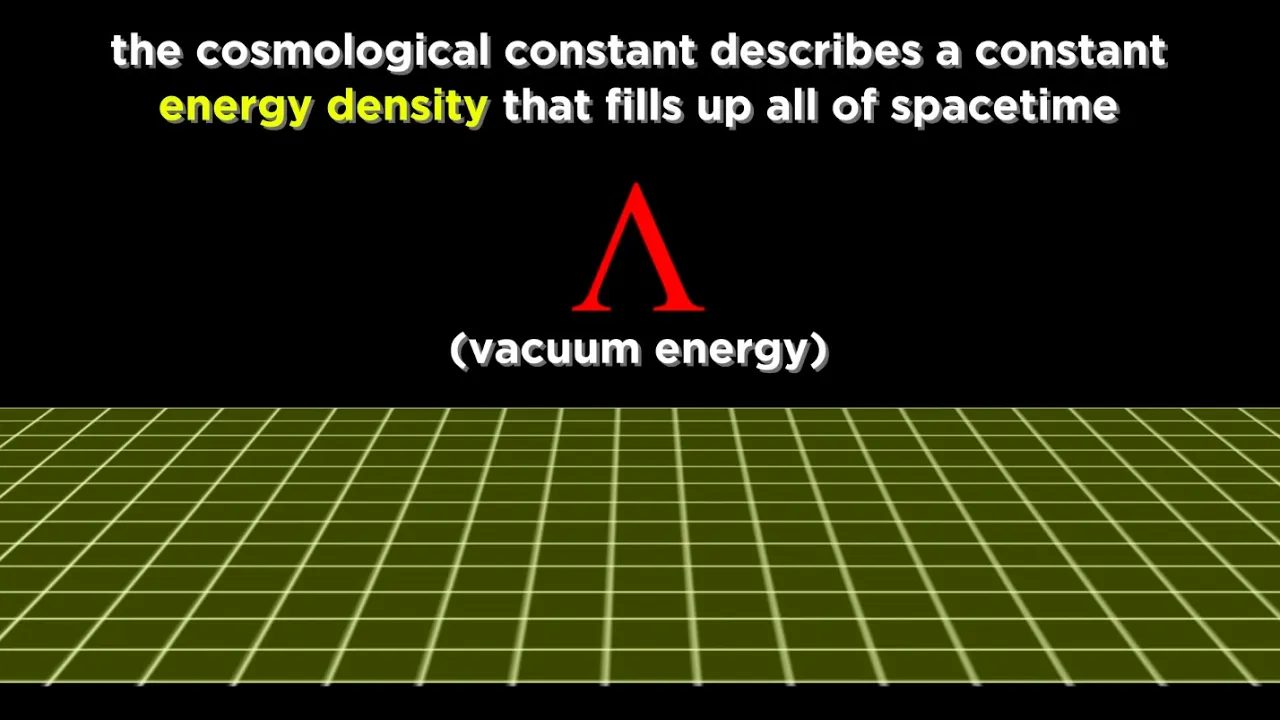
Dark Matter and Dark Energy: The Frontier of Astronomy
106.2K
Dark matter is invisible matter that does not emit, absorb, or reflect electromagnetic radiation because its particles do not produce photons through electron relaxation or nuclear reactions. It is non-baryonic, meaning it is not composed of protons and neutrons. Key evidence includes galactic rotation curves showing constant stellar velocities at galaxy edges (requiring ten times more mass than visible matter), gravitational lensing where light bends around massive objects revealing excess mass, and large-scale structure formation where dark matter's gravitational wells guided luminous matter into filaments and voids. These observations collectively confirm dark matter's existence despite its invisibility.
Click to watch →
На что способна тёмная материя?
104.9K
Dark matter constitutes approximately 84.5% of the universe's matter, yet remains invisible and undetectable through conventional means. Unlike ordinary matter that interacts through electromagnetic, gravitational, strong, and weak forces, dark matter exists in a state where it cannot interact with ordinary matter through these forces. This extreme non-interaction means dark matter would pass through ordinary objects like a table or Earth's crust without resistance. Scientists detect dark matter indirectly through its gravitational effects on galaxy clusters and rotation patterns. Leading candidates include WIMPs (Weakly Interacting Massive Particles) and axions, which are non-baryonic particles that provide the structural 'glue' holding the universe together.
Click to watch →

MATÉRIA ESCURA, O LADO OBSCURO E DESCONHECIDO DO UNIVERSO
14.2K
The universe is composed of approximately 27% dark matter, 68% dark energy, and only 5% ordinary matter. Dark matter, invisible and non-baryonic, cannot be detected through radiation absorption, gamma rays, or gravitational lensing. Leading candidates include axions (hypothetical low-mass particles) and sterile neutrinos. The cold dark matter theory (slow-moving particles) is most accepted, supported by the cosmic microwave background's smoothness. Dark matter's existence is proven through gravitational effects: galaxy rotation curves, mass discrepancies in galaxies like NGC 5585, and the 2018 discovery that NGC 1052-DF4 lacked dark matter, which was later stolen by its more massive companion. This demonstrates dark matter interacts gravitationally with normal matter and is essential for galactic structure.
Click to watch →
Deep Dive
The principles of gravitational lensing, specifically how massive objects bend the path of light from background sources according to Einstein's General Theory of Relativity.

Dávid Gyula: A csillagok fénye (Atomcsill, 2016.01.21.) - A 150. Atomcsill előadás
102.4K
Gravitational lensing is the bending of light by massive objects, as predicted by Einstein's general relativity. When light from a distant source passes near a massive object (like a galaxy or black hole), its path is bent, causing the source to appear in a different position than it actually is. This effect can distort, magnify, or multiply images of background objects. Einstein predicted this effect in 1915, and it was confirmed during the 1919 solar eclipse when Arthur Eddington measured the apparent positions of stars near the Sun.
Click to watch →

Kdyby to teleskop Jamese Webba nezachytil, nikdo by tomu nevěřil | Dokument pro klidný spánek
1.7K
In 1915, Albert Einstein published his theory of general relativity, which predicted that massive objects bend spacetime itself. Light traveling near extremely massive objects follows this curved geometry, causing the light path to appear bent to observers. This effect, called gravitational lensing, creates magnification. Light from background objects is stretched, intensified, and sometimes duplicated into multiple images. The more massive the intervening object, the stronger the lensing effect.
Click to watch →
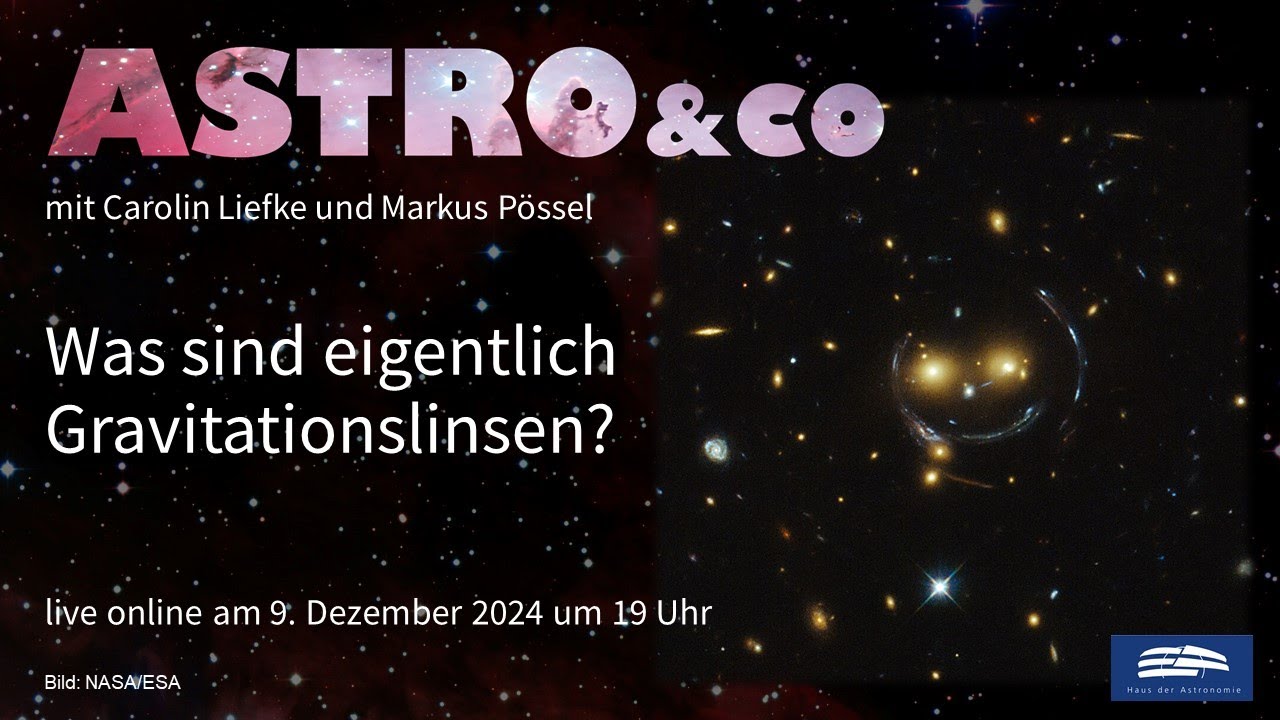
Was sind eigentlich Gravitationslinsen?
2.1K
Gravitational lensing is a phenomenon where massive objects (like galaxies or galaxy clusters) bend the path of light from background sources, creating distorted images, multiple images, or Einstein rings. This effect, predicted by Einstein's general relativity, allows astronomers to detect dark matter, measure cosmic distances, and study the universe's structure by analyzing how light is deflected around massive objects.
Click to watch →

Gravitational Lensing, Part 1
115
Gravitational lensing is the bending of light by massive objects in the universe, where light from a background source is deflected by a foreground lens object (such as a galaxy or galaxy cluster), creating phenomena like Einstein rings or multiple images of the same source; this effect depends on the lens's mass, the relative distances between source, lens, and observer, and the degree of alignment, and was first verified by Eddington's 1919 eclipse experiment confirming Einstein's prediction that mass distorts space, doubling the deflection angle from 2 to 4 times the original calculation.
Click to watch →
Le coeur de la matière et la masse manquante de l'Univers (9 septembre 2025)
1.7K
Gravitational lensing is the bending of light by massive objects, as predicted by Einstein's general relativity. When a massive object (like a galaxy cluster) lies between us and a distant light source, it bends the light, creating distorted or multiple images of the background source. This effect allows astronomers to map the distribution of mass (including dark matter) in the foreground object.
Click to watch →
Deep Dive
An understanding of X-ray astronomy and how hot, ionized gas (the intracluster medium, which represents the majority of normal baryonic matter) emits high-energy light.
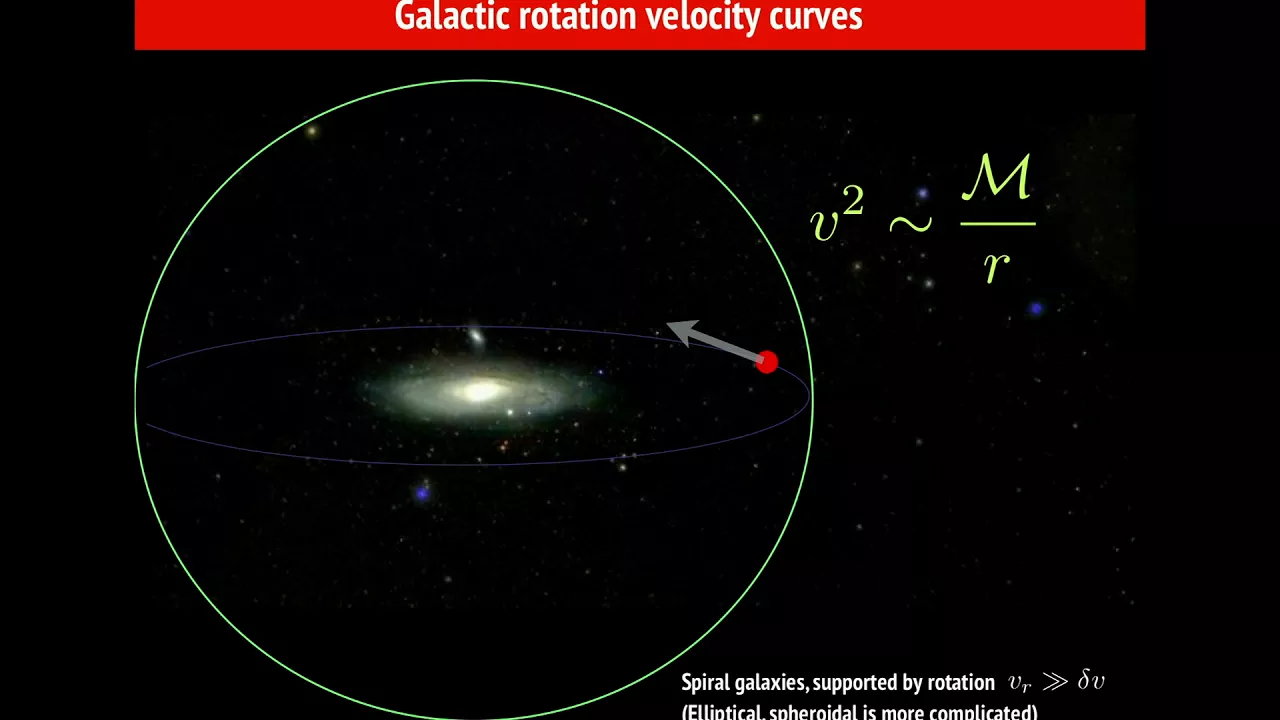
Dark Matter and Axions - Lecture 1
271
Galaxy clusters contain vast amounts of hot ionized gas (plasma) between galaxies, which emits X-rays due to high-energy collisions between particles. By analyzing X-ray spectra, astronomers can measure the temperature and density of this intracluster medium. The virial theorem applied to this hot gas reveals that most of the cluster's mass is not in the visible galaxies but in this diffuse plasma. However, even accounting for this baryonic gas, only about 15% of the total cluster mass is visible, leaving the remaining 85% unaccounted for by ordinary matter.
Click to watch →

ISSAA & RCAA 2022: Prof. Somak Raychaudhury - Groups and clusters of galaxies (I)
206
Galaxy clusters contain a diffuse hot gas called the intracluster medium, which reaches temperatures of 10^7 Kelvin or higher. At these extreme temperatures, the gas emits X-rays through thermal bremsstrahlung radiation. The hot gas fills the entire cluster volume and is heated by gravitational energy released when galaxies fall into the cluster's deep potential well. The X-ray emission provides direct evidence for the existence of this hot gas and allows measurement of its mass and temperature. The relationship between gravitational potential energy and thermal energy explains why this gas reaches such high temperatures.
Click to watch →
Iceberg Definitivo del Universo y Espacio | Completo
358.8K
The hot ionized medium refers to a plasma of moderately hot gas that cosmologists believe exists in intergalactic spaces and contains between 40-50% of baryons. It is described as a network of hot, diffuse gas. Much of what is known about the hot ionized medium comes from computer simulations of the cosmos. Due to its high temperature, it is expected to easily absorb or emit ultraviolet and low-energy X-ray radiation, making it potentially observable through these wavelengths.
Click to watch →

Clusters Of Galaxies - Professor Carolin Crawford
124.9K
Galaxy clusters contain a vast hot gas atmosphere called the intracluster medium, reaching temperatures of millions of degrees. This gas emits X-rays and has a mass approximately 7-10 times greater than all visible galaxies combined. The hot gas fills all space between galaxies and responds to gravitational forces. This atmosphere plays a crucial role in galaxy evolution, stripping gas from infalling galaxies and providing evidence for the enormous gravitational potential wells that bind clusters together.
Click to watch →

Holm 15A - The Heaviest Black Hole in the Observable Universe | Documentary for Sleep
40K
Beyond the stellar envelope of Holm 15A lies an even larger and more diffuse realm—the intracluster medium of Abell 85. Here, matter no longer takes the form of stars but of ionized gas so hot that it glows only in X-rays. This plasma fills the spaces between galaxies, bathing the entire cluster in a vast halo of energy. The temperature of this gas reaches tens of millions of degrees, high enough to strip electrons from every atom. What appears as emptiness in visible light is in truth a dynamic environment of heat, pressure, and slow motion. It is the atmosphere of the cluster sustained by gravity and shaped by the galaxies that move within it. X-ray telescopes orbiting Earth have mapped this halo in remarkable detail. Images from observatories like Chandra and XMM-Newton show that the gas around Abell 85 is densest near the cluster's center, where Holm 15A resides.
Click to watch →
Deep Dive
The basic structure and composition of galaxy clusters, including the relative mass distributions of stars, gas, and dark matter.

🔴CANLI - Kozmik Devlerin Evrimi - Dr. Ayşegül Tümer
20.8K
Galaxy clusters consist of three main components: visible matter (stars and galaxies) makes up only about 3% of total mass, hot gas fills spaces between galaxies and constitutes about 12%, while dark matter makes up approximately 85%. Dark matter provides the gravitational scaffolding for cosmic structure formation, creating a web-like network that guides ordinary matter distribution. Without dark matter's gravitational influence, galaxies and galaxy clusters would not have formed in their current configurations.
Click to watch →

Every Type of Cosmic Structure Explained in 2 Hours
900
The mass budget of a typical galaxy cluster breaks down roughly as follows: about 80-85% is dark matter, about 12-15% is the hot intracluster gas, and only about 2-5% is in the form of stars, galaxies, dust, and everything else we normally think of as matter. When you look at a photograph of a galaxy cluster showing hundreds of galaxies scattered across the sky, you are seeing only a few percent of what is actually there. The overwhelming majority is invisible dark matter and hot gas. There is no sharp dividing line between galaxy groups and clusters—it's more of a continuum.
Click to watch →

Conferencia A la caza de los cúmulos de galaxias.
2.2K
Galaxy clusters are gravitationally bound systems containing 50-1,000 galaxies, making them the largest gravitationally bound structures in the universe. Groups contain fewer than 50 galaxies. A single galaxy like the Milky Way contains about 200 billion stars, so clusters contain trillions of stars. Clusters are composed of three main components: galaxies containing stars, hot intracluster gas at 100 million degrees (visible in X-rays, about 20% of mass), and dark matter (about 84% of mass). Dark matter does not emit or absorb light, making it invisible to direct observation.
Click to watch →
Dunkle Materie in Galaxienhaufen • Giganten im All | Ewald Puchwein
47K
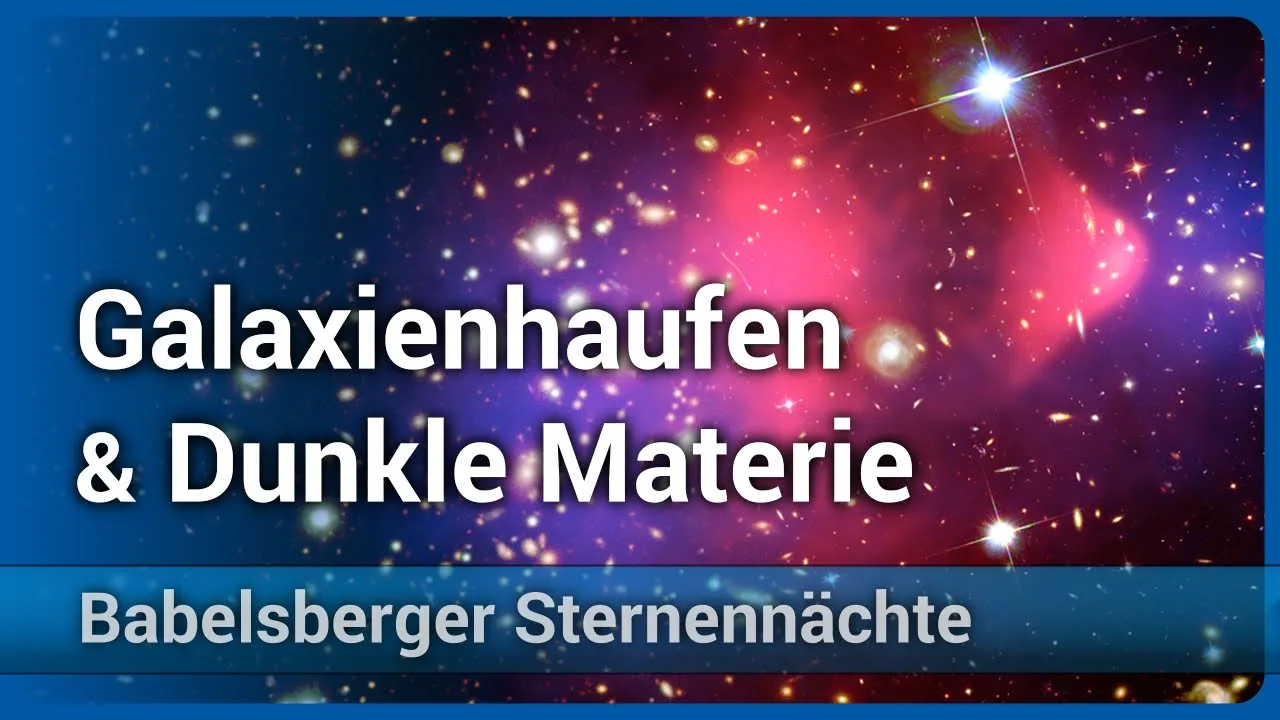
Galaxy clusters are massive cosmic structures containing hundreds to thousands of galaxies bound by gravity, spanning up to 10 million light-years. Astronomers first noticed dense regions in the 18th century, but Edwin Hubble proved in the 1920s these were separate galaxies containing billions of stars. The Doppler effect reveals galaxies move at 1000 km/s relative to each other, requiring gravitational binding. Visible stars constitute only 1% of total mass, revealing a mass discrepancy. X-ray observations show continuous emission filling space between galaxies, indicating hot plasma at 10-100 million Kelvin temperatures. Cosmological simulations reveal matter forms a 'cosmic web' structure with filaments connecting at nodes where clusters form. Two primary methods determine cluster mass: X-ray observations measure gas pressure balanced by gravitational forces, while gravitational lensing analyzes how massive clusters bend light from background galaxies. Dark matter constitutes 84% of cluster mass and does not emit electromagnetic radiation. Evidence comes from galaxy rotation curves and Big Bang nucleosynthesis predictions. The Bullet Cluster collision demonstrates dark matter interacts only gravitationally. Supermassive black holes at cluster centers release enormous energy through jets and outflows, heating surrounding gas and preventing excessive star formation through feedback mechanisms.
Click to watch →

Galaxy clusters – গ্যালাক্সি ক্লাস্টার
236
Galaxy clusters are massive cosmic structures located at the nodes of filaments in the cosmic web, containing approximately 3000 galaxies whose combined mass contributes only about 2% of the total cluster mass; the remaining mass consists of intergalactic gas (13%) and dark matter (85%), with the hot intra-cluster medium emitting X-rays through Bremsstrahlung and radio waves through synchrotron mechanisms, allowing astronomers to calculate cluster mass using velocity dispersion and gravitational potential energy equations.
Click to watch →
Prerequisite Knowledge
- Concept 01The fundamental concept of dark matter as an invisible, non-baryonic form of matter that interacts primarily through gravitational forces.
- Concept 02The principles of gravitational lensing, specifically how massive objects bend the path of light from background sources according to Einstein's General Theory of Relativity.
- Concept 03An understanding of X-ray astronomy and how hot, ionized gas (the intracluster medium, which represents the majority of normal baryonic matter) emits high-energy light.
- Concept 04The basic structure and composition of galaxy clusters, including the relative mass distributions of stars, gas, and dark matter.
Subsequent Learning
- Step 01An in-depth analysis of Modified Newtonian Dynamics (MOND) and why the spatial separation of mass in the Bullet Cluster poses a significant challenge to alternative theories of gravity.
- Step 02The study of other colliding galaxy clusters (such as the 'Train Wreck Cluster' Abell 520 or the Musket Ball Cluster) to observe how different collision geometries affect dark matter behavior.
- Step 03Current candidates for dark matter particles, such as Weakly Interacting Massive Particles (WIMPs) and axions, and the experiments designed to detect them (e.g., LUX-ZEPLIN, IceCube).
- Step 04The role of dark matter in cosmic structure formation and how it is modeled in large-scale cosmological simulations like the Illustris or Millennium projects.
Evidence Evolution
Self-Interaction Test
Evidence Evolution
0:02Playing Section
- 1
Dark matter introduced via cosmic and cluster studies.
- 2
Early evidence from Zwicki and bullet cluster analysis.
- 3
Gravitational lensing and X-ray data reveal separation.
Modified Gravity and the Bullet Cluster Challenge
While the Bullet Cluster is widely considered a 'smoking gun' for dark matter, proponents of Modified Gravity (such as MOND—Modified Newtonian Dynamics) offer alternative interpretations. They argue that the standard Lambda-CDM (dark matter) model struggles to explain the extremely high collision velocity of the two colliding galaxy clusters, which actually aligns more naturally with certain modified gravity frameworks. To account for the separation between the visible gas (X-ray) and the gravitational lensing peak, modified gravity theorists propose that a combination of modified gravitational laws and a population of undetected normal matter—such as massive neutrinos or cold gas—can explain the lensing observations. Relativistic formulations of modified gravity, such as Scalar-Tensor-Vector Gravity (MOG), attempt to mathematically reconstruct the lensing behavior of the Bullet Cluster without invoking non-baryonic dark matter particles. This perspective encourages researchers to continue questioning whether our understanding of gravity on cosmological scales is complete.
Deep Dive
An in-depth analysis of Modified Newtonian Dynamics (MOND) and why the spatial separation of mass in the Bullet Cluster poses a significant challenge to alternative theories of gravity.
Keine Dunkle Materie? • MOND: Bullet Cluster, Rotationskurven & Zwerggalaxien | Marcel Pawlowski
33.8K
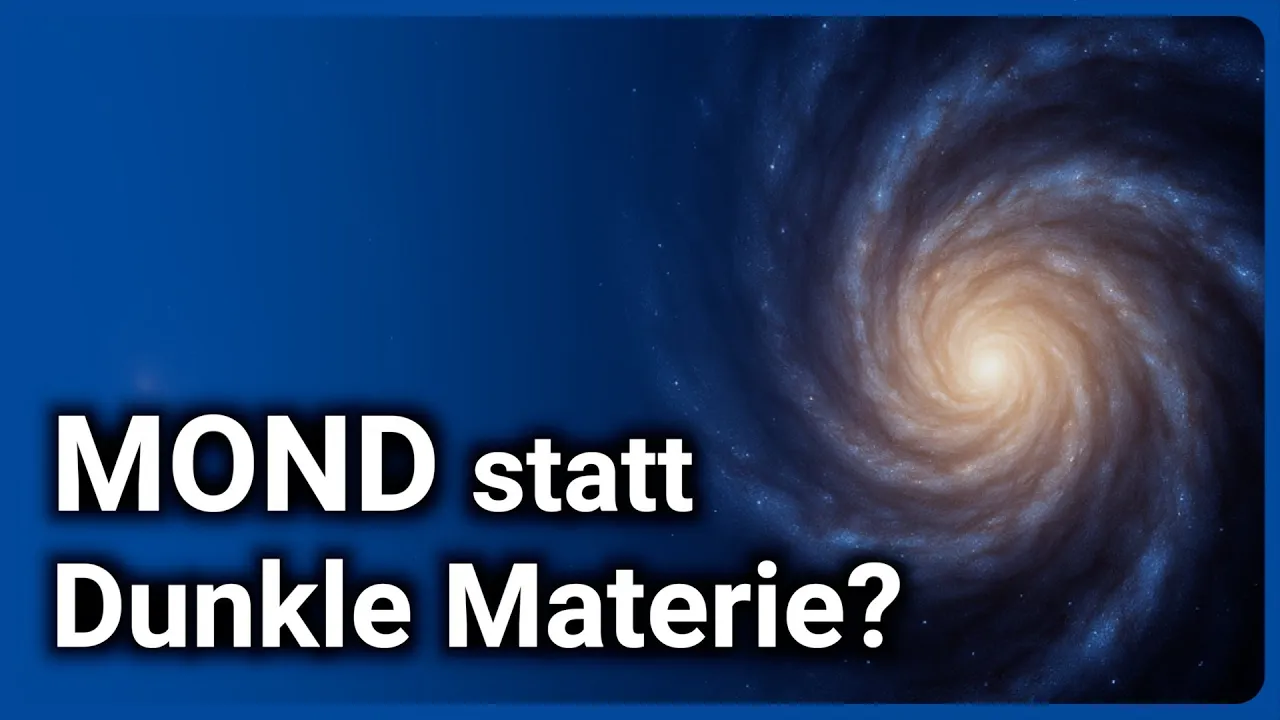
Modified Newtonian Dynamics (MOND) proposes that gravity behaves differently on galactic scales, with the same mass creating slightly stronger attractive forces, potentially explaining observed gravitational effects without requiring dark matter; however, challenges remain including the Bullet Cluster collision evidence showing dark matter separated from visible matter, and observations of dwarf galaxies and early-universe galaxy formation that sometimes favor the standard dark matter model (Lambda CDM).
Click to watch →
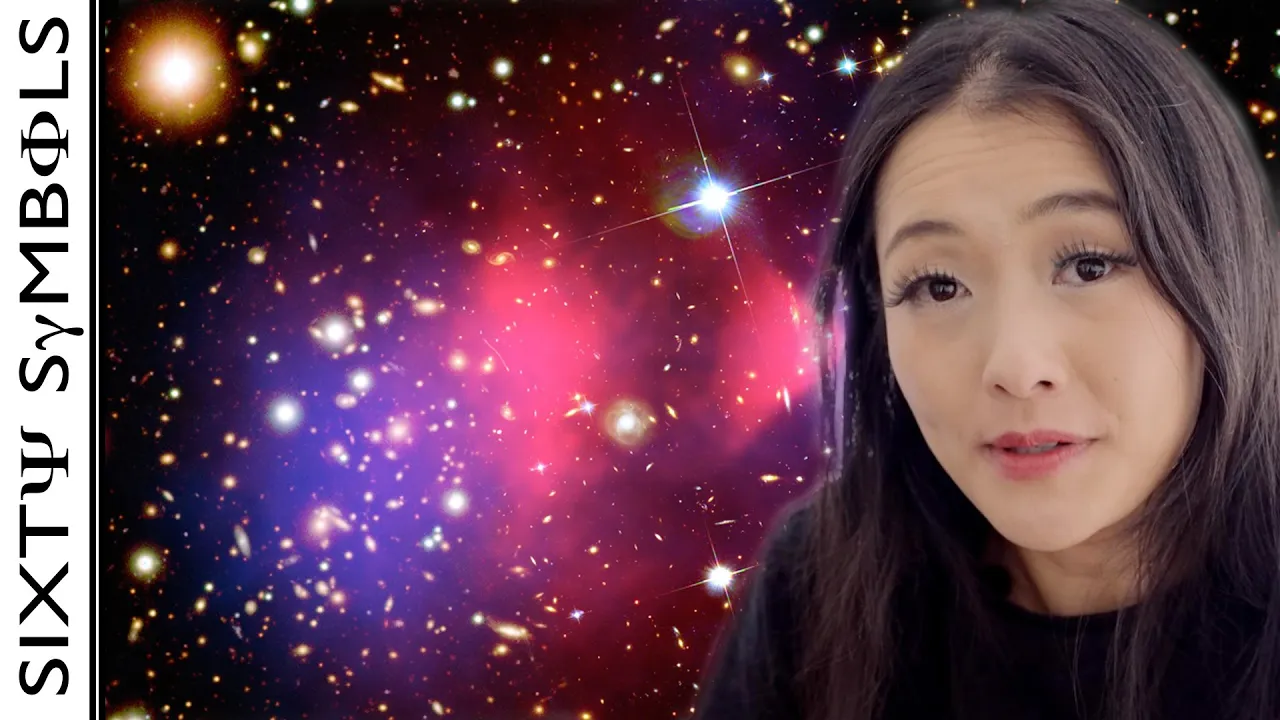
The Bullet Cluster (of Galaxies) - Sixty Symbols
75.1K
Modified Newtonian Dynamics (MOND) is an alternative theory to dark matter that modifies Newton's laws of gravity at high accelerations, predicting less gravitational attraction than standard Newtonian physics would predict. While MOND can explain galaxy rotation curves, it fails to explain the Bullet Cluster observations because the separation between mass and hot gas is too large to be explained by a simple modification factor. The original proposer of MOND even acknowledged that the Bullet Cluster proves dark matter exists.
Click to watch →

지금껏 암흑 물질을 못찾는 진짜 이유
96.3K
An alternative hypothesis to dark matter is Modified Newtonian Dynamics (MOND), which suggests that gravity works differently at smaller scales. According to MOND, gravity would be stronger than Newtonian physics predicts at low accelerations, which could explain why galaxies rotate faster than expected. However, MOND cannot easily explain the observations from the Bullet Cluster, where the separation between visible matter and gravitational mass is too large to be explained by modifying gravitational laws.
Click to watch →
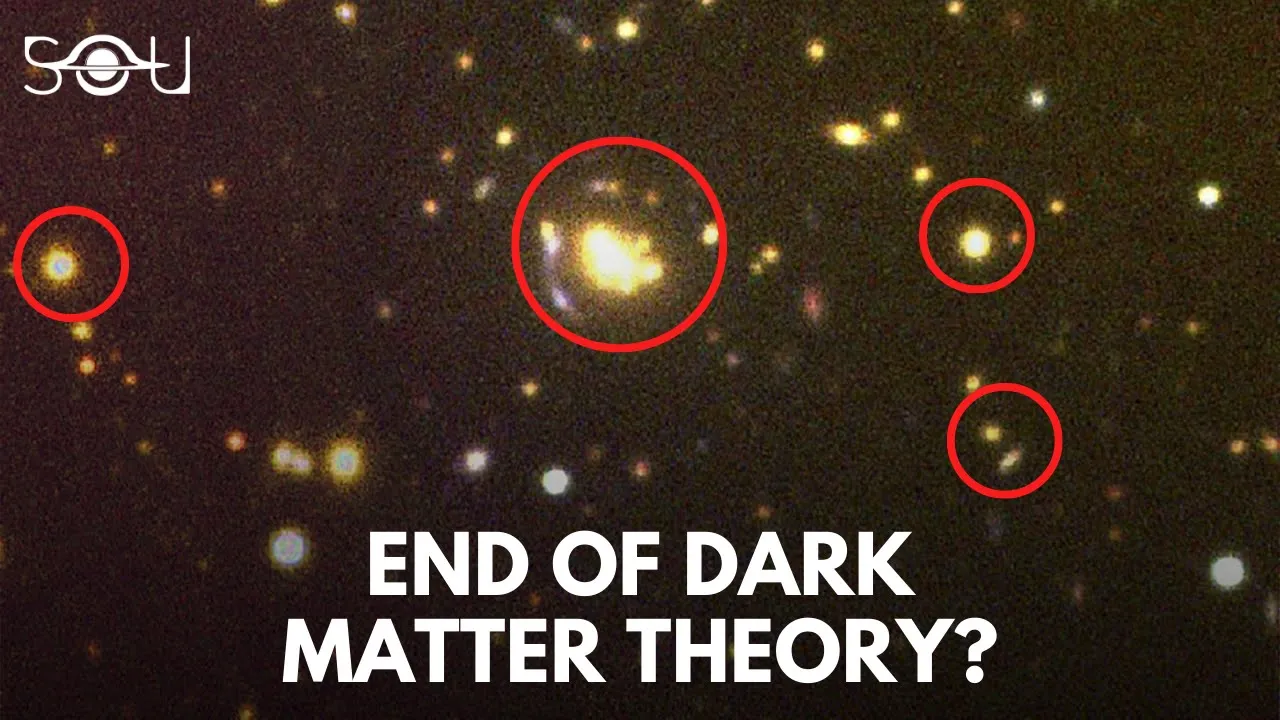
These Little Galaxies Have Changed The Way We Look At The Universe
220.9K
Modified Newtonian Dynamics (MOND) is an alternative explanation for galaxy dynamics proposed in 1983 by Israeli physicist Mordehai Milgrom. The original aim was to explain why star velocities in galaxies are observed to be larger than expected based on Newtonian mechanics, serving as an alternative to the dark matter hypothesis. While MOND appears effective at explaining the dynamics of spiral galaxies, it has significant limitations: it fails to explain galaxy cluster masses by a factor of 2 to 3 and cannot account for observations of the Bullet Cluster located 3.7 billion light years away. This creates an ongoing debate between the dark matter hypothesis and MOND as competing explanations for observed galactic phenomena.
Click to watch →

Dark Energy, or Worse: Was Einstein Wrong?
404.8K
Alternative explanations for cosmic phenomena challenge the dark matter paradigm. Mordehai Milgrom proposed in 1984 that gravity might behave differently at low accelerations, with Jacob Bekenstein later developing TeVeS (Tensor-Vector-Scalar theory) in 2004—a relativistic extension incorporating additional fields. However, the bullet cluster collision provides compelling evidence for dark matter: when two galaxy clusters collided, gravitational lensing revealed that the gravitational field aligns with galaxies (where dark matter resides), not with the hot gas (ordinary matter). This displacement cannot be explained by modified gravity alone without invoking collisionless dark matter particles, demonstrating that dark matter really exists and cannot be eliminated by changing gravity's laws.
Click to watch →
Deep Dive
The study of other colliding galaxy clusters (such as the 'Train Wreck Cluster' Abell 520 or the Musket Ball Cluster) to observe how different collision geometries affect dark matter behavior.

Dark Matter Gathered after Galaxy Collision Mystifies Scientists
4.7K
New Hubble observations of the Abell 520 galaxy cluster collision reveal that dark matter may not always remain bound to galaxies during high-speed collisions, challenging previous assumptions that dark matter and galaxies stay together even when galaxy clusters collide; this finding suggests dark matter behaves differently than expected and may leave behind concentrated 'rubble' at collision sites, indicating that our understanding of dark matter's properties requires re-evaluation.
Click to watch →

Bullet Cluster Analogues - Violent Crashes Reveal Invisible Universe
260
Abell 520, often called the Train Wreck Cluster, is a violent ongoing pile-up involving multiple clusters - a cosmic freeway accident with debris scattered everywhere. Initial gravitational lensing maps revealed a massive dense concentration of dark matter sitting right in the middle of the collision, but this dark core was not aligned with a swarm of galaxies that had mostly sailed onward. This was the complete opposite of the Bullet Cluster, suggesting dark matter might interact with itself.
Click to watch →
ESOcast 31: Pandora's Cluster
5K
The Pandora's Cluster (Abell 2744) demonstrates that galaxy clusters can form from simultaneous collisions of multiple clusters, revealing that dark matter behaves differently from visible matter and hot gas during cosmic collisions, as dark matter passes through unaffected while gas becomes separated and stripped away.
Click to watch →

Perforated Universe—Revision & Evidence
6.4K
The Train Wreck Cluster (AAL 520) is another cluster formed from collision and merger of other galactic clusters that cannot be explained by conventional dark matter theory due to the presence of a large void in the center that is devoid of galaxies but has a gravitational lensing effect. This central void could be composed of a large clump of spatial perforations that got disjointed from many galactic clusters after multiple collisions. The clump of perforations is centrally located due to the shell of galactic matter around it.
Click to watch →

Musket Ball Cluster
129
Astronomers discovered a violent collision between two galaxy clusters called the Musket Ball Cluster (DLSCL J0916.2+2951), where normal matter (hot gas detected via X-rays by Chandra) was wrenched apart from dark matter (mapped through gravitational lensing effects on light from distant objects); this system serves as an older, slower cousin to the famous Bullet Cluster, providing scientists with valuable insights into how galaxy clusters—the largest gravitationally-bound objects—evolve and change after major collisions.
Click to watch →
Deep Dive
Current candidates for dark matter particles, such as Weakly Interacting Massive Particles (WIMPs) and axions, and the experiments designed to detect them (e.g., LUX-ZEPLIN, IceCube).
Are neutrinos dark matter? | Even Bananas
60.6K
Two primary dark matter candidates exist: WIMPs (Weakly Interacting Massive Particles) and axions. WIMPs require particles thousands of times heavier than standard model neutrinos, interacting through weak nuclear force and gravity. Sterile neutrinos could theoretically serve as WIMPs but require carefully tuned models. Axions and axion-like particles offer an alternative as extremely light bosons that move slowly enough to enable gravitational clumping despite their low mass. Detection experiments differ accordingly: WIMP searches use large shielded detectors weighing several tons to capture rare interactions, while axion experiments employ electromagnetic cavities and magnets to convert axions into detectable photons. Both approaches require accounting for background signals like neutrino interactions.
Click to watch →

La matière noire est partout...ou nulle part
486.1K
Neutrinos were initially considered dark matter candidates due to their weak interactions, but Super-Kamiokande experiments showed their masses are too small (at most 18% of universe's mass). The leading candidate is WIMPs (Weakly Interacting Massive Particles) - hypothetical heavy particles interacting only through gravity and weak force. Supersymmetry theory proposes that every known particle has a superpartner, with the Lightest Supersymmetric Particle (LSP) being a prime dark matter candidate. The LSP, potentially composed of photino and Zino, would be stable and neutral, constituting most dark matter. Despite extensive experiments (PAMELA, AMS-02, IceCube, underground labs), no definitive detection has been confirmed.
Click to watch →
Teilchen der Dunklen Materie mit 99,7% Sicherheit gefunden! - Physik-Revolution
119K
Scientists have pursued two primary hypotheses for dark matter composition: WIMPs (Weakly Interacting Massive Particles) and axions. WIMPs are electrically neutral, massive particles that interact only weakly with ordinary matter through gravity and the weak nuclear force. Axions, originally proposed to resolve theoretical inconsistencies in quantum chromodynamics, are predicted to be extremely light and interact very weakly with normal matter. The Xenon1T experiment was designed to detect both types of particles by measuring rare interactions between dark matter candidates and liquid xenon atoms, producing characteristic Cherenkov light signals when collisions occur.
Click to watch →

The New Dark Matter Particle on the Edge of Physics
225K
Axions have emerged as the leading candidate for dark matter, replacing WIMPs, due to their ultra-lightweight nature and ability to solve two cosmological mysteries simultaneously; the Axion Dark Matter Experiment (ADMX) at the University of Washington uses a quantum computer-derived instrument with a superconducting cavity and strong magnetic field to convert axions into detectable microwave photons, representing the world's first dedicated axion search experiment.
Click to watch →
What is Reality? - with Frank Wilczek
289.9K
Axions are hypothetical particles originally proposed to make fundamental laws more symmetric and comprehensible. Remarkably, they possess exactly the right properties to explain dark matter: they interact very weakly with ordinary matter (explaining why we haven't detected them directly), were produced in the Big Bang, and are stable. Thousands of physicists worldwide are now designing experiments to detect axions, representing a beautiful example of how theoretical beauty leads to empirical predictions.
Click to watch →
Deep Dive
The role of dark matter in cosmic structure formation and how it is modeled in large-scale cosmological simulations like the Illustris or Millennium projects.
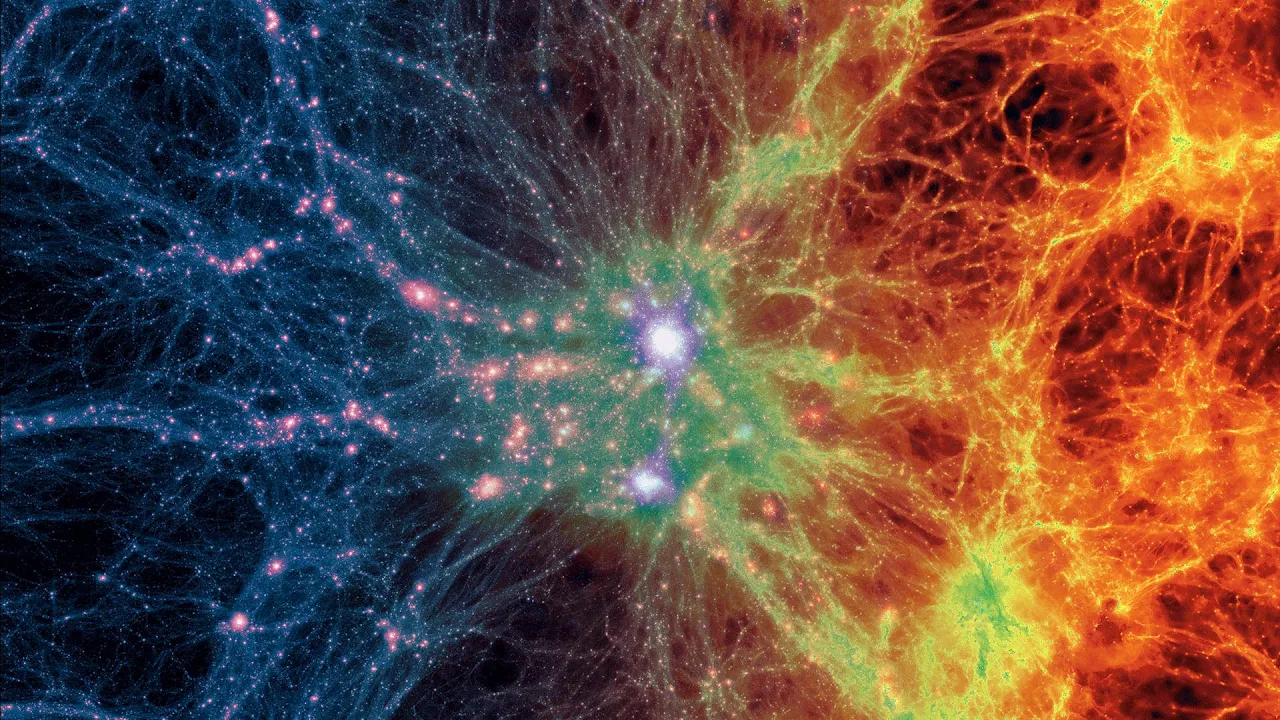
The Search for Dark Matter - Professor Carolin Crawford
125.5K
Computer simulations of cosmic structure formation attempt to reproduce the observed large-scale distribution of galaxies and galaxy clusters. These simulations start with initial conditions from the cosmic microwave background and evolve forward using known physics. Without dark matter, simulations cannot produce the observed structure within the available time since the Big Bang. Ordinary matter responds to multiple forces and clumps inefficiently, while dark matter responds only to gravity and clumps rapidly to form gravitational scaffolding that ordinary matter then accumulates around. Successful simulations require dark matter to be about 10 times more abundant than ordinary matter.
Click to watch →
How Gravity Shapes Space, Time, and the Fate of Galaxies | Sleepy Science
215
Dark matter is fundamental to the structure of the universe. In the early universe, shortly after the Big Bang, matter was distributed almost uniformly with only tiny density variations about one part in 100,000. Gravity amplified these variations—denser regions attracted more matter, becoming denser still, eventually forming the first stars and galaxies. Regions that were slightly less dense became voids. Dark matter provided the scaffolding, the initial structure upon which galaxies formed. Computer simulations of cosmic structure formation, which model billions of dark matter particles interacting only through gravity, reproduce this structure remarkably well. The Millennium simulation (2005) followed the evolution of over 10 billion dark matter particles in a cubic region about 2 billion light-years on a side. The result was a cosmic web that looks strikingly similar to what we observe when we map galaxy positions in the real universe—filaments, clusters, voids all emerging naturally from gravity acting on dark matter. The Illustris simulation (2014) went further, including not just dark matter but also ordinary matter, gas that cools, forms stars, feeds black holes, and is heated and expelled by supernova and black hole jets.
Click to watch →

The Story of Dark Matter | Crash Course Pods: The Universe #6
98.6K
Computer simulations of the universe's large-scale structure require dark matter to successfully reproduce observed galaxy distributions. Without dark matter, gas pressure prevents matter from collapsing efficiently to form galaxies. Dark matter acts as a gravitational scaffold, allowing regular matter to accumulate and form the cosmic web we observe today. Simulations with only dark matter can reproduce the overall structure, while simulations with only visible matter fail to produce realistic galaxy distributions.
Click to watch →
Illuminating Dark Matter with Robert McGehee, 18 Apr 2020
839
Dark matter played a crucial role in forming the large-scale structure of the universe. Computer simulations show that dark matter began clumping together shortly after the Big Bang due to its gravitational self-interaction. These dark matter clumps then acted as gravitational seeds, pulling ordinary matter (gas) into them over time. Without dark matter's gravitational scaffolding, ordinary matter would not have been able to form the complex structures we observe today, such as galaxies and galaxy clusters. This hierarchical structure formation process explains why dark matter is often called the 'cosmic parent' of all observable cosmic structures.
Click to watch →

Лекция Ольги Сильченко "Классические и современные теории формирования галактик" (Эволюция галактик)
15K
Cosmologists propose that dark matter was initially uniformly distributed and clumped under gravity to form the cosmic web. N-body simulations tracking gravitational interactions of many particles reproduce the observed large-scale structure: filaments, walls, and voids. This agreement between simulations and observations supports the dark matter paradigm. However, baryon bias means visible matter only forms structures in the densest regions, so galaxy distribution differs from dark matter distribution. The Lambda CDM model (Lambda Cold Dark Matter) successfully predicts the CMB power spectrum across all angular scales, constraining cosmological parameters with precision better than 1%.
Click to watch →
Evidence Evolution
Self-Interaction Test
Evidence Evolution
0:02- 1
Dark matter introduced via cosmic and cluster studies.
- 2
Early evidence from Zwicki and bullet cluster analysis.
- 3
Gravitational lensing and X-ray data reveal separation.
Modified Gravity and the Bullet Cluster Challenge
While the Bullet Cluster is widely considered a 'smoking gun' for dark matter, proponents of Modified Gravity (such as MOND—Modified Newtonian Dynamics) offer alternative interpretations. They argue that the standard Lambda-CDM (dark matter) model struggles to explain the extremely high collision velocity of the two colliding galaxy clusters, which actually aligns more naturally with certain modified gravity frameworks. To account for the separation between the visible gas (X-ray) and the gravitational lensing peak, modified gravity theorists propose that a combination of modified gravitational laws and a population of undetected normal matter—such as massive neutrinos or cold gas—can explain the lensing observations. Relativistic formulations of modified gravity, such as Scalar-Tensor-Vector Gravity (MOG), attempt to mathematically reconstruct the lensing behavior of the Bullet Cluster without invoking non-baryonic dark matter particles. This perspective encourages researchers to continue questioning whether our understanding of gravity on cosmological scales is complete.
The fundamental concept of dark matter as an invisible, non-baryonic form of matter that interacts primarily through gravitational forces.
The principles of gravitational lensing, specifically how massive objects bend the path of light from background sources according to Einstein's General Theory of Relativity.
An understanding of X-ray astronomy and how hot, ionized gas (the intracluster medium, which represents the majority of normal baryonic matter) emits high-energy light.
The basic structure and composition of galaxy clusters, including the relative mass distributions of stars, gas, and dark matter.
An in-depth analysis of Modified Newtonian Dynamics (MOND) and why the spatial separation of mass in the Bullet Cluster poses a significant challenge to alternative theories of gravity.
The study of other colliding galaxy clusters (such as the 'Train Wreck Cluster' Abell 520 or the Musket Ball Cluster) to observe how different collision geometries affect dark matter behavior.
Current candidates for dark matter particles, such as Weakly Interacting Massive Particles (WIMPs) and axions, and the experiments designed to detect them (e.g., LUX-ZEPLIN, IceCube).
The role of dark matter in cosmic structure formation and how it is modeled in large-scale cosmological simulations like the Illustris or Millennium projects.
951 views24likes3:00@howfarawayisitOriginal Release: 2025-12-06
We covered dark matter in the cosmos chapter of the How Far Away Is It video book. In the early 1930s, the astronomer Fritz Zwicki studied star motion in the Koma galaxy cluster and concluded that most of the mass must be dark matter.
He deduced that dark matter particles do not interact with ordinary berionic matter. Their only interaction is gravitational.
That is because they are matter and matter bends time. They bend spaceime.
This in turn causes all other particles trajectories to bend.
In 2006, the bullet galaxy cluster was used to provide additional evidence for dark matter. Specifically, data from the Chandra X-ray Observatory and the Hubble Space Telescope were analyzed to show that the hot gas in the cluster detected by Chandra was separated from the mass distribution inferred from gravitational lensing.
When we superimpose the dark matter shown in blue and the gas shown in pink over the visible components of the cluster's mass, we get the full picture.
The galaxies and the dark matter have traveled a great deal further than the gas. This indicates that the galaxies and dark matter in the two colliding clusters didn't interfere with each other.
On the other hand, the gas clouds were slowed by friction. Unfortunately, measurements were not detailed enough to determine whether dark matter particles interacted with themselves.
It was still possible that they might to some degree. Here we have the cluster as seen by Web. The two massive galaxy clusters that exist on either side of the large light blue spiral galaxy at the center are circled.
Web's extremely precise images revealed many more galaxies and faint objects.
Here are the gravitational lensing lines. They are used for the mass reconstruction based on the new web data. This enabled significantly better gravitational lensing accuracy which enabled astronomers to refine the amount of mass and its location in the two galaxy clusters.
The revised map of the bullet cluster is shown in this new image. Chandra data shows the hot gas in pink.
Refined measurements of the dark matter calculated by the web team are represented in blue.
Dark matter does not emit, reflect, or absorb light. And the team's findings indicate that dark matter shows no signs of significant self- interaction. If dark matter did self- interact, the team would have seen an offset between the galaxies and their respective dark matter. They did not find any offset, so no self- interaction is indicated.
Up Next

11:19
Hounsfield Units Explained: CT Numbers & Attenuation Scale
@HowRadiologyWorks
30.6K views•2022-03-08

12:53
21cm Hyperfine Transition in Neutral Hydrogen: Radio Astronomy Basics
@AaronRobertParsons
12.4K views•2011-10-13

32:32
NMR Spin Physics I: Zeeman Effect, Resonance Condition & Larmor Frequency
@nptel-indianinstituteofsci8064
2.3K views•2024-01-17

27:14
Entropy and the Second Law of Thermodynamics Explained
@veritasium
27.5M views•2023-07-01
Related Study Plans & Knowledge Roadmaps
Structured learning paths in Physics
physics
Nuclear Physics (Decay, Fission & Reactors)
01Atomic Structure and the Binding Force
02Radioactive Decay and Half-Life
03Nuclear Fission Mechanics and Chain Reactions
+ 2 more learning modules
12h5 modules
Explore Roadmap
physics
Soft Matter (Polymers, Colloids & Rheology)
01Foundations of Soft Matter & Thermal Forces
02Polymer Physics and Macromolecules
03Colloids, Surfactants, and Self-Assembly
+ 2 more learning modules
38h5 modules
Explore Roadmap
physics
Analytical Mechanics: Lagrangian & Hamiltonian
01Mathematical Foundations: Calculus of Variations
02From Newtonian Mechanics to Constraint Dynamics
03The Principle of Least Action & Lagrangian Mechanics
+ 3 more learning modules
28h6 modules
Explore Roadmap
physics
General Relativity (Spacetime & Cosmology)
01Foundations of Relativity: Special Relativity
02The Geometry of Spacetime: Equivalence Principle & Curvature
03Einstein's Field Equations: The Mathematics of Gravity
+ 2 more learning modules
55h5 modules
Explore Roadmap