

![[강연] 무한의 해부 : 칸토어 _ 금종해 교수](https://i.ytimg.com/vi/-KTX6ZwTEdA/maxresdefault.jpg)










![Set Theory | Lesson 11: Ordinals!!! [CC]](https://i.ytimg.com/vi/efTeurdX__A/maxresdefault.jpg)




A set is infinite if and only if it is equivalent to a proper subset of itself. The power set of any set A, denoted P(A), has cardinality 2^|A|, which is always strictly greater than |A|. This establishes that there are different sizes of infinity: countably infinite sets (equivalent to ℕ, cardinality ℵ₀) and uncountably infinite sets (like the power set of ℕ, cardinality 2^ℵ₀). The continuum hypothesis states that there is no set whose cardinality is strictly between ℵ₀ and 2^ℵ₀.
Infinite Sets & Cardinals: Cantor's Theorem Explained
Added:Basic set theory notation and concepts, including subsets, unions, intersections, and the definition of a power set.
The concept of mathematical functions, specifically injective (one-to-one), surjective (onto), and bijective (one-to-one correspondence) mappings.
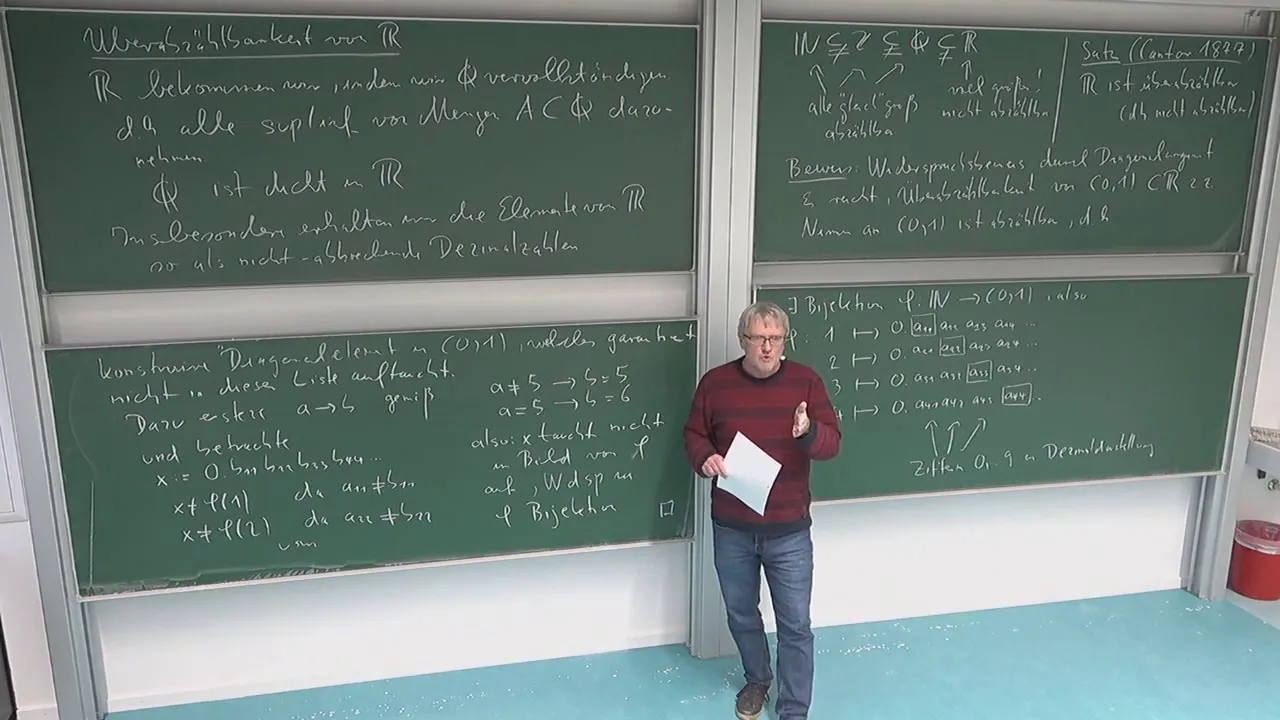
Fundamental proof techniques, particularly proof by contradiction, which is essential for understanding Cantor's diagonal argument.
An introductory understanding of countable sets, such as the natural numbers, and how to establish set equivalence using bijections.
The Continuum Hypothesis, which questions whether there exists a cardinal number strictly between the cardinality of the integers and the real numbers.
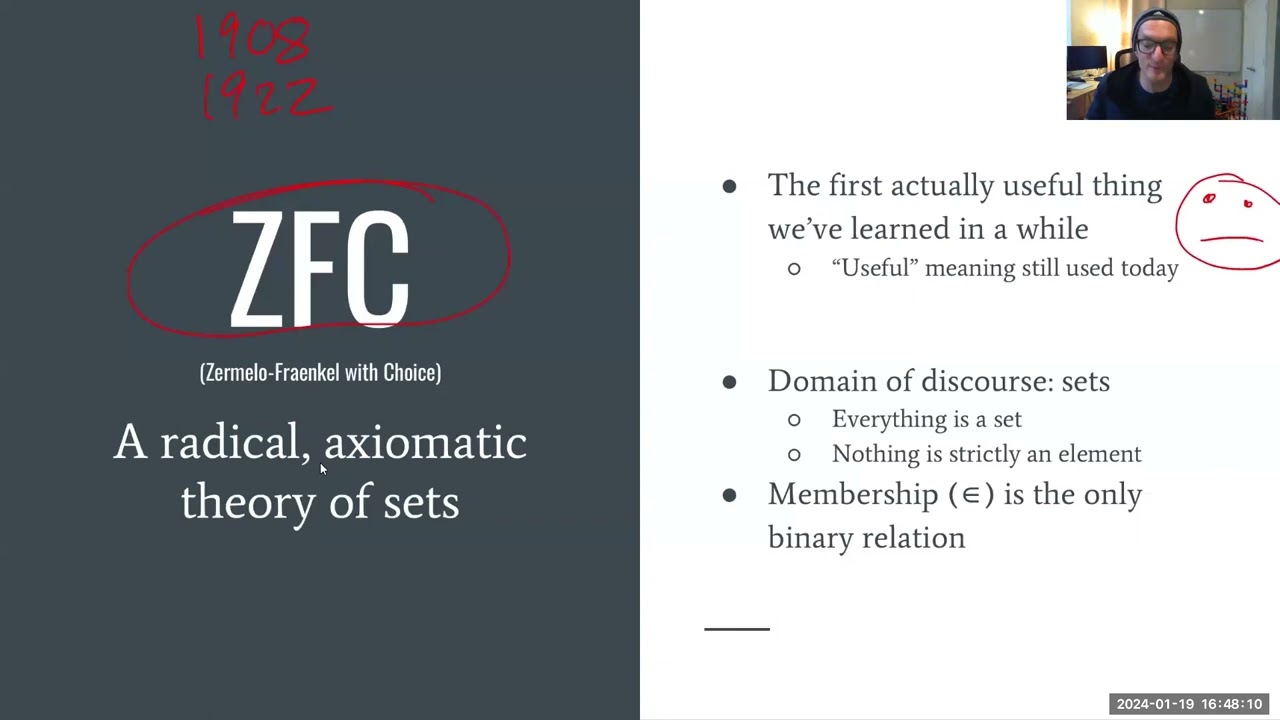
Axiomatic Set Theory (ZFC) to understand the formal foundations of mathematics and how set theory avoids paradoxes like Russell's Paradox.
Ordinal numbers and ordinal arithmetic, which explore the ordering and structure of infinite sets rather than just their size.
Applications of cardinality in Real Analysis, such as the properties of the Cantor Set and the concept of measure zero sets.
34K views167likes1:26:36Original Release: 2016-03-11
has accountably infinite subset and consequently a is infinite set means its size must be at least there is no infinite set which is smaller than accountably infinite set so these are some of the simple things that uh we saw last time and I will make few more comments about these infinite sets rather passing um it may not be possible for me to go into it will not be possible for me to go into all the details it's also always a comfortable situation okay right now what we want to start today is let's start with any infinite set okay so let me draw a picture start with any infinite set X then our property 3 says it has to have a countably infinite subset so by three so three above implies X has accountably infinite subset say one of them is X1 so it has a countably infinite subset X1 so here is the X1 and the remaining portion will call us X2 so let X2 be equal to x - X1 that's X2 okay so clearly X1 and X2 are disjoint and X Union X2 is the whole set so X1 X2 are this joint and their Union is exactly okay uh probably I should have okay doesn't matter drawn the picture there now we are going to focus on this X1 what do we know about X1 it is a accountably infinite set and therefore by property two it must be equivalent to a proper subset okay so X1 being countably infinite I'll write C in from now on countably infinite implies by Property 2 there exists a subset X2 and it will be a proper subset X2 with a subset of X1 not equal to X1 it's a proper subset of X1 such that X1 is equivalent to X2 so I should call it X2 I should call it X3 because I used X2 here so what is the picture now I have X2 this was X1 inside X1 there is a X3 this whole thing is X1 and inside X x one is sitting at X3 X3 is a proper subset of X1 okay so I have split the set now into three parts first I thought of splitting X1 and X2 then I split X1 itself into X3 and something extra and extra is non empty why because this is a proper subset okay now what I'm going to do is I am going to define a map or a function from the set X2 the following okay so now let us Define X hat to be X2 Union X3 xat is X2 Union X3 now I'm going to take only this part and this part so obviously it's a proper subset of X so X three is I'm sorry xat is a proper subet I'm going to claim that X is equalent to XA okay I'll make X I make X equalent okay so now what do I know first of all I know that X1 is equivalent to X3 so I can I must have a function from X1 to X3 which is 1 one and on two okay since X1 is equivalent to X3 there exist a function from X1 to X3 one one and on two so therefore let me draw a big line here from here to here is that F me of X1 are pulled to X3 and what happens the entire X1 comes and sits inside the entire three it's one one and on two so now Define a function H from X to X hat as follows now when I say I want to define a function from X to X hat what I want to do is what does that function H do to each element in X the result must be in X hat it take every element of X into X hat so the elements of X are made up into two Parts whenever an element is in this part this F tells us what to do and when it is in the other part just don't do anything okay so Define as follow h of X is equal to F ofx if x belongs to X1 and X itself if x belongs to X so what we are doing is any element here here goes to the same element and if some U is here it goes to F that's all now obviously this is one two okay the whole Space is filled the X2 part is filled the X3 part has already been filled so it's on two since f is one one there different pillows go to different things here it's identity obviously different pillows go to different things so clearly H is 1 one and on Two And therefore X is equivalent to X hat there is a one one on two function from X to X hat and therefore X is equivalent to X hat but X hat is a proper subset of X and therefore X is equivalent to proper Subs X is equal to proper Subs we can therefore conclude now three is not only true for countable infinite sets now I can say any infinite set is equivalent to a proper subset of itself and that is a characterization of infinite sets Okay so I'll write here therefore the fourth today's first property is that any infinite set is equalent to the proper subset of this is a characterization okay what is a characterization being equivalent to one of its prop subsets is a characterization of infinite sets so [Music] being equivalent to a proper subset of itself is the characterization of inces so what we have seen is that the if we take any count infinite set we denoted its size by some symbol called LF the question is when do I call a set countably infinite call a set account infinite set when it is equivalent to n the question is are there infinite set which are not equivalent to n if there are then I have to find another name they are infinite but not equivalent to n so the question therefore is are there infinite sets which are not equivalent to if so it will lead to some gradation of Infinities okay who bigger if not equivalent then it be either equivalent toset of this or this will be equivalent toset of that so one of them will to be bigger so what's happening and we have already seen that there is no Infinity less than so if there is such a thing it has to be more than Alf so in other words we have two sizes of infinity itself now we will in investigate this question now okay are there infinite sets which are not equivalent to n and we will see there are lots of there are many many of them so how do we go about doing it so the first we introduce the notion of power set okay so uh think I began this last time so let's consider a set a to start with a finite set which is the element of a c so a a finite set okay so what is the size of a with our notation that will be three it is equivalent to the set to three and therefore the size is three now what we are going to do is let us look at all the subsets of a and make a set out of it so construct all the subsets of a and make a set consisting of all these consisting of all these substance I'm going to look at it a little bit closely uh in two different ways maybe some of the things in two different place the what are the subsets first the empty set and then the way WR write will tell you what is happening I'm going to write next all the single T subset set then subsets which have two elements and then the whole set is always a subset of itself now I'm going to make a set consisting of all these sets the elements of the set are subsets of a and this we denote by PA and this is called the power set so in general if a is any set PA a the power set of a is the set of all subsets the set of all subsets of so the elements themselves are sets which set subset subsets of what subsets of a okay let's go back to this example what is the size of PA or the socalled cardinality of PA it has eight elements now it's again a finite set I write it as 2 Cube okay it is 0 element set 1 plus one element set 3 3 C1 plus 3 C2 + 3 C3 which is 1 + 1^ of 3 binomial theorem so it is 2 the^ of 3 okay we see that the power set has 2 to the^ of three elements and in general we can know from what I said you can see that if you have a finite set with n elements then the power set will have 2 to the power of n elements so in general if the finite set having n elements then the cardinality of is 2 to the it will be 1+ nc1 plus n C2 plus nc3 plus n n choose 4 Etc and choose n which is precisely 1 + 1 the^ of n okay now what is evident here is that the size of the power set in all these cases bigger than the set we started with if a had two PA had four if had three PA had eight so PA looks much bigger than this so therefore we see that for finite sets the power set size is always greater than the size of the set okay now what we are going to do is see that this is true even for infinite we will show that even for infinite sets the power set always has a big size okay this is true even if so peculiar argument like the results Paradox in sense uh okay probably I should have left that question doesn't matter how do we do that okay so on the one hand we have a on the other hand we have PA the two sets I'm comparing now the size of these two sets and the claim is that PA will always be bigger than a okay first of all we show that the size of a cannot be bigger than the size of P it has to be smaller so for any a element a in a we have the set subset consisting of only that element okay so we corresponding to every element in a we have the corresponding single T subset so where is this PO lying this p is sitting here because a subset of a and this p is sitting here an element of a so now I'm going to match the elements of a with the single T subset so Define a function the function f mapping a to PA a defined as F A is equal to the single t set a okay so the point a is mapped to the subset a is which is an element there [Music] now obviously this a one one map if a is A1 and A2 are different F and F F1 F A2 are different so clearly f is 1 one so the moment you have one one map between these two sets this cannot have size more than this so therefore that implies the size of a has to be less than or equal to the size of what we are claiming is that equality cannot take place we want to show that the power set is always bigger size so therefore want to remove the equality so we want to show equality cannot when will equality take place equivalent sets if they equivalent set there must be a one one on two map between them right and I will will now show that cannot be any onto map from here to here or here to here okay equality can take place if and only if there exist one one onto map H let's call it a G from p p right they have to be equivalent then there has to be one one on map from one to the other suppose this happens we will show that that leads to a contradiction and therefore this cannot happen so the contradiction is very funny the way we get the contradiction is funny so Suppose there is such a function so what does it mean it means the following I have PA let me put it a to PA whichever way okay this easier there must be a map with both direction must be a one one on two map so there is a there is Pa and this G is going to go from there to there and what it does is it every element to a subset okay so in other words uh every is converted to a team some team as a member of some okay an individual becomes a team the subset the team may consist of only one fellow doesn't matter so here are all teams here are all players so a player is going to be associated with a right soose this is onose this is one one and on then what it does is it will take an a to a g there so now let's see the picture separately here a is here and the ga will be what it will be an element or it will be subset of a so it will be some patch in a that is what G is right now it may so happen G May suck a inside or G may leave a outside so therefore what I'm going to do is I'm going to look at the set a set h g it depends on G of course all those elements of a which do not belong to the image patch picture should be like that a must be lying outside its image inside the pa okay so a is taken to your team every is taken is associated with Team not a member of the team I'm going to collect all those fellows who are not members of the team to which they are associated okay like I may be a supporter of delh daredevils but I'm not a member of delh darev so I'm going to collect all those fellows okay now that fellow being collection of elements of a is himself a subset of a so that fellow is sitting here this is one element Hg must be here right HG consists of all those fellows who are not members of the team to which they are allocated by G right now what happens the map G is on Two And therefore H must come and get mapped to HG because h g is on to every fellow as a preimage so because G is on two there exists an H in a such that g of H is HG okay so there is an H here who must get mapped to HG under G and now that leads to a contradiction see now the question is the two possibilities H May belong to HG H may not belong to HG H may be outside HG or H may be inside HG is a subset so this element a May the two possibilities outside the subset now if this happens that says H belongs to G of H HG is what G of the moment somebody Belongs To His Image you should not go to HG is not qualified to go to HG by very definition it says H does not belong to HG by definition of h that's a contradiction H belongs to HG H does not belong to HG is simple like the barbar Paradox okay so this is a contradiction and similarly here H does not belong to HG mean h belong does not belong to GH but H does not belong to GH is qualified to go to HG again a contradiction so both of them lead to a contradiction and there there cannot be a one one onto onto function and therefore we are done okay so therefore there cannot be such a function if if there was such a function lead to contradiction and therefore there exists no such G and therefore the PA is not equivalent to and we already shown that the size of a is less than and we are now shown it can therefore we have this important result that the size of a is less than the size of PA for every set finite or infinite it doesn't matter always in finite case was easy we could count them infinite case we have to go through all the matching processes okay and when infinite set came into being and caner many of these things there a lot of commotion probably was not accepted so easily now let's see what are the consequences of such a thing so now we have seen that the power set is always more powerful than the set itself it size is cinal power is much more okay now what happens we have the Set n which coity is Alf which is infinity but now by this by five the the power set of n must be greater than and therefore it cannot be countably infinite it is infinite but it is not countably infite so there hence there are infinite sets that are uncountably there are okay that are not equivalent to n these are called uncountably infinite s okay so we'll we'll call we will denote the cardinality of PN to be lf1 and certainly clearly LF not is less than L one because the power set is biger now we can write infinite of papers the power set of the power set will be bigger than the power set and therefore the power set of the power set of nality more than Alf one and that we will call as alf2 and so on and so and P of P of n p of N is a set take the set of all subset and that's a much bigger power set that will be greater than the cality of n PN which isf1 we call this as lf2 and then you can take power set of the power set of the power set of the power set so we get Alf not less than lf1 less than lf2 less than so we get the Infinity themselves are graded this below is okay infinite but there is some other bigger INF sitting above him there is some other B Infinity sitting above him so keeps on going okay again there is like 1 2 3 ends up in an Alf not this Alf not Alf one alf2 that finally Infinity will be called an Omega and all this nonsense will go on and on it becomes highly uh crazy okay so we will not get into so many things at least we now know there is certain amount of gradation of infinite set there is Count infinite and finite sets count infinite sets uncount infinite and even among uncount infinite set there could be comparison of one being smaller or one being bigger okay so there is it's not that all all infinite things are same okay one of the characterizations of the infinite sets is that it must be equivalent to one of its proper subsets okay now I do not intend getting too much into this cardinality I'm going to State a few things without any proof or anything like that okay uh the first thing that I would state is The Following when we were okay when we were small children or if you look at the books that people start using at L now nobody went to school before first standard okay I did not go to school up to six standard maybe that's why I'm little poor in adding and subtracting I don't know I was admitted to a school on the by my elder brother in the morning I came back in the afternoon from School lunchtime and my father asked why did you come back I said I know whatever they are teaching already I know I don't want to go so next day my brother went and told them this what he said they said okay I'll put him in second standard then again I came back at lunch time and said whatever they're teaching I already know I don't want to go to school so I I I just didn't go to school and in those days you could get admitted in sixth standard by directly writing an exam and so I wrote that exam and went into the sixth standard but now in the sixth month itself people start sending their children to school okay whatever it is called first it was called lkg ukg then it is now called Nursery there also pre nurser I don't know what it means okay anyway so now take any I just look at some of these books very nice in the sense that in the beginning we don't teach the child that 3 + 2 is 5 they put three apples another two apples and another picture having five apples seven apples eight apples and try to figure out where does that match right so they don't know three and two and five but they have concrete realizations of this three and the two and the five in sets of apples okay so they already in the the idea that every set generates a cardinal number okay and and the set a particular set is only a concrete realization of a an abstract concept called a number so now what we are saying is are not even finite numbers but there are certain infinite numbers like Alf not lf1 also which can be realized through certain concrete sets and every concrete set is the realization of some abstract number and therefore when we want to do arithmetic with it we do just like children because now as far as these crazy numbers are concerned we are children we have still not understood what they are very abstract so what we do is whenever we want to add to abstract cardinal numbers we first take their concrete realization of two sets who represent that cardinality and see how through that set we can add okay so therefore some kind of crazy simple arithmetic of cinal numbers when ainal number every set is ainal number for me Ates a number and all sets equivalent to that are the same number okay now first of all therefore we will look at the arithmetic that we know the arithmetic we know is of arithmetic of our ordinary finite numbers 1 2 3 4 5 Etc so we see that arithmetic and we go back to our Nursery days and see how it was interpreted and that interpretation again we'll use to get the arithmetic of these things okay so now first of all addition so in other words if I have two sets I have their cality how do I add those two cardinalities and get another cality and how what is a set that realizes that cardinality these are things that you have to look at okay now in finite case I have number two and number three how do I add them if I now take a set which represents the number two and a set which represents the number three then what does represent that number five which you have in addition the X Union y represents the number 2 + 3 but however if it was like this x un y does not so X is a realization of the number two and Y is the realization of the number three and there are disjoint realizations then X Union Y is a realization of the number 2 + 3 now we use the same thing if x is a realization of a cardinality and Y is a realization of a cality and X and Y are disjointed then X Union Y is the realization of the cardinality X + Y is that clear is there something funny there think about it if x is a realization of a cardinality y is a realization of a cardinality and X and Y are disjoint then X un Y is realization of the cality xinity of X cality of Y is there some problem with that definition think about it things come out like this what is the guarantee that I will get two disjoint realizations one realization for x and one realization of why that they are disjoint okay but that's always possible just think of your think about it for a moment uh we know what it is so with that in in mind we say XY dis joint then the coity of X coal of Y is defined to be a coal of X Union so that's a quick way of defining now this product is a difficult thing how do I Define the product so I have to go back to the usual common numbers that I am used to and see what is the product and how I can interpret the result in terms of sets so that once I have the result in terms of sets I can copy it here so let us say 2 into 3 is 6 how do I let it in terms of set two can be realized as AB three can be realized as set XY but how can I realize this number six from these two the cartisan product X cross y will have exactly six elements and that's what we are going to use the cartisian product of X and Y is by definition that size is called the product of the two numbers coord the X the cality of X and the cality of [Music] Y I'll just give one more thing how do I Define 2 power of three see 2 power of 3 I know it's how do I bring it to this level I can't say it 2 into 2 into then if I want X Y then more of them how do I do infinite of them how do I handle and things like that so what is meant by infinite number of cartisian products that's exactly what we are trying to do so now I have to find some way of 2^ of 3 which is equal to 8 some of you done a simple combinatory course somebody on day probably would have given you an exercise if I have a set with n elements another set with M elements how many functions can I defend from this set to that set let's say suppose I have a set with X with n elements and I set y with M elements how many possible functions are there from X to y h for this P there are M choices for this P there are M choices so it is M power okay so now that suggest if I have a cality uh let me call this as M and this as n so that my notations becom all right then if I want a cardinality mod x the^ of mod Y how should I Define this should come out of the domains set take the set X take the set Y and look at all possible functions from X to Y so I'm going to Define mod x^ of mod Y to be look at all functions from y to X and look at the size of that that's how mod x^ mod Y is defined okay cality mod x to the cality mod Y is the set of all functions from X to Y so let's look at one simple example of that last thing our second okay even I'll look at a simple thing about the second uh what is Alf not time Alf what is Alf timef it is n the cality of n CR n n CR n is n² we saw that n the K has the same cality as n so it is again Alf so Alf into Alf is Alf very that doesn't mean Alf equal to one you cancel Alf on both sides and right not equal so this cancellation laws are very dangerous okay yeah you don't don't cancel things like this so the first thing that we see is [Music] that by two Alf into Alf is the cardinality of n cross n which is equal to me look at an example of three for the start so what what is 2 to the so now we are in this situation I should for X take a set consisting of two elements and for y I should take a set which is countably infinite okay so I can take uh X as uh so what is y I should take y to be as y to be equal to n okay it should go for y equal to n and for X I should take two elements so I'll take zero one okay so now I should look at all functions from n to zero what does that suggest what is meant by a function from n to 01 all are living in modern days it's simply a binary string infinite sequence of Z Zer and ones so when you have infinite sequence of Zer and ones what does that suggest I'm not talking about power set anything that you know is always representable by an infinite string of zeros and ones what do you represent in binary strings a point A1 A2 A3 A4 A5 A6 A7 Etc where all the a are zeros and ones what will it give eventually a number what number real number which real number if I write if I write something like this what do you think it will give give between Z and one okay this this suggest I want to complete I want you to complete this this suggest that there is some connection between two to this this 2^ these functions and the real numbers between Z and one in fact they are exactly the same size okay but the real numbers between Z and one are the same size as the real number R okay so the two to the the r the same size as 2 The Power F not that's one of the caner arguments okay I want you to really technically write this proof because you are all great 01 people everybody does only computer ST so the 01 people should be there may be minor technical problems here but hand it but eventually you therefore find 2^ of Alf is the same as the cardinality of all the real numbers which is the same as the cardinality of R which are going to denote by okay that's a new terminology instead of in honor of because caner wanted scw people and put his name there this is very technical when bak introd bak space he called it b space and you knew that definitely someday people are going to call it banak space didn't call it as h space but maybe he did I don't know so now what have we got we have got this string of this was the 2 to thef KN okay and this is the same as the size of the real numbers the question is is there a set whose size is it is uncountable so it is more than this but it is not as big as the real numbers it's not as big as 2 the Power of f so a basic question that caner raised was was is there a set X such that it is uncountably infinite Al if not is strictly less than X but it is not as big as 2 to the and uh the answer is yes or no the standard AXS of the set theory yes is also consistent answer no is also a consistent answer an independent action okay was proved the middle of the 20th century by kohen that this uh this is an independent thing from the other AXS of set theory okay Frank a of we not get into so caner said that is called the Continuum hypothesis spelling of Continuum hypothesis this is called Canter Continuum hypothesis the answer is no but there is no Infinity between the integers and the real numbers the next level of infinity after the integers is the real number infinity there nothing in between so okay this hypothesis this hypothesis is independent independent a so this is shown by Ken I don't know somewhere around 1950s you know the in the the middle of the 20th century there were two such great results one was godel's incompleteness and immediately together with him was kohen's uh Independence of the Continuum hypothesis thesis okay so these were some Earth shaking results these were Earth shaking results because they destroyed Hill Bird's dream that everything can be aaed okay and the people coming from the same school started showing that no matter how consistent your axioms are there are always results outside your system okay so they in more or less uh the grand program of hbert aati everything died in a sense okay so uh I want to make one or two comments I mean these are all some random comments which we'll be using at some part of the course so therefore it's better I put it somewhere so what we have so here are some of the results that we have six 7 is two to the notal to C and then we had the Continuum hypo okay now I want to uh look at a few things first of all let us look at a set a and it power set the a this has cality a this is cality p to the what the connection between these two qualities okay so what I'm going to do now is what is what does this mean what does this 2 the^ mod a mean this is the size of all functions from a a to 2 is 01 a set having two elements and the cardinality of that that's what this means 2 to the mod a means the collection of you take the collection of all functions from a to 01 and that's a huge collection of functions and look at the size of that collection that is what 2^ mod by definition of our mod x to the power of mod Y right now take any such function in this okay take any such function what does it do how does it look here is a here is just two points set Z and one it will take an element put it here or put it there so F can take X to each element X to either zero or to one so now what I do is I take the following set all those elements in a let me put a all those elements in a for Which F is equal to 1 that is those points where it does not vanish at other point it's vanishes and this is this is called the support of f so I am going to look at take any member of this collection starting from the member of that collection I have constructed a set the set is all those points of a at which F takes the value one now this SF is a subset of a because it contain certain elements of a so therefore SF belongs to is an element of the power set a the elements of the power set a are subsets of a so what have I done so I have taken the set F a201 and from that I am now looking at PA I started with an f and now I have Associated that with an S is that clear with every function I have Associated a subset of a so now I have a mapping from this to this call that mapping as H uh whatever it is pi so let Pi mapping f a 01 1 to PA a be defined as 5 of f is the support of f Pi of f is the support of f then Pi takes a function to a set in and therefore now clearly two different functions will have two different supports because they have to differ at least at one point so at one point where that FL Z this follow must take one or vice versa okay so clearly clearly F notal to G implies SF notal s g implies 5f is not so therefore 5 is 1 one okay therefore 5 is 1 one so if we have a mapping from here to here which is one one the size of this must be less than or equal [Music] to the size of that whenever you have one one map from here to here that fellow has at least as many fellows as here size is this okay that is the first thing that we got now we look at the other way around we we looked at a function and constructed a set now we look at a set and construct a function okay so let a k belongs to P what do that mean here is a and K is a subset of P now construct function for whom this is the support so let F map uh a to 01 we defined as f of x is equal to 1 if x belongs to K Zer if x does not belong to K so what happens we have now construct at a map s from PA a to F A to 1 1 defined as s of K I'll call this function as FK FK which belongs to that now what can you say about this s different sets will now go to different function so K1 not equal to K2 implies fk1 not equal fk2 therefore s is 1 one and therefore uh the size of PA must be less than or equal to size of so we have got the two inequalities and now Sher bind times theorem says when both of them a the coity is less than or equal to that and that coity is less than equal to that there must be isomorphic so therefore I'll I'll write it SBT should theorem says this is the same as this which is what we called as yes let K belong to a subset a subset of K belongs to PA that means it is a subset of a now I'm going to define a function from a to PA I'm sorry uh what should it be I'm going to define a function now from a to 01 how do I Define that function whenever the point is in K it is one the switch the light is on whenever a point is outside the light is off it's zero okay now this is clearly a function from a to 01 and this is the collection of all the functions from a to 0 1 so F belongs to that side so this side which connects this set K to FK is a function from p a to F A to 01 okay and that is one one and we got so what we say is what we normally intuitively do is correct the cardinality of PA a is 2 to the power of the cardinality of cality of the power set is 2 to the cardinality of the set itself and that's what we got right in the finite set the cality of a is three it was 2 the^ of 3 four it was 2^ 4 now that that notation is true even in the infinite cases the cardinality of the set of all subsets of Any Given set is 2 power of and therefore what does that say 2 the^ of Al not must be the set of all subsets of nality of this power set of n this should be the this is the cality of n so this should be the cardinality of the power set of N and this is the cality of the real number so the real numbers equivalent to the set of all subs sets of n which follows from ki's construction of real numbers through equivalence classes and so on and so forth will not get into all this details about real numbers you will get that idea okay so now we have got some probably I started something last time which are the previous time I should complete that now okay now here are some questions okay what is the cardinality of r² question right what is the cality of the plane now first of all R is interval 01 R is equal to the interval 01 so we had last time the cartisan product will be equivalent to 1 CR 01 if x is equivalent to X1 Y is equivalent to Y y1 we said X CR Y is equal X1 CR y1 which you Pro observed last time so therefore what we have to look at is only the unit Square okay now what is the cardinality of the unit Square the claim is it is same as the cality of the unit L now very dangerous things are happening here what we are doing here is again these are all questions okay you have to fill in the blanks or look at some books if you look at either Stromberg or somewhere you'll find maybe a one line mention somewhere here or an exercise there and so on and so forth about these things okay uh what this says is if you take the unit square and if take only this there are lots of things that are happening if you are viewing this two fellows from the point of view of area the interval is area what Z height is z the interval as are measure Z where the square area one assuming the standard measure okay so therefore there is a world of difference between interval the uh unit Square from the you are looking at it from the point of view of measures but if you are looking at it from the point of view of Simply points and sets are nobody BG the other is equal so again small is is a of perception what is the spec that you are weing based on that you will see as something as very probably you know for an ant we are like Monsters okay we look too big for it but then for a monster whether an ant or you we will crush both of them with one leg okay so both of you are same so this who is looking at what in what Contex okay so therefore one must be very very careful so we will see now we already that the the same two things may look totally different from the point of measure Theory or area wise and same from the point of we will now subsequently introduce the Notions of some of the ideas of topology and there we will see there the notion of something being very small topologically and very big topologically different from these two fellows so therefore one must be extremely careful when somebody just dismisses something as small small in what sense okay so you must be very careful in thetic connotation whether you have a unit line or a unit square or a unit cube they are all of the same size that is very strange okay but from from Dimension analysis point of view may say that Dimension One this is dimension two that Dimension three but I don't care for Dimension finally they all have the same number of points okay so therefore these Notions of big and small that we are discussing are of the same being the same size is purely these are all the set theoretic ideas okay set theoretic size connotations they'll be different in some other context okay any any questions on this it'll take a while to get used to these things but best thing is uh sit down and write down these things yourself then when you put it in your language you realize oh this is not clear that how do I put this how do I connect this two and you you will then see for example even to realize that this definition how do you get it you have to see how it comes for normal numbers and then from that go to this so now figure out a few of these ideas and you some of these arithmetics are very crazy okay but let's not get into too much of uh these discussions right so now I'm going to look at a few properties of countably infinite sets let me at least begin State some of these things we will probably very quickly prove them next time and move on okay uh even before that let's use a terminology we have finite sets countably infinite sets uncountably infinite sets and the smallest level of infinity is the AL not countably infinite anything beyond that I'm uncomfortable things are getting out of control so most time we'll somehow be dealing with sequences or finite things okay whatever we do we will try to be within that thing so any set which is either finite when I say finite I include the empty set also the empty set is having zero elements finite or countably infinite is [Music] called a countable set I'll include both of them in this termin called a count so when I say countable I mean either finite countably infinite okay so now let's look at some very simple properties suppose I take two sets A and B both are finite what can I say about a union B that will also be fine so there's no problem suppose I take a finite number of finite sets then what can I say about the Union Yes all again will be fin now suppose I have a countably infinite number of finite sets countably infinite means it can be arranged in a sequence so I have a sequence of finite sets what can I say about the union countably infinite it can be either finite or countably infinite because some of them simply repeating I never said they are disjoint simply A1 will be equal to A2 equal to A3 equal to A4 all of them may be the same set so or it may be this will as something this will as something different this will something different this will something different then all of them will add up to countably inite so this is either finite or I can simply say it's countable and countably infinite if they are disjoined for example if they are disjoined they are definitely countably infinite each valow will come at least one element and therefore it will become countably infinite so therefore if I I know when I put together finite number of sets finite sets I know what happens now I want to look at what happens when I put together countably in finite sets Okay so now I'm going to look at countably in fin suppose a b countably infinite what can I say about a can it be finite already both of them are count infinite that has to be countably infinite okay now suppose I have countably in finite finite number of them what about the Union again countably infinite now what about accountably infinite Union of account of accountably infinite sets infinite un infinite sex will it be inite what's your guess either count infinite or uncount infinite that's no answer it's a set you should have said it be infite now it will trespass and the other side is will this be now this is another great proof of caner me various ways of looking at it I think he draw people crazy all these groups like this and it turns out it is so that's the advantage of these countable sets so what you can put all of them together you can say countable Union of countable sets is at countable un of countable sets is countable you put finite countable infite all these things anything together you will always be within that realm of accountability try to give a proof of this can okay intu how do you proce with such proofs okay now let me tell you how General proof like this should be written probably and looked at uh now in all these cases without loss of generality this is a typical mathematical statement which means there are several small things which want to write which I'm lazy to write you can take care of it and therefore I without L of generality I don't know the WG who invented without of you take all the to disj okay even in the disj case itself going to be infite the non disj case is automatically going to be infinite so they are all count infinite Union of disjoint mutually disjoint so just look at that case mutually disjoint countably infinite sets so what does that mean first of all I have an indexing set for these fellows so I have a set I and I have for each I in i a set a i such that Alf KN and AI intersection a and this index set is also countably infinite so that's what is countably infinite Union so the indexing set is countably infinite the sets involved are infinite they are all disjoint okay so what you have to do is I have set I that there is a mapping from n to I which is one one on two okay why is that because I is countably infinite there is the indexing set then there is a mapping from I to this collection of a collection K of disjoint set and which is also one one and on for every point in index set there is a set there and that set any two of them must be disjoint so now the question is Union I belonging to i a i Pro that's what the question is what does that mean that means call a or the union of I belonging to i a i okay you want to show that to show that this is the problem that we are trying to show but the union is Alf you already know why why we already know that because take for instance any one of the i a i it is equivalent to a subset [Music] of a namely a itself and therefore the size of AI must be smaller than the size of a but the size of AI is Alf so Alf is already less than or equal to so the only thing to show is only thing to be shown is how do we show that suppose we can construct okay I think I leave it at this I leave it to you to prove that see whether you can show that if not I'll give you the proof next time so what we have therefore is what will happen if I put a finite set and an in countably infite set and take the UN if I take a finite set and a countably infinite said and take their Union they'll still be countably infinite so therefore when I mix this finite are accountably infinite I am not going to go beyond the realm of this things so therefore countable Union of countable sets is countable that's what the word countable means I may be having finite or I may be having countably infinite so countable Union of countable sets is countable that is the one important observation of canra so we will be using these facts very very strongly okay now what I will do in the next class probably is uh very quickly dispose of the last section of my preliminaries I will quickly introduce you to Z slma which we'll be using several times in the course in functional analysis and then I will very quickly go through some standard qualities which again we will be using no in in our course so that will be the last lecture of preliminaries okay next time I will do the Z slma and inequalities and then we'll be ready to start with the chapter on Metric spaces if we understand metric spaces well we can zoom through the rest of it because there will be others with additional properties which will only help us do better and not hurt us more okay so subsequently I will do the chapter on Metric spaces here I will bring in many of the standard properties of metric spaces and then go to the other aspects of functional analysis I think when you come to your class you must stay till the end of the class you can't walk out in the middle this is not a cinema theater okay if you don't want to come to the class don't come I have not asked you to come you volunteer to come I don't like my attention being disturbed by this sort of mement right okay okay so we'll meet uh Friday 3:30
Up Next

15:04
Gödel Numbers Explained: Arithmetization & Substitution
@CarneadesOfCyrene
28.1K views•2016-03-27

4:43
Elliptic Curve Cryptography Explained: ECC, ECDSA, ECDH
@PracticalNetworking
28.5K views•2024-10-21
10:44
Fourier Series Introduction: The Big Idea Explained
@DrTrefor
387K views•2021-05-03

6:00
The Mathematical Impossibility of Accurate World Maps
@Vox
23.3M views•2016-12-02
Related Study Plans & Knowledge Roadmaps
Structured learning paths in Mathematics
mathematics
Tensor Calculus: Vectors to Riemann Curvature
01Mathematical Foundations: Linear Algebra & Calculus
02Covectors, Dual Spaces, and Tensor Basics
03The Metric Tensor and Index Gymnastics
+ 2 more learning modules
40h5 modules
Explore Roadmap
mathematics
Gödel's Incompleteness: Logic, Proofs & Limits
01Introduction to Formal Systems & Hilbert's Dream
02Set Theory, Cardinality, and Cantor's Diagonal Argument
03Arithmetization and Gödel Numbering
+ 2 more learning modules
14h5 modules
Explore Roadmap
mathematics
Galois Theory: Fields, Groups & Solvability
01Foundations of Abstract Algebra: Groups & Fields
02Polynomials & Field Extensions
03Splitting Fields & Symmetries
+ 2 more learning modules
24h5 modules
Explore Roadmap
mathematics
Non-Euclidean Geometry: Models & Geodesics
01Euclid's Fifth Postulate and the Birth of New Geometries
02Hyperbolic Space and the Poincaré Disk Model
03Geodesics: Defining Straight Lines in Curved Spaces
+ 2 more learning modules
15h5 modules
Explore Roadmap