











![[2025 화학물질 배출량조사 교육영상] PRTR 동영상 강의 5장 - 공정별 배출∙이동량 산정방법](https://i.ytimg.com/vi/8SjYRU3GEqc/sddefault.jpg)








The CHEM21 project developed a systematic methodology for ranking solvents based on three criteria—safety, health, and environment—using easily accessible data from Safety Data Sheets, including GHS hazard statements and physical properties like boiling point and flash point; each criterion is scored from 1-10 with color-coded classifications (green for 1-3, yellow for 4-6, red for 7-10), and solvents are categorized as Recommended, Problematic, or Hazardous based on their combined scores, though expert consultation remains necessary for definitive rankings especially for bio-derived solvents.
Solvent Selection Guide: Chem21 Green Chemistry Methodology
Added:Fundamental principles of Green Chemistry, particularly the 12 Principles with an emphasis on safer solvents and auxiliaries.
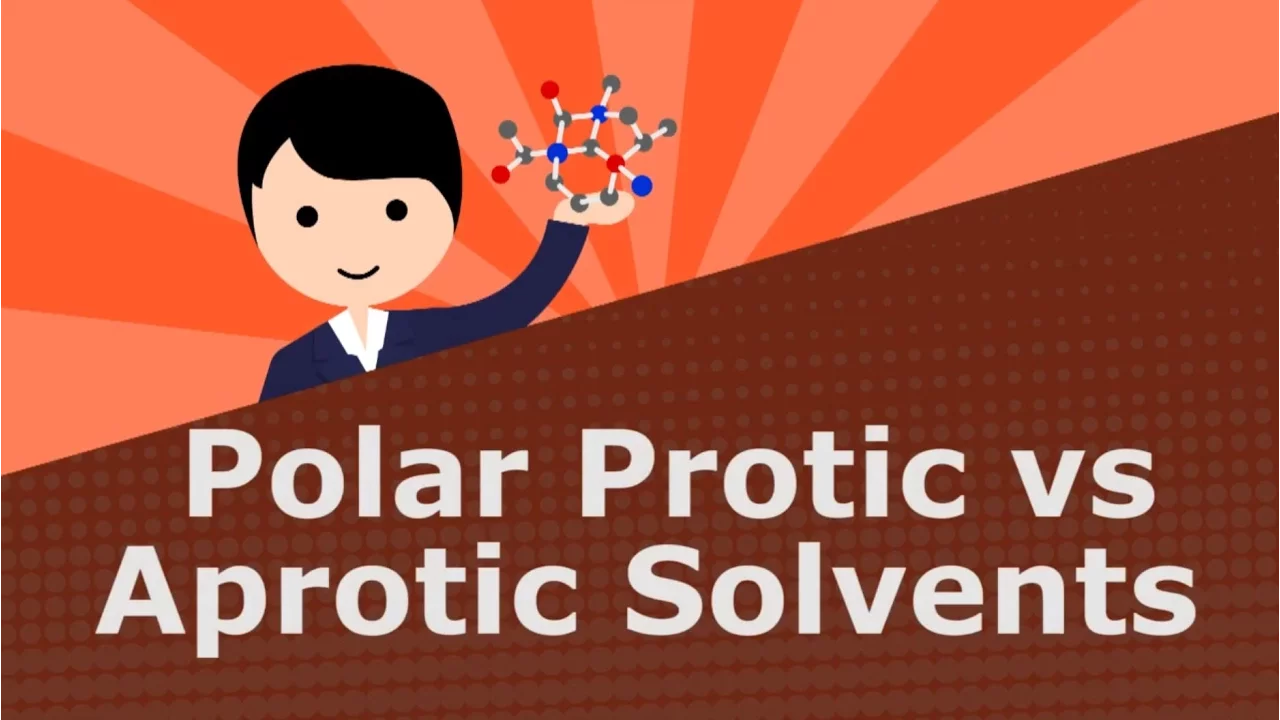
Basic organic chemistry classification of solvents, including polar protic, polar aprotic, and non-polar solvents and their functions in chemical reactions.
Introduction to HSE (Health, Safety, and Environmental) hazard metrics, such as flash points, exposure limits, and biodegradation.
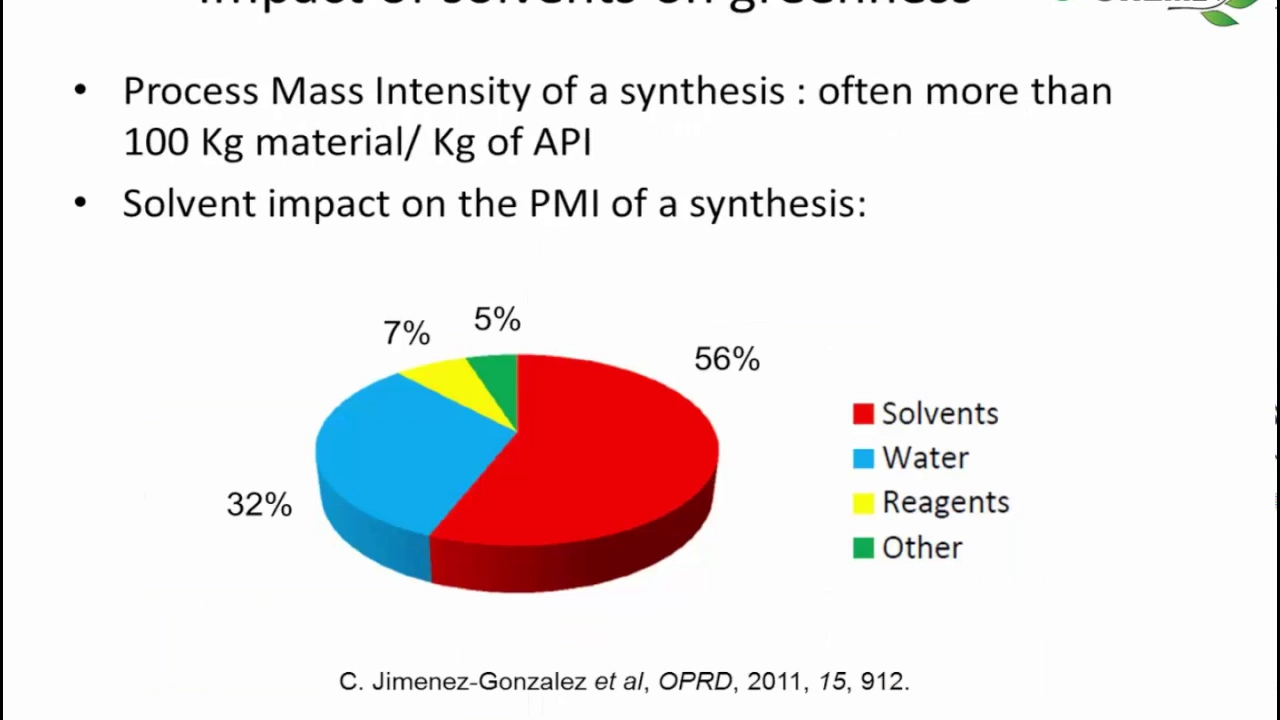
General understanding of pharmaceutical process development and the significant role solvents play in mass intensity and waste generation.
Application of Life Cycle Assessment (LCA) tools to quantitatively evaluate the environmental footprint of selected solvents from cradle to grave.
Advanced alternative solvent technologies, such as supercritical fluids, ionic liquids, deep eutectic solvents, and bio-based solvents.
Review of industrial case studies focusing on solvent replacement and optimization strategies in Active Pharmaceutical Ingredient (API) synthesis.
Familiarity with regulatory compliance standards and international guidelines, such as ICH Q3C (Impurities: Guideline for Residual Solvents) and REACH.
481 views6likes11:20Original Release: 2021-08-03
Many solvents have been presented as 'green' but none of them is really, fully green. The solvent desirability is influenced by many criteria which, sometimes, are contradictory. Occupational health, safety environment; which concerns air, water and carbon footprint; industrial issues linked with boiling point, cost, procurement and other constraints. Besides, greenness depends on the application. Criteria for a solvent for paint stripping are not the same as for chemical synthesis. This is why some pharma companies have elaborate solvent guides in order to help chemists in the selection of the most desirable solvents.
These guides reflect the policy of the company or institution, based on the local constraints, the accidents and their culture. Not surprisingly they differ by their structure and relative way of criteria.
As part of the Work Package 1 of Chem21 project, we made a survey of solvent selection guides and propose a methodology to establish and compare the ranking of solvents and presented it in the module entitled 'Survey of Solvent Selection Guides.' A combination of HS&E criteria for each guide gives a figure and a colour code for the three guides which did not give a clear overall ranking. And a comparison of the colors for each solvent shows the degree of convergence between these guides.
According to the survey, 67% of the 51 solvents considered are scored with low level of ambiguity as Recommended, Problematic, Hazardous or Highly Hazardous. This has been published in Green Chemistry 2014.
The glass can be seen as 2/3 full or 1/3 empty.
1/3 of solvent could not be ranked by this simplified system. This is not very surprising as these borderline solvents are often green with respect to one criterion and not for the others.
This also reflects the different perceptions and culture of the institutions.
For the elaboration of Chem21 solvent guide, we needed a methodology permitting a ranking as intermediate solvents. This methodology should work with a 67 percent of solvents having a clear ranking, and should also be able to give a greenness assessment of any solvent, in particular, bio-derived solvents.
The methodology we elaborated is quite simple and based on GHS statements and some physical data which can be collected from any Safety Data Sheet. Like for the solvent guides survey, we elaborated one safety, one health and one environment score. Each from one for the best stead to the worse and we associated a colour-code. 1-3, green, 4-6, yellow, 7-10 red. The 'Data Incomplete' corresponding score is 5.
The solvent ranking by default is obtained by simply counting the Safety, Health and Environmental score. One score greater or equal to 8 or two scores greater or equal to 7 flags a solvent as 'Hazardous'. One score equal to 7 scores the solvent as 'Problematic' as well as as two scores between 4 and 6. In other cases, the solvent is considered 'Recommended'.
How does it work?
The first task is to collect some data. Boiling point, flash point, auto-ignition temperature and the GHS statements from the Safety Data Sheets. Note that the GHS statements may vary depending on the supplier. In these cases, the advice of an occupational hazards list is useful. The safety score is mainly based on the flash point, with the same limits as GHS statements, but we define a distinction when the flashpoint is lower than 22 degrees C. Increments are added for each of the following properties: Auto-ignition temperature lower than 200 degrees C, high resistivity, ability to form explosive peroxides. For example, diethyl ether, with a flashpoint of minus 45 degrees C, has a basic safety score of 7, but as its auto-ignition temperature is 160 degrees, as it is resistive and forms hazardous peroxides, its final safety score is 10.
The health score derives from the most stringent H300 statements according to this table.
Thus CMR solvents of category 1A or 1B are scored 9 and the CMR of category 2, such as toluene, dichloromethane and THF, are scored 6.
1 is added to this score if the boiling point is lower than 85 degrees C to take into account the highest occupational risk of more volatile solvents. For benzene or dichloroethane, one ends up with 10.
The environment score is very qualitative. It is based of on both the GHS H400 statements and the boiling point.
Boiling point lower than 50 degrees C or higher than 200 degrees C gives a score of 7, as well as H400, H410 or H411 statements. For example, diethyl ether is ranked seven because of its low boiling point and heptane is ranked seven because of its eco-toxicity.
Let us apply ranking methodology with a safety, health and environmental score in hand, the ranking, by default, is immediately obtained. Ethyl acetate, with only one score of 5, is Recommended. Methyl THF, with two scores between 4 and 6, is Problematic.
Pentane, with one score of 8, is Hazardous. In this system we didn't make this distinction between Hazardous or Highly Hazardous, but solvents with one score of 10 are always Highly Hazardous according to the survey.
The University of York has developed an Excel tool, which is available in the training package, and which helps you to score any solvent. All you have to do is to enter the solvent name, the physical data, and put a word in each column corresponding to the relevant H-statements. The tool gives you the HSE scorings as well as your overall ranking by default.
For the solvents which had a clear ranking according to the survey, the ranking obtained by this system is the same for 81% of solvents, which is more than acceptable. In some cases, such as dioxane, the ranking by default is less severe. For anisole, it is more severe. As the ranking within the regime model is varied, it can be used to predict the desirability of any solvent. We used it first for the solvents which didn't have a clear ranking after the survey, then for bio-derived solvents and newer solvents, like the ethers proposed to substitute methyl tert-butyl ether.
The intermediates solvents were not easy to rank because of their unclear balance between advantages and hazards. In some cases we did not agree with the rankings given by the simplified system. For example, methanol is ranked as problematic by default because of its alarming health statements and relatively low boiling point. But as its occupation limit values are relatively high and as it is really biodegradable we decided to rank it as 'Recommended'. On the other hand, pyridine was ranked by default as Recommended, but as its occupational limit values are very low, we decided to rank it as hazardous. Thus, the simplified method has its limits and debate associating chemists and occupational hygienists is needed to give definitive rankings.
For bio-derived solvents we accepted the rankings by default. As shown in this table, many of the solvents appear as problematic as a result of their high boiling point giving an environment score of seven, such as 1,3 propane diol, glycerol or ethylene carbonate. In the case of p-cymene, the lack of the data also results ranking by default of Problematic. This illustrates the current difficulty to integrate these solvents in chemical processes.
In conclusion this guide is based on a survey of published solvent guides and comprises a methodology able to rank any solvent.
This system uses easily available physical data and GHS hazard statements given in the rich dossier and is aligned with the European regulations. This methodology is not perfect. The health ranking should be better based on the occupation evaluation limits debates, but they are not always available and not unified even in Europe. The environment criteria should include the impact of the solvent synthesis in terms of carbon footprint, and accumulated energy demand.
Beside which, dossiers are often incomplete. This is where a discussion with experts is needed to give a definitive ranking. This work has been published in 2015 in Green Chemistry.
This methodology offer other perspectives.
The Chem21 Solvent Guide has been designed for the pharma chemical industry, but the field of green chemistry is wider and solvent guides are needed for other applications with different criteria weight. Our system can easily be modified to fit with other constraints or requirement. For example, for coatings or solvents for paint stripping, the flashpoint weighing will be more severe and the environment criteria will favor hi boiling solvents, such as many bio-derived solvents.
Up Next

6:26
Demographic Transition Model & Population Pyramids | Geography
@hudsonworldgeo
202.1K views•2012-09-07

12:54
Triumph of Orthodoxy Icon: Byzantine Art & History Explained
@BenCallan
2.1K views•2024-08-06

9:49
FastAPI vs Flask vs Django: Choosing the Right Python Web Framework
@TechWithTim
302.5K views•2024-05-26

1:42
Game of Thrones Opening Credits: A Cinematic Analysis
@gameofthrones
46.3M views•2011-04-18
Related Study Plans & Knowledge Roadmaps
Structured learning paths in General & Interdisciplinary Studies
general-studies
Elevator Engineering: History, Physics & Cities
01From Hoists to Safety Brakes: The Dawn of Vertical Lift
02Hydraulic vs. Traction: The Engineering Physics of Elevators
03Modern Speed, Safety, and Algorithms
+ 2 more learning modules
12h5 modules
Explore Roadmap
general-studies
Rubber: Material Science, History & Geopolitics
01Origins of Natural Rubber & Mesoamerican History
02The Chemistry of Natural Rubber & Vulcanization
03The Geopolitics of the Rubber Boom & Colonization
+ 2 more learning modules
12h5 modules
Explore Roadmap
general-studies
Containerization: Evolution, Logistics & Trade
01Ancient Trade & Bulk Cargo: Amphorae to Barrels
02The Industrial Revolution & Cardboard Packaging
03The Containerization Revolution: Malcom McLean
+ 2 more learning modules
12h5 modules
Explore Roadmap
general-studies
Textile Tech: Evolution, Labor & Global Impact
01Pre-Industrial Textiles: Handloom & Cottage Industry
02Mechanization: The Spinning Jenny to the Power Loom
03The Factory System & Global Labor Transformation
+ 2 more learning modules
10h5 modules
Explore Roadmap