



























Immunochemistry involves antigen-antibody interactions where antibodies (monoclonal or polyclonal) bind to antigens through electrostatic, hydrogen, hydrophobic, and van der Waals forces; affinity measures the strength of a single binding site interaction while avidity reflects overall complex stability; immunoassays are classified as heterogeneous (requiring separation steps like solid-phase binding) or homogeneous (single-vessel reactions), and competitive assays show inverse signal-analyte relationships while non-competitive sandwich assays show direct proportionality; common labels include fluorescent, chemiluminescent, radioisotope, and enzyme-based markers; the hook effect causes false low readings at extremely high analyte concentrations, requiring dilution verification; heterophile antibodies can interfere with sandwich assays, and emerging technologies include aptamers and mass spectrometry.
Immunochemistry Basics: Antigen-Antibody Interactions
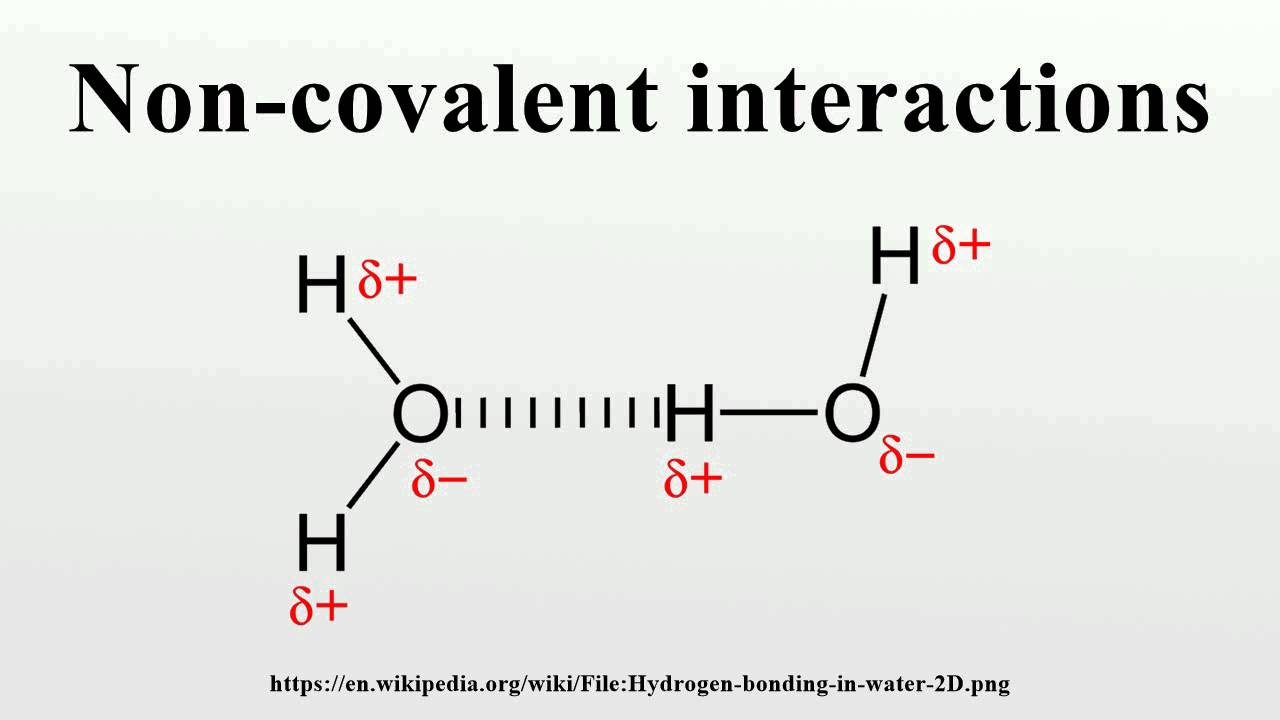
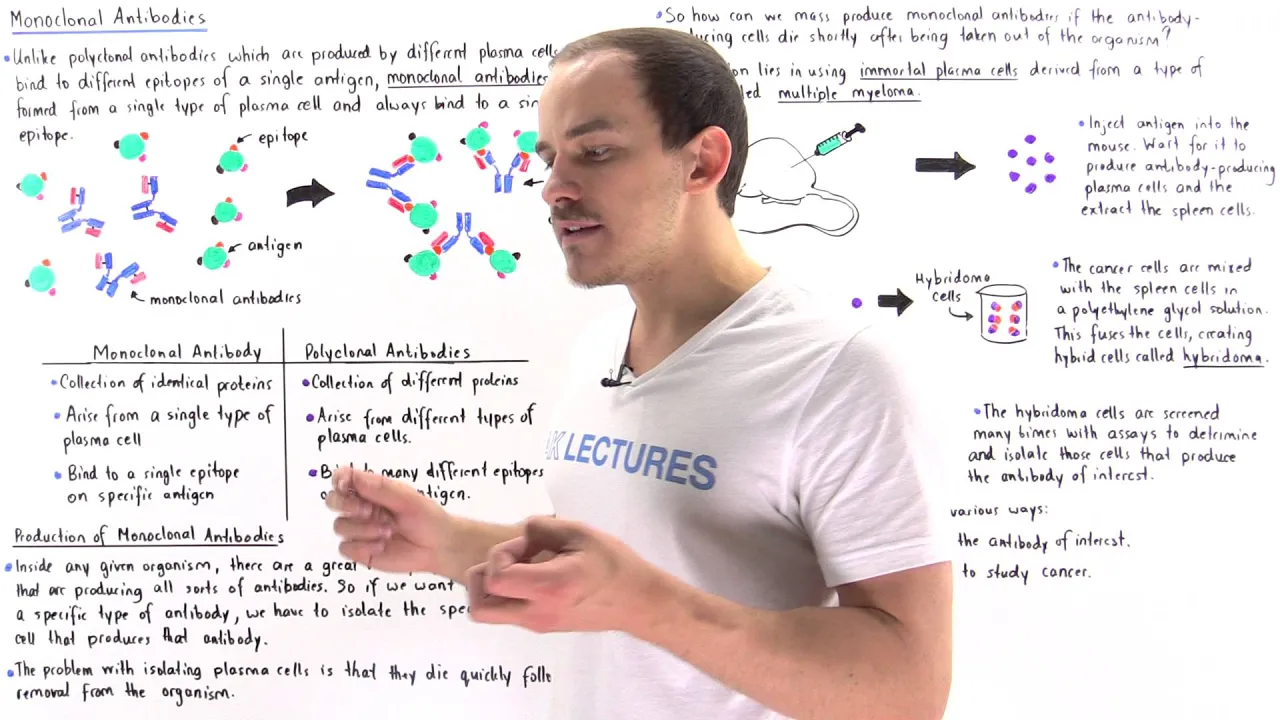
Added:hi everybody this is dr a in this short series on immunochemistry i'm going to bring you about three videos and we're going to start with some basic concepts in immunochemistry so in an immunoassay an antibody molecule usually igg recognizes and binds to an antigen which is then what is trying to be detected now here's a little twist here for you an antigen could just be a protein so like a drug or a vitamin or something we're trying to detect but an antigen could also be another antibody if we're trying to detect it so you can have an antibody to an antibody antibodies um that are used can be monoclonal or upon polyclonal the monoclonal ones will come from the same plasma line and they're usually preferred because they're much more specific um the polyclonal one will come from different plasma cell lines but still all directed against um the same maybe microbe or um you know protein because um when you make an antibody to an antigen to a protein there are different epitopes on that antigen and so there are different places that the antibody could attach to and the confirmation of the antibody can vary depending on the epitope that it's made against so you know some assays will use more monoclonal antibodies for higher specificities some may use some polyclonal antibodies the antigen antibody binding that happens is related to several things the concentration of each reactant so the concentration advantages concentration of antibodies the specificity of the antibody for the antigen so it just is it cross reacting or is it very specifically only reacting with that antigen the affinity and avidity for that pair of antigen and body interaction in the environmental conditions so that could be you know temperature and other things like that acidity uh things that you know are in the environment of the reaction so um the antigen antibody bonding how do they stick together is due to electrostatic interactions hydrogen bonds hydrophobic interactions in van der waals forces so let's define the terms affinity and avidity as related to androgen antibody bonding so the affinity is the strength of the bond between the antigen and the antibody high affinity antibodies will bind more antigen and uh it's the thermodynamic energy of interaction of a single antibody binding site plus its corresponding epitope on the antigen and it is always a property of the androgen so how well the antigen fits that antibody okay the avidity is the stability of the complex once this has formed so it is based on affinity so on the strength of the bond but also on the number of binding sites um so overall strength of binding of an antibody to an antigen and uh it is a property of the antibodies so how stable the complex is um so let's discuss in assay designs for immunoassays heterogeneous versus homogeneous immunoassays so uh all the hetero heterogeneous immunoassays require a separation step that separation step could be a chemical precipitation so there would be a protein precipitating chemical that would make the reaction visible an immunologic precipitation so you would have a second precipitating antibody that will allow then uh the antigen antibody pairs to be visible uh there could be a liquid phase absorption so the antigen is absorbed onto charcoal for example or maybe some latex particles and you can also have solid face at sort absorption so the antigen is or antibody is coated on a solid surface so this could be wells in a macro tight or well plate or beads or something else and the solid phase absorption is actually easier to do and then to automate so it's used quite a bit so a homogeneous amino acid does not require a separation step all the reactions happen in the same vessel all at the same time this is often used in urine tests for drugs of abuse and therapeutic drug assays and in homogeneous essays um the you would have a labeled antibody that binds to the analyte and that's what you would detect now you use labeled antibodies and heterogeneous immune immunoassay also so let's talk a little bit about those immunoassay labels um so there are compounds that are used as detectors in immunoassays an example of a label could be a fluorescent label like fluorescein it emits light that can be detected using a phototube and a fluorometer chemiluminescent labels are now commonly used especially luminol or acrydium esters they're also detected with a phototube as a reminder chemoluminescent is a light produced from a chemical reaction and then we also have radioisotopes that can be used um but being radioactive we use them less but they can be used and they are detected um it's the gamma rays that are being detected um and the enzymes uh are also commonly used to superoxidase alkaline phosphatase et cetera and enzymes will often um elicit a color change and so that what is what is usually detected and is detected by spectrophotometers so immunoassay labels are chemically bonded to the antigen or the antibody if it's a labeled antibody using a series of chemical reactions this is done by the manufacturer and then the instrumentation used to detect the label will depend on the type of label used of course so in the assay designs there's also competitive versus non-competitive immunoassays so in a competitive immunoassay there's always a competition between and the unlabeled analyte from the sample and a labeled antigen that's basically the equivalent of the analytes that is into reagents and they're competing for an antibody that isn't a reagent so like if you were detecting let's say vitamin b12 and it was a competitive immunoassay then you would have the vitamin b12 in the sample that's competing with labeled vitamin b12 in every agent for an anti-vitamin b12 antibody okay and in those the analyte concentration is always going to be inversely proportional to the signal because the signal comes from the labeled antigen so meaning um the more labeled antigens can bind to the antibody it means the less the unlabeled analyte was present and so uh as you see in this graph a high signal would mean low concentration in a low signal would mean a high concentration of the analyte in the sample in a non-competitive immunoassay they are also known as sandwich amino acid they also use labeled antibodies um they do have the highest level of sensitivity and specificity but the analyte concentration is directly proportional to the signal and the signal comes from the labeled antibody and so it's sandwiched because you usually have a capture and a body that's fixed on a bead or a plate or something and it captures the antigen and then there's a second antibody that can attach to it that has the label that has the signal um and so that is what is detected so if the analyte is not present in the sample so it will then it won't be captured by decapture in the body and then the signal antibody won't have anything to bind to and so there will not be a signal so if there's nothing there won't be a signal the more antigen is present the more that it's going to be captured and bound and the more the antibody signal antibody will have to bind to the higher the signal will be the hook effect is an issue with immunoassays so you need excess antibody for a proper reaction in labeled immunoassays so you need enough antibody to get a positive slope for the dose response curve if the analyte is in excess so if the those levels are extremely high in the patient's sample okay then the curve flattens out but then can become negatively sloped um and so that you you could have really high results that are reading deceptively lower so anytime there are any kind of questionable results with an immunoassay it is good to run a quick dilution protocol on it to verify that the results are accurate so if they're not confirmed with a dilution there could be a severe underestimation of the true analyte concentration and therefore that could affect the treatment of the patient and so here is a representation of the hook effect so as you can see here so if this is you know a normal going up those response curve in it but it keeps going and it can flatten out here as the concentration increases and then it starts going back down so that at this this really high concentration here and this pretty high concentration there too um mind you they're not the same right this one this this level here is way higher than this one here they would have the same signal and so uh with high values things around here then it's always good to do a dilution protocol to verify that the reading is actually accurate and so um also things that can interfere with immunoassay or heterophile antibodies so they tend to interfere with sandwich amino acids and the design disadvantage of the sandwich sandwich immunoassays are that they are subjected to false positives and false negative interferences due to heterophyll antibodies so heterophile antibodies are formed from patients who have autoimmune disease or other disorders where they have an abundance of these antibodies um and so it can create a hook type effect which is similar to the prozone effect or the zone of antibody excess effect so it just yeah there's too many antibodies and so it basically interferes with the reaction properly taking place so you could have um an immunoassay something that's reading negative or undetected when there actually is there and a little bit on future directions for amino acids so um we see more and more uh new instruments the large chemistry analyzers integrate immunochemistry with you know regular chemistry you know the spectrophotometry and ion select electrodes so nowadays those big chemistry analyzers are they all have an amino acid module um there is also a potential use of aptomers instead of antibodies so actimers are single-stranded oligonucleotides that fold into defined architectures define shapes and they can bind targets such as proteins so they can kind of function as an antibody without being an antibody because they can bind and capture proteins antigens that we may need to detect so that's potential use and then um we have seen advancements in mass spectrometry where it is more sensitive and specific than immunoassay and has less interferences so there are some assays that are going to mass spectrometry uh especially in reference labs um so it just yeah there's they're both there and they're competing um you know the manufacturer is always looking for greater sensitivity specificity and also newer assays so all right in our next video we are going to do unlabeled immunoassays i will see you there
Up Next

Understanding the Prozone Effect in Immunoassays: False Negatives
@diybiosensors
2.7K views•2023-06-26

Graphic Medicine: Comics for Collaborative Healthcare Communication
@nationalpatientadvocate
189 views•2023-12-04

Clinical Chemistry 1: Toxicology & Drugs of Abuse Testing
@DrAsClinicalLabVideos
6.2K views•2021-04-28

Stages of Labor and Vaginal Birth | Childbirth Animation
@nucleusmedicalmedia
52.1M views•2017-08-18
Related Study Plans & Knowledge Roadmaps
Structured learning paths in Medicine