The Higgs boson is the smallest quantum of the Higgs field, an energy field proposed by Peter Higgs in 1964 that permeates the entire universe and gives subatomic particles their mass through interaction; particles that interact more strongly with the Higgs field become more massive, similar to how a heavy person moves slowly through water while a streamlined fish moves easily, and the Higgs boson itself has not yet been definitively discovered.
Higgs Boson Explained: What Is It and Why It Matters
Added:Deep Dive
The Standard Model of Particle Physics: A basic understanding of how physicists classify fundamental particles and forces.
Sean Carroll on Radical Simplicity in Physics and Spacetime
590.1K
The standard model combines quantum field theory with the known particles and forces. It has been remarkably successful, matching all experimental data to date. It includes six quarks, six leptons arranged in three families, and force carriers (photons, gluons, W/Z bosons). The Higgs boson was discovered in 2012, completing the predicted particle list. However, dark matter and other phenomena suggest the model is incomplete.
Click to watch →

1a: Introdução
5.3K
The Standard Model is the theoretical framework that combines all known fundamental particles and their interactions. It includes: (1) Matter particles (fermions) - quarks and leptons that make up matter; (2) Force carrier particles (gauge bosons) - photons, gluons, W and Z bosons that mediate interactions; (3) The Higgs boson - responsible for giving particles mass. The Standard Model successfully explains most particle physics phenomena but does not include gravity or dark matter.
Click to watch →
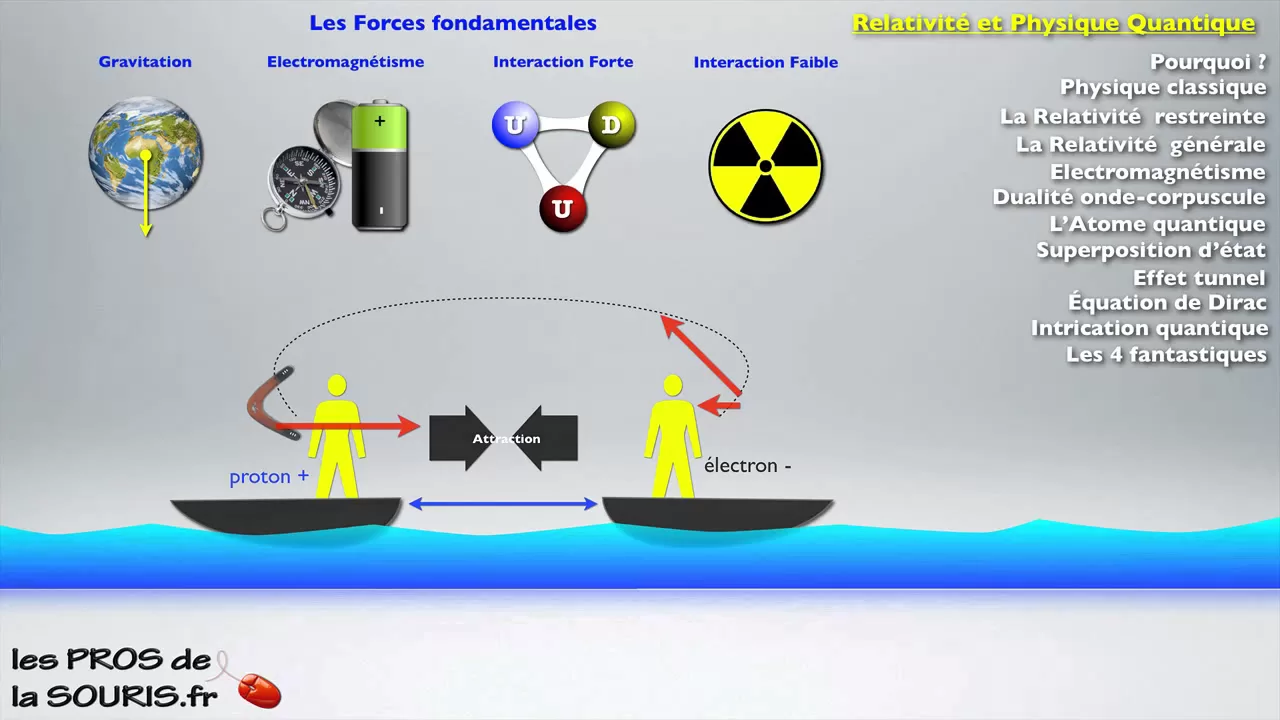
Einstein entre relativité et mécanique quantique ! partie 3
41.1K
The Standard Model is the current best theory describing all known particles and forces (except gravity). It includes fermions (matter particles) - quarks and leptons, with three generations of increasing mass; gauge bosons (force carriers) - photons (electromagnetism), W and Z bosons (weak force), gluons (strong force); and the Higgs boson, which gives particles their mass. The model has been remarkably successful in predicting experimental results. However, it does not include gravity or explain dark matter/energy. The Higgs mechanism explains how particles acquire mass through interaction with the Higgs field - particles that interact strongly are heavy, while those that don't interact (like photons) have zero mass.
Click to watch →

Jiří Podolský: Kosmos jako celek (MFF-FJDP 26.3.2026) (PO)
8.8K
The Standard Model describes the fundamental particles and forces of the universe. It includes six quarks (up, down, charm, strange, top, bottom) and six leptons (electron, muon, tau, and their neutrinos), organized into three generations. These particles interact through four fundamental forces: strong nuclear force (mediated by gluons), electromagnetic force (mediated by photons), weak nuclear force (mediated by W and Z bosons), and gravity. The model has been remarkably successful in predicting particle behavior and has been confirmed by experiments at particle accelerators like CERN.
Click to watch →

Are We On the Brink of Physics Beyond the Standard Model?
146.1K
The Standard Model is the best theoretical framework currently available to describe the known fundamental particles in nature. It includes electrons, quarks (which make up protons and neutrons in atoms), and photons (particles of light). There are 17 different particles in total within this model, encompassing both matter particles and force-carrying particles responsible for three of the four basic forces: electromagnetism, the strong force, and the weak force.
Click to watch →
Deep Dive
Elementary Particles: Familiarity with quarks, leptons (such as electrons), and gauge bosons (force carriers).
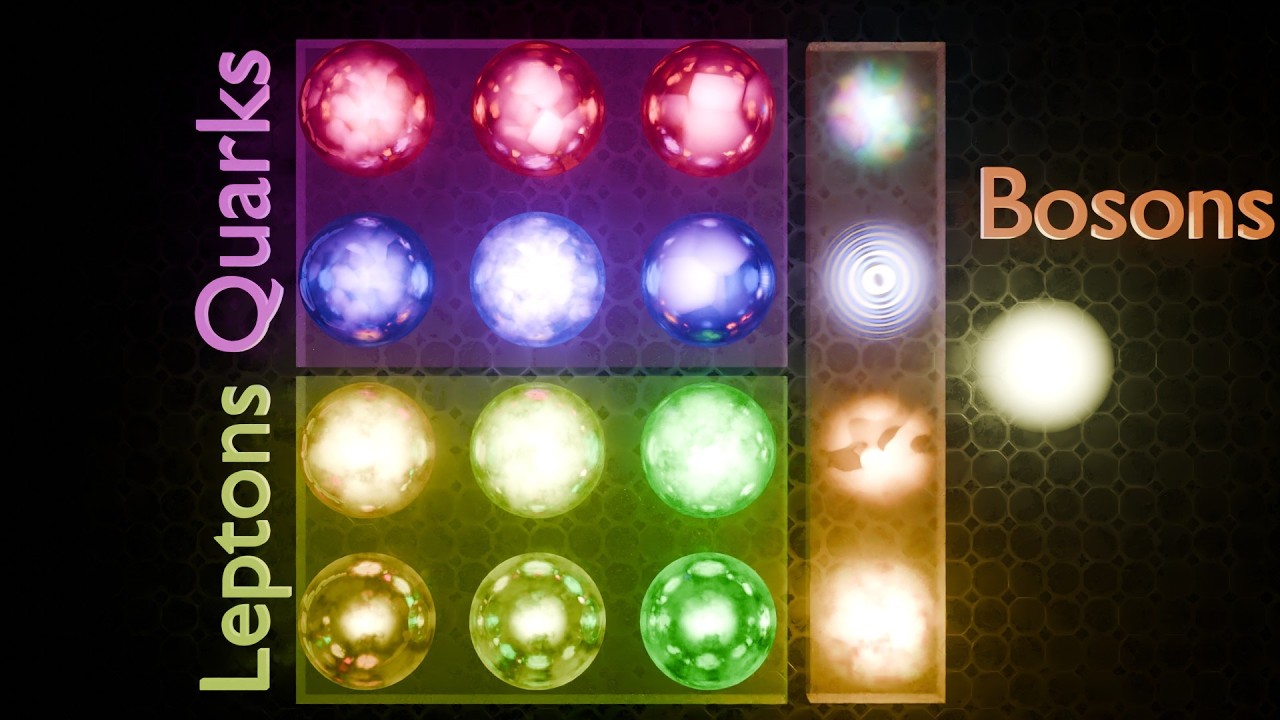
All Elementary Particles Explained
137.6K
Elementary particles are the fundamental building blocks of matter, organized into two main categories: fermions (matter particles) and bosons (force carriers). Fermions include quarks (which come in six types across three generations—up, down, strange, charm, bottom, top—and possess color charge, binding together via gluons to form protons and neutrons) and leptons (including electrons, muons, and taus, which do not interact via the strong force). Bosons include gluons (strong interaction), photons (electromagnetic interaction), W and Z bosons (weak interaction), and the Higgs boson (which gives particles mass through the Higgs mechanism). This comprehensive framework, known as the Standard Model, describes all known elementary particles and their interactions, representing over a century of scientific discovery and research.
Click to watch →

Cosa sono le PARTICELLE ELEMENTARI? Le risposte (e domande) della FISICA
43.2K
Elementary particles are fundamental constituents of matter that can be understood through multiple theoretical frameworks: as wave functions that collapse upon measurement, as excitations of quantum fields, as irreducible representations of symmetry groups characterized by properties like energy, momentum, and spin, as vibrating strings in higher-dimensional spaces, or as quantum bits (qubits) in holographic descriptions of reality.
Click to watch →

Elementary Particles - A Level Physics
196.7K
The Standard Model classifies all elementary particles into quarks (up, down, and strange), leptons (electron, muon, tau and their neutrinos), and gauge bosons (photon, gluon, W+, W-, and Z bosons); protons consist of two up quarks and one down quark while neutrons consist of one up quark and two down quarks, with each quark having specific charge (+2/3 for up, -1/3 for down and strange), baryon number (1/3), and strangeness (0 for up/down, -1 for strange); for every particle there exists an antiparticle with opposite charge but same mass, and certain conservation laws (charge, baryon number, strangeness, and lepton family numbers) must be maintained during particle interactions.
Click to watch →

Урок 474. Элементарные частицы. Позитрон. Нейтрино
118.2K
Elementary particles are fundamental building blocks of matter that cannot be divided into smaller components. The positron, predicted by Paul Dirac in 1931, is the antimatter counterpart of the electron with identical mass but positive charge; when an electron and positron meet, they annihilate each other, converting their mass entirely into energy (0.511 MeV per particle) as two gamma photons traveling in opposite directions to conserve momentum. The neutrino, proposed by Wolfgang Pauli in 1930 to resolve the beta decay energy spectrum problem, is an electrically neutral particle with extremely weak interactions that can pass through entire planets without interacting; it was experimentally confirmed in 1956 by Reines and Cowen using a nuclear reactor's antineutrino flux, who received the Nobel Prize in 1995 for this discovery.
Click to watch →

【鏡の世界では物理法則がわずかに変化する】ハーバード大学物理博士課程・久保田しおん/私たちが消えずに存在している理由を探る/CP対称性は“誰が”破ったのか【CROSS DIG 1on1】
482.1K
Elementary particles are the smallest units of matter that cannot be broken down further, analogous to Legos being the smallest building blocks for constructing various objects. The Standard Model is the current theoretical framework describing all known elementary particles and their interactions, currently including 17 types of particles. However, the Standard Model is not considered complete, as it cannot explain all phenomena, particularly gravity and dark matter. Scientists remain open to the possibility that it may need revision or replacement as new discoveries emerge.
Click to watch →
Deep Dive
The Concept of Mass and Inertia: Understanding the physical definition of mass as a resistance to acceleration, distinct from weight.

🌌 Dinâmica (1/5): Leis de Newton - Física - ENEM
172.5K
Mass is the measure of a body's inertia, which is the resistance a body offers to change its state of rest or motion. Greater mass means greater inertia and greater resistance to movement. Mass and inertia are synonymous concepts: more mass equals more inertia, and less mass equals less inertia.
Click to watch →

Масса. Плотность вещества. Теория
1K
Mass is a fundamental physical quantity introduced in 7th grade physics, denoted by 'm' and measured in kilograms (kg). Mass characterizes inertia—the property of a body to resist changes in velocity during interaction. Heavier objects have greater inertia and change velocity more slowly. Examples include cannon recoil and cart motion: lighter carts move faster than heavier ones under the same force. Mass is related to everyday concepts like 'inert' behavior in people, who resist changing their routines.
Click to watch →

فيزياء أولى ثانوي / الباب الرابع : درس الكتلة والوزن
366
Mass is defined as a measure of the amount of matter in an object, depending on the number and size of atoms. Mass is an intrinsic property that does not change with location, shape, or speed (for speeds much less than light). The SI unit is the kilogram (kg). Mass is measured using balance scales. Inertia is the property of mass that resists changes in motion, essentially Newton's First Law. The greater the mass, the greater the inertia. Mass and inertia are directly proportional - as mass increases, inertia increases. When mass approaches zero, inertia approaches zero, making it very easy to move or stop the object.
Click to watch →

UP Home Guard Science Class | UPP Home Guard Science | UP Home Guard Science Practice Set 08
32.5K
Mass is the total amount of matter in an object, measured in kilograms, and remains constant regardless of location. Weight is the force exerted on an object due to gravity, calculated as mass multiplied by gravitational acceleration (W = mg). Inertia is the property of matter that resists changes in motion, directly proportional to mass. Heavier objects have greater inertia and are harder to accelerate or decelerate. These concepts explain why astronauts weigh less on the Moon but retain the same mass, and why pushing a heavy shopping cart requires more effort than a light one.
Click to watch →

Massa e inércia
3.3K
Mass is the amount of matter in an object, while inertia is the resistance to acceleration. Mass cannot be determined by size or volume alone, as large objects can have low mass (cotton candy) and small objects can have high mass (neutron star material). Newton's Second Law (F=ma) provides a method to measure mass by applying a known force and measuring acceleration. This process reveals that mass quantifies an object's resistance to acceleration, which is its inertia. In atomic and quantum domains, mass is fundamentally defined by how particles respond to forces.
Click to watch →
Deep Dive
Fields in Physics: Knowing how fields (like gravitational or electromagnetic fields) permeate space and influence matter.

فيزياء !! ارواح تدي 20/20 مع تيتشر ايمن Bem 2026 🏆😍
110.8K
Physics is divided into three main fields: (1) Electrical phenomena - studying everything related to electricity, including static electricity, current electricity, and electrical safety; (2) Electrolytes and electrolytic solutions - covering electrolysis, reactions between acids and metals, and chemical indicators; (3) Mechanics - studying solid bodies under forces, including equilibrium conditions and Newton's third law of action-reaction.
Click to watch →
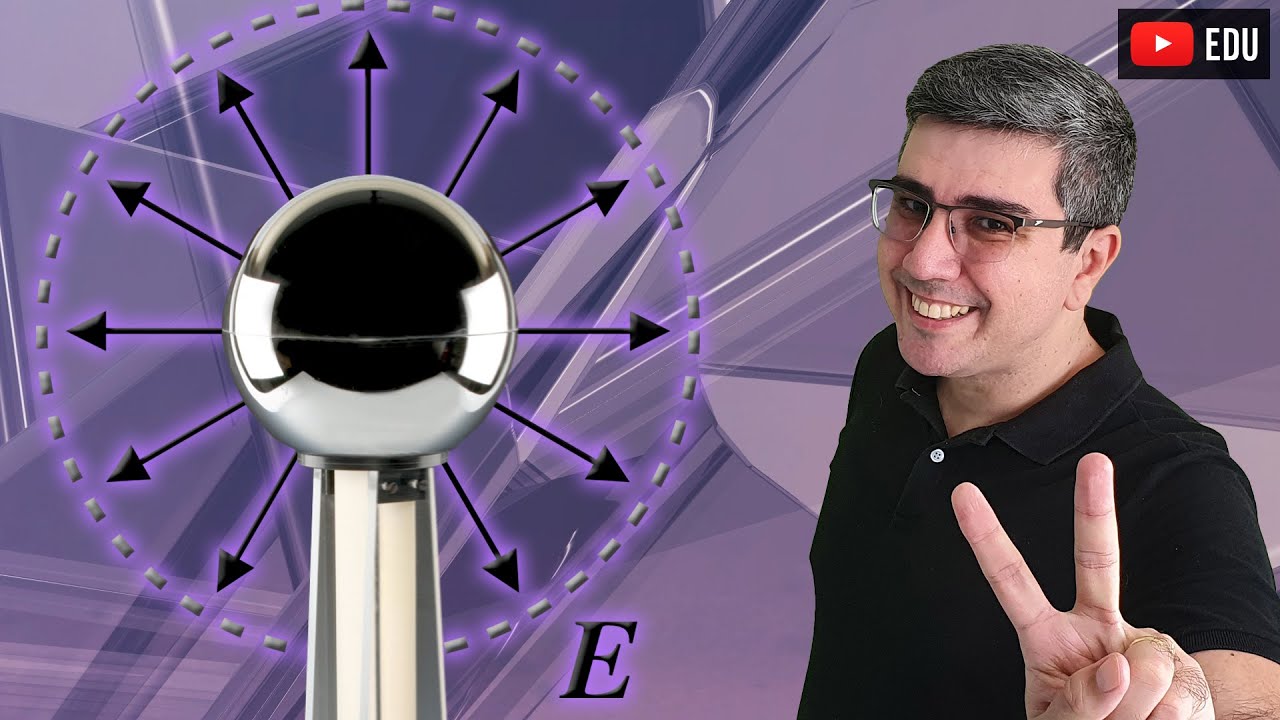
Introdução ao Campo elétrico e à força elétrica | Física para a prova
24.6K
A field in physics is a property that exists at each point in space, not a region of space. Gravitational field near Earth's surface is 10 m/s² (equivalent to 10 N/kg), meaning any mass experiences proportional force. Masses generate gravitational fields, while electric charges generate electric fields. Unlike mass which has only one type, charges come in positive and negative varieties. By convention, field lines emerge from positive charges and enter negative charges. Fields are abstract mathematical constructs created by humans to represent natural phenomena.
Click to watch →
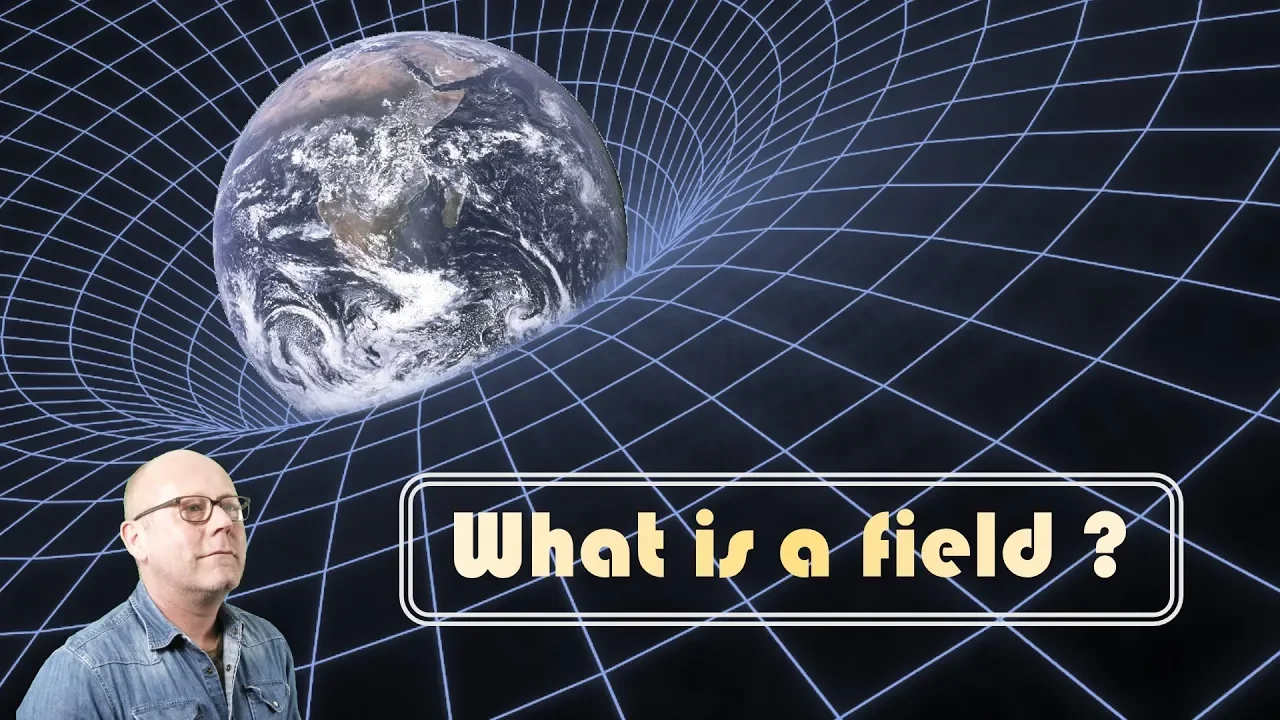
What is a Field ? (Physics)
49.8K
A field in physics is a region of space where each point is associated with a specific physical quantity; fields are categorized into scalar fields (where each point has a single numerical value like temperature, pressure, or salinity) and vector fields (where each point has a vector quantity with both magnitude and direction like wind speed, electric force, or gravitational force).
Click to watch →

Généralités sur les champs - Physique-Chimie - 1ère - Les Bons Profs
165.3K
In physics, a field is a physical quantity defined at every point in space, which can be either scalar (defined by a single value, like temperature) or vectorial (defined by a vector with point of application, direction, sense, and magnitude, like wind velocity); scalar fields use equipotential lines to connect points with equal values, while vector fields use field lines tangent to the vectors at each point, and a field is uniform when all values or vectors are identical throughout the space.
Click to watch →

Professor Brian Cox Particle Physics Lecture at CERN
620.2K
In physics, a field is a quantity that has a value at every point in space. Simple fields, like temperature in a room, can be represented as a single number at each point. More complex fields, like the electromagnetic field, have both direction and magnitude at each point. Quantum mechanical wave functions are fields that can be represented as clock faces at each point, where the direction of the clock hand and the length of the hand determine the probability of finding a particle at that location.
Click to watch →
Prerequisite Knowledge
- Concept 01The Standard Model of Particle Physics: A basic understanding of how physicists classify fundamental particles and forces.
- Concept 02Elementary Particles: Familiarity with quarks, leptons (such as electrons), and gauge bosons (force carriers).
- Concept 03The Concept of Mass and Inertia: Understanding the physical definition of mass as a resistance to acceleration, distinct from weight.
- Concept 04Fields in Physics: Knowing how fields (like gravitational or electromagnetic fields) permeate space and influence matter.
Subsequent Learning
- Step 01Electroweak Symmetry Breaking: Exploring how the electromagnetic and weak forces unified at high energies and separated as the universe cooled.
- Step 02Experimental Detection at the LHC: Investigating the engineering and experimental methods used by ATLAS and CMS to discover the Higgs boson in 2012.
- Step 03The Hierarchy Problem: Understanding the theoretical puzzle of why the Higgs boson's mass is so much lighter than gravity implies it should be.
- Step 04Introduction to Quantum Field Theory (QFT): Diving into the mathematical framework where all particles are viewed as excitations of quantum fields.
- Step 05Physics Beyond the Standard Model: Exploring theories like Supersymmetry (SUSY) and dark matter that address the limitations of the Higgs mechanism.
Higgs Field
Boson Link
Higgs Field
0:01Playing Section
- 1
Proposed in 1964 to explain varied particle masses via an energy field.
- 2
Water-swimmer analogy shows how field interaction dictates mass levels.
- 3
Top quark and electron differ in mass solely due to field interaction.
Technicolor and Composite Higgs Models
While the 2012 discovery of a 125 GeV boson at CERN strongly supported the Standard Model's explanation of mass generation, physicists have long explored alternative frameworks to address its theoretical shortcomings, such as the 'hierarchy problem'—the question of why the Higgs mass is so much lighter than the Planck scale. Historically, 'Technicolor' theories proposed that electroweak symmetry breaking is not caused by an elementary scalar Higgs field, but by a new strong force. Under this view, the Higgs is not a fundamental particle but a composite state of new, strongly-interacting fermions. Following the 2012 discovery, modern 'Composite Higgs' models have adapted this idea, suggesting the observed Higgs boson is a composite bound state of more fundamental constituents rather than an elementary scalar. This alternative perspective challenges the notion of the Higgs as a simple, indivisible point-particle, aiming to explain its mass naturally without the extreme fine-tuning required by the standard Higgs mechanism.
Deep Dive
Electroweak Symmetry Breaking: Exploring how the electromagnetic and weak forces unified at high energies and separated as the universe cooled.
Professor Brian Cox Particle Physics Lecture at CERN
620.2K
Electroweak symmetry breaking is the process that occurred approximately 10^-10 seconds after the Big Bang, when the unified electroweak force separated into the electromagnetic force and the weak nuclear force. This symmetry breaking is one of the main reasons for building the Large Hadron Collider and the International Linear Collider, as it represents a fundamental transition in the physics of the early universe that can be studied through high-energy particle collisions.
Click to watch →

What If Charge is NOT Fundamental?
1.3M
Electromagnetism and the weak force were once united as the electroweak force, sharing the same charges (weak isospin and hypercharge). An event in the very early universe called electroweak symmetry breaking forced these charges to take on specific combinations. This process created the weak and electromagnetic forces as we know them today. Electric charge is essentially a 'shadow' of the ancient fields from the birth of the universe. This symmetry breaking also created the Higgs field, which grants mass to elementary particles—another supposedly fundamental property that may not be truly fundamental.
Click to watch →

What Monsters Survive From The Time Of The Big Bang?
62.1K
At extremely high energies, the electromagnetic and weak nuclear forces merge into a unified electroweak force. This symmetry is broken in our everyday universe through the Higgs mechanism, where the Higgs boson field creates a wedge between these forces. The Higgs boson exists in an unstable symmetric state at high energies but collapses into a lower energy state as the universe cools, breaking the symmetry and separating the weak and electromagnetic forces. This process was confirmed experimentally at CERN in 1983 when particle colliders achieved sufficient energies to observe the unification of these forces.
Click to watch →

Neil and a Particle Physicist Discuss Why There’s Something Instead of Nothing
1M
About a trillionth of a second after the Big Bang, the electroweak symmetry broke—a phase transition similar to water boiling. The Higgs field switched on for the first time, giving mass to particles and resetting the fundamental forces. This transition may have been the moment when more matter than antimatter was created. The LHC recreates these extreme conditions to study this process.
Click to watch →

7 Subatomic Stories: Antimatter
100.1K
At high temperatures above a critical point, the electromagnetic and weak forces unify as the electroweak force, where mass and electrical charge do not exist. Two sets of massless force-carrying particles exist: a singlet B particle and a triplet of W particles. When temperature drops below the critical point, the Higgs field becomes non-zero, causing some particles to gain mass while others remain massless. This symmetry breaking produces the familiar W and Z bosons (massive) and the photon (massless). This mechanism explains how unified forces differentiate into distinct forces we observe at everyday temperatures.
Click to watch →
Deep Dive
Experimental Detection at the LHC: Investigating the engineering and experimental methods used by ATLAS and CMS to discover the Higgs boson in 2012.

ခဲကနေ ရွှေဖြစ်အောင် လုပ်နိုင်ပြီဆိုတာ တကယ်ပဲလား
70.8K
The LHC experiments use ultra-peripheral collisions where particles pass close without direct impact. Scientists detect transmutation by measuring ejected protons: one proton ejected creates thallium (81), two create mercury (80), three create gold (79). In 83% of collisions, no transmutation occurs. Rarely, two or three protons are ejected. This experimental approach allows scientists to study nuclear forces and particle interactions without the extreme violence of direct collisions.
Click to watch →

CERN detekoval fyzikální anomálii – a ta neodpovídá známé fyzice
974
The CMS anomaly detection system is not passive but a live trigger deciding in real-time which collision events to record. LHC produces so much data that no system can store everything, so it must select precisely the anomalies. This creates a curated dataset of events AI considered too special to reject—events it couldn't explain. The system has been running for months inside CERN's richest campaign in history without releasing any summary of what it flagged. No preliminary results or statements that searching continues.
Click to watch →

¡El Mundo en Shock! Algo Extraño Está Ocurriendo en el CERN y Nadie Puede Explicarlo – Documental
4.8K
The Large Hadron Collider (LHC) is a 27-kilometer circular tunnel where protons accelerate to 99.9999% light speed before colliding, recreating conditions from microseconds after the Big Bang. Detecting neutrinos within the LHC was considered nearly impossible because they escape without interacting with detectors. The FASER (Forward Search Experiment) solved this by placing a detector 480 meters from the collision point where neutrinos form a concentrated cone. The detector uses alternating layers of dense metal plates (lead, tungsteno) and photographic emulsion. When neutrinos collide with nuclei, they generate secondary particles that leave tracks in the emulsion, allowing scientists to identify neutrino interactions and flavors.
Click to watch →
The hunt for new physics at the Large Hadron Collider — Dr Martin White, ISS2015
4.7K
The Large Hadron Collider accelerates protons to near-light speed in a 27-km circular tunnel using superconducting magnets operating at 1.9 Kelvin, producing 800 million collisions per second. Each collision carries ~10^-7 joules concentrated into volumes a million million times smaller than a mosquito, recreating early-universe conditions. Particle detectors use silicon tracking strips (6 million total), calorimeters, and muon detectors to measure momentum via magnetic deflection (p = BqR) and identify collision products. Dark matter cannot be observed directly at the LHC but can be inferred through missing transverse momentum when it carries away momentum with visible particles. Three complementary approaches search for dark matter: (1) Direct detection uses underground tanks to catch rare dark matter-nucleus interactions; (2) Indirect detection searches for gamma rays from dark matter annihilation in dense regions; (3) Collider production creates dark matter in controlled laboratory conditions. Australia participates in CTA, a ground-based gamma-ray telescope array for indirect detection. These experiments represent frontier research requiring international collaboration and cutting-edge technology.
Click to watch →

Update on the Large Hadron Collider
215
The LHC is a 27-km circular accelerator at CERN, with protons from hydrogen bottles accelerated through linear accelerators and booster rings. It operates underground to shield from cosmic rays. Four experiments (ATLAS, CMS, ALICE, LHCb) detect collision products. The CMS detector is a massive cylindrical instrument 140 meters underground, housing a superconducting solenoid magnet. It consists of four layers: silicon tracker (10-20 micron precision), electromagnetic calorimeter (scintillating crystals), hadronic calorimeter (brass/scintillator), and muon chambers. Particle detection works by measuring interactions: charged particles ionize silicon, electrons/photons deposit energy in crystals, hadrons produce showers, and muons penetrate all layers. The Higgs boson was discovered in 2012 through decay channels into two photons and two Z bosons, with 6.5 sigma significance confirming the discovery.
Click to watch →
Deep Dive
The Hierarchy Problem: Understanding the theoretical puzzle of why the Higgs boson's mass is so much lighter than gravity implies it should be.

The Greatest Mysteries in Physics: Forces, Numbers, Energies, and Sizes | ASMR
353.8K
The hierarchy problem addresses the enormous discrepancy between gravity and the other three fundamental forces. While electromagnetism, strong nuclear force, and weak nuclear force are within a few orders of magnitude of each other, gravity is 10^24 times weaker than the weakest quantum force (the weak interaction). This creates a fundamental tension because gravity operates at cosmic scales while the other forces dominate at subatomic scales. The weakness of gravity at quantum scales makes it essentially irrelevant to quantum field theories, yet gravity dominates everyday experience and cosmic structure formation.
Click to watch →

On a RECRÉÉ le BIG BANG… et voilà ce qu’on a DÉCOUVERT
119.6K
The Hierarchy Problem is a major unsolved mystery in physics: why is the Higgs boson so light? According to Standard Model calculations, quantum corrections should make the Higgs boson extremely heavy—billions of times heavier than observed. For the Higgs mass to remain at 125 GeV, the theory requires an extraordinarily precise cancellation of quantum effects. This fine-tuning suggests the existence of new physics beyond the Standard Model, such as supersymmetry (which predicts partner particles for each known particle), though no such particles have been found despite extensive searching.
Click to watch →

Evren sanılandan daha mı yaşlı? / Prof. Dr. Ersin Göğüş & Prof. Dr. Sertaç Öztürk - Teke Tek Bilim
159.7K
The hierarchy problem is the question of why gravity is so much weaker than the other fundamental forces. Electromagnetic forces between a proton and electron are about 10^40 times stronger than gravitational forces between them. This enormous difference in strength is not explained by current physics and is one of the major unsolved problems in theoretical physics. Some theories, like string theory, attempt to explain this through extra dimensions.
Click to watch →

Karanlık madde evreni nasıl şekillendiriyor? / Prof. Dr. Bora Işıldak & Prof. Dr. Emre Onur Kahya
186.8K
The hierarchy problem refers to the unexplained large differences between fundamental physical constants, such as the ratio of the weak force to gravity (approximately 10^25). The baryon asymmetry problem refers to the observed dominance of matter over antimatter in the universe. According to the Big Bang theory, equal amounts of matter and antimatter should have been created, but they would have annihilated each other. The observed matter excess suggests some physical process in the early universe favored matter production.
Click to watch →

【神回】意識の正体は「重力」だった...量子力学と最新宇宙論が導き出した、パラレルワールドの全貌が衝撃すぎる。【量子力学 意識の正体 都市伝説】
191.4K
The Hierarchy Problem is the long-standing mystery of why gravity is so much weaker than other fundamental forces. For example, Earth's gravitational pull is easily overcome by the static electricity from a small magnet. The difference in strength is approximately 10^30 times. Lisa Randall's membrane theory explains this: gravity is not inherently weak but appears weak because it leaks into higher dimensions.
Click to watch →
Deep Dive
Introduction to Quantum Field Theory (QFT): Diving into the mathematical framework where all particles are viewed as excitations of quantum fields.
What Is Quantum Field Theory | Quantum Field Theory Course | Quantum Field Theory Lectures
1.2K
Quantum Field Theory (QFT) is a theoretical framework that unifies classical field theory, special relativity, and quantum mechanics by treating particles not as localized objects but as excitations of underlying fields that permeate all of spacetime; QFT employs two main approaches—canonical quantization, which extends quantum mechanics to fields by promoting classical variables to operators and introduces creation and annihilation operators to handle variable particle numbers, and Feynman's path integral formulation, which calculates probabilities by summing over all possible paths weighted by complex exponential factors proportional to action; quantization is essential because classical physics fails to explain phenomena like the ultraviolet catastrophe and wave-particle duality, and unlike quantum mechanics where particle numbers are fixed, QFT allows for particle creation and annihilation through field operators.
Click to watch →

Was ist und wozu braucht man Quantenfeldtheorie?
2.2K
Quantum Field Theory (QFT) is the quantum theory of fields, analogous to how quantum mechanics is the quantum version of classical mechanics. The term literally means 'Quantum Theory of Fields.' QFT applies quantum mechanical principles to fields rather than particles. The axioms of quantum theory are highly abstract and general, applicable to any fundamental theory including field theory. This establishes QFT as the quantum version of classical field theory, just as quantum mechanics is the quantum version of classical mechanics.
Click to watch →

Quantum Field Theory: University of Cambridge | Lecture 1: Introduction to QFT
13.7K
Quantum Field Theory (QFT) is necessary because combining special relativity with quantum mechanics implies that particle number is not conserved, and all particles of the same type are fundamentally indistinguishable; QFT addresses these issues by treating fields as fundamental entities rather than particles, where quantizing the ripples of these fields produces particles, and the mathematical framework involves promoting classical field degrees of freedom to operator-valued functions over space-time, governed by Lagrangian densities and the principle of least action.
Click to watch →

2025 Quantum Field Theory Lecture 1: Why QFT?/Lorentz Group/Harmonic Oscillator
446
Quantum Field Theory (QFT) is the fundamental framework that emerges when combining quantum mechanics with special relativity, as naive relativistic quantum mechanics fails because particle number is not conserved at high energies and no positive conserved probability density exists; QFT promotes classical fields to operator-valued functions arranged in space-time, incorporating infinite degrees of freedom constrained by locality, unitarity, causality, and Lorentz invariance, while the Lorentz group SO(1,3) represents rotations in 4D space-time with 6 independent parameters (3 rotations + 3 boosts), and the harmonic oscillator quantization demonstrates how classical variables become operators satisfying commutation relations.
Click to watch →

Spinors for Beginners 21: Introduction to Quantum Field Theory from the ground up
66.5K
Quantum Field Theory (QFT) treats particles as excitations in fields (electrons in electron field, photons in photon field). It combines three pillars: Newtonian physics, special relativity, and quantum mechanics. Combining quantum mechanics with special relativity gives relativistic quantum mechanics (predicts antimatter but has inconsistencies). Combining quantum mechanics with field theory gives non-relativistic QFT (useful for condensed matter). Combining field theory with special relativity gives relativistic field theory. Combining all three gives relativistic QFT, the standard meaning of QFT. QFT has two main subareas: particle physics (studying particle collisions and interactions) and condensed matter physics (studying collective behavior of huge particle numbers to understand states of matter).
Click to watch →
Deep Dive
Physics Beyond the Standard Model: Exploring theories like Supersymmetry (SUSY) and dark matter that address the limitations of the Higgs mechanism.

Physics beyond the Standard Model
162
Physics beyond the Standard Model refers to theoretical frameworks developed to address the Standard Model's limitations, including its inability to explain gravity, dark matter, dark energy, neutrino masses, and the matter-antimatter asymmetry; these theories range from supersymmetry and grand unified theories to string theory and M-theory, with experimental verification remaining the ultimate arbiter of which theory best advances our understanding of fundamental physics.
Click to watch →

Séminaire de physique - Faire un doctorat en Physique des Hautes Energies - Sonia Bouchiba
927
Three major phenomena indicate physics beyond the Standard Model: dark matter (inferred from gravitational effects on galaxies that cannot be explained by visible matter), neutrino oscillations (neutrinos changing flavor, which requires mass), and matter-antimatter asymmetry (the universe contains vastly more matter than antimatter). Lepton flavor universality violation (discrepancies in decay rates between electron, muon, and tau) may indicate new physics. These phenomena drive ongoing research into physics beyond the Standard Model.
Click to watch →

Everything is 057 | Conspiracy Corner #3 CERN
107
Scientists at CERN published findings in March showing particle behavior in 'penguin decays' that does not match the predictions of the Standard Model. The Standard Model is the theory that has defined physics for 50 years and explains every fundamental particle and force we know about. The researchers described the findings as possibly the strongest hints yet of physics beyond the Standard Model, meaning there are forces or particles operating in our universe that current physics cannot explain and has not yet been identified. CERN is building a machine 10 times more powerful to find more of something they already cannot explain.
Click to watch →

Eric Cornell
243
Experimental searches for physics beyond the Standard Model can be organized by their approach to comparing precision measurements against theoretical predictions. Differential measurements compare today's results with yesterday's to cancel systematic effects. Time-varying measurements detect changes over time. Some experiments are designed to naturally suppress Standard Model contributions. For lepton-photon interactions, Standard Model calculations achieve ~12 significant digits, enabling subtraction of known contributions. Forbidden effects—phenomena with zero or near-zero probability in the Standard Model—serve as clean signatures for new physics, including fractional charge, spin statistics violation, and CP violation. The metaphor of 'poltergeists' describes hypothetical particles that are both massive and weakly interacting, representing a class of exotic particles that evade conventional detection methods.
Click to watch →
Physics Overview by John Ellis
504
Five key reasons drive the search for physics beyond the Standard Model: (1) Standard Model predicts empty space is unstable; (2) It cannot explain dark matter or matter-antimatter asymmetry; (3) It fails to explain mass hierarchies among particles; (4) It doesn't address the scale of the Standard Model relative to gravity; (5) The cosmological constant's magnitude remains unexplained. The Higgs boson itself presents puzzles: its couplings vary over many orders of magnitude, the Higgs mass term requires unnatural fine-tuning, and the vacuum may be metastable. These issues motivate continued exploration at the LHC and future colliders.
Click to watch →
Higgs Field
Boson Link
Higgs Field
0:01- 1
Proposed in 1964 to explain varied particle masses via an energy field.
- 2
Water-swimmer analogy shows how field interaction dictates mass levels.
- 3
Top quark and electron differ in mass solely due to field interaction.
Technicolor and Composite Higgs Models
While the 2012 discovery of a 125 GeV boson at CERN strongly supported the Standard Model's explanation of mass generation, physicists have long explored alternative frameworks to address its theoretical shortcomings, such as the 'hierarchy problem'—the question of why the Higgs mass is so much lighter than the Planck scale. Historically, 'Technicolor' theories proposed that electroweak symmetry breaking is not caused by an elementary scalar Higgs field, but by a new strong force. Under this view, the Higgs is not a fundamental particle but a composite state of new, strongly-interacting fermions. Following the 2012 discovery, modern 'Composite Higgs' models have adapted this idea, suggesting the observed Higgs boson is a composite bound state of more fundamental constituents rather than an elementary scalar. This alternative perspective challenges the notion of the Higgs as a simple, indivisible point-particle, aiming to explain its mass naturally without the extreme fine-tuning required by the standard Higgs mechanism.
The Standard Model of Particle Physics: A basic understanding of how physicists classify fundamental particles and forces.
Elementary Particles: Familiarity with quarks, leptons (such as electrons), and gauge bosons (force carriers).
The Concept of Mass and Inertia: Understanding the physical definition of mass as a resistance to acceleration, distinct from weight.
Fields in Physics: Knowing how fields (like gravitational or electromagnetic fields) permeate space and influence matter.
Electroweak Symmetry Breaking: Exploring how the electromagnetic and weak forces unified at high energies and separated as the universe cooled.
Experimental Detection at the LHC: Investigating the engineering and experimental methods used by ATLAS and CMS to discover the Higgs boson in 2012.
The Hierarchy Problem: Understanding the theoretical puzzle of why the Higgs boson's mass is so much lighter than gravity implies it should be.
Introduction to Quantum Field Theory (QFT): Diving into the mathematical framework where all particles are viewed as excitations of quantum fields.
Physics Beyond the Standard Model: Exploring theories like Supersymmetry (SUSY) and dark matter that address the limitations of the Higgs mechanism.
3.5M views30.9Klikes3:27@fermilabOriginal Release: 2011-07-07
[music] If you've had any interested in physics at all you've heard about a thing called the Higgs boson.
But just what is it then why is it interesting?
In 1964 a physicist by the name of Peter Higgs took some ideas that were floating around at the time, added an insight or two of his own, and proposed that there was an energy field that permeated the entire universe.
This energy field is now called the "Higgs field."
The reason he proposed this field was that nobody understood why some subatomic particles had a great deal of mass while others had little and some had none at all!
The energy field that Higgs proposed would interact with the sub-atomic particles and give them their mass. Very massive particles would interact a lot of the field while massless particles wouldn't interact at all.
To better understand the idea, we can use the analogy of water and swimmers.
In our analogy the water serves the role of the Higgs field.
A barracuda, being supremely streamlined, interacts only slightly with the field and can move through it very easily.
The barracuda would then be similar to a low-mass particle.
In contrast, my buddy Eddie, no stranger to doughnuts can only move very slowly through the water.
In our analogy, Eddie is a massive particle made massive by interacting a lot with the water.
The lightest of the familiar subatomic particles is the electron, while in the subatomic world the king of mass is the top quark.
It weighs about as much as an entire atom of gold, about three hundred and fifty thousand times more than the electron!
I'd like to stress that we believe the top quark is not more massive because it's bigger. It's not!
In fact, we believe that both the top quark and the electron are exactly the same size!
Indeed, they both have zero size!
The top quark is more massive than the electron simply because it interacts more with the Higgs field. Actually, if the Higgs field didn't exist, neither of these particles would have any mass at all!
Now, in the press you don't hear about the Higgs field but rather the Higgs boson.
How are these two things related?
The Higgs boson is the smallest bit of the Higgs field.
To understand how that works we should again return to water.
Everyone knows what water is.
If you're immersed in it you know that water is everywhere. It's a continuous medium and there are no holes in it.
We also know that water is made of molecules - specifically H20.
If you hold these two ideas in your head with the realization that water consists of countless individual molecules you can now begin to appreciate the Higgs boson.
The Higgs field that gives subatomic particles their mass is made of countless individual Higgs bosons, just like water is made of individual molecules.
You should keep in mind that the Higgs boson hasn't been discovered yet, and what I'm describing is simply the most popular idea as to why subatomic particles have the masses that they do.
As I speak my colleagues and I are studying data taken at huge particle accelerators to see if this idea is true.
Stay tuned!
[music]
Up Next

3:19
The Higgs Field Explained: Particle Physics Analogy
@TEDEd
1.1M views•2013-08-27

12:53
21cm Hyperfine Transition in Neutral Hydrogen: Radio Astronomy Basics
@AaronRobertParsons
12.4K views•2011-10-13
105:22
The Dark Universe: Dark Matter & Dark Energy Explained
@fermilab
7.7M views•2016-06-06

27:14
Entropy and the Second Law of Thermodynamics Explained
@veritasium
27.5M views•2023-07-01
Related Study Plans & Knowledge Roadmaps
Structured learning paths in Physics
physics
Nuclear Physics (Decay, Fission & Reactors)
01Atomic Structure and the Binding Force
02Radioactive Decay and Half-Life
03Nuclear Fission Mechanics and Chain Reactions
+ 2 more learning modules
12h5 modules
Explore Roadmap
physics
Soft Matter (Polymers, Colloids & Rheology)
01Foundations of Soft Matter & Thermal Forces
02Polymer Physics and Macromolecules
03Colloids, Surfactants, and Self-Assembly
+ 2 more learning modules
38h5 modules
Explore Roadmap
physics
Analytical Mechanics: Lagrangian & Hamiltonian
01Mathematical Foundations: Calculus of Variations
02From Newtonian Mechanics to Constraint Dynamics
03The Principle of Least Action & Lagrangian Mechanics
+ 3 more learning modules
28h6 modules
Explore Roadmap
physics
General Relativity (Spacetime & Cosmology)
01Foundations of Relativity: Special Relativity
02The Geometry of Spacetime: Equivalence Principle & Curvature
03Einstein's Field Equations: The Mathematics of Gravity
+ 2 more learning modules
55h5 modules
Explore Roadmap