







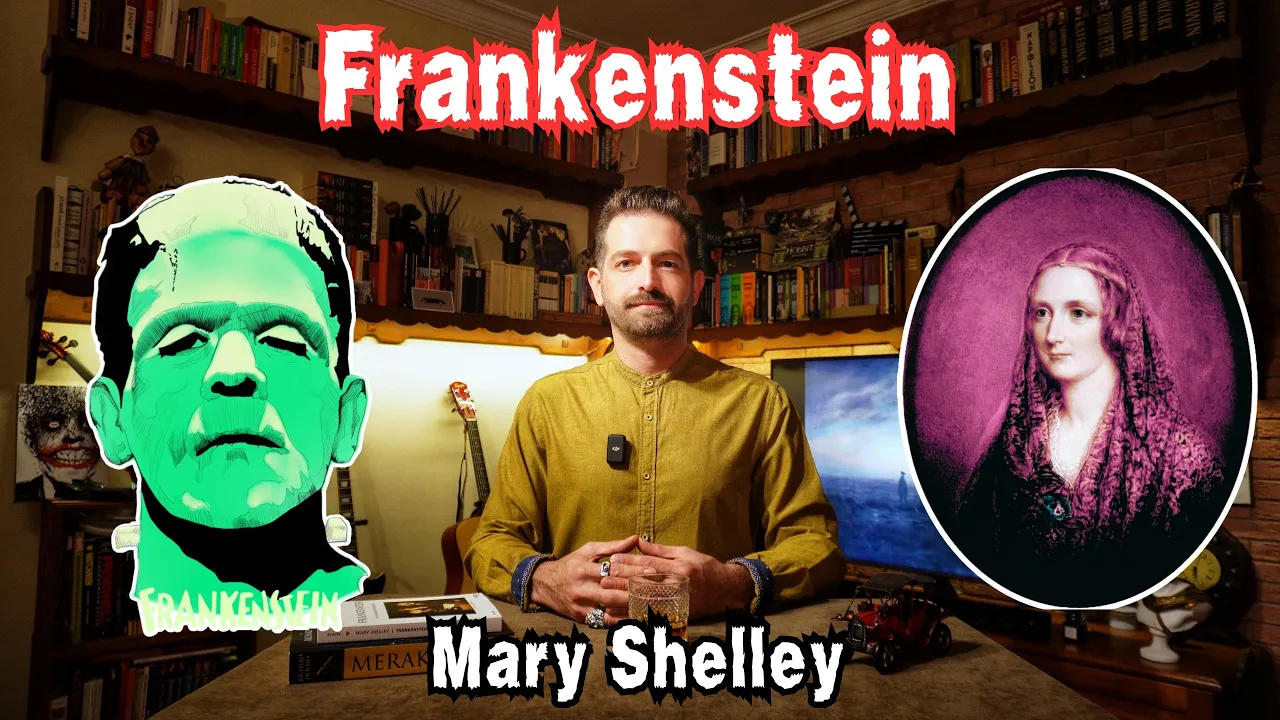












Mary Shelley's Frankenstein is fundamentally a feminist novel exploring the psychological horror of creation without maternity, where Victor Frankenstein's abandonment of his eight-foot-tall creature mirrors Shelley's own childhood experiences of maternal loss and rejection by her stepmother, ultimately revealing that the absence of nurturing maternal bonds transforms potential beings into monsters regardless of their inherent goodness.
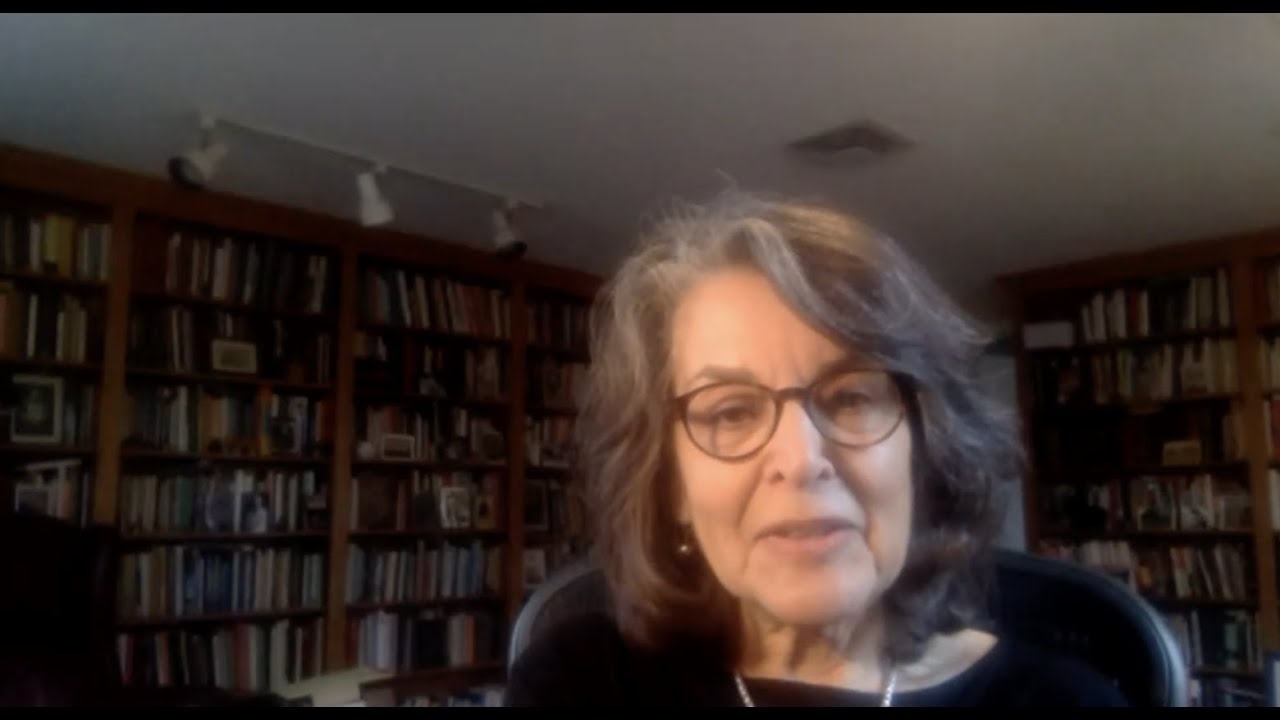
Mothering Monsters: Mary Shelley's Frankenstein | Anne K. Mellor Lecture
Added:A foundational understanding of the plot, characters, and major themes of Mary Shelley's 1818 novel, 'Frankenstein'.
Basic principles of feminist literary theory, particularly how patriarchal power dynamics and gender roles are analyzed in literature.
The historical and scientific context of the late 18th and early 19th centuries, including the Romantic movement's skepticism toward the Scientific Revolution's hubris.
Mary Shelley's biography, specifically her relationship with her mother (feminist philosopher Mary Wollstonecraft) and her personal experiences with pregnancy and infant loss.
An exploration of ecofeminism, examining how the domination of nature in 'Frankenstein' mirrors the patriarchal exploitation of the female body and natural processes.
The application of Shelley's critique to contemporary bioethics, reproductive technologies, and the ethical responsibilities of creators in artificial intelligence and cloning.
A comparative study of other Female Gothic literature to see how domestic entrapment, maternal anxiety, and the 'monstrous' are depicted by other female authors.
A psychoanalytic analysis of the Creature, focusing on the psychological development of an individual deprived of maternal bonding and parental recognition.
50.1K views1.5Klikes1:16:32Original Release: 2019-01-15
Welcome to the Ian Fletcher Memorial Lecture, an annual event honouring Ian’s focus in the fields of Victorian and 19th Century Studies.
One of my small regrets about being at ASU, and I had few of those, for those not withstanding, is that I never got a chance to meet Ian, and talking with Allan and others, he sounded like a positively marvelous man, and practically everybody who has ever come into this lecture knows his work well. So, I thank you for finding time to attend this event at the end of a busy and rather complicated semester for everybody. I am truly honoured to introduce this evening’s speaker, Anne K. Mellor, Distinguished Professor of Romantic Literature, Women's Studies, and Art and Literature at UCLA. Anne received her BA from Brown University and her MA and PhD in Comp. Lit. from Columbia University. I first encountered Anne’s work while writing my MA thesis on William Blake through her groundbreaking study titled, “Blake’s Human Form Divine,” which served to actually reorient Blake’s studies, and that work cast long shadows over my own Blakean efforts and still reads as fresh today as when it first emerged, in spite of your claims earlier today. For example, whenever I write on Blake, I return to my heavily annotated copy of her stunning book first. It is a real stunner. After the Blake book, she published a wide range of work that have literally revolutionized romantic studies, including English romantic irony, romanticism and gender, romanticism and feminism, and Mothers of the Nation, Women’s Political Writing in England, 1780 to 1830. Anne’s work, more than any other scholar, led to the resurrection and subsequent resurgence of important studies of neglected women writers and broke forever the “big six” approach to the field that dominated before her emergence. This effort peaked with the production of the best anthology of romantic studies currently available, British Literature 1780 to 1830, and for those of you who are taking my class this summer, it's the textbook that we’re using. Other works followed as her scope widened, including forging connections, women’s poetry from the renaissance to romanticism, and passionate encounters in a time of sensibility. She also edited Mary Willstonecraft's "Vindication of the Rights of Women," and "Muriah" or "The Wrongs of Women," as well as other works. Of course, what I’ve neglected thus far, are the works that intersect the topic of today’s talk on Mary Shelley. She offered Mary Shelley her life, her fiction, her monsters, and she co-edited approaches to teaching Shelley’s "Frankenstein," and the other Mary Shelley beyond "Frankenstein." She also produced editions of "Frankenstein" and "The Last Man." Through this work, she established herself, to state the matter directly, as the world’s leading authority on the life and work of Mary Shelley. Anne's efforts in the profession could function as the prototype for an exemplary career. She serves on the editorial boards on the most important journals in my field and beyond, including the MLA, European Romantic Review, 19th Century Contexts, 19th Century Literature, and Women’s Studies. She has directed 3 NEH summer seminars and has received 2 Guggenheim fellowships. She has also garnered fellowships from the American Council of Learned Societies, the NGH, and Rockefeller. In recognition of her energetic recasting of the field of romantic studies, she received in 1999, the highest award offered in my field--the Keats-Shelley Association Distinguished Scholar Award. However, Anne’s most important achievement, I would argue, actually doesn’t appear in any of her publications and awards. They are impressive, but she has been a tireless champion of emerging scholars, and has mentored two generations of students into our profession with an energy and intensity that continues to ripple through her diverse fields of endeavor. A brief side note, when I was looking up stuff just to make sure that I had everything right. Of course the inevitable Google search must ensue, and it goes on forever because after the first four or five pages, it’s simply books by young scholars, established scholars, older scholars in which she’s got essays, or people are citing her relentlessly. I finally gave up at 14 pages in. I hope you don’t mind. Actually, I mean this sincerely, she is beloved by literally everyone in my field as no other scholar before her, so please join me in welcoming Professor Anne Mellor, whose talk this evening is entitled, “Mothering Monsters: Mary Shelley’s Frankenstein.” [Applause] [Anne Mellor] Yes, lights off and the slide machine on, and the first image.
I just want to show you a few images of some of the people I’m going to be talking about tonight so you'll have some visual record of them, and then we'll come to the text of Frankenstein itself. Can you all hear me in the back?
Yes? Even way back over there? Okay. Let me know if you can't.
This is William Godwin. William Godwin was the leading philosopher in the late 18th century of political theory. He is the man who invented the concept of anarchism. He also was the man who argued that human beings could become perfect, could become gods, if they followed reason above all. And he is, of course, the father of Mary Shelley.
Her mother, Mary Wollstonecraft, author of the Vindication of the Rights of Women.
Leading feminist of the day. The woman who argued, really for the first time, that boys and girls should receive exactly the same education, that women were as capable of rational thought as were men, and that the ideal marriage, which she entered into with William Godwin, would be based on compatibility, affection, perhaps not quite as much sexual desire as goodwill. In fact, Mary Wollstonecraft’s notion of the perfect marriage is, first, you find the perfect roommate, and then after that, sex can be really exciting, but you gotta find a good roommate first.
This is the most famous portrait of Mary Shelley, daughter of Godwin and Wollstonecraft, christened Mary Wollstonecraft Godwin, done in her late 40s. At the age of 16, she elopes with the married poet, Percy Shelley. He abandons his wife and two children to go off to Europe with her. This is an image of her in her early 20s, a little after she completed Frankenstein, which she started writing when she was 18 years old, completes when she's 19. So those of you who are over 18, you gotta catch up here. [Laughter] This is the only image of the creature in Frankenstein that we know Mary herself saw. So, as I talk about Frankenstein tonight, I want you to think of this image, not Boris Karloff with bolts coming out of his head, not Robert De Niro with a face that looks sutured baseball, not a green creature. He’s actually a pretty handsome guy, and the engraver of this image was clearly thinking of Michelangelo's Adam from the Sistine Chapel ceiling.
So, to turn to the text now. Frankenstein is usually, historically anyway, has been read as primarily a story about a scientist who gives birth to a monster that ends up destroying its maker. I want to come back to the whole way in which he's thinking about science in this novel.
I want to start talking about the novel, first from a feminist perspective. From my perspective, as a feminist, this is fundamentally a novel about what happens when a man tries to have a baby without a [Laughter] woman, and clearly it all goes wrong. So, I’ll start first with that passage which this actually illustrates. The passage in Frankenstein when Victor Frankenstein, after gathering all the pieces of bodies, both from cemeteries and charnel houses, human pieces, but also from slaughterhouses--animal pieces, has put them together, has finally created a creature.
“It was on a dreary night of November that I beheld the accomplishment of my toils. With an anxiety that almost amounted to agony, I collected the instruments of life around me, that I might infuse a spark of being into the lifeless thing that lay at my feet. It was already one in the morning; the rain pattered dismally against the panes, and my candle was nearly burnt out, when, by the glimmer of the half-extinguished light, I saw the dull yellow eye of the creature open; it breathed hard, and a convulsive motion agitated its limbs.” Let me pause there and I want you to hear Mary Shelley’s language here. This is the imagery of giving birth, this is what happens after you give birth. If the child doesn’t start breathing immediately, you spank it so that it will breathe hard, a convulsive motion will agitate its limbs. Here’s Victor Frankenstein’s response: “How can I describe my emotions at this catastrophe, or how delineate the wretch whom with such infinite pains and care I had endeavoured to form? His limbs were in proportion, and I had selected his features as beautiful. Beautiful! -- Great God! His yellow skin scarcely covered the work of muscles and arteries beneath; his hair was of a lustrous black, and flowing; his teeth of a pearly whiteness; but these luxuriances only formed a more horrid contrast with his watery eyes, that seemed almost of the same colour as the dun white sockets in which they were set, his shrivelled complexion and straight black lips.” At this point, those of you who have read the novel know, Victor Frankenstein, after taking one look at this creature, and instead of finding it beautiful, and this is kind of a parody of Pygmalion and Galatea in classical mythology. Pygmalion set out to create a sculpture of the most beautiful woman possible and took pieces of different women, a nose from here, a limb from there, and then after he put her all together, fell in love with the sculpture. Then the gods intervene, and she comes alive and loves him back. Victor Frankenstein does the same thing, tries to create a beautiful, superior version of a human species, but takes one look at it, is terrified, runs away, runs to his bedroom, literally falls asleep, has a dream, and then suddenly is awakened because the creature has gotten up, followed him into the bedroom, and pulled aside the bed curtains. So then we hear: “I beheld the wretch -- the miserable monster whom I had created. He held up the curtain of the bed and his eyes, if eyes they may be called, were fixed on me. His jaws opened, and he muttered some inarticulate sounds, while a grin wrinkled his cheeks. He might have spoken, but I did not hear; one hand was stretched out, seemingly to detain me, but I escaped, and rushed down stairs.” What I’d like to observe here is that what the creature does is what you would expect an infant to do toward its parent. Reaching out to embrace it, inarticulate sounds--baby talk, smiles even. "A grin wrinkled his cheeks." Victor Frankenstein is horrified, and he runs away. So, the first question I wanted to explore with you is why? Why is it that Victor Frankenstein, after all, he spent nine months looking at this creature, we’re told that, “Winter, spring, and summer had passed away… to renew life where death had apparently devoted the body to corruption.” So, why is he so terrified?
One of the first things you observe, of course, is that Victor Frankenstein has no sense of identification with his creature. No maternal instinct, no sense of bonding with his creature. Never once during the nine months in which he has been putting it together has he ever stopped to ask himself, “Would this thing want to be created? Would it want to be born?” And the real problem, of course, is that he made this creature 8 feet tall because, as he says, “Bigger pieces are easier to work with than little pieces.” Now, to understand the horror of that for Mary Shelley’s readers. Nowadays, I think we may even have 8 feet tall basketball players. They're getting up at least into the high 7ft. A really tall man in Mary Shelley’s day was 5 foot 9 inches tall. So, you have to extrapolate up. So, this creature would be, today, somewhere between 11 and 12 feet tall. So, we’re talking about a huge giant--we would be looking up at this thing if he were here beside me, right up to the ceiling. So, keep that in mind.
What I want to suggest first about this novel is that the novel grows out of--the immediate origin of the novel comes out of Mary Shelley’s own anxieties about giving birth. We know that the novel emerged from a dream that she herself had. She tells us this in the introduction to the 1831 edition of the novel. The origin of the novel is perhaps as famous as the novel itself.
Percy Shelley, Mary, her stepsister Claire Clairmont, the poet Byron, and Byron’s doctor were all in Geneva in Switzerland in the summer of 1816. This is perhaps the one time that we can actually date a major literary event to a geological event. For those of you who are scientists, you may be interested to know that it was because the volcano Tambora erupted in the Indonesian archipelago in April of 1815. It threw so much ash into the air--40 tons of cubic material into the air--which then blew west over Europe. It was so cold in Europe that summer; the sun never shown, it snowed in England, and it was freezing in Switzerland. So, these 5 young people gathered together, had thought that they would spend the summer swimming, playing out in the lake, being outdoors. Instead, they were confined to the house. They were amusing themselves by reading ghost stories to each other. They decided when they finally ran out of ghost stories, to have a competition, that they would each try to write the most frightening ghost story possible. Percey Shelley goes off and writes a paragraph, then gives up, then writes a few lines of a poem, then gives that up. Byron doesn’t even bother. Claire Clairmont doesn’t bother. The other person that really took the competition seriously was Byron’s doctor, John Polidori, who actually wrote a short story called "The Vampire," which was published under Byron’s name, and is the origin of Dracula. So, both Dracula and Frankenstein come from this night. Mary Shelley tells us that they have been talking about the competition, “Night waned upon this talk, and even the witching hour had gone by, before we retired to rest." And this is not the origin of the novel. "When I placed my head on my pillow, I did not sleep, nor could I be said to think. My imagination, unbidden, possessed and guided me, gifting the successive images that arose in my mind with a vividness far beyond the usual bounds of reverie. I saw—with shut eyes, but acute mental vision, —I saw the pale student of unhallowed arts kneeling beside the thing he had put together. I saw the hideous phantasm of a man stretched out, and then, on the working of some powerful engine, show signs of life, and stir with an uneasy, half vital motion. Frightful must it be; for supremely frightful would be the effect of any human endeavour to mock the stupendous mechanism of the Creator of the world. His success would terrify the artist; he would rush away from his odious handywork, horror-stricken.
He would hope that, left to itself, the slight spark of life which he had communicated would fade; that this thing, which had received such imperfect animation, would subside into dead matter; and he might sleep in the belief that the silence of the grave would quench for ever the transient existence of the hideous corpse which he had looked upon as the cradle of life. He sleeps; but he is awakened; he opens his eyes; behold the horrid thing stands at his bedside, opening his curtains, and looking on him with yellow, watery, but speculative eyes. I opened mine in terror.” The question I want to ask first is, what terrified Mary Wollstonecraft Godwin, at this point she isn’t married to Percy, what terrified her so much about this image? To answer that question, I need to tell you a little bit about her biography. A year and a half before she has this dream, Mary Wollstonecraft Godwin, having eloped with Percy at the age of 16, gets pregnant immediately.
18 months before June 16th, 1816, she has a little baby girl--she gave birth prematurely to her, who she christened Clara, and who dies 2 weeks later. After that little girl dies, Mary has a recurrent dream that she records in her journal. “Dreamt that my little baby came to life again; that it had only been cold, and that we rubbed it before the fire, and it lived. Awake and find no baby.” So, already in her dream, she’s associating bringing the dead back to life with fire, a spark of life. Now, six months before she has the dream, she gives birth a second time, this time a little boy, who’s christened William. He’s born in January 1816. While she’s writing out the manuscript of Frankenstein, she’s pregnant for a third time from June until May 1817. That's when she's writing the manuscript. She finally gives birth to a third child, a little girl christened Clara Everina after the dead little girl. That daughter is born September 21st, 1817. What I wanted to suggest at this point is that this dream, and the origin of Frankenstein, rose out of Mary Godwin’s own deepest anxieties about giving birth. Remember, she’s very young--she’s only 18 years old, she’s not married, she’s been pregnant 3 times as she’s writing, and she’s experiencing, I think, the questions that any very young, unmarried, frequently pregnant girl would be asking herself.
Questions like, “What if my child is born deformed? A freak? Will I be able to raise a normal, healthy child? Will I be able to love my child? What if my child dies? How would I feel then?” Because not only of course had her first daughter died, but this was a time when there was an incredibly high infant mortality rate in Europe. At least 70% of infants did die within the first year of birth. In fact, of the 5 pregnancies Mary Shelley has in her lifetime, only one child survives to adulthood. Fifth question, “Could I ever want my child to die? Could I ever want to kill my child?” This, I think, is something that’s very hard for us to hear through the novel, but young women giving birth for the first time don’t always fall powerfully in love with their newborn infants. We’ve now medicalized this condition--we call it postpartum depression. There are many young women who simply do not bond with their newborn children. I think Mary Shelley is the only writer who actually understood that phenomenon, may even have experienced it herself, and unfortunately, we don’t have much in the way of support for these young women. We just say, “Oh, you’ll get over it, it’s a phase. You’ll come to love your child if you breastfeed it, if you spend enough time with it.” Some women never do come to love their children, and I think Mary Shelley is registering that possibility in this dream, in which the creator is horrified by his creation. And then the last question that she’s got to be asking herself with each of her pregnancies, “Could my child kill me because I killed my mother?” Mary Wollstonecraft died giving birth to Mary Wollstonecraft Shelley. So, Victor Frankenstein’s immediate, horrified rejection of his child at this psychological level expresses the hostility that some mothers either feel or are afraid of feeling toward their newborn infants. However, in the novel, as you’d know if you’ve read it, the author’s sympathies, identification; she starts out clearly identifying with Victor Frankenstein--she looks up in terror, he looks up in terror at the creature. But as the novel develops, her sympathies, her identification, shift--shifts away from the creator to the creature. And of course, what happens to this creature, after Victor Frankenstein runs away, he stands up, and goes out into the world alone, seeking comfort, seeking some sort of family. Of course, being 8 feet tall, being a huge giant, everywhere he goes, people take one look at him, are terrified, run away. At one point, he’s trying to save a drowning girl and her boyfriend comes along and shoots him because he’s convinced he’s trying to drown her rather than to save her.
So, what we’re getting at this level of the novel, I would suggest, is again deeply autobiographical. After Mary Wollstonecraft Godwin’s birth, and her mother’s death, William Godwin is left with not only a newborn infant baby girl to raise, but also a little girl who’s three years old who’s the daughter of Mary Wollstonecraft and a previous lover, Gilbert Imlay. A little girl known as Fanny, Fanny Imlay. So, Godwin does what a bachelor widower would do in England at this point. He rushes out, and hires a nanny to raise these two little girls. A woman named Louisa Jones. For three years, Louisa Jones is a devoted mother to these little girls, but when Mary is three, Louisa falls in love with one of Godwin's disciples, a man named George Dyer. Godwin doesn’t really approve of this disciple, partially because he’s a gambler, or he’s an alcoholic--he doesn’t want him hanging around the house. So, he gives Louisa an ultimatum: give up George, or leave. Louisa chooses to leave. At the age of three, Mary loses the only maternal figure she’s ever known, so once again, she’s motherless, she feels abandoned, rejected. Godwin then goes on a two year search to find another woman to care for these children. Then comes the day when Mary’s about five years old. Godwin’s living in a duplex in London, and there’s a balcony, and he’s out on his balcony. He looks over at the adjoining balcony, and there is a mature woman standing there. She looks at him, and she says, "Is this the divine Godwin that I behold?” To which he says, “Well, yes it is! Are you married?” It turns out Mary Jane Clairmont, as she called herself, she called herself a widow, although in fact she was never married, and had two illegitimate children of her own. Her two children are about the ages of Mary and Fanny. So, Godwin thinks this is ideal. Okay. They get married, and Mary Jane Clairmont, Mrs. Godwin and Mr. Godwin, proceed then to have a child of their own, a little boy whom they call William. If you read Mary Shelley’s journals, letters describing this period of her life, it’s as though she’s Cinderella with a wicked stepmother. Mrs. Godwin clearly treated her badly; always favoured her own children at the expense of Wollstonecraft's children, was particularly hostile to Mary because any time any famous person came to the Godwin household, the only child they ever wanted to meet was the daughter of Godwin and Wollstonecraft--they didn’t care about Mary Jane Clairmont’s children. In fact, Collridge came and asked to meet Mary, and read her the Rhyme of the Ancient Mariner when she was eight years old. So, Mary grows up feeling really rejected, disliked, her stepmother won’t let her have lessons--she gives special French lessons to her own daughter, but she won’t give them to Mary. Although Mary, I have to say, does get an excellent education from Godwin. Because Godwin is basically going to go on to be a major philosopher, but he is willing to teach his children.
He gives them homework assignments, and everyday they get two hours in his study where they go over their homework with him.
She learns--she’s clearly brilliant--but she learns an enormous amount from Godwin.
Emotionally, she feels completely rejected, just like the creature. In fact, her rejection becomes so deeply psychological and psychosomatic that when she’s 12 years old, she comes out with boils all over her body. They send her to the seaside to cure her, and as long as she’s away from her stepmother, she’s fine. She gets better in 3 to 4 weeks. Comes back home, and immediately starts fighting with her stepmother again.
Just at this point, Godwin gets a letter from one of his fans. Someone’s he’s never met. A man named David Baxter, who lives in Dundee, Scotland. David Baxter writes to him and he says, “I am a wealthy man, I have a large family, I live in Dundee, which is 600 miles away from London, and I read your works all the time, I admire you enormously. If there’s anything I can do for you, just let me know.” Godwin immediately writes back and says, “By the way, there is something you can do for me. I have a daughter who’s causing me a great deal of trouble--can I send her to you?” And David Baxter says, “Well, of course.” And so, Mary is shipped off at the age of 14 all by herself, 600 miles, to Dundee, alone, to stay with a family that are total strangers to her.
She spends 2 years there, sort of looking in on this happy family where she feels welcomed, but still, they aren’t her family. Remember that in the novel, the creature, after he leaves Frankenstein’s laboratory, goes out, wanders through the woods, and finally find a family--the De Lacey family, living in a cottage in the woods, and he spends literally 2 years looking through a keyhole at this family, learning how to speak because they were in the process of teaching a foreign woman, Safie, who’s joined them, teaching her how to speak French, so he learns how to speak perfect French. He brings them gifts of firewood, which he leaves for them, but then of course, finally, at a certain point, wants to introduce himself to this family. Let me come back to that in a moment. There were some other parallels between the creature and Mary that are recorded in the novel. Beyond this experience of rejection, looking at a happy family. When the creature rushes out of the laboratory, he’s naked, of course. He grabs Victor Frankenstein’s cloak, which is hanging on a hook.
In this cloak, which much have had voluminous pockets, there are many books, which the creature proceeds to read. These are the books that Mary Shelley is also reading as she writes out Frankenstein. So, they both read Paradise Lost, they both read Plutarch’s Lives of the Noble Romans, they both read Goethe’s Sorrows of Young Werther--they both get the same education. They also both read about their own moment of conception. In Victor Frankenstein’s lab cloak are his lab reports, so the creature can actually read the whole story of his creation and the moment when the spark of life, which can be the fire or electricity, brings him to life. Godwin kept a diary of all the time that he was dating Mary Wollstonecraft before they actually moved in together. They didn’t get married until she was five months pregnant, but all the time that they were interacting with each other, every time they spent a night together, he would put it in his diary. “Shay L” if it were her place, “Shay Wah” if it’s his place. We now know from the brilliant detective work of William Saintclair, that every time they had sex, he would put a little dot after Shay Wah or Shay L. So, Mary could actually figure out the exact night of which she was conceived.
The other thing that she clearly shares with the creature as he goes out into the world is the sense of having no role model, no one she can imitate, no one that she belongs to, no one that she can rely on. The argument that I want to make first about the novel is that, at the psychological level, the creature’s experience, this experience of rejection, abandonment, isolation, articulates Mary Shelley's deepest fear about herself. That since she was also an unloved, abandoned, rejected child, that she might grow up to become a monster. This is what the creature keeps saying throughout the novel. “I was benevolent and good; misery made me a fiend.” It's only, of course, when the creature is finally rejected by the De Lacey family. If you’ve read the novel you’d know that Father De Lacey, and this is very significant, is blind. So, the creature waits for a moment, two years, when father De Lacey is alone. He’s got a son named Felix and a daughter named Agatha living with him, and they are joined by Felix’s girlfriend, Safie. He waits for a moment when all the children are out of the house, and then he goes to introduce himself to father De Lacey because he already knows that there’s something about his appearance that upsets people. Father De Lacey responds entirely positively--the creature speaks like a French gentleman. Father De Lacey welcomes him, says that he’s welcome to stay in the family, to be a guest under their house. But at that moment, Felix comes back in, sees this giant bending over his father, immediately assumes the giant is about to hurt his father, grabs his father, and races away. That’s the point at which the De Lacey family leaves the novel, and it’s also the point at which the creature performs his first act of violence. Disappointed, he sets fire to the De Lacey cottage and dances around it.
He then decides that a strange family isn’t going to welcome him, he’s got to go back to his own parent, Victor Frankenstein, and demand some sort of family relationship, some sort of companionship from his maker. On the way to Geneva to finding Victor Frankenstein, the creature runs into a little boy with blonde hair and blue eyes, who immediately calls him an ogre, but also announces that he is the son of Alphonse Frankenstein. The creature then immediately recognizes that this little boy is a member of his own family--he’s Victor Frankenstein’s youngest brother. And so, he reaches out, and his motivation in the novel is to adopt this child, make him a member of his family. He reaches out and embraces him, but in embracing him, kills him. This is the moment in the novel where, for the first time, we lose identification--sympathy--with the creature. It’s this moment in the novel when Mary Shelley registers her own deepest fear about herself--that she is capable of imagining herself killing her own child. Because little William Frankenstein, William. That name is overdetermined. It’s a patricidal act, killing off William Godwin. It’s a fratricidal act, killing off the stepbrother, half brother, William Godwin, who had become the nexus of the Godwin household, who displaced her. And it’s also, of course, a matricidal act. She is imagining the murder of her own son. Because little William Shelley has exactly the same blonde curly hair and blue eyes that little William Frankenstein has in the novel, and more to the point, both of those two little Williams, William Shelley and William Frankenstein, have a best friend, a little girl who’s last name is Byron. In the case of William Shelley, it’s Claire Clairmont’s daughter by Byron, by the poet Byron. In the novel, it’s simply a friend named Byron. So, what Mary Shelley is doing at this moment is recognizing the deepest fear she has about herself and a case sydrome that we are now familiar with--that a battered child might grow up to become a battering parent. That, if a child is not loved, not mothered, not nurtured, it can become a monster. This, afterall, is what the creature says over and over again. He says, “I was benevolent; my soul glowed with love and humanity: but am I not alone, miserably alone?” And then he goes on, “My vices are the children of a forced solitude that I abhor, and my virtues will necessarily arise when I live in communion with an equal.” But of course, as you know, Victor Frankenstein, even after the creature finds him and demands that he be given an Eve for his Adam, that Victor Frankenstein create a female companion for this male creature. Victor Frankenstein, after all, initially, is responsive to this play. For the first time in the novel, and we’re about halfway through, he acknowledges that he has some responsibilities for his creature, that perhaps he should create a female companion for him. He starts the process--he goes to England so he can find out from the latest cutting-edge science on midwifery there how a female womb is constructed, and then he goes to an island off the coast of Scotland, the Orkney Islands, and starts assembling a female creature, a companion for his male. But then, halfway through this process, he suddenly stops, and rips up the female that he's been creating. I just wanted to read that passage to you, and as I read, the question I want to propose here is, what is it that Victor Frankenstein is really afraid of?
“I was now about to form another being, of whose dispositions I was alike ignorant; she might become ten thousand times more malignant than her mate, and delight, for its own sake, in murder and wretchedness. He had sworn to quit the neighbourhood of man, and hide himself in deserts; but she had not; and she, who in all probability was to become a thinking and reasoning animal, might refuse to comply with a compact made before her creation.
They might even hate each other; the creature who already lived loathed his own deformity, and might he not conceive a greater abhorrence for it when it came before his eyes in the female form? She also might turn with disgust from him to the superior beauty of man; she might quit him, and he be again alone, exasperated by the fresh provocation of being deserted by one of his own species. Even if they were to leave Europe, and inhabit the deserts of the new world, yet one of the first results of those sympathies for which the daemon thirsted would be children, and a race of devils would be propagated upon the earth who might make the very existence of the species of man a condition precarious and full of terror. Had I right, for my own benefit, to inflict this curse upon everlasting generations?” What is it that Victor Frankenstein is truly afraid of here? I don't think it’s that he’s afraid of inflicting pain on others. I think what he’s really afraid of is the fact that he might create a woman who might be independent, refuse to obey a compact made before her creation, a woman who would be angry, sadistic, not just twice as malignant than the male creature, but 10,000 times more malignant than the male creature. A woman who would be ugly, a woman who would be lustful, who might prefer the “superior beauty of man,” in which case, the man standing right there, who she might prefer would be Victor himself, and since she would be 8 feet tall, and he’s only 5’4’’, she would be able to work her will, her sexual will and desire upon him. And finally, of course, he's afraid of her reproductive powers, the fact that she can give birth to a race of like creatures. What I want to suggest here is that what Victor Frankenstein is really afraid of is an independent female sexuality, a female sexuality that’s not controlled by men. Because, remember, in the 18th century and all the way through the 19th century and most of the 20th century, males could never know for sure that their sons were their biological sons unless they controlled their partners, their wives' sexual practices.
Now, we have DNA, but before DNA testing, they could never know. So, what they would do, of course, is to confine their women. Confine them in the private sphere, not allow them to go out into public, keep them under lock and key. One of the interesting things to think about is the way that women in 18th and 19th century Europe in the novel are represented. They are all represented, the women of the Frankenstein family and even beyond, represented in effect without powerful sexual desires.
Victor Frankenstein’s mother marries the best friend of her father, Victor Frankenstein himself is engaged to a woman who’s been raised in his own household as his sister, sister named Elizabeth Lavenza. And even the De Lacey family--Safie, who comes across thousands of miles by herself, and that’s the homage to Mary Wollstonecraft in the novel, to be with her lover, Felix, we never even see them kiss. They just hold hands once. So, what I’m suggesting here is that Victor Frankenstein’s anxiety about female sexuality is characteristic of the entire culture of which he lives, and it’s what motivates his entire scientific project. What Victor Frankenstein really wants to do in this novel is to eliminate the need to have females because if males can produce males generation after generation, you simply don’t need women, females. That aspect of Victor Frankenstein’s project is something that Mary Shelley is acutely aware of, because when Victor Frankenstein runs away from his creature, runs back to his bedroom, falls asleep, has a dream. Let me read you the dream. “I slept, indeed, but I was disturbed by the wildest dreams. I thought I saw Elizabeth, in the bloom of health, walking in the streets of Ingolstadt.
Delighted and surprised, I embraced her; but as I imprinted the first kiss on her lips, they became livid with the hue of death; her features appeared to change, and I thought that I held the corpse of my dead mother in my arms; a shroud enveloped her form, and I saw the grave-worms crawling in the folds of the flannel.” What Victor Frankenstein really desires is DEAD females, and after he tears up the female creature, it’s an image that the novel presents almost as a kind of rape, recall, “trembling with passion, I tore to pieces the thing on which I was engaged,” then, he comes back the next morning, “The remains of the half-finished creature, whom I had destroyed, lay scattered on the floor, and I almost felt as if I had mangled the living flesh of a human being.” After he tears up the female creature, the next major event in the novel, of course, the creature was observing the creation of the female creature, and when he sees Victor Frankenstein destroying the female, he says, “I will be with you on your wedding night.” Victor then goes back home, marries Elizabeth. On their wedding night, you would expect Victor to be in bed with his bride in their honeymoon suite, but instead, Victor leaves his bride alone to go out and patrol the boundaries of the hotel where they’re staying. Victor assumes that when the creature says, “I will be with you,” narcissistic egotist that he is, that the creature means only Victor, but of course, we would assume, if someone were to join you on your wedding night, it’s you plural. So, of course, the creature comes in and kills Elizabeth in retaliation for the loss of his partner. It’s at this point in the novel, and it’s the only time in the novel, that Victor embraces Elizabeth with “ardour” only after she’s dead. “She had been moved from the posture in which I had first beheld her; and now, as she lay, her head upon her arm, and a handkerchief thrown across her face and neck, I might have supposed her asleep. I rushed towards her, and embraced her with ardour; but the deathly languor and coldness of the limbs told me that what I now held in my arms had ceased to be the Elizabeth whom I had loved and cherished.” The first part, I was arguing that Victor Frankenstein's project and the origin of the novel grows out of Mary Shelley’s anxieties about giving birth, but also out of a patriarchal fear of female--independent female sexuality.
Victor wants to, in a spect, destroy the mother by becoming the mother.
In the second part, I want to look at the science that lies behind this novel. Because it’s also a novel clearly about modern science, and about the dangers of modern science. And so, first, we should think a little bit about what science Mary Shelley actually knew. She was clearly no scientist herself. Victor Frankenstein’s extraordinary experiment takes place, as far as we can tell, entirely in an attic, lit by a single candle. But, I would argue that she had a very sound grasp of the cutting- edge science of her day, that she had learned this first from Godwin, then from many people who had visited Godwin who were scientists, then finally from Percey Shelley, who was obsessed with science. So, there are three scientists that actually lie behind this novel whose research she’s drawing on. The first is Sir Humphry Davy. He was the founder of the Royal Academy of Science in England. You may know him today as the creator of the Miner's Lamp. The Davy Lamp. Humphry Davy is the model for Victor’s science teacher in the novel, for Professor Waldman.
Davy had published a pamphlet called “A Discourse Introductory to a Course of Lectures on Chemistry” in 1802, which Mary Shelley had read, virtually memorized, and Professor Waldman’s lectures are drawn from this. Davy makes a claim for the chemist, or the field of chemical physiology, which is the claim that Victor Frankenstein is inspired by and he’s trying to live up to.
This is what Davy says. Chemistry, the new field of chemistry, has bestowed upon the chemist "powers which may be almost called creative; which have enabled him to modify and change the beings surrounding him, and by his experiments to interrogate nature with power, not simply as a scholar, passive and seeking only to understand her operations, but rather as a master, active with his own instruments.” There are two important things in that passage that I want you to hear. First of all, Davy is engaging in a sexual politics, that for him, the scientist is a male, a master, and nature is female. Nature is something that the master scientist, as professor Waldman says, the modern masters of this science penetrate into the recesses of nature, and show how she works in her hiding places.” But more important, Davy’s making a distinction between two kinds of science. On the one hand, what we might call interventionist science--a science that seeks to actively change the way that nature works, and for Davy, this is what scientists ought to do. In opposition, there’s what we might call descriptive science, science that simply tries to describe or analyze how nature works. For Davy, this is passive science, scholarly science, bad science--or at least inferior science. I would suggest that for Mary Shelley, it’s the opposite.That interventionist science is highly problematic, and passive science, descriptive science, is good. For her, the positive scientists that lies behind this is Erasmus Darwin.
Erasmus Darwin is the great uncle of Charles Darwin, and you all know Charles Darwin is the father of the theory of evolution. How many of you know that Erasmus Darwin is the father of the theory of evolution? Three, okay. I always like to point out to English majors that Charles Darwin gets all the credit for his great uncle’s discoveries because he could write better. Erasmus Darwin published all his accounts and experiments, in which he described quite thoroughly, of the theory of evolution through sexual selection, through random mutation, through survival of the fittest. He described all this in the form of footnotes to a very long, very bad poem. Two huge volume poems called The Botanic Garden, or The Love of the Plants. Nobody reads it, and therefore, nobody reads the footnotes. But his great nephew read the footnotes religiously, and set about finding more evidence to prove them by going to the Galapagos, and then published his findings in clear, lucid prose, so he gets all the credit.
Sometimes writing is more important even than discovery.
But, Erasmus Darwin, who Mary Shelley had read, she read The Botanic Garden, what she learned that’s relevant to the novel is two things. First of all, according to Erasmus Darwin, evolution proceeds up an evolutionary ladder from single-sex propagation, the division of amoebas, to dual-sex propagation, males and females. So, in effect, Victor Frankenstein is anti-evolution--he’s going down the evolutionary ladder backwards from dual-sex propagation to single-sex by combining animal and human parts, and doing it. He’s also claiming that he’s creating a new species. According to Erasmus Darwin, that’s impossible; you can’t have a new species just created.
One species evolves out of previous species through mutation. Darwin is all descriptive science, he’s simply just telling us how nature has worked through time.
The last scientist that lies behind this is Luigi Galvani. Galvani, you would know, if you know at all, is galvanized rubber, rubber through which electricity has been run. Galvani was trying to prove that life force and electricity are the same. So, what he was doing, this was late 18th century, he was a professor of science at the University of Bologna, the oldest university in Europe. If you go to Bologna, you have to be sure to see the sculpture of Luigi Galvani that stands in the courtyard right in front of the university. Because what Galvani was doing was running electrical charges through dead animals in order to reanimate them. His speciality was frogs: get a dead frog, run a charge of electricity through it, and it’ll get up and hop away. So, in the sculpture, he’s standing there, and he’s got his book of knowledge that’s open in front of him, but look carefully, there’s a dead frog in the book. So, Galvani is electrifying frogs, and he’s also moving on to cows. Finally, his nephew, Giovanni Aldini, comes to London--this is in June 1803--and decides to do the ultimate Galvani experiment--to run electricity through a dead human corpse. So, Aldini collects the dead body of a recently hanged criminal from Newgate Prison, a man named Thomas Foster, takes him to an operating theater, and proceeds to run ever-stronger charges of electricity through his corpse. At the first charge, Thomas Foster, he recounts this later, opened his eyes, clenched his fists, and his entire body went into convulsions. He then increases the electrical arch of the charge, and finally concludes, “The actions, even of those muscles, furthest distance from the points of contact with the electrical arch, was so much increased as almost to give an appearance of reanimation.” And then, the final sentence, “Vitality might perhaps have been restored if many circumstances had not rendered it [Audience laughs] impossible.” I just wanted to call your attention, this is cutting edge science that Victor is doing. This is the latest, cutting-edge experiment on electricity, and of course, Victor Frankenstein is using a spark of light, an electrical spark, to animate his creature.
Part 3. In Mary Shelley’s novel, Victor Frankenstein does not succeed in his scientific project. Does not succeed in becoming the creator of a new race of Supermen, a species, which as he says, “Would bless me as its creator and source; many happy and excellent natures would owe their being to me. No father could claim the gratitude of his child so completely as I should deserve their's.” Now, I would like to suggest that the reason why his experiment failed is because Mother Nature fights back. Fights back first by cursing Victor Frankenstein with diseases. All the time that Victor Frankenstein is carrying out his creation, both the male creature and the female creature, he gets sick. He gets physically sick, he gets mentally sick. In fact, after the creation of the male creature, he has a total nervous breakdown, and he has to get his best friend to come and nurse him back to health, which takes 6 months. Finally, he is so overwhelmed by disease that he dies of natural causes at the age of 26. Secondly, Mother Nature pursues Victor Frankenstein with the very elements that he tried to steal from her. I like to suggest that all the atmospheric events, all the effects in the novel, which we think of as the paraphernalia of gothic novels or gothic films, all the lightning, thunder, and rain that occurs all during Victor Frankenstein’s constructions of his creatures. All that is there, not just as a background, it’s there to remind us of the elemental power of nature--that she has the capacity to pursue Victor, just as he’s been trying to pursue her to her hiding places.
It's almost as though if you think back to the Greek tragedy like Orestes, those spirits that pursue Orestes, that’s going on in this novel as well. Thirdly, Mother Nature punishes Victor by depriving him of any kind of maternal instinct, parental instinct--instinct to bond with his own child. Finally, she punishes him by making it impossible for him to procreate his own natural children by having his creature kill his fiance on their wedding night. At this level, clearly, the message of the novel is those who violate Mother Nature will be killed.
I don’t want to end there. Fourth part. I think, implicit in this novel is an alternative idea to Victor Frankenstein’s project. His project is to control nature, change her, and eliminate female sexuality. What I think Mary Shelley is trying to suggest in this novel is an alternative to that. I think she believes that civilization can be improved--the human species can be improved only by people who value and cooperate with nature. I think it’s very important that the only member of the Frankenstein family who is literally alive at the end of this novel is Victor’s brother, Ernest.
The only thing we know about Ernest is that his father wanted him to be a lawyer, but he refused and insisted instead on becoming a farmer, and farmers, of course, are people who have to collaborate with nature in order to survive. The best model for this natural collaboration in Mary Shelley’s view, I think, is the nuclear family, but it’s a nuclear family that is grounded on a mutually loving, mutually respecting, egalitarian family dynamic. This is the way in which Mary Wollstonecraft’s ideal of the companion at marriage gets into Frankenstein.
The De Lacey family is a gesture in that direction, but notice that the De Lacey family lacks a mother. Although they’re a happy family, as their names suggest; Felix, the son, “happiness”; Agatha means goodness; they’re joined by Safie, sofia--wisdom.
Although they move in that direction, even they lack in the maternal embrace of a mother, and hence, they disappear from the novel. What I'm suggesting here is that Mary Shelley wants to endorse what nowadays we would call an ethic of care, a society and morality in which the needs of everyone in the family are met, are acknowledged, and nurture is met. She wants us to see that when the nurturing love of a mother is absent, that is when monsters get made. Also, when someone places higher value on their work than they do on the domestic affection and their human relationships, that’s also when monsters get made. And she says this, actually. In a passage in the novel, which is in Victor Frankenstein’s voice, but I think comes as close to anything in the novel to articulating Mary Shelley’s own view. She says, “A human being in perfection ought always to preserve a calm and peaceful mind, and not to allow a passion or a transitory desire to disturb his tranquility.
I do not think that the pursuit of knowledge is an exception to this rule. If the study to which you apply yourself has a tendency to weaken your affections, and to destroy your taste for those simple pleasures in which no alloy can possibly mix, then that study is certainly unlawful, that is to say, not befitting the human mind.” Now, if we could have the slides up. This passage goes on, and it goes on to make a really important political point. She goes on to say, “If this rule were always observed; if no man allowed any pursuit whatsoever to interfere with the tranquillity of his domestic affections, Greece had not been enslaved, Caesar would have spared his country, America would have been discovered more gradually, and the empires of Mexico and Peru had not been destroyed.” There’s a powerful political argument going on all through Frankenstein, and it has to do with the French Revolution.
You can see the creature as the embodiment of the history of the French Revolution, starting out as the belief of the innate goodness of human beings, but then moving through the terror, becoming frightening. This is why I wanted to show you this slide.
The subtitle of the novel, of course, is Frankenstein, or the Modern Prometheus. Frankenstein, like the Greek hero, Prometheus, stole fire from the Gods to give to man. She wants to suggest, following this print by Cruikshank, that the true modern prometheus of her day was Napoleon. This is Napoleon, who has stolen the innate ethic of justice from the origins of the French Revolution, profited from the terror, and reinscribed a tyranny. So, the image is the downfall of tyranny, the downfall of the modern Prometheus of Napoleon at the hands of justice. Mary Shelley, too, wants to say that the problem of the French Revolution is that the original thinkers, the revolutionary thinkers, the Japanese, did not make room in their new Republic, their egalitarian-democratic republic, they did not make room in it for the aristocrats, the Roman Catholics, the King and Queen. Instead, they executed them by the guillotine, and thereby transformed what could have been an improved social organization into a tyranny.
I think, she wants to draw an analogy between that political argument and her scientific argument. She wants to suggest that scientists also have to take responsible for the predictable consequences of their research. They have to take political and ethical responsibility. This is the most pressing aspect of the novel in the way that it speaks directly to what's going on at this very moment. This is keenly on my mind because UCLA is very much on the forefront of this scientific research.
The Human Genome Project and germline engineering, stem cell engineering--how many of you are familiar with this? What stem cell engineering does, as you know, is that it alters DNA forever. It alters the DNA of a pre-fertilized egg that’s then implanted, and then goes on. I went to a conference in 1998, it was the first conference of it’s time, called Engineering the Human Germline at UCLA. All the guys were there--Craig Venter of the Human Genome Project, Watson of Watson and Crick. They’re saying why we should alter germlines, why we should engage in stem cell engineering. The first thing they want to do is to eliminate genetic diseases; SAX Disease, Huntington's Disease--that sounds fine.
Then, they go and say they want to eliminate mental diseases, like Bipolar Disorder. So, of course, I’m thinking to myself, “Okay, there goes Virginia Woolf, there goes Van Gogh, there goes Proust.
Maybe we want to think about this some more?” Then, they go, “Of course, we want to improve attractiveness.” I think, “Who gets to decide? Emotional stability? We’re really into Brave New World at this point.” Finally, they wanted to eliminate all the natural causes of aging. And I'm thinking, “Oh, my God, we’re all going to living to 150, 200.” In fact, when the audience was asked on how many of them would do this for their unborn infants, 99% of the people in the audience said, “Of course we would do this if we can afford it.” The only person who objected was someone from social security saying, “Have you thought about the implications for social security?” And I objected because I saw them all as one little Frankenstein after another. This project creates a perfect human species that would live forever.
The latest wrinkle in this, and this is the conference that I went to last year, is called Babies by Design. Women who do ex-vitro fertilization, which of course, more and more women do because as they get into their late 30s early 40s, they’ll produce many eggs, usually as many as 2 a dozen. Then, they have to decide which eggs to have implanted. Luckily, they’re not all octo-moms, they don't want all eggs implanted. So, they do genetic diagnoses of the eggs, it’s called Preimplantation Genetic Diagnosis. What they’re going to do is to screen these eggs to eliminate genetic diseases, but also to eliminate things like congenital deafness, blindness, bowel syndrome, dwarfism. One of the members of this panel was Paul Miller. You may know him, he’s a dwarf, he’s been the leader of the Americans with Disabilities Act movement in America, and has had the most impact on Congress in this regard.
Paul Miller got up, and he said, “You do have to realize, from the point of view of the communities of the deaf, the blind, dwarves--this is tantamount to a Holocaust.” Think about that. That’s Victor Frankenstein’s project, alive and well, UCLA right now. So, think about it in terms of bioethics. There’s also an argument in this novel about race. Because the creature is not just a giant, he’s a yellow skin giant. This is my own version of the creature, coloured for your benefit. What I wanted to call you attention to is the fact that Mary Shelley is making a comment about race in the novel. When she gives the creature long flowing black hair and yellow skin. The yellow skin is not jaundice, it’s not disease--it’s a racial marker. She had been reading Blumenbach, who developed our current classifications of the 5 races of man. Caucasian, white, and yellow would be Asian. So, for her, this creature is clearly marked as an Asian. Walton, who picks up Victor Frankenstein at the North Pole, who sees the creature at a distance, says, “He is not a European.” The creature thus represents the advent of someone of another race into the European culture, and I think contributes to Victor Frankenstein’s fear. What I want to suggest then, finally, is that the argument of this novel, the implicit argument, is that we have to learn how to embrace Mother Nurture, even that which is radically different from ourselves. Even if it’s an 8 foot giant, even if it’s a member of another race, even if it is someone who is categorically different. If we don’t embrace them, if we respond to them in fear as Victor Frankenstein does, then we write them as monstrous, and if we write them as monstrous, we are the authors of monstrosity--we create the monsters that we describe. So, I wanted to leave you the last image, the alternative to Victor Frankenstein’s reaction. This is Diane Arbus’s famous photograph of the Jewish giant at home with his parents in the Bronx. Thank you.
Up Next

29:21
Wilkie Collins Novels: A Complete Literary Analysis and Ranking
@jenniferbrooks
6.2K views•2023-10-31

13:43
Formalism in Literary Criticism: An Academic Lecture Overview
@mattalberhasky9952
39.1K views•2015-08-05

6:08
Point of View in Fiction: First Person vs. Third Person
@magicalthriftyteacher
153.8K views•2014-03-31

15:25
1984: Orwell's Dystopian World and the Mechanisms of Totalitarianism
@AlternateHistoryHub
7M views•2017-03-04
Related Study Plans & Knowledge Roadmaps
Structured learning paths in Literature
literature
Graphic Memoirs: Visual Art, Trauma & History
01Foundations of Sequential Art and Visual Language
02Autographics and Processing Historical Trauma
03Visualizing Personal Trauma, Grief, and Graphic Medicine
+ 2 more learning modules
14h5 modules
Explore Roadmap
literature
Campus Novels: Evolution, Themes & Critique
01Introduction to the Campus Novel Genre
02Mid-Century Satire and the Post-War Academy
03Dark Academia and the Critique of Privilege
+ 2 more learning modules
14h5 modules
Explore Roadmap
literature
Theater of the Absurd: Philosophy & Plays
01Postwar Existentialism & Historical Roots
02Dismantling Narrative: Esslin & Absurdist Conventions
03Samuel Beckett and Tragicomic Existentialism
+ 2 more learning modules
12h5 modules
Explore Roadmap
literature
Revenge Tragedy: Justice, Madness & State
01Foundations of Early Modern English Theatre
02Anatomy of Revenge: Structural Conventions
03Psychological Complexity: Madness and Melancholy
+ 2 more learning modules
15h5 modules
Explore Roadmap