















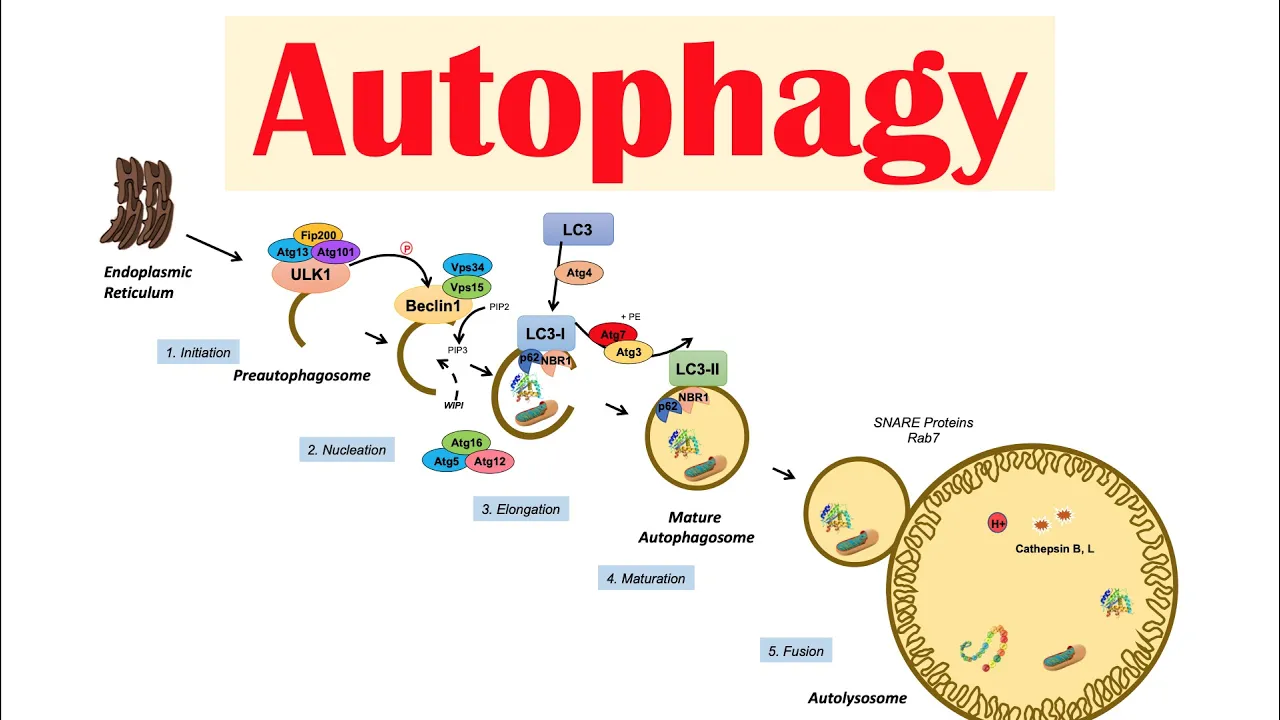



Autophagy is a fundamental cellular process that degrades damaged organelles and misfolded proteins through a highly regulated pathway involving the ULK1 complex, class III PI3K complex, and LC3-II conjugation system, with its activity controlled by nutrient-sensing kinases like mTOR and AMPK that respond to cellular energy status; this process is critically important for neuronal health and is implicated in neurodegenerative diseases such as Parkinson's disease, where impaired autophagy leads to accumulation of toxic protein aggregates.
Autophagy Lecture: Molecular Mechanisms Explained in Depth
Added:Fundamental cell biology, specifically the structure and function of lysosomes, mitochondria, and the endoplasmic reticulum.
Basic intracellular signaling concepts, including kinase phosphorylation cascades and the opposing roles of mTOR and AMPK in cellular metabolism.
The mechanics of vesicular transport, membrane remodeling, and fusion events within the endomembrane system.
An understanding of the ubiquitin-proteasome system (UPS) as the primary alternative pathway for intracellular protein degradation.
Clinical applications of autophagy modulation, including the development of autophagy inhibitors and activators for cancer oncology and neurodegenerative therapies.
The molecular pathology of mitophagy defects in Parkinson's disease, specifically focusing on the PINK1 and Parkin pathway.
Other forms of selective autophagy, such as xenophagy (targeting pathogens), pexophagy (peroxisomes), and lipophagy (lipid droplets).
Experimental methodologies for measuring and monitoring autophagic flux, such as LC3 lipid conjugation assays and tandem fluorescent mRFP-GFP-LC3 reporters.
26.2K views564likes1:19:31Original Release: 2017-07-10
hi everyone my name is AJ Keith in this presentation I'm going to be reviewing Auto Fiji in graduate level detail I originally made this presentation for myself and to simply review ontology but I decided to upload it for other students I'd recommend pausing the video at each new slide and reading through it and soaking in the information beforehand if you have any questions at all anything please please let me know in comment I love talking about molecular biology and it will most definitely respond also if I get anything wrong or if I need to clarify also please comment and let me know anyways I hope you guys enjoy the video and I hope you learn a ton this is a a rough summary of what I'll be covering so I'm going to be spending most the time covering pre-initiation and nucleation aspects of etapa G because they are by far the most complex most highly regulated steps I'll touch on transport mechanisms and lysosomal fusion pren I'm going to provide some context of otology by covering my tofu G and a graph of G and also CM a or chaperone mediated otaku G and finally I'll finish with why this whole process is so interesting and connection to neurodegeneration and other diseases the pre-initiation stage is governed by this one complex it's responsible for activating the auto Pejic membrane nucleation phase that is coming next so Oakland is a critical protein that basically synthesizes all kinds of information and serves as the master regulatory hub and decision maker of otology for example the Oakland complex is able to respond to glucose and in general ATP a MP concentration ratios through the ampk or a MP kinase general starvation and stress signaling through m torque amino acid levels through Susteren and gator and also through GC n 2 and directly and Isetta is an incredibly important post trans translational modification that Prime's various auto Pejic proteins for autopsy and is mainly orchestrated by this tug of war between cert deacetylases and the p300 acetylase don't worry if all this seems like a lot I'm gonna be going through each one of these topics individually and discussing how they each each of these topics contributes to the activation of the old one complex before going any further I just want to recognize and highlight some of the basic components of the pre-initiation complex so by far the most important player is oak one which also has a homologue o2 with a slightly different functionality what one is a serine threonine kinase that is going to be relaying the decision to enter otology or not through its phosphorylations ATG 13 is an important regulatory proteins in the complex and is a target of import phosphorylation and inhibition v 280 G 101 I'm not entirely sure what their individual functions are and maybe they might be partially scaffolding proteins but for the purpose of this presentation I would suggest just knowing Oak 1 and its role as a kinase so what is the okk 1 complex actually doing and it's actually very simple it's just a kinase that relays phosphorylations that are critical for the initiation of auto fiji so an oak one is an activated state which we'll discuss how that happens it places activating phosphorylations on two key players beckylyn 1 and ambra now I'm sure there's probably hundreds of other proteins that are phosphorylated and that's just the nature of a kinase but these are the two key players so beckylyn one is is a component of the complex that is directly involved in nucleating the autophagy zone and ambra you can tell by its name activating molecule in fact when regulated otology is also very important to activating Beckman's nucleating complex so although Oakland's role and activating Auto Fuji looks at face value very simple the devil is in the regulation because this protein is so central to autocracy initiation it's also heavily regulated and that's what we're going to be talking about for the next few slides on the right is a nice overview of what one's regulation and some of the important kinase targets although curiously missing is the most important target and and that's going to be back when one in order to understand the regulation of oak one we need to cover the regulation of imp torque because imp torque is the principal upstream regulator of oak one so put simply import is a nutrient sensing kinase that is located mainly at the lysosome it's usually in complex with other nutrient sensors like a complex called raggy later we're going to discuss that in a second so import is a master regulator that basically balances a cell's anabolic and catabolic activity import achieves this by regulating our pre initiation complex of one in thus controlling catabolic autophagy activity and import also regulates translation and thus modulates a cell's anabolic activity import modulates global translation by phosphorylating to key proteins for EBP and s6k the combined effect of which promotes translation in contrast when in torque is inactivated the loss of phosphorylation on for EBP and s6k causes a global shutdown in translation this has important implications for otology because these two cellular programs form a kind of en being relationship and it's ultimately controlled by M torque so if translation is up regulated by in torque then Auto Fujii will be turned off and that makes sense because you don't want to be making protein and degrading protein simultaneously and you also don't want to be making protein when energy is scarce because translation is an incredibly expensive process so the mutual exclusivity of translation and otology is due to the important import complex basically it's keeping the two processes in sync for optimal protein homeostasis import in a general sense is downstream of growth signaling pathways like neuro trophic factors a KT or you know also called protein kinase B or insulin or wrasse and it's activated by these pro-growth signals as you can see in the graphic I have here with the a KT so going through TS c red and eventually if you can see through the double negatives the Akt pathway is turning on import so in contrast import is also is going to be inhibited by stress signals some of the stress signaling that's going to be inhibiting import is going to be J and K p53 from damaged DNA hypoxia or viral infection which what again makes sense because you know when a cell pumping out protein and using massive amounts of ATP when a cell is stressed or when there's viral RNA around or you know a general severe energetic crisis but for the purposes of this presentation we're just going to focus on import as a critically important regulator of our pre initiation complex Oakland so Oakland interacts with M torque via M torques raptor domain and imp torque will then phosphorylate and inhibit oakland so so this autopsy repressing interaction between Raptor and Oakland is is then prevented by a special kinase called a and PK which we're going to discuss in greater detail in a second but you can see AMPK in the graphic right here over here so basically when Raptor gets phosphorylated at this key site it dissociates from M torque and it binds a phosphorus iron binding protein called 1433 which inhibits Raptor and without Raptor in torque cannot recognize and find out one and this frees oak one from in torques repression and allows out one to go on phosphorylating in promoting ontology so to summarize when in torque is on auto Fuji is off and translation is on when M torque is off Auto Fiji is on and translation is off so that's the general idea of import regulation this is a slight digression but from Malaysian is another aspect of in torque regulation I wanted to briefly mention just simply because it's fascinating so as I said earlier M torque is mainly localized to the lysosome and in order to be act active it needs to be at the lysosome the question is how does it get there I think that's an interesting story so M torque is recruited to the lysosome by a protein called rag a B which is recruited itself which is part of a complex called raggy later which we're going to be discussing in the next slide but the question that is how to regulate or get to the lysosome the answer is parental ation so front elation is simply the process of attaching a hydrophobic lipid to the c-terminus of a protein and regulator gets this parental group this this prenta lipid group and that allows it to imbed itself into the lysosomal membrane if you look closely you can you can see below the regulator complex is this little squiggly line it's embedded in the membrane and that is the parental group this rag complex attached to regulator is is the protein responsible for recruiting import and then Reb which is responsible for then activating import also has this parental group interestingly when a small molecule inhibitor of crenellations is administered cells actually kill themselves by Auto fiji because ultimately regulator in the in torque cannot get to the lysosome where it's activated and this allows one free rein to begin phosphorylating Beckmann one and it over initiates and over activates otology leading to cell death so I want to say a word about how in torque is activated by the presence of amino acids so to reiterate if M torque is active oak one is inhibited in so is autopsy however when a cell is nutrient deprived a protein called Gator one down here called Gator one binds and inhibits a part of the regulator complex called rag a B it's a TTP ace and and when rag a B is inhibited by Gator one it cannot recruit and activate M torque in Gator one is only allowed to inactivate import because a protein called Gator 2 is shut off by caster ancestor into so to summarize without nutrients Gator one binds rag a B shuts it off and this prevents import from being recruited to the lysosome it turns off M torque when nutrients are abundant amino acids arginine and lysine or loosing sorry fine castor and Susteren and this prevents them from inhibiting Gator - this allows Gator 2 to then inhibit Gator one and allows rag a be to recruit import to the lysosome and activate it now this is kind of an annoying pathway with a whole bunch of double negatives but just remember that amino acids interact with these castor ancestor and proteins to modulate m torque activity and this provides a means by which M torque is regulated indirectly by amino acid presence and so if amino acid concentrations fall such as during starvation they fail to inactivate castor ancestral and these two proteins lead to the inhibition of in torque and really quick I also want to say a word about it about a kinase called GC n - it's a really is special kinase that is activated by uncharged tRNA so if there is a lack of amino acids there will be plenty of uncharged tRNA floating around and this activates GC and - this kind of does not to my knowledge directly activate autopsy but it does activate various autopsy promoting transcription factors like ATF for it also inhibits translation and it up regulates a hormone called fgf21 or fibroblast growth factor 21 which stimulates anabolic activity in general NPK is a critically important positive regulator of book1 I would say it's just secondary to import in fact ampk is intricately tied to the mTOR colon regulatory axis so ampk is a kinase that is allosteric li activated by a MP molecules when so the question is when when is their abundant MP concentrations well when ATP has been used and converted to a MP which obviously happens when the cell is experiencing an energetic deficit so MDK also requires activating phosphorylations in addition to allosteric activation by ampk and this is done primarily by lkb1 or liver kinase b1 and also by a calcium dependent kinase km k k beta when activated ampk becomes a powerful of initiator of etapa g by directly phosphorylating and activating both one it also phosphorylates and inhibits m torque so NPK inhibits import by phosphorylating it's Raptor domain which you might remember causes Raptor to dissociate and bind the inhibitory 1433 protein and import without Raptor cannot inhibit both one so ampk is is a strong upstream activator of oak one so this is a visual depiction of what the last few slides were discussing basically glucose glucose triggers insulin signaling like a Katie and this inhibits ampk allowing the Raptor domain of M torque to phosphorylate oak one and cause inhibition however during low glucose or a general energetic deficiency that allows a and B Que to activate oak one directly via phosphorylation through here mpk can then deactivate in torque through these two pathways first AMPK directly phosphorylates and inhibits raptor but it can also indirectly inactivate in torque through this TSC rebbe axis so i'm going to discuss that really quickly so TSC is a Reb gap a guanine activating protein meaning TS c when activated by a and PK hydrolyzes the GTP of red and when JEB when i started when Rev is holding on to gdp it cannot bind and activate in torque remember Reb was that prenta lated molecule on the on the lysosome that activated in torque once rag a be recruited it so to summarize am PK activates TS c which in activates Reb by hydrolyzing its GTP and without GTP Reb cannot recruit m torque so import would technically be a Reb effector protein at this point and an interesting note about TS c is that it's mutation causes a serious disease from which the protein was named for called tuberous tuberous sclerosis this disease is marked by tumors in about 40 percent of the people with this mutation have autism and so it just goes to show that the activity of TS c that is turning off Reb and thus import has serious implications for human disease I want to include this slide just to provide a a whole summary of the regular business regulatory access between Oakland em to work and AMPK so during energy starvation you can see molecules or sorry proteins like lkb liver kinase p1 activating and piqué and piqué can then do two things that can directly activate oak one right through here and it can inactivate imports through these two pathways so MDK can inactivate import through the activation of T SC which hydrolyzes the gtp of red which in activates in torque NPK can also directly phosphorylate and activate the Raptor domain of in torque and without this Raptor domain you see coming just off the wrapper domain you can see the inhibitory interaction between M torque and oak one so M torque inhibits oak 1 oak one is activated by NPK NPK in activates M torque and you can see the general activity of M torque will lead to cell growth and discover it up import is associated with cell growth hawk one associated with Auto foggy and ampk activation is associated with energy starvation nucleation is the process by which the auto pages ohm is born so after a cell has decided to initiate at Apogee this is how the process actually happens strangely elias I thought is that a pi3k or phosphatidyl inositol kinase is at the center of this process so this critically important class 3 pi3k complex is basically what is activated by the oakland complex and its purpose is to simply phosphorylate a phospholipid called phosphatidyl inositol at 3 primed positions so when a meant when a target membrane is enriched in these 3 prime of phosphorylated inositol various autophagy CEM brain binding proteins then flock to that membrane the first proteins to arrive at these pi3 p enriched membranes include whippy WIP i dscp ATG 7 & 8 EG 12 then what happens is a very curious ubiquitin light conjugation system is initiated that ultimately constructs a complex consisting of ATG 12 5 and 16 at the Defago 4 and and Vega 4 is just the name of a forming autophagy zone it kind of just looks like a wave at this point then lastly this ATG 12 5 16 complex that was formed by the ubiquitin looking congregation system begins conjugating a protein called LC 3 2 2 phosphatidyl ethanolamine or PE and this occurs on the 4 and it also kind of looks like a ubiquitin light conjugation system so the e of these 2 ubiquitin like conjugation systems that are occurring simultaneously to nucleate the membrane of the out of ageism alright so we have two main complexes here the first is the class 3 pi3k complex and it consists most importantly of the VPS 34 protein the VPS 34 protein is the actual kinase that phosphorylates the phosphatidyl inositol FD 3 prime position VPS 15 is a regulatory and scaffolding domain for the VPS 34 kinase and then beckylyn one is probably the second most important protein and it is the class 3 pi3k regulatory subunit so in a couple slides when we begin discussing regulation we will almost exclusively be talking about Becklund 1 the ubiquitin light conjugation system comprises e ATG 12/7 ATG 10 and 80 g5 enzymes they each resemble an e1 e2 or e3 in enzyme from the ubiquitin reactions we also have lc3 it's a very very important protein that will eventually coat the autophagy zomes and is the principal marker of what is or is not an auto-pay jism and so lc3 is also the protein that binds autophagy substrate so we're going to go through each of these players in in some detail all right so the kinase the kindness that is activated by the oak one pre initiation complex is the class three pi3k complex which i'm just going to call pi3k from here on so very simply it phosphorylates phosphatidyl inositol at specific membranes and the the actual membranes that are going to be phosphorylated and subsequently form the autophagy zome it's still not exactly clear which membranes those are but the ER membrane is a big candidate because it's rich in phosphatidyl inositol so in the bottom right you can see the wave-like Faga for it's also called the omega zone in this in this graphic it is forming due to the enrichment of pi3 P which itself promotes curvature in the membrane so the actual physical geometry of phosphatidyl inositol is that it has this huge head group and it can cause the membrane to curve just because the head groups take up so much space along the membrane compared to the tail groups alongside the pi3k complex are these whippy proteins whippy and DF CP they they use a a special pi/3 p binding domain either a WD 40 repeat domain or a 5e domain FY ve and and they not only further promote membrane curvature but they they then recruit the ATG proteins and when these 80 g proteins arrived they self assemble into a functional ATG 12 v 60 complex we're going to discuss how that happens in what that ATT 12 5/16 complex does in the next slide for this slide I want to briefly cover the conventional ubiquitination process so you can kind of see the parallels to the ubiquitin like process that we see in autopsy so an e-1 we actually might remember is called the activation step basically an e-1 enzyme uses ATP to activate one of these small ubiquitin proteins with a high-energy bond priming it for the next reaction the the high-energy bond is used to conjugate the ubiquitin protein to an e2 protein called the conjugation reaction then in the the e3 ubiquitin ligase is the final step and it's the protein that comes around and basically moves the ubiquitin molecule for from e2 onto a substrate that is determined by the e3 enzyme so the e3 enzyme is is uniquely important because it imparts substrate specificity to the entire reaction so the e3 enzyme determines where the activated ubiquitin is going to be landing in on top of G we have a very similar process ATG 12 for example is remarkably similar to ubiquitin in that it's small and it has a high sequence similarity to ubiquitin ATG 7 plays the role of an e1 enzyme and is responsible for using ATP to generate a high energy bond between itself and ATG 12 the e2 enzyme ATG 10 comes along and takes ATG 12 and transfers it to a t g 5a t g5 is basically the substrate of the ubiquitin like 80 g 12 protein and in this unit this entire reaction is for the purpose of putting ATG 12 onto a CG ATG 5 once a CG 5 and a TG 12 have been finally joined by this ubiquitin like reaction it can now recruit and interact with a tg16 l and and this finally forms the D credibly important ATG 12 5/16 complex that we're going to discuss next and just remember that this entire ubiquitin like 80g reaction is occurring at the forming Vega for all right so really quickly I want to go over how we got here so we started probably with M torque and when that kinase was inhibited it allowed oak 1 to activate the pi3k complex which began making pi/3 pee in a membrane that was that then recruited the whip e and d FCP proteins which then jump started this ubiquitin light conjugation system that ultimately led to the creation of the ATG 12 5 16 complex that we're going to be discussing here so what does this a TG 8 12 5/16 complex do well it's actually it actually begins conjugating LC 3 2 on to phosphatidyl ethanolamine or PE at the forming Vega 4 so this process is called lipid ation so LC 3 2 is again a very important marker of autophagy zomes and it is required for the recognition of substrate it's also required for the expansion and nucleation of the of the membrane here and what's happening is that this ATG 12 5 16 complex is lipid ating LC 3 2 with phosphatidyl ethanolamine on the Faga board so in other words our ATG 12 6 12 5 16 complex is just simply decorating the autophagy zone with LC 3 2 proteins now this means that LC 3 2 is very important to know for research purposes I want to say a quick word about that for example if someone is doing a Western blot for immunohistochemistry in their targeting LC 3 2 you should immediately realize that they are looking at Auto pages ohms in fact a lot of in vivo research for otology involves introducing LC 3 to Shrek's fused to a fluorescent molecule like gfp and that allows a researcher to watch the formation and movement of an auto basis ohm even more interesting our lc3 to contracts fused with both our FB red fluorescence protein and GFP because when LC 3 is eventually dumped into the lysosome at the end of this process GFP but not RFP is quenched by the pH of the lysosome so again picture in lc3 - protein fused to both gfp and rfp it's at this point it's going to appear yellow during microscopy but when the autophagy zone is matured into a lysosome the green GFP will then be quenched and the red fluorescence will dominate so that's another popular method for not only tracking Auto phages ohms but actually monitoring their maturity and also a lot of researchers will knock out a protein like a TG 5 if they want to completely wipe out autophagy activity so hopefully you will think of this presentation when you read something like that and say you know ATG 5 is required trails LC 3 conjugation - the autophagy membrane and without a protein like a TG 5 there won't be any auto pages ohms so if you may have noticed that I keep saying I keep saying LC 3 - that's because LC 3 1 is distinctly different so the processing of LC 3 1 into LC 3 2 is a very regulated process in order for LC 3 to be ready for conjugation onto natto pages ohm it needs to be cleaved and this LC 3 cleavage is done by a TG 4 there is also a lot of evidence that LC 3 is to be deacetylated by certain proteins and we're going to discuss that in detail in the next slide and of course LC 3 needs to be lipid dated by phosphatidyl ethanolamine but that's kind of the whole point because that's how it's embedded into the auto paycheck membrane so ATG 4 Cleves lc3 proteins dia steadily lc3 and ATG 12 516 complex is responsible for lipid aiding the process to lc3 into the autophagy membrane it's also important to note that LC 3 is not the only protein that does this gaba wrap is equally important and so is gate 16 LC 3 was just the first one of this class to be characterized and I'm sure there's this probably subtle differences between each of these but I haven't added time to specifically specifically look into it but just remember that LC 3 is performing a similar job as as gaba wrap and gate 16 this slide dives into the regulation of the pi3 be complex and various ATG proteins so in general ATG proteins are almost entirely regulated post-translationally what that means is that relative protein abundance and things like rates of transcription and translation are actually not very good at predicting the activity of the ATG proteins and autophagy activity and that means that ATG proteins are mainly regulated post-translationally by modifications such as a Siddall a ssin and in the next slide we're going to discuss phosphorylation the general rule of thumb is that assimilation generally opposes ATG protein activity and deacetylation promotes their activity and this makes a lot of sense because when you think of what drives the scintillation you'll remember that acidic Co a is the source of the signal groups an acidic way is only abundant when glucose and fatty acids are being broken down so if there is a lack of acidity there must also be a lack of energy and fuel and thus it would make sense that decreased 80 g protein assimilation should favor autophagy the proteins that carry out this deacetylation are of cert class SIRT these proteins are also dependent on nad which should give you another 50 because when is nad abundant during you know during periods of low energy nad is abundant when NADH is scarce so it's a lot like the ampk mechanism of activation basically when metabolism slows down nad accumulates activates certain proteins to deacetylase AG proteins in favor otology to help respond to that energetic deficit i also want to say a quick word about p300 down here p300 is the primary acid' elise that directly opposes cert protein deacetylation remember this this enzyme can't function well when there's a lack of acetyl co a around because as the source of its acetyl groups so its ability to keep proteins assimilated is compromised during starvation additionally a protein called bat 3 b83 regulates the nuclear and cytoplasmic localization of p300 and in during starvation bat 3 binds p300 and shuttles it to the nucleus preventing cytoplasmic ATG Asit elation to remember this I personally think of bat 3 as kind of like a fad that flies around and it flies p300 into the nucleus during starvation some other things you might note is that the lc3 proteins are heavily assimilated and so are these the ATG 12 5 16 complex right here and this is this X represents the inability to lipid 8lc 3 on to the autophagy zone in contrast when proteins are deacetylated which is occurring because these cert proteins down here are activated they take off these 8 these acetyl groups and allows the elimination of lc3 onto our membrane and it forms the outer phages ohm also note curiously is that tubulin down here stays assimilated and that's actually a very fascinating process that we're going to discuss later in the context of autophagy zone transport phosphorylation is perhaps not surprisingly a very critical mechanism by which the pi3k complex is controlled so again beckylyn 1 is part of the pi3k complex and it's also heavily regulated the the most important thing to remember about Becklund is that it has a BH 3 domain now if you've learned much about apoptosis this should ring a bell because BH 3 domains are typically used by anti-apoptotic bcl-2 proteins to bind and prevent the oligomerization of pro-apoptotic back and backs proteins so i don't want to get into apoptosis but the presence of a BH 3 domain on beckylyn means that it binds and interacts with bcl-2 and this Becklund bcl-2 interaction prevents otology because it removes Becklund from de pi3k complex in other words the bcl-2 is a negative regulator of Auto fangy because it removes Becklund from the pi3k complex however a phosphor phosphorylation can disrupt this interaction in various kinase is like C k2 or DAP K or GS GS k 3 beta and JN k these are all kinase is that phosphorylate beckylyn or bcl-2 and prai beckylyn one away from bcl-2 allowing it to promote autofit G now these kinase is ck to adapt K which stands for death associated protein kinase and j NK these are all stress inducing kindnesses that can promote cell death if they are too active so when a cell is stress for whatever reason you know it could be aggregated pro disrupting protein homeostasis could be mitochondrial dysfunction could be an infection it whatever it is it causes phosphorylation of beckylyn and this releases it from the bcl-2 proteins and then construction of the pi/3 p complex also pro-apoptotic proteins like kuma or bin or bad these so called BH 3 only proteins they can bind to bcl-2 this BH 3 domain and they directly displace beckylyn one so these so for these two reasons stress kinase phosphorylation and BH 3 proteins dislocating Becklund one these are the two reasons why apoptosis is almost almost always accompanied by Auto fiji and in general this this is kind of made it difficult to determine if autopsy has any role in promoting or maybe even preventing apoptosis simply by virtually the fact that beckylyn is is so intricately tied to apoptosis because of this BH 3 domain added this slide just for some visualization of Beckman's regulation and and also to illustrate how important the bcl-2 beckylyn 1 interaction is this slide was added for the visualization of Beckman's regulation and also to to illustrate how important the bcl-2 1 or bcl-2 beckylyn one interaction is we can look at the the effect of knocking out this protein called naff one red protein that is finding bcl-2 so this protein map 1 stands for nutrient deprivation auto fatigue factor and it's very important and it basically functions to stabilize the inhibitory interaction between bcl-2 and Becklund 1 and and when nap 1 is mutated in humans caused by usually caused by a splicing error it causes a neurodegenerative disease called Wolfram syndrome it's super rare but in mouse models when this gene is knocked out there is excessive the cells basically eat themselves to death and the animal loses tons of weight muscle mass is non-existent and of course they experience near neuro degeneration so to summarize keeping Becklund inhibited by bcl-2 proteins is a critical regulatory mechanism that can potentially cause significant damage when the when disrupted for a prolonged amount of time and also I want to point out Ambro one you can see hanging off beckylyn and the pi/3 p complex remember Ambra was one of the proteins activated by o'the one and although its function is not really understood what is clear is that it associates with Becklund it up regulates the activity of the pi/3 p complex and in activating mutations cause severe deficits in autophagy k-- activity one last thing about Becklund regulations i want to mention is ubiquitination so poly ubiquitination can target Becklund one for proteasome Oh destruction and turnover and that actually serves as a mechanism to down regulate Itachi so there's one very important ubiquitinated enzyme involved in this process it's called ned for ned for directly poly ubiquitinated beckylyn one can see right through here and and and it's this ned for pol ubiquitination is directly counteracted by various d ubiquitin aces called USP 13 USP 10 and a taxon 3 in fact this last enzyme here at axon 3 can cause a neurodegenerative disease when it's mutated suggesting its ability to keep Becklund d ubiquitinated might actually be so important that when that mechanism is lost it can potentially cause certain neurons to die other research has found that inhibiting these dubser disease d ubiquitin aces almost completely abolished the activity of the pi3k complex so in other words d ubiquitinated and protecting beckylyn one from the proteasome is necessary for pi3k activity aside from beckylyn one though other components of esophageal ike both one and the lc3 processing enzyme ATG 4 have also been shown to be heavily regulated by poly ubiquitinated ok so here we are we have decided to initiate etapa G with Oakland our beckylyn 1 was not inhibited and it allowed the VPS 34 enzyme to enrich an ER membrane with pi/3 P the 80 g proteins self-assembled using their ubiquitin light conjugation system the resulting ATG 12 v 16 complex begins to conjugate processed LC 3 to on to phosphatidyl ethanolamine and finally we are ready to start engulfing things so the question is how does not auto-pay jism know what to phagocytose and the answer is in these cargo recognition proteins that act as adapters between ubiquitinated substrate and LC 3 2 on the autophagy zone and so the basic idea is that a ubiquitous ated substrate it could be a mitochondria it could be aggregated protein you know it could be a bacterium some ubiquitinated substrate is bound by a cargo adaptor that then links up to in Auto phages ohms LC 3 that is decorated on the surface of the autophagy 'sm so another so basically what's happening is you have these poly ubiquitinated come off of some substrate could be activated protein mitochondria that binds to a cargo adapter protein such as P 62 and then Pete does P 62 then acts as an adapter between this LC 3 on the autophagy zone and the poly ubiquitinated on the substrate and this induces phagocytosis the cardio recognition proteins are very numerous and they're roughly defined by the presence of two key domains which is why I have them bolted here so the key domains are Li r li R stands for LC 3 interacting region and you BA si ubiquitin binding domain so there are also a few accessory domains like PD one protein binding domain which is important for the self oligomerization of P 62 at aggregates and this in some way promotes etapa G we also see ADH 3 domain on Nix over here and so by that I'm guessing that Nix is regulated by a bot products signaling and we're actually going to see in the next slide how that works and we're also going to look at a few other cargo recognition domains or proteins but in general there's 14 different cargo recognition proteins and so I'm not going to be able to go through very many of them I'm just going to cover three and how they work and describe the context that they function and so we are going to start our discussion of cargo recognition with this inchoate 4 so in Co F 4 is a cargo adapter that is especially important for ferrets Natha g or the process by which iron-rich ferritin proteins are digested so ferritin is a protein that can basically hold thousands of iron atoms and in order for it to be broken down to release those iron atoms it goes through ferritin off G so when when n co f 4 is mutated or lost completely it actually causes a severe iron deficiency because cells are essentially unable to utilize the iron they have bound up in these huge ferritin proteins P 62 I commonly see implicated in aggregate clearance for example when a researcher wants to monitor monitor the clearance of Huntington aggregates they will use an antibody towards P 62 because aggregates are usually coated with these P 62 molecules in fact studies in Drosophila and - suggest that P 62 is required for the aggregation of ubiquitinated substrate which is of course important if a cell is going to degrade aggregates through ecology you want them to all be in one place so think of P 62 is kind of a garbage Packer that in some way facilitates the movement of aggregates into one singular location for otology in lastly nicks it's also called bead nip 3 it contained that bh3 domain and is perhaps not surprisingly implicated in my tofu G and is primarily located at mitochondrial so the bh3 domain is actually very functional meaning that Nick's can double as a conventional pro-apoptotic bh3 protein that interacts with bcl-2 and this promotes the oligomerization of back and back and back in the mitochondrial membrane to cause cell death it's also possible that makes competes with beckylyn one for bcl-2 and it can perhaps displace declan one to promote otology alright so now we're at the point where we have an auto phages ohm and it's filled with ubiquitinated substrate and it's looking for a lysosome to dump its contents into so before this happens though the autophagy zone needs to be transported to regions of a cell where lysosomes are abundant and this is especially true for neurons that need to transport autophagy zones along their dendrites in their axons so the big player in this story is going to be wrapped 7 Rab 7 is a DT pas way like protein that like grass and rayon can switch between GTP and gdp and this exchange greatly alters the affinity of the RAB protein to different effector proteins so when rap 7 which is located on the autophagy zone when rap 7 has gtp when it's holding on to gtp it is able to bind various effector proteins that then facilitate the movement of the of the autophagy zone towards the lysosome so in our case some really important Rab 7 gtp effectors include our ILP and FICO one our ILP stands for RAB 7 interacting lysosomal protein it is an adapter between RAB 7 on the auto fascism and dining on the microtubule and when our ILP is artificially up regulated in cultured cells lysosomes and autophagy zomes clustered around the nucleus and that suggests that our ALP is responsible for the retrograde transport of RAB 7 positive vesicles by KO one accident a similar way but facilitates the antegrade movement so the plus end movement it is an adapter that bridges lc3 on the auto phages ohm and kinesin the the general importance of rap 7 is illustrated in a disease called charcot-marie-tooth it's a motor neuron disease that is occasionally caused by RAB 7 mutations and these rap 7 mutations caused a profound block in autophagy zome transport and degradation it eventually causes certain motor neurons to degenerate there also appears to be another hugely important player and this is JIT one ji p one stands for J&K interacting protein and is mainly a scaffolding protein that sequester's J and K and other MAPK proteins in in dining Alexis it turns out that one also functions as an adapter between dining and lc3 to facilitate retrograde transport in fact when chip one is depleted by RNA interference in cell culture it completely a completely abolished retrograde movement it actually caused auto pages ohms to begin moving towards C+ and now I find this really interesting because again chip one is required for the retrograde transport of auto phages ohms and jiff one also functions to sequester and inhibit J&K I wonder this is just a theory but I wonder if these two activities of chip one are mutually exclusive so if chip one or sorry if J&K was active and not sequestered by chip one it would be promoting etaf ajit by bcl-2 and Becklund phosphorylation and that would also mean that chip one would then be free to begin facilitating the transport of the subsequently forming autophagy zomes and it wouldn't make a lot of sense for JIP one to be simultaneously sequestering J&K and facilitating retrograde transport of the autophagy zone because these two processes are basically in opposition so I don't think it's a coincidence that both J and K and jiff one promote Auto Fuji in their own respects I think that's I think a cell designed that to do that on purpose anyways in the image to the right you can kind of see a lot of this activity you can see the autophagy zomes interacting with dining and kinesin as you can see this kind of causes what's called bi-directional stuttering in a kind of tug-of-war you can see J and K being released by chip one and phosphorylating Becklund one to form v pi3k complex and form the autophagy zone what's not shown here is that once J and K is released from this complex jiff one can go on promoting the retrograde transport of the autophagy zone when this complex right here dissolves for whatever reason it releases jnk to activate Declan one via ECL to phosphorylation and it also releases chip 1 to facilitate retrograde transport so the dissolution of this complex provides at least two mechanisms of promoting Auto Fuji so this is an interesting aspect of transport that I wanted to talk about and it's that microtubules actually become hyper assimilated during starvation now that should raise red flag in your mind because starvation normally causes global deacetylation by the SIRT proteins and also by a lack of acetyl co a but apparently that is not always the case and in fact microtubules actually become hyper acidity lated and that's actually very important for the transport and for the lysosomal fusion of the auto pages ohms so microtubules can be assimilated at position 40 of tubulin and this is generally known as a stabilizing modification that prevents deeply memorization and in our story we find that microtubule assimilation enhances the retrograde transport and is actually required to the fusion of Auto phages ohms with lysosomes so how is this accomplished how our microtubules spared from the global deacetylation that occurs during starvation and the trick lies in the interaction between EP 300 also simply called P 300 and we discussed this earlier on the acetylene slide and also a protein called alpha tat right here so alpha tat is another Siddha lace that is actually inhibited by the P 300 acid' Elyse and during starvation p300 is shuttled and sequestered in the nucleus by a protein called bat 3 as we discussed earlier and this relieves the inhibition on alpha tat allows alpha tat to begin Asit elating its targets so what does alpha tat a satellite well it's late microtubules in Alpha Tau actually does this very well so as soon as p300 is dispatched to the nucleus by that 3 alpha tat begins hyperacidity microtubules and this greatly enhances the the auto fayek transport towards the lysosomes now finally our Auto phages ohm arrives at the lysosome and begins the process of fusion so fusion is mediated by snare proteins that are basically zippers that use mechanical force to pull two membranes so close together that they actually fuse and then they exchange their cargo so the two classes of snares are accused snares or I think more appropriately named T snares for target snares and they're going to be located on the acceptor membrane in this case the Q or t snare would be on the lysosome so syntaxin 17 and snap 25 those are going to be on the lysosomes then we also have our snares or again more appropriately named these snares for vesicular snare and they're going to be located on the autophagy zone and pretty simple the DT and V snares they bind the zipper up and then they fuse the two membranes this fusion however is contingent on three main things so first is there needs to be adequate pH in the lysosome many if not all of the enzymes in the lysosome require high pH in order or sorry no they require low pH in order to digest their contents and when the pH Rises because of for example ATP depletion and dysfunction of the V ATPase proton pumps the the enzyme will shut down and the contents of the lysosome are not broken down because the pH rises to levels that the enzymes are no longer functional in so this would cause like cellular congestion basically a big traffic jam and the autophagy zomes will be unable to deliver their contents to the lysosomes because the lysosomes will at that point D Pole so we're going to talk a little more about this later in the in the context of Parkinson's disease also second as I just mentioned the microtubule they need to be adequately assimilated in fact is actually required for the fusion of the lysosome in the auto foot auto-pay chisholm and lastly and this is kind of obvious but lysosomes need to be abundant and in the correct location so lysosomes are actually dynamically shuttled around the cytoplasm depending on the energy level of the cell when a cell has plenty of ATP and plenty of energy lysosomes are actually shuttled to the periphery of a settle and they're kind of just kept there dormant until they are needed and then during starvation a lot like Auto phases ohms they are retrograde lis transported to the centrosome where they basically collide with autophagy somes and this is shalini occurring just outside the nucleus usually is where they cluster during starvation so studies have actually shown that when lysosome lysosomal transport is disrupted autophagy zomes just kind of accumulate in the perinuclear region and you know they kind of say where where's my lysosome I have garbage to dispose of but you know it's as if the garbage men went on strike and the garbage just piles up next to the nucleus so proper positioning and transport for both the auto pages ohms and the lysosomes they actually need to be coordinated for this process to function correctly so there are multiple very important transcription factors that promote otology but I personally found the most interesting transcription factor to be TF EB and it's evil twin z case can 3ck scan 3 so I call ZK scan 3 it's evil twin because it does almost the complete opposite of what TF EB does so TF EB is a transcription factor that binds to clear elements in DNA so CLE a are clear elements they are found on Pro autophagy gene promoters and they are basically a element for auto Fiji and TFE binds to them and promotes their their transcription it's a pretty straightforward and simple process what's interesting is is who controls TFE B and that's none other than in torque so import phosphorylation which inhibits otology in lots of other ways also inhibits TFE b's ability to activate Auto fiji so in torques phosphorylation on TFE B actually produces a 1433 binding site on TFE B and when 1433 binds TFE B it keeps it in the cytoplasm and in activates it however TF EB is evil twin z case can three is actually activated by import phosphorylation and this activation causes zk scan 3 to enter the nucleus and it binds clear elements and actually represses them so does the complete opposite of what TF e b does so TF e b can eventually escape imp torque suppression when imp torque is shut off by starvation signals like a and PK and also by calcineurin so calcineurin is a calcium activated phosphatase that cleaves inhibit the inhibitory serine phosphorylation from TF e be allowing it to translocate to the nucleus and activate those those clear elements so I don't want to digress too much but I think calcineurin regulation of TF EB is is a very fascinating mechanism because so because it's a calcium-activated phosphatase meaning this means that localized regions of calcium flux that act that activate calcineurin can then activate T F EB so there's evidence for example that that lysosomes that are stressed or even mitochondria that are stressed release little puffs of calcium outward and these little puffs of calcium that are released by the stressed organelles can actually activate calcineurin so these activated calcineurin then remove 1433 from TFE be using its phosphatase activity and this allows TFE B to move to the nucleus and activate autophagy and lysosomal enzymes another well studies and important autophagy transcription factor is Fox o3 a so normally this this transcription factor is phosphorylated by a KT and sequestered in 1433 like TF TV so remembered a KT is the central component of the growth factor signaling pathway and if it's active the B cell is probably not not stressed so when a KT signaling is lost due to stress Fox so 3a will then lose its inhibitory phosphorylation and then move to the nucleus and activate Auto phage ik gene transcription and thirdly a slightly unrelated but still very interesting transcription factor is HS f1 standing for heat shock factor one it's a transcription factor that is normally bound by hsp70 or sorry HSP chaperones but it's displaced by miss folded proteins so miss folded proteins will bind to to the hsp70 protein in this displaces HS f1 so it can now enter the nucleus and activate Auto Fuji or or more folding chaperones so this is actually a mechanism by which miss folded proteins can trigger transcription and changes in gene expression anyways like I said there are tons of transcription factors but these are just three examples I I found pretty compelling in this slide I want to briefly talk about an alternative to Auto Fidji and also proteasome wall degradation and that is chaperone mediated otology or simply cma it's kind of like direct autopsy G without membrane formation or any of that it's pretty straightforward this heat shock protein over here it's a HSC 70 bow is bound to a Miss folded protein and it will deliver the miss folded protein to a lysosome which expresses this lamp to a protein which is actually receptor for HSC 70 so the interaction between HSC 70 and lamp to a induces lamp to a oligomerization and then it forms a poor and the hsp90 on the inside on the lysosomal interior will recognize the miss folded protein and begin pulling the miss folded transcript into the lysosome so this process is also interestingly regulated by G fat which you might recognize as intermediate filament as an intermediate filament mainly found in astrocytes and I'm actually not sure if what the connection is if there is any connection but nevertheless it does seem to be regulated by G fab anyways I mentioned this process because it's as as big implications for alpha-synuclein disposal and Parkinson's disease and we're going to discuss that in a bit all right so now that we've extensively covered otology I want to talk about specific types of etapa G in in the context of disease so the first the most well understood type of etapa G is my toffee G and before jumping into the process of my toffee I want to kind of cover some basics about why this process is so critical and the steps that lead up to my toffee G so we know that mitochondria are basically these self-replicating organelles with their own genome and they're also generating the majority of sells reactive oxygen species now this process poses a big problem for the cell because not only do mitochondria lack robust DNA repair mechanisms but they are also making the reactive oxygen species that destroy DNA so we should expect by the end of an animal's lifetime that that you know perhaps mitochondria DNA might just be totally leveled it might be completely mutated and destroyed however this is not actually what is this is not what is observed when a monic Andreea or perhaps a segment of the mitochondrial reticular network becomes dysfunctional as a result of a mutation for example you know States say there's a critical mutation in the electron transport chain complex one or something this causes a drop in the mitochondria as electrical potential which as you can see this is step one in the in the process of my toffee G and when this happens it actually activates this protein called parl one oops so before going to that I just want to reiterate that the basic idea of them of my toffee is that it governs this Darwinian selection like process because when you have a mitochondrion that begins failing it's destroyed by my Tata G and so this process is critical because if my talk to G was absent dysfunctional mitochondria would escape destruction and they would just wreak havoc on the cell by you know producing reactive oxygen species and they wouldn't be producing very much ATP so that's the theory behind maitake and why it's so important because it helps take out the dysfunctional mitochondria so they can be replaced by healthy non-mutated Bonneau Kandra so I have this process divided into six steps the first thing that happens is that mitochondria a mitochondrion becomes dysfunctional which causes the potential to drop and this deactivates a protease called paarl one when part of one is inactive it can no longer cleave the second protein called pink when pink one cannot be degraded it gets stuck in the Trant the tom complex which is translocation of the outer membrane protein it's the mitochondrial translocon this happens because in order for a protein like pink one to be imported into the mitochondria it requires a functional membrane potential so pink one gets stuck in the Tom Channel where it actually begins phosphorylating ubiquitin and a sato solid protein called Parkin so pink one phosphorylation of ubiquitin and part one activates the poly ubiquitinated of outer mitochondrial membrane proteins by part Parkin one so Parkin one is actually an e3 ubiquitin ligase that when activated by pink one begins masky big with an aiding proteins on the mitochondria and then quite simply the you know the might the ubiquitin Nations are recognized and bound by cargo adapters like P 62 or Nick's or B nip or fun DC and they eventually bind LC 3 and then they initiate otology and so this is the general process that happens and there are caveats to it but very important process and has huge implications for Parkinson's disease another very basic and interesting process is aggressive G so it's basically the process by which an agar is ohm is degraded by Auto Fuji so the agarose ohm as it sounds is this big metabolically inert collection of misfolded protein and it's usually located at the centrosome and surrounded by intermediate filaments such as vimentin now the interesting part of this story is not the engulfment of the aggregate agarose ohm that's just basic etapa G the interesting part is how the agarose ohm is constructed how smaller aggregates from around the cell are added piecemeal to the growing agarose ohm so there are three primary mechanisms by which the the agarose ohm is constructed the first mechanism revolves around chip hsp70 and bag three so chip is an e3 ubiquitin ligase that targets and poly Vic with tonight's hsp70 bound proteins and this causes them to be shuttled to either the agarose ohm or the proteosome so remember that hsp70 is a folding chaperone that will be the first responder to miss folded protein and so this chip protein is really important for the poly ubiquitination of miss folded proteins in fact mutations and chip have been linked to spinocerebellar ataxia and then bag 3 does another hsp70 interaction protein that links hsp70 and it's now poly ubiquitinated miss folded substrate to dining for retrograde transport so these three proteins function to get miss folded proteins to the agarose own for a graffiti another mechanism by which aggregates are transported to the acrosome is through HDX six it's a cytoplasmic deacetylase that is confusingly called a histone deacetylase which is what HDX stands for so HX 6 is interesting because it binds directly to ubiquitinated aggregates and links them to dining and it escorts them to the centrosome a lot like what bag three is doing so in addition this p97 /vc p protein appears to be related to this mechanism because when p 97 is knocked out miss folded proteins and h 2 x6 accumulate in the periphery of the cell and they are not transported so somehow P 97 is priming miss folded proteins for retrograde transport by H 2 X 6 and interestingly P 97 is also involved in ear ad ER associated degradation and so it's likely that P 97 uses some kind of mechanical force because in an AAA ATPase triple-a ATPase so perhaps it's dislodging miss folded proteins from other proteins like HSP and then maybe hands them to HDX six for transport back to the acrosome also another quick tidbit about 1997 that's worth mentioning here is that it's actually required for the autophagy clearance of stress granules so stress granules are these transient aggregations of mRNA and mrna binding proteins that are formed obviously during stress and they play a role in controlling rates of translation and when these granules become incorrigibly tangled and need to just be degraded p97 is actually required in some way for the autophagy clearance of these granules so although the mechanism is not clear it's speculated that p97 pulls you bik whatin ated substrate out of distress granule and exposes it for recognition by cargo receptors I added this slide just for some visual support of what we were discussing in the last slide so basically we have BCPL so-called p97 and assisting in you can see over here and ear ad coming from the ER and also from HDX 6 so it's binding these aggregates either directly from ER through here or through here through the HVAC sixaxis and HVAC sticks is being linked to dining and retrograde lis transporting the aggregate back to the centrosome also called the microtubule organizing Center so for my final slide I want to just kind of finish broadly about why Auto Fiji is so exciting for research into neurodegeneration so first of all neurodegeneration in many different diseases is marked by miss folded protein and in aggregate formation so these multi mirek a granade proteins are not suitable for the proteosome so they have to be degraded by Papaji so whenever we have a neurodegenerative disease marked by aggregation which is many of them we can immediately speculate that otology may not be functioning appropriately to remove them additionally etapa G appears to decline with H and again ages is obviously a major risk factor for almost every neurodegenerative disease so perhaps a slow and gradual decline in Auto Pejic activity it is why the process takes 50 or 60 years for the disease to appear for example so the question is why does auto Fujii decline with age what is happening what's what's behind that well in neurons we can be pretty confident that mutations play some kind of a role because our neurons are senescent they don't divide so harmful mutations cannot be selected against like they are proliferative tissues so when a neuron gets a mutation it's like a tattoo it's you know it's going to be there for life if if that mutation happens to occur in a a critical autophagy protein like beckylyn 1 or ATG 5 that neuron may experience a field a a failure of autophagy and this is additionally critical because of my next point that is neurons are highly metabolically active they they consume an enormous amount of oxygen thus producing an enormous amount of reactive reactive oxygen species and and so they're going to be garnering more mutations than other tissue we know this is the case because red eteri mutations in DNA repair machinery actually manifest as neurodegenerative diseases so DNA repair is critical and even more so in neurons because they are not inviting and because they produced a lot of free radicals but the high energy demand of neurons also means that they they can't tolerate metabolic fluctuations they need a constant and steady metabolism because a neurons metabolic activity is it's going to be critical at all time of the day so otology provides a means to respond to energetic flux and so if a neuron can't mount an auto Pejic response to starvation because maybe it's sustained a mutation in vp s 34 then it's going to die it's going to fail neurons cannot survive without adequate ATP production and a good example of just how true this is comes from experiments that conditionally knock out critical autophagy proteins usually using this tree lock system than something like doxycycline - to trigger recombination so these conditional recombination experiments and deletion of proteins like Becklund 1 or ATG 5 or VPS 35 they all call they all cause neuro degeneration the neurons simply cannot survive without otology so for these reasons etapa G is uniquely important for neurons and that's why I think if you if you are interested in neuroscience you might want to consider researching otology thanks for watching and I hope you were able to get through all of it and I think if you did manage to get through all of it you are ready to begin reading and diving into the literature please post any comments below suggestions questions or ideas for future videos any of that would be very much appreciated and thanks for watching
Up Next
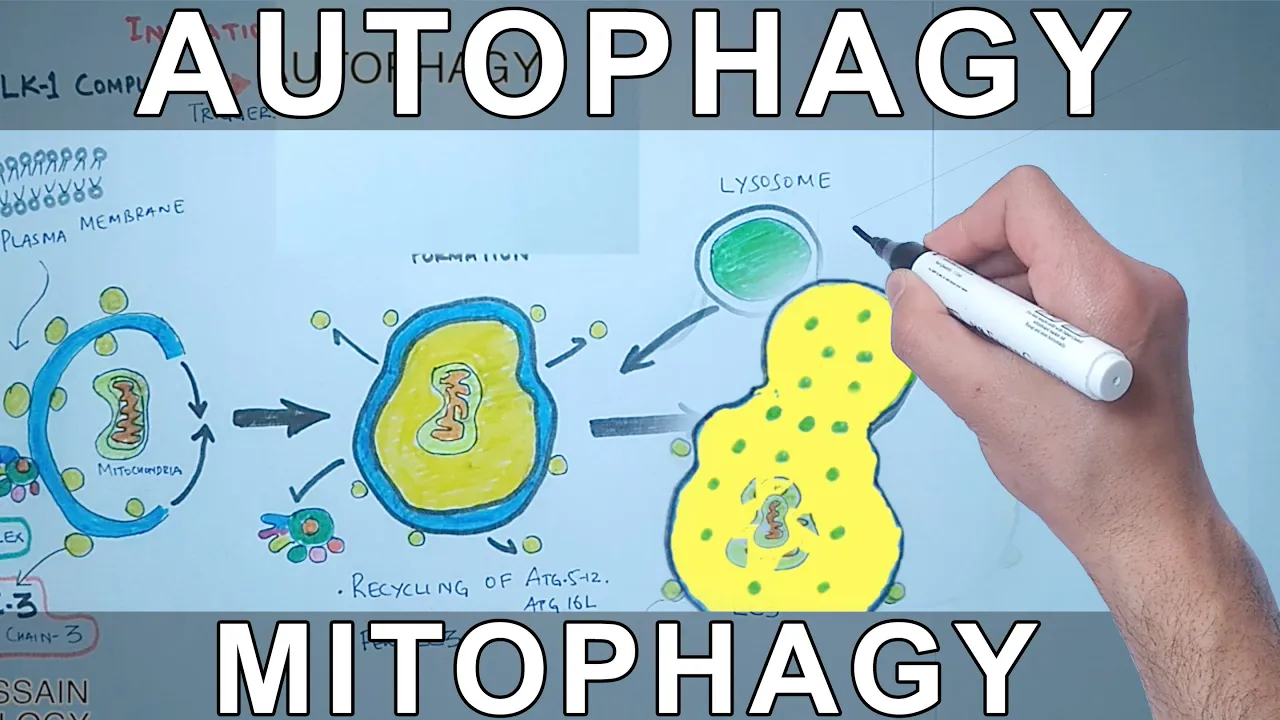
3:29
Autophagy and Mitophagy: Pathway and Mechanisms Explained
@hussainbiology
102.1K views•2020-03-11
50:12
Bacterial Communication: Quorum Sensing and Biofilm Formation Explained
@JHUAAP
12.6K views•2011-06-28
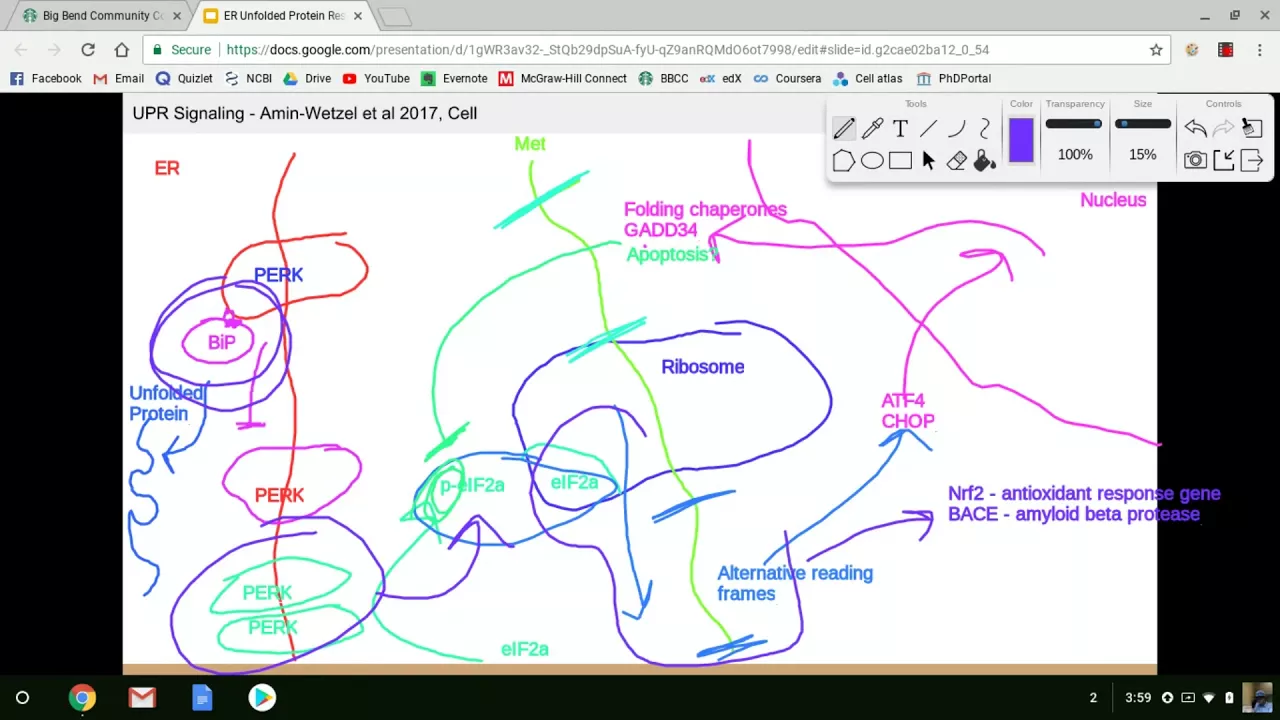
41:52
Unfolded Protein Response Signaling Explained (2017 Cell Paper Review)
@AJKeefe
13.3K views•2018-01-14
7:08
Bacteriophages: Earth's Deadliest Killers and Future Antibiotics
@kurzgesagt
34.6M views•2018-05-13
Related Study Plans & Knowledge Roadmaps
Structured learning paths in Biology
biology
RNAi: Biogenesis, RISC & Gene Silencing
01Molecular Biology Foundations: DNA to Protein
02Introduction to RNA Interference (RNAi)
03Molecular Biogenesis of miRNA and siRNA
+ 2 more learning modules
10h5 modules
Explore Roadmap
biology
Mycorrhizae: Signaling, Biophysics & Ecology
01Foundations of Mycorrhizal Symbiosis
02Molecular Signaling and Root Colonization
03Biophysics and Bioenergetics of Nutrient Exchange
+ 1 more learning modules
11h4 modules
Explore Roadmap
biology
Circadian Clocks: TTFL, SCN & Periphery
01Foundations of Molecular Biology & Gene Expression
02Introduction to Chronobiology and Actograms
03The Core TTFL: Molecular Architecture of the Clock
+ 3 more learning modules
14h6 modules
Explore Roadmap
biology
Population Genetics: Math, Drift & Selection
01Genetic & Probability Foundations
02The Hardy-Weinberg Principle and Baseline Models
03Mathematical Modeling of Natural Selection
+ 3 more learning modules
18h6 modules
Explore Roadmap