

























Carbon pricing through taxation or cap-and-trade systems addresses market failure by internalizing the environmental costs of greenhouse gas emissions; carbon taxes impose direct costs on emissions sources, while cap-and-trade creates tradable emission permits that incentivize efficiency and innovation, with evidence showing both approaches effectively reduce emissions, stimulate green technology development, and generate revenue for climate adaptation while maintaining economic growth.
Carbon Pricing Explained: Carbon Tax vs. Cap-and-Trade Systems
Added:The economic concept of negative externalities, specifically how pollution represents a market failure where social costs exceed private costs.
Basic scientific understanding of climate change, greenhouse gas (GHG) emissions, and global mitigation targets.
Fundamental microeconomic principles of supply, demand, and how price signals influence producer and consumer behavior.
The general role of government intervention in market economies through policy instruments like taxes, subsidies, and regulations.
Analysis of prominent real-world applications, such as the European Union Emissions Trading System (EU ETS) and regional carbon taxes.
The challenge of 'carbon leakage' and the implementation of Border Carbon Adjustments (BCAs) to maintain industrial competitiveness.
Revenue recycling mechanisms, examining how governments redistribute carbon pricing revenues via tax cuts, green investments, or direct dividends.
The socio-political debates surrounding the equity of carbon pricing, including its potentially regressive impact on lower-income households.
6.8K views30likes8:56Original Release: 2013-06-28
[Music] [Music] greenhouse gas emissions come from the goods and services we produce and consume the market for goods and services fails to account for these emissions and they have impacts that are not priced as a production cost this represents a market failure economists around the world tell us that the simplest and least expensive way to correct the market failure and reduce the amount of carbon dioxide being dumped into the atmosphere is to put a price on carbon emissions increasingly governments are introducing carbon levies that improve market efficiency by allocating the costs of impacts to their emission sources evidence shows that carbon pricing reduces emissions stimulates Innovation and raises revenues that can be recycled back into the economy let's take a look at the two major approaches to price carbon the first is imposition of a carbon tax on fossil fuel consumption this puts a direct cost on carbon emissions produced when a fuel is burned such as gasoline diesel natural gas or coal greenhouse gas emissions resulting from non-combustion processes such as such as the venting of carbon dioxide extracted during the processing of raw natural gas can also be taxed in this way direct carbon taxes offer three key benefits emissions decline because consumers reduce their fuel consumption when costs go up producers become more efficient by adopting higher efficiency Technologies and cutting waste and carbon tax revenue can be used to fund environmentally beneficial projects reduce income or employment taxes and help Society adapt to climate change carbon taxation is not New Finland launched the world's first carbon tax in 1990 covering energy content of fuels and carbon dioxide emissions Sweden adopted finland's system a year later Great Britain introduced a carbon tax in 2001 to reduce energy usage with revenues targeted for Energy Efficiency improvements and renewable energy support Australia set up a carbon tax in 2012 pricing carbon at 23 Australian dollar per ton of carbon dioxide emitted the Australian scheme targets the 300 largest emitters and the price will increase each year until 2015 when the country will shift to a c and trade system the revenues generated from the tax will be used to reduce net income tax increase pensions and social welfare payments in Canada the province of Quebec LED North America by applying a small carbon tax in 2007 on petroleum natural gas and coal today the tax raises $200 million per year for climate change initiatives in the province in 2008 British Columbia followed suit with a more aggressive carbon tax of $10 per ton of carbon dioxide emitted in an important innovation the tax was set to increase by $5 per year through 2012 it now sits at $30 per ton per year this adds 7 cents to the cost of a liter of gasoline in British Columbia by scheduling the annual increases as much as 5 years in advance consumers were sent a progressive signal that encouraged less fossil fuel use British Columbia's carbon tax covers about 3/4 of the province's total emissions these are generated mainly from fossil fuel combustion and include natural gas flaring the remaining untaxed emissions largely result from industrial processes in the natural gas smelting and cement industries that do not involve combustion of fossil fuels what are are some of the benefits by law all revenues from the carbon tax are used to reduce personal and corporate income taxes in the province British Columbia now enjoys the lowest personal income tax in Canada for net incomes up to $119,000 per year and BC's corporate income tax rate is among the lowest in the G8 countries moreover British Columbia's carbon tax is working since the tax was introduced in 2008 fossil fuel consumption has declined more rapidly in BC than in any other Canadian province and over the same period BC's gross domestic product grew faster than the Canadian average suggesting minimal impact on the province's economy but BC's carbon tax will need to rise above $30 per ton to encourage further reductions in fossil fuel use to be consistent and fair the tax could be applied more broadly to cover non-combustion process emissions such changes will be easier to put into action when more regions of North America join British Columbia in pricing carbon now let's consider another approach to carbon pricing cap and trade it is different from carbon taxation as it targets industrial emitters and sometimes fuel suppliers governments require factories power plants and other companies to hold a permit usually called an allowance for each ton of greenhouse gas emitted the total number of allowances available is capped and over time it is reduced establishment of a trading Market allows any company that exceeds its greenhouse gas reduction targets to sell or trade spare allowances to other companies that require more in many jurisdictions the price of allowances is set by a thus Market rules of supply and demand establish a price for emissions and that price will rise as the total number of allowances is reduced companies that are highly efficient in reducing emissions will reap the benefits of selling allowances but those that are less efficient will pay more to emit cap and trade like carbon taxation is not new let's consider some International examples the European Union emissions trading system is a good example of cap and trade system that targets heavy emitters although the European system has been criticized for granting too many allowances when it was first set up in 2005 it is expected to reduce emissions by almost 20% by 2020 other jurisdictions are actively exploring the cap and trade approach China for example now has seven pilot CPP and trade systems in operation at the provincial and City scales in North America California and Quebec established a joint cap and trade system that entered into effect in 2013 like direct carbon taxation cap and trade systems reduce emissions encourage Innovation and raise government revenue which could be used to support energyefficient infrastructure tax code adjustments and adaptation to climate change it has become clear in recent years that putting a price on carbon is the most effective and easiest way to reduce emissions such a price provides a direct incentive for society to move toward a low carbon economy and is catching on by the end of 2013 it is expected that more than 30 countries and almost 20 subnational jurisdictions will have some form of carbon pricing in place but while the trend is welcome it is also insufficient it still comes nowhere near to addressing the full external costs imposed on the planet by global warming the need to appropriately price carbon thus remains a major challenge for Humanity
Up Next
82:08
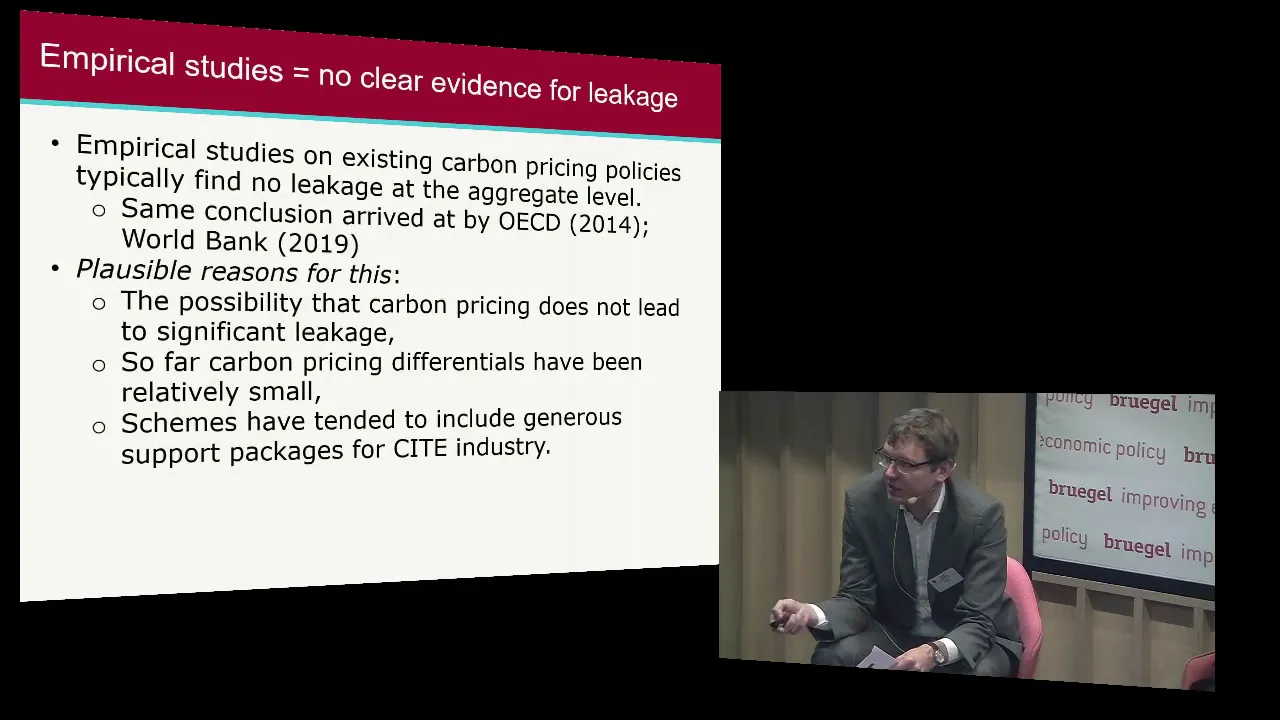
Border Carbon Adjustment: Gains, Losses, and Trade-offs
@BruegelTV
1K views•2020-03-05

5:07
Impact of Yuan in Indo-Russian Trade Amid Sanctions
@WION
261.9K views•2022-07-01
10:33
Behavioral Economics Explained: Rationality, Nudges, and Risk
@crashcourse
1.1M views•2016-03-12

113:18
The Age of Easy Money: Fed & Inflation | Full Documentary
@frontline
21.2M views•2023-03-15
Related Study Plans & Knowledge Roadmaps
Structured learning paths in Economics
economics
Sovereign Debt: Defaults, IMF & Restructuring
01Introduction to Sovereign Debt & Government Bonds
02Debt Sustainability & Credit Ratings
03Anatomy and History of Debt Crises
+ 2 more learning modules
12h5 modules
Explore Roadmap
economics
Market Design: Matching Theory & Gale-Shapley
01Introduction to Market Design and Price-Free Markets
02Two-Sided Matching & The Gale-Shapley Algorithm
03School Choice Systems and Mechanism Design
+ 2 more learning modules
10h5 modules
Explore Roadmap
economics
Impossible Trinity: Forex, Capital & Policy
01Introduction to Monetary Policy and Central Banking
02Exchange Rates and International Capital Flows
03The Mundell-Fleming Model
+ 2 more learning modules
8h5 modules
Explore Roadmap
economics
Healthcare Economics: Market Failures & Systems
01Introduction to Healthcare Markets and Market Failure
02Asymmetric Information and Adverse Selection
03Moral Hazard and Insurance Design
+ 2 more learning modules
12h5 modules
Explore Roadmap